
Desktop Utilities Market Report 2026
Global Outlook – By Utility Type (Security Utilities, System Optimization Utilities, Backup And Recovery Utilities, File Management Utilities, System Monitoring And Diagnostics Utilities, Other Utilities), By Deployment Mode (On-premise, Cloud-based, Hybrid), By Distribution Channel (Direct Sales, Digital Marketplaces And App Stores, Value-Added Resellers (VARs) And Distributors, Original Equipment Manufacturer (OEMs Bundles), By End User (Individual Consumers, Enterprises, Government Organizations, Educational Institutions, Other End Users) – Market Size, Trends, Strategies, and Forecast to 2030
Desktop Utilities Market Overview
• Desktop Utilities market size has reached to $7.8 billion in 2025 • Expected to grow to $8.38 billion in 2030 at a compound annual growth rate (CAGR) of 7.6% • Growth Driver: Surge In Proliferation Of Remote And Hybrid Work Models Fueling The Growth Of The Market Due To Increasing Demand For Continuous Desktop Performance And Remote Access Management • Market Trend: Unified Digital Workplace Platforms Strengthen Enterprise Utility Management • North America was the largest region in 2025 and Asia-Pacific is the fastest growing region.What Is Covered Under Desktop Utilities Market?
Desktop utilities refer to software applications designed to enhance, optimize, secure, and manage the performance and usability of desktop computing environments. These tools support system maintenance, file management, security enhancement, productivity improvement, and resource optimization for both individual users and enterprise IT environments. They play a critical role in ensuring seamless system operations, improving overall efficiency, and extending the functional capabilities of desktop operating systems. The main utility types of desktop utilities include security utilities, system optimization utilities, backup and recovery utilities, file management utilities, system monitoring and diagnostics utilities, and others. Security utilities refer to software tools designed to protect computer systems, networks, and data from malware, cyber threats, and unauthorized access. The deployment mode include on-premise, cloud-based, and hybrid modes and there are distribution channel include direct sales, digital marketplaces and app stores, value-added resellers (VARs) and distributors, and original equipment manufacturer (OEM) bundles, and the key end-users include individual consumers, enterprises, government organizations, educational institutions, and others.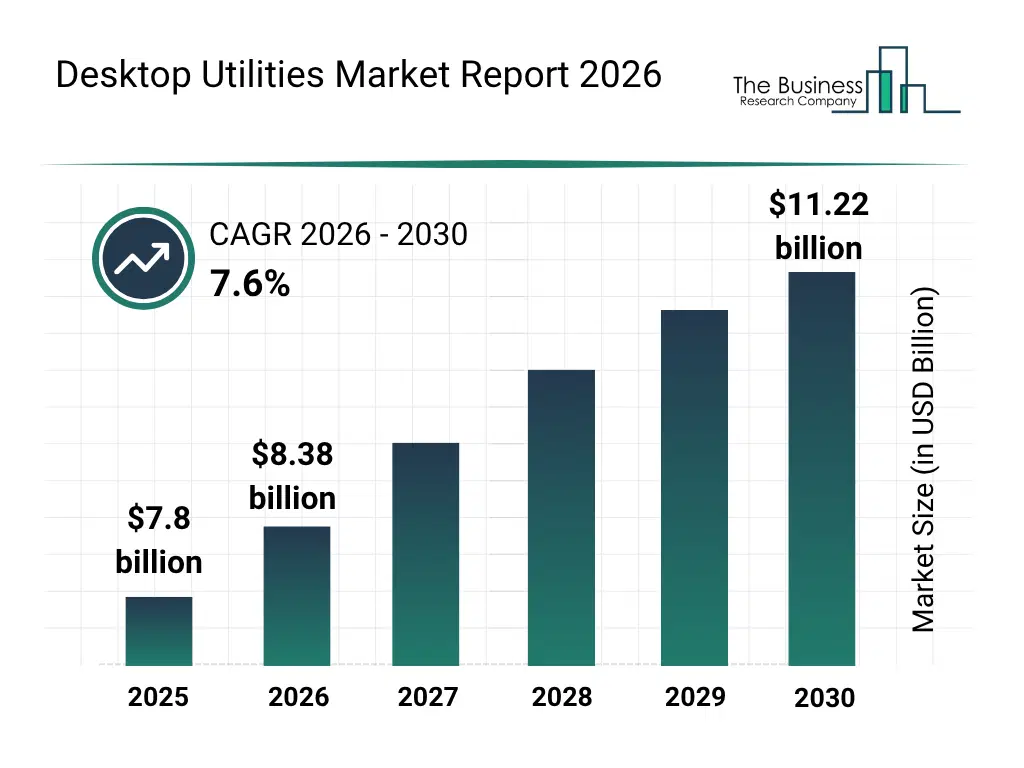
What Is The Desktop Utilities Market Size and Share 2026?
The desktop utilities market size has grown strongly in recent years. It will grow from $7.8 billion in 2025 to $8.38 billion in 2026 at a compound annual growth rate (CAGR) of 7.4%. The growth in the historic period can be attributed to increasing adoption of antivirus and firewall software, growing need for system performance optimization tools, rising use of file management utilities in enterprises, expansion of personal computer usage globally, increasing cybersecurity threats on desktop systems.What Is The Desktop Utilities Market Growth Forecast?
The desktop utilities market size is expected to see strong growth in the next few years. It will grow to $11.22 billion by 2030 at a compound annual growth rate (CAGR) of 7.6%. The growth in the forecast period can be attributed to growing integration of AI-powered desktop optimization tools, rising demand for automated system maintenance solutions, increasing shift toward cloud-based utility ecosystems, expansion of remote and hybrid work environments, growing focus on endpoint security and compliance management. Major trends in the forecast period include growing adoption of AI-based system optimization utilities, rising demand for zero-trust desktop security solutions, increasing integration of cloud-synced desktop utility suites, expansion of automated backup and recovery tools, rising focus on lightweight and modular utility software.
Global Desktop Utilities Market Segmentation
1) By Utility Type: Security Utilities, System Optimization Utilities, Backup And Recovery Utilities, File Management Utilities, System Monitoring And Diagnostics Utilities, Other Utilities 2) By Deployment Mode: On-premise, Cloud-based, Hybrid 3) By Distribution Channel: Direct Sales, Digital Marketplaces And App Stores, Value-Added Resellers (VARs) And Distributors, Original Equipment Manufacturer (OEMs Bundles 4) By End User: Individual Consumers, Enterprises, Government Organizations, Educational Institutions, Other End Users Subsegments: 1) By Security Utilities: Antivirus Protection Software, Firewall Management Software, Identity And Access Protection Tools, Encryption And Data Protection Software, Network Security Monitoring Tools, Email And Web Security Tools 2) By System Optimization Utilities: Disk Cleanup Tools, Memory Optimization Tools, Startup Management Tools, Registry Cleaning Tools, Performance Tuning Software, System Update Management Tools 3) By Backup And Recovery Utilities: Full System Backup Tools, Incremental Backup Tools, Cloud Backup Software, Disaster Recovery Solutions, File Recovery Tools, System Restore Utilities 4) By File Management Utilities: File Explorer And Organizer Tools, File Compression And Decompression Tools, Duplicate File Finder Tools, File Transfer Management Tools, Storage Management Tools, File Search And Indexing Tools 5) By System Monitoring And Diagnostics Utilities: Performance Monitoring Tools, Hardware Diagnostics Tools, Network Monitoring Tools, Resource Usage Tracking Tools, Error Detection And Logging Tools, System Health Analysis Tools 6) By Other Utilities: Disk Partition Management Tools, Clipboard Management Tools, Screen Capture Tools, Automation And Scheduling Tools, System Customization Tools, Uninstall And Cleanup ToolsWhat Is The Driver Of The Desktop Utilities Market?
The proliferation of remote and hybrid work models is expected to propel the growth of the desktop utilities market going forward. Remote and hybrid work models represent work structures in which employees operate remotely or divide their time between home and office environments using digital systems and connected devices. The adoption of these models is increasing as organizations implement flexible work arrangements to sustain productivity, enhance employee satisfaction, and ensure operational continuity across distributed teams. Desktop utilities play a critical role in supporting remote and hybrid work environments by enabling seamless device management, secure remote access, performance optimization, data protection, and workflow continuity across multiple locations and endpoints. For instance, in March 2025, according to the U.S. Bureau of Labor Statistics, a US-based federal government agency, in the first quarter of 2024, 35.5 million individuals worked from home or teleworked for pay, representing an increase of 5.1 million compared to the previous year. These workers accounted for 22.9% of total employment during the period, up from 19.6% in the same quarter of the prior year. Therefore, the proliferation of remote and hybrid work models is driving the growth of the desktop utilities industry.Key Players In The Global Desktop Utilities Market
Major companies operating in the desktop utilities market are Broadcom Inc.; Microsoft Corporation; International Business Machines Corporation; Dell Technologies Inc.; HP Inc.; Adobe Inc.; Check Point Software Technologies Ltd; OpenText Corporation; Qualys Inc.; Gen Digital Inc.; Commvault Systems Inc.; Dropbox Inc.; Progress Software Corporation; Jamf Holding Corp; Box Inc.; BlackBerry Limited; SolarWinds Corporation; CyberArk Software Ltd; TeamViewer SE; N able Inc.
This chart is for illustrative purposes; the full report includes a detailed competitor analysis and comprehensive overview of the top 10 companies in the market.
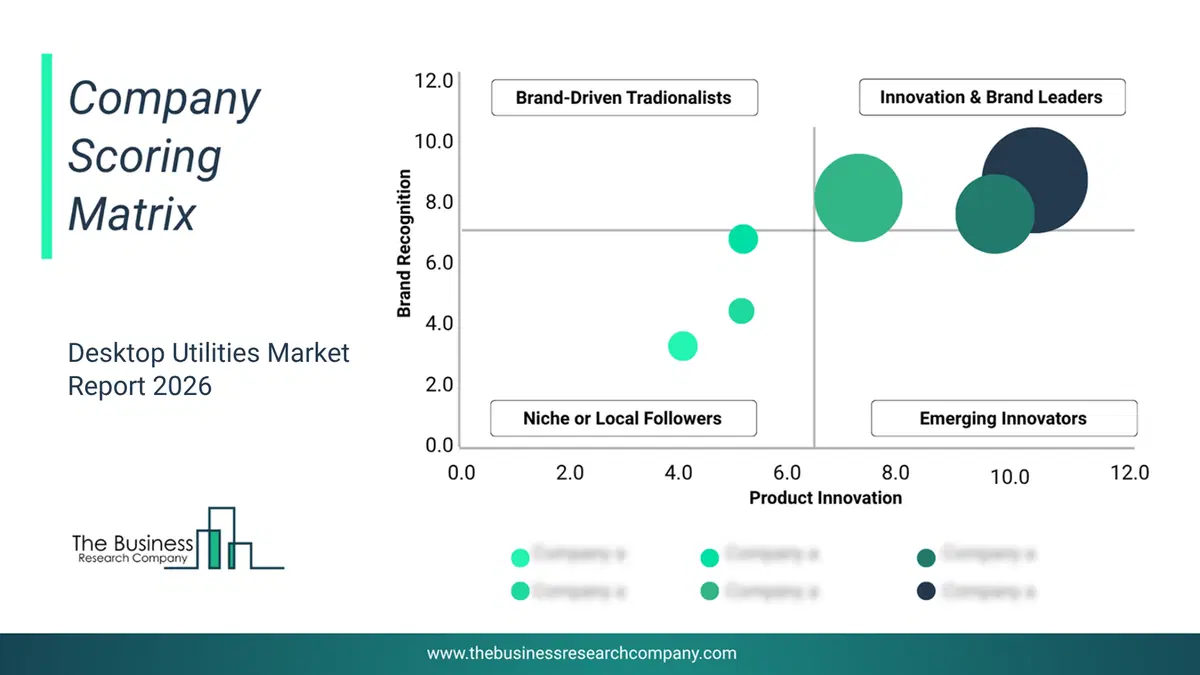
This chart maps companies by product innovation and brand strength, with bubble size indicating relative revenue, helping identify market leaders, challengers, and niche players. This is an illustrative chart; the full report provides a complete and accurate competitive analysis.
Global Desktop Utilities Market Trends and Insights
Major companies operating in the desktop utilities market are increasingly prioritizing technological advancements, particularly unified digital workplace platforms with integrated endpoint intelligence, to strengthen their competitive positioning. Unified digital workplace platforms integrate remote connectivity, endpoint management, digital employee experience monitoring, and automation into a centralized environment. This enables enterprises to efficiently manage distributed devices, reduce system downtime, and improve IT support effectiveness. For instance, in May 2025, TeamViewer SE, a Germany-based digital workplace software company, launched TeamViewer ONE, an integrated platform designed to unify endpoint management and remote connectivity within a single interface. The solution incorporates digital employee experience capabilities for real-time issue identification and resolution while leveraging artificial intelligence-powered automation to streamline IT operations, optimize resource utilization, and improve workforce productivity. Additionally, the platform enhances visibility across IT environments and enables predictive issue management, supporting more resilient and efficient enterprise operations, thereby reinforcing enterprise utility management capabilities and accelerating the adoption of integrated desktop utility solutions.What Are Latest Mergers And Acquisitions In The Desktop Utilities Market?
In December 2024, TeamViewer SE, a Germany-based provider of remote connectivity solutions, acquired 1E for $720 million. With this acquisition, TeamViewer aims to strengthen its digital workplace technology capabilities, expand its enterprise IT management portfolio, and enhance its ability to deliver digital employee experience and autonomous endpoint management solutions across global markets. 1E is a UK-based provider of desktop utilities focused on enterprise IT management and digital employee experience (DEX).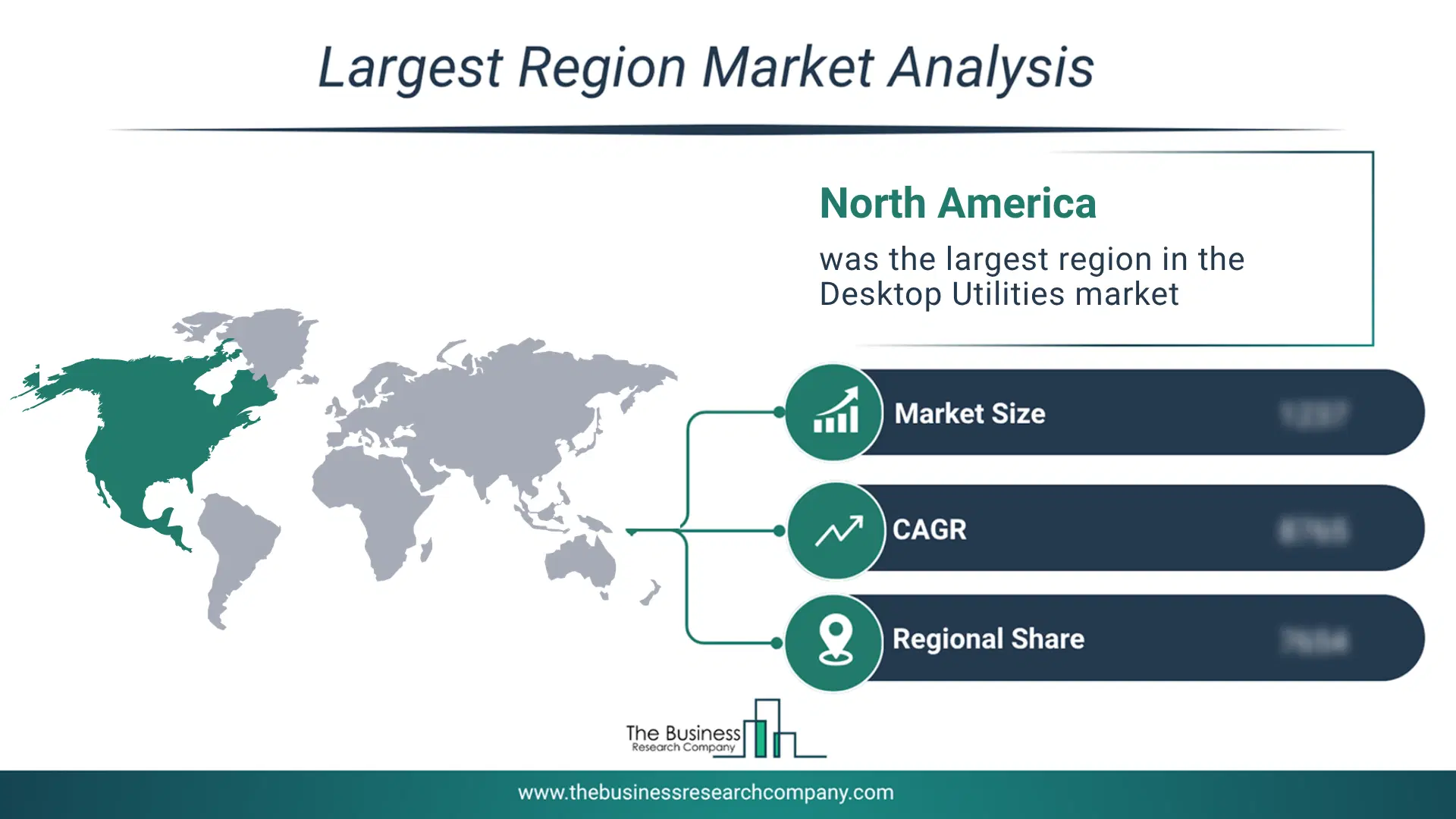
Regional Insights
North America was the largest region in the desktop utilities market in 2025. Asia-Pacific is expected to be the fastest-growing region in the forecast period. The regions covered in this market report are Asia-Pacific, South East Asia, Western Europe, Eastern Europe, North America, South America, Middle East, Africa. The countries covered in this market report are Australia, Brazil, China, France, Germany, India, Indonesia, Japan, Taiwan, Russia, South Korea, UK, USA, Canada, Italy, Spain.What Defines the Desktop Utilities Market?
The desktop utilities market consists of revenues earned by entities by providing services such as antivirus and security utilities, backup and recovery solutions, and system monitoring applications. The market value includes the value of related goods sold by the service provider or included within the service offering. Only goods and services traded between entities or sold to end consumers are included.How is Market Value Defined and Measured?
The market value is defined as the revenues that enterprises gain from the sale of goods and/or services within the specified market and geography through sales, grants, or donations in terms of the currency (in USD unless otherwise specified). The revenues for a specified geography are consumption values that are revenues generated by organizations in the specified geography within the market, irrespective of where they are produced. It does not include revenues from resales along the supply chain, either further along the supply chain or as part of other products.
This chart presents market attractiveness based on a quantitative evaluation of growth, competition, strategic alignment, and risk, offering a clear view of opportunity areas for decision-making. This chart is for illustrative purposes; the full report contains the complete analysis.

This chart highlights the Total Addressable Market (TAM) by estimating the maximum revenue opportunity using an assumption-driven approach, supporting strategic planning and opportunity sizing across markets. The chart is illustrative; the full report provides a more comprehensive analysis.
What Key Data and Analysis Are Included in the Desktop Utilities Market Report 2026?
The desktop utilities market research report is one of a series of new reports from The Business Research Company that provides market statistics, including industry global market size, regional shares, competitors with the market share, detailed market segments, market trends and opportunities, and any further data you may need to thrive in the desktop utilities industry. The market research report delivers a complete perspective of everything you need, with an in-depth analysis of the current and future state of the industry.Desktop Utilities Market Report Forecast Analysis
| Report Attribute | Details |
|---|---|
| Market Size Value In 2026 | $8.38 billion |
| Revenue Forecast In 2030 | $11.22 billion |
| Growth Rate | CAGR of 7.6% from 2026 to 2030 |
| Base Year For Estimation | 2025 |
| Actual Estimates/Historical Data | 2020-2025 |
| Forecast Period | 2026 - 2030 |
| Market Representation | Revenue in USD Billion and CAGR from 2026 to 2030 |
| Segments Covered | Utility Type, Deployment Mode, Distribution Channel, End User |
| Regional Scope | Asia-Pacific, Western Europe, Eastern Europe, North America, South America, Middle East, Africa |
| Country Scope | The Countries Covered In This Market Report Are Australia, Brazil, China, France, Germany, India, Indonesia, Japan, Taiwan, Russia, South Korea, Uk, Usa, Canada, Italy, Spain. |
| Key Companies Profiled | Broadcom Inc., Microsoft Corporation, International Business Machines Corporation, Dell Technologies Inc., HP Inc., Adobe Inc., Check Point Software Technologies Ltd, OpenText Corporation, Qualys Inc., Gen Digital Inc., Commvault Systems Inc., Dropbox Inc., Progress Software Corporation, Jamf Holding Corp, Box Inc., BlackBerry Limited, SolarWinds Corporation, CyberArk Software Ltd, TeamViewer SE, N able Inc. |
| Customization Scope | Request for Customization |
| Pricing And Purchase Options | Explore Purchase Options |