

Device Vulnerability Market Report 2026
Global Outlook – By Component (Software, Services), By Device Type (Desktops And Laptops, Servers, Internet Of Things (IoT) Endpoints), By Deployment Mode (On-Premises, Cloud-Based), By Application (Risk And Compliance Management, Threat Intelligence And Monitoring, Patch And Configuration Management, Incident Response), By End-User (Banking, Financial Services, Insurance (BFSI), Information Technology (IT) And Telecom, Healthcare, Government And Defense, Retail And E-commerce, Manufacturing, Energy And Utilities) – Market Size, Trends, Strategies, and Forecast to 2030
Device Vulnerability Market Overview
• Device Vulnerability market size has reached to $2.24 billion in 2025 • Expected to grow to $2.61 billion in 2030 at a compound annual growth rate (CAGR) of 16.7% • Growth Driver: Rising Cyberattacks And Data Breaches Driving The Growth Of The Market Due To Expanding Digital Attack Surface • Market Trend: Innovation In AI-Driven Vulnerability Detection Reshaping Device Security Landscape • North America was the largest region in 2025 and Asia-Pacific is the fastest growing region.What Is Covered Under Device Vulnerability Market?
Device vulnerability refers to weaknesses or flaws in hardware, software, or firmware that can be exploited by threat actors to gain unauthorized access or disrupt operations. It arises due to inadequate security controls, outdated systems, or misconfigurations within connected devices. Addressing device vulnerabilities is critical for ensuring data integrity, operational continuity, and overall cybersecurity resilience in modern digital ecosystems. The main components of the device vulnerability are software and services. Software refers to security solutions designed to identify, assess, and remediate vulnerabilities across connected devices by continuously scanning systems for weaknesses and enforcing security policies. These solutions are categorized by device type, including desktops and laptops, servers, and Internet of Things (IoT) endpoints. They are deployed through on-premises and cloud-based deployment modes. The solutions are used across various applications, such as risk and compliance management, threat intelligence and monitoring, patch and configuration management, and incident response, and serve multiple end-user industries, including banking, financial services and insurance (BFSI), information technology (IT) and telecom, healthcare, government and defense, retail and e-commerce, manufacturing, and energy and utilities.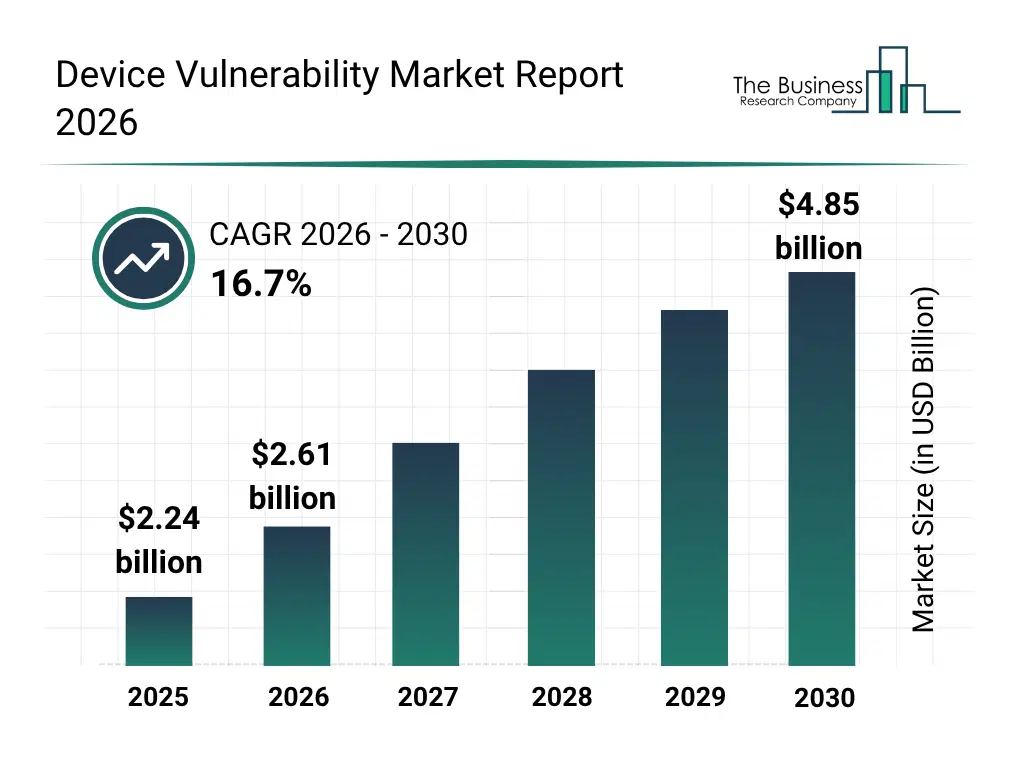
What Is The Device Vulnerability Market Size and Share 2026?
The device vulnerability market size has grown rapidly in recent years. It will grow from $2.24 billion in 2025 to $2.61 billion in 2026 at a compound annual growth rate (CAGR) of 16.5%. The growth in the historic period can be attributed to legacy system vulnerabilities exposure, limited endpoint security adoption, reactive incident response practices, increasing device connectivity expansion, lack of standardized firmware security protocols.What Is The Device Vulnerability Market Growth Forecast?
The device vulnerability market size is expected to see rapid growth in the next few years. It will grow to $4.85 billion by 2030 at a compound annual growth rate (CAGR) of 16.7%. The growth in the forecast period can be attributed to rise in iot and connected device proliferation, growing adoption of zero trust architectures, increasing regulatory cybersecurity compliance mandates, expansion of automated vulnerability scanning tools, rising sophistication of cyber threats and exploits. Major trends in the forecast period include zero trust device security adoption, firmware and embedded system vulnerability management, automated patch and configuration management systems, endpoint hardening and threat detection expansion, hardware root of trust and secure boot implementation.
Global Device Vulnerability Market Segmentation
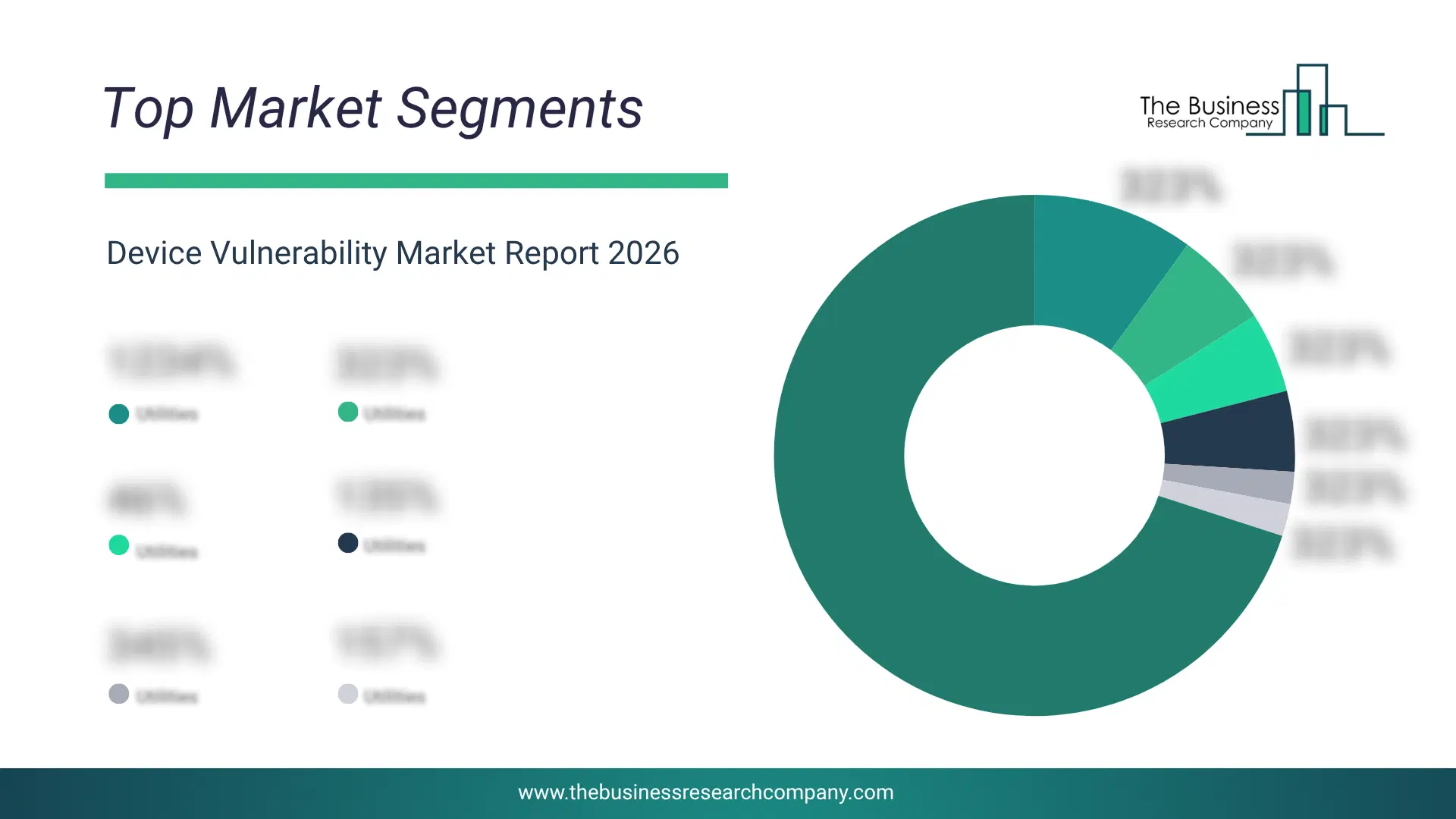
1) By Component: Software, Services 2) By Device Type: Desktops And Laptops, Servers, Internet Of Things (IoT) Endpoints 3) By Deployment Mode: On-Premises, Cloud-Based 4) By Application: Risk And Compliance Management, Threat Intelligence And Monitoring, Patch And Configuration Management, Incident Response 5) By End-User: Banking, Financial Services, Insurance (BFSI), Information Technology (IT) And Telecom, Healthcare, Government And Defense, Retail And E-commerce, Manufacturing, Energy And Utilities Subsegments: 1) By Software: Operating Systems, Application Software, Firmware, Database Management Systems, Web Applications, Mobile Applications, Cloud-based Software, Security Software 2) By Services: Consulting Services, Integration And Deployment, Support And Maintenance, Managed Security Services, Training And EducationWhat Is The Driver Of The Device Vulnerability Market?
The rising frequency of cyberattacks and data breaches is expected to propel the growth of the device vulnerability market going forward. Cyberattacks and data breaches are unauthorized attempts to access, disrupt, or steal data from digital systems, resulting in financial, operational, and reputational damage. The increase in cyberattacks and data breaches is driven by growing digital dependence, as a larger volume of sensitive data is stored online, expanding the attack surface and creating more opportunities for exploitation. Device vulnerability solutions support organizations by identifying weaknesses across endpoints and systems, thereby strengthening their ability to prevent, detect, and respond to cyber threats and data breaches. For instance, in October 2025, according to the Australian Signals Directorate, an Australia-based government agency, during the financial year (FY) 2024–25, the Australian Cyber Security Centre (ACSC) notified entities more than 1,700 times of potentially malicious cyber activity, representing an 83% increase compared to the previous year. Therefore, the rising frequency of cyberattacks and data breaches is driving the growth of the device vulnerability industry.Key Players In The Global Device Vulnerability Market
Major companies operating in the device vulnerability market are Microsoft Corporation; International Business Machines Corporation; Palo Alto Networks Inc.; Fortinet Inc.; CrowdStrike Holdings Inc.; Zoho Corporation; Check Point Software Technologies Ltd.; Rapid7 Inc.; Tenable Inc.; Qualys Inc.; Tanium Inc.; BreachLock Inc.; Claroty Ltd.; Dragos Inc.; CyCognito Ltd; Indusface Inc.; Greenbone Networks GmbH; Kratikal Tech Ltd.; NopSec Inc.; SecureLayer7 IT Solutions Pvt. Ltd.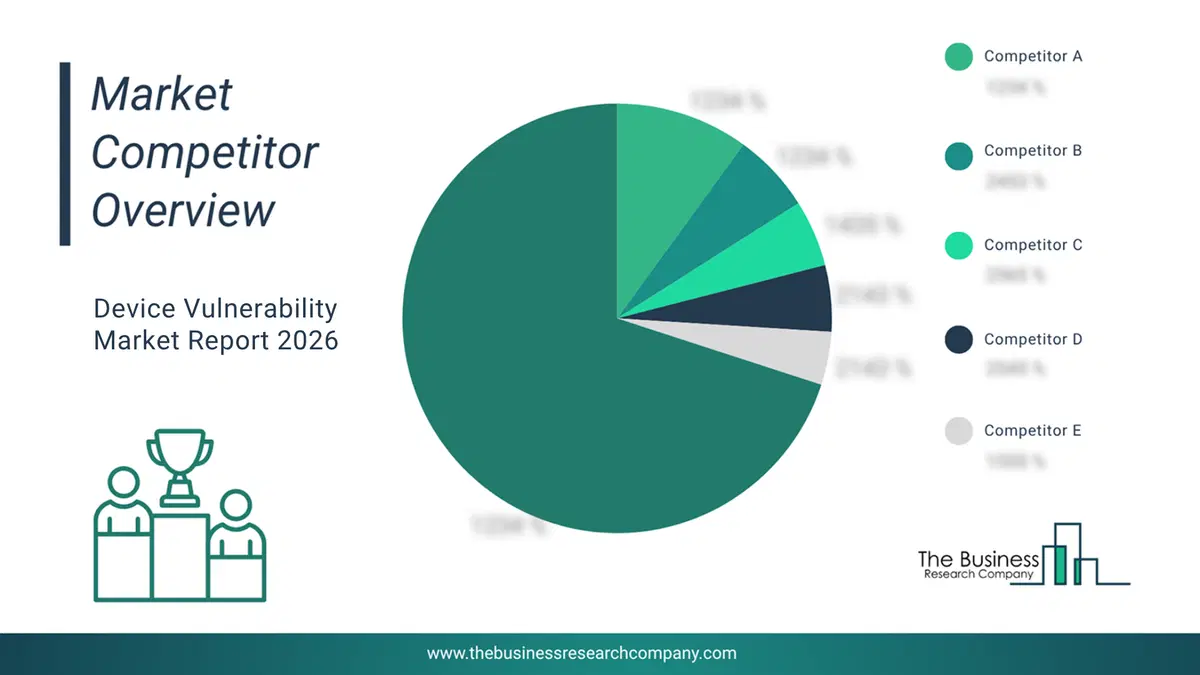
This chart is for illustrative purposes; the full report includes a detailed competitor analysis and comprehensive overview of the top 10 companies in the market.
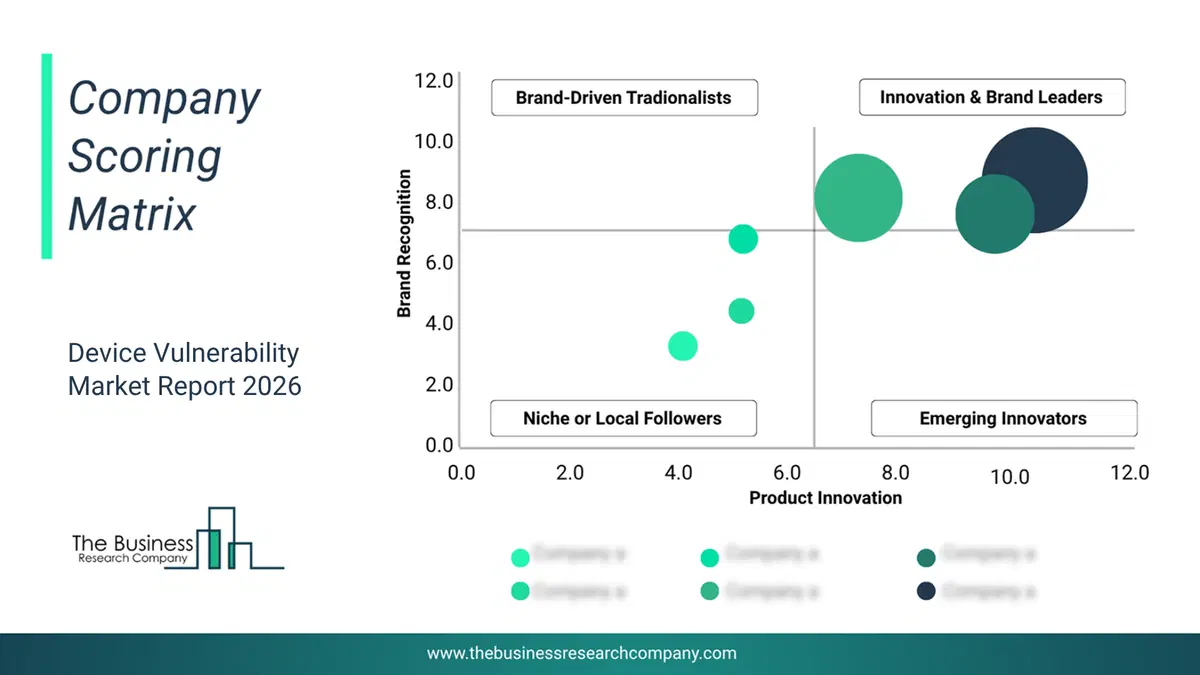
This chart maps companies by product innovation and brand strength, with bubble size indicating relative revenue, helping identify market leaders, challengers, and niche players. This is an illustrative chart; the full report provides a complete and accurate competitive analysis.
Global Device Vulnerability Market Trends and Insights
Major companies operating in the device vulnerability market are focusing on developing innovative solutions, such as AI-powered vulnerability management platforms, to address the growing need for proactive threat detection, continuous monitoring, and automated remediation amid the rapid increase in cyber threats and software vulnerabilities. AI-powered vulnerability management platforms are advanced cybersecurity solutions that leverage machine learning, threat intelligence, and automation to continuously scan devices, identify vulnerabilities, and prioritize remediation. For instance, in November 2025, Cybereason Inc., a US-based cybersecurity company, launched its integrated Vulnerability Management product within the Cybereason Endpoint Protection Platform. The solution enables a shift from reactive detection to proactive risk mitigation by continuously analyzing endpoint applications, mapping them against Common Vulnerabilities and Exposures (CVE) databases, and delivering prioritized remediation guidance through a unified interface. By integrating vulnerability assessment with endpoint protection, it eliminates the need for standalone tools, provides a consolidated view of threats and vulnerabilities, and reduces operational complexity.What Are Latest Mergers And Acquisitions In The Device Vulnerability Market?
In February 2025, Tenable, a US-based technology company, acquired Vulcan Cyber for an undisclosed amount. Through this acquisition, Tenable aims to enhance its vulnerability management capabilities by integrating unified vulnerability data aggregation, prioritization, and automated remediation, thereby strengthening its exposure management platform and reducing tool fragmentation for security teams. Vulcan Cyber is an Israel-based technology company specializing in unified vulnerability management solutions that enable organizations to efficiently prioritize and remediate critical security risks.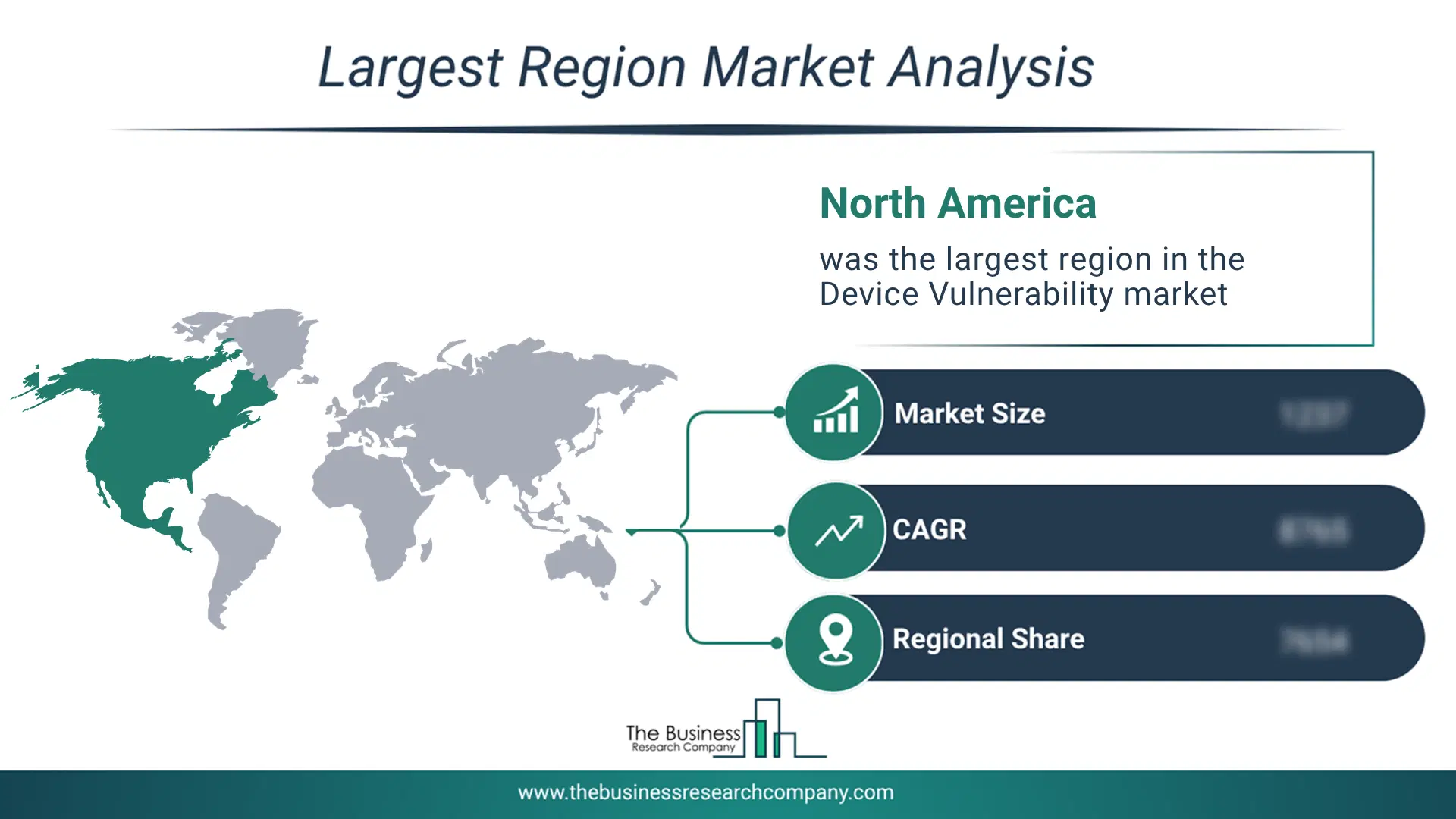
Regional Insights
North America was the largest region in the device vulnerability market in 2025. Asia-Pacific is expected to be the fastest-growing region in the forecast period. The regions covered in this market report are Asia-Pacific, South East Asia, Western Europe, Eastern Europe, North America, South America, Middle East, Africa. The countries covered in this market report are Australia, Brazil, China, France, Germany, India, Indonesia, Japan, Taiwan, Russia, South Korea, UK, USA, Canada, Italy, Spain.What Defines the Device Vulnerability Market?
The device vulnerability market consists of revenues earned by entities by providing services such as vulnerability assessment, threat analysis, patch management, risk mitigation, system integration, installation and setup, maintenance and support, and security consulting. The market value includes the value of related goods sold by the service provider or included within the service offering. The device vulnerability market also includes sales of routers, firewalls, intrusion detection devices, and hardware security modules (HSMs). Values in this market are ‘factory gate’ values, that is the value of goods sold by the manufacturers or creators of the goods, whether to other entities (including downstream manufacturers, wholesalers, distributors and retailers) or directly to end customers. The value of goods in this market includes related services sold by the creators of the goods.How is Market Value Defined and Measured?
The market value is defined as the revenues that enterprises gain from the sale of goods and/or services within the specified market and geography through sales, grants, or donations in terms of the currency (in USD unless otherwise specified). The revenues for a specified geography are consumption values that are revenues generated by organizations in the specified geography within the market, irrespective of where they are produced. It does not include revenues from resales along the supply chain, either further along the supply chain or as part of other products.
This chart presents market attractiveness based on a quantitative evaluation of growth, competition, strategic alignment, and risk, offering a clear view of opportunity areas for decision-making. This chart is for illustrative purposes; the full report contains the complete analysis.

This chart highlights the Total Addressable Market (TAM) by estimating the maximum revenue opportunity using an assumption-driven approach, supporting strategic planning and opportunity sizing across markets. The chart is illustrative; the full report provides a more comprehensive analysis.
What Key Data and Analysis Are Included in the Device Vulnerability Market Report 2026?
The device vulnerability market research report is one of a series of new reports from The Business Research Company that provides market statistics, including industry global market size, regional shares, competitors with the market share, detailed market segments, market trends and opportunities, and any further data you may need to thrive in the device vulnerability industry. The market research report delivers a complete perspective of everything you need, with an in-depth analysis of the current and future state of the industry.Device Vulnerability Market Report Forecast Analysis
| Report Attribute | Details |
|---|---|
| Market Size Value In 2026 | $2.61 billion |
| Revenue Forecast In 2030 | $4.85 billion |
| Growth Rate | CAGR of 16.7% from 2026 to 2030 |
| Base Year For Estimation | 2025 |
| Actual Estimates/Historical Data | 2020-2025 |
| Forecast Period | 2026 - 2030 |
| Market Representation | Revenue in USD Billion and CAGR from 2026 to 2030 |
| Segments Covered | Component, Device Type, Deployment Mode, Application, End-User |
| Regional Scope | Asia-Pacific, Western Europe, Eastern Europe, North America, South America, Middle East, Africa |
| Country Scope | The Countries Covered In This Market Report Are Australia, Brazil, China, France, Germany, India, Indonesia, Japan, Taiwan, Russia, South Korea, Uk, Usa, Canada, Italy, Spain. |
| Key Companies Profiled | Microsoft Corporation, International Business Machines Corporation, Palo Alto Networks Inc., Fortinet Inc., CrowdStrike Holdings Inc., Zoho Corporation, Check Point Software Technologies Ltd., Rapid7 Inc., Tenable Inc., Qualys Inc., Tanium Inc., BreachLock Inc., Claroty Ltd., Dragos Inc., CyCognito Ltd, Indusface Inc., Greenbone Networks GmbH, Kratikal Tech Ltd., NopSec Inc., SecureLayer7 IT Solutions Pvt. Ltd. |
| Customization Scope | Request for Customization |
| Pricing And Purchase Options | Explore Purchase Options |