

Digital Language Learning Market Report 2026
Global Outlook – By Technology (Virtual Reality(VR), Artificial Intelligence, Big Data Analytics, Natural Language Processing, Other Technologies), By Language Type (English, German, Spanish, Mandarin, Other Languages), By Operating System (Windows, Android, iOS, Other Operating Systems), By End-User (Individuals, Enterprises, Educational Institutions, Government Agencies, Other End Users) – Market Size, Trends, Strategies, and Forecast to 2030
Digital Language Learning Market Overview
• Digital Language Learning market size has reached to $35.86 billion in 2025 • Expected to grow to $83.87 billion in 2030 at a compound annual growth rate (CAGR) of 17.9% • Growth Driver: Fueling Growth The Intersecting Forces of Online Education and Digital Language Learning • Market Trend: Innovations In Language Learning Applications Enhancing User Engagement And Proficiency • Asia-Pacific was the largest region in 2025.What Is Covered Under Digital Language Learning Market?
Digital language learning refers to the process of acquiring, practicing, and mastering a language using digital tools, platforms, and resources, often accessed through the internet. It includes online language courses, interactive apps, language learning software, virtual classrooms, and multimedia materials designed to enhance language acquisition and proficiency in a digital environment. The main technologies of digital language learning are virtual reality (VR), artificial intelligence, big data analytics, natural language processing, and other technologies. Virtual Reality refers to a computer-generated simulation of an environment or experience that immerses users in a three-dimensional, interactive virtual world. The various language types include English, German, Spanish, Mandarin, and other languages that are operated through various operating systems such as windows, android, and iOS, other operating systems and used by various end-users such as individuals, enterprises, educational institutions, government agencies, and others.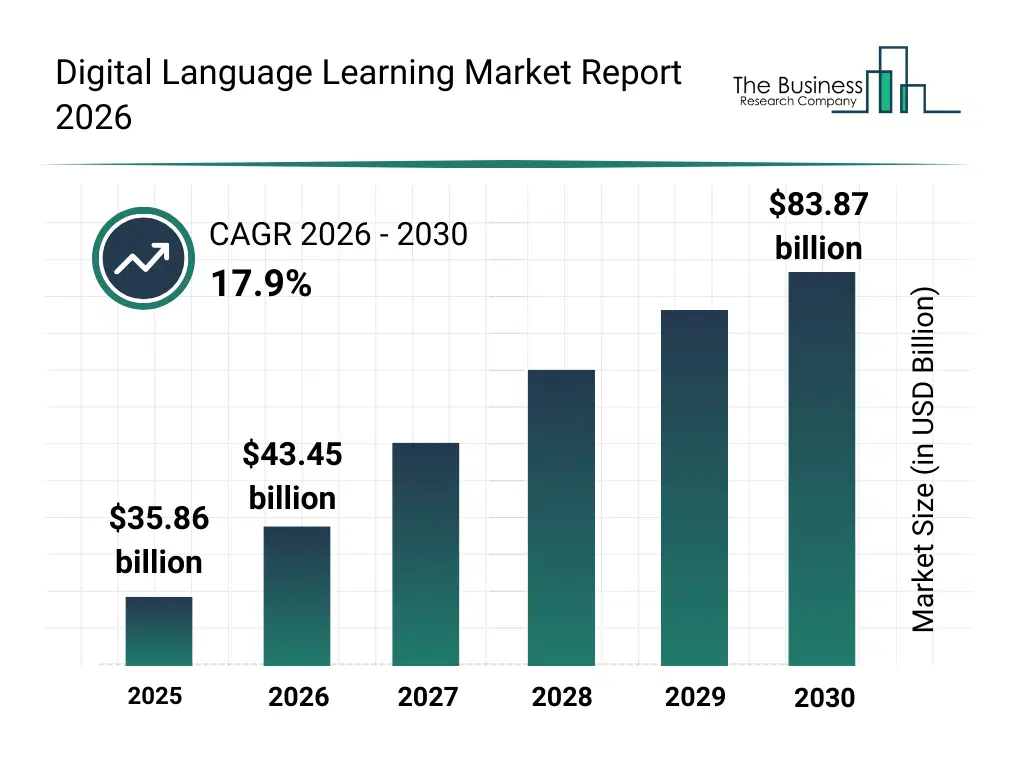
What Is The Digital Language Learning Market Size and Share 2026?
The digital language learning market size has grown exponentially in recent years. It will grow from $35.86 billion in 2025 to $43.45 billion in 2026 at a compound annual growth rate (CAGR) of 21.2%. The growth in the historic period can be attributed to expansion of global digital education access, growth in smartphone usage, increasing demand for language skills, adoption of online self-learning models, availability of cloud-based learning tools.What Is The Digital Language Learning Market Growth Forecast?
The digital language learning market size is expected to see rapid growth in the next few years. It will grow to $83.87 billion in 2030 at a compound annual growth rate (CAGR) of 17.9%. The growth in the forecast period can be attributed to increasing adoption of immersive language learning, rising focus on personalized education, expansion of enterprise language training programs, growing integration of ai and nlp technologies, increased demand for cross-border communication skills. Major trends in the forecast period include increasing adoption of ai-driven language learning platforms, growing use of gamified learning applications, rising demand for multilingual learning solutions, expansion of mobile-first language apps, enhanced integration of speech and pronunciation analytics.
Global Digital Language Learning Market Segmentation
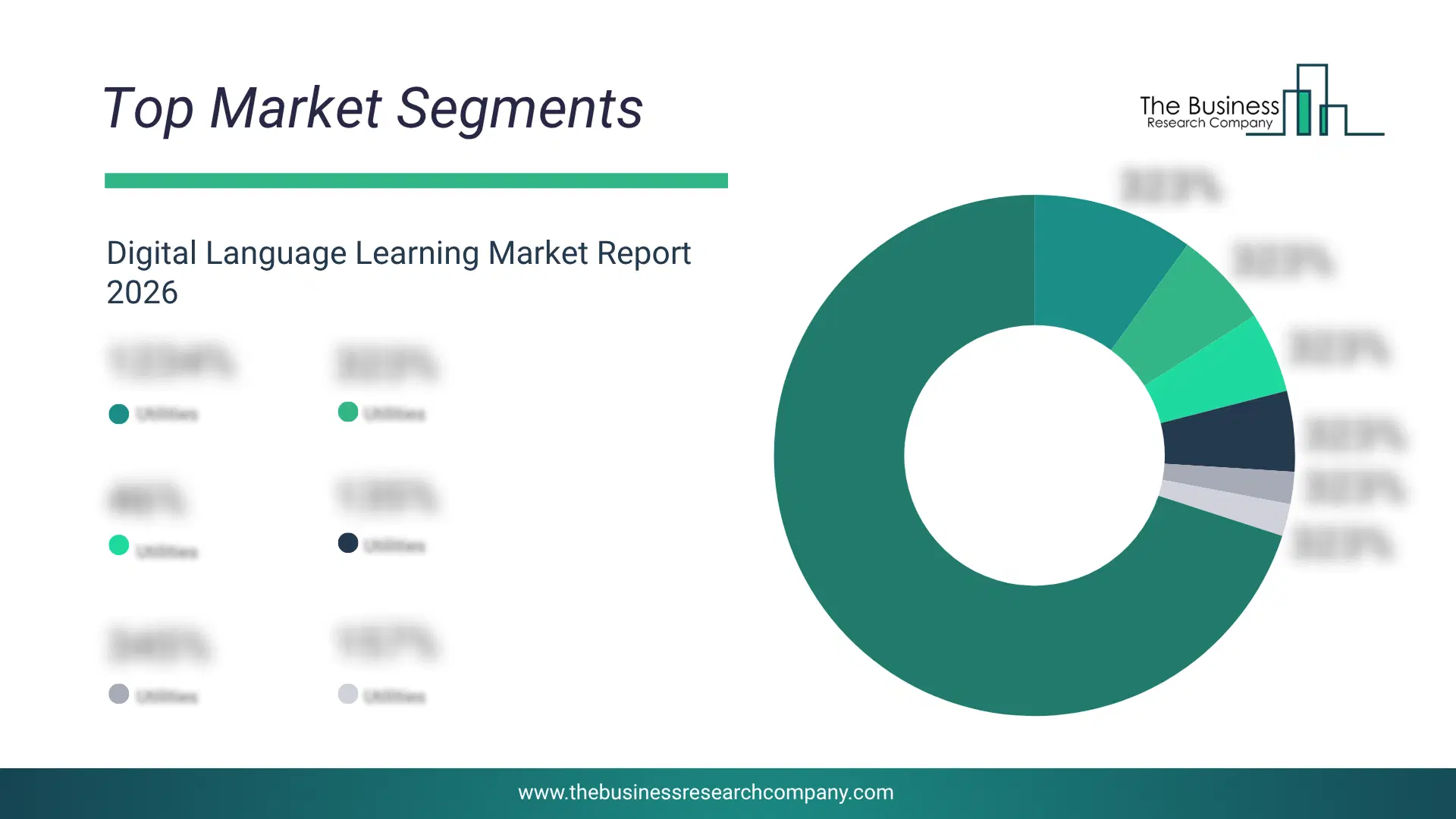
1) By Technology: Virtual Reality(VR), Artificial Intelligence, Big Data Analytics, Natural Language Processing, Other Technologies 2) By Language Type: English, German, Spanish, Mandarin, Other Languages 3) By Operating System: Windows, Android, iOS, Other Operating Systems 4) By End-User: Individuals, Enterprises, Educational Institutions, Government Agencies, Other End Users Subsegments: 1) By Virtual Reality (Vr): Immersive Language Learning Environments, Virtual Classrooms, Language Learning Simulations, Interactive Vr-Based Language Practice, 360° Language Learning Videos And Experiences 2) By Artificial Intelligence (AI): Ai-powered Language Tutors, Personalized Learning Paths, Speech Recognition And Pronunciation Feedback, Chatbots For Conversational Practice, Ai-Based Assessment And Evaluation Tools 3) By Big Data Analytics: Learning Behavior Analytics, Personalized Content Delivery, Learning Progress Tracking, Data-Driven Insights For Curriculum Development, Predictive Analytics For Language Learning Success 4) By Natural Language Processing (Nlp): Speech-To-Text Conversion, Grammar And Syntax Correction Tools, Automated Translation Systems, Text-To-Speech And Speech Recognition, Language Sentiment Analysis 5) By Other Technologies: Gamification And Game-Based Learning, Cloud-Based Language Learning Platforms, Mobile Learning Apps, Augmented Reality (Ar), Wearable Language Learning DevicesWhat Is The Driver Of The Digital Language Learning Market?
The rising demand for online education is expected to propel the digital language learning market going forward. Online education refers to delivering educational content and instruction via the internet. The demand for online education is rising due to its flexibility, accessibility, and quality of remote learning options, driven by technological advancements and evolving learning needs. Online education facilitates digital language learning by providing access to various interactive resources, personalized learning experiences, and real-time practice and feedback opportunities. For instance, in July 2024, Ward Education And Training, a UK-based company, in 2024, online education had 11.7 million users, representing 17.5% of the population, and this number is projected to grow to 15.7 million users, or 23.5%, by 2029. Therefore, the rising demand for online education is driving the growth of the digital language learning industry.Key Players In The Global Digital Language Learning Market
Major companies operating in the digital language learning market are Pearson plc, McGraw-Hill Education Holdings LLC, Cambridge University Press, Udemy Inc., Coursera Inc., Duolingo Inc., italki HK Limited, Babbel GmbH, Varsity Tutors, Rosetta Stone Inc., Verbling Inc., edX Inc., Lingoda GmbH, Busuu Limited, Mango Languages a division of HarperCollins Publishers LLC, Oxford University Press, Memrise Limited, Pimsleur Language Programs, Tandem Fundazioa, Yabla Inc., FluentU Inc., Living Language, EF Education First Ltd., Transparent Language Inc., Berlitz Corporation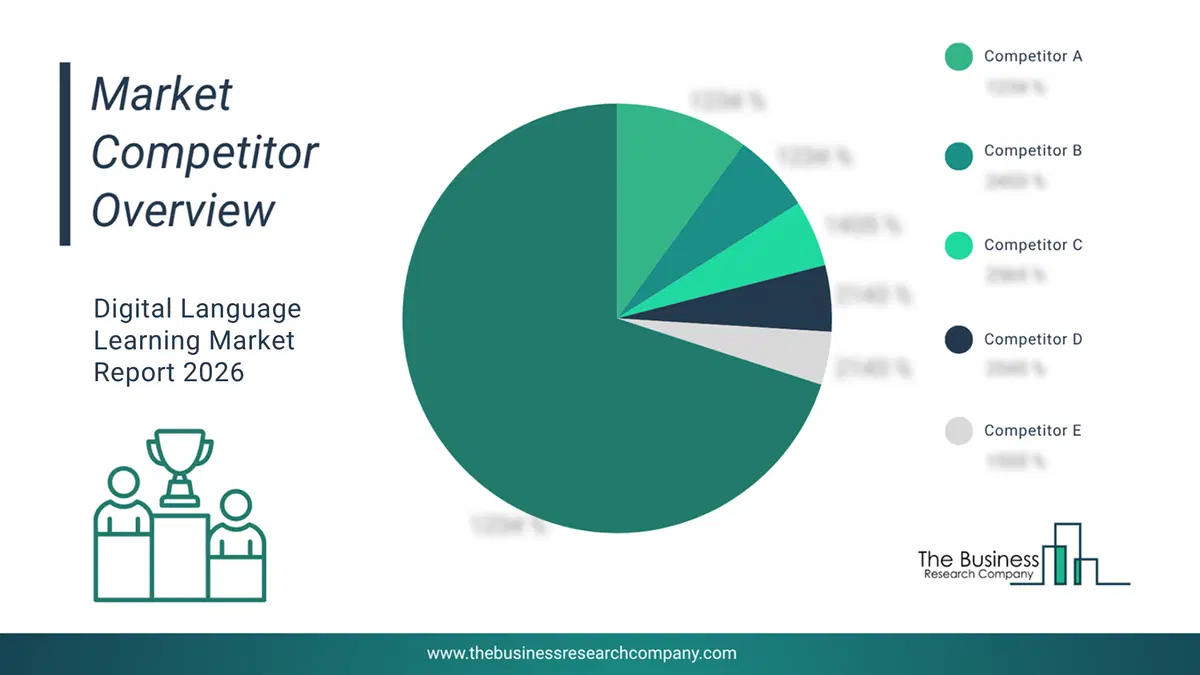
This chart is for illustrative purposes; the full report includes a detailed competitor analysis and comprehensive overview of the top 10 companies in the market.
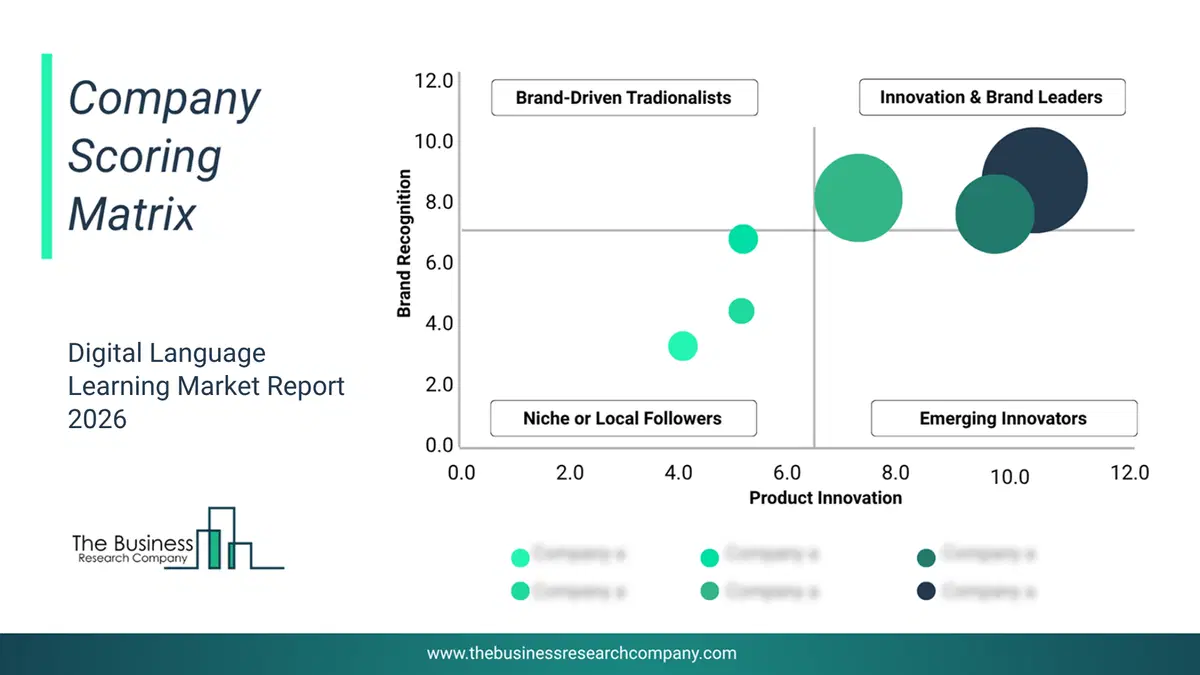
This chart maps companies by product innovation and brand strength, with bubble size indicating relative revenue, helping identify market leaders, challengers, and niche players. This is an illustrative chart; the full report provides a complete and accurate competitive analysis.
Global Digital Language Learning Market Trends and Insights
Major companies operating in the digital language learning market focus on developing innovative solutions, such as advanced language learning applications, to enhance user engagement, personalized learning experiences, and language proficiency. Advanced Language Learning Applications refer to software platforms or mobile applications designed to facilitate acquiring and improving language skills through innovative features, techniques, and technologies. For instance, in February 2024, Unacademy, an India-based educational technology company, launched its new language learning app to expand Unacademy's product portfolio and establish it as a critical player in the global language learning industry. The app aims to leverage Unacademy's robust technology infrastructure and extensive network of educators to establish itself as a key player in the worldwide language learning industry and pave the way for further international expansion. This move is part of Unacademy's strategy to expand its product portfolio and establish itself as a key player in the global language learning industry.What Are Latest Mergers And Acquisitions In The Digital Language Learning Market?
In April 2023, Wall Street English, a Spain-based English language education provider, partnered with Zoom, to integrate Zoom’s Video SDK into Wall Street English’s digital classrooms. Through this collaboration, the companies aim to deliver interactive, high-quality online English lessons that replicate in-person learning experiences and improve accessibility for learners worldwide. This partnership underscores the digital English language learning market’s growing focus on leveraging advanced virtual classroom technologies to enhance learner engagement and outcomes. Zoom Communications Inc is a US-based video communications company that offers an easy-to-use communication platform and solutions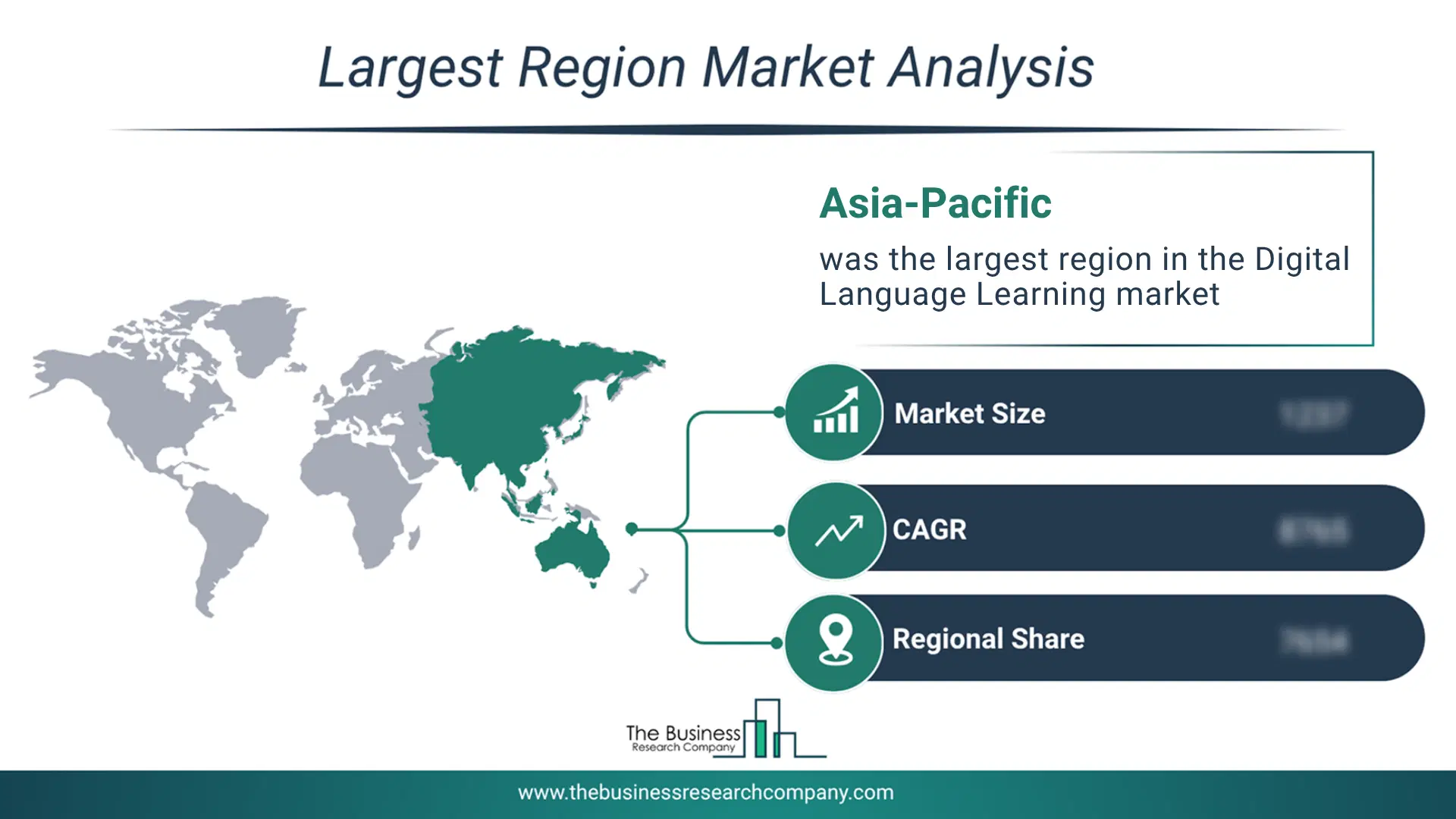
Regional Insights
Asia-Pacific was the largest region in the digital language learning market in 2025. The regions covered in this market report are Asia-Pacific, South East Asia, Western Europe, Eastern Europe, North America, South America, Middle East, Africa. The countries covered in this market report are Australia, Brazil, China, France, Germany, India, Indonesia, Japan, Taiwan, Russia, South Korea, UK, USA, Canada, Italy, Spain.What Defines the Digital Language Learning Market?
The digital language learning market consists of revenues earned by entities by providing services such as online language courses, language assessment and certification, language assessment services, and virtual tutoring services. The market value includes the value of related goods sold by the service provider or included within the service offering. The digital language learning market also includes sales of products including language exchange platforms, language learning software, language learning websites, language learning apps, and language learning platforms. Values in this market are ‘factory gate’ values, that is, the value of goods sold by the manufacturers or creators of the goods, whether to other entities (including downstream manufacturers, wholesalers, distributors, and retailers) or directly to end customers. The value of goods in this market includes related services sold by the creators of the goods.How is Market Value Defined and Measured?
The market value is defined as the revenues that enterprises gain from the sale of goods and/or services within the specified market and geography through sales, grants, or donations in terms of the currency (in USD unless otherwise specified). The revenues for a specified geography are consumption values that are revenues generated by organizations in the specified geography within the market, irrespective of where they are produced. It does not include revenues from resales along the supply chain, either further along the supply chain or as part of other products.
This chart presents market attractiveness based on a quantitative evaluation of growth, competition, strategic alignment, and risk, offering a clear view of opportunity areas for decision-making. This chart is for illustrative purposes; the full report contains the complete analysis.

This chart highlights the Total Addressable Market (TAM) by estimating the maximum revenue opportunity using an assumption-driven approach, supporting strategic planning and opportunity sizing across markets. The chart is illustrative; the full report provides a more comprehensive analysis.
What Key Data and Analysis Are Included in the Digital Language Learning Market Report 2026?
The digital language learning market research report is one of a series of new reports from The Business Research Company that provides market statistics, including industry global market size, regional shares, competitors with the market share, detailed market segments, market trends and opportunities, and any further data you may need to thrive in the digital language learning industry. The market research report delivers a complete perspective of everything you need, with an in-depth analysis of the current and future state of the industry.Digital Language Learning Market Report Forecast Analysis
| Report Attribute | Details |
|---|---|
| Market Size Value In 2026 | $43.45 billion |
| Revenue Forecast In 2030 | $83.87 billion |
| Growth Rate | CAGR of 21.2% from 2026 to 2030 |
| Base Year For Estimation | 2025 |
| Actual Estimates/Historical Data | 2020-2025 |
| Forecast Period | 2026 - 2030 |
| Market Representation | Revenue in USD Billion and CAGR from 2026 to 2030 |
| Segments Covered | Technology, Language Type, Operating System, End-User |
| Regional Scope | Asia-Pacific, Western Europe, Eastern Europe, North America, South America, Middle East, Africa |
| Country Scope | The countries covered in the report are Australia, Brazil, China, France, Germany, India, Indonesia, Japan, Taiwan, Russia, South Korea, UK, USA, Canada, Italy, Spain. |
| Key Companies Profiled | Pearson plc, McGraw-Hill Education Holdings LLC, Cambridge University Press, Udemy Inc., Coursera Inc., Duolingo Inc., italki HK Limited, Babbel GmbH, Varsity Tutors, Rosetta Stone Inc., Verbling Inc., edX Inc., Lingoda GmbH, Busuu Limited, Mango Languages a division of HarperCollins Publishers LLC, Oxford University Press, Memrise Limited, Pimsleur Language Programs, Tandem Fundazioa, Yabla Inc., FluentU Inc., Living Language, EF Education First Ltd., Transparent Language Inc., Berlitz Corporation |
| Customization Scope | Request for Customization |
| Pricing And Purchase Options | Explore Purchase Options |