
Digital Sovereignty In Government Market Report 2026
Global Outlook – By Component (Hardware, Software, Services), By Deployment Model (On-Premises, Cloud-Based, Hybrid), By Government Functionality (Data Management, Cybersecurity, Service Delivery, Privacy Protection), By Technology (Cloud Computing, Blockchain, Artificial Intelligence, Data Analytics), By End User (Federal Government, State Government, Local Government) – Market Size, Trends, Strategies, and Forecast to 2030
Digital Sovereignty In Government Market Overview
• Digital Sovereignty In Government market size has reached to $17.66 billion in 2025 • Expected to grow to $31.18 billion in 2030 at a compound annual growth rate (CAGR) of 12.1% • Growth Driver: Increasing Cybersecurity Threats Driving The Growth Of The Market Due To Rising Attack Volume And Risk Mitigation Needs • Market Trend: Localized Support And Control Services For Enhanced Digital Sovereignty And Regulatory Compliance • North America was the largest region in 2025 and Asia-Pacific is the fastest growing region.Market Gains By 2030 – Top Opportunities By Segment
Market Gain identifies the most promising market opportunities by highlighting the segments or products expected to generate the highest incremental revenue growth over the next five years.
What Is Covered Under Digital Sovereignty In Government Market?
Digital sovereignty in government refers to a government’s ability to control, govern, and protect its digital infrastructure, data, and technologies in accordance with national laws and strategic priorities. These practices ensure that public-sector digital services operate securely, transparently, and within regulatory boundaries. It helps to safeguard sensitive government data, maintain regulatory authority, and ensure resilient, trusted digital public services. The main components of the digital sovereignty in government are hardware, software, and services. Hardware includes secure servers, data centers, and networking infrastructure, software comprises sovereign cloud platforms, cybersecurity tools, and data governance solutions, and services cover consulting, integration, and managed services. These solutions are deployed through on-premises, cloud-based, and hybrid models. They support key government functionalities, including data management, cybersecurity, service delivery, and privacy protection, and leverage advanced technologies such as cloud computing, blockchain, artificial intelligence, and data analytics. These serves various end users, including federal, state, and local governments.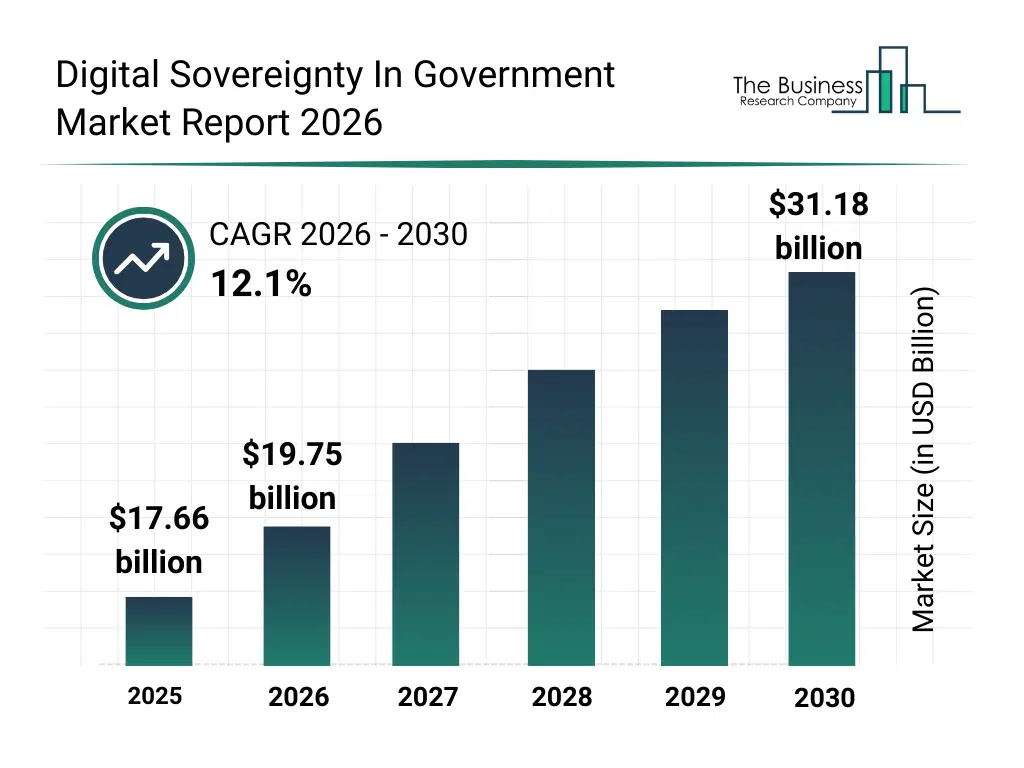
What Is The Digital Sovereignty In Government Market Size and Share 2026?
The digital sovereignty in government market size has grown rapidly in recent years. It will grow from $17.66 billion in 2025 to $19.75 billion in 2026 at a compound annual growth rate (CAGR) of 11.8%. The growth in the historic period can be attributed to rising cyber threats to government systems, reliance on foreign cloud and infrastructure, increasing government focus on data protection, early adoption of consulting services, lack of standardized digital sovereignty frameworks.What Is The Digital Sovereignty In Government Market Growth Forecast?
The digital sovereignty in government market size is expected to see rapid growth in the next few years. It will grow to $31.18 billion in 2030 at a compound annual growth rate (CAGR) of 12.1%. The growth in the forecast period can be attributed to implementation of sovereign cloud platforms, growth in cybersecurity and national infrastructure protection services, expansion of Digital identity management, stricter regulatory compliance mandates, modernization of public-sector digital applications. Major trends in the forecast period include sovereign cloud infrastructure expansion, data localization and residency enforcement, secure government application modernization, digital identity and access management adoption, national cybersecurity risk assessment integration.
Global Digital Sovereignty In Government Market Segmentation
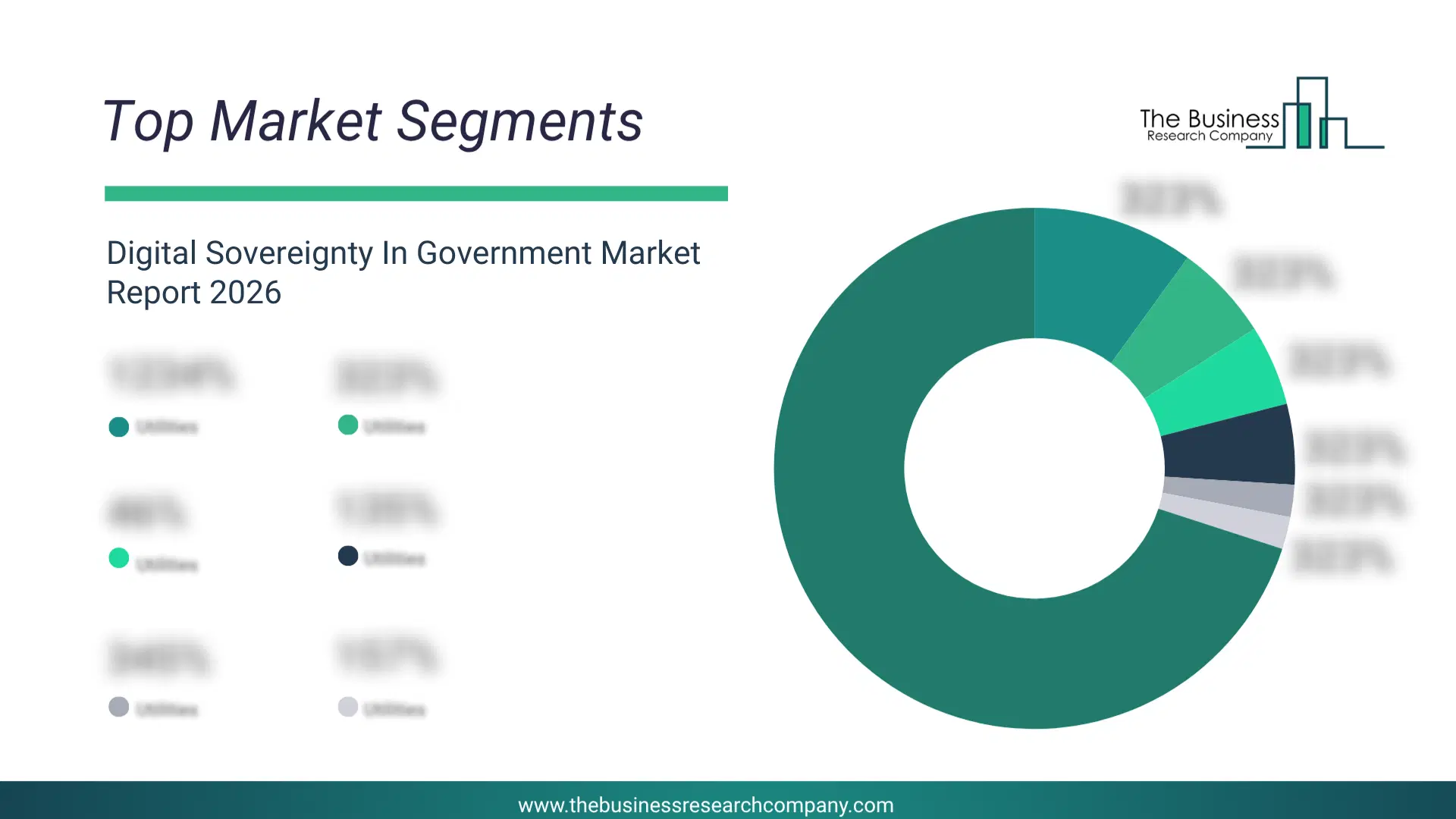
1) By Component: Hardware, Software, Services 2) By Deployment Model: On-Premises, Cloud-Based, Hybrid 3) By Government Functionality: Data Management, Cybersecurity, Service Delivery, Privacy Protection 4) By Technology: Cloud Computing, Blockchain, Artificial Intelligence, Data Analytics 5) By End User: Federal Government, State Government, Local Government Subsegments: 1) By Hardware: Secure Servers, Encryption Devices, Data Storage Systems, Network Security Appliances, Identity Verification Hardware 2) By Software: Data Governance Platforms, Cybersecurity Management Software, Digital Identity Management Systems, Compliance And Monitoring Tools, Sovereign Cloud Software 3) By Services: Consulting And Advisory Services, Implementation And Integration Services, Managed Security Services, Data Protection Services, Training And Support Services The top segments in the digital sovereignty in government market will be: • Software will reach $15.42 Billion by 2030. • Services will reach $10.08 Billion by 2030. • Hardware will reach $5.68 Billion by 2030.What Is The Driver Of The Digital Sovereignty In Government Market?
The increasing cybersecurity threats are expected to propel the growth of digital sovereignty in government market going forward. Cybersecurity threats refer to the growing frequency, sophistication, and impact of malicious activities targeting digital systems, networks, applications, or data, aiming to disrupt operations, steal sensitive information, or compromise system integrity. Cybersecurity threats are increasing due to the rapid expansion of digital connectivity and cloud-based systems that widen the attack surface for cybercriminals. Digital sovereignty in government strengthens national resilience by giving governments full control over data storage, system governance, and cybersecurity architecture, helping mitigate risks, protect sensitive information, and maintain operational continuity. For instance, in June 2024, according to the United States Office of Management and Budget’s FISMA Annual Report to Congress, a US-based government cybersecurity authority, federal agencies reported 32,211 cybersecurity incidents in fiscal year 2023, representing an approximate 9.9% increase compared with the 29,319 incidents reported in fiscal year 2022. Therefore, the increasing cybersecurity threats are driving the growth of digital sovereignty in government industry.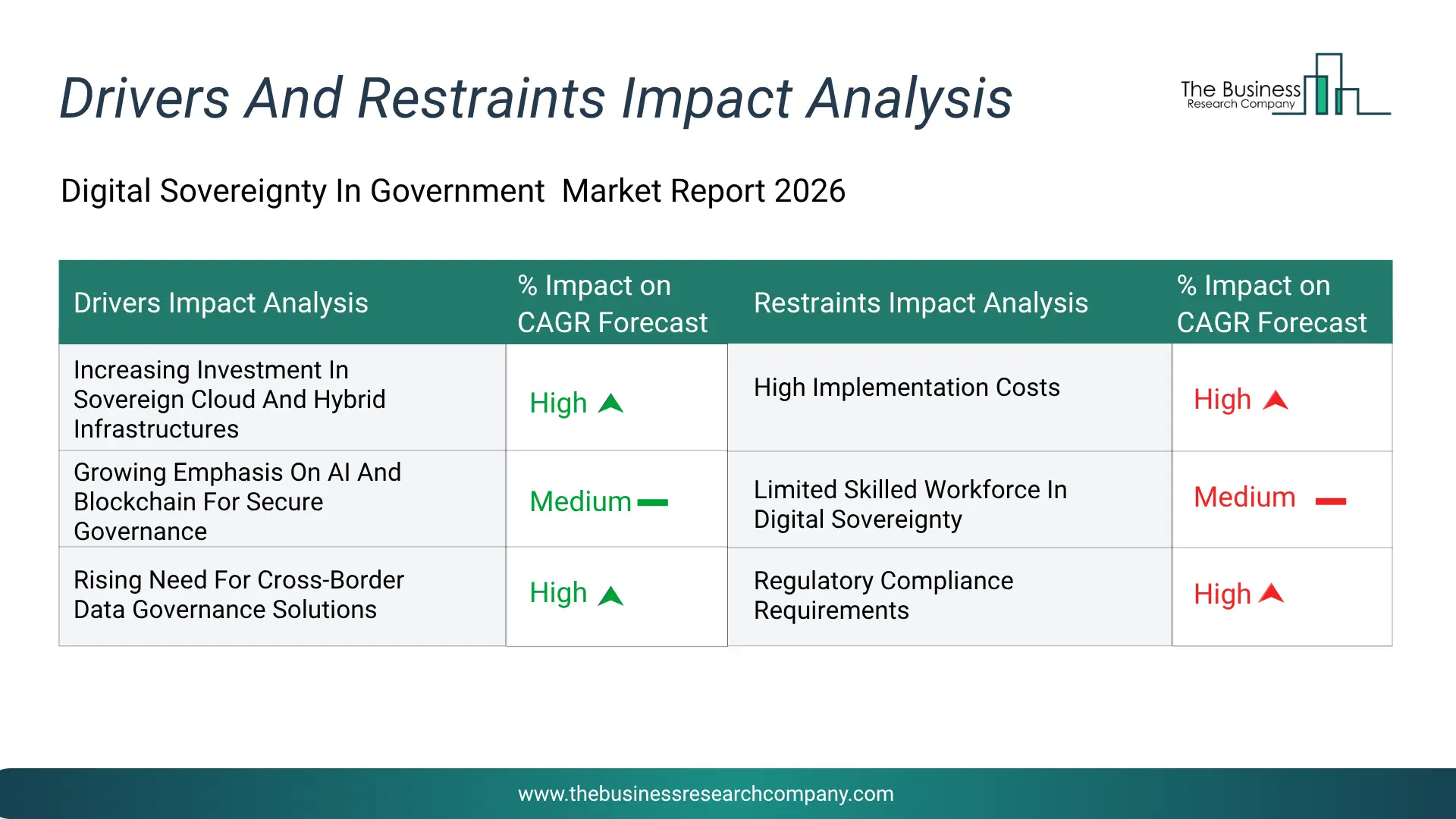
Infographic Chart Showing Key Market Drivers Analysis And Restraints For Digital Sovereignty In Government Market
The chart presents an impact analysis of key drivers and restraints, quantifying their relative influence on the market's growth rate and helping assess the balance between growth enablers and limiting factors. This chart offers a high-level perspective; the full report contains more detailed insights.
How Will The Drivers Impact Growth In The Global Digital Sovereignty In Government Market?
• Increasing Investment In Sovereign Cloud And Hybrid Infrastructures (High) – During the forecast period, the increasing investment in sovereign cloud and hybrid infrastructures is expected to become a key growth driver for the digital sovereignty in government market by 2030. Governments are accelerating the deployment of dedicated cloud environments that ensure data residency, operational independence, and compliance with national regulations. Hybrid infrastructure models are gaining traction as they enable seamless integration of legacy systems with modern sovereign cloud platforms while maintaining control over critical workloads. Public sector organizations are prioritizing infrastructure resilience, scalability, and secure access frameworks to support digital transformation initiatives. This shift toward sovereign and hybrid infrastructure ecosystems is strengthening long-term market expansion. • Growing Emphasis On AI And Blockchain For Secure Governance (Medium) – During the forecast period, the growing emphasis on artificial intelligence and blockchain for secure governance is expected to emerge as a major factor driving the expansion of the digital sovereignty in government market by 2030. Governments are adopting AI-powered systems for real-time monitoring, threat detection, and automated compliance enforcement, while blockchain technologies are being integrated to enhance data integrity, transparency, and auditability. These technologies enable secure data exchange across departments without compromising sovereignty requirements. Additionally, the ability to establish tamper-proof records and decentralized trust frameworks is strengthening digital governance models. • Rising Need For Cross-Border Data Governance Solutions (High) – During the forecast period, the rising need for cross-border data governance solutions is expected to act as a key growth catalyst for the digital sovereignty in government market by 2030. Governments and international institutions are increasingly dealing with complex data-sharing requirements across jurisdictions while ensuring compliance with varying regulatory frameworks. This has led to the development of advanced governance models that enable secure data exchange, policy enforcement, and jurisdictional control without compromising sovereignty. The need to balance global collaboration with national data protection priorities is accelerating investments in interoperable and policy-driven governance solutions.How Will The Restraints Impact Growth In The Global Digital Sovereignty In Government Market?
• High Implementation Costs (High) – During the forecast period, high implementation costs are restricting the growth of the digital sovereignty in government market. Significant investments required for sovereign cloud infrastructure, secure data centers, and localized digital systems are increasing financial burden on governments, thereby limiting large-scale adoption • Limited Skilled Workforce In Digital Sovereignty (Medium) – During the forecast period, limited skilled workforce in digital sovereignty is restricting the growth of the digital sovereignty in government market. Shortage of professionals with expertise in cybersecurity, data governance, and sovereign cloud technologies is creating operational challenges and slowing implementation • Regulatory Compliance Requirements (High) – During the forecast period, regulatory compliance requirements are restricting the growth of the digital sovereignty in government market. Complex and evolving legal frameworks, strict data protection laws, and compliance obligations are increasing administrative burden and delaying deployment of digital sovereignty initiativesKey Players In The Global Digital Sovereignty In Government Market
Major companies operating in the digital sovereignty in government market are Amazon.com Inc., Google LLC, Microsoft Corporation, Dell Technologies Inc., Accenture plc, International Business Machines Corporation, Cisco Systems Inc., Oracle Corporation, Salesforce Inc., SAP SE, Hewlett Packard Enterprise Company, Fujitsu Limited, Thales Group, Atos SE, Nutanix Inc., Unisys Corporation, Kontron S&T AG, OVHcloud SAS, Macquarie Technology Group Limited, Industrial Innovation Group (IIG) Inc.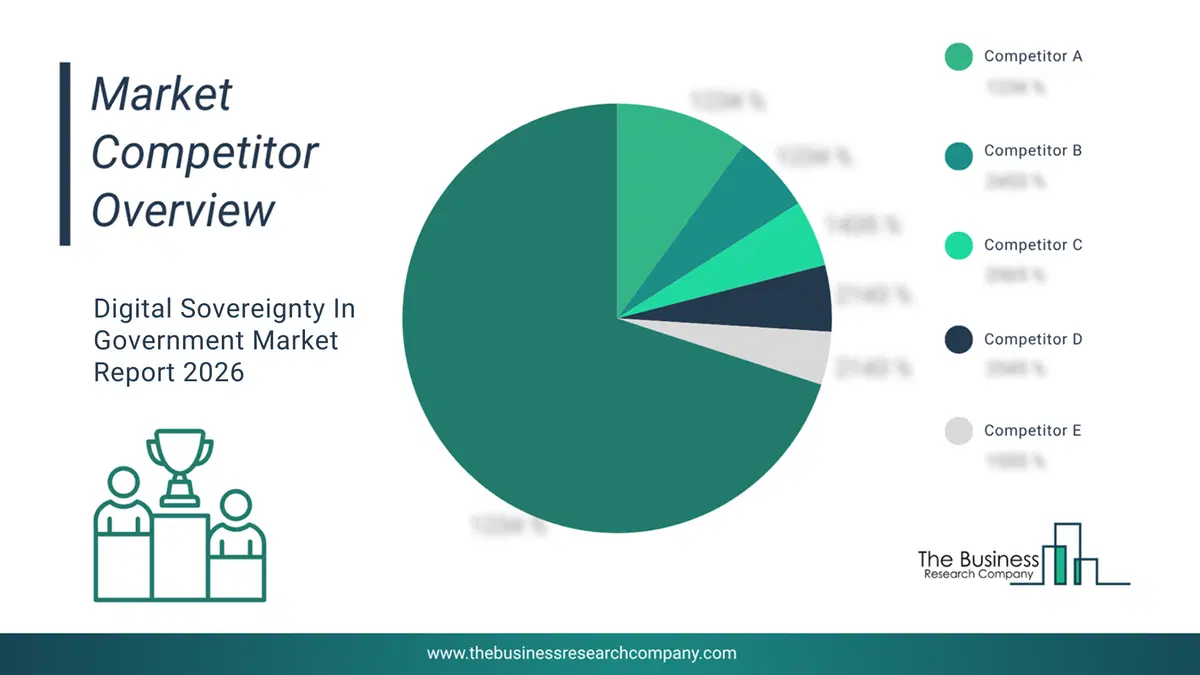
This chart is for illustrative purposes; the full report includes a detailed competitor analysis and comprehensive overview of the top 10 companies in the market.
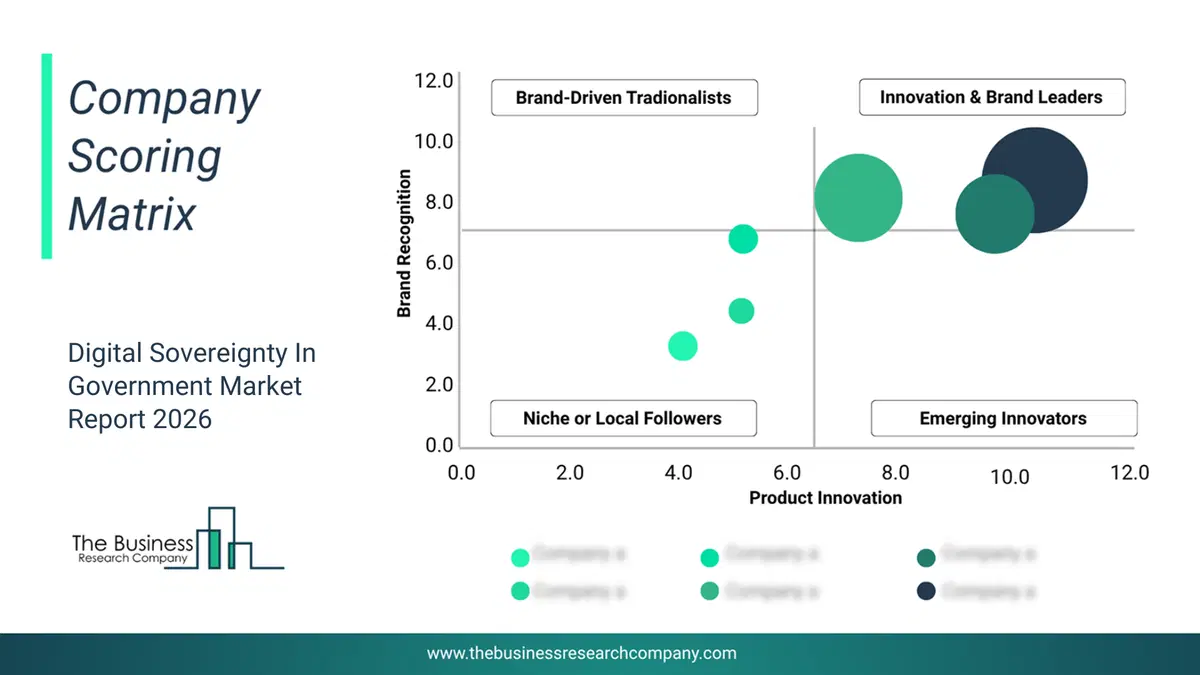
This chart maps companies by product innovation and brand strength, with bubble size indicating relative revenue, helping identify market leaders, challengers, and niche players. This is an illustrative chart; the full report provides a complete and accurate competitive analysis.
Global Digital Sovereignty In Government Market Trends and Insights
Major companies operating in the digital sovereignty in government market are focusing on developing innovative solutions, such as sovereign support and control services, to meet the rising demand for regulatory compliance, data privacy, and national control over digital infrastructure. Sovereign support and control services provide localized operational control, enhanced data privacy, and region‑specific support frameworks that ensure compliance with local laws and governance requirements, offering clear advantages over traditional global, centralized service models that may not meet strict sovereign data mandates. For instance, in July 2025, SUSE S.A., a Germany‑based software company, launched SUSE Sovereign Premium Support, a digital sovereignty support offering designed specifically for European Union environments that stores customer support data on EU‑located servers and provides named EU‑based technical support personnel to meet stringent data privacy and compliance needs. The service extends traditional support by combining localized expertise, enhanced data control, and proactive governance capabilities to help government and regulated organizations navigate evolving sovereign requirements, reduce dependency on non‑regional infrastructures, and strengthen operational resilience. SUSE Sovereign Premium Support encompasses enhanced encryption for troubleshooting, direct access to EU‑based engineers and service delivery managers, and tailored support across an extensive portfolio of enterprise solutions to address compliance and sovereignty challenges.What Are Latest Mergers And Acquisitions In The Digital Sovereignty In Government Market?
In November 2025, Kyndryl Holdings Inc., a US‑based technology services company, acquired Solvinity Group B.V. for an undisclosed amount. Through this acquisition, Kyndryl aims to enhance its technology services portfolio by combining its mission‑critical advisory, implementation, and managed services capabilities with Solvinity’s secure private and hybrid sovereign cloud offerings to better support customers with sensitive workload security, compliance, and data sovereignty requirements. Solvinity Group B.V. is a Netherlands‑based provider of secure managed private and hybrid cloud services tailored to strict data security and regulatory compliance requirements.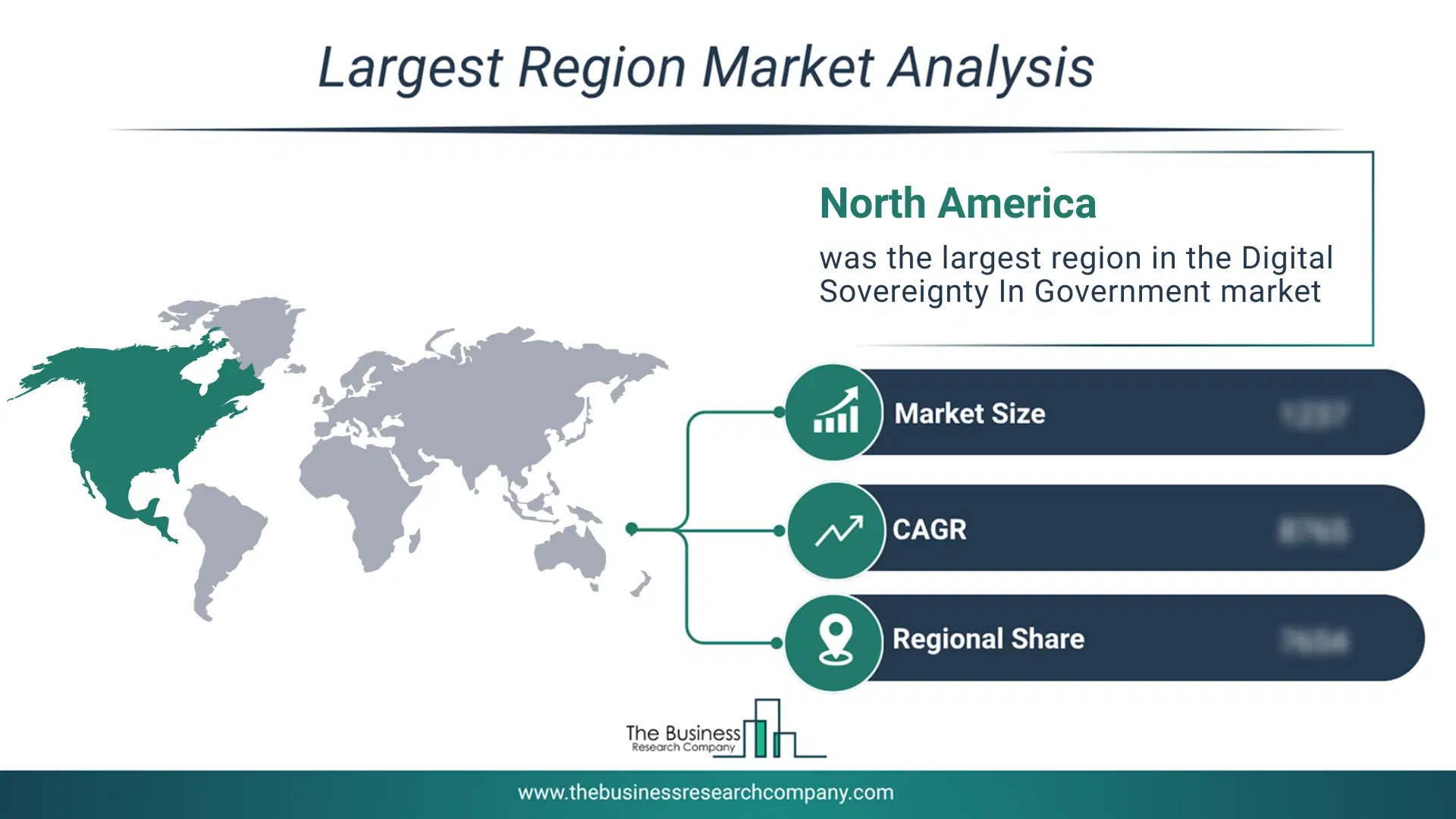
Regional Outlook
North America was the largest region in the digital sovereignty in government market in 2025. Asia-Pacific is expected to be the fastest-growing region in the forecast period. The regions covered in this market report are Asia-Pacific, South East Asia, Western Europe, Eastern Europe, North America, South America, Middle East, Africa. The countries covered in this market report are Australia, Brazil, China, France, Germany, India, Indonesia, Japan, Taiwan, Russia, South Korea, UK, USA, Canada, Italy, Spain.What Defines the Digital Sovereignty In Government Market?
The digital sovereignty in government market consists of revenues earned by entities by providing services such as data localization and governance consulting, cybersecurity and national infrastructure protection services, digital identity and access management services, regulatory compliance and risk assessment, and secure application and platform modernization. The market value includes the value of related goods sold by the service provider or included within the service offering. The digital sovereignty in government market also includes sales of sovereign cloud platforms, data localization and residency enforcement software, secure government cloud infrastructure products, and encryption and key management systems. Values in this market are ‘factory gate’ values, that is the value of goods sold by the manufacturers or creators of the goods, whether to other entities (including downstream manufacturers, wholesalers, distributors and retailers) or directly to end customers. The value of goods in this market includes related services sold by the creators of the goods.How is Market Value Defined and Measured?
The market value is defined as the revenues that enterprises gain from the sale of goods and/or services within the specified market and geography through sales, grants, or donations in terms of the currency (in USD unless otherwise specified). The revenues for a specified geography are consumption values that are revenues generated by organizations in the specified geography within the market, irrespective of where they are produced. It does not include revenues from resales along the supply chain, either further along the supply chain or as part of other products.
This chart presents market attractiveness based on a quantitative evaluation of growth, competition, strategic alignment, and risk, offering a clear view of opportunity areas for decision-making. This chart is for illustrative purposes; the full report contains the complete analysis.

This chart highlights the Total Addressable Market (TAM) by estimating the maximum revenue opportunity using an assumption-driven approach, supporting strategic planning and opportunity sizing across markets. The chart is illustrative; the full report provides a more comprehensive analysis.
What Key Data and Analysis Are Included in the Digital Sovereignty In Government Market Report 2026?
The digital sovereignty in government market research report is one of a series of new reports from The Business Research Company that provides market statistics, including industry global market size, regional shares, competitors with the market share, detailed market segments, market trends and opportunities, and any further data you may need to thrive in the digital sovereignty in government industry. The market research report delivers a complete perspective of everything you need, with an in-depth analysis of the current and future state of the industry.Digital Sovereignty In Government Market Report Forecast Analysis
| Report Attribute | Details |
|---|---|
| Market Size Value In 2026 | $19.75 billion |
| Revenue Forecast In 2030 | $31.18 billion |
| Growth Rate | CAGR of 11.8% from 2026 to 2030 |
| Base Year For Estimation | 2025 |
| Actual Estimates/Historical Data | 2020-2025 |
| Forecast Period | 2026 - 2030 |
| Market Representation | Revenue in USD Billion and CAGR from 2026 to 2030 |
| Segments Covered | Component, Deployment Model, Government Functionality, Technology, End User |
| Regional Scope | Asia-Pacific, Western Europe, Eastern Europe, North America, South America, Middle East, Africa |
| Country Scope | The countries covered in the report are Australia, Brazil, China, France, Germany, India, Indonesia, Japan, Taiwan, Russia, South Korea, UK, USA, Canada, Italy, Spain. |
| Key Companies Profiled | Amazon.com Inc., Google LLC, Microsoft Corporation, Dell Technologies Inc., Accenture plc, International Business Machines Corporation, Cisco Systems Inc., Oracle Corporation, Salesforce Inc., SAP SE, Hewlett Packard Enterprise Company, Fujitsu Limited, Thales Group, Atos SE, Nutanix Inc., Unisys Corporation, Kontron S&T AG, OVHcloud SAS, Macquarie Technology Group Limited, Industrial Innovation Group (IIG) Inc. |
| Customization Scope | Request for Customization |
| Pricing And Purchase Options | Explore Purchase Options |