
Digital Twin Technology Market Report 2026
Global Outlook – By Type (Product Digital Twins, Process Digital Twins, System Digital Twins, Asset Performance Digital Twins), By Application (Predictive Maintenance, Product Design And Development, Supply Chain Optimization, Remote Monitoring And Control, Performance Optimization), By End-User Industry (Manufacturing, Energy And Utilities, Transportation And Logistics, Other End Users) – Market Size, Trends, Strategies, and Forecast to 2030
Digital Twin Technology Market Overview
• Digital Twin Technology market size has reached to $22.4 billion in 2025 • Expected to grow to $94.27 billion in 2030 at a compound annual growth rate (CAGR) of 32.2% • Growth Driver: IoT Devices Adoption Fuels The Digital Twin Technology Market Expansion • Market Trend: Revolutionizing Infrastructure Management With AI-Driven Digital Twin Solutions • North America was the largest region in 2025.What Is Covered Under Digital Twin Technology Market?
Digital twin technology refers to the creation of a digital replica or simulation of a physical object, process, system, or entity using sensor data to simulate behaviors and predict performance. This enables optimization and predictive maintenance, which improve productivity and reduce downtime in a variety of sectors. The main types of digital twin technology include product digital twins, process digital twins, system digital twins, asset performance digital twins, and others. Product digital twins are virtual duplicates of actual objects that preserve their design, structure, and behavior. It is used for various applications, including predictive maintenance, product design and development, supply chain optimization, remote monitoring and control, and performance optimization, by several end-users, such as manufacturing, energy and utilities, transportation and logistics, healthcare, and others.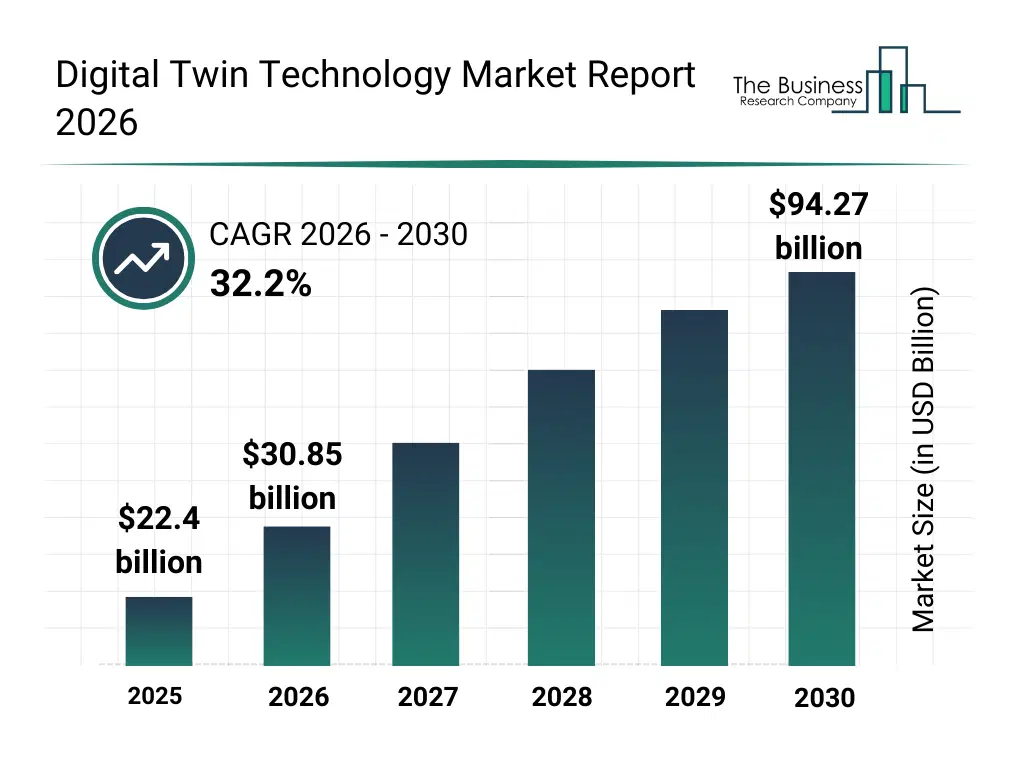
What Is The Digital Twin Technology Market Size and Share 2026?
The digital twin technology market size has grown exponentially in recent years. It will grow from $22.4 billion in 2025 to $30.85 billion in 2026 at a compound annual growth rate (CAGR) of 37.7%. The growth in the historic period can be attributed to increasing adoption of industrial automation systems, growth in sensor and iot deployments, rising need for asset lifecycle visibility, expansion of advanced manufacturing processes, availability of high-performance computing platforms.What Is The Digital Twin Technology Market Growth Forecast?
The digital twin technology market size is expected to see exponential growth in the next few years. It will grow to $94.27 billion in 2030 at a compound annual growth rate (CAGR) of 32.2%. The growth in the forecast period can be attributed to increasing investments in smart manufacturing, rising adoption of AI-enabled digital twins, expansion of smart infrastructure projects, growing demand for remote monitoring and optimization, increasing integration of digital twins with enterprise systems. Major trends in the forecast period include increasing deployment of real-time asset digital twins, rising adoption of predictive maintenance applications, growing use of simulation-based design tools, expansion of system-level digital twin models, enhanced focus on operational performance optimization.
Global Digital Twin Technology Market Segmentation
1) By Type: Product Digital Twins, Process Digital Twins, System Digital Twins, Asset Performance Digital Twins 2) By Application: Predictive Maintenance, Product Design And Development, Supply Chain Optimization, Remote Monitoring And Control, Performance Optimization 3) By End-User Industry: Manufacturing, Energy And Utilities, Transportation And Logistics, Other End Users Subsegments: 1) By Product Digital Twins: Consumer Products, Industrial Products, Automotive Products, Aerospace Products, Electronics And High-Tech Products 2) By Process Digital Twins: Manufacturing Processes, Supply Chain Processes, Energy Management Processes, Chemical Processes, Industrial Automation Processes 3) By System Digital Twins: Operational Systems, Smart Cities, Buildings And Infrastructure Systems, Transportation Systems, Utilities And Grid Systems 4) By Asset Performance Digital Twins: Predictive Maintenance, Performance Monitoring, Lifecycle Management, Condition MonitoringWhat Is The Driver Of The Digital Twin Technology Market?
The increasing adoption of IoT devices is expected to propel the growth of the digital twin technology market going forward. IoT (Internet of Things) devices are specialized hardware devices, such as sensors, actuators, and appliances, that communicate wirelessly with a network to gather, exchange, and process data. The demand for IoT (Internet of Things) devices is increasing due to enhanced connectivity, digital transformation, convenience and efficiency, safety, and security. IoT devices collect real-time data on a variety of characteristics, such as temperature, pressure, and usage patterns, which digital twins utilize to generate virtual models. With continuous data streaming, digital twins provide real-time monitoring, allowing businesses to optimize operations and detect challenges in advance. For instance, in April 2025, according to Ericsson, a Sweden-based telecommunications company, global IoT connections reached 18.8 billion connections in 2024 and are expected to increase to 43.0 billion connections by 2030. Therefore, the increasing adoption of IoT devices is driving the growth of the digital twin technology industry.Key Players In The Global Digital Twin Technology Market
Major companies operating in the digital twin technology market are Microsoft Corporation, Siemens AG, General Electric Company, Amazon Web Services Inc., International Business Machines Corporation, Oracle Corporation, Schneider Electric SE, Honeywell International Inc., SAP SE, ABB Limited, NTT DATA Corporation, Infosys Limited, Emerson Electric Co., Dassault Systèmes, Hexagon AB, Autodesk Inc., ANSYS Inc., PTC Inc., Bosch Global Software Technologies Private Limited, AVEVA Group Limited, Bentley Systems Incorporated, TIBCO Software Inc., L&T Technology Services Limited, Altair Engineering Inc., Digital Twin Consortium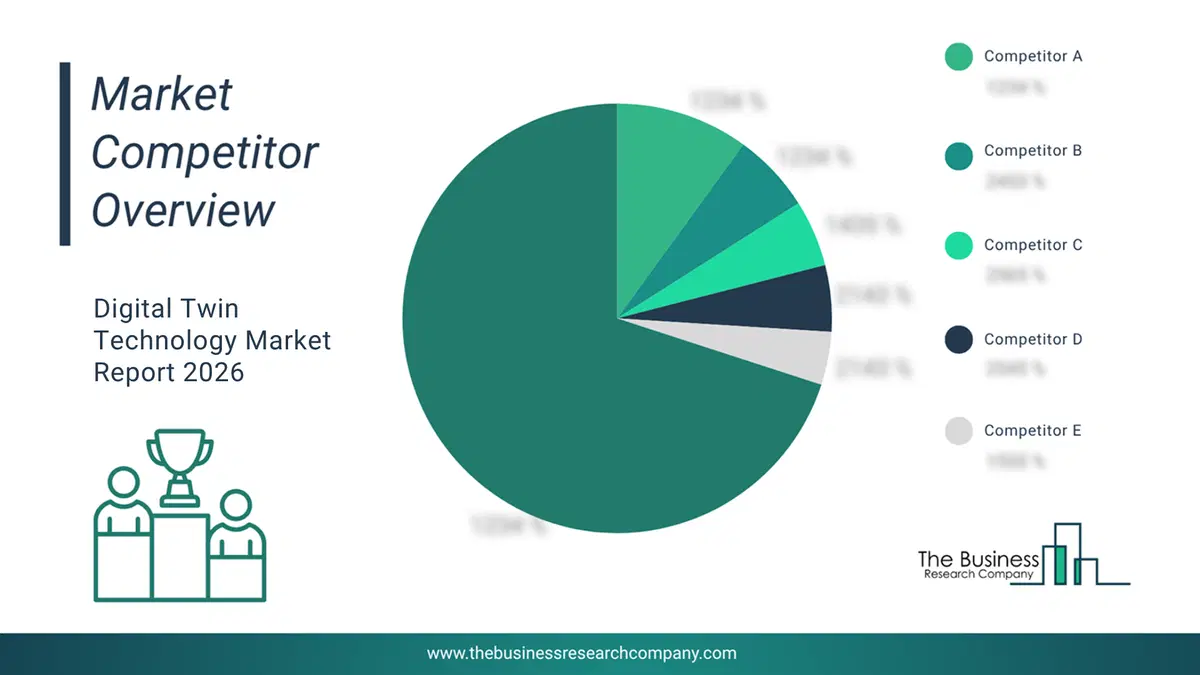
This chart is for illustrative purposes; the full report includes a detailed competitor analysis and comprehensive overview of the top 10 companies in the market.
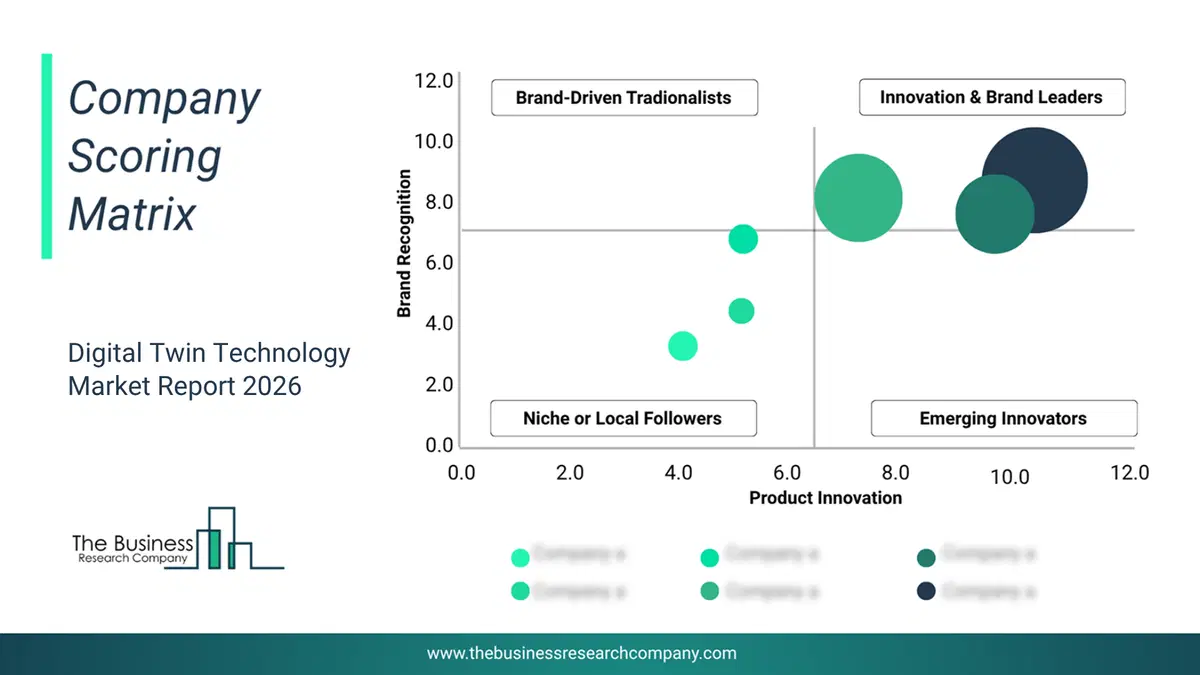
This chart maps companies by product innovation and brand strength, with bubble size indicating relative revenue, helping identify market leaders, challengers, and niche players. This is an illustrative chart; the full report provides a complete and accurate competitive analysis.
Global Digital Twin Technology Market Trends and Insights
Major companies operating in the digital twin technology market are focused on developing next-generation technological solutions, such as AI-enabled digital twin platforms, to digitize and analyze critical infrastructure assets. An AI-enabled digital twin platform refers to a sophisticated software system that integrates artificial intelligence (AI) capabilities into the creation and management of digital twins. For instance, in March 2024, Looq AI, a US-based software company, launched its AI-enabled digital twin technology, the Looq platform. It is a one-stop solution for surveyors, engineers, contractors, and asset owners to digitally map the physical world's infrastructure in minutes with survey-grade precision, allowing them to create and maintain a safer, more sustainable, and electrified future. The Looq platform is driven by a handheld 'Q' camera, which combines four high-resolution cameras, survey-grade GPS, and an AI processor. This gives nearly 360-degree coverage, allowing for quick data gathering. The Looq platform offers a complete end-to-end workflow, allowing project teams to engage with created digital twins and AI-derived data to fulfill engineering, surveying, analysis, and coordinating activities.What Are Latest Mergers And Acquisitions In The Digital Twin Technology Market?
In October 2023, Clockworks Analytics, a US-based SaaS startup that helps buildings keep track of their operating systems, acquired the digital twin assets from Animated Insights for an undisclosed amount. This acquisition aims to improve Clockworks Analytics' capabilities in the digital twin domain, particularly 3D digital twin visualization and device monitoring technology. This deal will strengthen Clockworks Analytics' position as a full provider of digital twin solutions for the built environment. Animated Insights is a US-based provider of digital twin technology.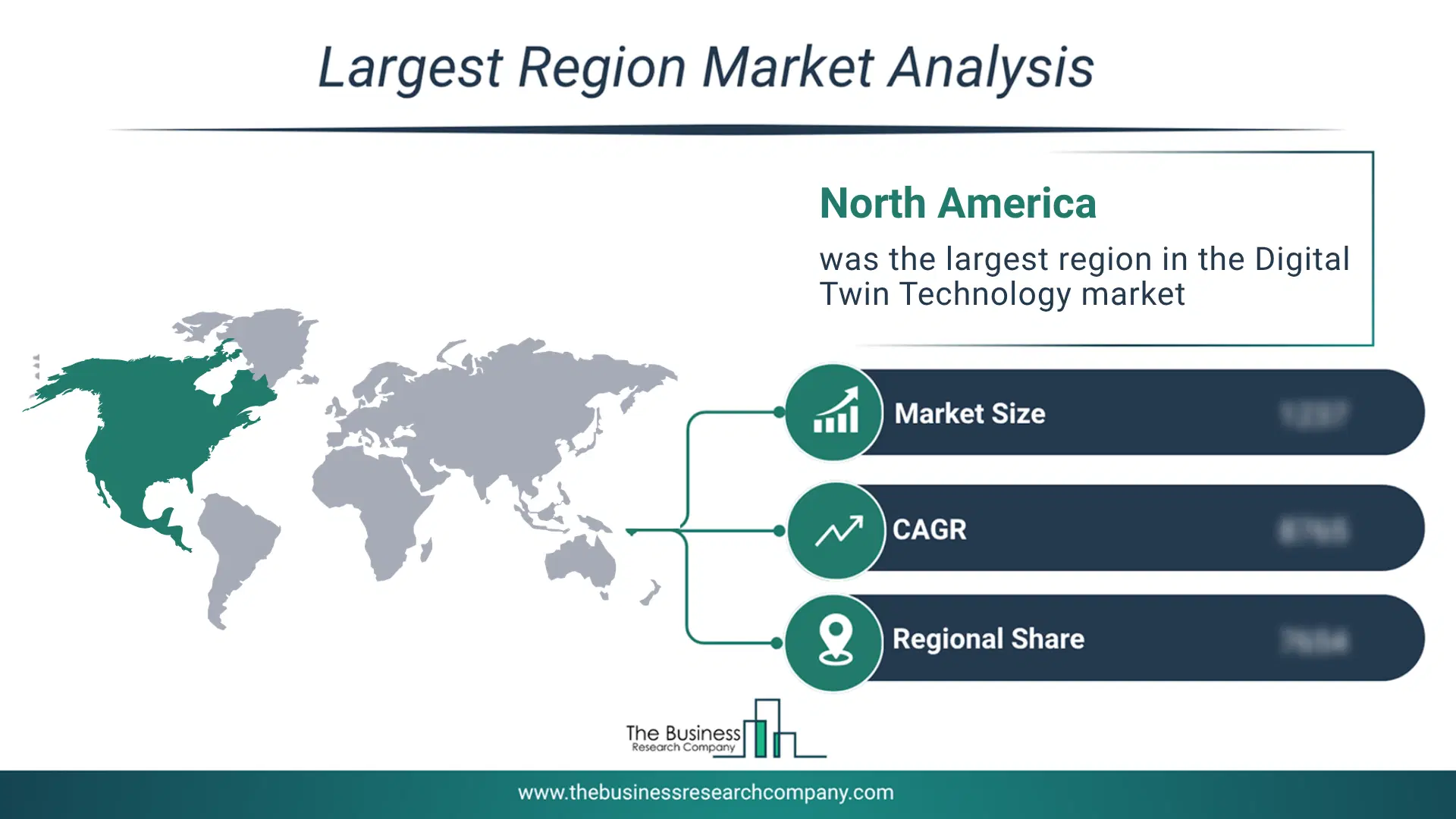
Regional Insights
North America was the largest region in the digital twin technology market in 2025. The regions covered in this market report are Asia-Pacific, South East Asia, Western Europe, Eastern Europe, North America, South America, Middle East, Africa. The countries covered in this market report are Australia, Brazil, China, France, Germany, India, Indonesia, Japan, Taiwan, Russia, South Korea, UK, USA, Canada, Italy, Spain.What Defines the Digital Twin Technology Market?
The digital twin technology market includes revenues earned by entities by providing services, such as simulation and modeling, optimization and control, virtual prototyping and testing, and personalization. The market value includes the value of related goods sold by the service provider or included within the service offering. The market value includes the value of related goods sold by the service provider or included within the service offering. Only goods and services traded between entities or sold to end consumers are included.How is Market Value Defined and Measured?
The market value is defined as the revenues that enterprises gain from the sale of goods and/or services within the specified market and geography through sales, grants, or donations in terms of the currency (in USD unless otherwise specified). The revenues for a specified geography are consumption values that are revenues generated by organizations in the specified geography within the market, irrespective of where they are produced. It does not include revenues from resales along the supply chain, either further along the supply chain or as part of other products.
This chart presents market attractiveness based on a quantitative evaluation of growth, competition, strategic alignment, and risk, offering a clear view of opportunity areas for decision-making. This chart is for illustrative purposes; the full report contains the complete analysis.

This chart highlights the Total Addressable Market (TAM) by estimating the maximum revenue opportunity using an assumption-driven approach, supporting strategic planning and opportunity sizing across markets. The chart is illustrative; the full report provides a more comprehensive analysis.
What Key Data and Analysis Are Included in the Digital Twin Technology Market Report 2026?
The digital twin technology market research report is one of a series of new reports from The Business Research Company that provides market statistics, including industry global market size, regional shares, competitors with the market share, detailed market segments, market trends and opportunities, and any further data you may need to thrive in the digital twin technology industry. The market research report delivers a complete perspective of everything you need, with an in-depth analysis of the current and future state of the industry.Digital Twin Technology Market Report Forecast Analysis
| Report Attribute | Details |
|---|---|
| Market Size Value In 2026 | $30.85 billion |
| Revenue Forecast In 2030 | $94.27 billion |
| Growth Rate | CAGR of 32.2% from 2026 to 2030 |
| Base Year For Estimation | 2025 |
| Actual Estimates/Historical Data | 2020-2025 |
| Forecast Period | 2026 - 2030 |
| Market Representation | Revenue in USD Billion and CAGR from 2026 to 2030 |
| Segments Covered | Type, Application, End-User Industry |
| Regional Scope | Asia-Pacific, Western Europe, Eastern Europe, North America, South America, Middle East, Africa |
| Country Scope | The Countries Covered In This Market Report Are Australia, Brazil, China, France, Germany, India, Indonesia, Japan, Taiwan, Russia, South Korea, Uk, Usa, Canada, Italy, Spain. |
| Key Companies Profiled | Microsoft Corporation, Siemens AG, General Electric Company, Amazon Web Services Inc., International Business Machines Corporation, Oracle Corporation, Schneider Electric SE, Honeywell International Inc., SAP SE, ABB Limited, NTT DATA Corporation, Infosys Limited, Emerson Electric Co., Dassault Systèmes, Hexagon AB, Autodesk Inc., ANSYS Inc., PTC Inc., Bosch Global Software Technologies Private Limited, AVEVA Group Limited, Bentley Systems Incorporated, TIBCO Software Inc., L&T Technology Services Limited, Altair Engineering Inc., Digital Twin Consortium |
| Customization Scope | Request for Customization |
| Pricing And Purchase Options | Explore Purchase Options |