
Direct Satellite-To-Phone Cellular Market Report 2026
Global Outlook – By Type (Consumer Services, Fixed Satellite Services, Mobile Satellite Services, Earth Observation Services), By Connectivity Type (Two-Way Communication, One-Way Communication), By End-User Industry (Media And Entertainment, Government, Defense, Aerospace, Retail And Enterprise, Other End User Industries) – Market Size, Trends, Strategies, and Forecast to 2035
Direct Satellite-To-Phone Cellular Market Overview
• Direct Satellite-To-Phone Cellular market size has reached to $3.65 billion in 2025 • Expected to grow to $17.62 billion in 2030 at a compound annual growth rate (CAGR) of 37% • Growth Driver: Surge In Demand For Seamless Global Connectivity Driving The Growth Of The Market Due To Rising Mobile Broadband Subscriptions And Remote Area Coverage • Market Trend: Expansion Of Direct Satellite Connectivity Enhancing Coverage And Resilience While Addressing Remote Communication Challenges • North America was the largest region in 2025 and Asia-Pacific is the fastest growing region.Market Gains By 2030 – Top Opportunities By Segment
Market Gain identifies the most promising market opportunities by highlighting the segments or products expected to generate the highest incremental revenue growth over the next five years.
What Is Covered Under Direct Satellite-To-Phone Cellular Market?
Direct satellite-to-phone cellular refers to a communication technology that enables mobile phones to connect directly to satellites without relying on traditional terrestrial cellular networks. It integrates satellite communication capabilities into standard mobile devices, allowing them to send and receive signals through low Earth orbit or geostationary satellites. This technology ensures seamless connectivity by extending network coverage to remote or underserved areas where terrestrial infrastructure is unavailable or unreliable. The main types of direct satellite-to-phone cellular are consumer services, fixed satellite services, mobile satellite services, and earth observation services. Consumer services are engineered for power efficiency and minimal antenna changes so standard smartphones can maintain essential connectivity in rural, maritime, or disaster areas, improving user safety and experience without replacing cell plans. It offers different connectivities, such as two-way communication and one-way communication, and is used by several end-user industries, including media and entertainment, government, defense, aerospace, retail and enterprise, and others.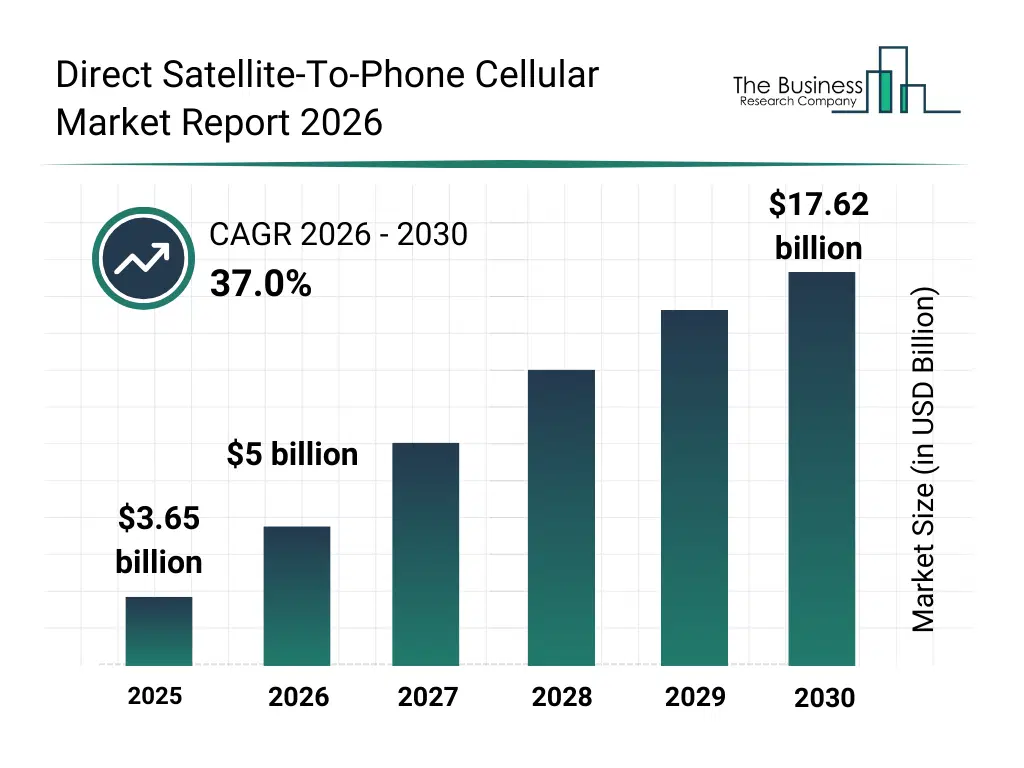
What Is The Direct Satellite-To-Phone Cellular Market Size and Share 2026?
The direct satellite-to-phone cellular market size has grown exponentially in recent years. It will grow from $3.65 billion in 2025 to $5 billion in 2026 at a compound annual growth rate (CAGR) of 37.3%. The growth in the historic period can be attributed to coverage gaps in remote and rural regions, increasing demand for emergency connectivity, growth of satellite broadband constellations, smartphone feature differentiation race, government initiatives for disaster communications.What Is The Direct Satellite-To-Phone Cellular Market Growth Forecast?
The direct satellite-to-phone cellular market size is expected to see exponential growth in the next few years. It will grow to $17.62 billion in 2030 at a compound annual growth rate (CAGR) of 37.0%. The growth in the forecast period can be attributed to mass-market adoption of NTN-capable handsets, expansion of two-way satellite data services, integration with 5G core and network slicing, growth in maritime and aviation connectivity demand, improved spectrum coordination and roaming agreements. Major trends in the forecast period include hybrid terrestrial-satellite connectivity, emergency messaging and sos services, satellite-enabled iot backhaul, operator partnerships with leo constellations, standardization of ntn cellular protocols.
Global Direct Satellite-To-Phone Cellular Market Segmentation
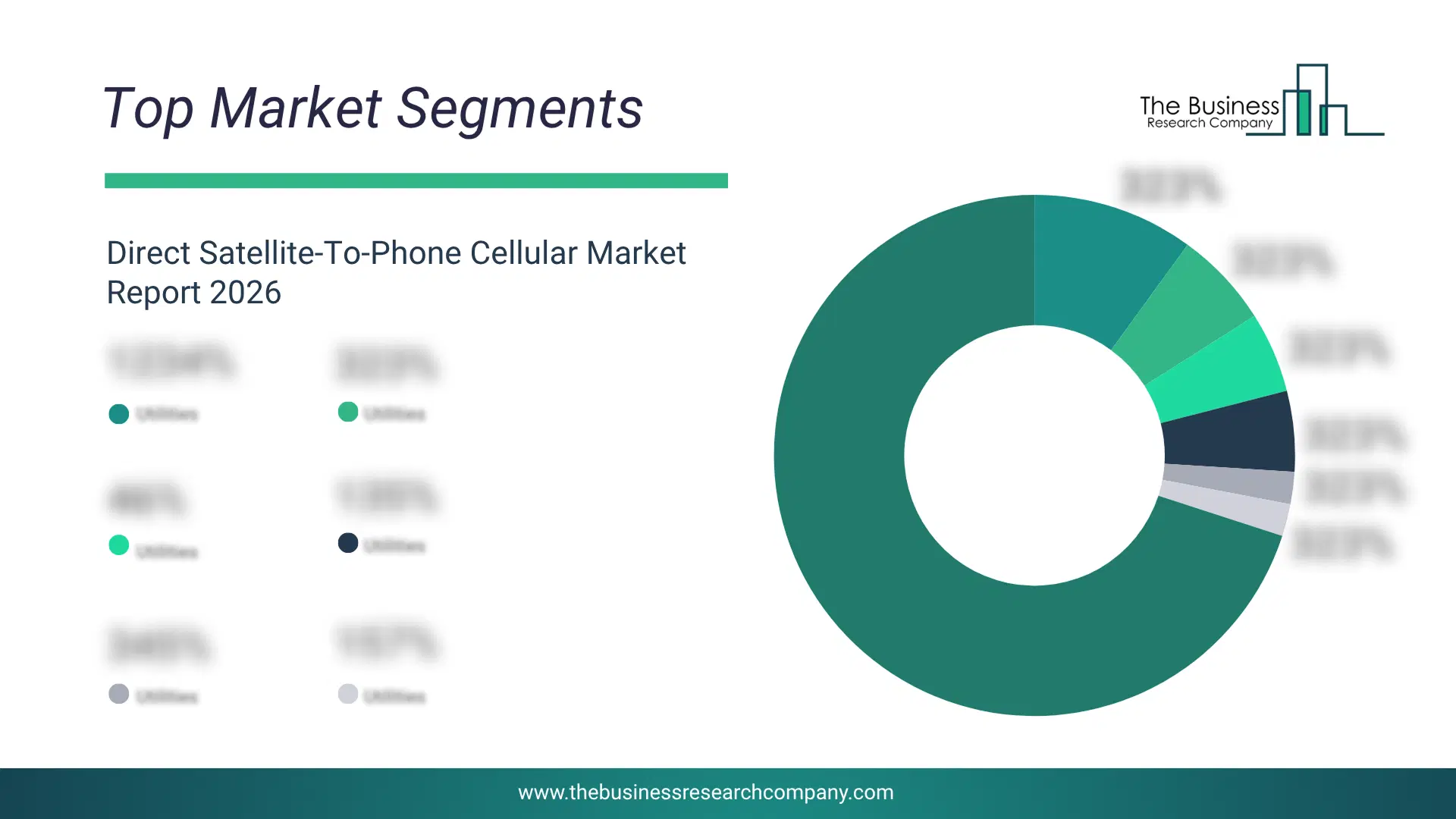
1) By Type: Consumer Services, Fixed Satellite Services, Mobile Satellite Services, Earth Observation Services 2) By Connectivity Type: Two-Way Communication, One-Way Communication 3) By End-User Industry: Media And Entertainment, Government, Defense, Aerospace, Retail And Enterprise, Other End User Industries Subsegments: 1) By Consumer Services: Voice Communication, Data Communication, Messaging Services, Internet Access 2) By Fixed Satellite Services: Broadcast Television, Satellite Radio, Satellite Internet, Telemetry And Control 3) By Mobile Satellite Services: Satellite Voice Services, Satellite Data Services, Satellite Messaging Services, Emergency Communication Services 4) By Earth Observation Services: Weather Monitoring, Environmental Monitoring, Disaster Management, Resource Management The top segments in the direct satellite-to-phone cellular market will be: • Two-Way Communication will reach $2573.27 Million by 2025. • Consumer Services will reach $1726.08 Million by 2025. • Individual will reach $1218.09 Million by 2025. • Mobile Satellite Services will reach $926.78 Million by 2025. • Defense will reach $497.41 Million by 2025.What Is The Driver Of The Direct Satellite-To-Phone Cellular Market?
The growing demand for seamless global connectivity is expected to propel the growth of the direct satellite-to-phone cellular market going forward. Connectivity refers to the ability of devices, systems, or networks to establish and maintain communication or data exchange with one another. The demand for seamless global connectivity is increasing as mobile broadband subscriptions continue to rise worldwide, driven by consumers’ reliance on continuous connectivity for digital communication and services. Direct satellite-to-phone cellular enables seamless global connectivity by delivering network coverage in remote, maritime, and disaster-affected regions where terrestrial networks are lacking. For instance, in March 2025, according to GSMA, a UK-based non-profit trade association, the number of unique mobile subscribers, currently at 5.8 billion with a 71% penetration rate, is expected to rise to 6.5 billion by 2030. Therefore, the growing demand for seamless global connectivity is driving the growth of the direct satellite-to-phone cellular industry.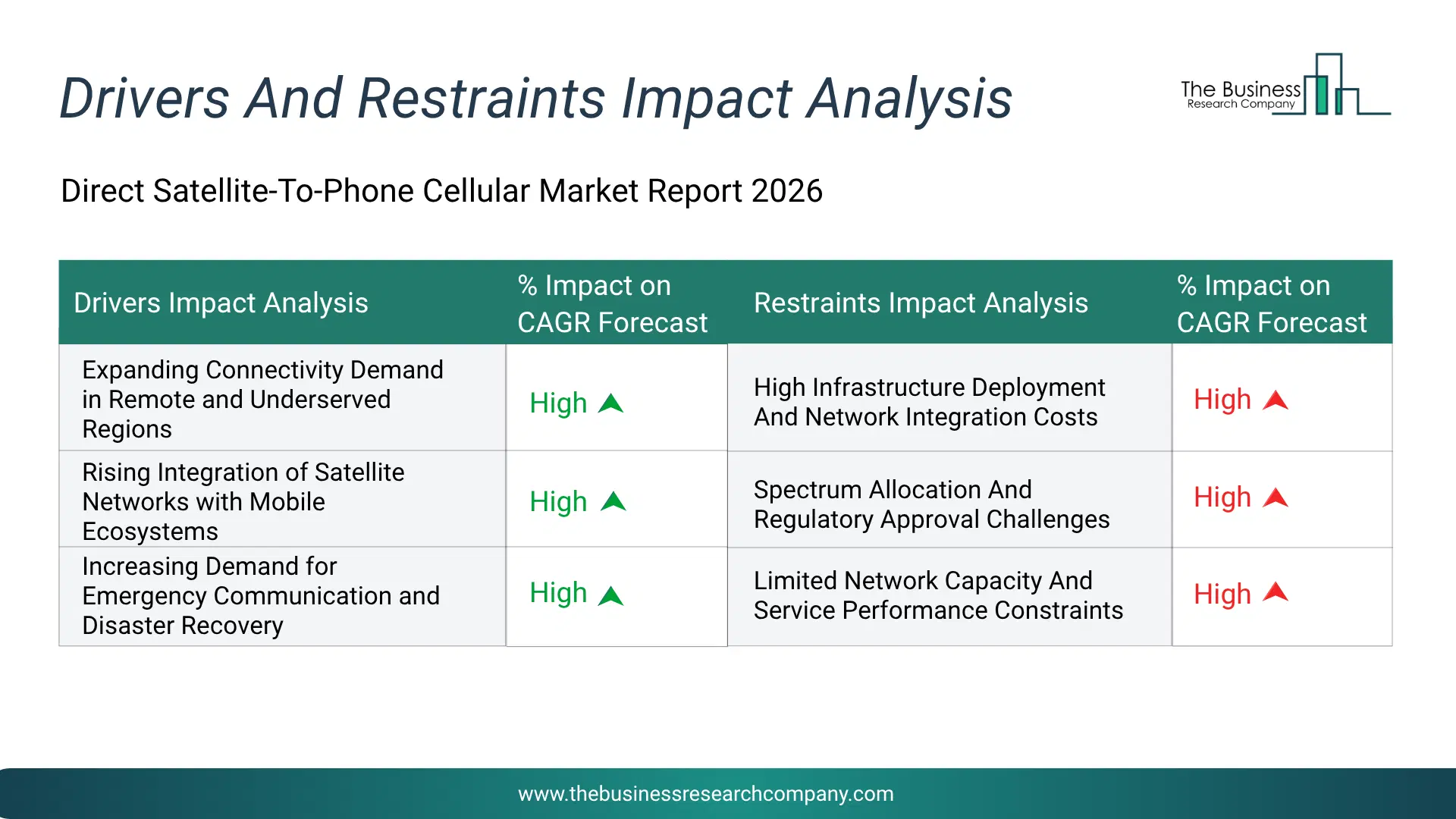
Infographic Chart Showing Key Market Drivers Analysis And Restraints For Direct Satellite-To-Phone Cellular Market
The chart presents an impact analysis of key drivers and restraints, quantifying their relative influence on the market's growth rate and helping assess the balance between growth enablers and limiting factors. This chart offers a high-level perspective; the full report contains more detailed insights.
How Will The Drivers Impact Growth In The Global Direct Satellite-To-Phone Cellular Market?
• Integration Of Satellite With 5G Non-Terrestrial Networks (NTN) (High) – The integration of satellite with 5g non-terrestrial networks (NTN) will become a key driver of growth in the direct satellite-to-phone cellular market by 2029. The integration of satellites with 5G Non-Terrestrial Networks enables seamless connectivity between terrestrial mobile systems and orbiting infrastructure. This convergence allows direct communication between standard mobile devices and satellites using compatible spectrum and protocols. It improves network continuity in areas where ground-based towers are unavailable or overloaded. Advances in 5G standards supporting NTN make it technically feasible to extend coverage globally without major changes to user devices. This interoperability reduces dependency on traditional infrastructure while enhancing scalability. As a result, the integration of satellite with 5g non-terrestrial networks (NTN) is anticipated to contributing to an annual growth in the market. • Rising Need For Satellite Connectivity In Border And Surveillance Regions (Medium) – The rising need for satellite connectivity in border and surveillance regions will emerge as a major factor driving the expansion of the direct satellite-to-phone cellular market by 2029. Border and surveillance regions often lack reliable terrestrial communication due to difficult terrain, sparse population, or strategic restrictions. Satellite-based direct connectivity ensures uninterrupted communication for defense forces, patrol units and monitoring systems operating in such zones. It supports real-time data exchange, situational awareness and coordination in remote or high-risk environments. Traditional networks may not be feasible to deploy or maintain in these areas due to cost and security concerns. Satellite-to-phone links provide a flexible and resilient alternative that enhances operational efficiency. Consequently, the rising need for satellite connectivity in border and surveillance regions is projected to contributing to an annual growth in the market. • Growing Requirement For Emergency SOS And Safety Communication (High) – The growing requirement for emergency SOS and safety communication will serve as a key growth catalyst for the direct satellite-to-phone cellular market by 2029. Emergency situations such as natural disasters, accidents, or remote expeditions require instant communication even when terrestrial networks fail. Direct satellite connectivity enables users to send SOS alerts and share location data without relying on ground infrastructure. This capability is especially valuable in remote, rural, maritime and mountainous areas where coverage gaps exist. Increasing awareness about personal safety and regulatory emphasis on emergency preparedness are encouraging adoption of such features in mobile devices. Integration of satellite-based emergency messaging improves response times for rescue teams. Therefore, this growing requirement for emergency SOS and safety communication is projected to supporting to an annual growth in the market. • Growth In Government Initiatives For Digital Inclusion (Medium) – The growth in government initiatives for digital inclusion will become a significant driver contributing to the growth of the direct satellite-to-phone cellular market by 2029. Governments worldwide are prioritizing digital inclusion to ensure connectivity reaches underserved and rural populations. Satellite-to-phone technology supports this objective by providing coverage in areas where deploying terrestrial networks is economically or geographically challenging. Public programs aimed at bridging the digital divide are increasingly considering satellite solutions as part of national connectivity strategies. These initiatives help enable access to communication, education, healthcare and financial services in remote communities. Policy support, spectrum allocation and regulatory frameworks are evolving to facilitate wider adoption of non-terrestrial communication systems. Consequently, the growth in government initiatives for digital inclusion is projected to contributing to an annual growth in the market.How Will The Restraints Impact Growth In The Global Direct Satellite-To-Phone Cellular Market?
• Regulatory Hurdles (High) – Regulatory hurdles is expected to restrain market growth during the forecast period. It creates operational, financial, regulatory, or commercial challenges that can increase costs, delay projects, reduce investments, or discourage purchasing decisions depending on the market. These challenges can reduce product adoption, affect business confidence, and limit the ability of companies to expand efficiently across key regions. This can reduce operational efficiency, delay expansion plans, and affect the ability of companies to achieve sustainable business growth. • Limited Data Bandwidth (Medium) – During the forecast period, limited data bandwidth is likely to limit market expansion. It creates operational, financial, regulatory, or commercial challenges that can increase costs, delay projects, reduce investments, or discourage purchasing decisions depending on the market. These challenges can reduce product adoption, affect business confidence, and limit the ability of companies to expand efficiently across key regions. As a result, businesses may face increased cost pressures, slower commercial adoption, and reduced revenue opportunities. • Impact Of Trade War And Tariff (High) – The market is expected to face challenges due to impact of trade war and tariff over the forecast period. It creates operational, financial, regulatory, or commercial challenges that can increase costs, delay projects, reduce investments, or discourage purchasing decisions depending on the market. These challenges can reduce product adoption, affect business confidence, and limit the ability of companies to expand efficiently across key regions. This may discourage new investments, delay strategic expansion initiatives, and weaken the overall competitive position of market participants.Key Players In The Global Direct Satellite-To-Phone Cellular Market
Major companies operating in the direct satellite-to-phone cellular market are Verizon Communications Inc., AT&T Inc., T Mobile US Inc., Qualcomm Incorporated, Telstra Corporation Limited, Rogers Communications Inc., Vodafone Group Plc., Viasat Inc., SES S.A., Iridium Communications Inc., Inmarsat Plc., Hughes Network Systems LLC, Globalstar Inc., Starlink, Skylo Technologies, Lynk Global Inc., AST SpaceMobile Inc., OQ Technology, OneWeb Technologies Inc., Connecta Satellite Solutions LLC.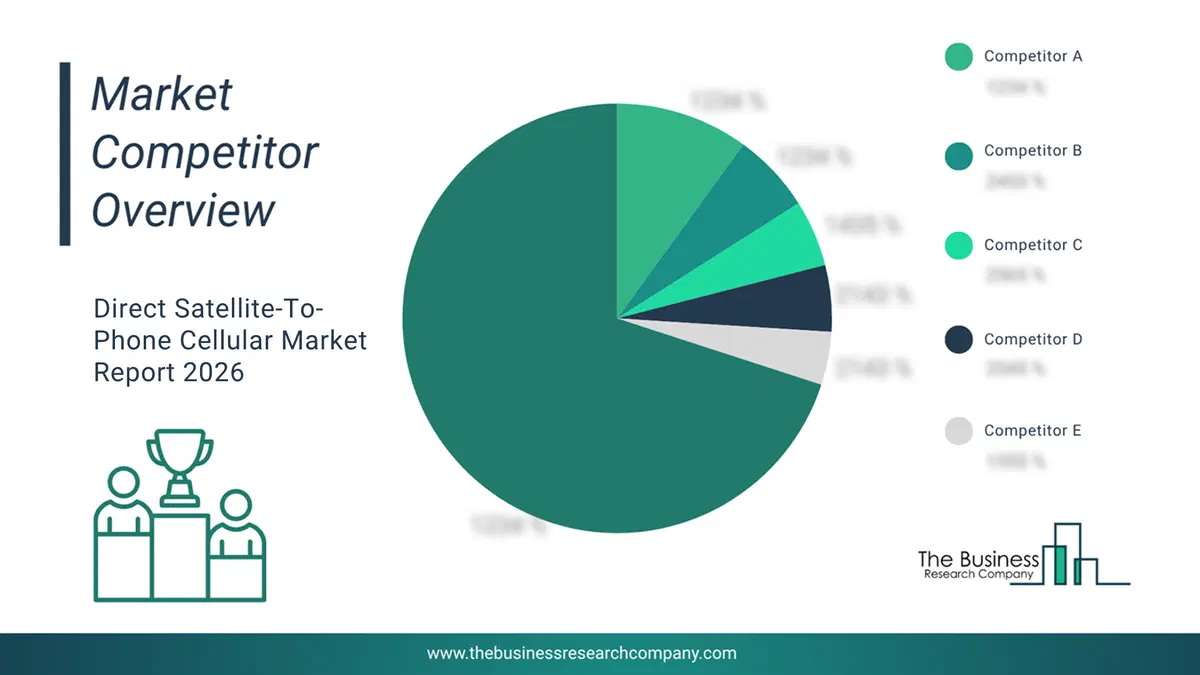
This chart is for illustrative purposes; the full report includes a detailed competitor analysis and comprehensive overview of the top 10 companies in the market.
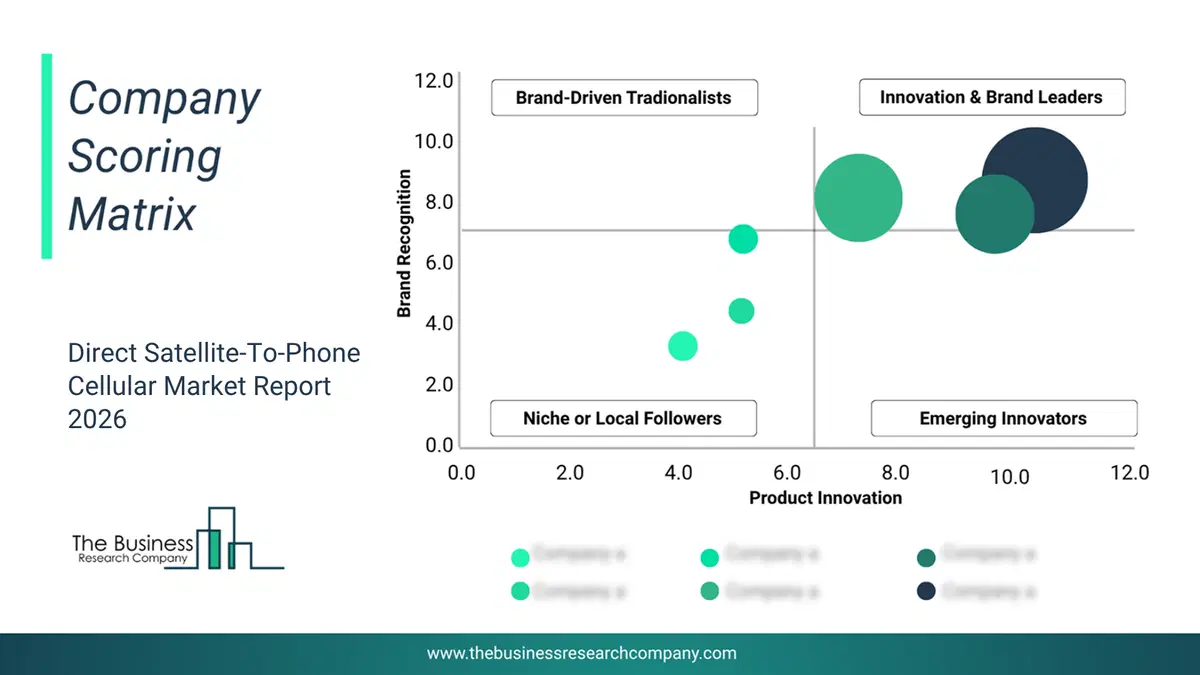
This chart maps companies by product innovation and brand strength, with bubble size indicating relative revenue, helping identify market leaders, challengers, and niche players. This is an illustrative chart; the full report provides a complete and accurate competitive analysis.
Global Direct Satellite-To-Phone Cellular Market Trends and Insights
Major companies operating in the direct satellite-to-phone cellular market are focusing on developing direct-to-device (D2D) satellite links to gain a competitive advantage in the market. D2D allows standard mobile phones to connect directly to satellites without intermediate ground infrastructure, extending coverage into remote or underserved regions. For instance, in October 2025, T-Mobile, a US-based wireless communications company, introduced T-Satellite via Starlink, enabling texting and app data over Starlink’s satellite-based LTE links on existing phones. That service features seamless fallback between terrestrial and satellite networks and functions without hardware changes. The strengths include expanded reach, network redundancy, and improved emergency resilience; limitations include lower data throughput, spectral regulatory constraints, and increased latency in obstructed environments.What Are Latest Mergers And Acquisitions In The Direct Satellite-To-Phone Cellular Market?
In March 2025, Vodafone Group Plc, a UK-based provider of mobile telecommunications, broadband, and digital services, partnered with AST SpaceMobile Inc. to support mobile network operators (MNOs) in all European markets. This partnership aims to create a European direct-to-device satellite service provider, enabling mobile network operators to offer space-based cellular broadband connectivity directly to everyday unmodified smartphones. AST SpaceMobile Inc. is a US-based provider of space-based cellular broadband services designed to connect standard mobile phones directly to satellites without the need for terrestrial network infrastructure.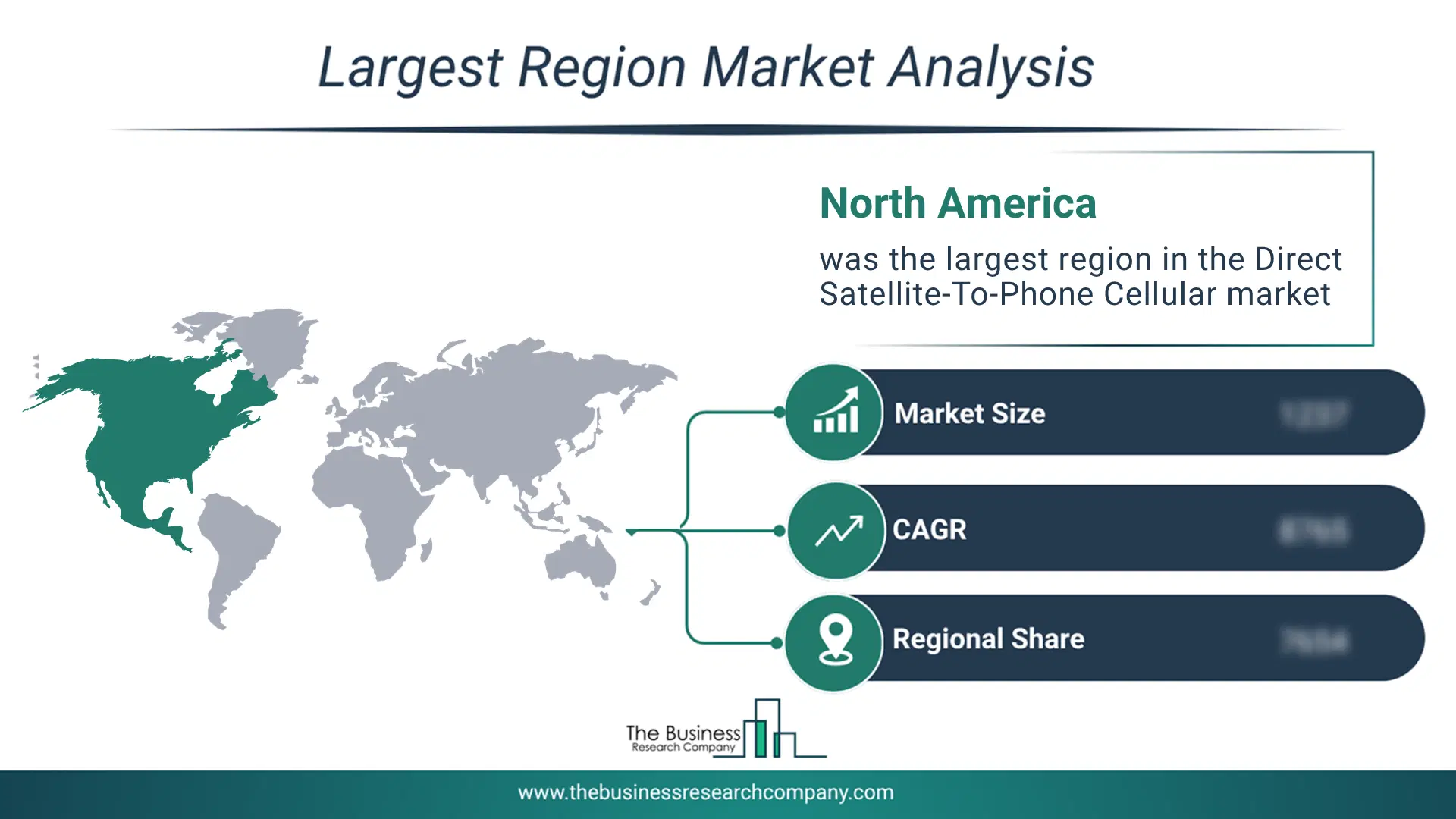
Regional Insights
North America was the largest region in the direct satellite-to-phone cellular market in 2025. Asia-Pacific is expected to be the fastest-growing region in the forecast period. The regions covered in this market report are Asia-Pacific, South East Asia, Western Europe, Eastern Europe, North America, South America, Middle East, Africa. The countries covered in this market report are Australia, Brazil, China, France, Germany, India, Indonesia, Japan, Taiwan, Russia, South Korea, UK, USA, Canada, Italy, Spain.What Defines the Direct Satellite-To-Phone Cellular Market?
The direct satellite-to-phone cellular market consists of revenues earned by entities by providing services such as emergency communication services, rural and remote area mobile connectivity, global satellite voice and data services, internet of things (IoT) satellite solutions, and subscription-based satellite phone services. The market value includes the value of related goods sold by the service provider or included within the service offering. Only goods and services traded between entities or sold to end consumers are included.How is Market Value Defined and Measured?
The market value is defined as the revenues that enterprises gain from the sale of goods and/or services within the specified market and geography through sales, grants, or donations in terms of the currency (in USD unless otherwise specified). The revenues for a specified geography are consumption values that are revenues generated by organizations in the specified geography within the market, irrespective of where they are produced. It does not include revenues from resales along the supply chain, either further along the supply chain or as part of other products.
This chart presents market attractiveness based on a quantitative evaluation of growth, competition, strategic alignment, and risk, offering a clear view of opportunity areas for decision-making. This chart is for illustrative purposes; the full report contains the complete analysis.

This chart highlights the Total Addressable Market (TAM) by estimating the maximum revenue opportunity using an assumption-driven approach, supporting strategic planning and opportunity sizing across markets. The chart is illustrative; the full report provides a more comprehensive analysis.
What Key Data and Analysis Are Included in the Direct Satellite-To-Phone Cellular Market Report 2026?
The direct satellite-to-phone cellular market research report is one of a series of new reports from The Business Research Company that provides market statistics, including industry global market size, regional shares, competitors with the market share, detailed market segments, market trends and opportunities, and any further data you may need to thrive in the direct satellite-to-phone cellular industry. The market research report delivers a complete perspective of everything you need, with an in-depth analysis of the current and future state of the industry.Direct Satellite-To-Phone Cellular Market Report Forecast Analysis
| Report Attribute | Details |
|---|---|
| Market Size Value In 2026 | $5 billion |
| Revenue Forecast In 2035 | $17.62 billion |
| Growth Rate | CAGR of 37.3% from 2026 to 2035 |
| Base Year For Estimation | 2025 |
| Actual Estimates/Historical Data | 2020-2025 |
| Forecast Period | 2026 - 2030 - 2035 |
| Market Representation | Revenue in USD Billion and CAGR from 2026 to 2035 |
| Segments Covered | Type, Connectivity Type, End-User Industry |
| Regional Scope | Asia-Pacific, Western Europe, Eastern Europe, North America, South America, Middle East, Africa |
| Country Scope | The countries covered in the report are Australia, Brazil, China, France, Germany, India, ... |
| Key Companies Profiled | Verizon Communications Inc., AT&T Inc., T Mobile US Inc., Qualcomm Incorporated, Telstra Corporation Limited, Rogers Communications Inc., Vodafone Group Plc., Viasat Inc., SES S.A., Iridium Communications Inc., Inmarsat Plc., Hughes Network Systems LLC, Globalstar Inc., Starlink, Skylo Technologies, Lynk Global Inc., AST SpaceMobile Inc., OQ Technology, OneWeb Technologies Inc., Connecta Satellite Solutions LLC. |
| Customization Scope | Request for Customization |
| Pricing And Purchase Options | Explore Purchase Options |