
Dispersing Agents Market Report 2026
Global Outlook – By Product Type (Suspension, Solution, Colloid, Powder, Other Product Type), By Formation Type (Waterborne, Oil-Borne, Solvent-Borne), By End-User Industry (Paints And Coatings, Oil And Gas, Construction, Pulp And Paper, Textile, Other End-User Industries) – Market Size, Trends, Strategies, and Forecast to 2030
Dispersing Agents Market Overview
• Dispersing Agents market size has reached to $7.7 billion in 2025 • Expected to grow to $10.99 billion in 2030 at a compound annual growth rate (CAGR) of 7.2% • Growth Driver: Rising Oil Drilling And Exploration Activities Propel The Dispersing Agent Market • Market Trend: Driving Innovation in Dispersion with Solvent-Based Agents • Asia-Pacific was the largest region in 2025 and Asia-Pacific is the fastest growing region.What Is Covered Under Dispersing Agents Market?
The dispersing agents refer to chemicals containing surfactants and solvent components that break petroleum oil into tiny droplets. These compounds make colors with extremely low solubilities that dissolve steadily in water. The main product types of dispersing agents are suspension, solution, colloid, powder, and other product types. Suspension refers to a heterogeneous combination of solid particles dispersed throughout the liquid without dissolving. The foam type includes waterborne, oil borne, and solvent borne. The various end industries involve paints and coatings, oil and gas, construction, pulp and paper, textiles, and other end-user industries.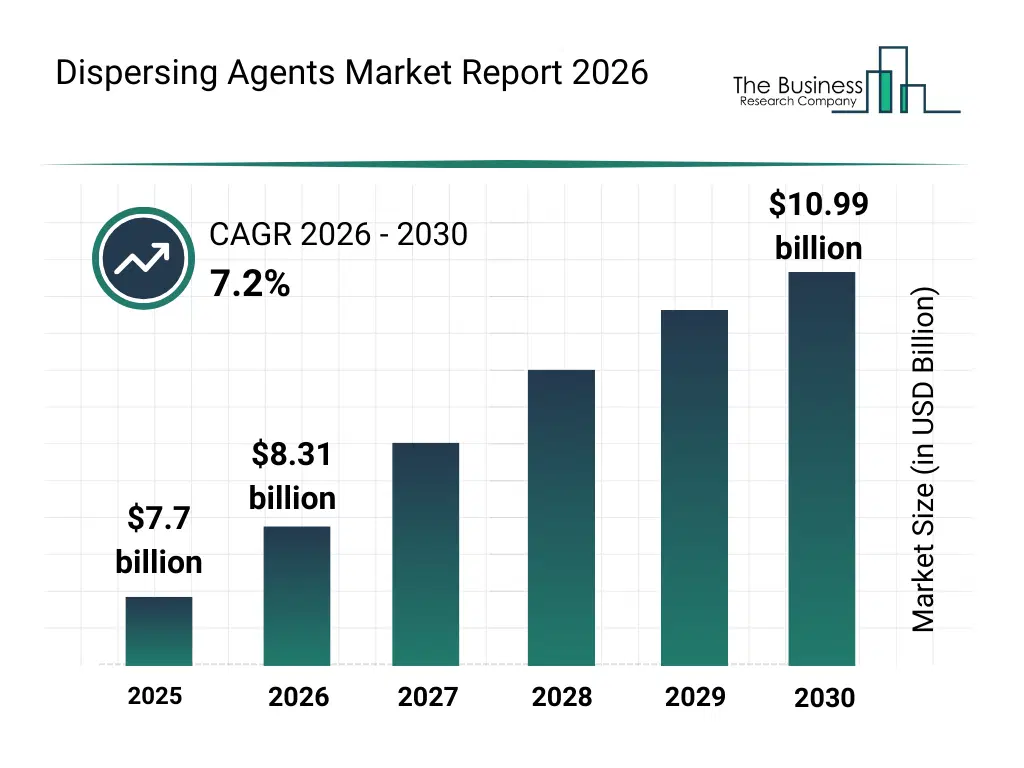
What Is The Dispersing Agents Market Size and Share 2026?
The dispersing agents market size has grown strongly in recent years. It will grow from $7.7 billion in 2025 to $8.31 billion in 2026 at a compound annual growth rate (CAGR) of 7.9%. The growth in the historic period can be attributed to expansion of coatings and construction industries, increasing use of pigments and fillers, availability of surfactant-based dispersants, growth of industrial formulations, scale-up of chemical processing capacities.What Is The Dispersing Agents Market Growth Forecast?
The dispersing agents market size is expected to see strong growth in the next few years. It will grow to $10.99 billion in 2030 at a compound annual growth rate (CAGR) of 7.2%. The growth in the forecast period can be attributed to increasing demand for eco-friendly dispersing agents, rising adoption of high-solids formulations, expansion of specialty coatings applications, growing focus on dispersion efficiency, increasing use in advanced material systems. Major trends in the forecast period include increasing use of advanced dispersion technologies, rising demand for waterborne formulations, growing adoption in paints and coatings, expansion of high-performance pigment dispersions, enhanced focus on stability and shelf life.
Global Dispersing Agents Market Segmentation
1) By Product Type: Suspension, Solution, Colloid, Powder, Other Product Type 2) By Formation Type: Waterborne, Oil-Borne, Solvent-Borne 3) By End-User Industry: Paints And Coatings, Oil And Gas, Construction, Pulp And Paper, Textile, Other End-User Industries Subsegments: 1) By Suspension: Aqueous Suspensions, Non-Aqueous Suspensions 2) By Solution: Aqueous Solutions, Solvent-Based Solutions 3) By Colloid: Colloidal Silica, Colloidal Carbon 4) By Powder: Dry Powder Dispersants, Granular Dispersants 5) By Other Product Type: Emulsions, Liquid DispersantsWhat Is The Driver Of The Dispersing Agents Market?
Increasing oil drilling and exploration activities are expected to drive the dispersing agent market. Oil drilling refers to boring a hole using a drill bit to produce oil and natural gas. Exploration activities refer to the procedures and techniques used to identify potential locations for drilling and extracting oil and gas. Dispersing agents such as an oil dispersant are a mixture of emulsifiers and solvents that are used to break oil into small droplets following an oil spill and destroy oil slicks on the water surface and stop the prevalent winds from moving them to reduce greenhouse gas emissions and achieve other goals. For instance, in January 2023, according to the U.S. Energy Information Administration (EIA), a US-based governmental agency, in January 2023, it was projected that U.S. crude oil production would average 12.4 million barrels per day (b/d) in 2023, increasing to 12.8 million b/d in 2024, reflecting a growth of 3.2% year-over-year. Therefore, increasing oil drilling and exploration activities are driving the dispersing agent industry.Key Players In The Global Dispersing Agents Market
Major companies operating in the dispersing agents market are BASF SE, Clariant AG, Altana AG, Arkema Group, Ashland Inc., Croda International PLC., Emerald Performance Materials, Solvay SA, Elementis PLC., Evonik Industries AG, Gruppo Chimico Dalton SpA, King Industries Inc., Cera-Chem Pvt. Ltd., CHRYSO SAS, Rudolf GmbH, Dow Inc., Akzo Nobel N.V., Lonza Group AG, Huntsman Corporation, DIC Corporation, Wacker Chemie AG, Kao Corporation, Buckman Laboratories International Inc., Milliken & Company, Michelman Inc., PCC SE, Harmony Additive Pvt. Ltd., Safic-Alcan Group, Shamrock Technologies Inc., Pulcra Chemicals
This chart is for illustrative purposes; the full report includes a detailed competitor analysis and comprehensive overview of the top 10 companies in the market.
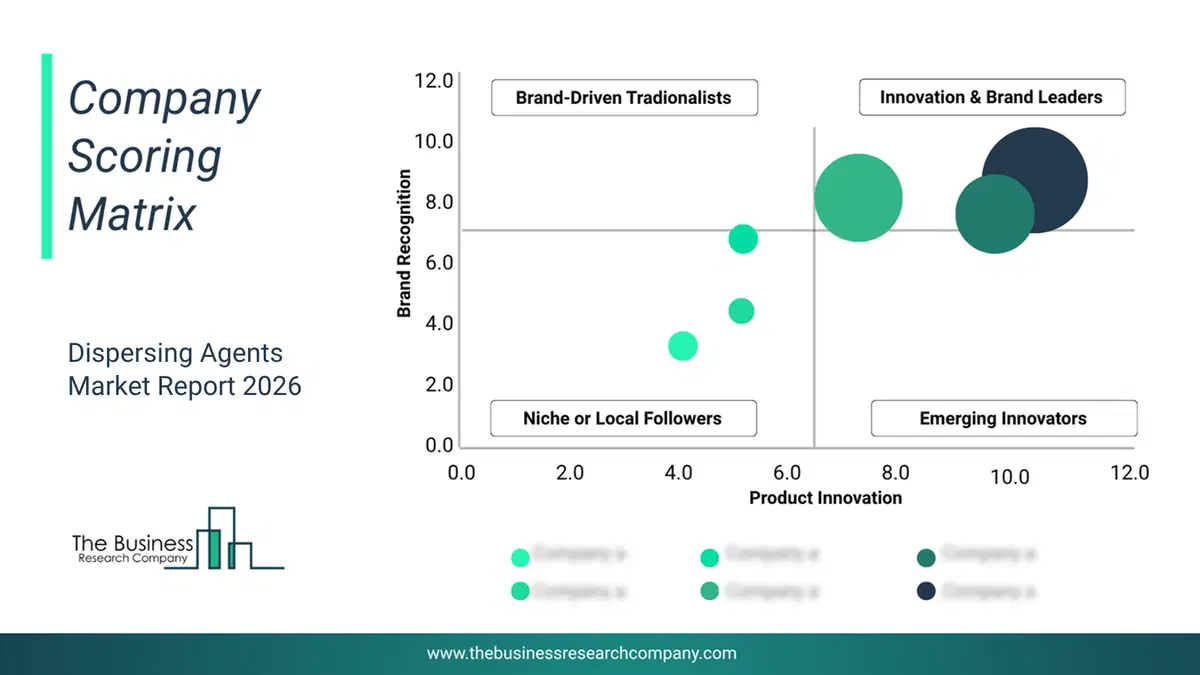
This chart maps companies by product innovation and brand strength, with bubble size indicating relative revenue, helping identify market leaders, challengers, and niche players. This is an illustrative chart; the full report provides a complete and accurate competitive analysis.
Global Dispersing Agents Market Trends and Insights
Major companies operating in the dispersing agent market are focusing on introducing innovative products such as solvent-based dispersing agents to enhance the stability and performance of their formulations. Solvent-based dispersing agents are substances used to enhance the dispersion of solid particles in a liquid medium, helping to stabilize suspensions and improve the uniformity of mixtures in various applications, including coatings, inks, and cosmetics. For instance, in April 2023, BASF, a Germany-based chemical company, introduced Efka PX 4360, a next-generation dispersing agent designed specifically for solvent-based industrial coatings. Utilizing BASF’s Controlled Free Radical Polymerization (CFRP) technology, this product offers superior performance, excellent compatibility with various pigment and coating systems, and is formulated for aromatic- and tin-free solutions.What Are Latest Mergers And Acquisitions In The Dispersing Agents Market?
In July 2024, Arclin, a US-based chemical company that focuses on providing advanced adhesive solutions and surface technologies, acquired RG Dispersants for an undisclosed amount. With the acquisition of RG Dispersants, Arclin aims to diversify its product offerings and expand its market presence in North America, enhancing its capabilities in sectors such as wallboard, specialty concrete, and agriculture while reinforcing its core chemical competencies and manufacturing expertise. RG Dispersants is a US-based chemical company focused on producing dispersants and surface-active products for various industrial applications.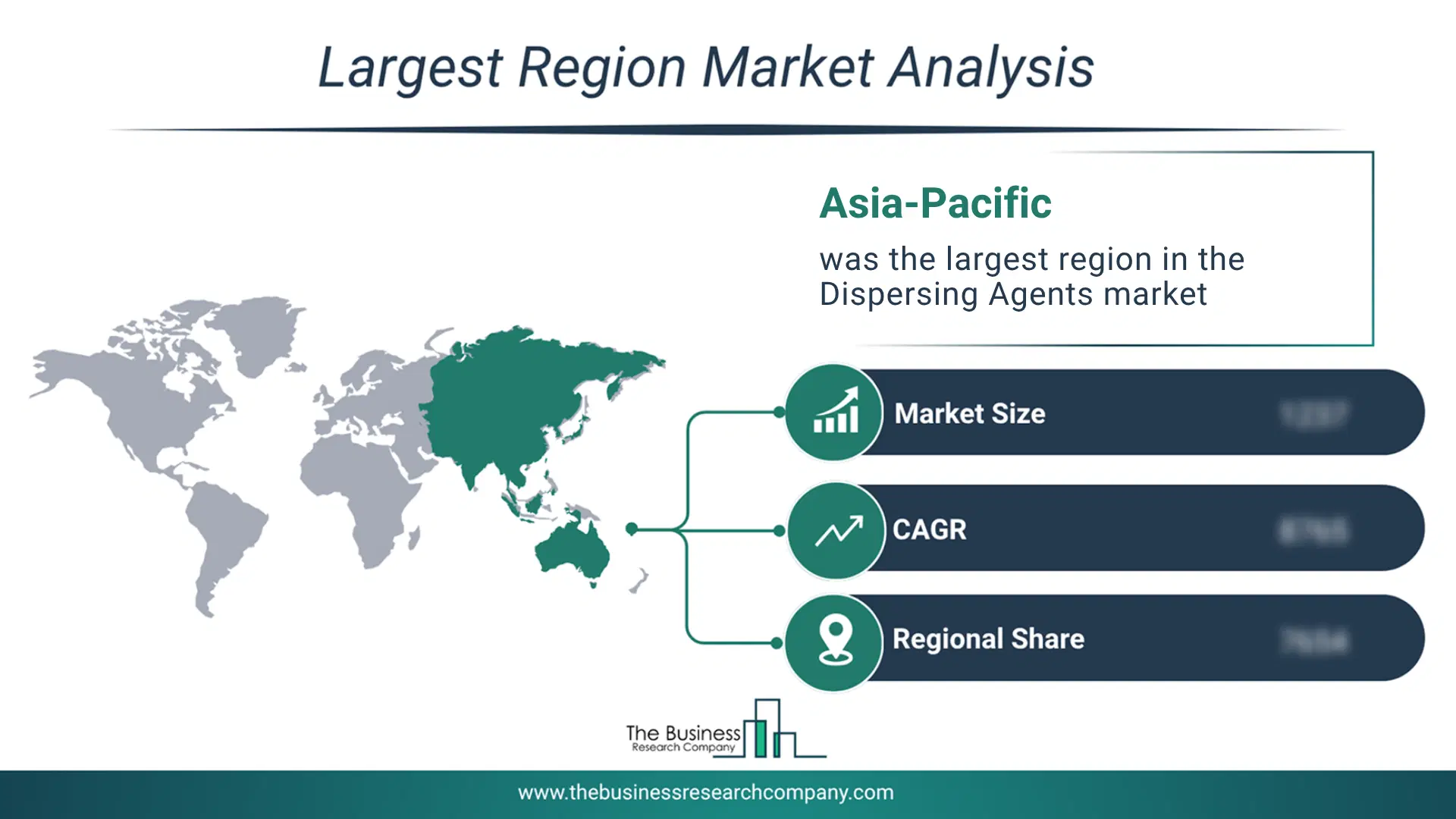
Regional Insights
Asia-Pacific was the largest region in the dispersing agent’s market in 2025. The regions covered in this market report are Asia-Pacific, South East Asia, Western Europe, Eastern Europe, North America, South America, Middle East, Africa The countries covered in this market report are Australia, Brazil, China, France, Germany, India, Indonesia, Japan, Taiwan, Russia, South Korea, UK, USA, Canada, Italy, SpainWhat Defines the Dispersing Agents Market?
The dispersing agents market consists of sales of cationic and non-ionic dispersing agents. Values in this market are ‘factory gate’ values, that is the value of goods sold by the manufacturers or creators of the goods, whether to other entities (including downstream manufacturers, wholesalers, distributors and retailers) or directly to end customers. The value of goods in this market includes related services sold by the creators of the goods.How is Market Value Defined and Measured?
The market value is defined as the revenues that enterprises gain from the sale of goods and/or services within the specified market and geography through sales, grants, or donations in terms of the currency (in USD unless otherwise specified). The revenues for a specified geography are consumption values that are revenues generated by organizations in the specified geography within the market, irrespective of where they are produced. It does not include revenues from resales along the supply chain, either further along the supply chain or as part of other products.
This chart presents market attractiveness based on a quantitative evaluation of growth, competition, strategic alignment, and risk, offering a clear view of opportunity areas for decision-making. This chart is for illustrative purposes; the full report contains the complete analysis.

This chart highlights the Total Addressable Market (TAM) by estimating the maximum revenue opportunity using an assumption-driven approach, supporting strategic planning and opportunity sizing across markets. The chart is illustrative; the full report provides a more comprehensive analysis.
What Key Data and Analysis Are Included in the Dispersing Agents Market Report 2026?
The dispersing agents market research report is one of a series of new reports from The Business Research Company that provides market statistics, including industry global market size, regional shares, competitors with the market share, detailed market segments, market trends and opportunities, and any further data you may need to thrive in the dispersing agents industry. The market research report delivers a complete perspective of everything you need, with an in-depth analysis of the current and future state of the industry.Dispersing Agents Market Report Forecast Analysis
| Report Attribute | Details |
|---|---|
| Market Size Value In 2026 | $8.31 billion |
| Revenue Forecast In 2030 | $10.99 billion |
| Growth Rate | CAGR of 7.9% from 2026 to 2030 |
| Base Year For Estimation | 2025 |
| Actual Estimates/Historical Data | 2020-2025 |
| Forecast Period | 2026 - 2030 |
| Market Representation | Revenue in USD Billion and CAGR from 2026 to 2030 |
| Segments Covered | Product Type, Formation Type, End-User Industry |
| Regional Scope | Asia-Pacific, Western Europe, Eastern Europe, North America, South America, Middle East, Africa |
| Country Scope | The countries covered in this market report are Australia, Brazil, China, France, Germany, India, Indonesia, Japan, Taiwan, Russia, South Korea, UK, USA, Canada, Italy, Spain |
| Key Companies Profiled | BASF SE, Clariant AG, Altana AG, Arkema Group, Ashland Inc., Croda International PLC., Emerald Performance Materials, Solvay SA, Elementis PLC., Evonik Industries AG, Gruppo Chimico Dalton SpA, King Industries Inc., Cera-Chem Pvt. Ltd., CHRYSO SAS, Rudolf GmbH, Dow Inc., Akzo Nobel N.V., Lonza Group AG, Huntsman Corporation, DIC Corporation, Wacker Chemie AG, Kao Corporation, Buckman Laboratories International Inc., Milliken & Company, Michelman Inc., PCC SE, Harmony Additive Pvt. Ltd., Safic-Alcan Group, Shamrock Technologies Inc., Pulcra Chemicals |
| Customization Scope | Request for Customization |
| Pricing And Purchase Options | Explore Purchase Options |