
Pigment Dispersion Market Report 2026
Global Outlook – By Pigment Type (Organic Pigments, Inorganic Pigments), By Dispersion Type (Water-Based Dispersions, Solvent-Based Dispersions), By Industry Vertical (Paints and Coatings, Printing Inks, Plastics and Polymers, Automotive, Packaging, Construction Materials, Textiles and Leather, Paper and Pulp, Cosmetics and Personal Care, Food and Beverage) – Market Size, Trends, Strategies, and Forecast to 2030
Pigment Dispersion Market Overview
• Pigment Dispersion market size has reached to $45.18 billion in 2025 • Expected to grow to $64.54 billion in 2030 at a compound annual growth rate (CAGR) of 7.3% • Growth Driver: Rising Wood Demand Fuels Growth In The Pigment Dispersion Market • Market Trend: Expanding Advanced Solutions For Pigment Dispersion In Asia • Asia-Pacific was the largest region in 2025 and Middle East is the fastest growing region.Market Gains By 2030 – Top Opportunities By Segment
Market Gain identifies the most promising market opportunities by highlighting the segments or products expected to generate the highest incremental revenue growth over the next five years.
What Is Covered Under Pigment Dispersion Market?
The pigment dispersion are dry pigments dispersed in liquid material, which is stabilized using resins or surfactants/additives to minimize the formation of lumps. The process involves replacing air-solid interfaces within the dry powder with liquid-solid interfaces. They are generally used in additive quantities to impart color to a wide variety of products. The main types of pigment dispersion are organic pigments and inorganic pigments. Organic pigments are colored materials made of organic compounds with pigment properties. The various dispersion types are water-based dispersions and solvent-based dispersions and are employed in chemicals and petrochemicals, oil and gas, energy and power, automotive, food and beverages, healthcare, and other industry verticals.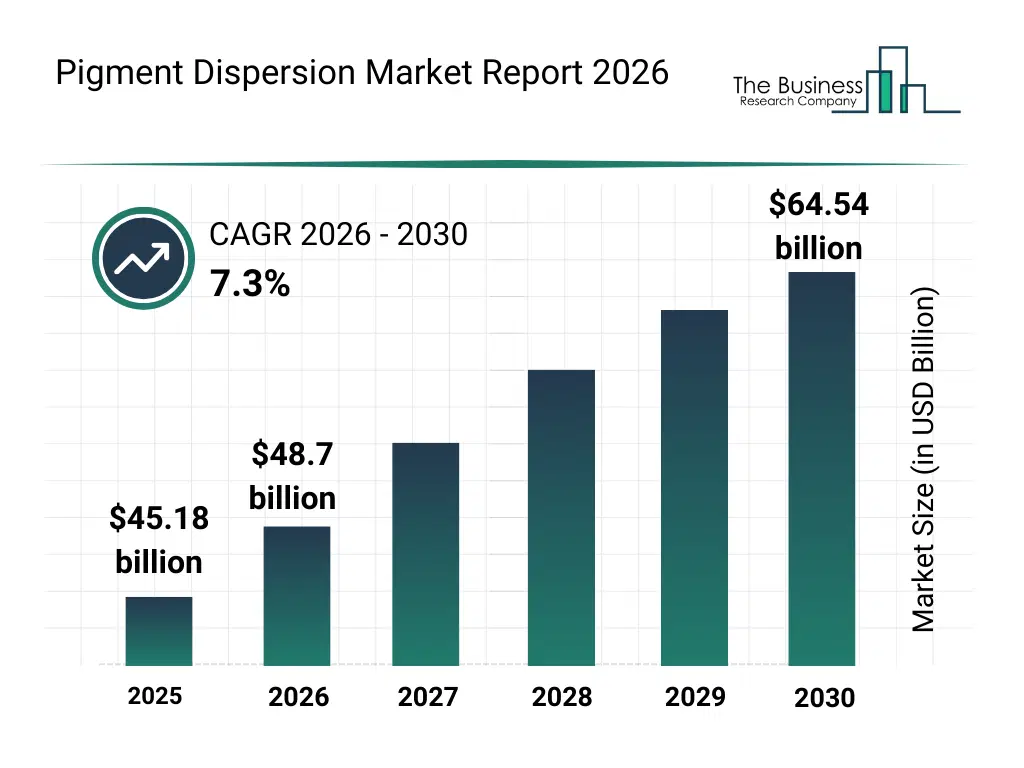
What Is The Pigment Dispersion Market Size and Share 2026?
The pigment dispersion market size has grown strongly in recent years. It will grow from $45.18 billion in 2025 to $48.7 billion in 2026 at a compound annual growth rate (CAGR) of 7.8%. The growth in the historic period can be attributed to expansion of paints and coatings industry, growth of plastic and polymer production, increasing use in printing inks, rising demand for color additives, availability of advanced dispersion technologies.What Is The Pigment Dispersion Market Growth Forecast?
The pigment dispersion market size is expected to see strong growth in the next few years. It will grow to $64.54 billion in 2030 at a compound annual growth rate (CAGR) of 7.3%. The growth in the forecast period can be attributed to increasing adoption of eco-friendly pigments, rising demand from automotive coatings, expansion of construction and infrastructure projects, growing focus on sustainable colorants, increasing use in specialty applications. Major trends in the forecast period include growing demand for high-stability pigment formulations, rising use in automotive and industrial coatings, expansion of water-based dispersions, increasing focus on color consistency and performance, enhanced use of additive manufacturing pigments.
Global Pigment Dispersion Market Segmentation
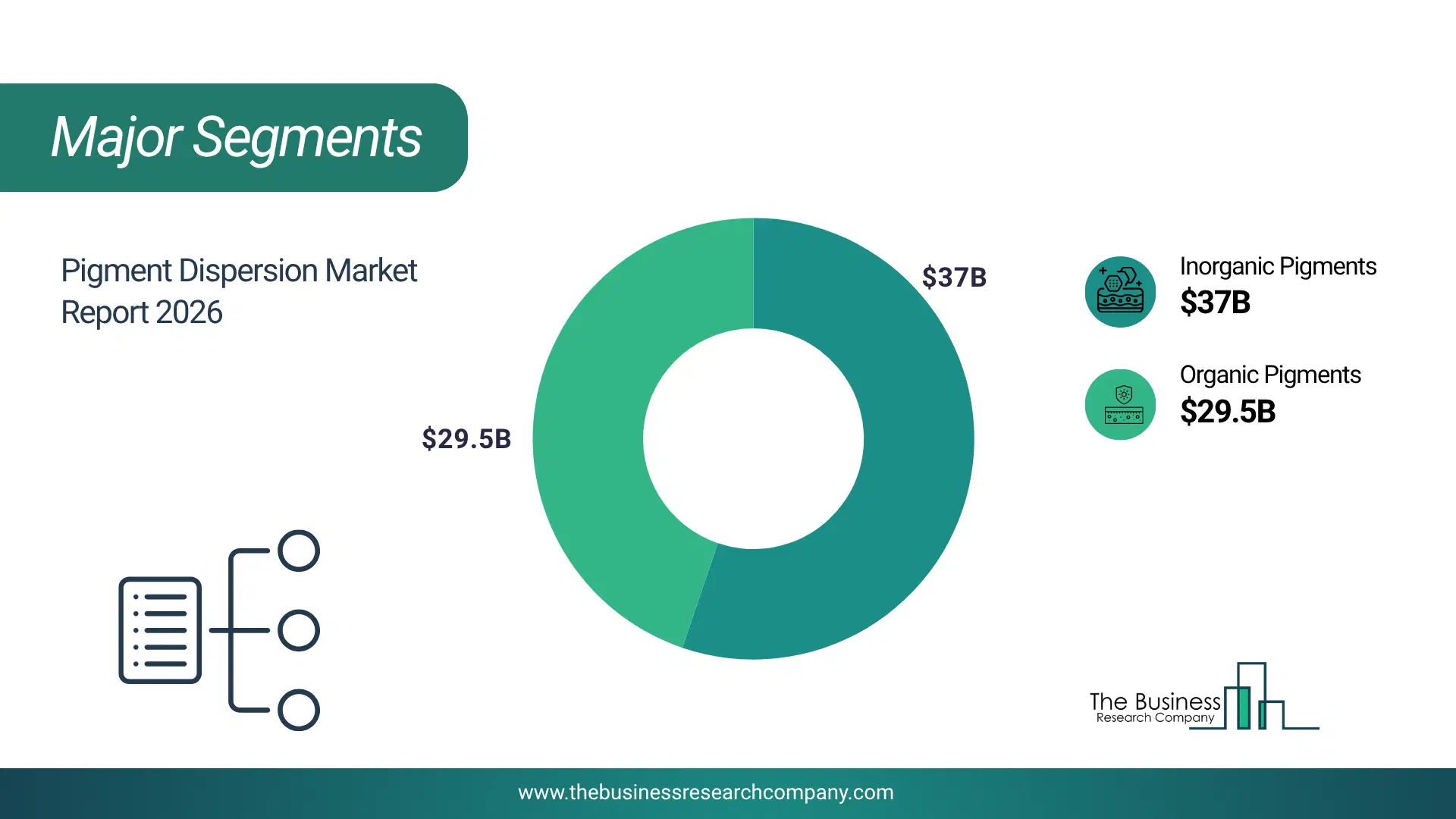
1) By Pigment Type: Organic Pigments, Inorganic Pigments 2) By Dispersion Type: Water-Based Dispersions, Solvent-Based Dispersions 3) By Industry Vertical: Paints and Coatings, Printing Inks, Plastics and Polymers, Automotive, Packaging, Construction Materials, Textiles and Leather, Paper and Pulp, Cosmetics and Personal Care, Food and Beverage Subsegments: 1) By Organic Pigments: Azo Pigments, Phthalocyanine Pigments, Anthraquinone Pigments, Quinacridone Pigments 2) By Inorganic Pigments: Titanium Dioxide (TiO2), Iron Oxide Pigments, Carbon Black, Chromium Oxide Pigments The top segments in the pigment dispersion market will be: • Inorganic Pigments will reach $36.99 billion by 2030. • Organic Pigments will reach $29.48 billion by 2030.What Is The Driver Of The Pigment Dispersion Market?
The growing demand for wood is expected to propel the growth of the pigment dispersion market going forward. Wood is a natural, organic material that forms the structural tissue of trees and woody plants and is widely used as a versatile material. Pigment dispersions are used to stain or color wood surfaces in furniture manufacturing and woodworking. For instance, in June 2024, according to the USDA Foreign Agricultural Service, a US-based Department of Agriculture agency, trade data shows that U.S. softwood lumber exports rose between November 2023 and March 2024, increasing 49 percent in value to $13 million and 86 percent in volume to 54,000 cubic meters. Therefore, growing demand for wood is driving the growth of the pigment dispersion industry.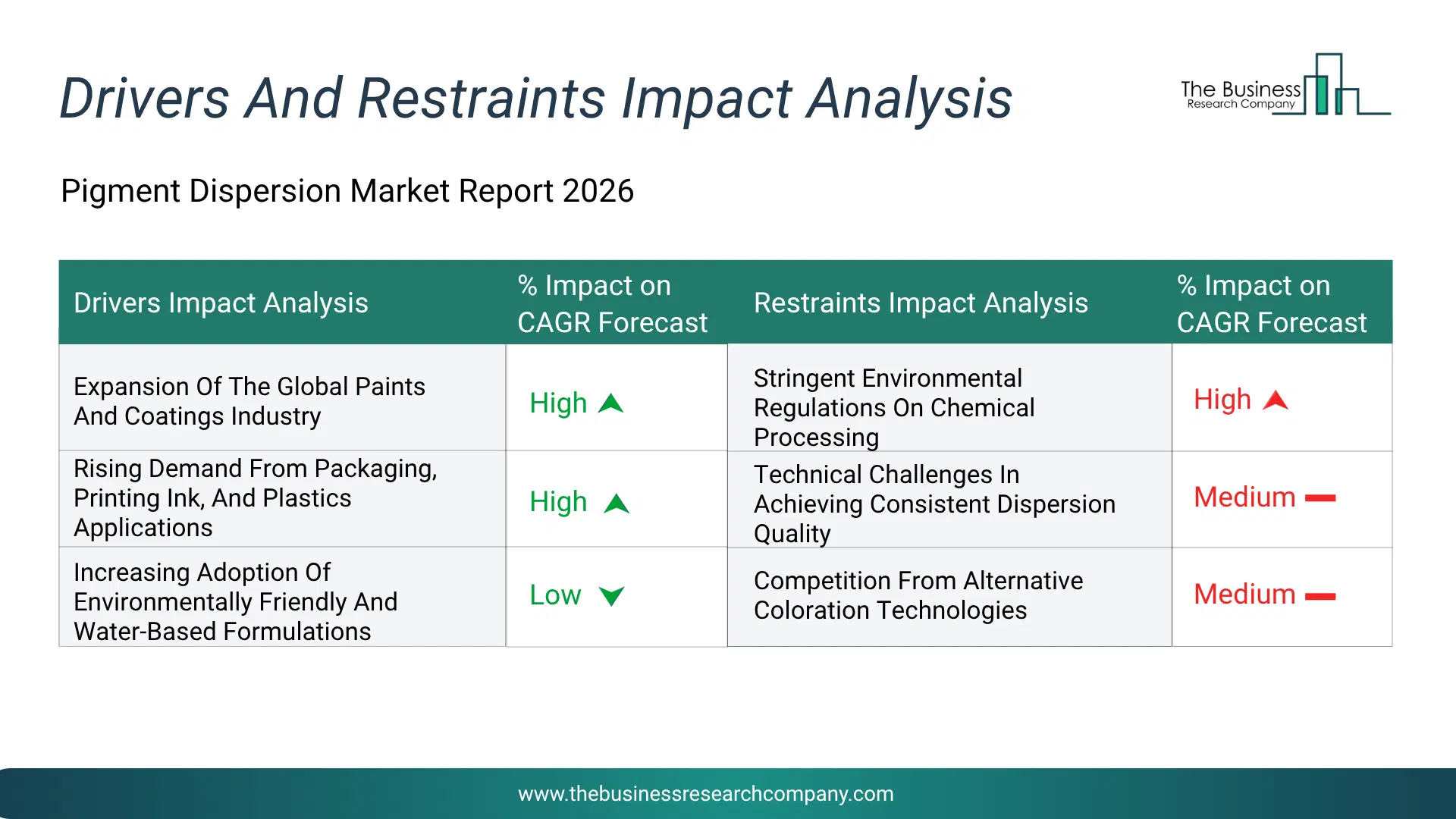
Infographic Chart Showing Key Market Drivers Analysis And Restraints For Pigment Dispersion Market
The chart presents an impact analysis of key drivers and restraints, quantifying their relative influence on the market's growth rate and helping assess the balance between growth enablers and limiting factors. This chart offers a high-level perspective; the full report contains more detailed insights.
How Will The Drivers Impact Growth In The Global Pigment Dispersion Market?
• Expansion Of The Global Paints And Coatings Industry (High) – During the forecast period, the expansion of the global paints and coatings industry is expected to become a key growth driver for the pigment dispersion market by 2030. Pigment dispersions play a critical role in achieving consistent color distribution, improved opacity, and enhanced stability in decorative and industrial coating formulations. Rising construction activities, infrastructure development, and increasing demand for automotive and protective coatings are significantly boosting the need for high -performance pigment dispersions. Manufacturers are therefore investing in advanced dispersion technologies that improve color strength, stability, and compatibility with modern coating systems. This continuous growth in coatings demand is reinforcing steady market expansion. • Rising Demand From Packaging, Printing Ink, And Plastics Applications (High) – During the forecast period, the rising demand from packaging, printing ink, and plastics applications is expected to emerge as a major factor driving the expansion of the pigment dispersion market by 2030. The growth of consumer goods, flexible packaging, and e-commerce packaging is increasing the need for high-quality colorants that provide vibrant appearance, durability, and consistency. Pigment dispersions are widely used in printing inks and plastic products to ensure uniform color distribution, processing stability, and enhanced visual appeal. Manufacturers are focusing on developing dispersions that offer higher pigment loading, improved compatibility with polymer systems, and faster color development. • Increasing Adoption Of Environmentally Friendly And Water-Based Formulations (Low) – During the forecast period, the increasing adoption of environmentally friendly and water-based formulations is expected to act as a key growth catalyst for the pigment dispersion market by 2030. Regulatory pressures on volatile organic compounds and hazardous substances are encouraging manufacturers to shift toward sustainable coatings and ink systems that rely on water-based pigment dispersions. These formulations offer lower environmental impact while maintaining strong color performance, stability, and application efficiency. Companies are therefore investing in advanced dispersant chemistries and eco-friendly pigment technologies to meet evolving environmental standards. As sustainable coatings and inks gain wider adoption across industries, demand for advanced pigment dispersions is expected to increase significantly.How Will The Restraints Impact Growth In The Global Pigment Dispersion Market?
• Stringent Environmental Regulations On Chemical Processing (High) – During the forecast period, the pigment dispersion manufacturing involves the use of solvents, additives, and specialty chemicals that are increasingly subject to environmental regulations. Governments worldwide are imposing stricter limits on emissions, hazardous substances, and waste disposal practices. Compliance often requires significant investments in cleaner production technologies and process modifications. These additional costs can reduce profitability and create barriers for smaller manufacturers. • Technical Challenges In Achieving Consistent Dispersion Quality (Medium) – During the forecast period, the maintaining uniform particle distribution and color consistency across different batches remains a significant challenge for manufacturers. Variations in raw materials, processing conditions, and formulation techniques can affect final product performance. Inconsistent quality may lead to customer dissatisfaction and increased production waste. These technical complexities increase operational costs and limit production efficiency. • Competition From Alternative Coloration Technologies (Medium) – During the forecast period, the advancements in alternative coloration technologies, including digital printing and advanced coating solutions, are reducing reliance on conventional pigment dispersions in certain applications. End users increasingly seek solutions that offer improved sustainability, performance, and process efficiency. This shift creates competitive pressure on pigment dispersion manufacturers. As a result, market growth may be constrained in specific end-use industries.Key Players In The Global Pigment Dispersion Market
Major companies operating in the pigment dispersion market are BASF SE, DIC Corporation, Clariant AG, Sudarshan Chemical Industries Ltd., Cabot Corporation, Heubach GmbH, Penn Color Inc., Chromaflo Technologies Corporation, Ferro Corporation, Flint Group, AArbor Colorants Corporation, American Element, Aralon Color GmbH, AUM Farbenchem Pvt. Ltd., DyStar Group, Pidilite Industries Ltd., Altana AG, Achitex Minerva S.p.A., Decorative Color & Chemical Inc., Trust Chem Co., Ltd., Kama Pigments, Organic Dyes and Pigments, Reitech Corporation, Toyo Ink SC Holdings Co., Ltd.,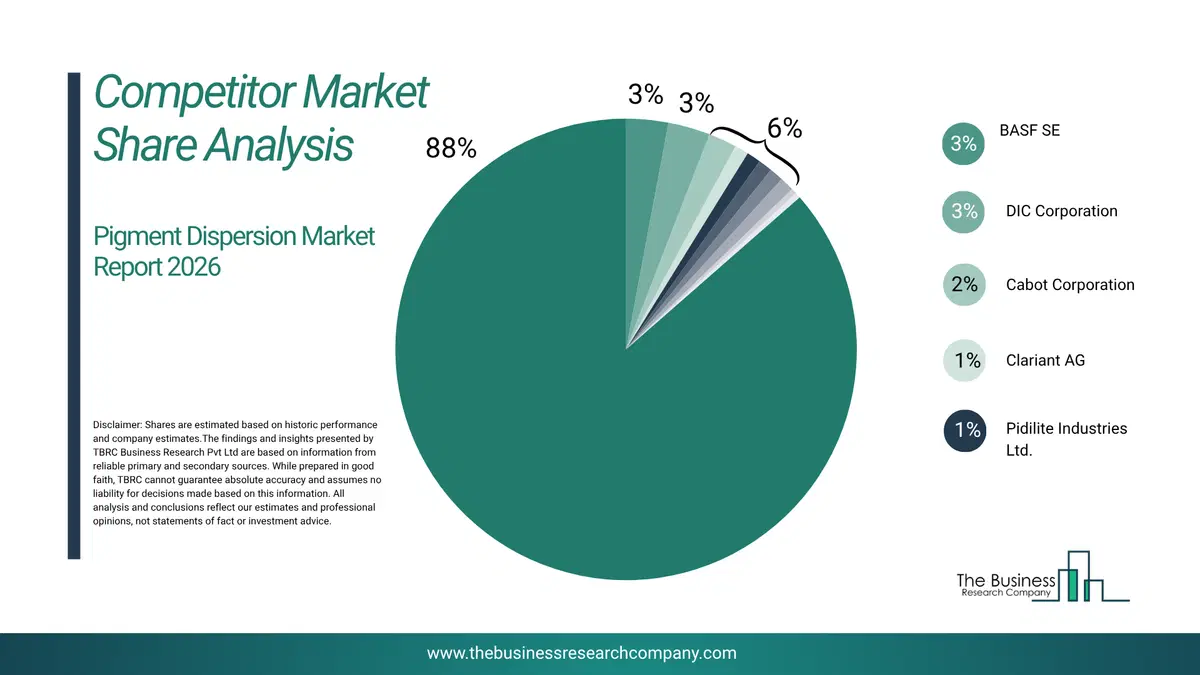
This chart is for illustrative purposes; the full report includes a detailed competitor analysis and comprehensive overview of the top 10 companies in the market.
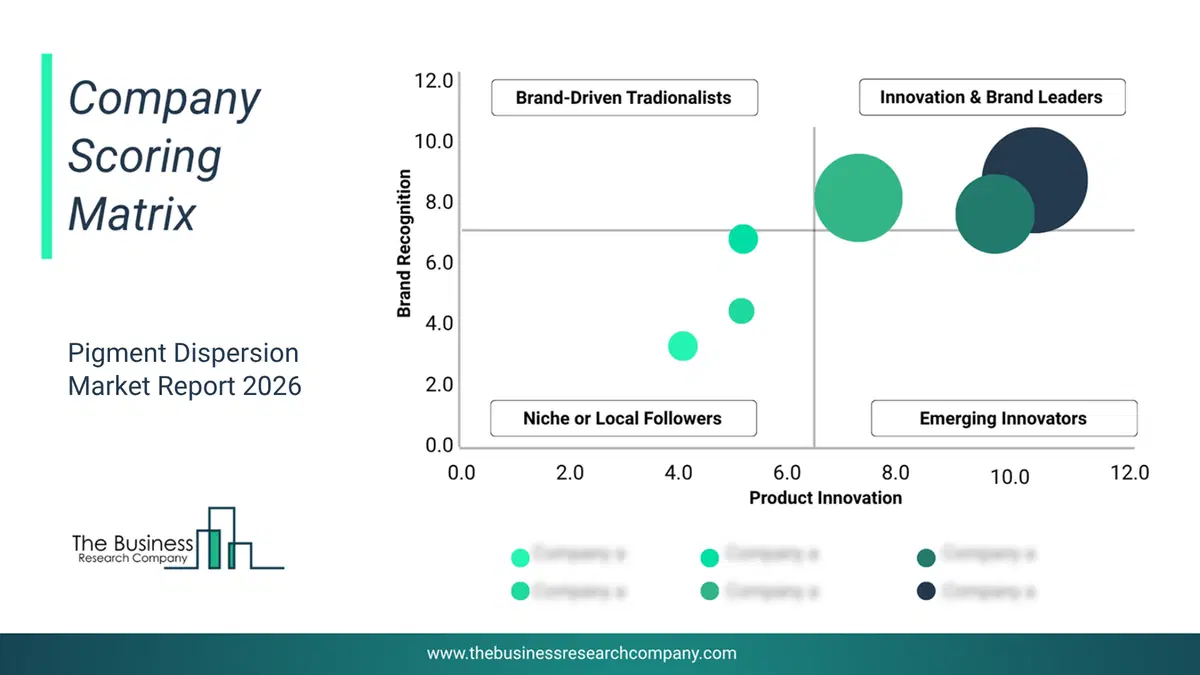
This chart maps companies by product innovation and brand strength, with bubble size indicating relative revenue, helping identify market leaders, challengers, and niche players. This is an illustrative chart; the full report provides a complete and accurate competitive analysis.
Global Pigment Dispersion Market Trends and Insights
Major companies operating in the pigment dispersion market are focusing on developing advanced solutions such as Controlled Free Radical Polymerization (CFRP) dispersants to enhance color performance, system stability, and formulation efficiency. CFRP dispersants are produced using a controlled polymerization process that ensures uniform polymer chain growth, resulting in superior pigment wetting, a broader color gamut, and improved dispersion stability. For instance, in October 2025, BASF SE, a Germany-based chemical company, launched a high-performance dispersant production line at its Jiangbei New Material Technology Park in Nanjing, China, featuring CFRP technology. The new production line enables local manufacturing to meet fast-growing demand in the industrial coatings and automotive sectors while supporting sustainable industry practices. Key features of the launched CFRP dispersants include excellent pigment dispersion for coatings, inks, and composites; enhanced color intensity; improved system stability; and compatibility with high-end applications. The technology also allows for greater flexibility in formulation design and supports the green transformation of customers through lower product carbon footprints.What Are Latest Mergers And Acquisitions In The Pigment Dispersion Market?
In February 2023, Vivify Specialty Ingredients, a US-based chemical company that manufactures and distributes specialty chemicals for colorant applications, acquired Reitech Corporation for an undisclosed amount. With this acquisition, Vivify Specialty Ingredients aims to enhance its product offerings, expand its market presence, and drive innovation in specialty colorants and additives across various industries. Reitech Corporation is a US-based manufacturing company that manufactures pigment dispersions intended for painting, coating, adhesive, textile, and other applications.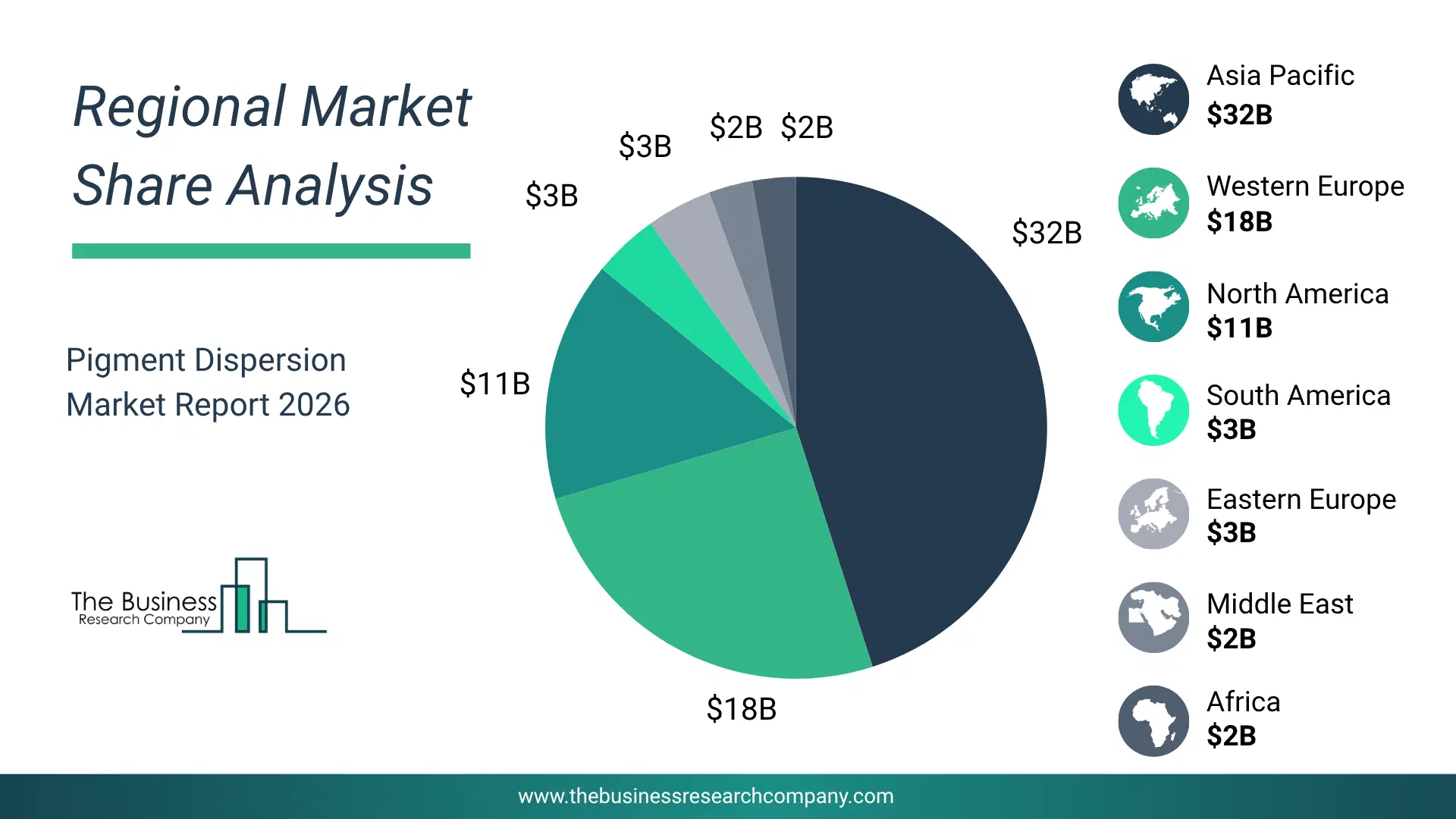
Regional Insights
Asia-Pacific was the largest region in the pigment dispersion market in 2025. Asia-Pacific is expected to be the fastest-growing region in the market. The regions covered in this market report are Asia-Pacific, South East Asia, Western Europe, Eastern Europe, North America, South America, Middle East, Africa The countries covered in this market report are Australia, Brazil, China, France, Germany, India, Indonesia, Japan, Taiwan, Russia, South Korea, UK, USA, Canada, Italy, SpainWhat Defines the Pigment Dispersion Market?
The pigment dispersion market consists of revenues earned by entities by providing pigment dispersion done through pigment wetting, deagglomeration and stabilization. Values in this market are ‘factory gate’ values, that is the value of goods sold by the manufacturers or creators of the goods, whether to other entities (including downstream manufacturers, wholesalers, distributors, and retailers) or directly to end customers. The value of goods in this market includes related services sold by the creators of the goods.How is Market Value Defined and Measured?
The market value is defined as the revenues that enterprises gain from the sale of goods and/or services within the specified market and geography through sales, grants, or donations in terms of the currency (in USD unless otherwise specified). The revenues for a specified geography are consumption values that are revenues generated by organizations in the specified geography within the market, irrespective of where they are produced. It does not include revenues from resales along the supply chain, either further along the supply chain or as part of other products.
This chart presents market attractiveness based on a quantitative evaluation of growth, competition, strategic alignment, and risk, offering a clear view of opportunity areas for decision-making. This chart is for illustrative purposes; the full report contains the complete analysis.

This chart highlights the Total Addressable Market (TAM) by estimating the maximum revenue opportunity using an assumption-driven approach, supporting strategic planning and opportunity sizing across markets. The chart is illustrative; the full report provides a more comprehensive analysis.
What Key Data and Analysis Are Included in the Pigment Dispersion Market Report 2026?
The pigment dispersion market research report is one of a series of new reports from The Business Research Company that provides market statistics, including industry global market size, regional shares, competitors with the market share, detailed market segments, market trends and opportunities, and any further data you may need to thrive in the pigment dispersion industry. The market research report delivers a complete perspective of everything you need, with an in-depth analysis of the current and future state of the industry.Pigment Dispersion Market Report Forecast Analysis
| Report Attribute | Details |
|---|---|
| Market Size Value In 2026 | $48.7 billion |
| Revenue Forecast In 2030 | $64.54 billion |
| Growth Rate | CAGR of 7.3% from 2026 to 2030 |
| Base Year For Estimation | 2025 |
| Actual Estimates/Historical Data | 2020-2025 |
| Forecast Period | 2026 - 2030 |
| Market Representation | Revenue in USD Billion and CAGR from 2026 to 2030 |
| Segments Covered | Pigment Type, Dispersion Type, Industry Vertical |
| Regional Scope | Asia-Pacific, Western Europe, Eastern Europe, North America, South America, Middle East, Africa |
| Country Scope | The countries covered in the report are Australia, Brazil, China, France, Germany, India, ... |
| Key Companies Profiled | BASF SE, DIC Corporation, Clariant AG, Sudarshan Chemical Industries Ltd., Cabot Corporation, Heubach GmbH, Penn Color Inc., Chromaflo Technologies Corporation, Ferro Corporation, Flint Group, AArbor Colorants Corporation, American Element, Aralon Color GmbH, AUM Farbenchem Pvt. Ltd., DyStar Group, Pidilite Industries Ltd., Altana AG, Achitex Minerva S.p.A., Decorative Color & Chemical Inc., Trust Chem Co., Ltd., Kama Pigments, Organic Dyes and Pigments, Reitech Corporation, Toyo Ink SC Holdings Co., Ltd., |
| Customization Scope | Request for Customization |
| Pricing And Purchase Options | Explore Purchase Options |