
Feed Pigment Market Report 2026
Global Outlook – By Product (Carotenoids, Natural Yellow Pigments, Natural Red Pigments, Microalgae-Based Pigments, Other Products), By Source (Natural, Synthetic), By Livestock (Poultry, Aquatic Animals, Swine, Ruminants, Other Livestock), By Form (Dry, Liquid) – Market Size, Trends, Strategies, and Forecast to 2030
Feed Pigment Market Overview
• Feed Pigment market size has reached to $1.82 billion in 2025 • Expected to grow to $2.54 billion in 2030 at a compound annual growth rate (CAGR) of 6.9% • Growth Driver: Surge In Meat Consumption To Drive Market Growth • Market Trend: Transforming The Feed Pigment Market With Carbon Capture Technology • North America was the largest region in 2025 and Asia-Pacific is the fastest growing region.What Is Covered Under Feed Pigment Market?
Feed pigments are natural or synthetic pigments that are added to animal feed to enhance the visual appeal of animal-derived products such as meat, eggs, and milk. It is used to enhance the appearance and nutritive value of animal feed. The main types of feed pigment products are carotenoids, curcumin, caramel, spirulina, and others. Carotenoids refer to lipid-soluble plant pigments that impart bright yellow, red, and orange colors in fruit, vegetables, fungi, and flowers. These are either natural or synthetic, and are used to feed several livestock including swine, poultry, ruminants, aquatic animals, and others.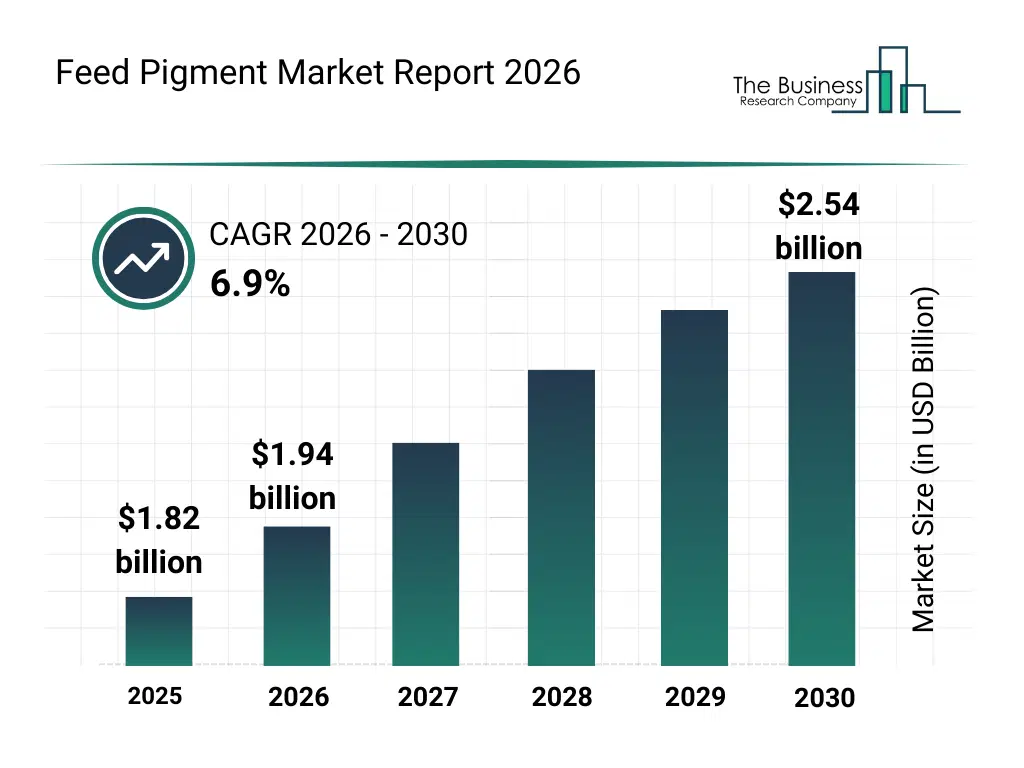
What Is The Feed Pigment Market Size and Share 2026?
The feed pigment market size has grown strongly in recent years. It will grow from $1.82 billion in 2025 to $1.94 billion in 2026 at a compound annual growth rate (CAGR) of 6.8%. The growth in the historic period can be attributed to growth of commercial livestock farming, consumer preference for visually appealing animal products, early adoption of carotenoids, expansion of poultry industry, increased feed fortification practices.What Is The Feed Pigment Market Growth Forecast?
The feed pigment market size is expected to see strong growth in the next few years. It will grow to $2.54 billion in 2030 at a compound annual growth rate (CAGR) of 6.9%. The growth in the forecast period can be attributed to rising demand for natural pigments, growth in aquaculture farming, stricter feed additive regulations, increasing animal protein consumption, innovation in plant based pigments. Major trends in the forecast period include rising use of natural feed pigments, growing demand for clean label animal products, increased adoption in poultry nutrition, expansion of aquaculture feed pigmentation, focus on nutritional and visual feed enhancement.
Global Feed Pigment Market Segmentation
1) By Product: Carotenoids, Natural Yellow Pigments, Natural Red Pigments, Microalgae-Based Pigments, Other Products 2) By Source: Natural, Synthetic 3) By Livestock: Poultry, Aquatic Animals, Swine, Ruminants, Other Livestock 4) By Form: Dry, Liquid Subsegments: 1) By Carotenoids: Beta-Carotene, Lutein, Astaxanthin, Canthaxanthin 2) By Natural Yellow Pigments: Marigold Extract (Xanthophylls), Turmeric / Curcumin, Annatto (Bixin & Norbixin) 3) By Natural Red Pigments: Paprika Oleoresin, Beetroot Red (Betalains), Carmine (Cochineal Extract) 4) By Microalgae-Based Pigments: Spirulina (Phycocyanin), Haematococcus pluvialis (Astaxanthin), Chlorella-Based Pigments 5) By Other Products: Riboflavin (Vitamin B2), Apo-Ester Pigments, Mixed Natural Pigment BlendsWhat Is The Driver Of The Feed Pigment Market?
Rising meat consumption is expected to propel the growth of the feed pigment market going forward. Meat consumption refers to the amount of meat that is consumed by individuals or populations. Feed pigments are added to animal feed to enhance the color of meat, poultry, and seafood, which makes them more visually appealing to consumers. For instance, in July 2024, according to Carlisle Technology, a US-based company providing software and hardware solutions for the food industry, chicken consumption, currently at 98.90 pounds per person, is projected to increase to 107.50 pounds by 2033, driven by its affordability and health benefits. In 2022, Americans consumed 98.90 pounds of broiler chicken per capita, with this figure set to rise significantly by 2033. Therefore, rising meat consumption is driving the growth of the feed pigment industry.Key Players In The Global Feed Pigment Market
Major companies operating in the feed pigment market are BASF SE, DSM-Firmenich AG, Kemin Industries, Inc., Novus International, Inc., Synthite Industries Ltd., Divi’s Laboratories Ltd., Archer-Daniels-Midland Company (ADM), Cargill Incorporated, Zhejiang NHU Co., Ltd., Givaudan SA, D.D. Williamson & Co., Inc., Cyanotech Corporation, Algatech Ltd., Algalíf Iceland ehf., Beijing Gingko Group, AstaReal Co., Ltd., Kalsec Inc., Chr. Hansen Holding A/S, Alltech Inc., Nutrex NV, Impextraco NV, EW Nutrition GmbH
This chart is for illustrative purposes; the full report includes a detailed competitor analysis and comprehensive overview of the top 10 companies in the market.
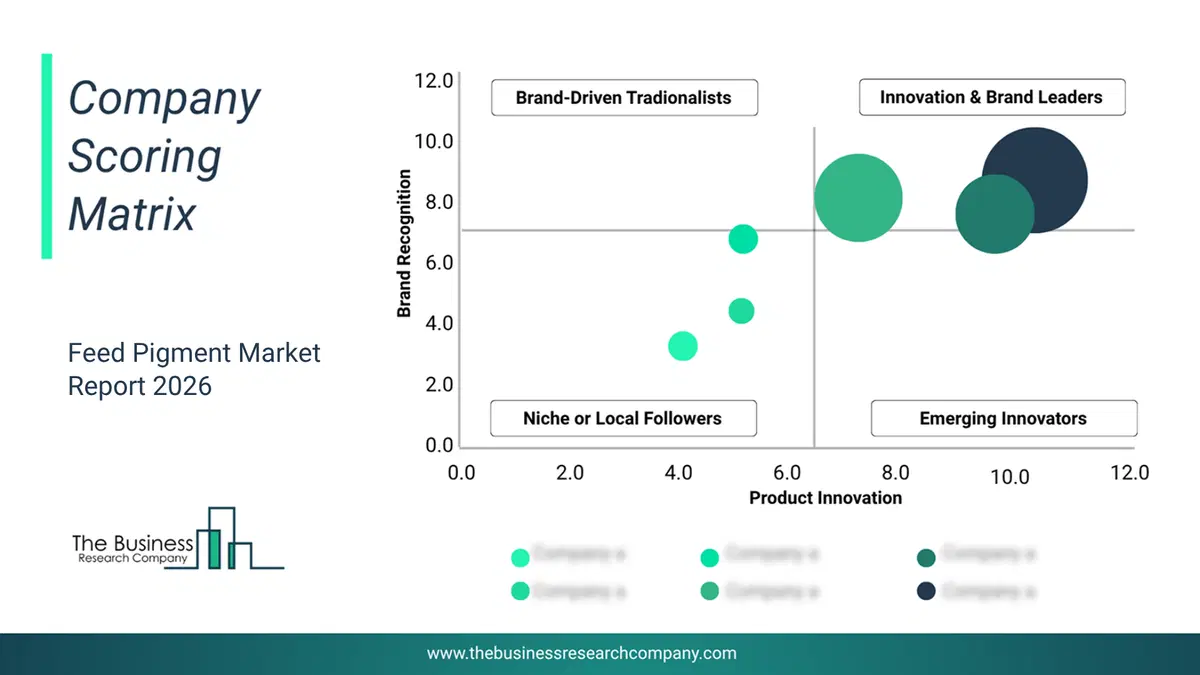
This chart maps companies by product innovation and brand strength, with bubble size indicating relative revenue, helping identify market leaders, challengers, and niche players. This is an illustrative chart; the full report provides a complete and accurate competitive analysis.
Global Feed Pigment Market Trends and Insights
Major companies operating in the market for feed pigment are focusing on innovative technologies such as carbon capture technology. Carbon capture technology involves methods for capturing and storing carbon dioxide emissions from sources such as industrial plants to reduce their environmental impact and address climate change. For instance, in March 2023, NovoNutrients, a US-based biotechnology company, launched carotenoid single-cell proteins. These are premium protein sources obtained from microorganisms that synthesize carotenoids, the pigments that give vibrant colors to many plants and some animals. These proteins are produced through fermentation processes that use carbon dioxide, hydrogen, and specific microbes, providing a sustainable alternative to conventional protein sources. In addition to supplying essential amino acids and nutrients for animal feed, carotenoid SCPs enhance the nutritional value of the feed by incorporating the benefits of carotenoids, which contribute to better health and improved coloration in aquaculture species.What Are Latest Mergers And Acquisitions In The Feed Pigment Market?
In August 2025, Corbion, a Netherlands-based sustainable ingredients company, partnered with Kuehnle AgroSystems (KAS) to develop and commercialize natural astaxanthin derived from non-GMO algae. The partnership focuses on producing algae-derived astaxanthin for human health and aquafeed applications, providing a sustainable, bioavailable, and scalable alternative to synthetic pigments. Kuehnle AgroSystems (KAS) is a US-based producer of pigments for feed applications.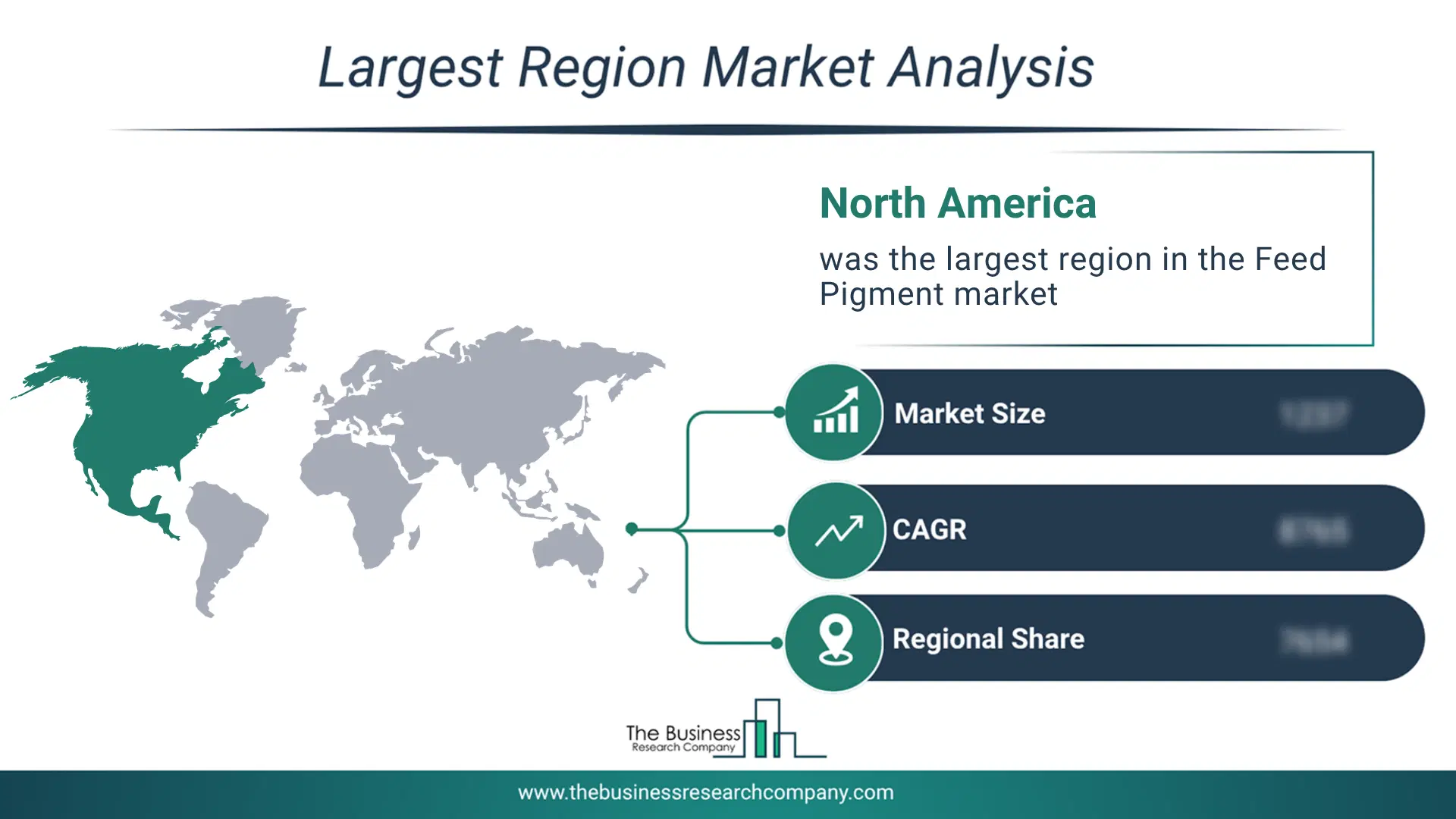
Regional Insights
North America was the largest region in the feed pigment market in 2025. Asia-Pacific is expected to be the fastest-growing region in the global feed pigment market during the forecast period. The regions covered in this market report are Asia-Pacific, South East Asia, Western Europe, Eastern Europe, North America, South America, Middle East, Africa The countries covered in this market report are Australia, Brazil, China, France, Germany, India, Indonesia, Japan, Taiwan, Russia, South Korea, UK, USA, Canada, Italy, SpainWhat Defines the Feed Pigment Market?
The feed pigment market consists of sales of xanthophylls, anthocyanins, lycopene, citraxanthin, and capsanthin. Values in this market are ‘factory gate’ values, that is the value of goods sold by the manufacturers or creators of the goods, whether to other entities (including downstream manufacturers, wholesalers, distributors, and retailers) or directly to end customers. The value of goods in this market includes related services sold by the creators of the goods.How is Market Value Defined and Measured?
The market value is defined as the revenues that enterprises gain from the sale of goods and/or services within the specified market and geography through sales, grants, or donations in terms of the currency (in USD unless otherwise specified). The revenues for a specified geography are consumption values that are revenues generated by organizations in the specified geography within the market, irrespective of where they are produced. It does not include revenues from resales along the supply chain, either further along the supply chain or as part of other products.
This chart presents market attractiveness based on a quantitative evaluation of growth, competition, strategic alignment, and risk, offering a clear view of opportunity areas for decision-making. This chart is for illustrative purposes; the full report contains the complete analysis.

This chart highlights the Total Addressable Market (TAM) by estimating the maximum revenue opportunity using an assumption-driven approach, supporting strategic planning and opportunity sizing across markets. The chart is illustrative; the full report provides a more comprehensive analysis.
What Key Data and Analysis Are Included in the Feed Pigment Market Report 2026?
The feed pigment market research report is one of a series of new reports from The Business Research Company that provides market statistics, including industry global market size, regional shares, competitors with the market share, detailed market segments, market trends and opportunities, and any further data you may need to thrive in the feed pigment industry. The market research report delivers a complete perspective of everything you need, with an in-depth analysis of the current and future state of the industry.Feed Pigment Market Report Forecast Analysis
| Report Attribute | Details |
|---|---|
| Market Size Value In 2026 | $1.94 billion |
| Revenue Forecast In 2030 | $2.54 billion |
| Growth Rate | CAGR of 6.8% from 2026 to 2030 |
| Base Year For Estimation | 2025 |
| Actual Estimates/Historical Data | 2020-2025 |
| Forecast Period | 2026 - 2030 |
| Market Representation | Revenue in USD Billion and CAGR from 2026 to 2030 |
| Segments Covered | Product, Source, Livestock, Form |
| Regional Scope | Asia-Pacific, Western Europe, Eastern Europe, North America, South America, Middle East, Africa |
| Country Scope | The countries covered in this market report are Australia, Brazil, China, France, Germany, India, Indonesia, Japan, Taiwan, Russia, South Korea, UK, USA, Canada, Italy, Spain |
| Key Companies Profiled | BASF SE, DSM-Firmenich AG, Kemin Industries, Inc., Novus International, Inc., Synthite Industries Ltd., Divi’s Laboratories Ltd., Archer-Daniels-Midland Company (ADM), Cargill Incorporated, Zhejiang NHU Co., Ltd., Givaudan SA, D.D. Williamson & Co., Inc., Cyanotech Corporation, Algatech Ltd., Algalíf Iceland ehf., Beijing Gingko Group, AstaReal Co., Ltd., Kalsec Inc., Chr. Hansen Holding A/S, Alltech Inc., Nutrex NV, Impextraco NV, EW Nutrition GmbH |
| Customization Scope | Request for Customization |
| Pricing And Purchase Options | Explore Purchase Options |