
Food Colorants Market Report 2026
Global Outlook – By Type (Natural, Synthetic), By Solubility (Dye, Lake), By Form (Powder, Liquid), By Application (Beverages, Dairy And Frozen products, Bakery, Meat, Poultry, and Seafood, Confectionery, Sauces and Condiments, Other Applications) – Market Size, Trends, Strategies, and Forecast to 2030
Food Colorants Market Overview
• Food Colorants market size has reached to $4.98 billion in 2025 • Expected to grow to $7.18 billion in 2030 at a compound annual growth rate (CAGR) of 7.8% • Growth Driver: Rising Demand For Organic Food Drives Growth In The Food Colorants Market • Market Trend: Innovation In Natural Color Production Drives Efficiency And Sustainability • Europe was the largest region in 2025.What Is Covered Under Food Colorants Market?
Food colorants, often known as food dyes or food additives, are chemical or natural additive used on food during processing or preparation to improve or change the color. Food colorants are used to improve or preserve the sensory qualities of the food product that may be impacted or lost during processing or storage. The main types of food colorants are natural and synthetic, which are sourced from plant-derived pigments and minerals. Natural items are all things generated by nature without the involvement of man. Natural food color refers to any color, pigment, or other substance derived from a vegetable, creature, substance, or other source. By solubility, these are of various types, including dye and lake. Various types of forms include powder and liquid, which are used in various applications such as beverages, dairy and frozen products, bakery, meat, poultry, and seafood, confectionery, sauces and condiments, and others.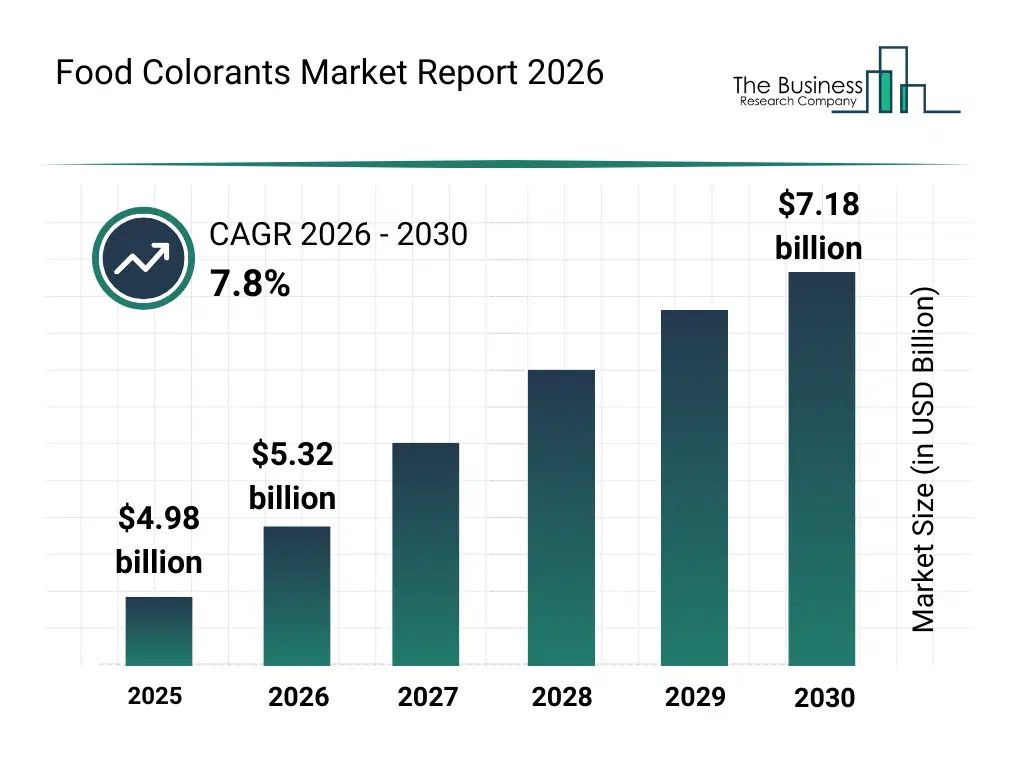
What Is The Food Colorants Market Size and Share 2026?
The food colorants market size has grown strongly in recent years. It will grow from $4.98 billion in 2025 to $5.32 billion in 2026 at a compound annual growth rate (CAGR) of 6.9%. The growth in the historic period can be attributed to expansion of processed food production, rising consumer demand for visually appealing foods, increased use of synthetic dyes, growth in beverage manufacturing, availability of food-grade color additives.What Is The Food Colorants Market Growth Forecast?
The food colorants market size is expected to see strong growth in the next few years. It will grow to $7.18 billion in 2030 at a compound annual growth rate (CAGR) of 7.8%. The growth in the forecast period can be attributed to increasing regulatory pressure on synthetic dyes, rising demand for natural and organic foods, expansion of functional and fortified food products, growing innovation in bio-based pigments, increasing adoption in beverage and confectionery industries. Major trends in the forecast period include increasing adoption of natural food colorants, rising demand for clean-label coloring solutions, growing use of plant-based pigments, expansion of heat-stable colorant applications, enhanced focus on color consistency and stability.
Global Food Colorants Market Segmentation
1) By Type: Natural, Synthetic 2) By Solubility: Dye, Lake 3) By Form: Powder, Liquid 4) By Application: Beverages, Dairy And Frozen products, Bakery, Meat, Poultry, and Seafood, Confectionery, Sauces and Condiments, Other Applications Subsegments: 1) By Natural Colorants: Plant-Based Colorants, Animal-Based Colorants 2) By Synthetic Colorants: Azo Dyes, Non-Azo Dyes, LakesWhat Is The Driver Of The Food Colorants Market?
The increasing demand for organic food is expected to propel the growth of the food colorants market going forward. Organic food refers to agricultural products produced using organic farming practices, which avoid the use of synthetic pesticides, fertilizers, genetically modified organisms (GMOs), and certain processing methods. Consumers who prioritize organic products prefer natural colorants, aligning with the clean label trends associated with organic foods. Organic certification standards, health and wellness perceptions, and regulatory support contribute to the rise of natural colorants in organic food production. As consumers become more aware and seek transparency in food ingredients, the market for natural colorants continues to expand. For instance, in May 2025, according to the GOV.UK, a UK-based government website, in 2024, the UK had a total of 503 thousand hectares of organically farmed land, marking a 1.0% increase from 2023. Therefore, the increasing demand for organic food is driving the growth of the food colorants industry.Key Players In The Global Food Colorants Market
Major companies operating in the food colorants market are Sun Food Tech Pvt. Ltd., Koninklijke DSM N.V., Florio Colori S.P.A., Chr. Hansen A/S, Cargill Incorporated, GNT Group, BASF SE, Riken Vitamin Co. Ltd., Wild Flavors Inc., Sensient Technologies Corporation, Naturex SpA, D.D. Williamson & Co. Inc., Döhler GmbH, Kalsec Inc., IFC Solutions, Kemin Industries Inc., Lycored Ltd., Symrise AG, Givaudan SA, Haarmann & Reimer GmbH
This chart is for illustrative purposes; the full report includes a detailed competitor analysis and comprehensive overview of the top 10 companies in the market.
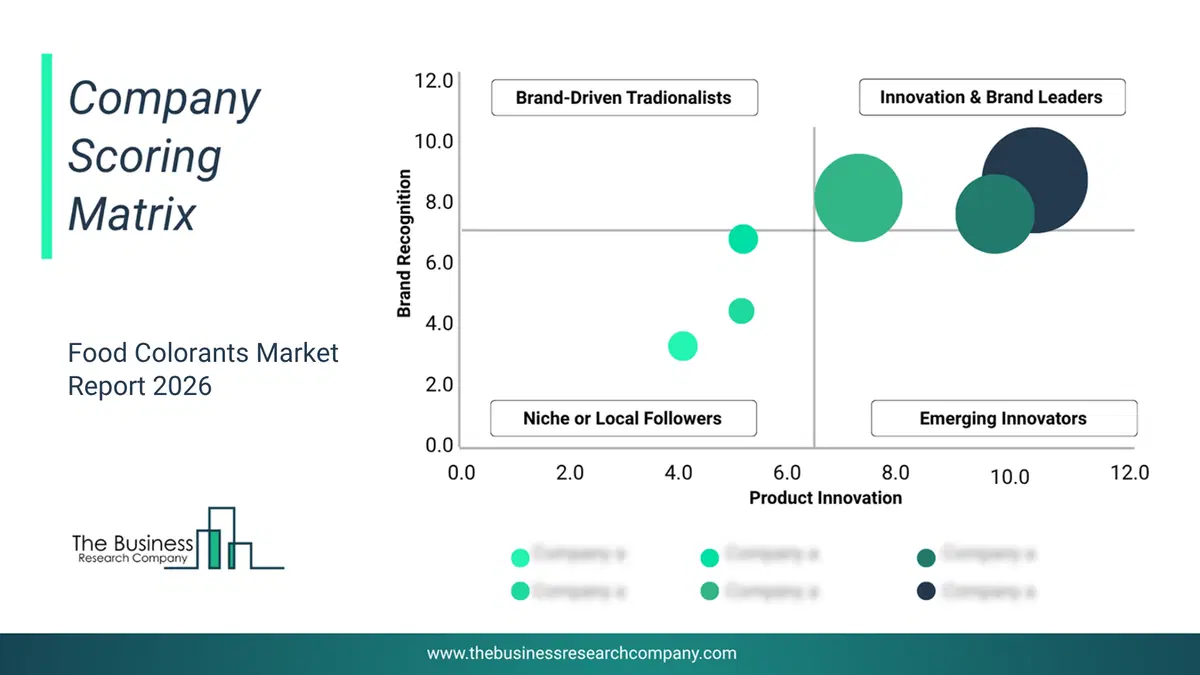
This chart maps companies by product innovation and brand strength, with bubble size indicating relative revenue, helping identify market leaders, challengers, and niche players. This is an illustrative chart; the full report provides a complete and accurate competitive analysis.
Global Food Colorants Market Trends and Insights
Major companies operating in the food colorants market are focusing on developing advanced solutions, such as high-efficiency bio-based color production, to enhance manufacturing yield, reduce production costs, and improve the sustainability profile of natural pigment ingredients. High-efficiency bio-based color production refers to the use of precision fermentation, cell programming, and high-throughput screening platforms to significantly boost the output of natural colors while minimizing environmental impact. For instance, in April 2025, Phytolon, an Israel-based biotechnology start-up, in collaboration with Ginkgo Bioworks, a US-based biotech company, announced a full-project milestone deliverable that nearly tripled the manufacturing efficiency of Phytolon’s natural food colors through Ginkgo’s cell programming and high-throughput screening platform. This achievement enabled the production of two natural pigments, “Beetroot Red” and “Prickly Pear Yellow”, with substantially higher yields, lower production costs, and reduced carbon footprint, offering vibrant, high-quality colorants suitable for baked goods, snacks, toppings and icings, confectioneries, dairy yogurts, ice creams, and frozen novelties upon regulatory approval.What Are Latest Mergers And Acquisitions In The Food Colorants Market?
In October 2025, ROHA, an India-based food color solutions company, acquired Tebracc for an undisclosed amount. Through this acquisition, ROHA aims to strengthen its global position in the food colorants market by integrating Tebracc’s portfolio of natural coloring solutions and expanding its offerings for the food and beverage industry. Tebracc is a Brazil-based company specializing in natural food colorants.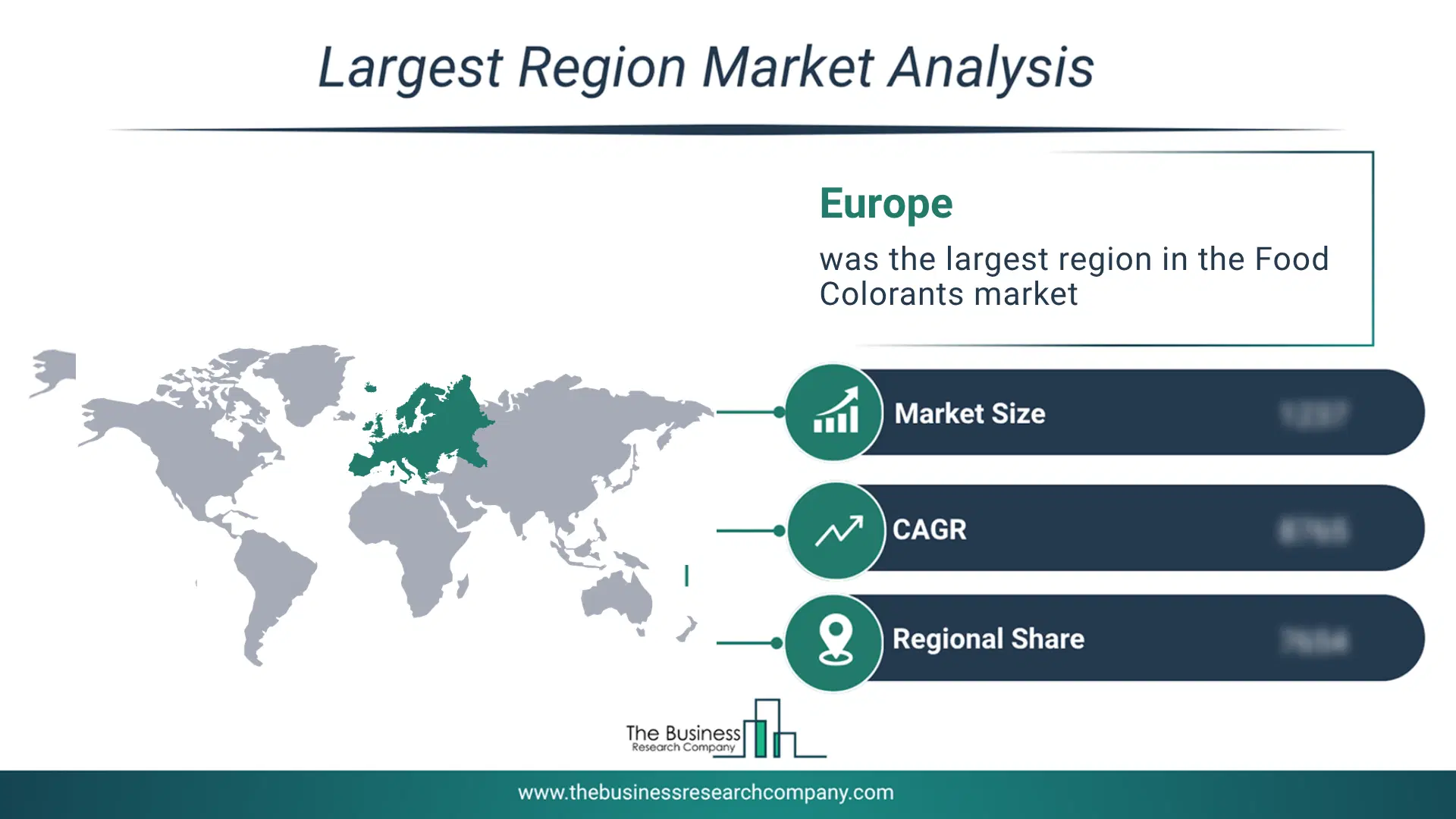
Regional Outlook
Europe was the largest region in the food colorants market in 2025. The regions covered in this market report are Asia-Pacific, South East Asia, Western Europe, Eastern Europe, North America, South America, Middle East and Africa. The countries covered in this market report are Australia, Brazil, China, France, Germany, India, Indonesia, Japan, Taiwan, Russia, South Korea, UK, USA, Italy, Spain, CanadaWhat Defines the Food Colorants Market?
The food colorants market consists of sales of beta-carotene, annatto extract, beet juice, purple carrot, and butterfly pea powder. Values in this market are ‘factory gate’ values, that is the value of goods sold by the manufacturers or creators of the goods, whether to other entities (including downstream manufacturers, wholesalers, distributors and retailers) or directly to end customers. The value of goods in this market includes related services sold by the creators of the goods.How is Market Value Defined and Measured?
The market value is defined as the revenues that enterprises gain from the sale of goods and/or services within the specified market and geography through sales, grants, or donations in terms of the currency (in USD unless otherwise specified). The revenues for a specified geography are consumption values that are revenues generated by organizations in the specified geography within the market, irrespective of where they are produced. It does not include revenues from resales along the supply chain, either further along the supply chain or as part of other products.
This chart presents market attractiveness based on a quantitative evaluation of growth, competition, strategic alignment, and risk, offering a clear view of opportunity areas for decision-making. This chart is for illustrative purposes; the full report contains the complete analysis.

This chart highlights the Total Addressable Market (TAM) by estimating the maximum revenue opportunity using an assumption-driven approach, supporting strategic planning and opportunity sizing across markets. The chart is illustrative; the full report provides a more comprehensive analysis.
What Key Data and Analysis Are Included in the Food Colorants Market Report 2026?
The food colorants market research report is one of a series of new reports from The Business Research Company that provides market statistics, including industry global market size, regional shares, competitors with the market share, detailed market segments, market trends and opportunities, and any further data you may need to thrive in the food colorants industry. The market research report delivers a complete perspective of everything you need, with an in-depth analysis of the current and future state of the industry.Food Colorants Market Report Forecast Analysis
| Report Attribute | Details |
|---|---|
| Market Size Value In 2026 | $5.32 billion |
| Revenue Forecast In 2030 | $7.18 billion |
| Growth Rate | CAGR of 6.9% from 2026 to 2030 |
| Base Year For Estimation | 2025 |
| Actual Estimates/Historical Data | 2020-2025 |
| Forecast Period | 2026 - 2030 |
| Market Representation | Revenue in USD Billion and CAGR from 2026 to 2030 |
| Segments Covered | Type, Solubility, Form, Application |
| Regional Scope | Asia-Pacific, Western Europe, Eastern Europe, North America, South America, Middle East, Africa |
| Country Scope | The countries covered in the report are Australia, Brazil, China, France, Germany, India, Indonesia, Japan, Taiwan, Russia, South Korea, UK, USA, Canada, Italy, Spain. |
| Key Companies Profiled | Sun Food Tech Pvt. Ltd., Koninklijke DSM N.V., Florio Colori S.P.A., Chr. Hansen A/S, Cargill Incorporated, GNT Group, BASF SE, Riken Vitamin Co. Ltd., Wild Flavors Inc., Sensient Technologies Corporation, Naturex SpA, D.D. Williamson & Co. Inc., Döhler GmbH, Kalsec Inc., IFC Solutions, Kemin Industries Inc., Lycored Ltd., Symrise AG, Givaudan SA, Haarmann & Reimer GmbH |
| Customization Scope | Request for Customization |
| Pricing And Purchase Options | Explore Purchase Options |