
Distributed Acoustic Sensing Market Report 2026
Global Outlook – By Component (Hardware, Software, Service), By Fiber (Single-Mode Fiber, Multi-Mode Fiber), By Application (Injection Flow, Production Flow, Wellbore Integrity Monitoring, Cross Well Analysis, Transport Tracking And Health Monitoring, Other Applications), By End-Use Industry (Power And Utility, Security And Surveillance, Environmental And Infrastructure, Transportation, Other End Users) – Market Size, Trends, Strategies, and Forecast to 2030
Distributed Acoustic Sensing Market Overview
• Distributed Acoustic Sensing market size has reached to $3.08 billion in 2025 • Expected to grow to $6.27 billion in 2030 at a compound annual growth rate (CAGR) of 15.2% • Growth Driver: Rising Demand In The Oil And Gas Sector Driving Market Growth With Increasing Investment In Exploration, Production, And Advanced Technologies • Market Trend: Technological Advancements Enhancing Market Growth • North America was the largest region in 2025 and Asia-Pacific is the fastest growing region.What Is Covered Under Distributed Acoustic Sensing Market?
Distributed acoustic sensing (DAS) is an advanced measurement technique. Distributed acoustic sensing (DAS) utilizes fiber optic cables to detect vibrations and acoustic signals over long distances, providing real-time monitoring for various applications such as pipeline surveillance, infrastructure integrity, and security. The main types of components in distributed acoustic sensing are hardware, software, and services. Hardware refers to the physical components of a computer system or any electronic device. These are used for various fibers, including single-mode fiber and multi-mode fiber. The various applications include injection flow, production flow, wellbore integrity monitoring, cross-well analysis, transport tracking, health monitoring, and other applications and are used by various end users such as power and utility, security and surveillance, environmental and infrastructure, transportation, and other end users.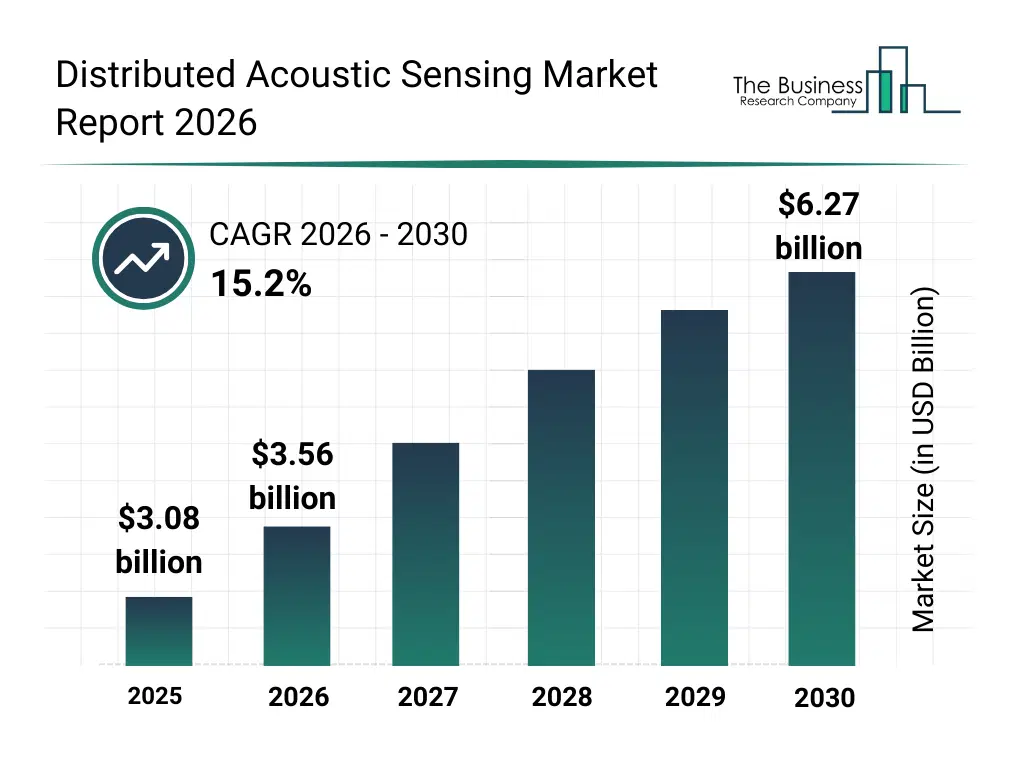
What Is The Distributed Acoustic Sensing Market Size and Share 2026?
The distributed acoustic sensing market size has grown rapidly in recent years. It will grow from $3.08 billion in 2025 to $3.56 billion in 2026 at a compound annual growth rate (CAGR) of 15.6%. The growth in the historic period can be attributed to need for pipeline monitoring, early fiber optic sensing adoption, infrastructure safety concerns, growth of energy transmission networks, increasing security threats.What Is The Distributed Acoustic Sensing Market Growth Forecast?
The distributed acoustic sensing market size is expected to see rapid growth in the next few years. It will grow to $6.27 billion in 2030 at a compound annual growth rate (CAGR) of 15.2%. The growth in the forecast period can be attributed to smart infrastructure expansion, increasing investments in critical infrastructure protection, adoption of AI analytics, growth of environmental monitoring needs, expansion of fiber optic networks. Major trends in the forecast period include real-time infrastructure monitoring, pipeline and perimeter security applications, AI-based signal interpretation, cloud-integrated das platforms, long-distance asset monitoring systems.
Global Distributed Acoustic Sensing Market Segmentation
1) By Component: Hardware, Software, Service 2) By Fiber: Single-Mode Fiber, Multi-Mode Fiber 3) By Application: Injection Flow, Production Flow, Wellbore Integrity Monitoring, Cross Well Analysis, Transport Tracking And Health Monitoring, Other Applications 4) By End-Use Industry: Power And Utility, Security And Surveillance, Environmental And Infrastructure, Transportation, Other End Users Subsegments: 1) By Hardware: Fiber Optic Cables, Interrogator Units, Acoustic Sensors, Signal Amplifiers, Connectivity Modules 2) By Software: Data Processing And Analytics Software, Real-Time Monitoring Software, Machine Learning And AI-Based Detection Software, Visualization And Reporting Tools, Cloud-Based DAS Solutions 3) By Service: System Integration And Deployment Services, Maintenance And Support Services, Training And Consulting Services, Remote Monitoring Services, Customization And Upgradation ServicesWhat Is The Driver Of The Distributed Acoustic Sensing Market?
Rising demand in the oil and gas sector is expected to propel the growth of the distributed acoustic sensing market going forward. Oil and gas refer to natural resources sourced from beneath the Earth's surface, primarily composed of hydrocarbons derived from the decomposition of ancient organic matter. The rising demand in the oil and gas sector is due to increasing global energy consumption, industrial growth, and the ongoing need for reliable and scalable energy sources to support economic development and infrastructure expansion. Distributed acoustic sensing (DAS) enables the oil and gas sector to enhance real-time monitoring of pipeline integrity, detect potential leaks or faults, optimize asset management, and improve safety protocols by converting fiber-optic cables into a vast network of sensors that can continuously track vibrations and pressure changes, thereby reducing operational risks, lowering maintenance costs, and ensuring the efficient and secure transportation of hydrocarbons. For instance, in June 2024, according to the U.S. Energy Information Administration (EIA), a U.S.-based Department of Energy statistical agency, crude oil production in the Permian Basin is expected to average about 6.3 million barrels per day in 2024, an increase of nearly 8% from 2023. Therefore, the rising demand in the oil and gas sector is expected to propel the growth of the distributed acoustic sensing industry.Key Players In The Global Distributed Acoustic Sensing Market
Major companies operating in the distributed acoustic sensing market are Schlumberger Limited, Baker Hughes Company, Halliburton Energy Services Inc., Weatherford International plc, Luna Innovations Incorporated, OptaSense, Optical Fiber Solutions, Bandweaver Technology, Senstar Corporation, Febus Optics, Future Fibre Technologies (FFT), Ziebel AS, Fiber SenSys Inc., Solifos AG, Hifi Engineering Inc., Omnisens SA, Aragon Photonics Labs, S.L., fibrisTerre Systems GmbH, Fotech Group Ltd.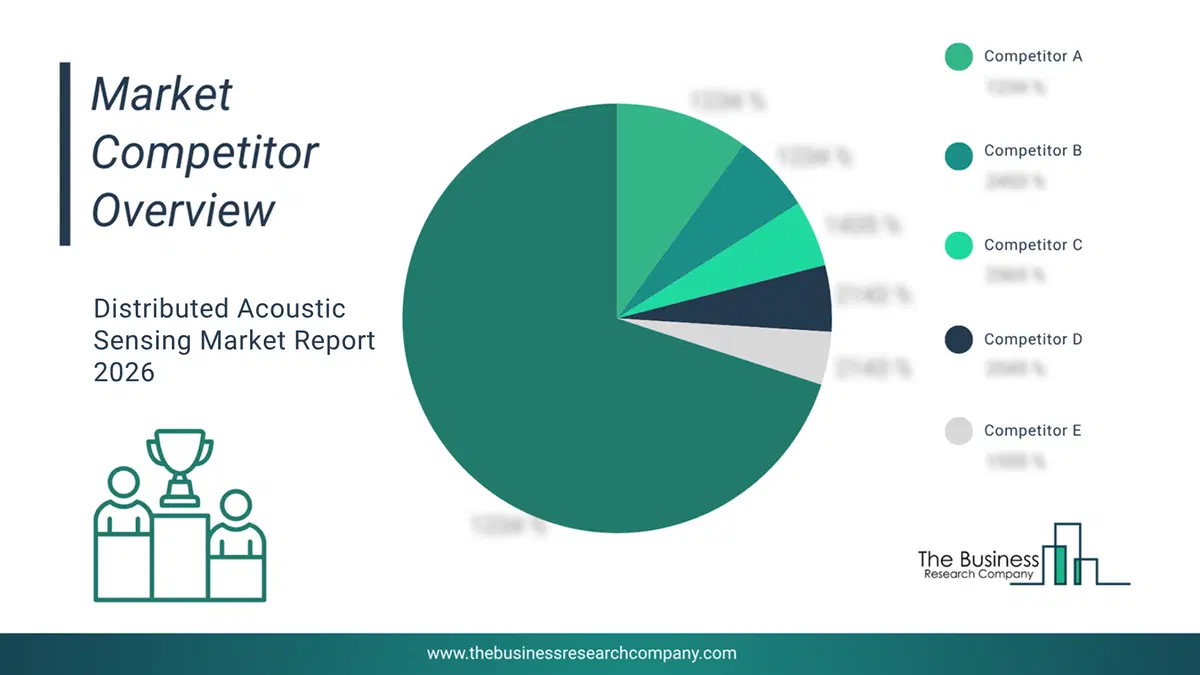
This chart is for illustrative purposes; the full report includes a detailed competitor analysis and comprehensive overview of the top 10 companies in the market.
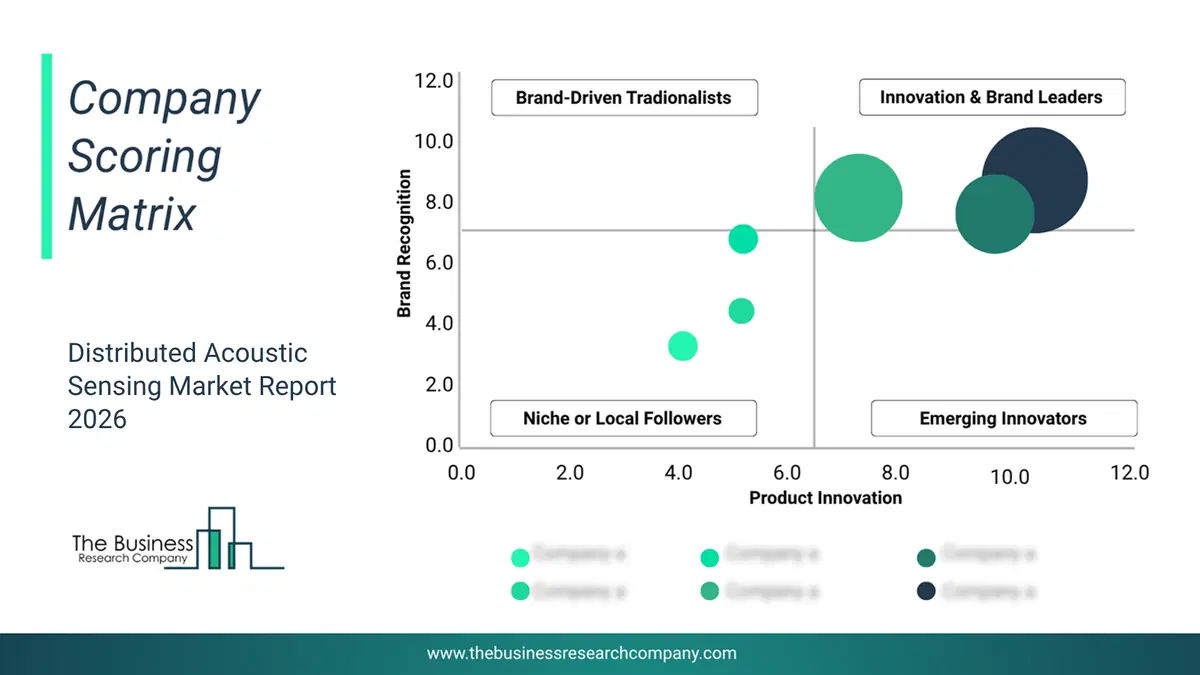
This chart maps companies by product innovation and brand strength, with bubble size indicating relative revenue, helping identify market leaders, challengers, and niche players. This is an illustrative chart; the full report provides a complete and accurate competitive analysis.
Global Distributed Acoustic Sensing Market Trends and Insights
Major companies operating in the distributed acoustic sensing market are focusing on technologies such as fiber optic sensing to enhance their capabilities and offerings. Fiber optic sensing technology refers to the use of optical fibers to measure physical parameters such as temperature, pressure, strain, displacement, and others. For instance, in March 2023, Optex Group, a Japan-based manufacturer of industrial process instruments, launched Echopoint distributed acoustic sensors utilizing fibre optic sensing technology for advanced intrusion detection across the highest security sites. It offers unique features, such as ±6 meter point detection accuracy over distances of up to 100 kilometers, advanced classification algorithms that differentiate between various intrusion types, flexible installation options for versatile applications, intelligent software zoning for customizable sensitivity settings, and robust reliability against electromagnetic interference and lightning.What Are Latest Mergers And Acquisitions In The Distributed Acoustic Sensing Market?
In December 2023, Luna Innovations, a US-based company that offers advanced fiber-optic technology, acquired Silixa for an undisclosed amount. Through this acquisition, Luna aims to enhance its expertise in distributed acoustic, temperature, and strain sensing through this acquisition, broadening its product portfolio and strengthening its competitive position in energy and environmental monitoring sectors. Silixa Ltd. is a UK-based company that offers distributed acoustic sensing.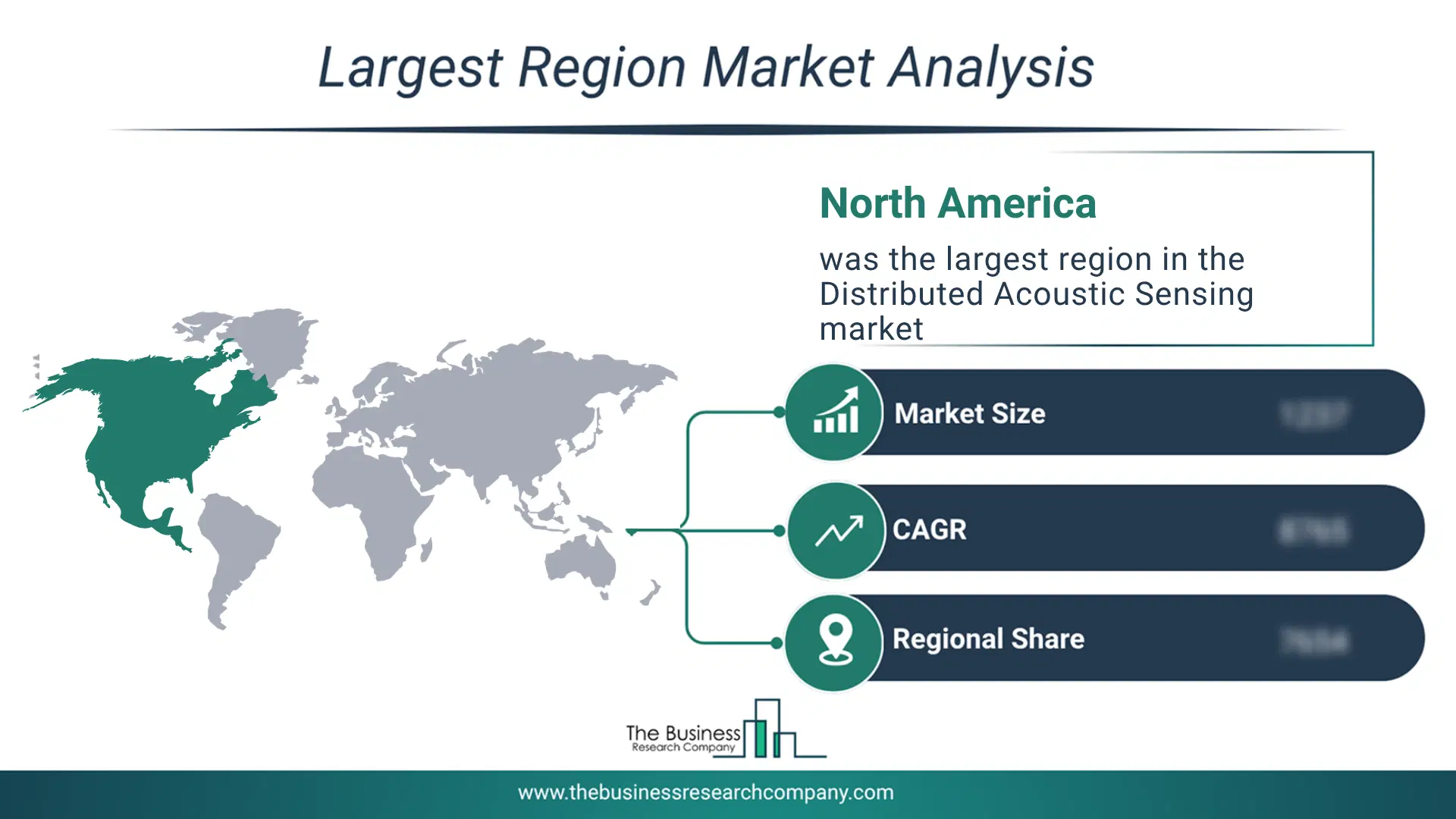
Regional Insights
North America was the largest region in the distributed acoustic sensing market in 2025. Asia-Pacific is expected to be the fastest-growing region in the forecast period. The regions covered in this market report are Asia-Pacific, South East Asia, Western Europe, Eastern Europe, North America, South America, Middle East, Africa. The countries covered in this market report are Australia, Brazil, China, France, Germany, India, Indonesia, Japan, Taiwan, Russia, South Korea, UK, USA, Canada, Italy, Spain.What Defines the Distributed Acoustic Sensing Market?
The distributed acoustic sensing market consists of revenues earned by entities by providing services such as pipeline monitoring, seismic monitoring, infrastructure health monitoring, environmental monitoring, and traffic monitoring. The market value includes the value of related goods sold by the service provider or included within the service offering. The distributed acoustic sensing market also includes sales of products including edge computing devices, acoustic event detection systems, real-time DAS monitoring platforms, fiber optic sensors, and seismic monitoring systems. Values in this market are ‘factory gate’ values, that is, the value of goods sold by the manufacturers or creators of the goods, whether to other entities (including downstream manufacturers, wholesalers, distributors, and retailers) or directly to end customers. The value of goods in this market includes related services sold by the creators of the goods.How is Market Value Defined and Measured?
The market value is defined as the revenues that enterprises gain from the sale of goods and/or services within the specified market and geography through sales, grants, or donations in terms of the currency (in USD unless otherwise specified). The revenues for a specified geography are consumption values that are revenues generated by organizations in the specified geography within the market, irrespective of where they are produced. It does not include revenues from resales along the supply chain, either further along the supply chain or as part of other products.
This chart presents market attractiveness based on a quantitative evaluation of growth, competition, strategic alignment, and risk, offering a clear view of opportunity areas for decision-making. This chart is for illustrative purposes; the full report contains the complete analysis.

This chart highlights the Total Addressable Market (TAM) by estimating the maximum revenue opportunity using an assumption-driven approach, supporting strategic planning and opportunity sizing across markets. The chart is illustrative; the full report provides a more comprehensive analysis.
What Key Data and Analysis Are Included in the Distributed Acoustic Sensing Market Report 2026?
The distributed acoustic sensing market research report is one of a series of new reports from The Business Research Company that provides market statistics, including industry global market size, regional shares, competitors with the market share, detailed market segments, market trends and opportunities, and any further data you may need to thrive in the distributed acoustic sensing industry. The market research report delivers a complete perspective of everything you need, with an in-depth analysis of the current and future state of the industry.Distributed Acoustic Sensing Market Report Forecast Analysis
| Report Attribute | Details |
|---|---|
| Market Size Value In 2026 | $3.56 billion |
| Revenue Forecast In 2030 | $6.27 billion |
| Growth Rate | CAGR of 15.2% from 2026 to 2030 |
| Base Year For Estimation | 2025 |
| Actual Estimates/Historical Data | 2020-2025 |
| Forecast Period | 2026 - 2030 |
| Market Representation | Revenue in USD Billion and CAGR from 2026 to 2030 |
| Segments Covered | Component, Fiber, Application, End-Use Industry |
| Regional Scope | Asia-Pacific, Western Europe, Eastern Europe, North America, South America, Middle East, Africa |
| Country Scope | The Countries Covered In This Market Report Are Australia, Brazil, China, France, Germany, India, Indonesia, Japan, Taiwan, Russia, South Korea, Uk, Usa, Canada, Italy, Spain. |
| Key Companies Profiled | Schlumberger Limited, Baker Hughes Company, Halliburton Energy Services Inc., Weatherford International plc, Luna Innovations Incorporated, OptaSense, Optical Fiber Solutions, Bandweaver Technology, Senstar Corporation, Febus Optics, Future Fibre Technologies (FFT), Ziebel AS, Fiber SenSys Inc., Solifos AG, Hifi Engineering Inc., Omnisens SA, Aragon Photonics Labs, S.L., fibrisTerre Systems GmbH, Fotech Group Ltd. |
| Customization Scope | Request for Customization |
| Pricing And Purchase Options | Explore Purchase Options |