

Distributor Market Report 2026
Global Outlook – By Product Type (Hardware Distribution, Software Distribution, Cloud Services Distribution, Cybersecurity Solutions Distribution, Networking And Infrastructure Solutions Distribution, Enterprise Applications Distribution), By Customer Type (Resellers, System Integrators (SIs), Managed Service Providers (MSPs), End Customers), By Enterprise Size Served (Large Enterprises, Mid Market Enterprises, Small And Medium Enterprises (SMEs)), By Distribution Model (Direct Distribution, Indirect Distribution Through Resellers, Hybrid Distribution Models, Cloud Based Digital Distribution Platforms, Marketplace Based Distribution), By End Use Vertical (Banking Financial Services And Insurance (BFSI), Healthcare) – Market Size, Trends, Strategies, and Forecast to 2030
Distributor Market Overview
• Distributor market size has reached to $4101.02 billion in 2025 • Expected to grow to $4426.73 billion in 2030 at a compound annual growth rate (CAGR) of 8.2% • Growth Driver: Growth In E-Commerce And Omnichannel Retail Driving The Market Growth Due To Expanding Online Sales Channels • Market Trend: Digital Platform Innovations Enhance Partner Enablement And Channel Ecosystem Efficiency • North America was the largest region in 2025 and Asia-Pacific is the fastest growing region.What Is Covered Under Distributor Market?
Distributor refers to an intermediary entity that procures technology products, software, and related services from manufacturers or vendors and supplies them to resellers, system integrators, or end customers within enterprise IT and outsourcing ecosystems. It facilitates supply chain management and channel enablement, ensuring efficient distribution, availability, and delivery of IT solutions across business service environments. The main product types of distributors include hardware distribution, software distribution, cloud services distribution, cybersecurity solutions distribution, networking and infrastructure solutions distribution, and enterprise applications distribution. Hardware distribution refers to the process of supplying and delivering computer hardware products from manufacturers to end customers through intermediary distributor networks. The customer types include resellers, system integrators (SIs), managed service providers (MSPs), and end customers, and the enterprise sizes served include large enterprises, mid-market enterprises, and small and medium enterprises (SMEs), and the distribution models include direct distribution, indirect distribution through resellers, hybrid distribution models, cloud based digital distribution platforms, and marketplace based distribution, with cloud based digital distribution platforms and marketplace based distribution, and the end use verticals include banking financial services and insurance (BFSI), healthcare and life sciences, retail and e commerce, manufacturing and industrial enterprises, and government and public sector and service providers.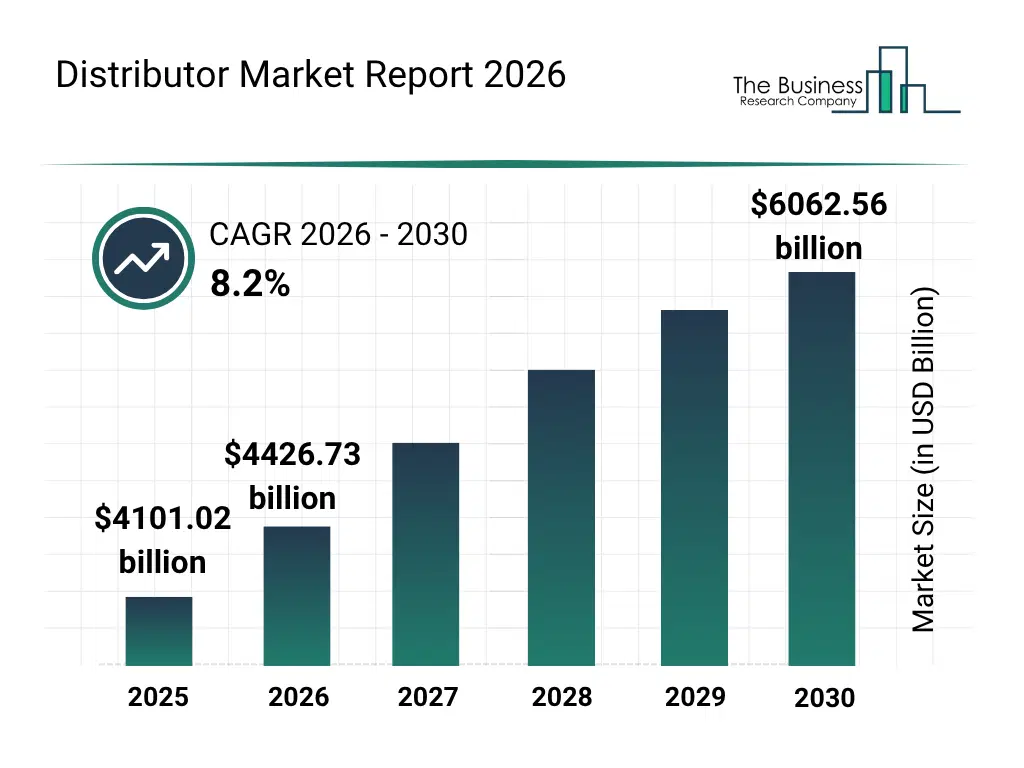
What Is The Distributor Market Size and Share 2026?
The distributor market size has grown strongly in recent years. It will grow from $4101.02 billion in 2025 to $4426.73 billion in 2026 at a compound annual growth rate (CAGR) of 7.9%. The growth in the historic period can be attributed to traditional it hardware distribution dependency, rise of global technology supply chains, growth of reseller and channel partner networks, expansion of enterprise software licensing models, increasing demand for on premise it solutions.What Is The Distributor Market Growth Forecast?
The distributor market size is expected to see strong growth in the next few years. It will grow to $6062.56 billion by 2030 at a compound annual growth rate (CAGR) of 8.2%. The growth in the forecast period can be attributed to shift toward cloud first procurement models, growing adoption of digital distribution platforms, rising demand for cybersecurity and managed services distribution, increasing automation in supply chain operations, expansion of AI driven partner ecosystem management. Major trends in the forecast period include cloud marketplace driven distribution expansion, cybersecurity and compliance led channel enablement, subscription based software distribution models, value added reseller ecosystem consolidation, api driven automated supply chain distribution platforms.
Global Distributor Market Segmentation
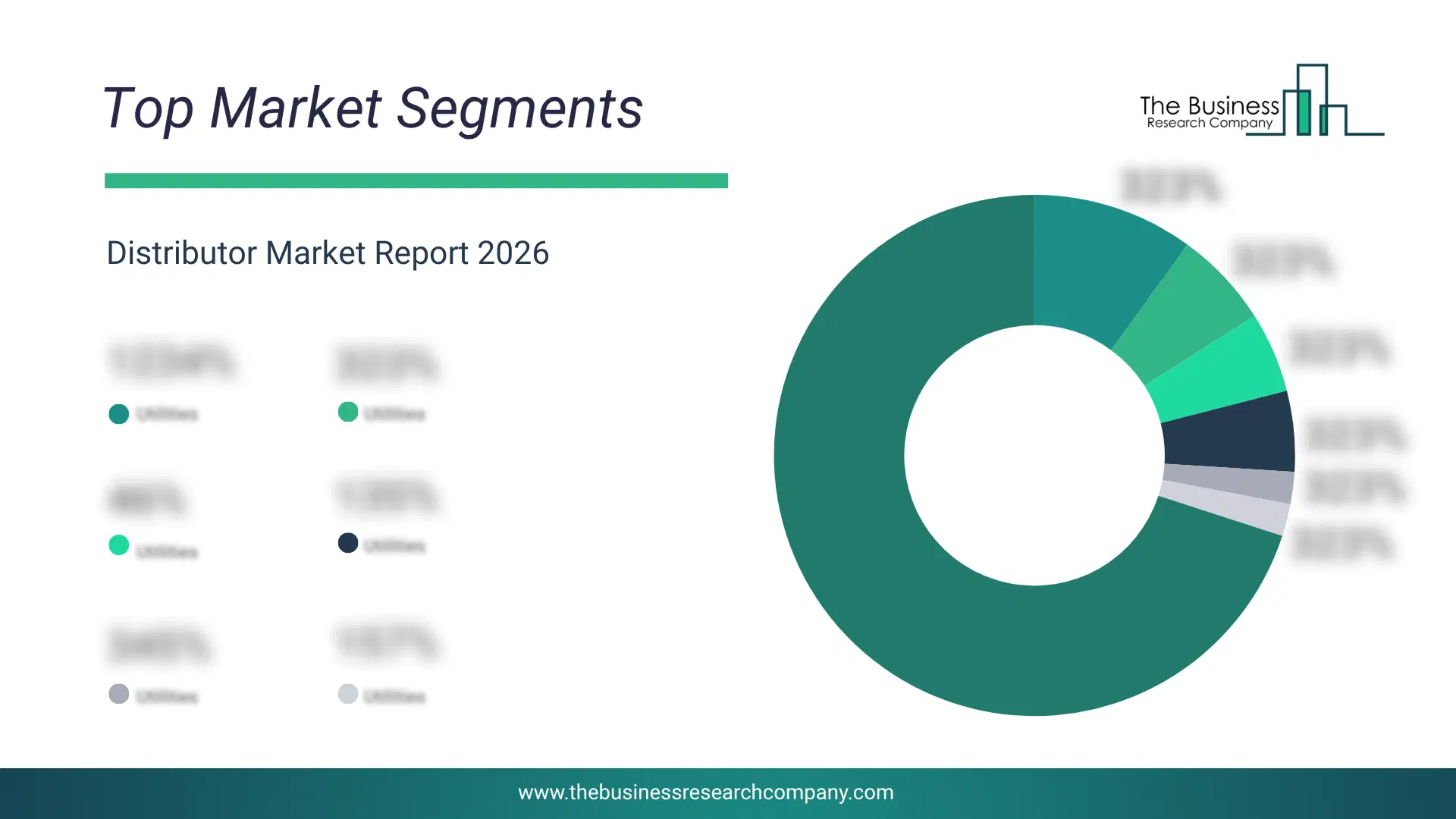
1) By Product Type: Hardware Distribution, Software Distribution, Cloud Services Distribution, Cybersecurity Solutions Distribution, Networking And Infrastructure Solutions Distribution, Enterprise Applications Distribution 2) By Customer Type: Resellers, System Integrators (SIs), Managed Service Providers (MSPs), End Customers 3) By Enterprise Size Served: Large Enterprises, Mid Market Enterprises, Small And Medium Enterprises (SMEs) 4) By Distribution Model: Direct Distribution, Indirect Distribution Through Resellers, Hybrid Distribution Models, Cloud Based Digital Distribution Platforms, Marketplace Based Distribution 5) By End Use Vertical: Banking Financial Services And Insurance (BFSI), Healthcare And Life Sciences, Retail And E Commerce, Manufacturing And Industrial Enterprises, Government And Public Sector, Telecommunications And Service Providers Subsegments: 1) By Hardware Distribution: Consumer Information Technology (IT) Hardware, Enterprise Servers And Storage, Peripherals And Accessories, Data Center Hardware, Industrial And Embedded Hardware 2) By Software Distribution: Operating Systems, Productivity Software, Database And Middleware Software, Design And Engineering Software, Industry-Specific Software 3) By Cloud Services Distribution: Infrastructure As A Service (IaaS), Platform As A Service (PaaS), Software As A Service (SaaS), Cloud Migration Services, Cloud Management And Optimization 4) By Cybersecurity Solutions Distribution: Network Security Solutions, Endpoint Security Solutions, Identity And Access Management, Data Protection And Encryption, Security Analytics And Threat Intelligence 5) By Networking And Infrastructure Solutions Distribution: Switching And Routing Solutions, Wireless Networking Solutions, Network Security Appliances, Unified Communication Systems, Data Center Networking Solutions 6) By Enterprise Applications Distribution: Enterprise Resource Planning (ERP), Customer Relationship Management (CRM), Supply Chain Management (SCM), Human Capital Management (HCM), Business Intelligence And Analytics ToolsWhat Is The Driver Of The Distributor Market?
The growth in e-commerce and omnichannel retail is expected to propel the growth of the distributor market going forward. E-commerce and omnichannel retail refer to the integration of online and offline sales channels that allow businesses to reach consumers through multiple platforms, including websites, mobile applications, and physical stores. The growth in e-commerce and omnichannel retail due to the rapid expansion of digital infrastructure and rising consumer preference for convenient, technology-driven purchasing experiences is accelerating online shopping adoption. The growth in online and multichannel retail significantly expands the reach and volume of product distribution, requiring distributors to broaden their logistics networks and supply chain capabilities to meet rising demand across diverse sales channels. For instance, in February 2024, according to the U.S. Census Bureau, a U.S.-based government agency, in 2023, total e-commerce sales were estimated at $1,118.7 billion, representing a 7.6% increase compared to 2022. Therefore, the growth in e-commerce and omnichannel retail is driving the growth of the distributor industry.Key Players In The Global Distributor Market
Major companies operating in the distributor market are Arrow Electronics Inc.; Avnet Inc.; WPG Holdings Ltd.; WESCO International Inc.; Graybar Electric Company Inc.; Redington Limited; ALSO Holding AG; Esprinet SpA; Datatec Limited; ScanSource Inc; DH Distributing Co; CMS Distribution Ltd; Westcoast Group; Winncom Technologies Corp; Digi-Key Electronics; VAD Technologies; Rexel SA; Ingram Micro Inc.; TD SYNNEX Corporation; Exertis Ltd.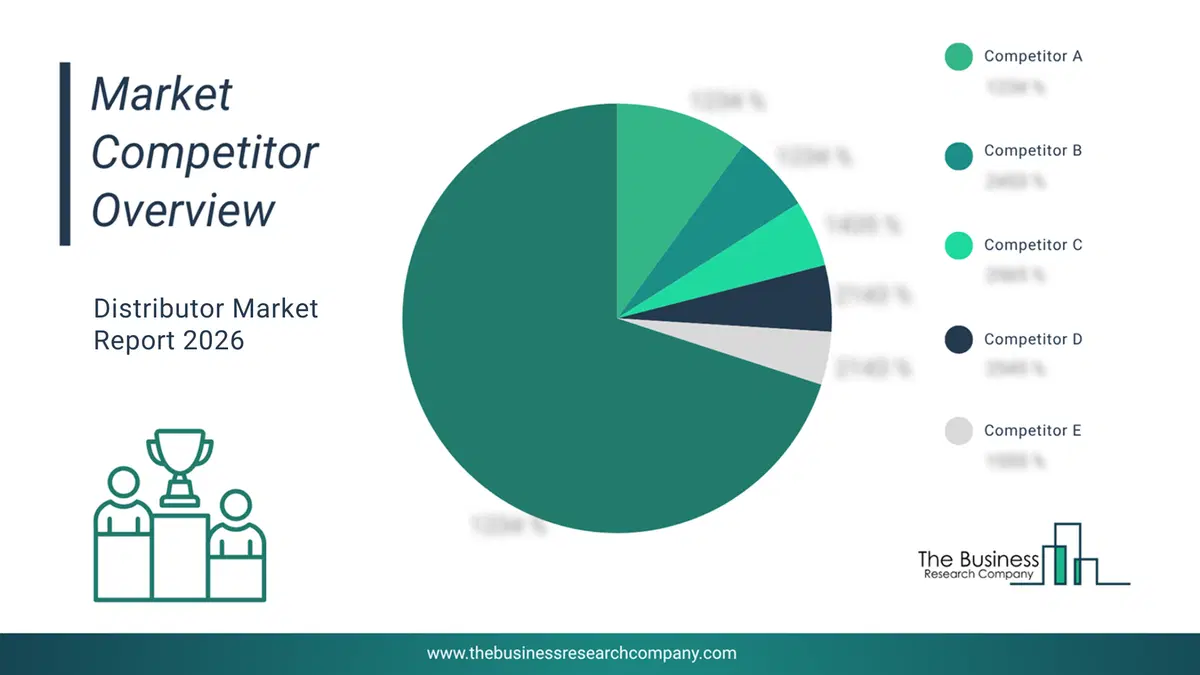
This chart is for illustrative purposes; the full report includes a detailed competitor analysis and comprehensive overview of the top 10 companies in the market.
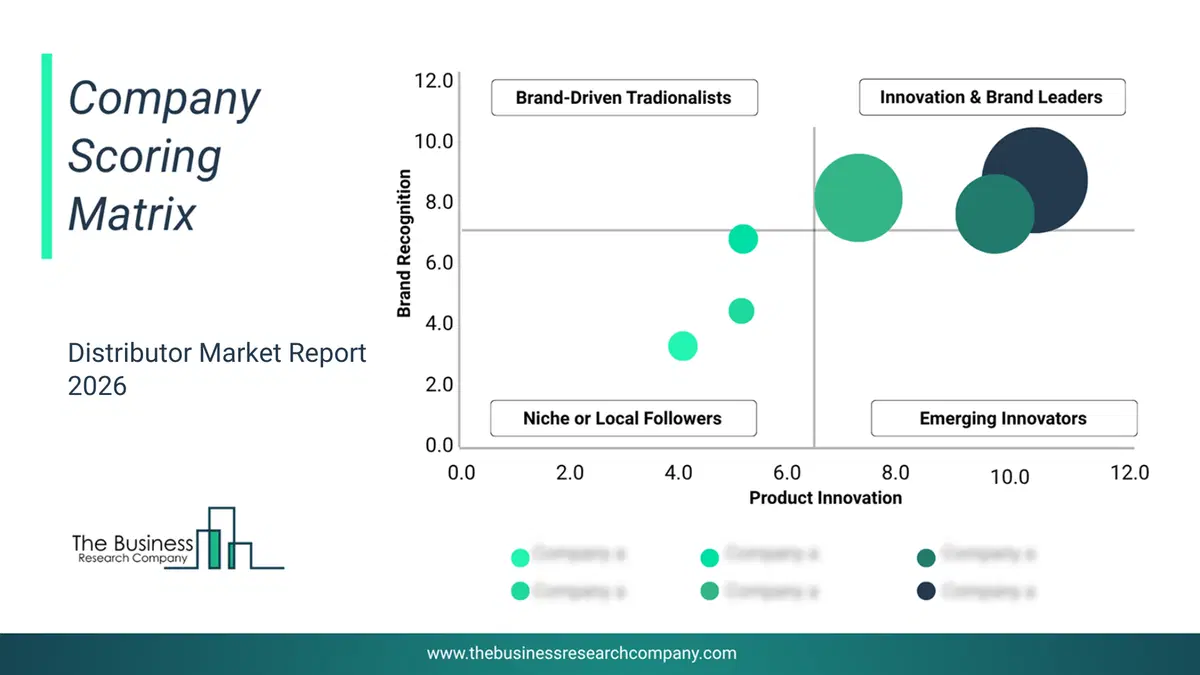
This chart maps companies by product innovation and brand strength, with bubble size indicating relative revenue, helping identify market leaders, challengers, and niche players. This is an illustrative chart; the full report provides a complete and accurate competitive analysis.
Global Distributor Market Trends and Insights
Major companies operating in the distributor market are focusing on developing advanced digital experience distributor platforms to unify partner capabilities, streamline engagement, and improve overall channel ecosystem performance. Digital experience distributor platforms are unified digital ecosystems that help distributors streamline partner engagement, optimize resources, and enhance sales operations through a centralized interface. For instance, in September 2025, TD SYNNEX, a US-based IT distribution and solutions aggregation company, introduced PartnerFirst, a digital experience distributor platform enhanced with capabilities within its PartnerFirst digital platform to unify partner engagement functions. The platform is designed to provide a centralized experience for partners, offering access to resources such as training, business intelligence, and program management tools, thereby improving partner productivity, accelerating go-to-market strategies, and strengthening collaboration across the channel ecosystem.What Are Latest Mergers And Acquisitions In The Distributor Market?
In April 2024, WT Microelectronics Co., Ltd., a Taiwan-based electronic components distributor, completed the acquisition of Future Electronics for $3.8 billion. Through this acquisition, WT Microelectronics strengthens its global distribution footprint, expands its presence across key international markets, and enhances its supply chain capabilities and channel reach within the electronics components ecosystem. Future Electronics Inc. is a Canada-based company specializing in the distribution of semiconductors and electronic components across the automotive, industrial, and consumer electronics industries.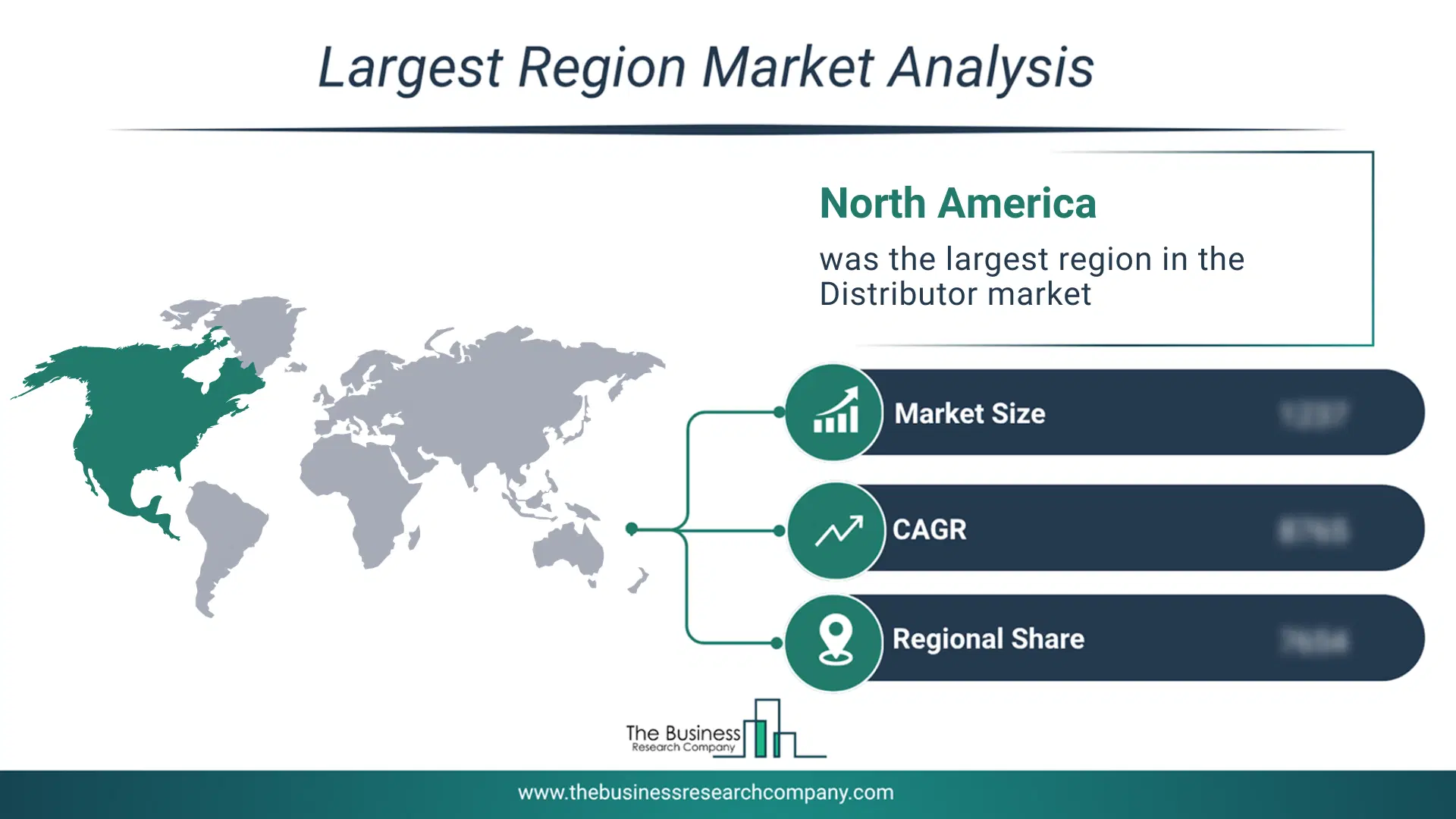
Regional Insights
North America was the largest region in the distributor market in 2025. Asia-Pacific is expected to be the fastest-growing region in the forecast period. The regions covered in this market report are Asia-Pacific, South East Asia, Western Europe, Eastern Europe, North America, South America, Middle East, Africa. The countries covered in this market report are Australia, Brazil, China, France, Germany, India, Indonesia, Japan, Taiwan, Russia, South Korea, UK, USA, Canada, Italy, Spain.What Defines the Distributor Market?
The distributor market consists of revenues earned by entities by providing services such as logistics and supply chain coordination, inventory warehousing and fulfillment, demand forecasting and planning, order processing and distribution management. The market value includes the value of related goods sold by the service provider or included within the service offering. Only goods and services traded between entities or sold to end consumers are included.How is Market Value Defined and Measured?
The market value is defined as the revenues that enterprises gain from the sale of goods and/or services within the specified market and geography through sales, grants, or donations in terms of the currency (in USD unless otherwise specified). The revenues for a specified geography are consumption values that are revenues generated by organizations in the specified geography within the market, irrespective of where they are produced. It does not include revenues from resales along the supply chain, either further along the supply chain or as part of other products.
This chart presents market attractiveness based on a quantitative evaluation of growth, competition, strategic alignment, and risk, offering a clear view of opportunity areas for decision-making. This chart is for illustrative purposes; the full report contains the complete analysis.

This chart highlights the Total Addressable Market (TAM) by estimating the maximum revenue opportunity using an assumption-driven approach, supporting strategic planning and opportunity sizing across markets. The chart is illustrative; the full report provides a more comprehensive analysis.
What Key Data and Analysis Are Included in the Distributor Market Report 2026?
The distributor market research report is one of a series of new reports from The Business Research Company that provides market statistics, including industry global market size, regional shares, competitors with the market share, detailed market segments, market trends and opportunities, and any further data you may need to thrive in the distributor industry. The market research report delivers a complete perspective of everything you need, with an in-depth analysis of the current and future state of the industry.Distributor Market Report Forecast Analysis
| Report Attribute | Details |
|---|---|
| Market Size Value In 2026 | $4426.73 billion |
| Revenue Forecast In 2030 | $6062.56 billion |
| Growth Rate | CAGR of 8.20% from 2026 to 2030 |
| Base Year For Estimation | 2025 |
| Actual Estimates/Historical Data | 2020-2025 |
| Forecast Period | 2026 - 2030 |
| Market Representation | Revenue in USD Billion and CAGR from 2026 to 2030 |
| Segments Covered | Product Type, Customer Type, Enterprise Size Served, Distribution Model, End Use Vertical |
| Regional Scope | Asia-Pacific, Western Europe, Eastern Europe, North America, South America, Middle East, Africa |
| Country Scope | The countries covered in the report are Australia, Brazil, China, France, Germany, India, Indonesia, Japan, Taiwan, Russia, South Korea, UK, USA, Canada, Italy, Spain. |
| Key Companies Profiled | Arrow Electronics Inc.; Avnet Inc.; WPG Holdings Ltd.; WESCO International Inc.; Graybar Electric Company Inc. Redington Limited; ALSO Holding AG; Esprinet SpA; Datatec Limited; ScanSource Inc; DH Distributing Co; CMS Distribution Ltd; Westcoast Group; Winncom Technologies Corp; Digi-Key Electronics; VAD Technologies; Rexel SA; Ingram Micro Inc.; TD SYNNEX Corporation; Exertis Ltd. |
| Customization Scope | Request for Customization |
| Pricing And Purchase Options | Explore Purchase Options |