

Drug Resistant Virus Treatment Market Report 2026
Global Outlook – By Virus Type (Human Immunodeficiency Virus Drug Resistant, Hepatitis B Virus Treatment Experienced, Cytomegalovirus Resistant Or Refractory, Influenza Resistant Strains, Herpes Simplex Virus Or Varicella Zoster Virus Acyclovir Resistant, Other Virus Types), By Therapy Class (Small Molecule Antivirals, Long Acting Injectables, Monoclonal Antibodies, Host Targeted Therapies, Combination Regimens), By Treatment Setting (Outpatient, Inpatient, Specialty Infusion Centers), By Route Of Administration (Oral, Intravenous, Subcutaneous, Intramuscular), By End User (Hospitals, Specialty Clinics, Homecare Settings) – Market Size, Trends, Strategies, and Forecast to 2035
Drug Resistant Virus Treatment Market Overview
• Drug Resistant Virus Treatment market size has reached to $9.42 billion in 2025 • Expected to grow to $14.69 billion in 2030 at a compound annual growth rate (CAGR) of 9.3% • Growth Driver: Increasing Prevalence Of Antiviral Drug Resistance Fueling The Growth Of The Market Due To Rapid Viral Mutation And Reduced Effectiveness Of Standard Antiviral Therapies • Market Trend: Innovation Accelerates In Long-Acting Therapies For Resistant Viral Infections • Asia-Pacific was the largest region and fastest growing region.What Is Covered Under Drug Resistant Virus Treatment Market?
Drug resistant virus treatment refers to the medical interventions, therapies, and pharmaceutical solutions designed to treat viral infections that no longer respond to standard antiviral drugs. Its primary purpose is to effectively manage, control, or eliminate resistant viral strains while preventing further mutation and spread. The main virus types of drug resistant virus treatment include human immunodeficiency virus drug resistant, hepatitis B virus treatment experienced, cytomegalovirus resistant or refractory, influenza resistant strains, herpes simplex virus or varicella zoster virus acyclovir resistant, and other virus types. Human immunodeficiency virus drug resistant refers to infections that no longer respond effectively to standard antiviral therapies due to resistance mutations. These treatments include therapy classes such as small molecule antivirals, long acting injectables, monoclonal antibodies, host targeted therapies, and combination regimens, and are administered across outpatient, inpatient, and specialty infusion centers. They are delivered through routes including oral, intravenous, subcutaneous, and intramuscular, while the end-use includes hospitals, specialty clinics, and homecare settings.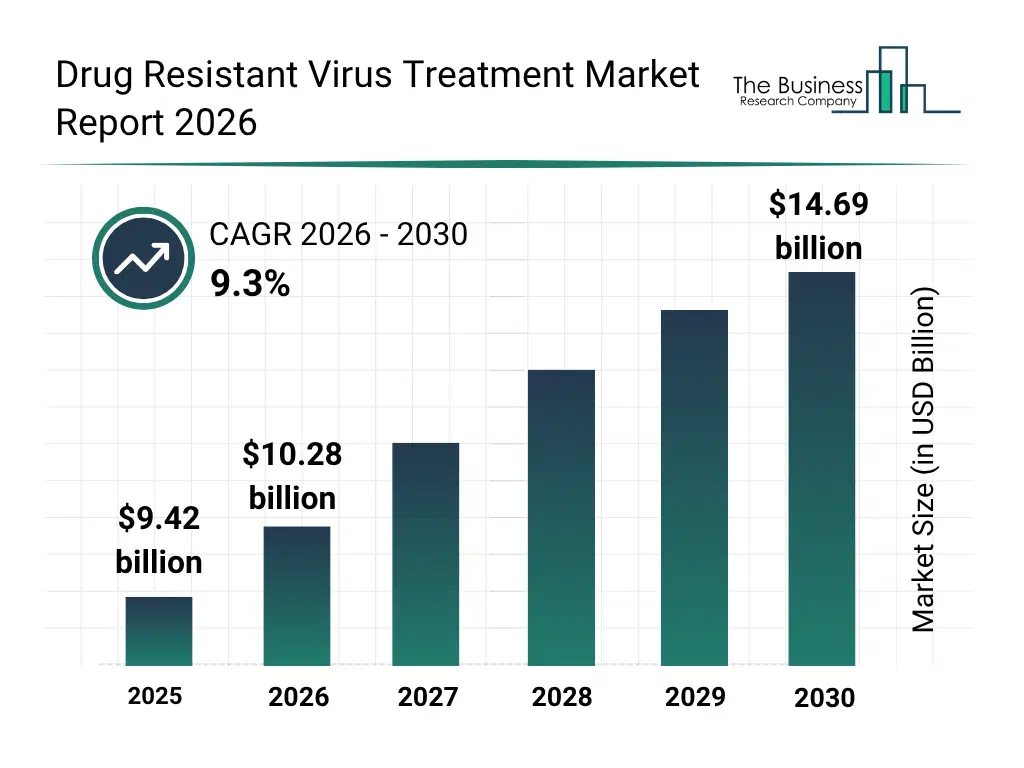
What Is The Drug Resistant Virus Treatment Market Size and Share 2026?
The drug resistant virus treatment market size has grown strongly in recent years.It will grow from $9.42 billion in 2025 to $10.28 billion in 2026 at a compound annual growth rate (CAGR) of 9.1%. The growth in the historic period can be attributed to limited antiviral drug diversity, emergence of hiv and hepatitis drug resistance cases, reliance on single mechanism antiviral therapies, growth of global viral outbreak monitoring systems, increased hospital based infectious disease treatment protocols.What Is The Drug Resistant Virus Treatment Market Growth Forecast?
The drug resistant virus treatment market size is expected to see strong growth in the next few years.It will grow to $14.69 billion by 2030 at a compound annual growth rate (CAGR) of 9.3%. The growth in the forecast period can be attributed to expansion of precision antiviral therapy development, rising prevalence of multi drug resistant viral strains, increased investment in monoclonal antibody research, growth of genomic based resistance tracking, expansion of global pandemic preparedness programs.Major trends in the forecast period include next generation antiviral drug combination therapy adoption, broad spectrum antiviral resistance inhibitor development, personalized viral resistance profiling diagnostics, adaptive clinical trial designs for resistant viral strains, monoclonal antibody based rescue therapy expansion.
Global Drug Resistant Virus Treatment Market Segmentation
1) By Virus Type: Human Immunodeficiency Virus Drug Resistant, Hepatitis B Virus Treatment Experienced, Cytomegalovirus Resistant Or Refractory, Influenza Resistant Strains, Herpes Simplex Virus Or Varicella Zoster Virus Acyclovir Resistant, Other Virus Types 2) By Therapy Class: Small Molecule Antivirals, Long Acting Injectables, Monoclonal Antibodies, Host Targeted Therapies, Combination Regimens 3) By Treatment Setting: Outpatient, Inpatient, Specialty Infusion Centers 4) By Route Of Administration: Oral, Intravenous, Subcutaneous, Intramuscular 5) By End User: Hospitals, Specialty Clinics, Homecare Settings Subsegments: 1) By Human Immunodeficiency Virus Drug Resistant: First Line Resistance, Second Line Resistance, Multi Drug Resistance, Transmitted Drug Resistance, Acquired Drug Resistance 2) By Hepatitis B Virus Treatment Experienced: Nucleoside Analogue Resistant, Lamivudine Resistant, Entecavir Resistant, Tenofovir Partial Response, Multi Drug Resistant Hepatitis B 3) By Cytomegalovirus Resistant Or Refractory: Ganciclovir Resistant, Foscarnet Resistant, Cidofovir Resistant, Multi Drug Resistant Cytomegalovirus, Refractory Cytomegalovirus Infection 4) By Influenza Resistant Strains: Neuraminidase Inhibitor Resistant, Adamantane Resistant, Oseltamivir Resistant, Zanamivir Reduced Susceptibility, Multi Drug Resistant Influenza 5) By Herpes Simplex Virus Or Varicella Zoster Virus Acyclovir Resistant: Acyclovir Resistant Herpes Simplex, Acyclovir Resistant Varicella Zoster, Foscarnet Resistant Herpes Virus, Cidofovir Resistant Herpes Virus, Multi Drug Resistant Herpes Virus 6) By Other Virus Types: Respiratory Syncytial Virus Resistant, Adenovirus Resistant, Enterovirus Resistant, Norovirus Resistant, Emerging Viral Resistant InfectionsWhat Is The Driver Of The Drug Resistant Virus Treatment Market?
The increasing prevalence of antiviral drug resistance is expected to propel the growth of the drug-resistant virus treatment market going forward.Antiviral drug resistance is the ability of a virus to mutate and survive despite treatment with antiviral medications, reducing the drug’s effectiveness.Antiviral drug resistance is rising due to the rapid mutation rates of viruses, which enable them to quickly develop resistance to existing treatments.Drug-resistant virus treatments are used in antiviral drug resistance by employing alternative or combination antiviral therapies that target different viral mechanisms to suppress strains that no longer respond to standard drugs.For instance, in November 2025, the World Health Organization (WHO), a Switzerland-based intergovernmental organization, reported that without mitigation measures, HIV drug resistance to Dolutegravir (DTG) is projected to rise sharply among those failing DTG-based ART, increasing from 18% in 2023 to 42% by 2035.Therefore, the increasing prevalence of antiviral drug resistance is driving the growth of the drug-resistant virus treatment market.Key Players In The Global Drug Resistant Virus Treatment Market
Major companies operating in the drug resistant virus treatment market are Johnson & Johnson, F. Hoffmann-La Roche Ltd., Merck & Co. Inc., Pfizer Inc., AbbVie Inc., Sanofi S. A., Novartis AG, AstraZeneca plc, Bristol-Myers Squibb Company, GlaxoSmithKline plc, Gilead Sciences Inc., Regeneron Pharmaceuticals Inc., Moderna Inc., BioNTech SE, Alnylam Pharmaceuticals Inc., Enanta Pharmaceuticals Inc., Vir Biotechnology Inc., Atea Pharmaceuticals Inc., Arbutus Biopharma Corporation, Chimerix Inc.Global Drug Resistant Virus Treatment Market Trends and Insights
Major companies operating in the drug resistant virus treatment market are focusing on developing innovative therapies such as, twice yearly long acting capsid inhibitor prophylactics to improve adherence and provide sustained protection against drug-resistant viral infections. Twice‑yearly long‑acting capsid inhibitor prophylactics are injectable antiviral therapies that target the viral capsid to block replication over an extended period, helping patients maintain viral suppression and prevent drug-resistant infections with just two doses per year. For instance, in June 2025, Gilead Sciences Inc., a US-based biopharmaceutical company, received U. S. Food and Drug Administration (FDA) approval for Yeztugo (lenacapavir), a twice-yearly long-acting HIV-1 capsid inhibitor indicated for pre-exposure prophylaxis (PrEP) to reduce the risk of sexually acquired HIV-1 infection in adults and adolescents weighing at least 35 kg, making it the first and only twice-yearly PrEP option approved in the United States. Yeztugo is composed of lenacapavir, which inhibits the HIV capsid protein crucial for viral assembly and replication, and is administered as two subcutaneous injections that provide up to six months of protection, offering the key benefits of extended dosing intervals, high efficacy in clinical trials (≥ 99. 9 % protection), and improved adherence compared with daily oral PrEP regimens such as FTC/TDF.What Are Latest Mergers And Acquisitions In The Drug Resistant Virus Treatment Market?
In January 2026, Merck & Co. Inc., a US-based healthcare technology company, acquired Cidara Therapeutics, Inc. for an undisclosed amount. With this acquisition, Merck & Co., Inc. aims to strengthen and diversify its respiratory portfolio by advancing innovative antiviral therapies, accelerating the development of next-generation treatments for infectious diseases, and expanding its presence in the high-growth antiviral market to address unmet medical needs globally. Cidara Therapeutics Inc. is a US-based biotechnology company that specializes in developing long-acting antiviral therapies, including CD388, a potential first-in-class treatment for the prevention of influenza in high-risk individuals.Regional Insights
Asia-Pacific was the largest region in the drug resistant virus treatment market in 2025. Asia-Pacific is expected to be the fastest-growing region in the forecast period. The regions covered in this market report are Asia-Pacific, South East Asia, Western Europe, Eastern Europe, North America, South America, Middle East and Africa. The countries covered in this market report are Australia, Brazil, China, France, Germany, India, Indonesia, Japan, Taiwan, Russia, South Korea, UK, USA, Canada, Italy, Spain.What Defines the Drug Resistant Virus Treatment Market?
The drug resistant virus treatment market consists of revenues earned by entities by providing services such as diagnostic testing for resistant viral strains, personalized antiviral therapies, patient monitoring and management, medical consultation and clinical support, research and development of new drugs, preventive vaccination programs, and telemedicine or remote care services. The market value includes the value of related goods sold by the service provider or included within the service offering. The drug resistant virus treatment market also includes sales of monoclonal antibodies, vaccines, diagnostic kits for resistance detection, rapid test kits, and supportive treatment products. Values in this market are ‘factory gate’ values, that is the value of goods sold by the manufacturers or creators of the goods, whether to other entities (including downstream manufacturers, wholesalers, distributors and retailers) or directly to end customers. The value of goods in this market includes related services sold by the creators of the goods.What is the Market Assessment and Strategic Outlook for the Drug Resistant Virus Treatment Industry?
The drug resistant virus treatment market research report is one of a series of new reports from The Business Research Company that provides market statistics, including industry global market size, regional shares, competitors with the market share, detailed market segments, market trends and opportunities, and any further data you may need to thrive in the drug resistant virus treatment industry. The market research report delivers a complete perspective of everything you need, with an in-depth analysis of the current and future state of the industry.What is the Market Assessment and Strategic Outlook for the Drug Resistant Virus Treatment Market Report 2026?
The drug resistant virus treatment market research report is one of a series of new reports from The Business Research Company that provides drug resistant virus treatment market statistics, including drug resistant virus treatment industry global market size, regional shares, competitors with a drug resistant virus treatment market share, detailed drug resistant virus treatment market segments, market trends and opportunities, and any further data you may need to thrive in the drug resistant virus treatment industry. This drug resistant virus treatment market research report delivers a complete perspective of everything you need, with an in-depth analysis of the current and future scenario of the industry.Drug Resistant Virus Treatment Market Report Forecast Analysis
| Report Attribute | Details |
|---|---|
| Market Size Value In 2026 | $10.28 billion |
| Revenue Forecast In 2035 | $14.69 billion |
| Growth Rate | CAGR of 9.3% from 2026 to 2035 |
| Base Year For Estimation | 2025 |
| Actual Estimates/Historical Data | 2020-2025 |
| Forecast Period | 2026 - 2030 - 2035 |
| Market Representation | Revenue in USD Billion and CAGR from 2026 to 2035 |
| Segments Covered | Virus Type, Therapy Class, Treatment Setting, Route Of Administration, End User |
| Regional Scope | Asia-Pacific, Western Europe, Eastern Europe, North America, South America, Middle East, Africa |
| Country Scope | The countries covered in the report are Australia, Brazil, China, France, Germany, India, Indonesia, Japan, Taiwan, Russia, South Korea, UK, USA, Canada, Italy, Spain. |
| Key Companies Profiled | Johnson & Johnson, F. Hoffmann-La Roche Ltd., Merck & Co. Inc., Pfizer Inc., AbbVie Inc., Sanofi S. A., Novartis AG, AstraZeneca plc, Bristol-Myers Squibb Company, GlaxoSmithKline plc, Gilead Sciences Inc., Regeneron Pharmaceuticals Inc., Moderna Inc., BioNTech SE, Alnylam Pharmaceuticals Inc., Enanta Pharmaceuticals Inc., Vir Biotechnology Inc., Atea Pharmaceuticals Inc., Arbutus Biopharma Corporation, Chimerix Inc. |
| Customization Scope | Request for Customization |
| Pricing And Purchase Options | Explore Purchase Options |