
E-Commerce Outsourcing Market Report 2026
Global Outlook – By Type (Digital Marketing, Customer Service, Order Processing, Content Creation, Product Information Management, Electronic Commerce Website Development And Maintenance, Website And Graphic Design), By Outsourcing Model (End-to-End Outsourcing, Partial or Functional Outsourcing, Managed Services, Project-Based Outsourcing), By Deployment Mode (Cloud-Based, On-Premise), By Application (Small And Medium Enterprises, Large Enterprises), By Industry Vertical (Retail, Consumer Electronics, Fashion And Apparel, Healthcare, Food And Beverage, Beauty And Personal Care, Home And Living, Automotive, Other Industry Verticals) – Market Size, Trends, Strategies, and Forecast to 2030
E-Commerce Outsourcing Market Overview
• e-commerce Outsourcing market size has reached to $78.72 billion in 2025 • Expected to grow to $146.22 billion in 2030 at a compound annual growth rate (CAGR) of 13.2% • Growth Driver: The Growing Digital Transformation Initiatives Accelerating The Growth Of The Market Through Enhanced Adoption Of Advanced Technologies • Market Trend: Advancements In End-To-End Automated Supply Chain Solutions Enhance Operational Efficiency In E-Commerce Outsourcing • North America was the largest region in 2025 and Asia-Pacific is the fastest growing region.What Is Covered Under E-Commerce Outsourcing Market?
E-commerce outsourcing refers to the practice in which businesses delegate part or all of their online commerce operations to third-party service providers. It enables companies to leverage specialized expertise, reduce operational costs, improve efficiency, and focus on core business activities while ensuring scalable and efficient online retail operations. The main types of e-commerce outsourcing include digital marketing, customer service, order processing, content creation, product information management, electronic commerce website development and maintenance, and website and graphic design. Digital marketing refers to services that help businesses promote products and services online through strategies such as search engine optimization, social media marketing, email campaigns, and paid advertising to drive traffic and sales. These solutions are delivered through end-to-end outsourcing, partial or functional outsourcing, managed services, and project-based outsourcing models, and are deployed via cloud-based and on-premise models. The various applications involved are small and medium enterprises and large enterprises, and they are used by several end users such as retail, consumer electronics, fashion and apparel, healthcare, food and beverage, beauty and personal care, home and living, automotive, and other industry verticals.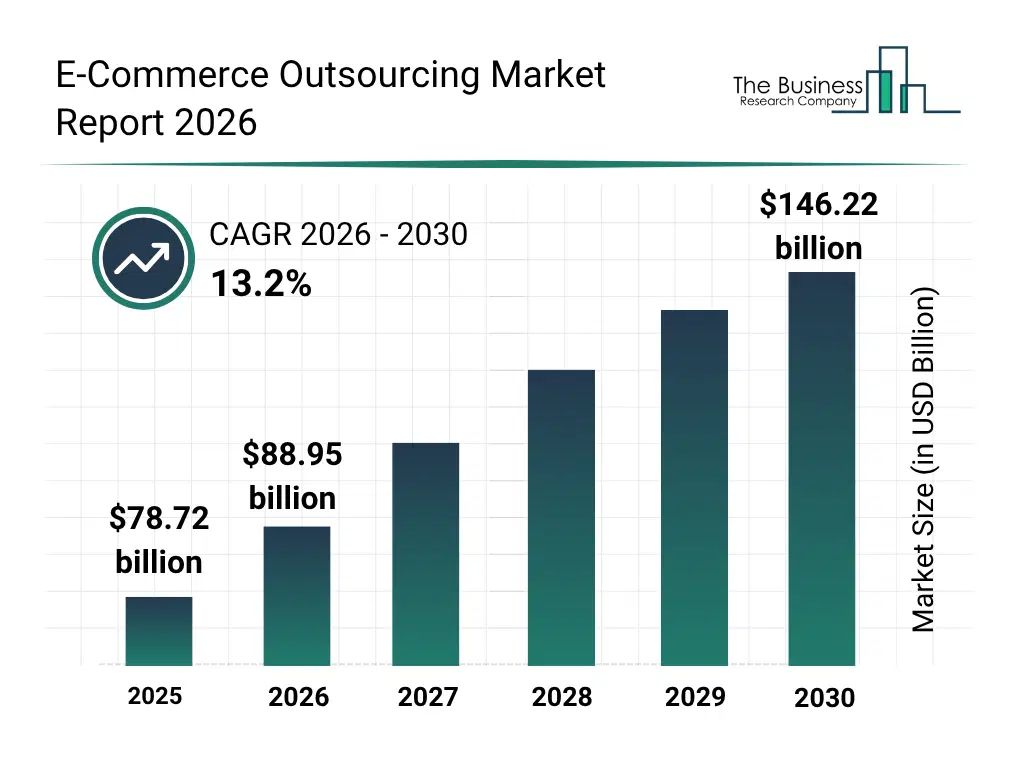
What Is The E-Commerce Outsourcing Market Size and Share 2026?
The e-commerce outsourcing market size has grown rapidly in recent years. It will grow from $78.72 billion in 2025 to $88.95 billion in 2026 at a compound annual growth rate (CAGR) of 13.0%. The growth in the historic period can be attributed to increasing adoption of online retail, rising demand for cost-efficient operations, growing need for specialized digital marketing services, expansion of customer support outsourcing, increasing complexity of product information management.What Is The E-Commerce Outsourcing Market Growth Forecast?
The e-commerce outsourcing market size is expected to see rapid growth in the next few years. It will grow to $146.22 billion in 2030 at a compound annual growth rate (CAGR) of 13.2%. The growth in the forecast period can be attributed to growing adoption of AI-driven marketing and analytics, increasing demand for cloud-based outsourcing platforms, rising focus on omnichannel e-commerce strategies, expansion of mobile commerce and platform integration, increasing need for enhanced website security and performance optimization. Major trends in the forecast period include rising adoption of cloud-based e-commerce outsourcing, growing demand for managed customer service solutions, increasing focus on content creation and localization services, expansion of payment processing and fraud detection services, rising integration of website development and optimization services.
Global E-Commerce Outsourcing Market Segmentation
1) By Type: Digital Marketing, Customer Service, Order Processing, Content Creation, Product Information Management, Electronic Commerce Website Development And Maintenance, Website And Graphic Design 2) By Outsourcing Model: End-to-End Outsourcing, Partial or Functional Outsourcing, Managed Services, Project-Based Outsourcing 3) By Deployment Mode: Cloud-Based, On-Premise 4) By Application: Small And Medium Enterprises, Large Enterprises 5) By Industry Vertical: Retail, Consumer Electronics, Fashion And Apparel, Healthcare, Food And Beverage, Beauty And Personal Care, Home And Living, Automotive, Other Industry Verticals Subsegments: 1) By Digital Marketing: Search Engine Marketing, Social Media Marketing, Email Marketing, Influencer Marketing, Online Advertising Management, Marketing Analytics And Reporting, Conversion Rate Optimization 2) By Customer Service: Email Support Services, Live Chat Support, Voice Support Services, Social Media Customer Support, Technical Support Services, Customer Feedback Management, Customer Retention Services 3) By Order Processing: Order Entry Management, Order Verification Services, Payment Processing Support, Billing And Invoicing Services, Order Tracking And Status Updates, Returns And Refunds Management, Fraud Detection Support 4) By Content Creation: Product Description Writing, Blog And Article Writing, Social Media Content Creation, Video Content Production, Image Content Development, Promotional Content Development, Content Localization Services 5) By Product Information Management: Product Data Collection, Product Data Cleansing, Product Data Enrichment, Catalog Management Services, Attribute And Specification Management, Data Standardization Services, Product Data Syndication 6) By Electronic Commerce Website Development And Maintenance: Website Design And Development, Platform Integration Services, Mobile Commerce Development, Payment Gateway Integration, Website Testing And Quality Assurance, Website Security Management, Performance Optimization Services 7) By Website And Graphic Design: User Interface Design, User Experience Design, Brand Identity Design, Banner And Advertisement Design, Product Image Editing, Landing Page Design, Visual Content OptimizationWhat Is The Driver Of The E-Commerce Outsourcing Market?
The increasing digital transformation initiatives are expected to propel the growth of the e-commerce outsourcing market going forward. Digital transformation initiatives refer to structured efforts by organizations to integrate digital technologies such as cloud computing, artificial intelligence, automation, and data analytics into business operations to improve efficiency, scalability, and customer experience. The increase in digital transformation initiatives is driven by enterprises seeking to modernize operations and remain competitive in an increasingly digital and platform-driven commercial environment. E-commerce outsourcing supports digital transformation initiatives by enabling businesses to access specialized digital skills, advanced technologies, and scalable operational models without large upfront investments. For instance, in November 2023, according to a report published by the Central Digital and Data Office, a UK-based government entity, the government’s focus on digital transformation has resulted in a 9% growth in the Government Digital and Data profession over the past six months, bringing the total number of professionals in this field to 28,337. Therefore, the increasing digital transformation initiatives are driving the growth of the e-commerce outsourcing industry.Key Players In The Global E-Commerce Outsourcing Market
Major companies operating in the e-commerce outsourcing market are Amazon.com Inc., Alibaba Group Holding Limited, FedEx Corporation, Accenture plc, Infosys Limited, Rakuten Group Inc., Wipro Limited, XPO Inc., Shopify Inc., Manhattan Associates Inc., Freshworks Inc., ShipMonk Inc., LivePerson Inc., Cart.com Inc., BigCommerce Holdings Inc., ShipBob Inc., Pattern Inc., Yotpo Ltd., Jungle Scout Inc., SellerApp Inc., Outsource School LLC, and Urban Seller LLC.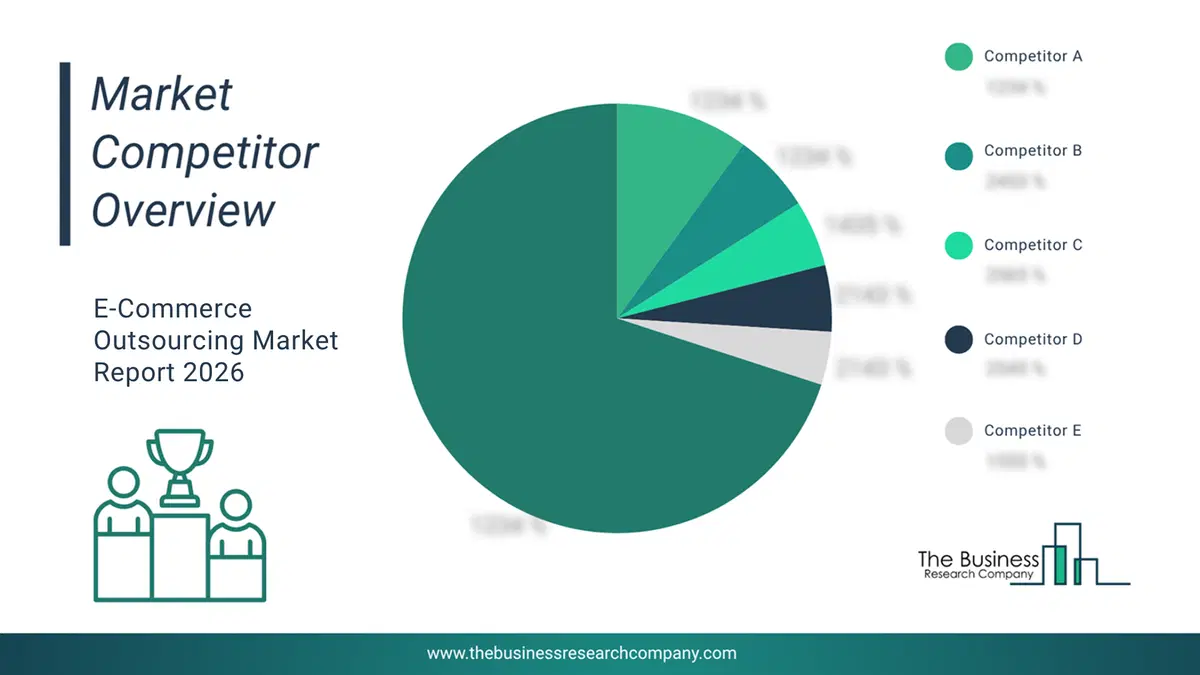
This chart is for illustrative purposes; the full report includes a detailed competitor analysis and comprehensive overview of the top 10 companies in the market.
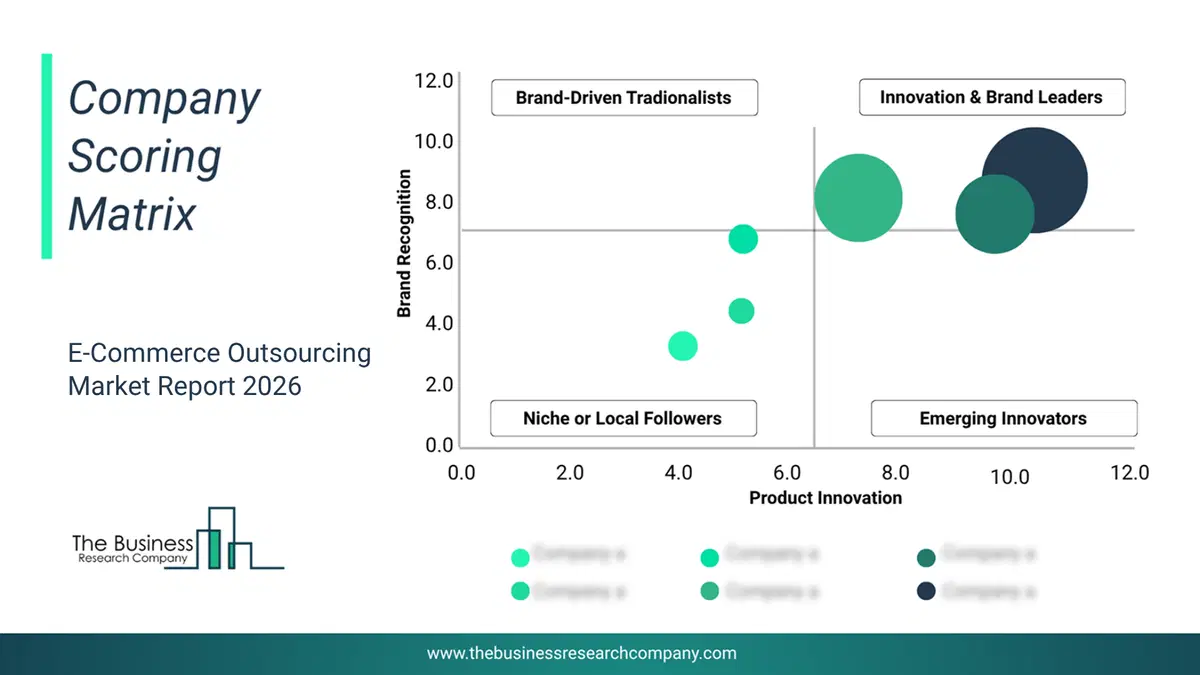
This chart maps companies by product innovation and brand strength, with bubble size indicating relative revenue, helping identify market leaders, challengers, and niche players. This is an illustrative chart; the full report provides a complete and accurate competitive analysis.
Global E-Commerce Outsourcing Market Trends and Insights
Major companies operating in the e-commerce outsourcing market are focusing on developing advanced end-to-end, fully automated solutions to enable brands and retailers to scale efficiently while reducing operational complexity and costs. An end-to-end, fully automated solution is an integrated service system that oversees the complete online selling cycle and that uses automated workflows and interconnected digital systems to minimize manual tasks, enhance operational efficiency, and deliver smooth and reliable performance throughout the e-commerce ecosystem. For instance, in September 2023, Amazon.com, Inc., a US-based e-commerce company, introduced Supply Chain by Amazon, an end-to-end, fully automated set of supply chain services. It offers features such as automatic inventory replenishment across fulfillment centers, multi-channel distribution to manage stock across multiple sales channels, and discounted cross-border shipping up to 25% lower than traditional methods. This solution allows sellers to leverage Amazon's logistics infrastructure while focusing on product development and customer engagement.What Are Latest Mergers And Acquisitions In The E-Commerce Outsourcing Market?
In July 2024, GLS Group, a Netherlands-based provider of parcel delivery, logistics, and cross-border shipping services, acquired iLogistic for an undisclosed amount. With this acquisition, GLS aims to strengthen its position in the e-commerce outsourcing market by expanding its fulfillment capabilities, enhancing value-added logistics services, and offering integrated end-to-end solutions to online merchants across Central and Eastern Europe. iLogistic is a Hungary-based provider of e-commerce fulfillment services, offering warehousing, pick-and-pack operations, inventory management, order processing, and returns handling for online retailers.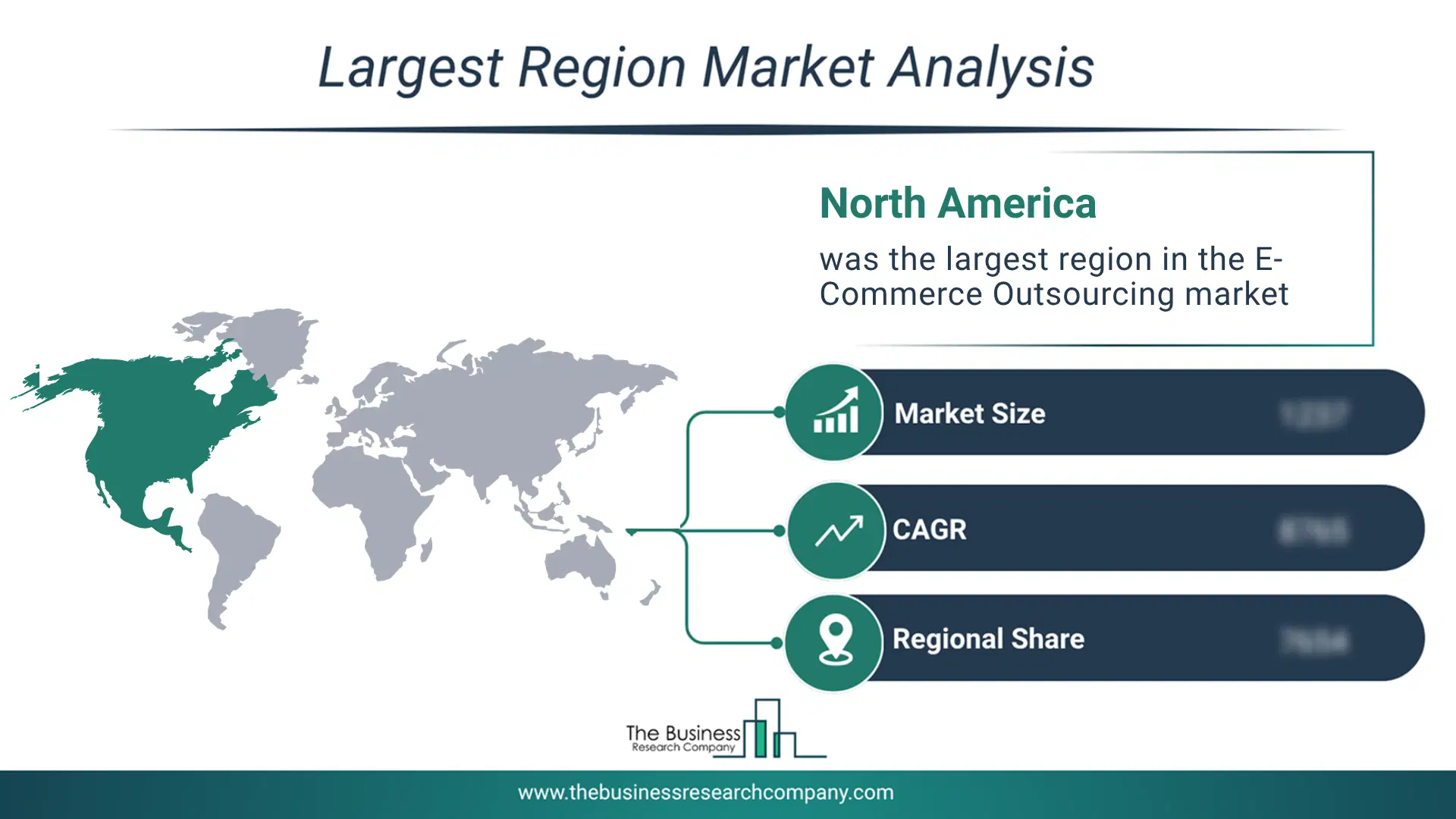
Regional Insights
North America was the largest region in the e-commerce outsourcing market in 2025. Asia-Pacific is expected to be the fastest-growing region in the forecast period. The regions covered in this market report are Asia-Pacific, South East Asia, Western Europe, Eastern Europe, North America, South America, Middle East, Africa. The countries covered in this market report are Australia, Brazil, China, France, Germany, India, Indonesia, Japan, Taiwan, Russia, South Korea, UK, USA, Canada, Italy, Spain.What Defines the E-Commerce Outsourcing Market?
The e-commerce outsourcing market consists of revenues earned by entities by providing services such as storefront and marketplace management, back-office operations, customer relationship management, order fulfillment coordination, analytics, and technical support for e-commerce platforms. The market value includes the value of related goods sold by the service provider or included within the service offering. Only goods and services traded between entities or sold to end consumers are included.How is Market Value Defined and Measured?
The market value is defined as the revenues that enterprises gain from the sale of goods and/or services within the specified market and geography through sales, grants, or donations in terms of the currency (in USD unless otherwise specified). The revenues for a specified geography are consumption values that are revenues generated by organizations in the specified geography within the market, irrespective of where they are produced. It does not include revenues from resales along the supply chain, either further along the supply chain or as part of other products.
This chart presents market attractiveness based on a quantitative evaluation of growth, competition, strategic alignment, and risk, offering a clear view of opportunity areas for decision-making. This chart is for illustrative purposes; the full report contains the complete analysis.

This chart highlights the Total Addressable Market (TAM) by estimating the maximum revenue opportunity using an assumption-driven approach, supporting strategic planning and opportunity sizing across markets. The chart is illustrative; the full report provides a more comprehensive analysis.
What Key Data And Analysis Are Included In The E-Commerce Outsourcing Market Report 2026?
The e-commerce outsourcing market research report is one of a series of new reports from The Business Research Company that provides market statistics, including industry global market size, regional shares, competitors with the market share, detailed market segments, market trends and opportunities, and any further data you may need to thrive in the e-commerce outsourcing industry. The market research report delivers a complete perspective of everything you need, with an in-depth analysis of the current and future state of the industry.E-Commerce Outsourcing Market Report Forecast Analysis
| Report Attribute | Details |
|---|---|
| Market Size Value In 2026 | $88.95 billion |
| Revenue Forecast In 2030 | $146.22 billion |
| Growth Rate | CAGR of 13.2% from 2026 to 2030 |
| Base Year For Estimation | 2025 |
| Actual Estimates/Historical Data | 2020-2025 |
| Forecast Period | 2026 - 2030 |
| Market Representation | Revenue in USD Billion and CAGR from 2026 to 2030 |
| Segments Covered | Type, Outsourcing Model, Deployment Mode, Application, Industry Vertical |
| Regional Scope | Asia-Pacific, Western Europe, Eastern Europe, North America, South America, Middle East, Africa |
| Country Scope | The Countries Covered In This Market Report Are Australia, Brazil, China, France, Germany, India, Indonesia, Japan, Taiwan, Russia, South Korea, Uk, Usa, Canada, Italy, Spain. |
| Key Companies Profiled | Amazon.com Inc., Alibaba Group Holding Limited, FedEx Corporation, Accenture plc, Infosys Limited, Rakuten Group Inc., Wipro Limited, XPO Inc., Shopify Inc., Manhattan Associates Inc., Freshworks Inc., ShipMonk Inc., LivePerson Inc., Cart.com Inc., BigCommerce Holdings Inc., ShipBob Inc., Pattern Inc., Yotpo Ltd., Jungle Scout Inc., SellerApp Inc., Outsource School LLC, and Urban Seller LLC. |
| Customization Scope | Request for Customization |
| Pricing And Purchase Options | Explore Purchase Options |