
Edge Computing Market Report 2026
Global Outlook – By Component (Hardware, Software, Services), By Technology (Mobile Edge Computing, Fog Computing), By Organization Size (Small And Medium-Sized Enterprises, Large Enterprises), By Application (Connected Cars, Smart Grids, Critical Infrastructure Monitoring, Traffic Management, Environmental Monitoring, Augmented Reality, Assets Tracking, Security And Surveillance), By End-User (Financial And Banking Industry, Retail, Healthcare And Life Sciences, Industrial, Energy And Utilities, Telecommunications, Other End-Users) – Market Size, Trends, Strategies, and Forecast to 2030
Edge Computing Market Overview
• Edge Computing market size has reached to $45.14 billion in 2025 • Expected to grow to $273.73 billion in 2030 at a compound annual growth rate (CAGR) of 43.2% • Growth Driver: Rising Adoption Of Internet Of Things (Iot) Driving The Growth Of The Market Due To Automation And Real-Time Data Processing • Market Trend: Companies Accelerate Innovation With Next-Generation Edge Platforms • North America was the largest region in 2025 and Asia-Pacific is the fastest growing region.Market Gains By 2030 – Top Opportunities By Segment
Market Gain identifies the most promising market opportunities by highlighting the segments or products expected to generate the highest incremental revenue growth over the next five years.
What Is Covered Under Edge Computing Market?
Edge computing is a distributed computing framework that processes data closer to its source rather than relying on centralized data centers. This approach reduces latency, enhances real-time processing, and minimizes bandwidth usage by limiting data transmission to central servers. The primary purpose of edge computing is to improve response times, ensure data security, and support applications that require low latency and high processing speed. The main components of edge computing are hardware, software, and services. Hardware in edge computing refers to the physical devices and equipment that enable data processing near the source. The various technologies involved are mobile edge computing and fog computing, which small and medium-sized enterprises and large enterprises provide. The various applications involved are connected cars, smart grids, critical infrastructure monitoring, traffic management, environmental monitoring, augmented reality, assets tracking, security and surveillance used by the financial and banking industry, retail, healthcare and life sciences, industrial, energy and utilities, telecommunications, and other end-users.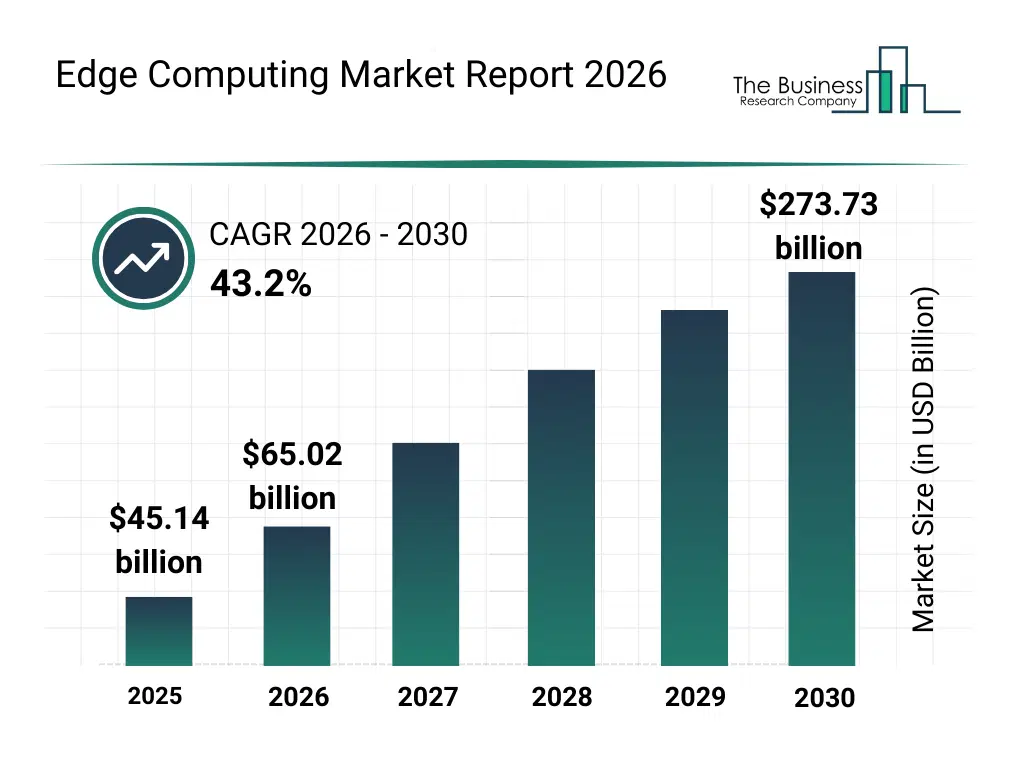
What Is The Edge Computing Market Size and Share 2026?
The edge computing market size has grown exponentially in recent years. It will grow from $45.14 billion in 2025 to $65.02 billion in 2026 at a compound annual growth rate (CAGR) of 44.0%. The growth in the historic period can be attributed to increasing IoT device deployments, early cloud latency limitations, rise in connected sensors, demand for faster data processing, initial smart infrastructure projects.What Is The Edge Computing Market Growth Forecast?
The edge computing market size is expected to see exponential growth in the next few years. It will grow to $273.73 billion in 2030 at a compound annual growth rate (CAGR) of 43.2%. The growth in the forecast period can be attributed to autonomous vehicle proliferation, expansion of 5G networks, growth in industrial automation, increasing real time analytics demand, security driven data localization needs. Major trends in the forecast period include distributed data processing expansion, edge AI deployment growth, low latency application enablement, decentralized infrastructure architectures, real time analytics at the edge.
Global Edge Computing Market Segmentation
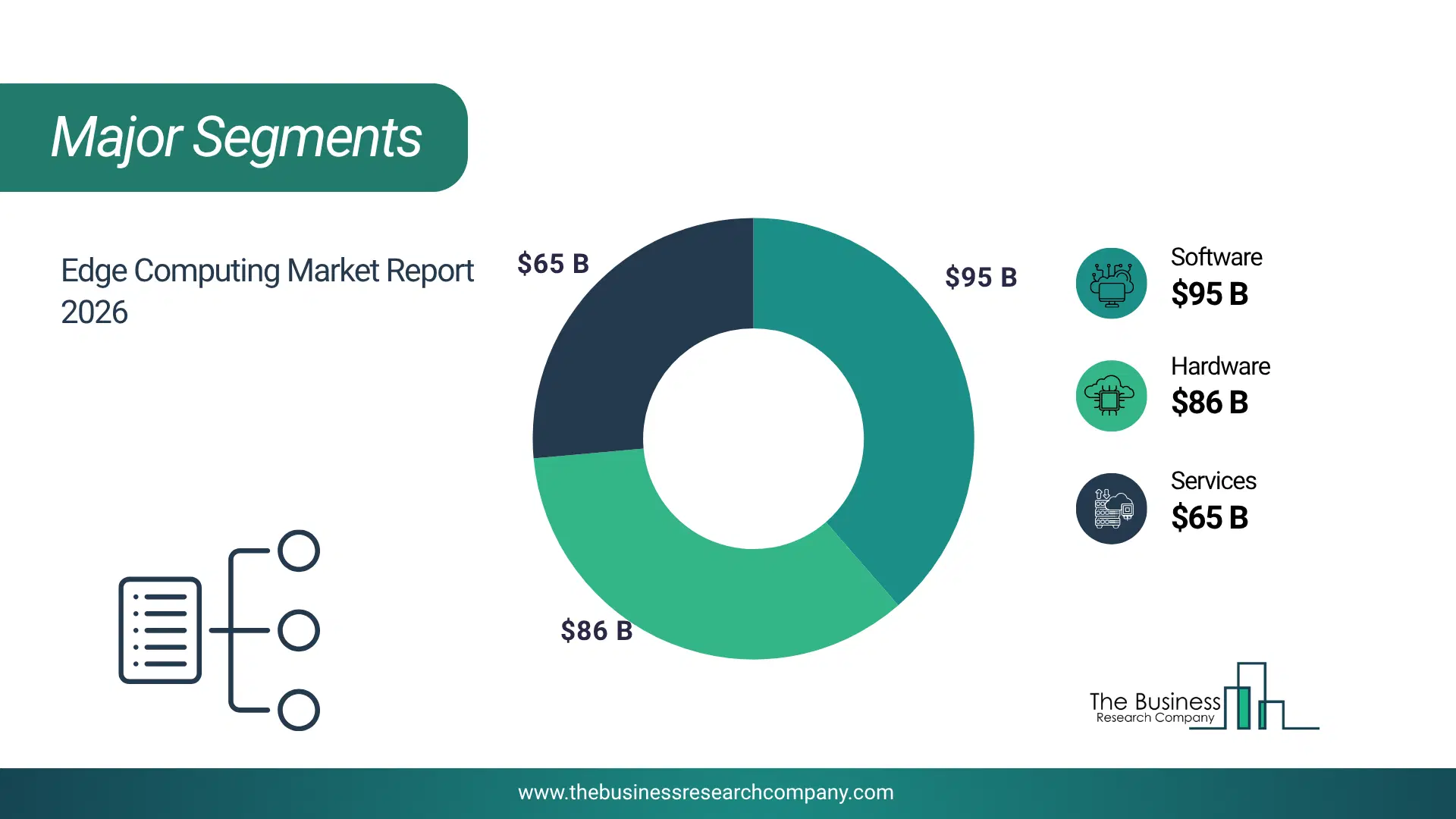
1) By Component: Hardware, Software, Services 2) By Technology: Mobile Edge Computing, Fog Computing 3) By Organization Size: Small And Medium-Sized Enterprises, Large Enterprises 4) By Application: Connected Cars, Smart Grids, Critical Infrastructure Monitoring, Traffic Management, Environmental Monitoring, Augmented Reality, Assets Tracking, Security And Surveillance 5) By End-User: Financial And Banking Industry, Retail, Healthcare And Life Sciences, Industrial, Energy And Utilities, Telecommunications, Other End-Users Subsegments: 1) By Hardware: Edge Servers, Gateways, Routers, Processors, Sensors And Actuators, Networking Equipment 2) By Software: Edge AI Platforms, Edge Data Management Platforms, Edge Security Software, Network Management Software, Application Deployment And Orchestration Platforms 3) By Services: Professional Services, Managed Services The top segments in the edge computing market will be: • Software will reach $94.65 Billion by 2030. • Hardware will reach $85.85 Billion by 2030. • Services will reach $64.72 Billion by 2030.What Is The Driver Of The Edge Computing Market?
The increasing adoption of the Internet of Things (IoT) is expected to propel the growth of the edge computing market going forward. Internet of Things (IoT) refers to the network of physical devices, vehicles, appliances, sensors, and other objects embedded with software, sensors, and connectivity that allow them to collect, exchange, and interact with data over the Internet. The increasing adoption of IoT is due to the growing need for automation efficiency and data-driven decision-making. As industries and consumers seek to improve operational efficiency and reduce human intervention, IoT enables the automation of various tasks by connecting devices and systems. Internet of Things (IoT) is closely integrated with edge computing to enable real-time data processing and decision-making at or near the source of data generation rather than relying on distant data centers. For instance, in October 2025, according to the IoT Analytics, a Germany-based, a leading global provider of market insights, the number of connected IoT devices is projected to grow by 14% in 2025, reaching 39 billion by 2030. Therefore, the increasing adoption of the Internet of Things (IoT) is driving the growth of the edge computing industry.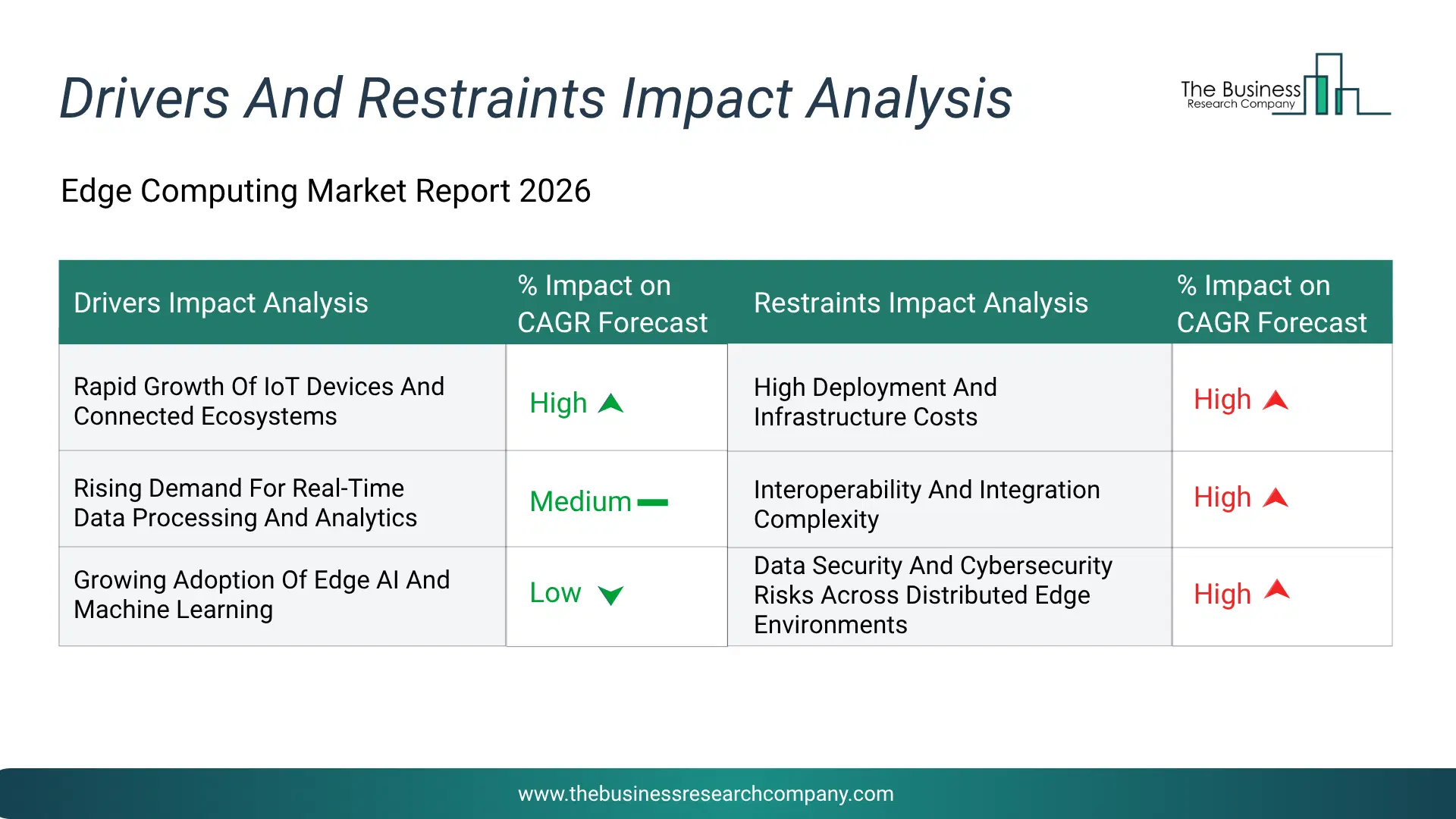
Infographic Chart Showing Key Market Drivers Analysis And Restraints For Edge Computing Market
The chart presents an impact analysis of key drivers and restraints, quantifying their relative influence on the market's growth rate and helping assess the balance between growth enablers and limiting factors. This chart offers a high-level perspective; the full report contains more detailed insights.
How Will The Drivers Impact Growth In The Global Edge Computing Market?
• Rapid Growth Of IoT Devices And Connected Ecosystems (High) – During the forecast period, the rapid growth of IoT devices and connected ecosystems is expected to become a key growth driver for the edge computing market by 2030. Billions of connected sensors, industrial machines, consumer devices, and smart infrastructure systems are generating massive volumes of data that require efficient local processing. Edge computing enables organizations to process this data closer to its source, minimizing network congestion, optimizing bandwidth utilization, and improving operational efficiency across distributed environments. Enterprises are increasingly deploying edge infrastructure to support large-scale IoT implementations while ensuring reliable and continuous system performance. • Rising Demand For Real-Time Data Processing And Analytics (Medium) – During the forecast period, the rising demand for real-time data processing and analytics is expected to emerge as a major factor driving the expansion of the edge computing market by 2030. Organizations are increasingly deploying latency-sensitive applications that require immediate insights to support critical operations and customer-facing services. Edge computing enables faster execution of workloads by reducing dependence on distant cloud infrastructure and delivering near-instantaneous data processing capabilities. The growing digitalization of industrial operations, enterprise networks, and intelligent infrastructure is further strengthening the adoption of distributed computing architectures. • Growing Adoption Of Edge AI And Machine Learning (Low) – During the forecast period, the growing adoption of edge AI and machine learning is expected to act as a key growth catalyst for the edge computing market by 2030. Businesses are increasingly deploying intelligent applications that require AI inference directly on edge devices to enhance responsiveness, operational autonomy, and decision accuracy. Processing AI workloads locally improves data privacy, reduces communication overhead, and enables continuous operation even in environments with limited network connectivity. Advancements in AI-enabled processors, software frameworks, and intelligent edge platforms are further accelerating enterprise investments in distributed AI infrastructure.How Will The Restraints Impact Growth In The Global Edge Computing Market?
• High Deployment And Infrastructure Costs (High) – During the forecast period, the high deployment and infrastructure costs act as a significant restraint on the edge computing market because implementing edge architectures requires substantial investments in hardware, software, networking, and maintenance. Organizations must deploy edge servers, gateways, processors, storage systems, and connectivity solutions across multiple locations to process data closer to end devices. Unlike centralized cloud environments, edge computing requires distributed infrastructure, which increases capital expenditure and operational complexity. Businesses must also invest in system integration, cybersecurity measures, and workforce training to manage edge environments effectively. For small and medium-sized enterprises, these upfront and ongoing costs can be difficult to justify, especially when return on investment may take time to materialize. Additionally, maintaining and upgrading numerous edge nodes across geographically dispersed locations further increases operational expenses. As a result, cost concerns can delay deployment decisions and limit adoption among budget-conscious organizations, thereby restraining overall market growth. • Interoperability And Integration Complexity (Medium) – During the forecast period, the interoperability and integration complexity restrain the edge computing market by creating challenges in connecting diverse devices, platforms, and existing IT infrastructure. Edge environments often consist of equipment from multiple vendors, each using different communication protocols, software frameworks, and hardware specifications. Integrating these components with legacy systems, cloud platforms, and enterprise applications can be technically demanding and time-consuming. Organizations may face difficulties in ensuring seamless data exchange, consistent performance, and centralized management across distributed edge networks. The absence of universally accepted standards further complicates deployment and increases the risk of compatibility issues. These challenges often require specialized expertise, additional customization, and higher implementation costs, extending project timelines and reducing operational efficiency. Consequently, many enterprises may hesitate to adopt or scale edge computing solutions, slowing market expansion and limiting the realization of the technology’s full potential. • Data Security And Cybersecurity Risks Across Distributed Edge Environments (Low) – During the forecast period, the data security and cybersecurity risks across distributed edge environments are expected to restrain the growth of the edge computing market. Edge computing deployments distribute computing resources across numerous edge nodes, gateways, and connected devices, significantly expanding the potential attack surface for cyber threats. Protecting data processed and stored at geographically dispersed edge locations is more complex than securing centralized cloud environments, as each edge node may be vulnerable to unauthorized access, malware, ransomware, and physical tampering. Organizations must implement robust encryption, identity and access management, endpoint protection, and continuous security monitoring to safeguard sensitive data and ensure secure communication between edge devices and cloud platforms. In addition, compliance with evolving data protection regulations and industry-specific security standards further increases implementation complexity and operational costs. These security concerns may discourage organizations from deploying large-scale edge computing infrastructure, particularly in industries handling critical or sensitive information. Consequently, data security and cybersecurity risks across distributed edge environments remain a significant restraint on the growth of the edge computing market.Key Players In The Global Edge Computing Market
Major companies operating in the edge computing market are Microsoft Corporation, Amazon Web Services Inc, Dell Inc, Siemens AG, Lenovo Group Limited, Intel Corporation, International Business Machines Corporation, Cisco Systems Inc, Schneider Electric, Google Cloud, Hewlett Packard Enterprise (HPE), NVIDIA Corporation, Eaton Corporation plc, WINSYSTEMS Inc, Rockwell Automation, Super Micro Computer Inc, Advantech Co Ltd, ADLINK Technology Inc, Stratus Technologies, Scale Computing, Foghorn Consulting, ClearBlade, GE Digital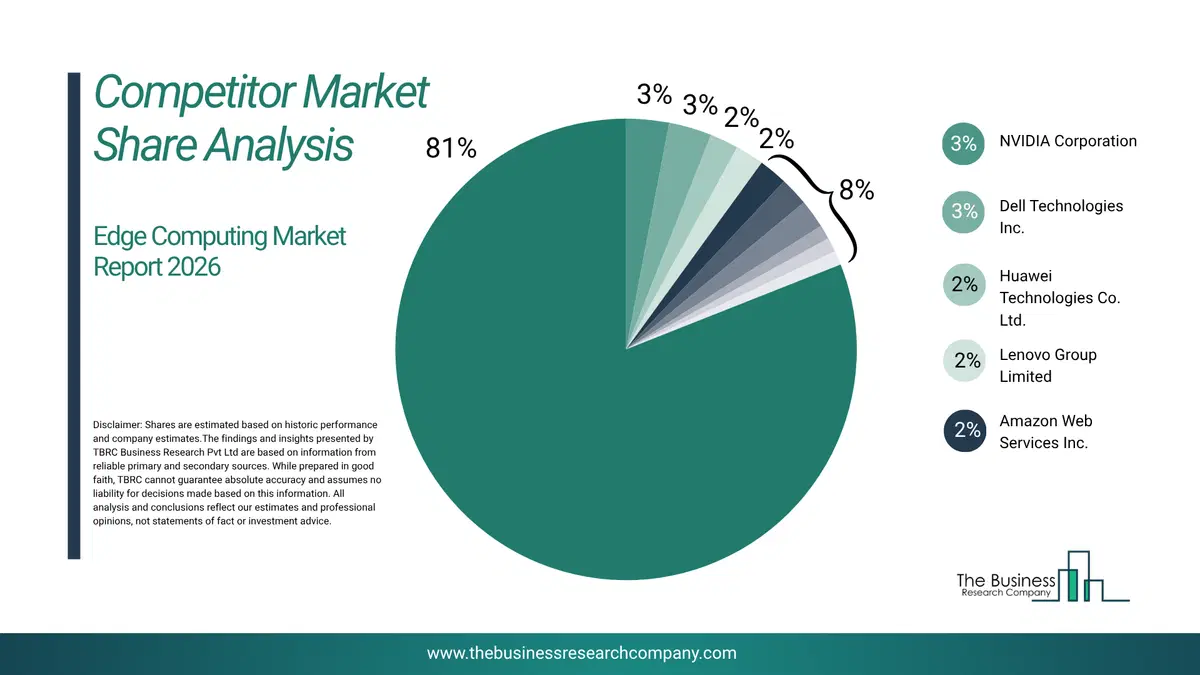
This chart is for illustrative purposes; the full report includes a detailed competitor analysis and comprehensive overview of the top 10 companies in the market.
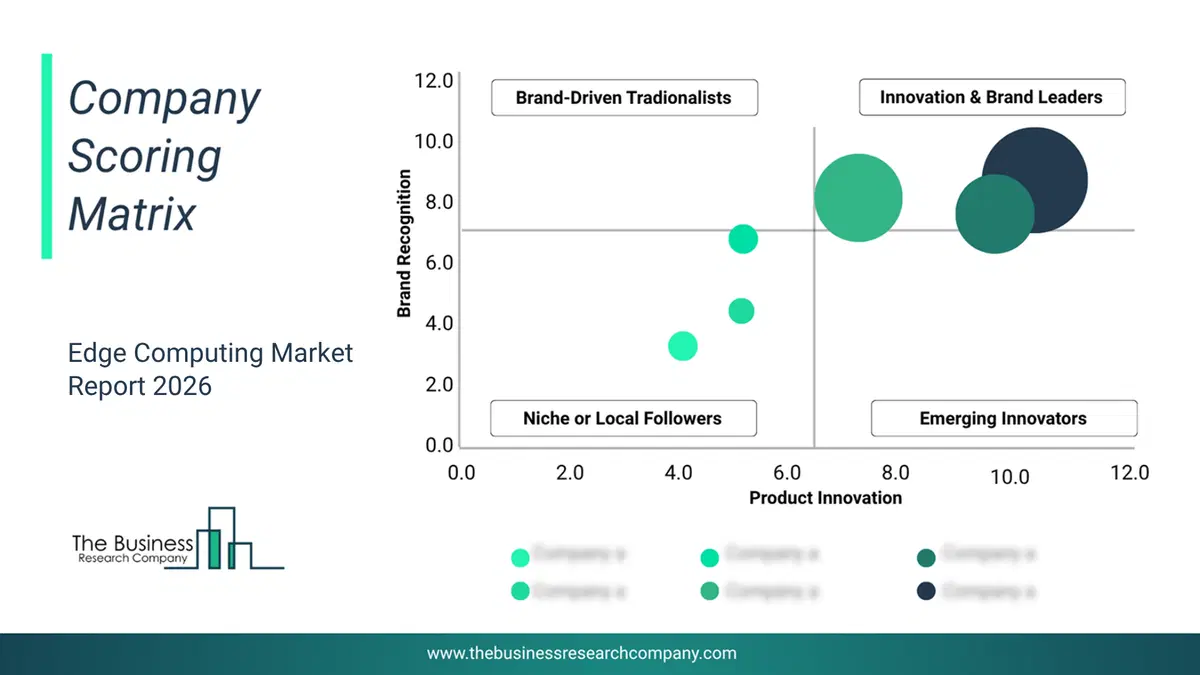
This chart maps companies by product innovation and brand strength, with bubble size indicating relative revenue, helping identify market leaders, challengers, and niche players. This is an illustrative chart; the full report provides a complete and accurate competitive analysis.
Global Edge Computing Market Trends and Insights
Major companies operating in the edge-computing market are focusing on developing innovative products, such as modular converged edge platforms, to bring real-time, AI-powered computing closer to where data is generated. A modular converged edge platform is a scalable system that integrates compute, storage, networking, and security in a serviceable chassis for distributed edge deployments. For instance, in November 2025, Cisco Systems Inc., a US-based technology company, launched the Cisco Unified Edge platform. The platform is built for low-latency agentic and physical AI workloads, offering AI-ready performance at the edge by extending data center scale to distributed locations. It unifies compute, storage, and networking in a modular chassis with configurable CPU or GPU options and redundant power or cooling to meet diverse edge demands. Operational simplicity is provided through zero-touch deployment, centralized fleet management via Cisco Intersight, and end-to-end observability using integrations such as Splunk and ThousandEyes.What Are Latest Mergers And Acquisitions In The Edge Computing Market?
In August 2025, Acumera Inc., a US-based technology company, acquired Scale Computing Inc. for an undisclosed amount. With this acquisition, Acumera aims to combine its secure networking and SaaS edge-management platforms with Scale’s virtualization and AI-ready infrastructure to build a more integrated, scalable edge-software company serving distributed enterprises. Scale Computing Inc. is a US-based technology company that offers edge computing solutions.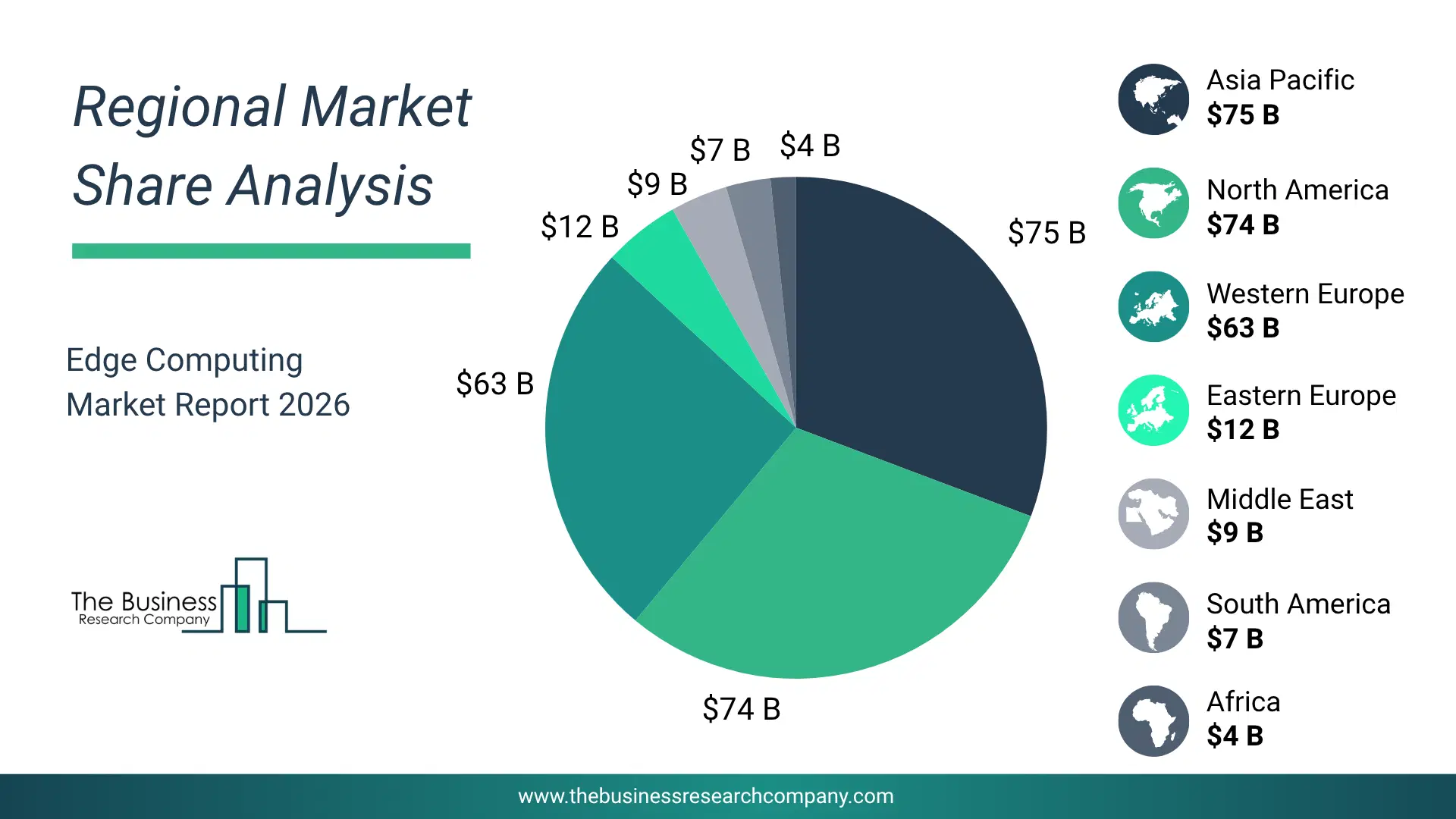
Regional Insights
North America was the largest region in the edge computing market in 2025. Asia-Pacific is expected to be the fastest-growing region in the forecast period. The regions covered in this market report are Asia-Pacific, South East Asia, Western Europe, Eastern Europe, North America, South America, Middle East, Africa. The countries covered in this market report are Australia, Brazil, China, France, Germany, India, Indonesia, Japan, Taiwan, Russia, South Korea, UK, USA, Canada, Italy, Spain.What Defines the Edge Computing Market?
The edge computing market consists of revenues earned by entities providing services such as real-time data processing, AI and machine learning at the edge, and IoT device management. The market value includes the value of related goods sold by the service provider or included within the service offering. The edge computing market also includes sales of edge servers and gateways, edge AI chips and processors, and IoT sensors and devices. Values in this market are ‘factory gate’ values, that is the value of goods sold by the manufacturers or creators of the goods, whether to other entities (including downstream manufacturers, wholesalers, distributors and retailers) or directly to end customers. The value of goods in this market includes related services sold by the creators of the goods.How is Market Value Defined and Measured?
The market value is defined as the revenues that enterprises gain from the sale of goods and/or services within the specified market and geography through sales, grants, or donations in terms of the currency (in USD unless otherwise specified). The revenues for a specified geography are consumption values that are revenues generated by organizations in the specified geography within the market, irrespective of where they are produced. It does not include revenues from resales along the supply chain, either further along the supply chain or as part of other products.
This chart presents market attractiveness based on a quantitative evaluation of growth, competition, strategic alignment, and risk, offering a clear view of opportunity areas for decision-making. This chart is for illustrative purposes; the full report contains the complete analysis.

This chart highlights the Total Addressable Market (TAM) by estimating the maximum revenue opportunity using an assumption-driven approach, supporting strategic planning and opportunity sizing across markets. The chart is illustrative; the full report provides a more comprehensive analysis.
What Key Data and Analysis Are Included in the Edge Computing Market Report 2026?
The edge computing market research report is one of a series of new reports from The Business Research Company that provides market statistics, including industry global market size, regional shares, competitors with the market share, detailed market segments, market trends and opportunities, and any further data you may need to thrive in the edge computing industry. The market research report delivers a complete perspective of everything you need, with an in-depth analysis of the current and future state of the industry.Edge Computing Market Report Forecast Analysis
| Report Attribute | Details |
|---|---|
| Market Size Value In 2026 | $65.02 billion |
| Revenue Forecast In 2030 | $273.73 billion |
| Growth Rate | CAGR of 44.0% from 2026 to 2030 |
| Base Year For Estimation | 2025 |
| Actual Estimates/Historical Data | 2020-2025 |
| Forecast Period | 2026 - 2030 |
| Market Representation | Revenue in USD Billion and CAGR from 2026 to 2030 |
| Segments Covered | Component, Technology, Organization Size, Application, End-User |
| Regional Scope | Asia-Pacific, Western Europe, Eastern Europe, North America, South America, Middle East, Africa |
| Country Scope | The countries covered in the report are Australia, Brazil, China, France, Germany, India, Indonesia, Japan, Taiwan, Russia, South Korea, UK, USA, Canada, Italy, Spain. |
| Key Companies Profiled | Microsoft Corporation, Amazon Web Services Inc, Dell Inc, Siemens AG, Lenovo Group Limited, Intel Corporation, International Business Machines Corporation, Cisco Systems Inc, Schneider Electric, Google Cloud, Hewlett Packard Enterprise (HPE), NVIDIA Corporation, Eaton Corporation plc, WINSYSTEMS Inc, Rockwell Automation, Super Micro Computer Inc, Advantech Co Ltd, ADLINK Technology Inc, Stratus Technologies, Scale Computing, Foghorn Consulting, ClearBlade, GE Digital |
| Customization Scope | Request for Customization |
| Pricing And Purchase Options | Explore Purchase Options |