

Edible Coatings For Produce Market Report 2026
Global Outlook – By Product Type (Polysaccharide-Based Coatings, Protein-Based Coatings, Lipid-Based Coatings, Composite Coatings, Other Product Types), By Function (Shelf Life Extension, Quality Maintenance, Antimicrobial Protection, Other Functions), By Distribution Channel (Direct Sales, Distributors, Online Retail, Other Distribution Channels), By Application (Fruits, Vegetables, Other Applications) – Market Size, Trends, Strategies, and Forecast to 2035
Edible Coatings For Produce Market Overview
• Edible Coatings For Produce market size has reached to $1.12 billion in 2025 • Expected to grow to $1.62 billion in 2030 at a compound annual growth rate (CAGR) of 7.7% • Growth Driver: Rising Consumption Of Fresh Fruits And Vegetables Driving The Growth Of The Market Due To Increasing Health Awareness And Demand For Extended Shelf Life • Market Trend: Allergen-Free And GMO-Free Formulations Transform Post-Harvest Preservation • North America was the largest region in 2025 and Asia-Pacific is the fastest growing region.What Is Covered Under Edible Coatings For Produce Market?
Edible coatings for produce are thin, consumable layers applied to fruits and vegetables to extend shelf life and maintain quality. They form a protective barrier that reduces moisture loss, slows down ripening, and minimizes microbial growth. These coatings can be made from natural polymers, proteins, lipids, or combinations, and are safe for direct consumption. The main product types of edible coatings for produce include polysaccharide-based coatings, protein-based coatings, lipid-based coatings, composite coatings, and other product types. Polysaccharide-based coatings refer to natural carbohydrate-derived films applied on produce surfaces to reduce moisture loss and enhance freshness retention. The different functions include shelf life extension, quality maintenance, antimicrobial protection, and other functions. The various distribution channels include direct sales, distributors, online retail, and other distribution channels and they used various applications involved are fruits, vegetables, and other applications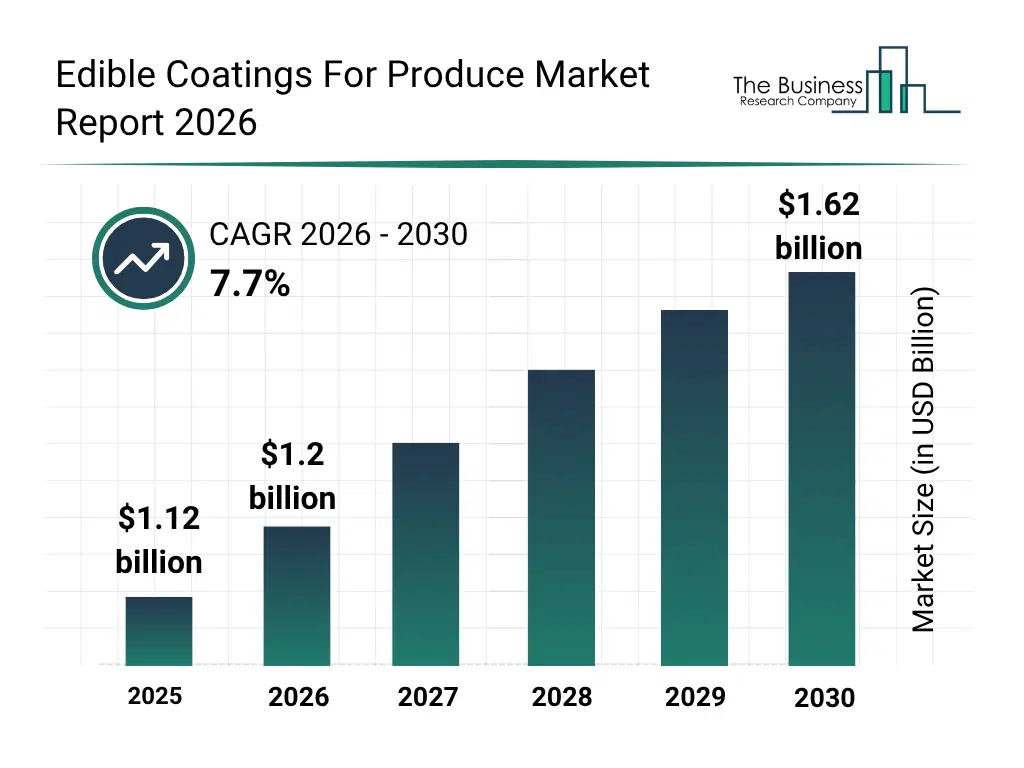
What Is The Edible Coatings For Produce Market Size and Share 2026?
The edible coatings for produce market size has grown strongly in recent years.It will grow from $1.12 billion in 2025 to $1.2 billion in 2026 at a compound annual growth rate (CAGR) of 7.5%. The growth in the historic period can be attributed to growing demand for extended shelf life of fresh produce, increasing consumer preference for natural food preservation methods, rising concerns regarding food wastage reduction, expansion of global fresh fruit and vegetable trade, advancements in edible biopolymer coating technologies.What Is The Edible Coatings For Produce Market Growth Forecast?
The edible coatings for produce market size is expected to see strong growth in the next few years.It will grow to $1.62 billion by 2030 at a compound annual growth rate (CAGR) of 7.7%. The growth in the forecast period can be attributed to increasing adoption of sustainable food preservation solutions, rising demand for clean label and chemical free produce coatings, growing investment in bio based coating material research, expansion of smart post harvest supply chain systems, increasing use of nanocomposite edible coatings for enhanced protection.Major trends in the forecast period include increasing adoption of natural edible coatings for fresh produce preservation, rising demand for antimicrobial edible coatings to reduce spoilage, growing use of plant based coating ingredients for clean label food protection, expansion of composite edible coatings for enhanced moisture retention, increasing preference for biodegradable post harvest preservation solutions.
Global Edible Coatings For Produce Market Segmentation
1) By Product Type: Polysaccharide-Based Coatings, Protein-Based Coatings, Lipid-Based Coatings, Composite Coatings, Other Product Types 2) By Function: Shelf Life Extension, Quality Maintenance, Antimicrobial Protection, Other Functions 3) By Distribution Channel: Direct Sales, Distributors, Online Retail, Other Distribution Channels 4) By Application: Fruits, Vegetables, Other Applications Subsegments: 1) By Polysaccharide-Based Coatings: Cellulose Derivatives, Starch-Based Coatings, Pectin-Based Coatings, Alginate-Based Coatings, Chitosan-Based Coatings, Carrageenan-Based Coatings, Gum-Based Coatings 2) By Protein-Based Coatings: Whey Protein Coatings, Casein Protein Coatings, Gelatin-Based Coatings, Soy Protein Coatings, Pea Protein Coatings, Zein Protein Coatings, Wheat Gluten Coatings 3) By Lipid-Based Coatings: Wax-Based Coatings, Fatty Acid-Based Coatings, Monoglyceride-Based Coatings, Diglyceride-Based Coatings, Vegetable Oil-Based Coatings, Resin-Based Coatings 4) By Composite Coatings: Polysaccharide And Lipid Composite Coatings, Protein And Lipid Composite Coatings, Protein And Polysaccharide Composite Coatings, Multilayer Composite Coatings, Nanocomposite Edible Coatings 5) By Other Product Types: Aloe Vera-Based Coatings, Plant Extract-Based Coatings, Essential Oil-Based Coatings, Herbal Extract-Based Coatings, Bioactive Compound-Based CoatingsWhat Is The Driver Of The Edible Coatings For Produce Market?
The growing consumption of fresh fruits and vegetables is expected to propel the growth of the edible coatings for produce industry going forward.Fresh fruits and vegetables are natural, unprocessed plant-based foods that are harvested at their peak ripeness for immediate consumption or minimal storage.The consumption of fresh fruits and vegetables is rising due to growing health awareness, as more people recognize their role in providing essential nutrients, boosting immunity, and reducing the risk of chronic diseases.The increasing demand for fresh fruits and vegetables fuels the need for edible coatings, as these coatings preserve freshness, extend shelf life, and maintain quality during storage and transport.For instance, in June 2025, according to the Department for Environment, Food and Rural Affairs, a UK-based government agency, the value of domestically produced fruit rose to nearly $1.47 billion (£1.1 billion) in 2024, marking a 4.5% increase from 2023.Therefore, the growing consumption of fresh fruits and vegetables is driving the growth of the edible coatings for produce industry.Key Players In The Global Edible Coatings For Produce Market
Major companies operating in the edible coatings for produce market are Ingredion Inc., John Bean Technologies Corporation, AgroFresh Solutions Inc., Pace International LLC, Apeel Sciences Inc., Mantrose-Haeuser Co. Inc., NatureSeal Holdings LLC, Citrosol Group, Hazel Technologies Inc., Decco U. S. Post-Harvest Inc., Sufresca Ltd., Xeda International S. A., Mori Inc., Akorn Technology Inc., PolyNatural, GreenPod Labs, Ryp Labs, AgriCoat NatureSeal Ltd., Fomesa Fruitech S. L., Liquidseal B. V.Global Edible Coatings For Produce Market Trends and Insights
Major companies operating in the edible coatings for produce market are focusing on developing innovative solutions, such as allergen-free and GMO-free formulations, to enhance shelf life, preserve freshness, maintain colour and texture, reduce food waste, and meet consumer demand for clean-label and natural produce. Allergen-free and GMO-free formulations are food coatings and treatments designed without common allergens or genetically modified ingredients, ensuring safety and natural integrity for consumers. For instance, in November 2025, Agricoat NatureSeal Ltd., a UK-based specialist in edible coatings and post-harvest preservation, showcased its NatureSeal portfolio at Fruit Attraction 2025, highlighting solutions designed to maintain freshness, colour, and texture in fresh-cut fruits and vegetables. The display included side-by-side comparisons of treated versus untreated produce, such as avocado, apple, banana, potato, and guacamole, demonstrating extended shelf life and improved visual appeal. The plant-based NatureSeal coatings form an invisible barrier to retain colour, texture, and flavour, while the chlorine-free NatureSeal First Step (FS) produce wash effectively controls spoilage organisms without impacting taste, supporting organic production standards. Recent innovations, including the sulphite-free NatureSeal PT1, prevent browning in peeled, sliced, or diced potatoes for up to 48 hours in ambient air and up to 10 days under vacuum packaging, without altering flavour or cooking performance. By combining allergen-free, GMO-free, and Kosher/Halal-compliant formulations with post-harvest preservation and sustainable packaging solutions, Agricoat NatureSeal enhances product quality, reduces waste, and strengthens its position as a global provider of shelf-life extension technologies for fresh-cut produce.What Are Latest Mergers And Acquisitions In The Edible Coatings For Produce Market?
In March 2024, AgroFresh Inc., a US-based provider of post-harvest produce freshness solutions, acquired Pace International LLC for an undisclosed amount. As a result of the acquisition, AgroFresh has strengthened its presence in major fruit-growing regions across North and South America. This expansion allows the company to better serve its global customers with enhanced quality and freshness solutions for high-value, highly perishable crops. Pace International LLC is a US-based manufacturer of edible coatings for produce.Regional Insights
North America was the largest region in the edible coatings for produce market in 2025. Asia-Pacific is expected to be the fastest-growing region in the forecast period. The regions covered in this market report are Asia-Pacific, South East Asia, Western Europe, Eastern Europe, North America, South America, Middle East and Africa. The countries covered in this market report are Australia, Brazil, China, France, Germany, India, Indonesia, Japan, Taiwan, Russia, South Korea, UK, USA, Canada, Italy, Spain.What Defines the Edible Coatings For Produce Market?
The edible coatings for produce market consists of sales of cellulose-based coatings, chitosan coatings, alginate coatings, carnauba coatings, and beeswax coatings. Values in this market are ‘factory gate’ values, that is the value of goods sold by the manufacturers or creators of the goods, whether to other entities (including downstream manufacturers, wholesalers, distributors and retailers) or directly to end customers. The value of goods in this market includes related services sold by the creators of the goods.What is the Market Assessment and Strategic Outlook for the Edible Coatings For Produce Industry?
The edible coatings for produce market research report is one of a series of new reports from The Business Research Company that provides market statistics, including industry global market size, regional shares, competitors with the market share, detailed market segments, market trends and opportunities, and any further data you may need to thrive in the edible coatings for produce industry. The market research report delivers a complete perspective of everything you need, with an in-depth analysis of the current and future state of the industry.What is the Market Assessment and Strategic Outlook for the Edible Coatings For Produce Market Report 2026?
The edible coatings for produce market research report is one of a series of new reports from The Business Research Company that provides edible coatings for produce market statistics, including edible coatings for produce industry global market size, regional shares, competitors with a edible coatings for produce market share, detailed edible coatings for produce market segments, market trends and opportunities, and any further data you may need to thrive in the edible coatings for produce industry. This edible coatings for produce market research report delivers a complete perspective of everything you need, with an in-depth analysis of the current and future scenario of the industry.Edible Coatings For Produce Market Report Forecast Analysis
| Report Attribute | Details |
|---|---|
| Market Size Value In 2026 | $1.2 billion |
| Revenue Forecast In 2035 | $1.62 billion |
| Growth Rate | CAGR of 7.7% from 2026 to 2035 |
| Base Year For Estimation | 2025 |
| Actual Estimates/Historical Data | 2020-2025 |
| Forecast Period | 2026 - 2030 - 2035 |
| Market Representation | Revenue in USD Billion and CAGR from 2026 to 2035 |
| Segments Covered | Product Type, Function, Distribution Channel, Application |
| Regional Scope | Asia-Pacific, Western Europe, Eastern Europe, North America, South America, Middle East, Africa |
| Country Scope | The countries covered in the report are Australia, Brazil, China, France, Germany, India, Indonesia, Japan, Taiwan, Russia, South Korea, UK, USA, Canada, Italy, Spain. |
| Key Companies Profiled | Ingredion Inc., John Bean Technologies Corporation, AgroFresh Solutions Inc., Pace International LLC, Apeel Sciences Inc., Mantrose-Haeuser Co. Inc., NatureSeal Holdings LLC, Citrosol Group, Hazel Technologies Inc., Decco U. S. Post-Harvest Inc., Sufresca Ltd., Xeda International S. A., Mori Inc., Akorn Technology Inc., PolyNatural, GreenPod Labs, Ryp Labs, AgriCoat NatureSeal Ltd., Fomesa Fruitech S. L., Liquidseal B. V. |
| Customization Scope | Request for Customization |
| Pricing And Purchase Options | Explore Purchase Options |