
Dehydrated Vegetables Market Report 2026
Global Outlook – By Product Type (Carrot, Onions, Potatoes, Broccoli, Beans, Peas, Cabbage, Mushrooms, Tomatoes, Other Product Types), By Technology (Vacuum Drying, Air Drying, Spray Drying, Freeze Drying, Drum Drying), By Form (Powders And Granules, Slice And Cubes, Minced And Chopped, Flakes, Other Forms), By End-User (Commercial, Household) – Market Size, Trends, Strategies, and Forecast to 2030
Dehydrated Vegetables Market Overview
• Dehydrated Vegetables market size has reached to $17.52 billion in 2025 • Expected to grow to $23.54 billion in 2030 at a compound annual growth rate (CAGR) of 6.3% • Growth Driver: Increasing Fast Food Sector Boost Market • Market Trend: Strategic Partnership For Pasteurization Process • North America was the largest region in 2025 and Asia-Pacific is the fastest growing region.What Is Covered Under Dehydrated Vegetables Market?
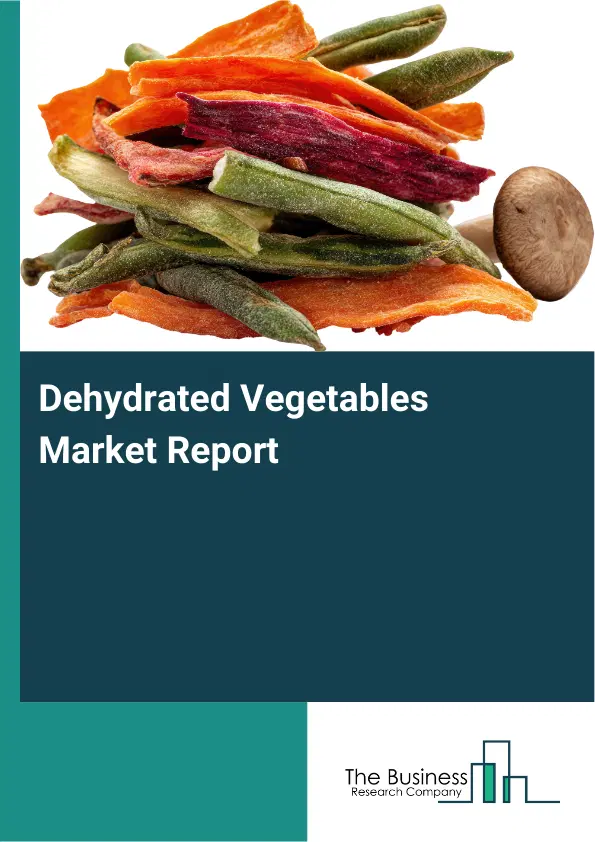
Dehydrated vegetables refer to the vegetables typically produced by companies that sun-dry or chemically dehydrate fruits and vegetables. The refreshed dehydrated vegetables take less time to cook than fresh vegetables. The main products of dehydrated vegetables are carrots, onions, potatoes, broccoli, beans, peas, cabbage, mushrooms, and tomatoes. Dehydrated carrots, which are properly sealed can be stored for a year and lighter weight than fresh carrots. By using vacuum drying, air drying, spray drying, freeze drying, and drum drying technologies vegetables are dried in the form of powders and granules, slices and cubes, minced and chopped, flakes, and others, which are distributed by various channels including store-based retailing, hypermarkets or supermarkets, convenience stores, food and drink specialty stores, and online retail for commercial and household end-users.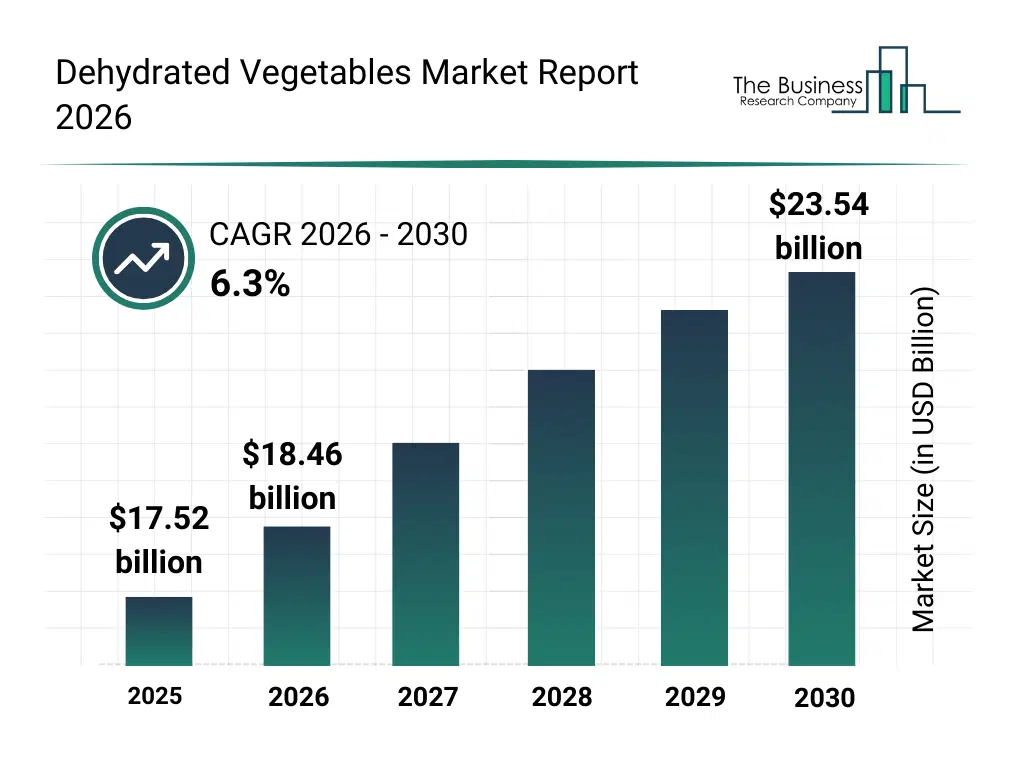
What Is The Dehydrated Vegetables Market Size and Share 2026?
The dehydrated vegetables market size has grown strongly in recent years. It will grow from $17.52 billion in 2025 to $18.46 billion in 2026 at a compound annual growth rate (CAGR) of 5.4%. The growth in the historic period can be attributed to growth of processed food industry demand, expansion of vegetable export markets, increasing use in soups and ready meals, advancements in drying technologies, rising awareness of food waste reduction.What Is The Dehydrated Vegetables Market Growth Forecast?
The dehydrated vegetables market size is expected to see strong growth in the next few years. It will grow to $23.54 billion in 2030 at a compound annual growth rate (CAGR) of 6.3%. The growth in the forecast period can be attributed to increasing demand for plant-based food ingredients, rising adoption in convenience food applications, expansion of sustainable food processing practices, growing online retail of dehydrated foods, increasing focus on traceability and quality assurance. Major trends in the forecast period include rising demand for shelf-stable vegetable ingredients, expansion of clean-label dehydrated foods, growing adoption of freeze and vacuum drying technologies, increasing use in foodservice and packaged foods, enhanced focus on nutrient retention.

Global Dehydrated Vegetables Market Segmentation
1) By Product Type: Carrot, Onions, Potatoes, Broccoli, Beans, Peas, Cabbage, Mushrooms, Tomatoes, Other Product Types 2) By Technology: Vacuum Drying, Air Drying, Spray Drying, Freeze Drying, Drum Drying 3) By Form: Powders And Granules, Slice And Cubes, Minced And Chopped, Flakes, Other Forms 4) By End-User: Commercial, Household Subsegments: 1) By Carrot: Diced, Sliced, Granulated 2) By Onions: Chopped, Minced, Flakes 3) By Potatoes: Mashed, Diced, Sliced 4) By Broccoli: Florets, Chopped 5) By Beans: Green Beans, Kidney Beans, Black Beans 6) By Peas: Green Peas, Split Peas 7) By Cabbage: Shredded, Chopped 8) By Mushrooms: Sliced, Diced, Whole 9) By Tomatoes: Diced, Powdered, Sun-Dried 10) By Other Product Types: Bell Peppers, Spinach, ZucchiniWhat Is The Driver Of The Dehydrated Vegetables Market?
The growing fast-food sector is expected to boost the growth of the dehydrated vegetable market going forward. Fast foods are defined as quick, convenient, and inexpensive alternatives to home-cooked meals. The dehydrated vegetables are used in the production of fast food, immediate ready-to-eat meals, condiments, and flavorings for sausages, pickles, chutneys, and other seasoning and spice goods. For instance, in August 2023, according to a report published by Budget Branders, a US-based provider of paper and plastic products, the fast food business is projected to have a global market worth 931. 7 billion dollars by 2027. Additionally, there are over 200,000 distinct fast-food outlets in the US. American consumers spend 200 billion dollars on fast food annually. Therefore, the growing fast-food sector is driving the growth of the dehydrated vegetable industry.Key Players In The Global Dehydrated Vegetables Market
Major companies operating in the dehydrated vegetables market are Van Drunen Farms, Mercer Foods, Silva International, Harmony House Foods, BCFoods, Olam Food Ingredients, Jain Farm Fresh Foods, Sensient Natural Ingredients, Mevive International Food Ingredients, European Freeze Dry, Freeze-Dry Foods International, Asahi Group Foods, Chaucer Foods, Natural Dehydrated Vegetables, Real Dehydrates, Garlico Industries, Green Field Spices, Hanan Products, NutraDry, Saipro Biotech
This chart is for illustrative purposes; the full report includes a detailed competitor analysis and comprehensive overview of the top 10 companies in the market.
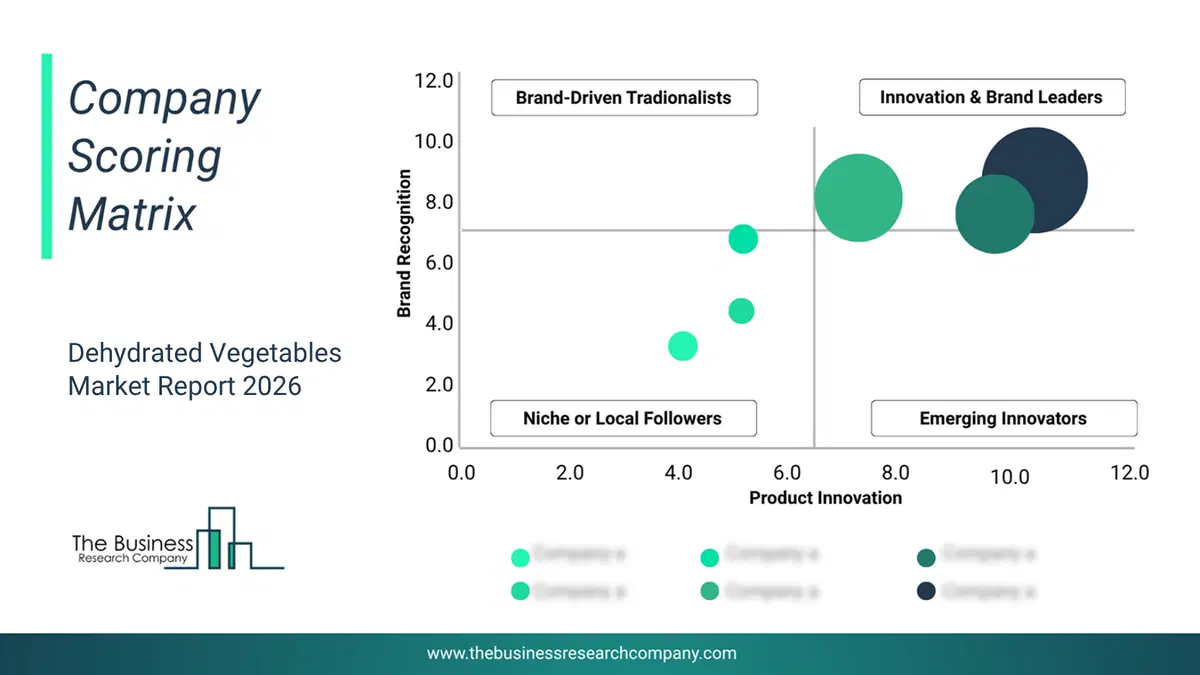
This chart maps companies by product innovation and brand strength, with bubble size indicating relative revenue, helping identify market leaders, challengers, and niche players. This is an illustrative chart; the full report provides a complete and accurate competitive analysis.
Global Dehydrated Vegetables Market Trends and Insights
Major companies operating in the dehydrated vegetables market are focusing on partnerships and collaborations to expand their product portfolio and geographic presence. Strategic partnerships refer to collaborative relationships between two or more entities that work together to achieve mutual success, such as improving product safety and market accessibility. For instance, in September 2023, Agri-Neo, a Canada-based leader in pasteurization of low-moisture foods, announced its partnership with BCFoods. This collaboration aims to establish new safety standards in the Chinese market for dehydrated vegetables. The companies will leverage Agri-Neo's Neo-Pure pasteurization process, which reduces pathogens such as Salmonella and E. coli by 99.999% without compromising food quality. The partnership will begin with dehydrated onions and is expected to expand the Neo-Pure Pasteurized (NPP) product portfolio in China.What Are Latest Mergers And Acquisitions In The Dehydrated Vegetables Market?
In March 2025, BranchOut Food Inc., a US-based manufacturer of dehydrated fruit and vegetable products, partnered with MicroDried to integrate BranchOut’s GentleDry dehydration technology into MicroDried’s ingredient offerings. Through this partnership, both companies aim to enhance the quality and diversity of dried vegetable and fruit solutions for food manufacturers worldwide by leveraging BranchOut’s advanced dehydration process and MicroDried’s existing market reach. MicroDried is a US-based provider of premium dried fruit and vegetable ingredients for the food and beverage industry.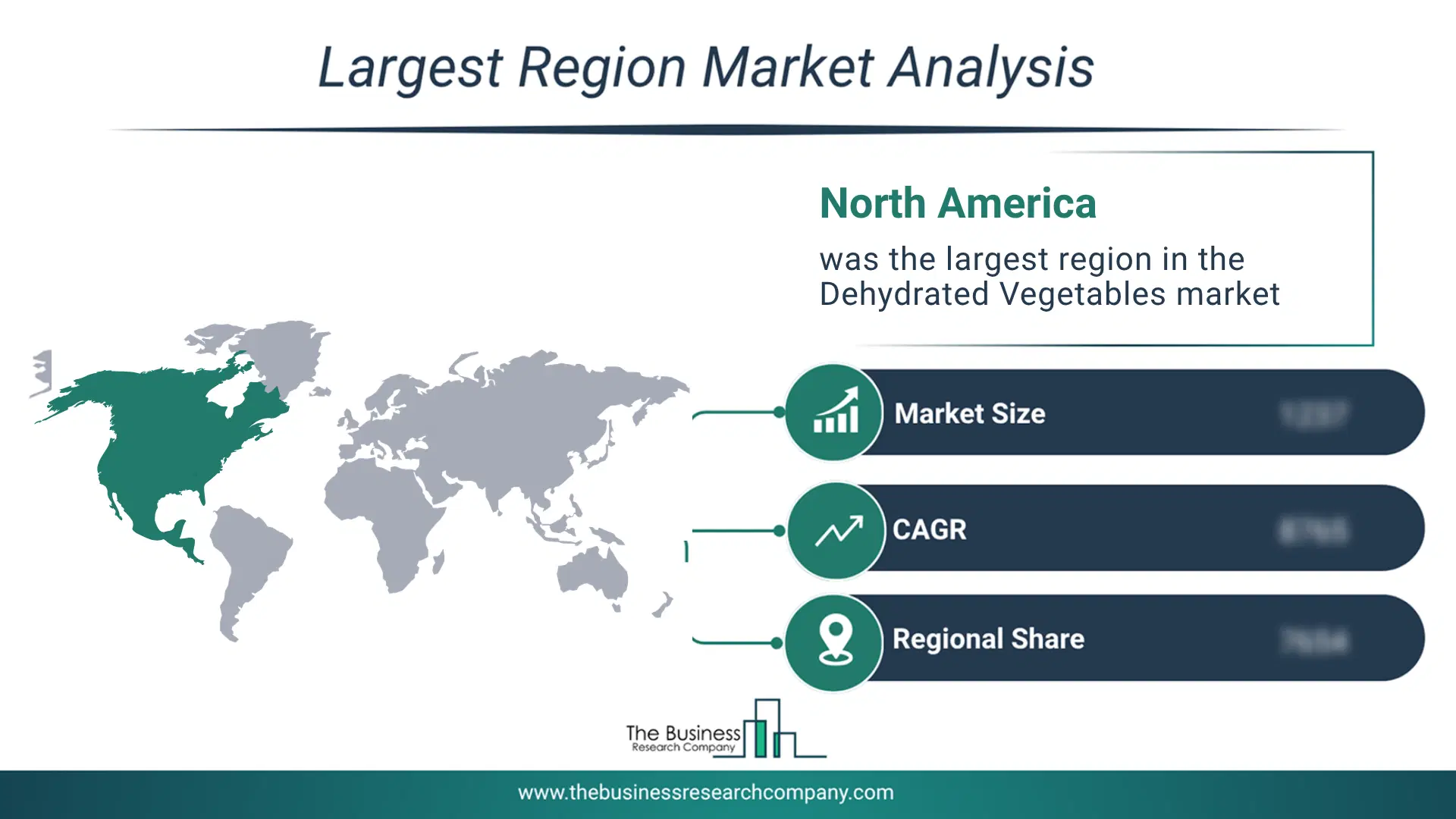
Regional Outlook
North America was the largest region in the dehydrated vegetable market in 2025. Asia-Pacific is expected to be the fastest-growing region in the forecast period. The regions covered in this market report are Asia-Pacific, South East Asia, Western Europe, Eastern Europe, North America, South America, Middle East and Africa. The countries covered in this market report are Australia, Brazil, China, France, Germany, India, Indonesia, Japan, Taiwan, Russia, South Korea, UK, USA, Italy, Spain, CanadaWhat Defines the Dehydrated Vegetables Market?
The dehydrated vegetable market consists of sales of squash, cucumbers, corn, peppers, Sauerkraut, and spinach. Values in this market are ‘factory gate’ values, that is the value of goods sold by the manufacturers or creators of the goods, whether to other entities (including downstream manufacturers, wholesalers, distributors and retailers) or directly to end customers. The value of goods in this market includes related services sold by the creators of the goods.How is Market Value Defined and Measured?
The market value is defined as the revenues that enterprises gain from the sale of goods and/or services within the specified market and geography through sales, grants, or donations in terms of the currency (in USD unless otherwise specified). The revenues for a specified geography are consumption values that are revenues generated by organizations in the specified geography within the market, irrespective of where they are produced. It does not include revenues from resales along the supply chain, either further along the supply chain or as part of other products.
This chart presents market attractiveness based on a quantitative evaluation of growth, competition, strategic alignment, and risk, offering a clear view of opportunity areas for decision-making. This chart is for illustrative purposes; the full report contains the complete analysis.

This chart highlights the Total Addressable Market (TAM) by estimating the maximum revenue opportunity using an assumption-driven approach, supporting strategic planning and opportunity sizing across markets. The chart is illustrative; the full report provides a more comprehensive analysis.
What Key Data and Analysis Are Included in the Dehydrated Vegetables Market Report 2026?
The dehydrated vegetables market research report is one of a series of new reports from The Business Research Company that provides market statistics, including industry global market size, regional shares, competitors with the market share, detailed market segments, market trends and opportunities, and any further data you may need to thrive in the dehydrated vegetables industry. The market research report delivers a complete perspective of everything you need, with an in-depth analysis of the current and future state of the industry.Dehydrated Vegetables Market Report Forecast Analysis
| Report Attribute | Details |
|---|---|
| Market Size Value In 2026 | $18.46 billion |
| Revenue Forecast In 2030 | $23.54 billion |
| Growth Rate | CAGR of 5.4% from 2026 to 2030 |
| Base Year For Estimation | 2025 |
| Actual Estimates/Historical Data | 2020-2025 |
| Forecast Period | 2026 - 2030 |
| Market Representation | Revenue in USD Billion and CAGR from 2026 to 2030 |
| Segments Covered | Product Type, Technology, Form, End-User |
| Regional Scope | Asia-Pacific, Western Europe, Eastern Europe, North America, South America, Middle East, Africa |
| Country Scope | The countries covered in the report are Australia, Brazil, China, France, Germany, India, Indonesia, Japan, Taiwan, Russia, South Korea, UK, USA, Canada, Italy, Spain. |
| Key Companies Profiled | Van Drunen Farms, Mercer Foods, Silva International, Harmony House Foods, BCFoods, Olam Food Ingredients, Jain Farm Fresh Foods, Sensient Natural Ingredients, Mevive International Food Ingredients, European Freeze Dry, Freeze-Dry Foods International, Asahi Group Foods, Chaucer Foods, Natural Dehydrated Vegetables, Real Dehydrates, Garlico Industries, Green Field Spices, Hanan Products, NutraDry, Saipro Biotech |
| Customization Scope | Request for Customization |
| Pricing And Purchase Options | Explore Purchase Options |