
Frozen, Canned and Dried Food Market Report 2026
Global Outlook – By Type (Frozen Foods, Canned Foods, Dried And Dehydrated Foods), By Distribution Channel (Supermarkets Or Hypermarkets, Convenience Stores, E-Commerce, Other Distribution Channels ), By User (Food Service Industry, Retail Users ) – Market Size, Trends, Strategies, and Forecast to 2030
Frozen, Canned and Dried Food Market Overview
• Frozen, Canned and Dried Food market size has reached to $488.02 billion in 2025 • Expected to grow to $644.81 billion in 2030 at a compound annual growth rate (CAGR) of 5.9% • Growth Driver: Growing Demand For Organic Food Products • Market Trend: Growing Interest In Plant-Based Diets • Asia-Pacific was the largest region in 2025 and Western Europe is the fastest growing region.What Is Covered Under Frozen, Canned and Dried Food Market?
Frozen foods are defined as foods that are preserved by a freezing process and stored in a freezer at the required temperature before cooking. Canned foods are defined as foods that are processed and sealed in airtight containers for a longer shelf life by a food preservation method. Dried and dehydrated foods are defined as foods from which the most of the original water content has been removed using a food preservation process. The main types of frozen, canned, and dried food are frozen food, canned food, and ambient food. Frozen food is food that is preserved in a frozen state from the time it is prepared to the time it is eaten. The main distribution channels are supermarkets and hypermarkets, convenience stores, e-commerce, and other distribution channels. The different users include foodservice industry users and retail users.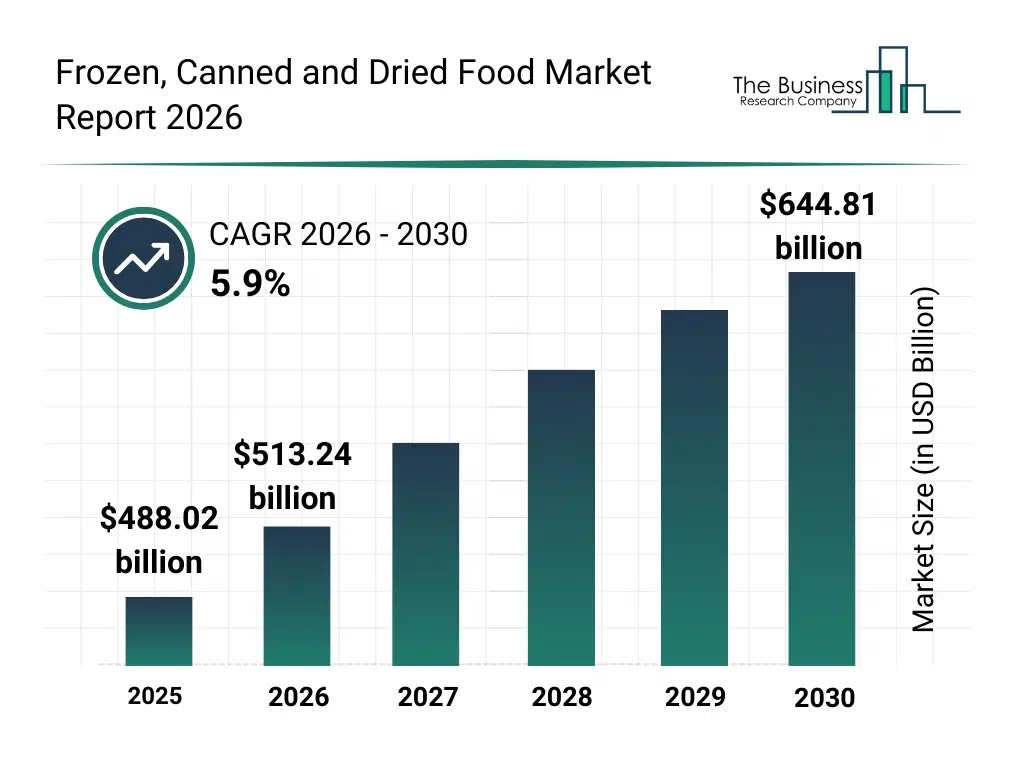
What Is The Frozen, Canned and Dried Food Market Size and Share 2026?
The frozen, canned and dried food market size has grown strongly in recent years. It will grow from $488.02 billion in 2025 to $513.24 billion in 2026 at a compound annual growth rate (CAGR) of 5.2%. The growth in the historic period can be attributed to expansion of packaged food consumption, growth of urban lifestyles, increased adoption of canned foods, improved food preservation technologies, rising demand for emergency food supplies.What Is The Frozen, Canned and Dried Food Market Growth Forecast?
The frozen, canned and dried food market size is expected to see strong growth in the next few years. It will grow to $644.81 billion in 2030 at a compound annual growth rate (CAGR) of 5.9%. The growth in the forecast period can be attributed to increasing demand for convenience foods, expansion of e-commerce grocery platforms, rising focus on food security, growing investments in food processing infrastructure, increasing preference for extended shelf-life products. Major trends in the forecast period include growing demand for shelf-stable food products, expansion of ready-to-eat and ready-to-cook meals, increasing focus on long-term food preservation, rising adoption of advanced packaging solutions, higher demand for multi-format food options.
Global Frozen, Canned and Dried Food Market Segmentation
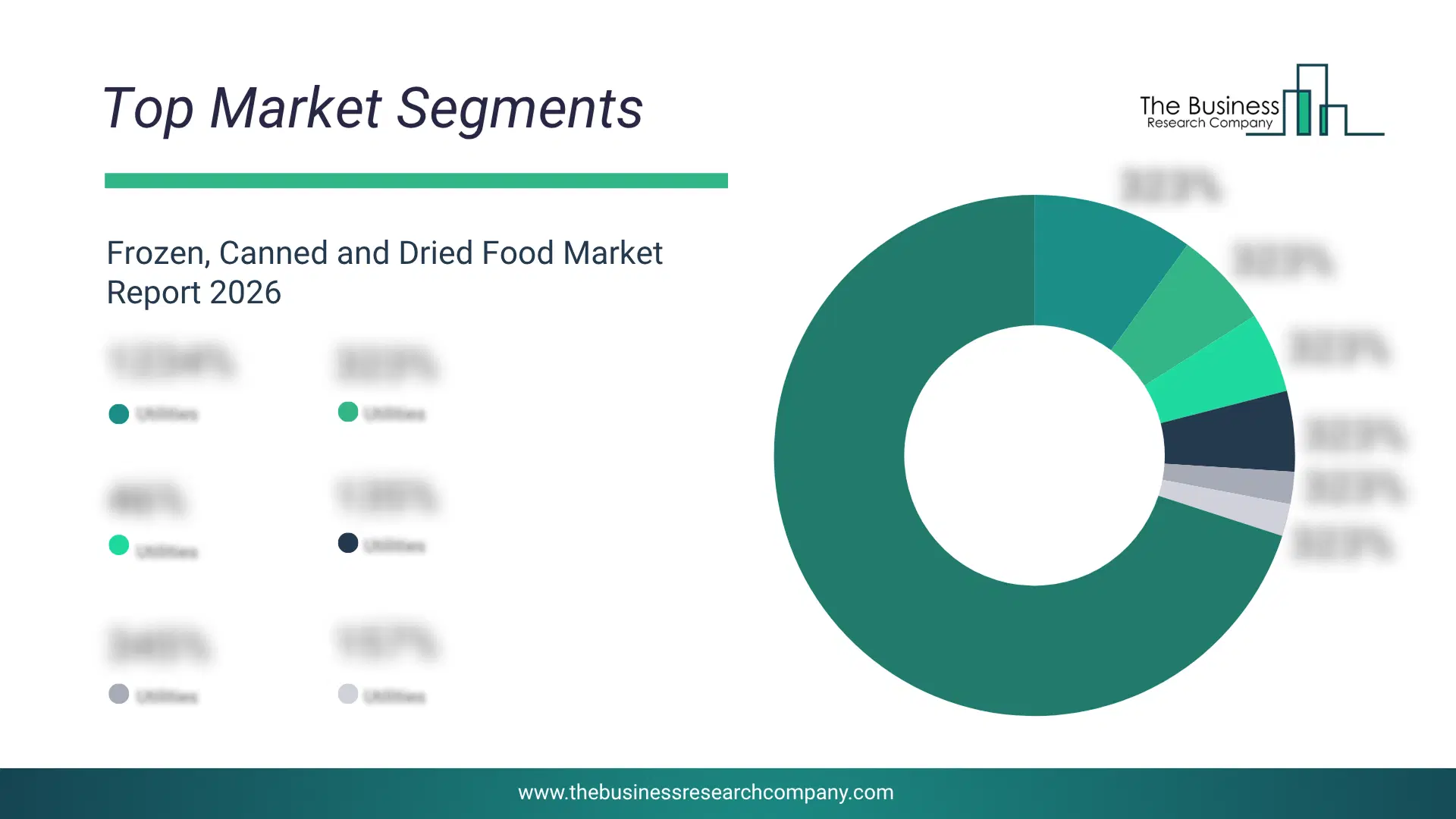
1) By Type: Frozen Foods, Canned Foods, Dried And Dehydrated Foods 2) By Distribution Channel: Supermarkets Or Hypermarkets, Convenience Stores, E-Commerce, Other Distribution Channels 3) By User: Food Service Industry, Retail Users Subsegments: 1) By Frozen Foods: Frozen Vegetables, Frozen Fruits, Frozen Ready Meals, Frozen Snacks, Frozen Meat, Frozen Poultry, Frozen Seafood 2) By Canned Foods: Canned Vegetables, Canned Fruits, Canned Meat, Canned Poultry, Canned Seafood, Canned Soups & Stews, Canned Ready Meals 3) By Dried And Dehydrated Foods: Dried Vegetables, Dried Fruits, Dehydrated Ready Meals, Instant Noodles, Dried Pasta & Grains, Powdered And Dehydrated SoupsWhat Are The Drivers Of The Frozen, Canned and Dried Food Market?
The increasing demand for local, sustainable, and organic food production is expected to positively impact the frozen, canned and dried food market during the forecast period. Organic food production, including organic frozen and fruit and vegetable markets, places a strong emphasis on consumer health, environmental protection, and animal welfare. Consumers are now becoming more concerned with how food is raised and prepared and are willing to pay a little more for something they recognize as healthy. For instance, in May 2023, according to the Organic Trade Association, a US-based organic industry, in 2022 total organic sales, including organic non-food products, reached a milestone of $60 billion. By 2023, this figure had surged to a record $67.6 billion, indicating a significant increase in the organic sector's market value. Thus likely driving the market during the forecast period. The growing demand for convenience food is expected to propel the growth of the frozen, canned, and dried food market. Convenience food refers to pre-packaged or processed food products that are quick and easy to prepare and require minimal cooking or effort, often designed for on-the-go or time-saving consumption. Consumers seek convenient meal options that require minimal preparation, making these preserved food categories a preferred choice for busy individuals and households. Moreover, the longer shelf life and ease of storage associated with these products further contribute to their increasing demand and market growth. For instance, in 2023, according to the United States Department of Agriculture, a US-based federal agency, the total value of US processed food products exported from the country increased to $36.59 billion in 2023, an increase of 1.7% compared to previous year. Therefore, the growing demand for convenience food is driving the growth of the frozen, canned and dried food industry going forward.Key Players In The Global Frozen, Canned and Dried Food Market
Major companies operating in the frozen, canned and dried food market are Nestlé S.A., Unilever plc, Tyson Foods Inc., The Kraft Heinz Company, Toyo Suisan Kaisha Ltd., General Mills Inc., Kellogg Company, Hormel Foods Corporation, Conagra Brands Inc., Ajinomoto Co. Inc., The Campbell Soup Company, McCain Foods Limited, Nichirei Corporation, Birds Eye Foods Inc., Greenyard NV, Maruha Nichiro Corporation, Lamb Weston Holdings Inc., Pinnacle Foods Inc., Nomad Foods Ltd., The Schwan Food Company, Bonduelle SCA, Del Monte Pacific Limited, B&G Foods Inc., The Hain Celestial Group Inc., Seneca Foods Corporation, Dr. Oetker GmbH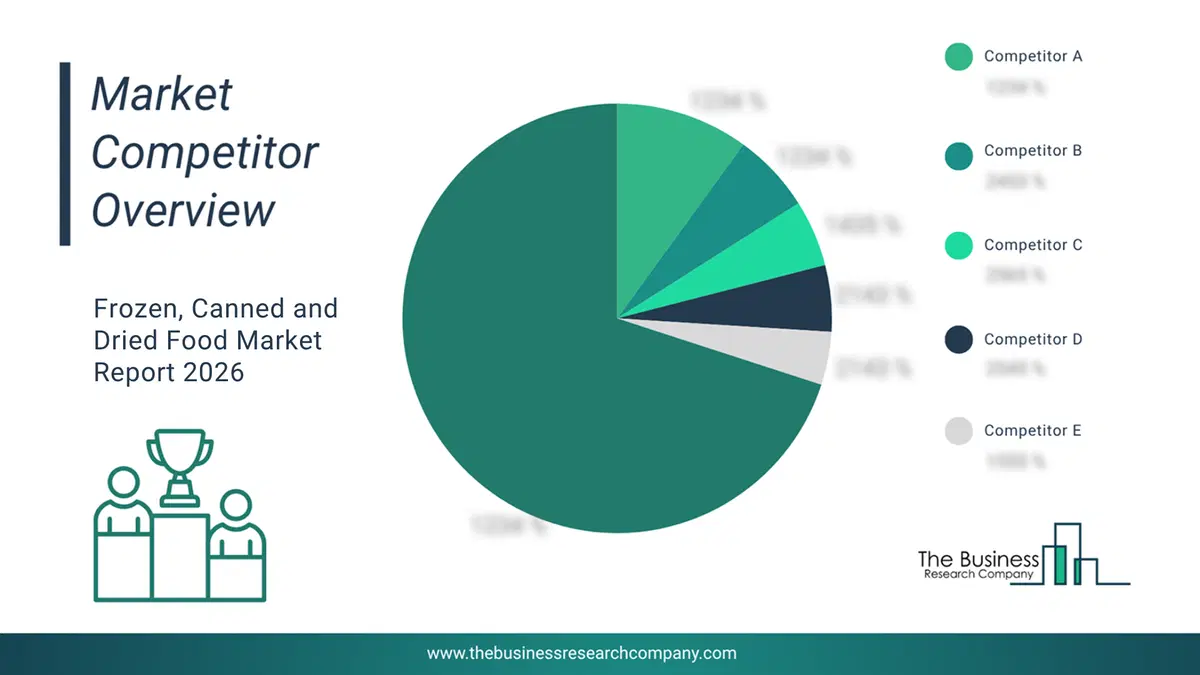
This chart is for illustrative purposes; the full report includes a detailed competitor analysis and comprehensive overview of the top 10 companies in the market.
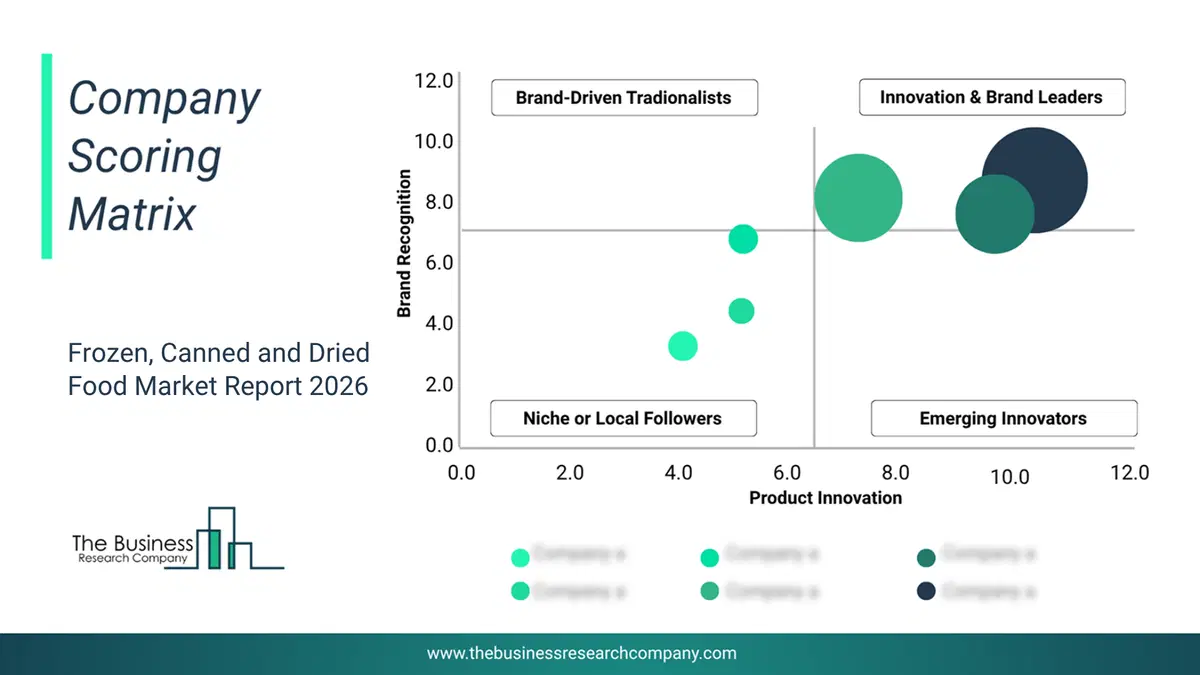
This chart maps companies by product innovation and brand strength, with bubble size indicating relative revenue, helping identify market leaders, challengers, and niche players. This is an illustrative chart; the full report provides a complete and accurate competitive analysis.
What Are Latest Mergers And Acquisitions In The Frozen, Canned and Dried Food Market?
Regional Outlook
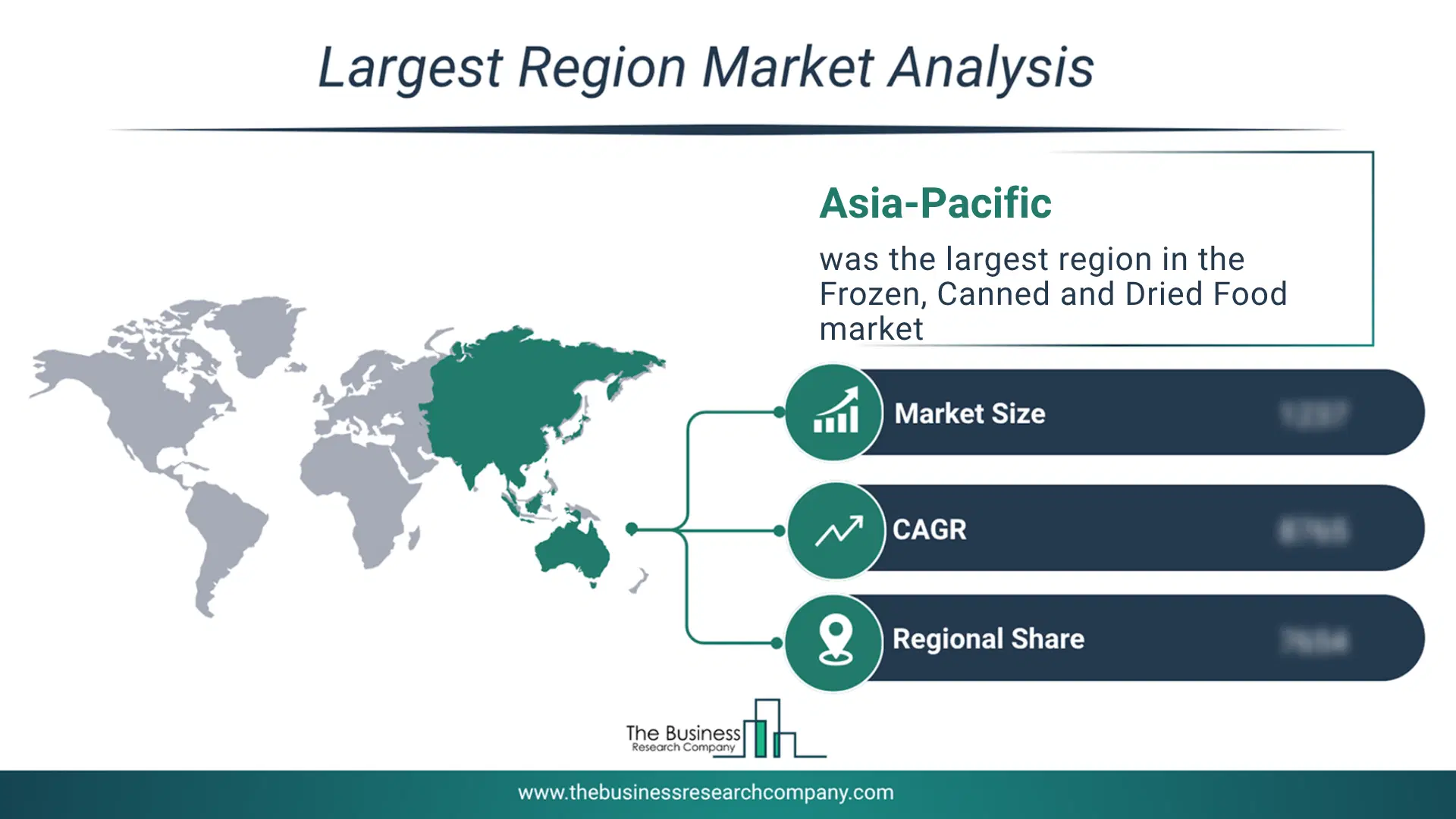
Asia-Pacific was the largest region in the frozen, canned, and dried food market in 2025. Western Europe was the second-largest region in the frozen, canned, and dried food market. The regions covered in this market report are Asia-Pacific, South East Asia, Western Europe, Eastern Europe, North America, South America, Middle East and Africa. The countries covered in this market report are China, India, Japan, Australia, Indonesia, South Korea, Bangladesh, Thailand, Vietnam, Malaysia, Singapore, Philippines, Hong Kong, Taiwan, New Zealand, UK, Germany, France, Italy, Spain, Austria, Belgium, Denmark, Finland, Ireland, Netherlands, Norway, Portugal, Sweden, Switzerland, Russia, Czech Republic, Poland, Romania, Ukraine, USA, Canada, Mexico, Brazil, Chile, Argentina, Colombia, Peru, Saudi Arabia, Israel, Iran, Turkey, UAE, Egypt, Nigeria, South Africa.What Defines the Frozen, Canned and Dried Food Market?
The frozen, canned, and dried food market consists of sales of frozen fruit, frozen juices, frozen vegetables, canned, pickled, and dried fruits, vegetables, frozen specialty foods, frozen dinners, entrees, side dishes, pizza, whipped toppings, waffles, pancakes, French toast, and other frozen and fruit and vegetables. This market does not include unprocessed fruit and vegetables which are part of the agricultural market, meat products, ice creams and frozen desserts. The companies in the industry package and distribute their products through various distribution channels to both individual customers and commercial establishments. Values in this market are ‘factory gate’ values, that is the value of goods sold by the manufacturers or creators of the goods, whether to other entities (including downstream manufacturers, wholesalers, distributors, and retailers) or directly to end customers. The value of goods in this market includes related services sold by the creators of the goods.How is Market Value Defined and Measured?
The market value is defined as the revenues that enterprises gain from the sale of goods and/or services within the specified market and geography through sales, grants, or donations in terms of the currency (in USD unless otherwise specified). The revenues for a specified geography are consumption values that are revenues generated by organizations in the specified geography within the market, irrespective of where they are produced. It does not include revenues from resales along the supply chain, either further along the supply chain or as part of other products.
This chart presents market attractiveness based on a quantitative evaluation of growth, competition, strategic alignment, and risk, offering a clear view of opportunity areas for decision-making. This chart is for illustrative purposes; the full report contains the complete analysis.

This chart highlights the Total Addressable Market (TAM) by estimating the maximum revenue opportunity using an assumption-driven approach, supporting strategic planning and opportunity sizing across markets. The chart is illustrative; the full report provides a more comprehensive analysis.
What Key Data and Analysis Are Included in the Frozen, Canned and Dried Food Market Report 2026?
The frozen, canned and dried food market research report is one of a series of new reports from The Business Research Company that provides market statistics, including industry global market size, regional shares, competitors with the market share, detailed market segments, market trends and opportunities, and any further data you may need to thrive in the frozen, canned and dried food industry. The market research report delivers a complete perspective of everything you need, with an in-depth analysis of the current and future state of the industry.Frozen, Canned and Dried Food Market Report Forecast Analysis
| Report Attribute | Details |
|---|---|
| Market Size Value In 2026 | $513.24 billion |
| Revenue Forecast In 2030 | $644.81 billion |
| Growth Rate | CAGR of 5.2% from 2026 to 2030 |
| Base Year For Estimation | 2025 |
| Actual Estimates/Historical Data | 2020-2025 |
| Forecast Period | 2026 - 2030 |
| Market Representation | Revenue in USD Billion and CAGR from 2026 to 2030 |
| Segments Covered | Type, Distribution Channel, User |
| Regional Scope | Asia-Pacific, Western Europe, Eastern Europe, North America, South America, Middle East, Africa |
| Country Scope | The countries covered in the report are Australia, Brazil, China, France, Germany, India, Indonesia, Japan, Taiwan, Russia, South Korea, UK, USA, Canada, Italy, Spain. |
| Key Companies Profiled | Nestlé S.A., Unilever plc, Tyson Foods Inc., The Kraft Heinz Company, Toyo Suisan Kaisha Ltd., General Mills Inc., Kellogg Company, Hormel Foods Corporation, Conagra Brands Inc., Ajinomoto Co. Inc., The Campbell Soup Company, McCain Foods Limited, Nichirei Corporation, Birds Eye Foods Inc., Greenyard NV, Maruha Nichiro Corporation, Lamb Weston Holdings Inc., Pinnacle Foods Inc., Nomad Foods Ltd., The Schwan Food Company, Bonduelle SCA, Del Monte Pacific Limited, B&G Foods Inc., The Hain Celestial Group Inc., Seneca Foods Corporation, Dr. Oetker GmbH |
| Customization Scope | Request for Customization |
| Pricing And Purchase Options | Explore Purchase Options |