
Frozen Tuna Market Report 2026
Global Outlook – By Type (Frozen Albacore, Frozen Big Eye Ahi, Frozen Bluefin Tuna, Frozen Skipjack, Frozen Yellowfin Tuna), By Distributed Channel (Online, Offline), By Application (Supermarkets And Hypermarkets, Convenience Stores, Specialty Stores, Online Retail) – Market Size, Trends, Strategies, and Forecast to 2030
Frozen Tuna Market Overview
• Frozen Tuna market size has reached to $9.05 billion in 2025 • Expected to grow to $14.2 billion in 2030 at a compound annual growth rate (CAGR) of 9.2% • Growth Driver: The Growing Demand For Seafood Fuels The Expansion Of The Frozen Tuna Market • Market Trend: Ultra-Low Temperature Freezing Revolutionizing Frozen Tuna Market • Asia-Pacific was the largest region in 2025.What Is Covered Under Frozen Tuna Market?
Frozen tuna refers to fish caught, processed, and then frozen to preserve its freshness and nutritional value. The freezing process helps to prevent the growth of bacteria and other microorganisms, maintaining the quality and safety of the fish. Frozen tuna is widely used in commercial and consumer markets, especially in regions where fresh tuna may not be readily available. The main types of frozen tuna are frozen albacore, frozen big eye ahi, frozen bluefin tuna, frozen skipjack, and frozen yellowfin tuna. Frozen albacore is a type of tuna that has been caught, processed, and frozen to preserve its freshness and quality. These are distributed online, and offline and are used in various applications such as supermarkets and hypermarkets, convenience stores, specialty stores, and online retail.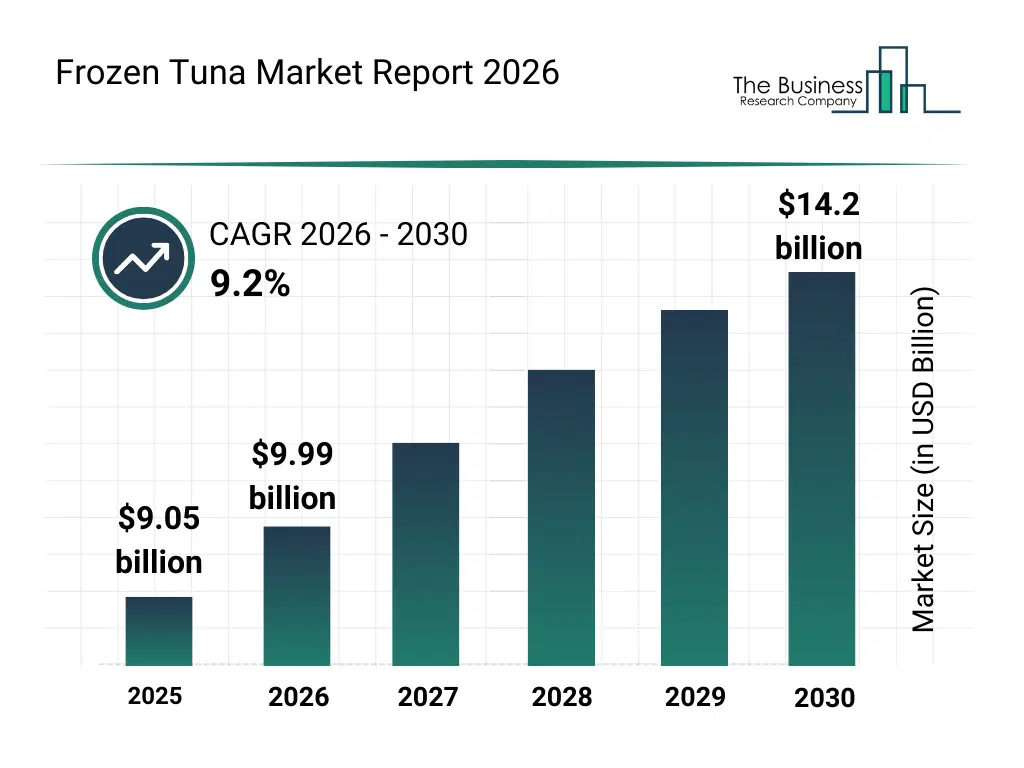
What Is The Frozen Tuna Market Size and Share 2026?
The frozen tuna market size has grown rapidly in recent years. It will grow from $9.05 billion in 2025 to $9.99 billion in 2026 at a compound annual growth rate (CAGR) of 10.3%. The growth in the historic period can be attributed to expansion of global tuna consumption, growth of international seafood trade, advancements in freezing technology, increased demand from foodservice sector, availability of large-scale tuna processing facilities.What Is The Frozen Tuna Market Growth Forecast?
The frozen tuna market size is expected to see strong growth in the next few years. It will grow to $14.2 billion in 2030 at a compound annual growth rate (CAGR) of 9.2%. The growth in the forecast period can be attributed to growing preference for certified sustainable tuna, expansion of cold chain logistics infrastructure, rising demand for premium frozen seafood, increased traceability requirements, technological innovation in tuna preservation. Major trends in the forecast period include increasing adoption of ultra-low temperature freezing, rising demand for sushi-grade frozen tuna, growing focus on sustainable tuna fishing, expansion of export-oriented tuna processing, enhanced emphasis on quality retention.
Global Frozen Tuna Market Segmentation
1) By Type: Frozen Albacore, Frozen Big Eye Ahi, Frozen Bluefin Tuna, Frozen Skipjack, Frozen Yellowfin Tuna 2) By Distributed Channel: Online, Offline 3) By Application: Supermarkets And Hypermarkets, Convenience Stores, Specialty Stores, Online Retail Subsegments: 1) By Frozen Albacore: Wild-Caught Frozen Albacore 2) By Frozen Big Eye Ahi: Wild-Caught Frozen Big Eye Ahi, Frozen Big Eye Ahi Steaks 3) By Frozen Bluefin Tuna: Wild-Caught Frozen Bluefin Tuna, Frozen Bluefin Tuna Steaks, Frozen Bluefin Tuna Belly 4) By Frozen Skipjack: Wild-Caught Frozen Skipjack, Frozen Skipjack Loins 5) By Frozen Yellowfin Tuna: Wild-Caught Frozen Yellowfin Tuna, Frozen Yellowfin Tuna Steaks, Frozen Yellowfin Tuna SakuWhat Is The Driver Of The Frozen Tuna Market?
The growing demand for seafood is expected to propel the growth of the frozen tuna market going forward. Seafood refers to edible aquatic animals and plants, including fish, shellfish, mollusks, and seaweeds, harvested from oceans, rivers, and lakes, which are sources of protein and nutrients for many cultures worldwide. The demand for seafood is due to rising awareness of its health benefits, expansion of aquaculture, changing dietary preferences, improved supply chain logistics, and sustainability concerns regarding land-based protein sources. Frozen tuna plays a crucial role in meeting the growing global demand for seafood by providing a reliable, versatile, and high-quality product that can be enjoyed in various forms and cuisines worldwide. For instance, in July 2025, according to the Organization for Economic Co-operation and Development (OECD), aa France-based intergovernmental economic organization, the total apparent consumption of fish and other aquatic foods is projected to reach 192 million tonnes by 2034, up 22 million tonnes from the 2022–2024 average. Therefore, the growing demand for seafood drives the frozen tuna industry.Key Players In The Global Frozen Tuna Market
Major companies operating in the frozen tuna market are ITOCHU Corporation, Sojitz Corporation, Dongwon Group, Nissui Corporation, Thai Union Group PCL, Bolton Group, IBL Ltd., High Liner Foods Inc., Century Pacific Food Inc., The Jealsa Rianxeira S.A.U., Bumble Bee Foods LLC, Chicken of the Sea, Shanghai Kaichuang Marine International, Zhejiang Ocean Family Co. Ltd., Grupo Calvo, FCF Co. Ltd., Sea Delight LLC, Pescanova SA, Stehr Group, Golden Prize Canning Co. Ltd., Maruha Nichiro Corporation, Tri Marine Group, Kyokuyo Co. Ltd., Mitsui & Co. Ltd.
This chart is for illustrative purposes; the full report includes a detailed competitor analysis and comprehensive overview of the top 10 companies in the market.
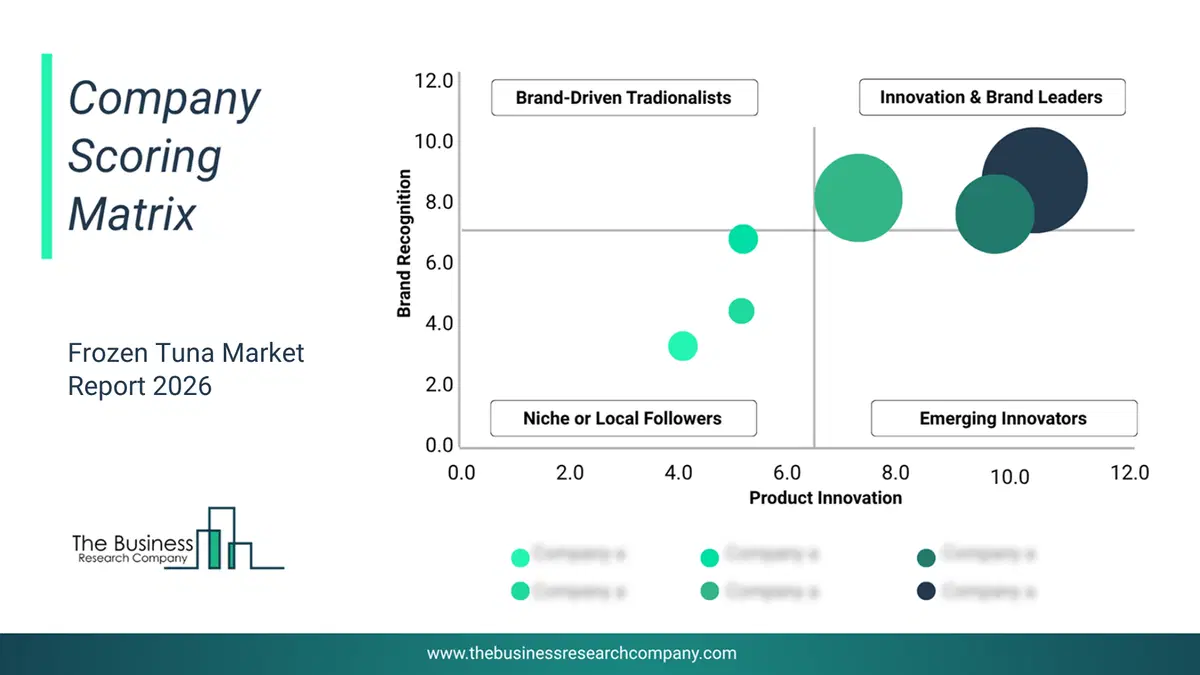
This chart maps companies by product innovation and brand strength, with bubble size indicating relative revenue, helping identify market leaders, challengers, and niche players. This is an illustrative chart; the full report provides a complete and accurate competitive analysis.
Global Frozen Tuna Market Trends and Insights
Major companies operating in the frozen tuna market are focusing on developing innovative products such as ultra-low temperature (ULT) frozen fish to improve the quality, shelf-life, and sustainability of their frozen tuna products. Ultra-low temperature (ULT) frozen fish refers to fish that has been frozen at extremely low temperatures to maintain its quality and freshness for an extended period. ULT freezing typically involves temperatures much lower than conventional freezing methods, often reaching as low as -60 degrees Celsius (-76 degrees Fahrenheit) or even lower. For instance, in April 2023, Big Fish Maldives, a Maldives-based seafood processing company, launched its ultra-low temperature frozen tuna products. The product remains fresh for an extended period due to its rapid freezing capability at temperatures as low as minus 60 degrees Celsius. Freezing fish at such ultra-low temperatures allows high-quality fish to be sold in overseas markets at prices approximately 150% higher than previously frozen fish at 20 degrees Celsius. Ultra-low temperature (ULT) frozen tuna is widely preferred for sashimi and high-end sushi due to its ability to preserve its natural ruby-red color, rich fat content, and excellent eating quality.What Are Latest Mergers And Acquisitions In The Frozen Tuna Market?
In September 2023, Mark Foods Inc., a US-based importer, processor, and marketer of premium frozen seafood products, acquired Arista Industries Inc, for an undisclosed amount. Through this acquisition, Mark Foods aims to expand its frozen seafood portfolio, increase operational scale, and strengthen its distribution capabilities across retail and foodservice channels by integrating Arista’s extensive product range and experienced team. Arista Seafood is a US-based frozen seafood company specializing in sustainably sourced products including shrimp, mussels, lobster, crab, octopus, Tuna, and other frozen seafood varieties.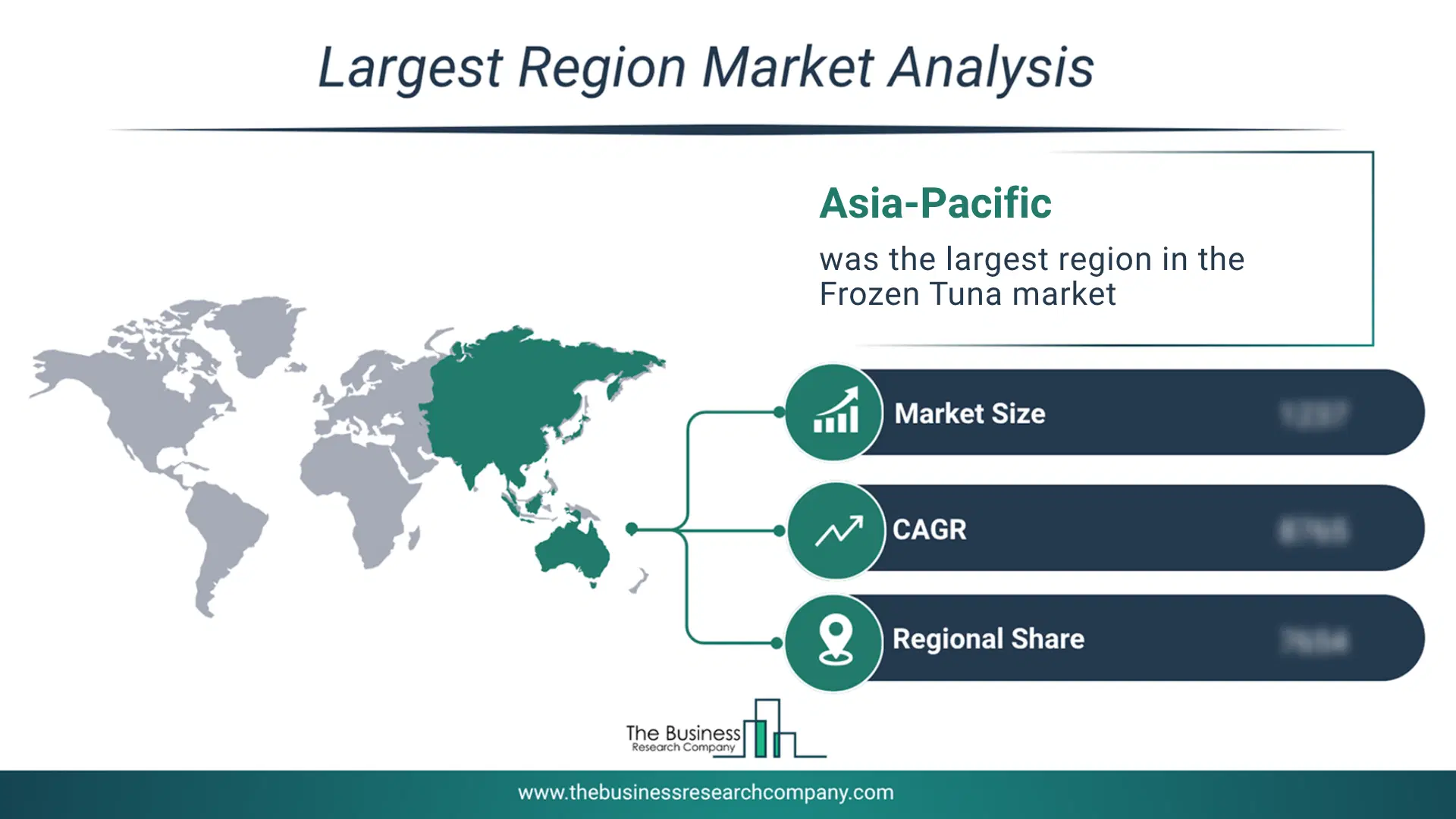
Regional Outlook
Asia-Pacific was the largest region in the frozen tuna market in 2025. The regions covered in this market report are Asia-Pacific, South East Asia, Western Europe, Eastern Europe, North America, South America, Middle East and Africa. The countries covered in this market report are Australia, Brazil, China, France, Germany, India, Indonesia, Japan, Taiwan, Russia, South Korea, UK, USA, Italy, Spain, CanadaWhat Defines the Frozen Tuna Market?
The frozen tuna market consists of sales of frozen tuna steaks, frozen tuna fillets, pre-marinated frozen tuna, canned tuna, tuna sashimi, and sushi grade. Values in this market are ‘factory gate’ values, that is the value of goods sold by the manufacturers or creators of the goods, whether to other entities (including downstream manufacturers, wholesalers, distributors, and retailers) or directly to end customers. The value of goods in this market includes related services sold by the creators of the goods.How is Market Value Defined and Measured?
The market value is defined as the revenues that enterprises gain from the sale of goods and/or services within the specified market and geography through sales, grants, or donations in terms of the currency (in USD unless otherwise specified). The revenues for a specified geography are consumption values that are revenues generated by organizations in the specified geography within the market, irrespective of where they are produced. It does not include revenues from resales along the supply chain, either further along the supply chain or as part of other products.
This chart presents market attractiveness based on a quantitative evaluation of growth, competition, strategic alignment, and risk, offering a clear view of opportunity areas for decision-making. This chart is for illustrative purposes; the full report contains the complete analysis.

This chart highlights the Total Addressable Market (TAM) by estimating the maximum revenue opportunity using an assumption-driven approach, supporting strategic planning and opportunity sizing across markets. The chart is illustrative; the full report provides a more comprehensive analysis.
What Key Data and Analysis Are Included in the Frozen Tuna Market Report 2026?
The frozen tuna market research report is one of a series of new reports from The Business Research Company that provides market statistics, including industry global market size, regional shares, competitors with the market share, detailed market segments, market trends and opportunities, and any further data you may need to thrive in the frozen tuna industry. The market research report delivers a complete perspective of everything you need, with an in-depth analysis of the current and future state of the industry.Frozen Tuna Market Report Forecast Analysis
| Report Attribute | Details |
|---|---|
| Market Size Value In 2026 | $9.99 billion |
| Revenue Forecast In 2030 | $14.2 billion |
| Growth Rate | CAGR of 10.3% from 2026 to 2030 |
| Base Year For Estimation | 2025 |
| Actual Estimates/Historical Data | 2020-2025 |
| Forecast Period | 2026 - 2030 |
| Market Representation | Revenue in USD Billion and CAGR from 2026 to 2030 |
| Segments Covered | Type, Distributed Channel, Application |
| Regional Scope | Asia-Pacific, Western Europe, Eastern Europe, North America, South America, Middle East, Africa |
| Country Scope | The countries covered in the report are Australia, Brazil, China, France, Germany, India, Indonesia, Japan, Taiwan, Russia, South Korea, UK, USA, Canada, Italy, Spain. |
| Key Companies Profiled | ITOCHU Corporation, Sojitz Corporation, Dongwon Group, Nissui Corporation, Thai Union Group PCL, Bolton Group, IBL Ltd., High Liner Foods Inc., Century Pacific Food Inc., The Jealsa Rianxeira S.A.U., Bumble Bee Foods LLC, Chicken of the Sea, Shanghai Kaichuang Marine International, Zhejiang Ocean Family Co. Ltd., Grupo Calvo, FCF Co. Ltd., Sea Delight LLC, Pescanova SA, Stehr Group, Golden Prize Canning Co. Ltd., Maruha Nichiro Corporation, Tri Marine Group, Kyokuyo Co. Ltd., Mitsui & Co. Ltd. |
| Customization Scope | Request for Customization |
| Pricing And Purchase Options | Explore Purchase Options |