
Electric Mobility Market 2025
By Product Type (Electric Cars, Electric Truck, Electric Bus, Electric LCV, Electric Bikes, Electric Scooters, Electric Motorized Scooters, Electric Motorcycles), By Drive (Belt Drive, Chain Drive, Hub Drive), By Battery (Lead Acid Battery, Li-Ion Battery, Other Batteries), By End User (Personal, Commercial), And By Region, Opportunities And Strategies – Global Forecast To 2035
Electric Mobility Market Definition
Electric mobility refers to the use of electric-powered vehicles for transporting people or goods. These vehicles are propelled either fully or partially by electric motors powered by rechargeable batteries. The market includes a broad range of vehicle types such as electric cars, trucks, buses, light commercial vehicles (LCVs), motorcycles, mopeds, scooters and bicycles. The electric mobility market consists of sales by entities (organizations, sole traders and partnerships) of electric mobility that are used by individuals for personal commuting, by businesses for logistics and last-mile delivery and by governments for public transportation. It uses a cleaner alternative to internal combustion engine (ICE) vehicles due to growing concerns over pollution, rising fuel costs and supportive regulatory policies.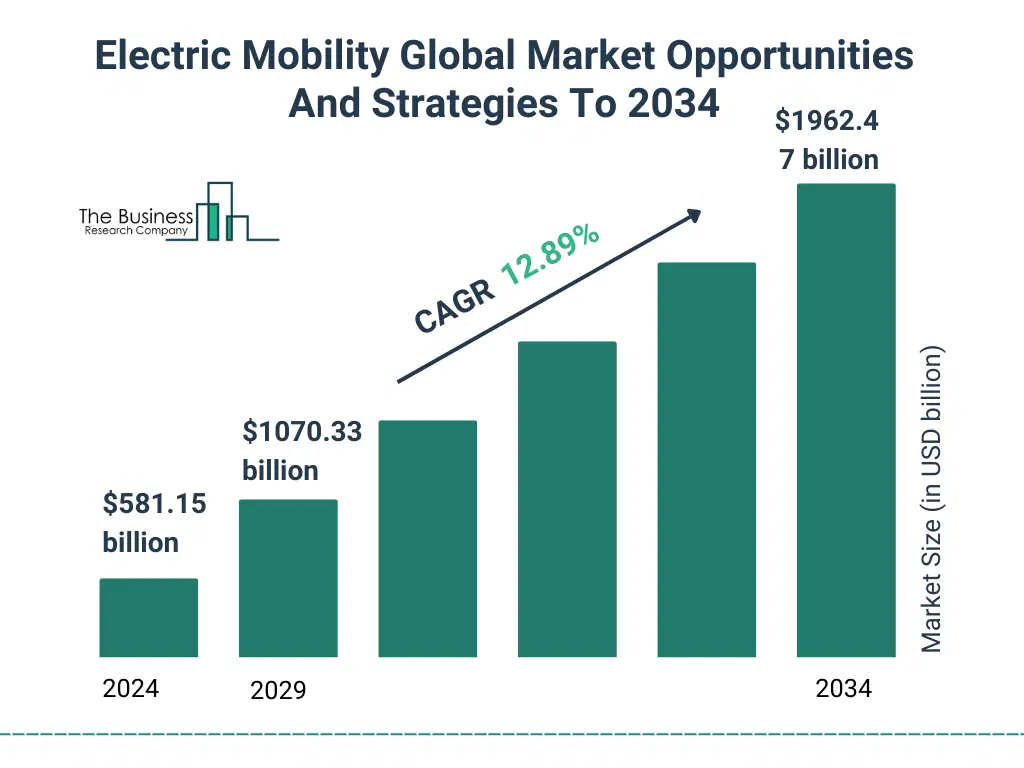
Electric Mobility Market Size
The global electric mobility market reached a value of nearly $581,149.88 million in 2024, having grown at a compound annual growth rate (CAGR) of 35.67% since 2019. The market is expected to grow from $ 5, 81,149.88 million in 2024 to $1,070,327.36 million in 2029 at a rate of 12.99%. The market is then expected to grow at a CAGR of 12.89% from 2029 and reach $1,962,473.09 million in 2034. Growth in the historic period resulted from rising traffic congestion, expansion of smart city initiatives, growth in shared mobility services and expansion of charging infrastructure. Factors that negatively affected growth in the historic period were safety concerns and battery supply chain constraints. Going forward, increasing demand for sustainable transportation, higher fuel prices, government policy and incentives and increasing demand for electric vehicles will drive growth. Factors that could hinder the growth of the electric mobility market in the future include limited driving range, regulatory and policy uncertainty and impact of trade war and tariff.Electric Mobility Market Drivers
The key drivers of the electric mobility market include: Increasing Demand For Sustainable Transportation Increasing demand for sustainable transportation is expected to propel the growth of the electric mobility market going forward. The rising demand for sustainable transportation is driving consumers and businesses to shift from conventional fossil-fuel vehicles to electric vehicles (EVs), which produce lower emissions and reduce environmental impact. The growing environmental awareness among the public is encouraging the adoption of cleaner mobility options. The increasing demand for sustainable transportation growth contribution during the forecast period in 2024 is 2.38%.Electric Mobility Market Restraints
The key restraints on the electric mobility market include: Limited Driving Range Limited driving range are expected to restrain the growth of the electric mobility market during the forecast period by creating concerns over vehicle usability for long-distance travel. Many consumers fear running out of charge in areas with insufficient charging infrastructure, reducing confidence in EV adoption. This limitation makes electric vehicles less attractive compared to conventional fuel-powered vehicles. Growth affected by limited driving range during the forecast period in 2024 is -2.00%.Electric Mobility Market Trends
Major trends shaping the electric mobility market include: Next-Generation Multi-Use Electric Vehicle Revolutionizes Urban Mobility Major companies operating in the electric mobility market are focusing on the launch of innovative products, such as multi-use mobility platforms, to enhance urban transportation efficiency, provide flexible travel options and promote sustainable, integrated mobility solutions. For instance, in September 2025, Toyota Motor Corporation (Toyota), a Japan-based company, specializing in automotive manufacturing, launches the next-generation e-Palette battery electric vehicle (BEV), designed for versatile urban mobility applications such as mobile retail, shuttles and entertainment. With a spacious, accessible interior and customizable features, it enhances urban accessibility and transforms cityscapes. The e-Palette supports Level 2 automated driving and is prepared for future upgrades to Level 4 autonomy by fiscal year 2027. Launch Of E-Bus Platform With Cell-To-Chassis (CTC) Technology Leading companies in the electric mobility market are focusing on launch of e-bus platform to improve efficiency, safety and intelligence. e-Bus Platform is third-generation electric bus technology platform which integrates new advances in safety, efficiency and intelligence into a unified architecture for pure electric buses. For instance, in September 2025, BYD, a Chinese multinational manufacturing conglomerate, has unveiled the latest generation of its e-bus platform in China, featuring a 1,000-volt system architecture and batteries integrated using a cell-to-chassis design. The company also presented the first series model based on the new platform: the eleven-metre BYD C11, which can accommodate almost 600 kilowatt-hour (kWh) of batteries. The e-Bus Platform 3.0 also integrates BYD’s driver assistance system 2.0 and its intelligent torque control system.Opportunities And Recommendations In The Electric Mobility Market
Opportunities – The top opportunities in the electric mobility market segmented by product will arise in the electric cars segment, which will gain $382,417.97 million of global annual sales by 2029. The top opportunities in the electric mobility market segmented by drive will arise in the hub drive segment, which will gain $231,155.07 million of global annual sales by 2029. The top opportunities in the electric mobility market segmented by battery will arise in the li-ion battery segment, which will gain $456,195.93 million of global annual sales by 2029. The top opportunities in the electric mobility market segmented by end user will arise in the personal segment, which will gain $345,884.22 million of global annual sales by 2029. The electric mobility market size will gain the most in China at $120,197.01 million. Recommendations- To take advantage of the opportunities, The Business Research Company recommends the electric mobility companies to focus on advancing electric bus platforms for growth, focus on developing multi-use electric mobility platforms, focus on expanding electric cab rental platforms, focus on offering multi-battery options in electric two-wheelers, focus on launching high-performance electric mountain bikes, focus on developing long-distance electric trucks with fast charging, focus on integrating advanced digital features in electric two-wheelers, focus on adopting sodium-ion battery technology, focus on developing autonomous minibus platforms, focus on launching lightweight electric bikes for urban mobility, focus on launching 3-wheeled electric motorcycles for urban mobility, focus on electric light commercial vehicles for growth, focus on hub drive systems for urban and shared mobility, focus on li-ion batteries for high-performance electric vehicles, expand in emerging markets, focus on expanding distribution channels for electric mobility, focus on competitive and flexible pricing strategies for electric mobility, focus on awareness and education campaigns for electric mobility, focus on strategic partnerships and incentive programs for promotion and focus on commercial electric vehicles for growth.
Electric Mobility Market Segmentation
The electric mobility market is segmented by product, by drive, by battery and by end-user.By Type –
The electric mobility market is segmented by type into:
- a) Electric Cars
- b) Electric Trucks
- c) Electric Bus
- d) Electric Lcv
- e) Electric Bikes
- f) Electric Scooters
- g) Electric Motorized Scooters
- h) Electric Motorcycles
By Drive –
The electric mobility market is segmented by drive into:
- a) Belt Drive
- b) Chain Drive
- c) Hub Drive
By Battery –
The electric mobility market is segmented by battery into:
- a) Lead Acid Battery
- b) Li-Ion Battery
- c) Other Batteries Home Use
By End-User –
The electric mobility market is segmented by end-user into:
- a) Personal
- b) Commercial
By Geography - The electric mobility market is segmented by geography into:
- • China
- • India
- • Japan
- • Australia
- • Indonesia
- • South Korea
- • USA
- • Canada
- • Brazil
- • France
- • Germany
- • UK
- • Italy
- • Spain
- • Russia
-
o Asia Pacific
o Africa