
Energy-Efficient Building Market Report 2026
Global Outlook – By Type (Heating, Ventilation, And Air Conditioning (HVAC), Lighting, Building Controls, Water Efficiency, Water Heating, Building Envelope, Other Types), By Material (Roofing, Fiber Cement, Concrete Tiles, Insulation, Construction Chemicals, Sealants, Water Proofers, Other Materials), By End User (Residential, Commercial, Industrial Sector) – Market Size, Trends, Strategies, and Forecast to 2030
Energy-Efficient Building Market Overview
• Energy-Efficient Building market size has reached to $145.09 billion in 2025 • Expected to grow to $192.52 billion in 2030 at a compound annual growth rate (CAGR) of 5.8% • Growth Driver: Government Investment Fueling Growth In The Energy-Efficient Building Market • Market Trend: Smart Internet Of Things (IoT) Solutions Transforming Market • Europe was the largest region in 2025 and Asia-Pacific is the fastest growing region.Market Gains By 2030 – Top Opportunities By Segment
Market Gain identifies the most promising market opportunities by highlighting the segments or products expected to generate the highest incremental revenue growth over the next five years.
What Is Covered Under Energy-Efficient Building Market?
Energy-efficient building refers to structures designed and constructed with a focus on minimizing energy consumption while maintaining or improving occupant comfort, health, and productivity. These practices are also employed in the construction and operation of commercial and industrial facilities such as offices, retail stores, factories, warehouses, and institutional buildings. The main types of energy-efficient building are heating, ventilation, and air conditioning (HVAC), lighting, building controls, water efficiency, water heating, building envelope, and others. HVAC refers to the system used in buildings to control the temperature, humidity, and air quality. It includes heating systems for warmth, ventilation systems for fresh air circulation, and air conditioning systems for cooling. The materials used are roofing, fiber cement, concrete tiles, insulation, construction chemicals, sealants, water proofers, and others, which are used residential, commercial, and industrial sector.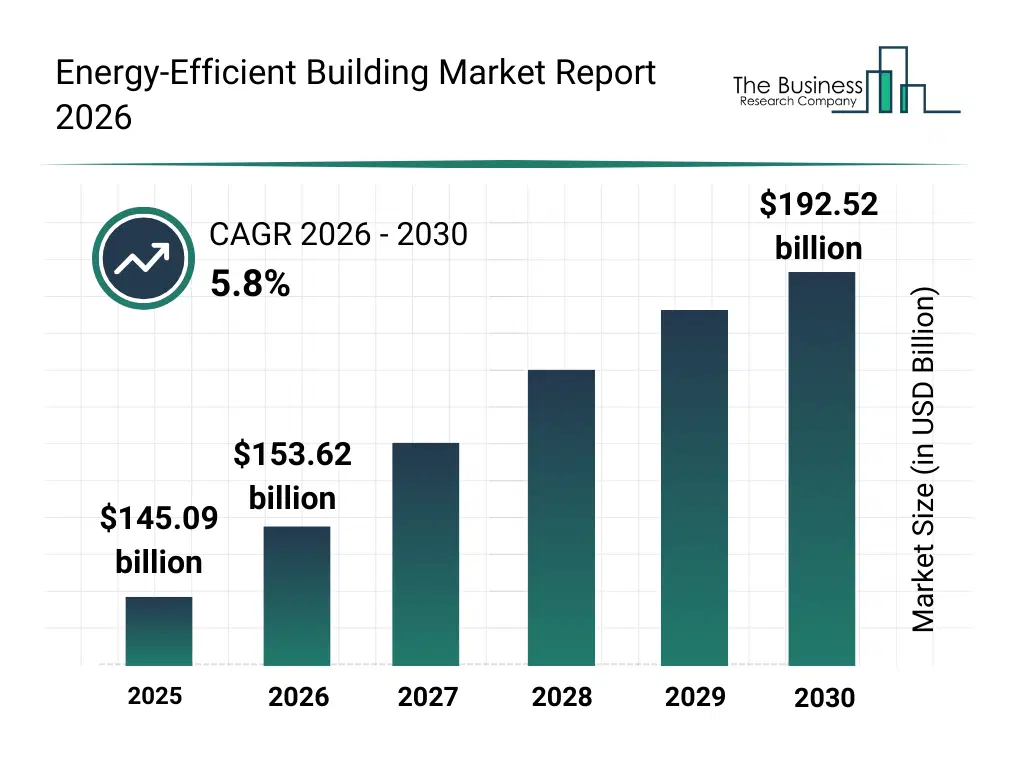
What Is The Energy-Efficient Building Market Size and Share 2026?
The energy-efficient building market size has grown strongly in recent years. It will grow from $145.09 billion in 2025 to $153.62 billion in 2026 at a compound annual growth rate (CAGR) of 5.9%. The growth in the historic period can be attributed to rising demand for sustainable construction practices, early adoption of efficient lighting and hvac systems, growth in green building certifications, increasing focus on reducing operational costs, expansion of regulatory standards for energy efficiency.What Is The Energy-Efficient Building Market Growth Forecast?
The energy-efficient building market size is expected to see strong growth in the next few years. It will grow to $192.52 billion in 2030 at a compound annual growth rate (CAGR) of 5.8%. The growth in the forecast period can be attributed to growing investment in net-zero building projects, rising adoption of smart building technologies, increasing integration of renewable energy systems, expansion of energy management services, growth in advanced building envelope materials. Major trends in the forecast period include rising integration of high-efficiency hvac solutions, growing adoption of smart energy management systems, expansion of renewable energy integration in buildings, increased use of advanced insulation materials, growth in net-zero and near-zero energy building projects.
Global Energy-Efficient Building Market Segmentation
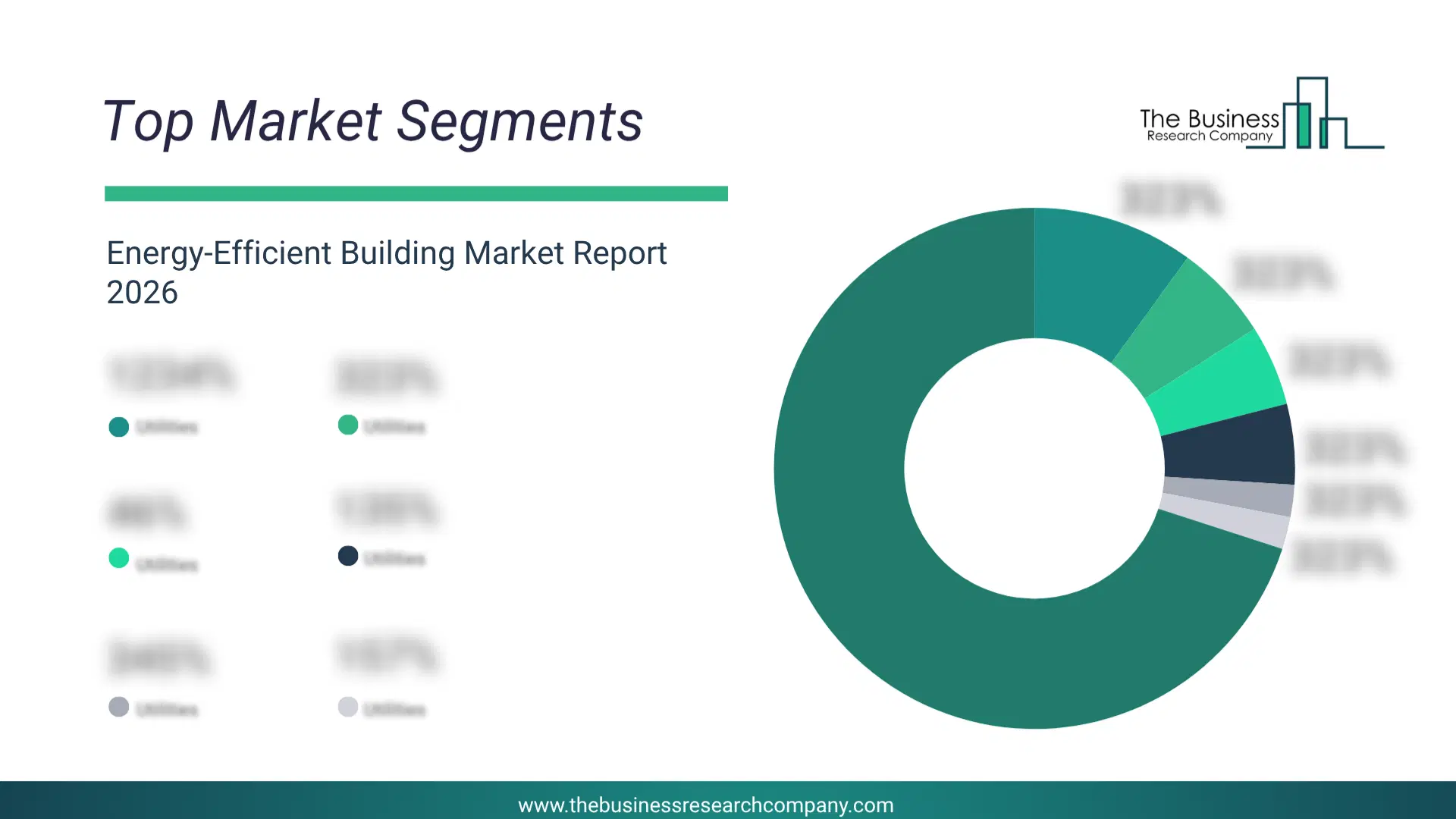
1) By Type: Heating, Ventilation, And Air Conditioning (HVAC), Lighting, Building Controls, Water Efficiency, Water Heating, Building Envelope, Other Types 2) By Material: Roofing, Fiber Cement, Concrete Tiles, Insulation, Construction Chemicals, Sealants, Water Proofers, Other Materials 3) By End User: Residential, Commercial, Industrial Sector Subsegments: 1) By Heating, Ventilation, And Air Conditioning (HVAC): High-Efficiency HVAC Systems, Geothermal Heating And Cooling Systems, Smart Thermostats, Variable Refrigerant Flow (VRF) Systems 2) By Lighting: LED Lighting, Smart Lighting Systems, Solar-Powered Lighting, Dimmable Lighting, Lighting Controls 3) By Building Controls: Building Management Systems (BMS), Energy Management Systems (EMS), Smart Thermostats, Occupancy Sensors, Advanced Metering Infrastructure (AMI) 4) By Water Efficiency: Low-Flow Fixtures, Water-Efficient Landscaping, Rainwater Harvesting Systems, Greywater Recycling Systems 5) By Water Heating: Solar Water Heating Systems, Heat Pump Water Heaters, Tankless Water Heaters, High-Efficiency Water Heaters 6) By Building Envelope: Insulation Materials, Energy-Efficient Windows, Roofing Solutions, Air Sealing And Draft Prevention, Reflective And Insulating Materials 7) By Other Types: Energy-Efficient Appliances, Renewable Energy Systems, Smart Home Technology For Energy Efficiency, Green Building Materials The top segments in the energy-efficient building market will be: • Heating, Ventilation, And Air Conditioning (HVAC) will reach $69.06 Billion by 2030. • Lighting will reach $37.73 Billion by 2030. • Building Controls will reach $30.66 Billion by 2030. • Building Envelope will reach $21.21 Billion by 2030. • Water Heating will reach $14.14 Billion by 2030.What Is The Driver Of The Energy-Efficient Building Market?
The increase in government investment expected to fuel the growth of the energy-efficient building market going forward. Government investment refers to funds allocated by governmental bodies for various purposes, such as infrastructure development, social programs, education, healthcare, research and development, and clean energy initiatives. Government investment in energy-efficient building initiatives plays a crucial role in accelerating the adoption of sustainable building practices, reducing energy consumption, lowering greenhouse gas emissions, and promoting economic growth and resilience. For instance, in July 2024, according to the Office for National Statistics, a UK-based executive office of the UK Statistics Authority, total market sector investment in infrastructure in 2023 was $14.93 billion in constant prices, up 3.9% from 2022. Therefore, the increase in government investment is driving the energy-efficient building industry.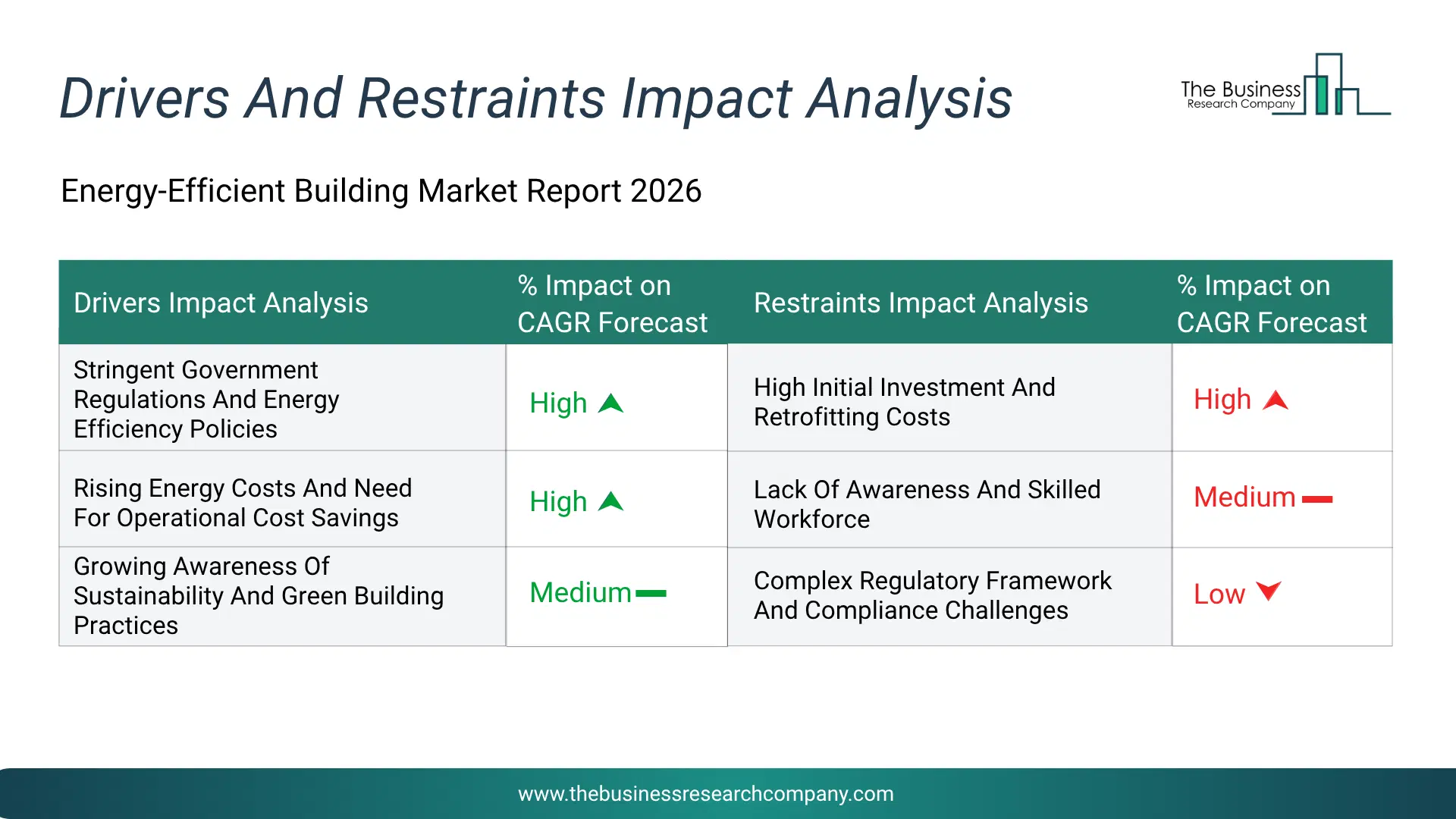
Infographic Chart Showing Key Market Drivers Analysis And Restraints For Energy-Efficient Building Market
The chart presents an impact analysis of key drivers and restraints, quantifying their relative influence on the market's growth rate and helping assess the balance between growth enablers and limiting factors. This chart offers a high-level perspective; the full report contains more detailed insights.
How Will The Drivers Impact Growth In The Global Energy-Efficient Building Market?
• Stringent Government Regulations And Energy Efficiency Policies (High) – During the forecast period, the stringent government regulations and energy efficiency policies are expected to become a key growth driver for the energy-efficient building market by 2030. Governments worldwide are implementing stricter building energy codes, performance standards, and emissions reduction targets to improve the efficiency of residential, commercial, and industrial buildings. These regulatory frameworks are encouraging developers and property owners to adopt advanced energy-saving technologies and high-performance building materials. Compliance requirements are also accelerating investments in sustainable construction and renovation projects. • Rising Energy Costs And Need For Operational Cost Savings (High) – During the forecast period, the rising energy costs and the need for operational cost savings are expected to emerge as a major factor driving the expansion of the energy-efficient building market by 2030. Building owners are increasingly investing in energy-efficient systems and infrastructure to reduce electricity consumption and lower long-term utility expenditures. Technologies such as efficient HVAC systems, smart controls, advanced insulation, and energy monitoring solutions are becoming essential for improving building performance. The growing focus on reducing operating expenses is strengthening demand for energy-efficient construction and retrofitting activities. • Growing Awareness Of Sustainability And Green Building Practices (Medium) – During the forecast period, the growing awareness of sustainability and green building practices is expected to act as a key growth catalyst for the energy-efficient building market by 2030. Increasing environmental concerns and corporate sustainability commitments are encouraging adoption of eco-friendly construction methods and resource-efficient building designs. Consumers, businesses, and developers are prioritizing buildings that offer lower environmental impact, improved occupant well-being, and enhanced long-term value. The expanding adoption of green building certifications and sustainable development initiatives is further supporting market growth.How Will The Restraints Impact Growth In The Global Energy-Efficient Building Market?
• High Initial Investment And Retrofitting Costs (High) – During the forecast period, the high initial investment and retrofitting costs act as a key restraint for the energy-efficient building market by increasing the financial burden on developers and property owners. Advanced insulation, smart systems, and renewable integrations require significant upfront capital, making adoption less attractive, especially for small and medium enterprises. Retrofitting existing buildings further adds complexity and cost due to structural modifications and system upgrades. These high expenses often result in longer payback periods, discouraging immediate investment decisions. Consequently, market growth is slowed as stakeholders delay or avoid transitioning to energy-efficient solutions. • Lack Of Awareness And Skilled Workforce (High) – During the forecast period, the lack of awareness and skilled workforce acts as a restraint by limiting the effective adoption and implementation of energy-efficient building practices. Many stakeholders are not fully informed about the long-term benefits, cost savings, and available technologies, leading to hesitation in adoption. Additionally, the shortage of trained professionals in energy modeling, green construction, and system integration affects project quality and execution timelines. This skill gap increases dependency on specialized labor, raising project costs and risks. As a result, the market faces slower penetration, particularly in developing regions. • Complex Regulatory Framework And Compliance Challenges (Medium) – During the forecast period, the complex regulatory framework and compliance challenges act as a restraint by creating operational and administrative hurdles for market participants. Energy-efficient building projects must adhere to varying standards, certifications, and codes across different regions, increasing compliance complexity. Navigating these regulations requires additional time, expertise, and financial resources, which can delay project approvals and execution. Frequent updates and inconsistencies in policies further add uncertainty for developers and investors. This regulatory burden limits scalability and slows the widespread adoption of energy-efficient building solutions.Key Players In The Global Energy-Efficient Building Market
Major companies operating in the energy-efficient building market are Siemens AG, Panasonic Corporation, GE Electrical Equipment, Veolia Environnement S.A., Mitsubishi Electric Corporation, Schneider Electric SE, Honeywell International Inc., ABB Ltd., Daikin Industries Ltd., Toshiba Corporation, Johnson Controls International plc, Eaton Corporation PLC, Carrier Global Corporation, Koninklijke Philips N.V., Trane Technologies plc, Emerson Electric Co., Legrand S.A., Osram GmbH, Acuity Brands Inc., Itron Inc., Zumtobel Group AG, Cree Inc., GridPoint Inc., Pacific Controls Inc., BuildingIQ Inc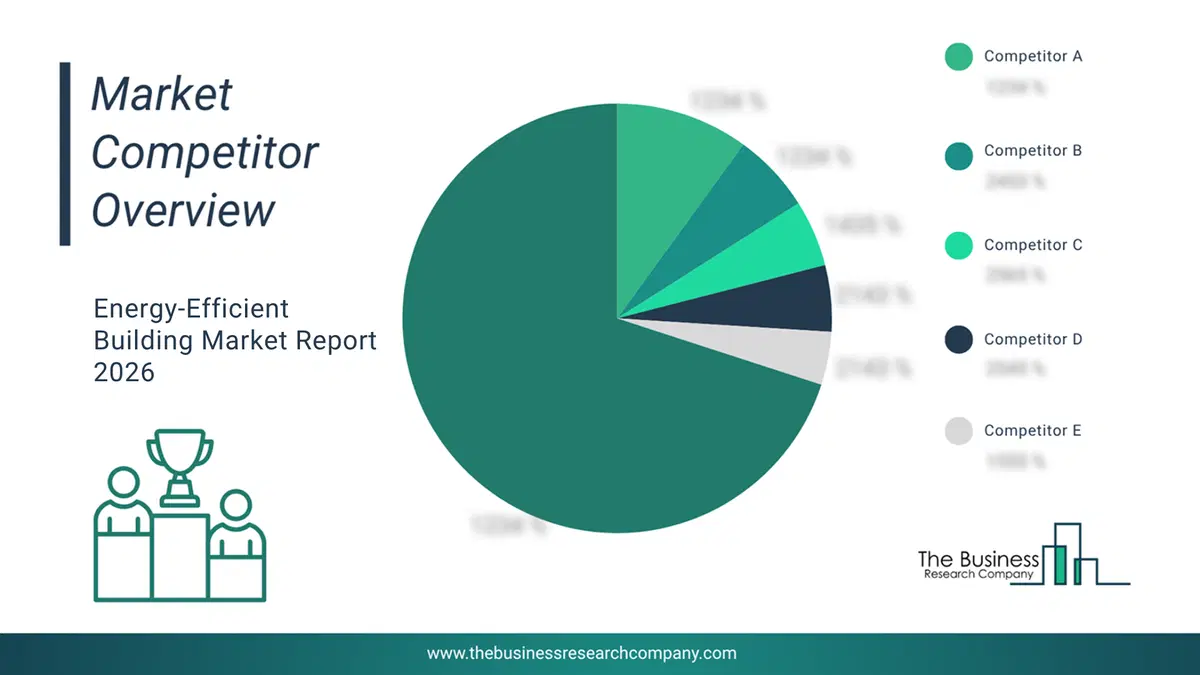
This chart is for illustrative purposes; the full report includes a detailed competitor analysis and comprehensive overview of the top 10 companies in the market.
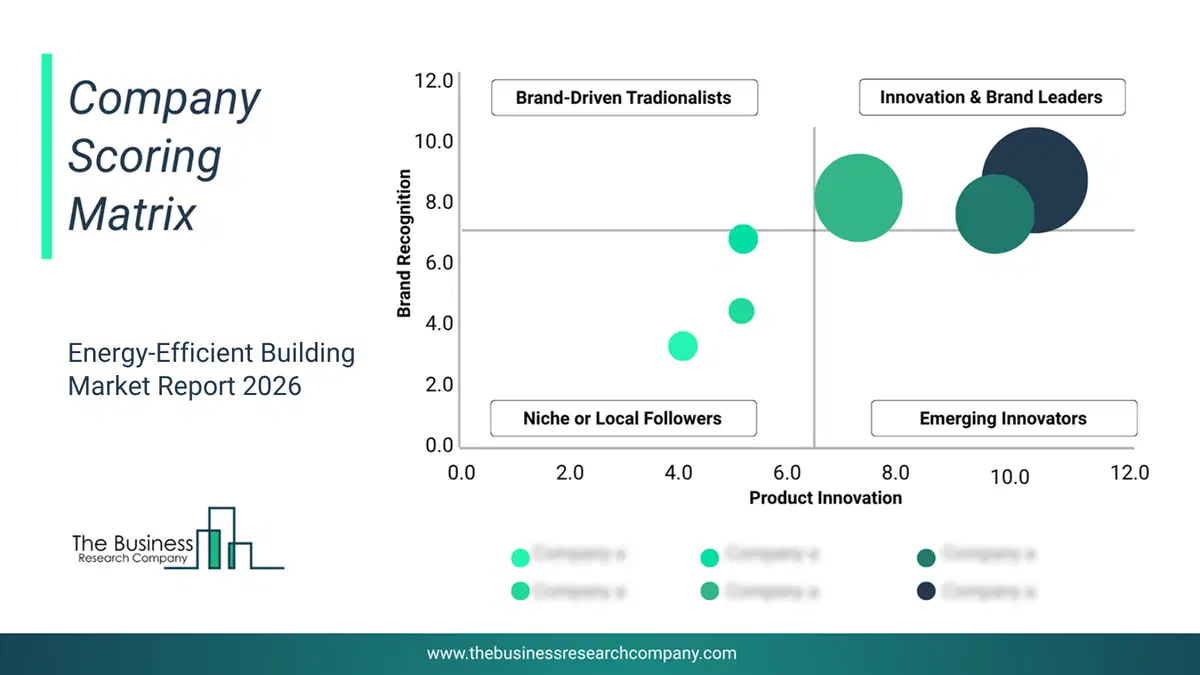
This chart maps companies by product innovation and brand strength, with bubble size indicating relative revenue, helping identify market leaders, challengers, and niche players. This is an illustrative chart; the full report provides a complete and accurate competitive analysis.
Global Energy-Efficient Building Market Trends and Insights
Major companies operating in the energy-efficient building market are focused on developing innovative products with advanced technologies, such as smart IoT solutions to increase their profitability in market. Smart IoT solutions helps to promote energy efficiency across various domains, including homes, buildings, industries, and cities, ultimately contributing to sustainability and environmental conservation efforts. For instance, in March 2023, Siemens AG, a Germany-based energy technology and manufacturing company, launched Connect Box. Connect Box is an IoT solution for small to medium-sized buildings, seamlessly integrating wired or wireless devices. It optimizes energy usage, monitors performance, and enhances indoor air quality through real-time analysis. With plug-and-play setup, diverse licensing options, and user-friendly interfaces, it caters to varied needs while ensuring compliance with sustainability regulations and delivering up to 30% energy savings.What Are Latest Mergers And Acquisitions In The Energy-Efficient Building Market?
In May 2023, Bosch Building Technologies, a Germany-based company providing integrated solutions for building security, building automation and energy services, acquired Paladin Technologies for an undisclosed amount. With this acquisition, Paladin Technologies strengthens Bosch's expertise, market presence, and competitive advantage in North America's commercial building services industry, which is driven by energy efficiency and security needs. Paladin Technologies is a Canada-based company providing complex systems integrator for building technology solutions, specializing in IP security, audiovisual, low voltage, and integrated technology solutions.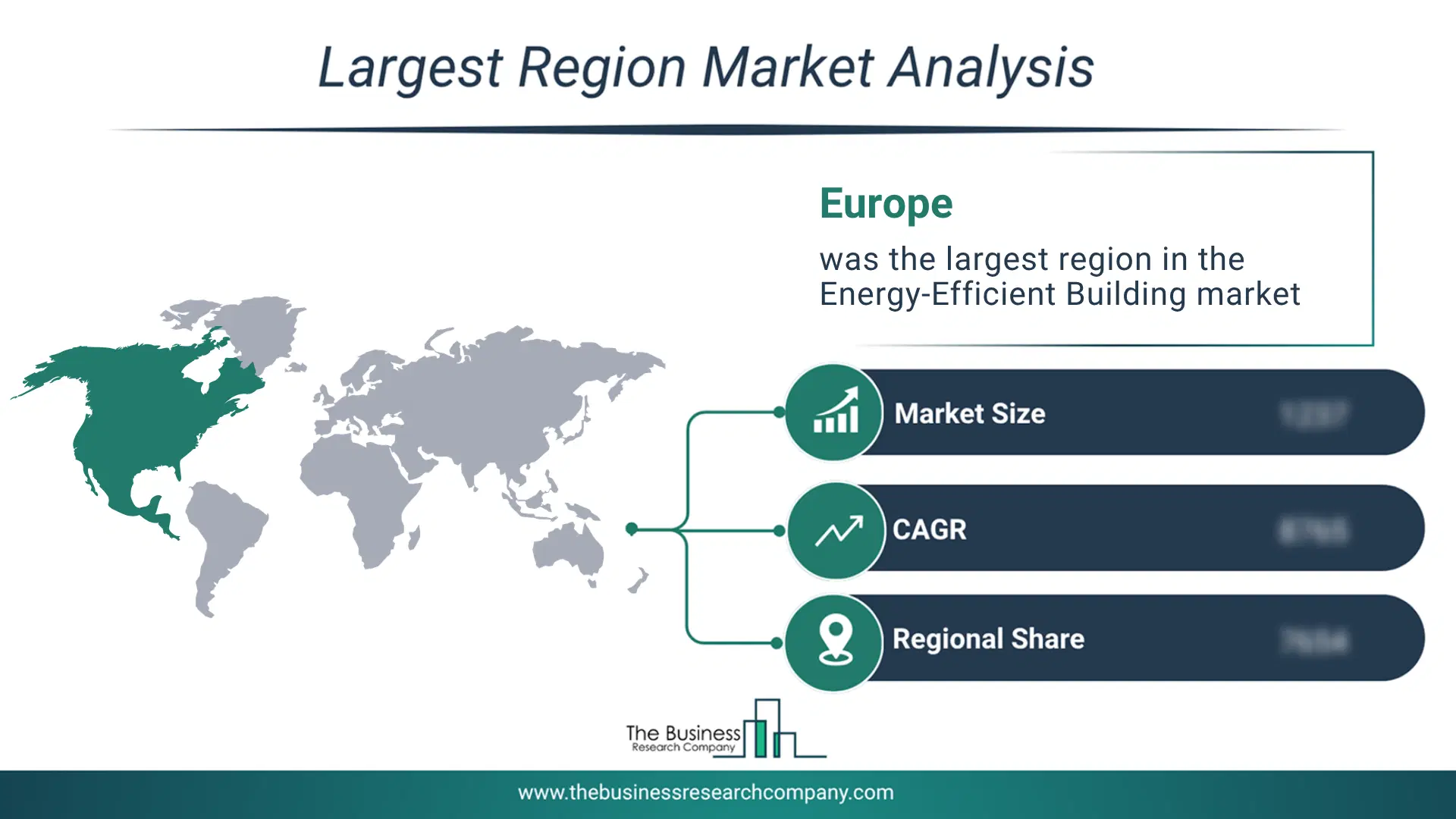
Regional Insights
Europe was the largest region in the energy-efficient building market in 2025. Asia-Pacific is expected to be the fastest-growing region in the forecast period. The regions covered in this market report are Asia-Pacific, South East Asia, Western Europe, Eastern Europe, North America, South America, Middle East, Africa. The countries covered in this market report are Australia, Brazil, China, France, Germany, India, Indonesia, Japan, Taiwan, Russia, South Korea, UK, USA, Canada, Italy, Spain.What Defines the Energy-Efficient Building Market?
The energy-efficient building market includes revenues earned by entities by providing services such as conducting energy audits, designing energy-efficient systems, installing high-efficiency equipment, providing maintenance, incorporating renewable energy sources, implementing building automation, monitoring energy use, and educating occupants. The market value includes the value of related goods sold by the service provider or included within the service offering. Only goods and services traded between entities or sold to end consumers are included.How is Market Value Defined and Measured?
The market value is defined as the revenues that enterprises gain from the sale of goods and/or services within the specified market and geography through sales, grants, or donations in terms of the currency (in USD unless otherwise specified). The revenues for a specified geography are consumption values that are revenues generated by organizations in the specified geography within the market, irrespective of where they are produced. It does not include revenues from resales along the supply chain, either further along the supply chain or as part of other products.
This chart presents market attractiveness based on a quantitative evaluation of growth, competition, strategic alignment, and risk, offering a clear view of opportunity areas for decision-making. This chart is for illustrative purposes; the full report contains the complete analysis.

This chart highlights the Total Addressable Market (TAM) by estimating the maximum revenue opportunity using an assumption-driven approach, supporting strategic planning and opportunity sizing across markets. The chart is illustrative; the full report provides a more comprehensive analysis.
What Key Data and Analysis Are Included in theEnergy-Efficient Building Market Report 2026?
The energy-efficient building market research report is one of a series of new reports from The Business Research Company that provides market statistics, including industry global market size, regional shares, competitors with the market share, detailed market segments, market trends and opportunities, and any further data you may need to thrive in the energy-efficient building industry. The market research report delivers a complete perspective of everything you need, with an in-depth analysis of the current and future state of the industry.Energy-Efficient Building Market Report Forecast Analysis
| Report Attribute | Details |
|---|---|
| Market Size Value In 2026 | $153.62 billion |
| Revenue Forecast In 2030 | $192.52 billion |
| Growth Rate | CAGR of 5.9% from 2026 to 2030 |
| Base Year For Estimation | 2025 |
| Actual Estimates/Historical Data | 2020-2025 |
| Forecast Period | 2026 - 2030 |
| Market Representation | Revenue in USD Billion and CAGR from 2026 to 2030 |
| Segments Covered | Type, Material, End User |
| Regional Scope | Asia-Pacific, Western Europe, Eastern Europe, North America, South America, Middle East, Africa |
| Country Scope | The countries covered in the report are Australia, Brazil, China, France, Germany, India, Indonesia, Japan, Taiwan, Russia, South Korea, UK, USA, Canada, Italy, Spain. |
| Key Companies Profiled | Siemens AG, Panasonic Corporation, GE Electrical Equipment, Veolia Environnement S.A., Mitsubishi Electric Corporation, Schneider Electric SE, Honeywell International Inc., ABB Ltd., Daikin Industries Ltd., Toshiba Corporation, Johnson Controls International plc, Eaton Corporation PLC, Carrier Global Corporation, Koninklijke Philips N.V., Trane Technologies plc, Emerson Electric Co., Legrand S.A., Osram GmbH, Acuity Brands Inc., Itron Inc., Zumtobel Group AG, Cree Inc., GridPoint Inc., Pacific Controls Inc., BuildingIQ Inc |
| Customization Scope | Request for Customization |
| Pricing And Purchase Options | Explore Purchase Options |