
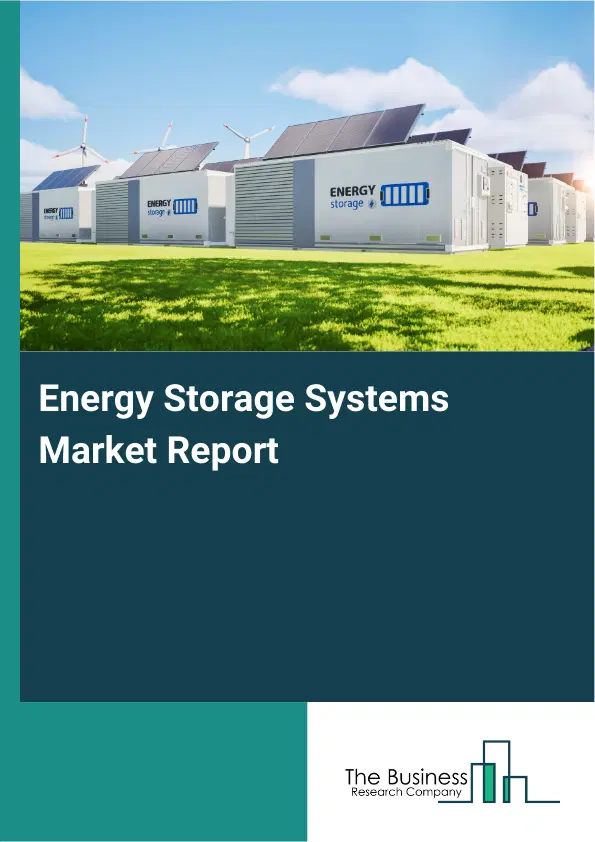
Energy Storage Systems Market Report 2026
Global Outlook – By Technology ( Pumped Hydro Storage, Battery Energy Storage, Compressed Air Energy Storage, Flywheel Energy Storage ), By Application ( Stationary, Transportation ), By End User ( Residential, Non-Residential, Utilities) – Market Size, Trends, Strategies, and Forecast to 2035
Energy Storage Systems Market Overview
• Energy Storage Systems market size has reached to $266.84 billion in 2025 • Expected to grow to $391.56 billion in 2030 at a compound annual growth rate (CAGR) of 8% • Growth Driver: Escalating Adoption Of Renewable Energy Sources Is Anticipated To Fuel The Energy Storage Systems Market • Market Trend: Adoption Of Battery Energy Storage Systems To Enhance Renewable Integration And Grid Stability • Asia-Pacific was the largest region in 2025 and North America is the fastest growing region.Market Gains By 2030 – Top Opportunities By Segment
Market Gain identifies the most promising market opportunities by highlighting the segments or products expected to generate the highest incremental revenue growth over the next five years.
What Is Covered Under Energy Storage Systems Market?
Energy Storage System (ESS) refers to a device or collection of equipment created to convert electrical energy from power systems and store energy. An ESS also aids in managing and using electrical energy efficiently. The energy storage systems store energy from renewables and release energy when customers need power. The main technologies in energy storage systems are pumped hydro storage, battery energy storage, compressed air energy storage, and flywheel energy storage. A pumped hydro storage system refers to a type of hydroelectric energy storage and a set-up of two water reservoirs at various altitudes that can produce power as water flows through a turbine as it discharges from one reservoir to the other. Energy storage systems are used in major applications such as stationary and transportation. It is used by various end-user industries such as residential, non-residential, and utilities.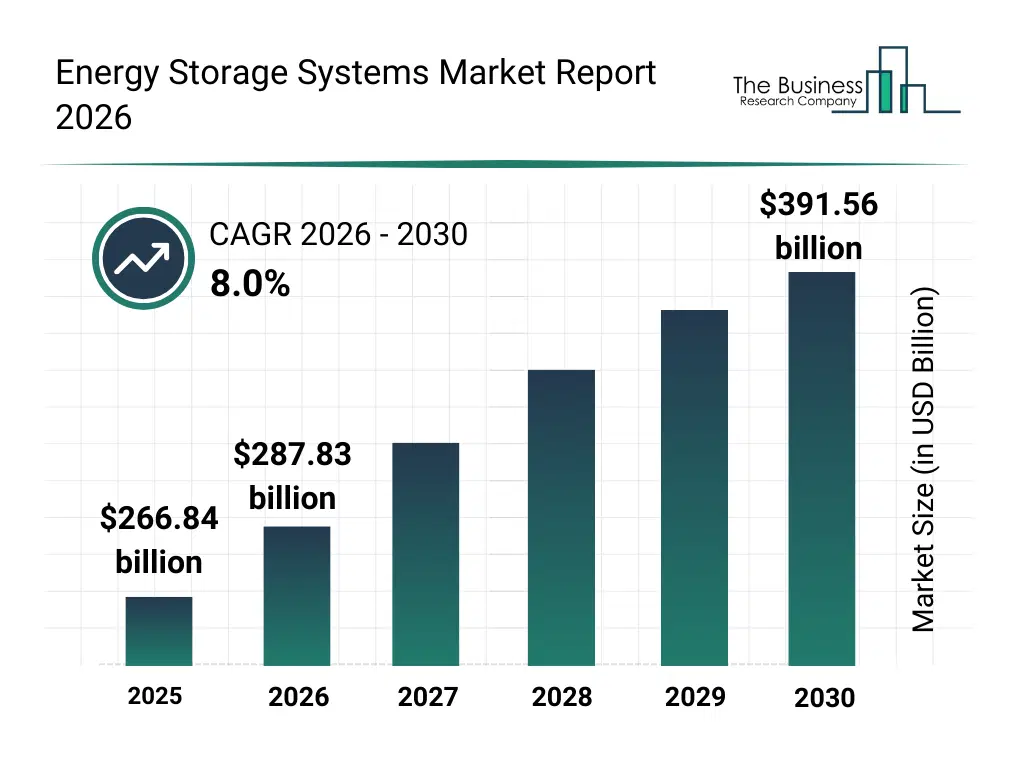
What Is The Energy Storage Systems Market Size 2026 And Growth Rate?
The energy storage systems market size has grown strongly in recent years. It will grow from $266.84 billion in 2025 to $287.83 billion in 2026 at a compound annual growth rate (CAGR) of 7.9%. The growth in the historic period can be attributed to growth in renewable energy deployment, early adoption of pumped hydro storage, expansion in backup power applications, reliance on traditional grid stabilization methods, increased investment in lithium-ion technologies.What Is The Energy Storage Systems Market Growth Forecast?
The energy storage systems market size is expected to see strong growth in the next few years. It will grow to $391.56 billion in 2030 at a compound annual growth rate (CAGR) of 8.0%. The growth in the forecast period can be attributed to increasing demand for distributed energy storage, rising adoption of utility-scale battery systems, expansion of residential energy storage solutions, growth in electric vehicle charging integration, development of long-duration storage technologies. Major trends in the forecast period include adoption of grid-integrated smart storage solutions, expansion of electric mobility energy storage platforms, development of IoT-connected distributed storage networks, advancement of intelligent manufacturing for battery systems, integration of cloud-based energy analytics.
Global Energy Storage Systems Market Segmentation
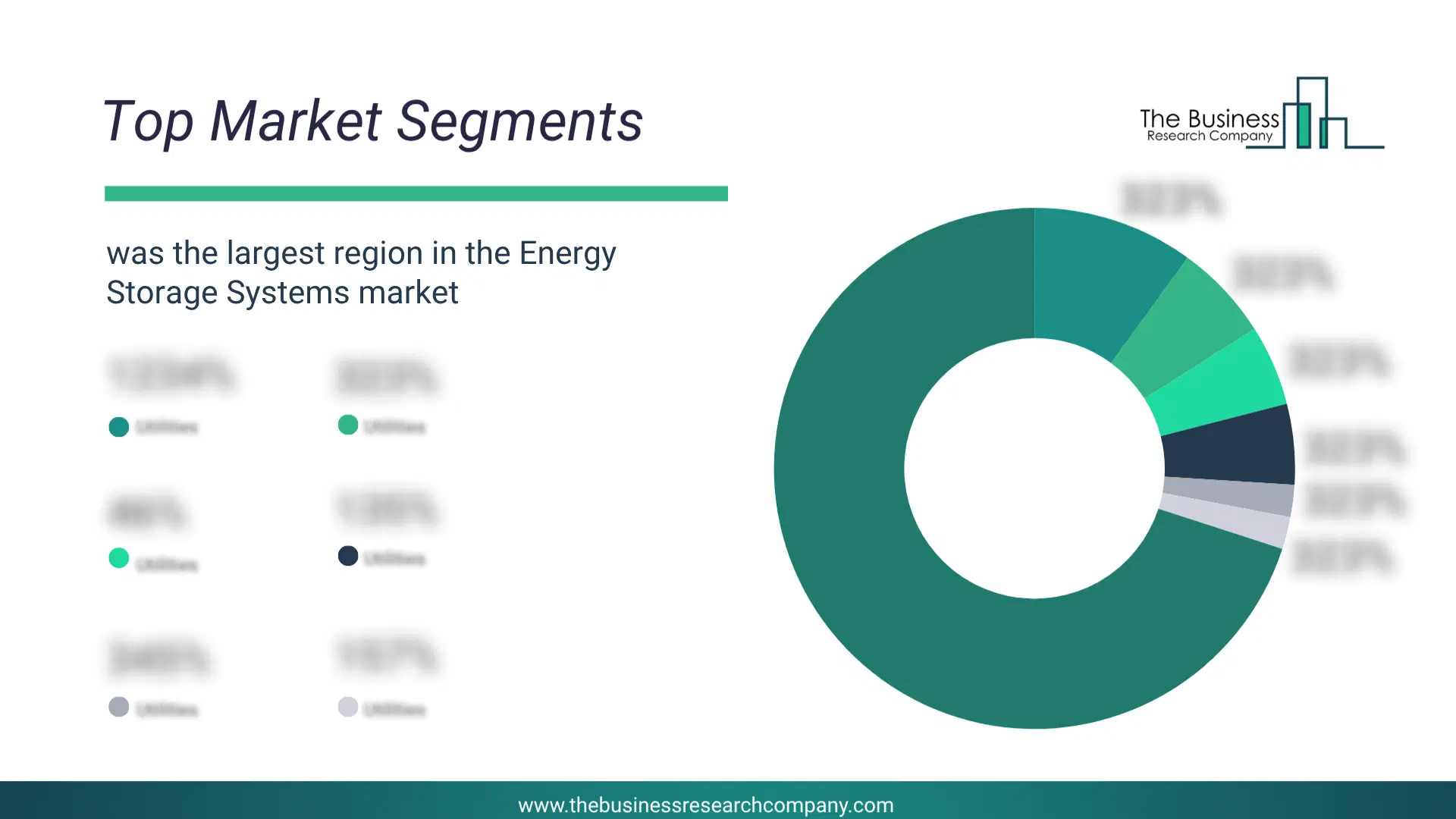
1) By Technology: Pumped Hydro Storage, Battery Energy Storage, Compressed Air Energy Storage, Flywheel Energy Storage 2) By Application: Stationary, Transportation 3) By End User: Residential, Non-Residential, Utilities Subsegments: 1) By Pumped Hydro Storage: Conventional Pumped Hydro Storage, Advanced Pumped Hydro Storage 2) By Battery Energy Storage: Lithium-Ion Batteries, Lead-Acid Batteries, Flow Batteries, Sodium-Sulfur Batteries 3) By Compressed Air Energy Storage (CAES): Above Ground CAES, Underground CAES 4) By Flywheel Energy Storage: Mechanical Flywheels, Magnetic Bearings Flywheels The top segments in the energy storage systems market will be: • Stationary will reach $213754.6 Million by 2025. • Pumped Hydro Storage will reach $153202.9 Million by 2025. • Utilities will reach $125761.2 Million by 2025. • Battery Energy Storage will reach $86014 Million by 2025. • Non-Residential will reach $70110.5 Million by 2025.What Is The Driver Of The Energy Storage Systems Market?
An escalating adoption of renewable energy sources is expected to propel the growth of the energy storage systems market going forward. Renewable energy sources are natural resources that are replenished naturally and sustainably. Renewable energy sources are increasing due to growing global efforts to reduce carbon emissions and combat climate change. Energy Storage Systems in Renewable Energy Sources facilitate the capture and efficient utilization of intermittent energy, ensuring reliable power supply. For instance, in January 2024, according to the International Energy Agency (IEA), a France-based autonomous intergovernmental organization, in 2023, global renewable energy capacity increased by 50%, reaching nearly 510 gigawatts (GW), with solar PV contributing to three-quarters of the growth. China alone added as much solar PV in 2023 as the entire world did in 2022, with its wind power additions rising by 66% year-on-year. Therefore, the escalating adoption of renewable energy is driving the energy storage systems industry.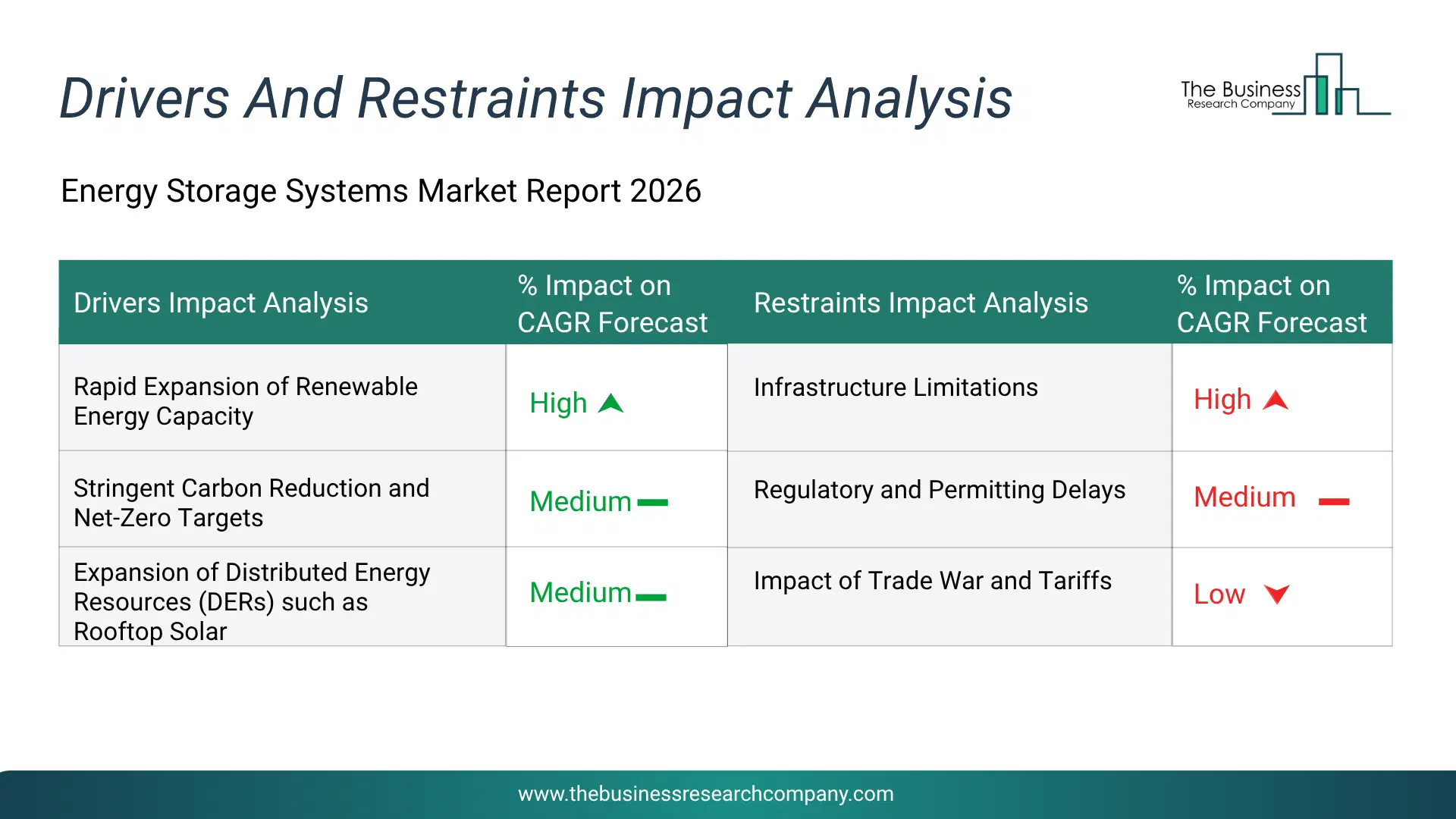
Infographic Chart Showing Key Market Drivers Analysis And Restraints For Energy Storage Systems Market
The chart presents an impact analysis of key drivers and restraints, quantifying their relative influence on the market's growth rate and helping assess the balance between growth enablers and limiting factors. This chart offers a high-level perspective; the full report contains more detailed insights.
How Will The Drivers Impact Growth In The Global Energy Storage Systems Market?
• Rapid Expansion of Renewable Energy Capacity (High) – The rapid expansion of renewable energy capacity will become a key driver of growth in the energy storage systems market by 2030. As installations of solar, wind, and other renewable sources increase, the need for efficient energy storage becomes critical to address intermittency and ensure grid stability. Energy storage systems enable excess power generated during peak production periods to be stored and utilized when generation is low or demand is high. Additionally, supportive government policies, decarbonization targets, and rising investments in clean energy infrastructure are accelerating renewable deployment. This, in turn, is creating strong demand for advanced energy storage solutions, reinforcing sustained market growth. As a result, the rapid expansion of renewable energy capacity is anticipated to contributing to a 2.0% annual growth in the market. • Stringent Carbon Reduction and Net-Zero Targets (Medium) – The stringent carbon reduction and net-zero emission targets will emerge as a major factor driving the expansion of the energy storage systems market by 2030. Governments and corporations worldwide are committing to decarbonization, accelerating the transition from fossil fuels to renewable energy sources. However, the intermittent nature of renewables such as solar and wind creates a critical need for reliable energy storage solutions to ensure consistent power supply and grid stability. Energy storage systems play a vital role in balancing supply and demand, reducing emissions, and enhancing energy efficiency. As regulatory pressure intensifies, investments in advanced storage technologies are projected to rise, supporting sustained market expansion. Consequently, the stringent carbon reduction and net-zero emission targets is projected to contributing to a 1.5% annual growth in the market. • Expansion of Distributed Energy Resources (DERs) such as Rooftop Solar (Medium) – The expansion of distributed energy resources (ders) such as rooftop solar will serve as a key growth catalyst for the energy storage systems market by 2030. As more residential, commercial, and industrial users adopt decentralized energy generation, the need for efficient storage solutions increases to manage energy variability and optimize self-consumption. Energy storage systems enable users to store excess electricity generated during peak production periods and utilize it during low generation or high demand. Additionally, the growing focus on energy independence, grid resilience, and cost savings is accelerating DER adoption. This trend is creating strong demand for scalable and reliable energy storage technologies, supporting overall market growth. Therefore, this expansion of distributed energy resources (ders) such as rooftop solar is projected to supporting to a 1.0% annual growth in the market. • Increasing Adoption of Microgrids and Off-grid Solutions (Low) – The increasing adoption of microgrids and off-grid solutions will become a significant driver contributing to the growth of the energy storage systems market by 2030. Microgrids, which operate independently or alongside centralized grids, require reliable storage to manage intermittent renewable energy sources such as solar and wind. Similarly, off-grid systems in remote or underserved areas depend on energy storage to ensure a consistent power supply. Increasing investments in rural electrification, disaster-resilient infrastructure, and decentralized energy systems are further supporting this trend. As a result, the demand for advanced, efficient, and scalable energy storage technologies is anticipated to rise steadily, strengthening overall market growth. Consequently, the increasing adoption of microgrids and off-grid solutions is projected to contributing to a 0.8% annual growth in the market.How Will The Restraints Impact Growth In The Global Energy Storage Systems Market?
• Infrastructure Limitations (High) – Infrastructure limitations is expected to restrain market growth during the forecast period. It creates operational, financial, regulatory, or commercial challenges that can increase costs, delay projects, reduce investments, or discourage purchasing decisions depending on the market. These challenges can reduce product adoption, affect business confidence, and limit the ability of companies to expand efficiently across key regions. This can reduce operational efficiency, delay expansion plans, and affect the ability of companies to achieve sustainable business growth. • Regulatory and Permitting Delays (Medium) – During the forecast period, regulatory and permitting delays is likely to limit market expansion. It creates operational, financial, regulatory, or commercial challenges that can increase costs, delay projects, reduce investments, or discourage purchasing decisions depending on the market. These challenges can reduce product adoption, affect business confidence, and limit the ability of companies to expand efficiently across key regions. As a result, businesses may face increased cost pressures, slower commercial adoption, and reduced revenue opportunities. • Impact of Trade War and Tariffs (Medium) – The market is expected to face challenges due to impact of trade war and tariffs over the forecast period. It creates operational, financial, regulatory, or commercial challenges that can increase costs, delay projects, reduce investments, or discourage purchasing decisions depending on the market. These challenges can reduce product adoption, affect business confidence, and limit the ability of companies to expand efficiently across key regions. This may discourage new investments, delay strategic expansion initiatives, and weaken the overall competitive position of market participants.Key Players In The Global Energy Storage Systems Market
Major companies operating in the energy storage systems market are Schneider Electric SE, SMA Solar Technology AG, Exide Industries Limited, SK energy Co. Ltd., Enerbrax Acumuladores Ltd., Eguana Technologies, Tata Power Company Limited, BYD Company Ltd., ABB Limited, Beacon Power LLC, Convergent Energy + Power, S&C Electric Company, General Electric Company, LG Chem Ltd., Samsung Electronics Co. Ltd., Panasonic Corporation, Tesla Inc., Hitachi Chemical, GS Yuasa Corporation, Toshiba Corporation, Voith GmbH, Genex Power Limited, Alstom SA, Schluchseewerk AG, East Penn Manufacturing Inc., Showa Denko Materials Co. Ltd.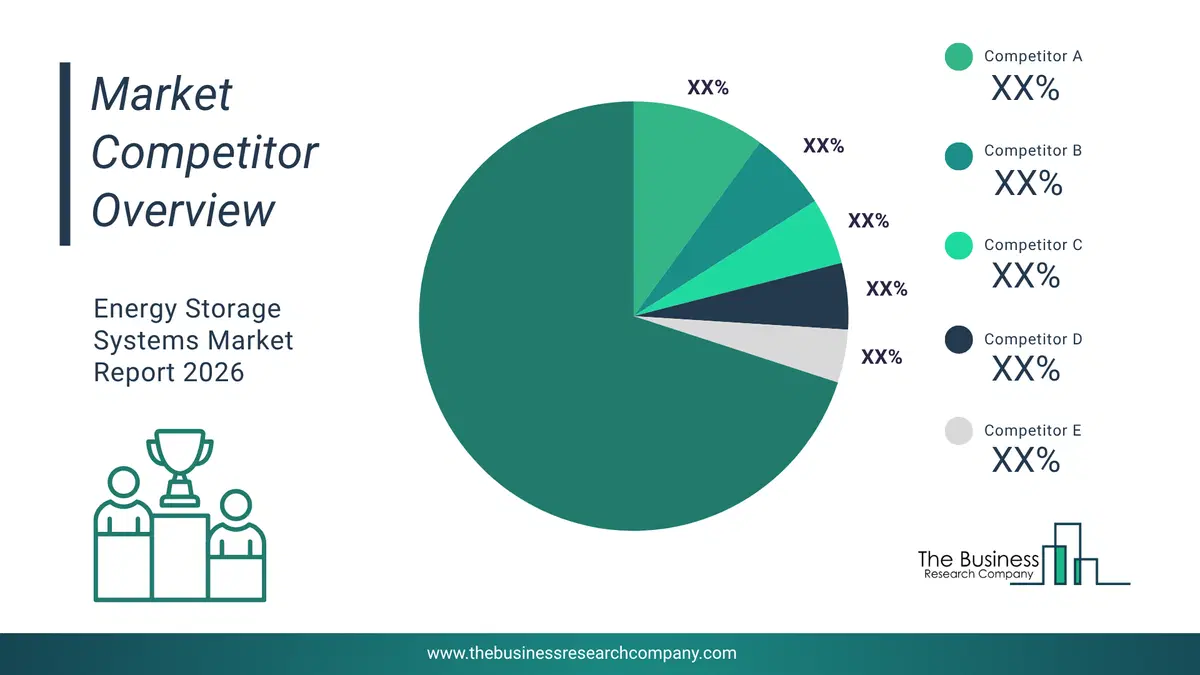
This chart is for illustrative purposes; the full report includes a detailed competitor analysis and comprehensive overview of the top 10 companies in the market.
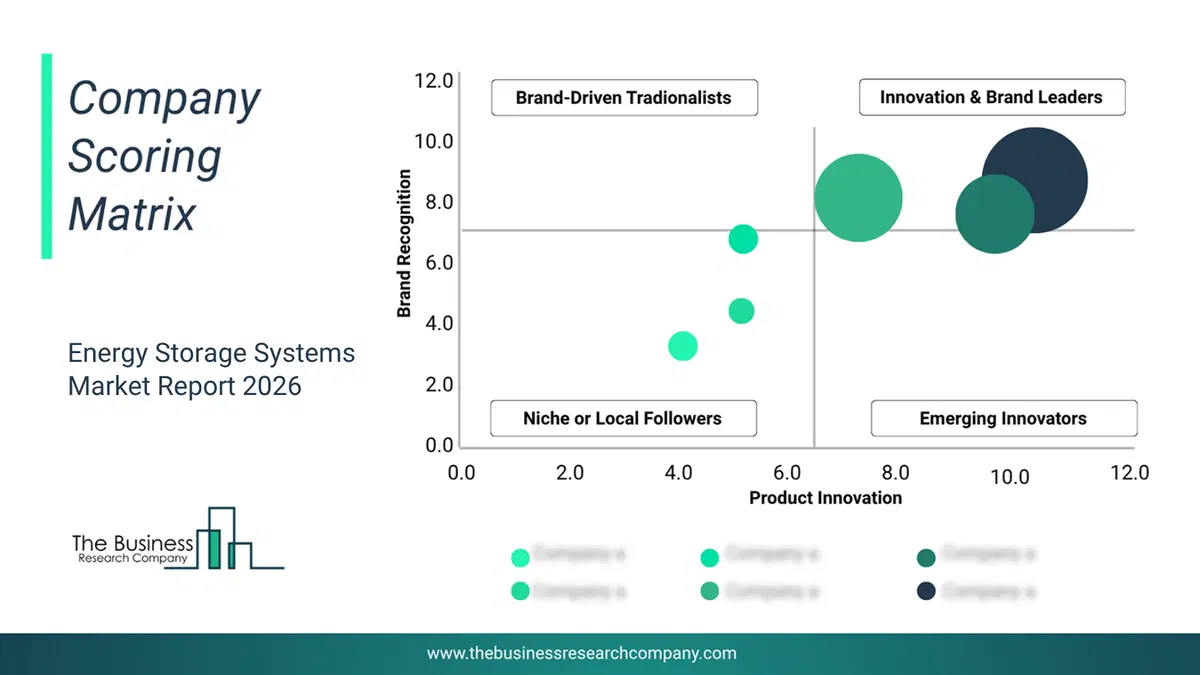
This chart maps companies by product innovation and brand strength, with bubble size indicating relative revenue, helping identify market leaders, challengers, and niche players. This is an illustrative chart; the full report provides a complete and accurate competitive analysis.
Global Energy Storage Systems Market Trends and Insights
Major companies are operating in the energy storage systems market focusing on developing innovative technologies such as advanced battery energy storage systems (BESS) to meet the rising demand for renewable energy integration, grid stabilization, and peak-shaving applications. A BESS is a stationary energy storage technology that stores electrical energy typically using lithium-ion or lithium ferrophosphate (LFP) battery chemistry and discharges it when required. Compared to traditional solutions such as diesel generators or pumped hydro storage, BESS offers faster response times, modular scalability, lower emissions, and improved compatibility with intermittent renewable sources. For instance, in June 2025, Cummins India Limited, an India-based power solutions provider, launched its Battery Energy Storage Systems, a modular and scalable solution available in 10ft and 20ft containerized units with energy outputs ranging from 200 kWh to 2 MWh. The system features LFP battery cells, an integrated liquid-cooling thermal management system, plug-and-play installation, and full AC-output integration, enabling efficient renewable energy integration, peak-shaving, and energy-shifting for commercial, industrial, and mining applications.What Are Latest Mergers And Acquisitions In The Energy Storage Systems Market?
In October 2023, Hitachi Energy, a Switzerland-based provider of power-grid technologies, power conversion systems, and energy management solutions, acquired a controlling stake in Eks Energy for an undisclosed amount. This acquisition enhances Hitachi Energy’s capabilities in battery energy storage systems and renewable energy integration, expands its portfolio with advanced power conversion and control technologies, and strengthens its position as a leading provider of grid-interactive energy storage solutions. Eks Energy is a Spain-based provider of power conversion systems, inverters, and energy management solutions for battery energy storage systems and renewable energy applications.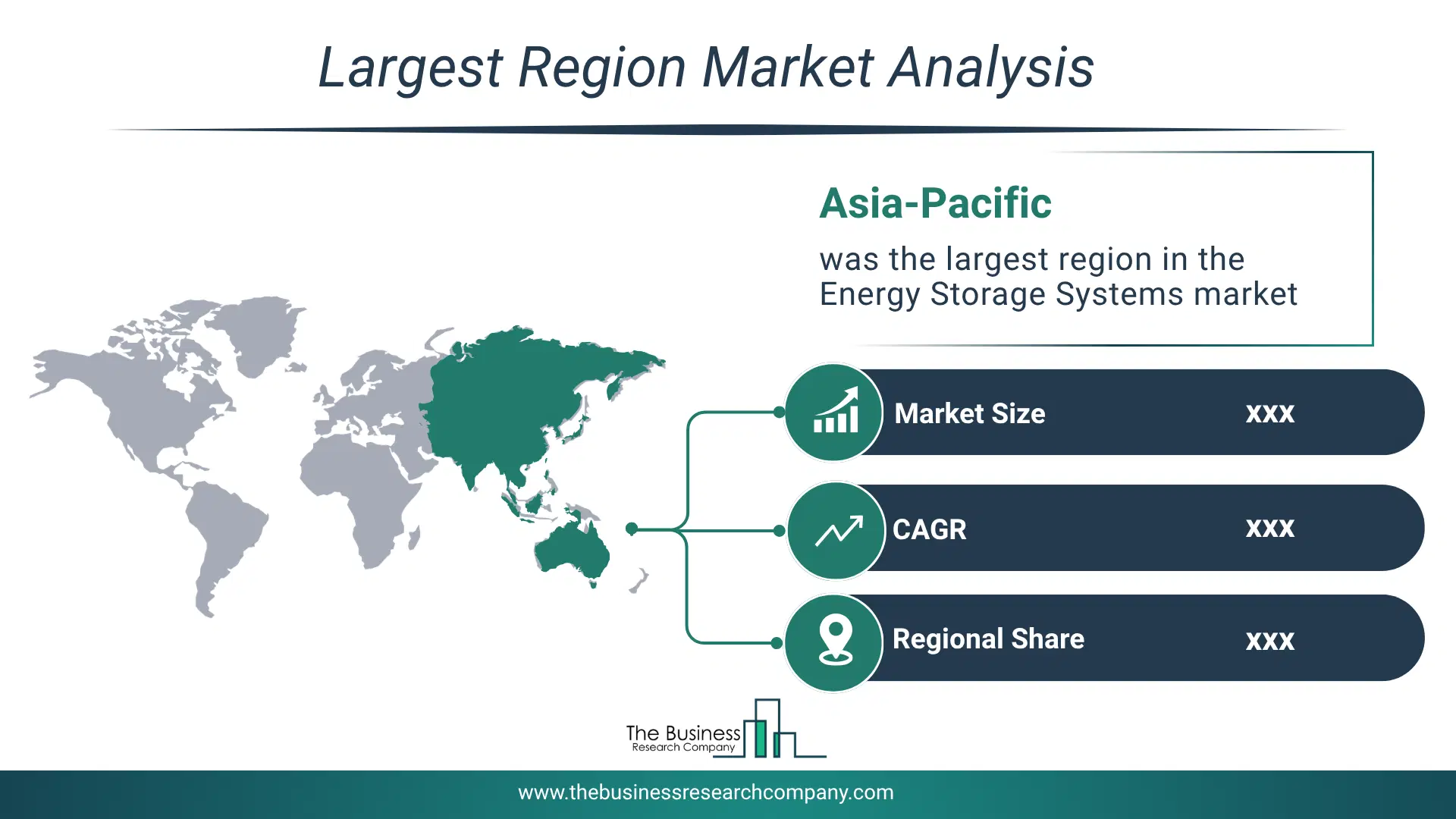
Regional Outlook
Asia-Pacific was the largest region in the energy storage systems market share in 2025. North America is expected to be the fastest-growing region in the forecast period. The regions covered in this market report are Asia-Pacific, South East Asia, Western Europe, Eastern Europe, North America, South America, Middle East, Africa. The countries covered in this market report are Australia, Brazil, China, France, Germany, India, Indonesia, Japan, Taiwan, Russia, South Korea, UK, USA, Canada, Italy, Spain.What Defines the Energy Storage Systems Market?
The energy storage system (ESS) market consists of sales of electro chemical, thermal storage and mechanical energy storage systems. Values in this market are ‘factory gate’ values, that is the value of goods sold by the manufacturers or creators of the goods, whether to other entities (including downstream manufacturers, wholesalers, distributors and retailers) or directly to end customers. The value of goods in this market includes related services sold by the creators of the goods.How is Market Value Defined and Measured?
The market value is defined as the revenues that enterprises gain from the sale of goods and/or services within the specified market and geography through sales, grants, or donations in terms of the currency (in USD unless otherwise specified). The revenues for a specified geography are consumption values that are revenues generated by organizations in the specified geography within the market, irrespective of where they are produced. It does not include revenues from resales along the supply chain, either further along the supply chain or as part of other products.
This chart presents market attractiveness based on a quantitative evaluation of growth, competition, strategic alignment, and risk, offering a clear view of opportunity areas for decision-making. This chart is for illustrative purposes; the full report contains the complete analysis.

This chart highlights the Total Addressable Market (TAM) by estimating the maximum revenue opportunity using an assumption-driven approach, supporting strategic planning and opportunity sizing across markets. The chart is illustrative; the full report provides a more comprehensive analysis.
What Key Data and Analysis Are Included in the Energy Storage Systems Market Report 2026?
The energy storage systems market research report is one of a series of new reports from The Business Research Company that provides market statistics, including industry global market size, regional shares, competitors with the market share, detailed market segments, market trends and opportunities, and any further data you may need to thrive in the energy storage systems industry. The market research report delivers a complete perspective of everything you need, with an in-depth analysis of the current and future state of the industry.Energy Storage Systems Market Report 2026 Market Report Forecast Analysis
| Report Attribute | Details |
|---|---|
| Market Size Value In 2026 | $287.83 billion |
| Revenue Forecast In 2035 | $391.56 billion |
| Growth Rate | CAGR of 7.9% from 2026 to 2035 |
| Base Year For Estimation | 2025 |
| Actual Estimates/Historical Data | 2020-2025 |
| Forecast Period | 2026 - 2030 - 2035 |
| Market Representation | Revenue in USD Billion and CAGR from 2026 to 2035 |
| Segments Covered | Technology, Application, End User |
| Regional Scope | Asia-Pacific, Western Europe, Eastern Europe, North America, South America, Middle East, Africa |
| Country Scope | The countries covered in the report are Australia, Brazil, China, France, Germany, India, ... |
| Key Companies Profiled | Schneider Electric SE, SMA Solar Technology AG, Exide Industries Limited, SK energy Co. Ltd., Enerbrax Acumuladores Ltd., Eguana Technologies, Tata Power Company Limited, BYD Company Ltd., ABB Limited, Beacon Power LLC, Convergent Energy + Power, S&C Electric Company, General Electric Company, LG Chem Ltd., Samsung Electronics Co. Ltd., Panasonic Corporation, Tesla Inc., Hitachi Chemical, GS Yuasa Corporation, Toshiba Corporation, Voith GmbH, Genex Power Limited, Alstom SA, Schluchseewerk AG, East Penn Manufacturing Inc., Showa Denko Materials Co. Ltd. |
| Customization Scope | Request for Customization |
| Pricing And Purchase Options | Explore Purchase Options |