
Residential Energy Storage Market Report 2026
Global Outlook – By Technology ( Lead-Acid, Lithium-Ion), By Utility ( 3KW To < 6KW, 6KW To < 10KW, 10KW To 29KW), By Connectivity ( On-Grid, Off-Grid), By Ownership Type ( Customer Owned, Utility Owned, Third-Party Owned), By Operation ( Solar And Storage System, Standalone Systems) – Market Size, Trends, Strategies, and Forecast to 2030
Residential Energy Storage Market Overview
• Residential Energy Storage market size has reached to $1.08 billion in 2025 • Expected to grow to $2.27 billion in 2030 at a compound annual growth rate (CAGR) of 16% • Growth Driver: Rise In Demand For Renewable Energy Fueling Growth In The Residential Energy Storage Market • Market Trend: Innovative Solutions Reshaping The Residential Energy Storage Market • Europe was the largest region in 2025 and Asia-Pacific is the fastest growing region.What Is Covered Under Residential Energy Storage Market?
Residential energy storage refers to a systems allow homeowners to store electricity generated from renewable sources such as solar panels, wind turbines, or the grid during off-peak hours when electricity rates are lower. These systems typically include batteries that store electrical energy in the form of chemical energy, and further stored energy can be converted into usable electricity through an inverter. The main technological types of residential energy storage include lead-acid and lithium-ion. Lead-acid refers to a type of rechargeable battery commonly used to store excess energy generated from renewable sources, providing a reliable power supply during outages or when renewable energy production is low for residential uses. The utility type is categorized into 3KW to < 6KW, 6KW to < 10KW, and 10KW to 29KW by connectivity models such as on-grid and off-grid. The ownership types include customer-owned, utility-owned, and third-party-owned, further categorized into operation types such as solar and storage systems and standalone systems.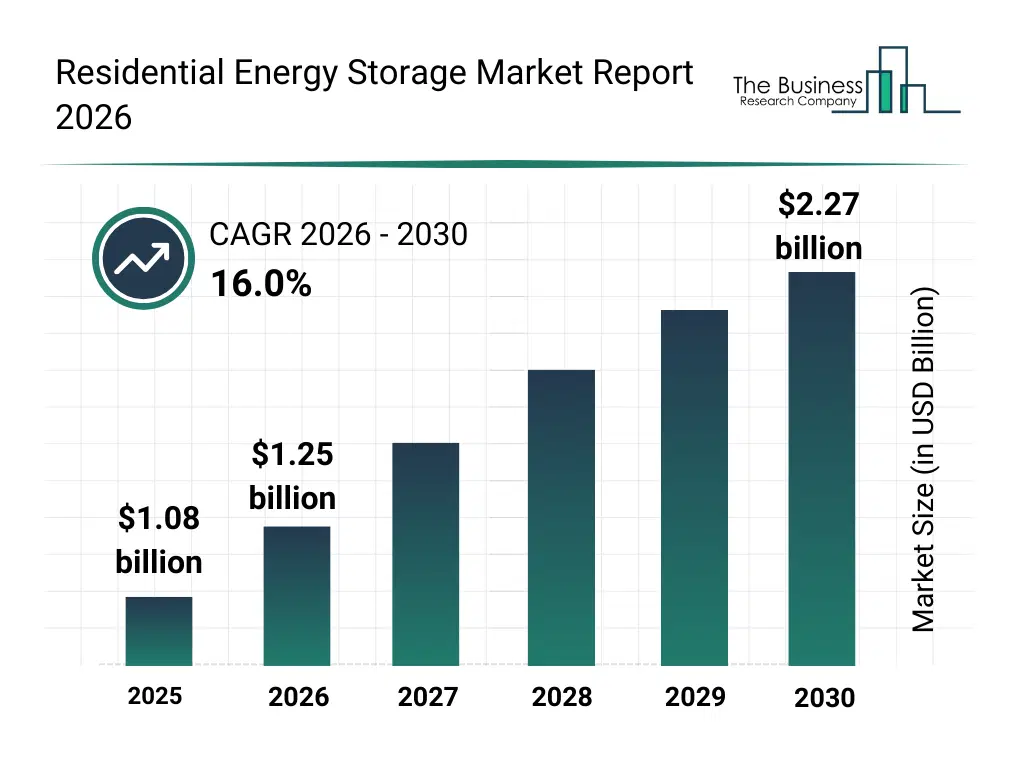
What Is The Residential Energy Storage Market Size 2026 And Growth Rate?
The residential energy storage market size has grown rapidly in recent years. It will grow from $1.08 billion in 2025 to $1.25 billion in 2026 at a compound annual growth rate (CAGR) of 16.4%. The growth in the historic period can be attributed to early adoption of rooftop solar systems, rise in household power outage concerns, declining cost of lithium ion batteries, increased utility time of use pricing programs, emergence of residential energy independence trends.What Is The Residential Energy Storage Market Growth Forecast?
The residential energy storage market size is expected to see rapid growth in the next few years. It will grow to $2.27 billion in 2030 at a compound annual growth rate (CAGR) of 16.0%. The growth in the forecast period can be attributed to rising demand for sustainable home energy solutions, expansion of virtual power plant programs, increasing adoption of smart meters and energy monitoring tools, growth in home electrification and ev charging needs, rising regulatory support for residential storage incentives. Major trends in the forecast period include increasing adoption of home backup power solutions, growing demand for high capacity residential battery systems, expansion of solar plus storage installations in households, rising preference for smart energy management systems, shift toward long duration and high efficiency storage technologies.
Global Residential Energy Storage Market Segmentation
1) By Technology: Lead-Acid, Lithium-Ion 2) By Utility: 3KW To < 6KW, 6KW To < 10KW, 10KW To 29KW 3) By Connectivity: On-Grid, Off-Grid 4) By Ownership Type: Customer Owned, Utility Owned, Third-Party Owned 5) By Operation: Solar And Storage System, Standalone Systems Subsegments: 1) By Lead-Acid: Flooded Lead-Acid Batteries, Sealed Lead-Acid Batteries 2) By Lithium-Ion: Lithium Iron Phosphate (LiFePO4), Nickel Manganese Cobalt (NMC), Lithium Nickel Cobalt Aluminum Oxide (NCA)What Is The Driver Of The Residential Energy Storage Market?
The surging demand for renewable energy is expected to propel the growth of the residential energy storage market going forward. Renewable energy refers to energy derived from naturally replenishing sources, such as sunlight, wind, rain, tides, and geothermal heat, which are considered sustainable and environmentally friendly alternatives to finite fossil fuels. The rising demand for renewable energy is fueled by a desire to minimize climate change through switching to sustainable and clean power sources. Renewable energy facilitates residential energy storage by providing a sustainable and intermittent power source, allowing homeowners to store excess energy during peak generation periods for later use, enhancing grid resilience, and reducing reliance on traditional energy sources. For instance, in April 2024, the International Renewable Energy Agency (IRENA), a UAE-based intergovernmental organization, reported global renewable power capacity increased by 585 GW in a single year, indicating a record rate of 15.1% annual growth, which surpasses 2023's growth rate of 14.3%. Therefore, the rise in demand for renewable energy is driving the growth of the residential energy storage industry.Key Players In The Global Residential Energy Storage Market
Major companies operating in the residential energy storage market are Huawei Technologies Co. Ltd., Tesla Inc., Siemens AG, Hitachi Energy Ltd., Panasonic Corporation, BYD Company Limited, ABB Ltd, Eaton Corporation plc, LG Energy Solution Ltd., Samsung SDI Co. Ltd., Delta Electronics Inc., Enphase Energy Inc., SMA Solar Technology AG, Saft Groupe SA, VARTA AG, Jiangsu GoodWe Power Supply Technology Co. Ltd., Sonnen GmbH, ShanghAI PYTES Energy Co. Ltd, Dyness Power Energy Limited, Deutsche Energieversorgung GmbH, Powervault Ltd., TESVOLT GmbH, Turbo Energy Ltd., Alpha ESS Co. Ltd., Sunverge Energy LLC, Eguana Technologies Inc.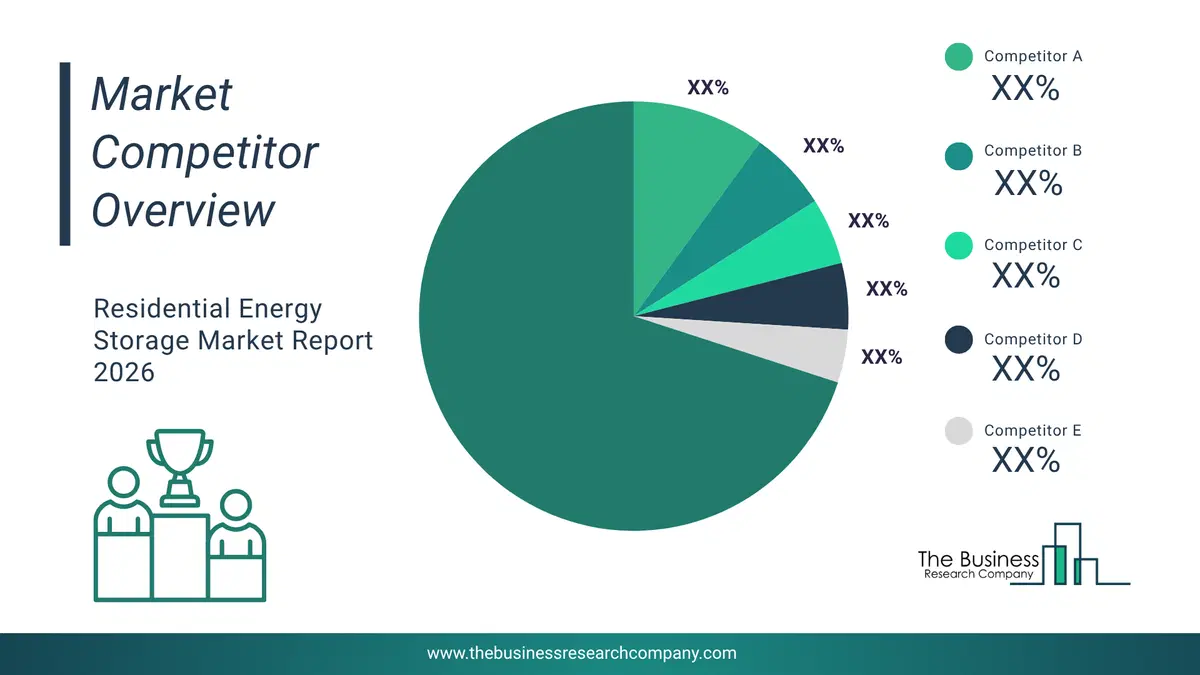
This chart is for illustrative purposes; the full report includes a detailed competitor analysis and comprehensive overview of the top 10 companies in the market.
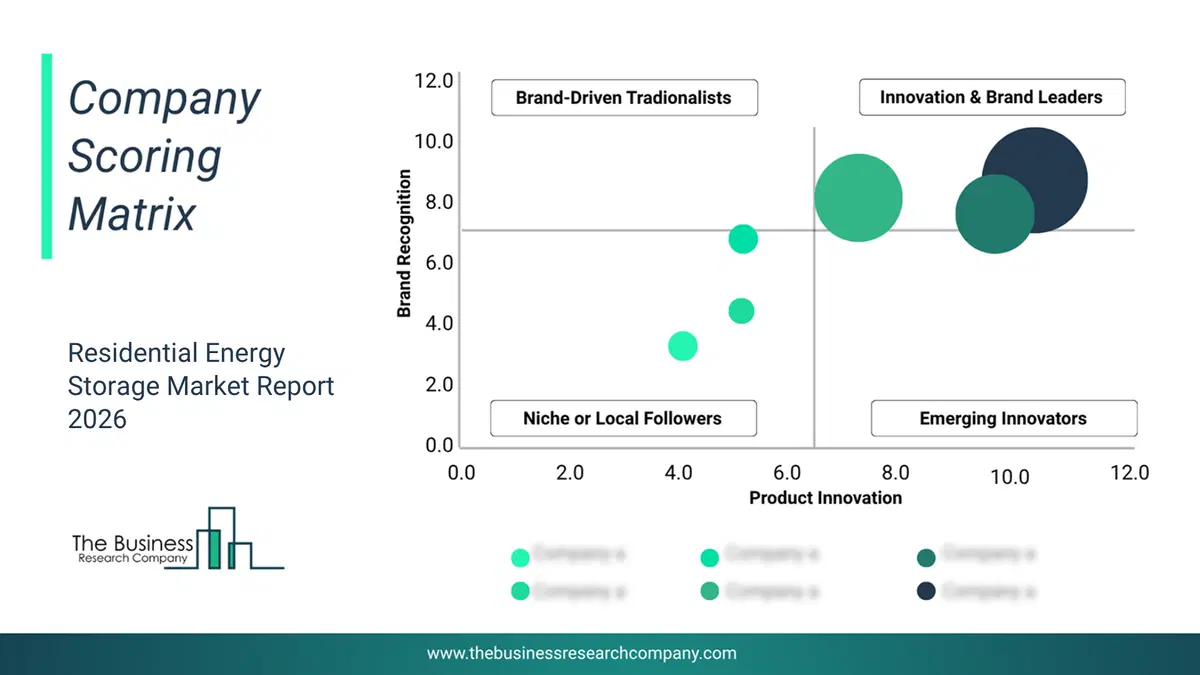
This chart maps companies by product innovation and brand strength, with bubble size indicating relative revenue, helping identify market leaders, challengers, and niche players. This is an illustrative chart; the full report provides a complete and accurate competitive analysis.
Global Residential Energy Storage Market Trends and Insights
Major companies operating in the residential energy storage market are developing advanced home storage battery system technologies, such as electrified vehicle battery technology, to enhance energy storage capacity, efficiency, and sustainability for residential users. These systems leverage EV battery technology to provide residential users with reliable backup power, optimize energy usage from renewable sources such as solar panels, and reduce electricity costs through peak shaving and load shifting strategies. For instance, in June 2024, Pylontech, a China-based provider of battery energy storage systems, introduced Force H3X, a next-generation residential storage system. The platform offers modular and scalable capacity from 10 kWh up to 210 kWh, supports both single-phase and three-phase power output configurations, and integrates a battery management system with intelligent energy management to optimize solar energy usage and enhance home energy reliability. This solution represents a significant advancement in the residential energy storage market, supporting energy efficiency, cost savings, and sustainable energy usage.What Are Latest Mergers And Acquisitions In The Residential Energy Storage Market?
In October 2023, Hitachi Energy, a Switzerland-based advanced sustainable energy solution provider, acquired eks Energy for an undisclosed amount. With this acquisition, Hitachi aims to deliver advanced and dependable solutions by leveraging Eeks Energy's successful product range deployment in North America and Europe, along with Powin's global expansion. This strategic move positions Hitachi Energy to address the growing demands of the global battery energy storage systems (BESS) market. EKS Energy is a UK-based company that designs and builds plug-and-play integrated storage systems for residential use.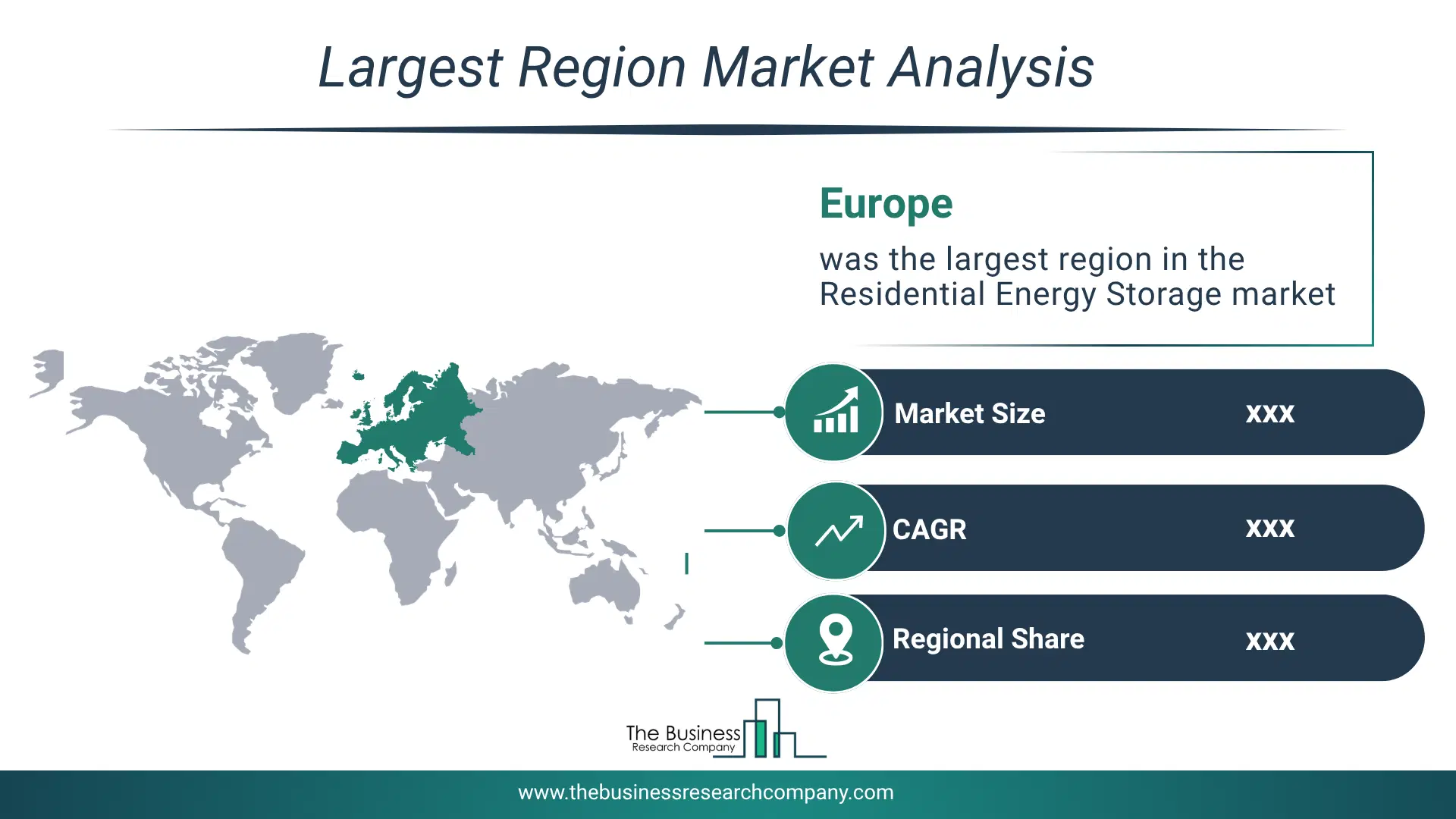
Regional Outlook
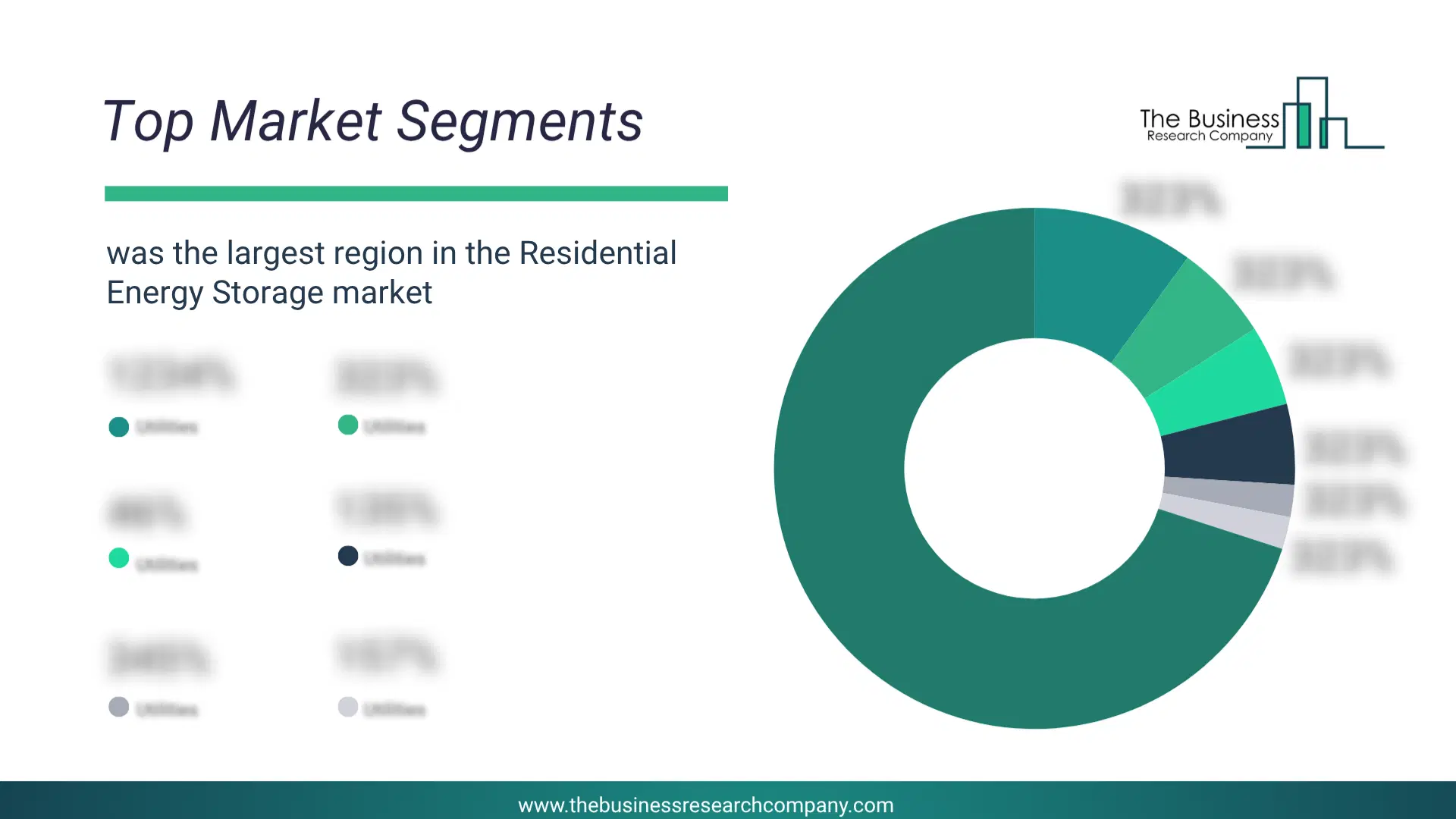
Europe was the largest region in the residential energy storage market in 2025. Asia-Pacific is expected to be the fastest-growing region in the forecast period. The regions covered in this market report are Asia-Pacific, South East Asia, Western Europe, Eastern Europe, North America, South America, Middle East, Africa. The countries covered in this market report are Australia, Brazil, China, France, Germany, India, Indonesia, Japan, Taiwan, Russia, South Korea, UK, USA, Canada, Italy, Spain.What Defines the Residential Energy Storage Market?
The residential energy storage market consist of revenues earned by entities by providing services such as installation, ongoing maintenance, and energy management. The market value includes the value of related goods sold by the service provider or included within the service offering. The residential energy storage market also includes sales of rechargeable energy storage systems, home battery systems, and solar-plus-storage solutions. Values in this market are ‘factory gate’ values, that is the value of goods sold by the manufacturers or creators of the goods, whether to other entities (including downstream manufacturers, wholesalers, distributors and retailers) or directly to end customers. The value of goods in this market includes related services sold by the creators of the goods.How is Market Value Defined and Measured?
The market value is defined as the revenues that enterprises gain from the sale of goods and/or services within the specified market and geography through sales, grants, or donations in terms of the currency (in USD unless otherwise specified). The revenues for a specified geography are consumption values that are revenues generated by organizations in the specified geography within the market, irrespective of where they are produced. It does not include revenues from resales along the supply chain, either further along the supply chain or as part of other products.
This chart presents market attractiveness based on a quantitative evaluation of growth, competition, strategic alignment, and risk, offering a clear view of opportunity areas for decision-making. This chart is for illustrative purposes; the full report contains the complete analysis.

This chart highlights the Total Addressable Market (TAM) by estimating the maximum revenue opportunity using an assumption-driven approach, supporting strategic planning and opportunity sizing across markets. The chart is illustrative; the full report provides a more comprehensive analysis.
What Key Data and Analysis Are Included in the Residential Energy Storage Market Report 2026?
The residential energy storage market research report is one of a series of new reports from The Business Research Company that provides market statistics, including industry global market size, regional shares, competitors with the market share, detailed market segments, market trends and opportunities, and any further data you may need to thrive in the residential energy storage industry. The market research report delivers a complete perspective of everything you need, with an in-depth analysis of the current and future state of the industry.Residential Energy Storage Market Report Forecast Analysis
| Report Attribute | Details |
|---|---|
| Market Size Value In 2026 | $1.25 billion |
| Revenue Forecast In 2030 | $2.27 billion |
| Growth Rate | CAGR of 16% from 2026 to 2030 |
| Base Year For Estimation | 2025 |
| Actual Estimates/Historical Data | 2020-2025 |
| Forecast Period | 2026 - 2030 |
| Market Representation | Revenue in USD Billion and CAGR from 2026 to 2030 |
| Segments Covered | Technology, Utility, Connectivity, Ownership Type, Operation |
| Regional Scope | Asia-Pacific, Western Europe, Eastern Europe, North America, South America, Middle East, Africa |
| Country Scope | The countries covered in the report are Australia, Brazil, China, France, Germany, India, Indonesia, Japan, Taiwan, Russia, South Korea, UK, USA, Canada, Italy, Spain. |
| Key Companies Profiled | Huawei Technologies Co. Ltd., Tesla Inc., Siemens AG, Hitachi Energy Ltd., Panasonic Corporation, BYD Company Limited, ABB Ltd, Eaton Corporation plc, LG Energy Solution Ltd., Samsung SDI Co. Ltd., Delta Electronics Inc., Enphase Energy Inc., SMA Solar Technology AG, Saft Groupe SA, VARTA AG, Jiangsu GoodWe Power Supply Technology Co. Ltd., Sonnen GmbH, ShanghAI PYTES Energy Co. Ltd, Dyness Power Energy Limited, Deutsche Energieversorgung GmbH, Powervault Ltd., TESVOLT GmbH, Turbo Energy Ltd., Alpha ESS Co. Ltd., Sunverge Energy LLC, Eguana Technologies Inc. |
| Customization Scope | Request for Customization |
| Pricing And Purchase Options | Explore Purchase Options |