
Enterprise WLAN Market Report 2026
Global Outlook – By Component (Hardware, Software, Service), By Organization Size (Small and Medium Enterprises, Large Enterprises), By Application (BFSI, IT And Telecom, Healthcare, Retail, Government, Other Applications) – Market Size, Trends, Strategies, and Forecast to 2030
Enterprise WLAN Market Overview
• Enterprise WLAN market size has reached to $44.08 billion in 2025 • Expected to grow to $168.54 billion in 2030 at a compound annual growth rate (CAGR) of 30.8% • Growth Driver: Growing Adoption Of BYOD Policies Fuels The Enterprise WLAN Market • Market Trend: Embracing The Wi-Fi 6 Standard: A Trend In The Enterprise WLAN Market • North America was the largest region in 2025 and Asia-Pacific is the fastest growing region.Market Gains By 2030 – Top Opportunities By Segment
Market Gain identifies the most promising market opportunities by highlighting the segments or products expected to generate the highest incremental revenue growth over the next five years.
What Is Covered Under Enterprise WLAN Market?
Enterprise WLAN is a device that helps to link two or more wireless devices using wireless communication and provide mobility to the network users. It utilizes radio communication while connecting to the wired network within a limited area, such as a work campus or office building. The main types of components in the enterprise WLAN market are hardware, software, and service. Hardware for wireless LANs includes network interface cards, routers, and switches. It is used in enterprises to administrate wireless network access points and connected wireless devices. The different organization sizes include small and medium enterprises and large enterprises and are employed in various sectors, including BSFI, IT and telecom, healthcare, retail, government, and others.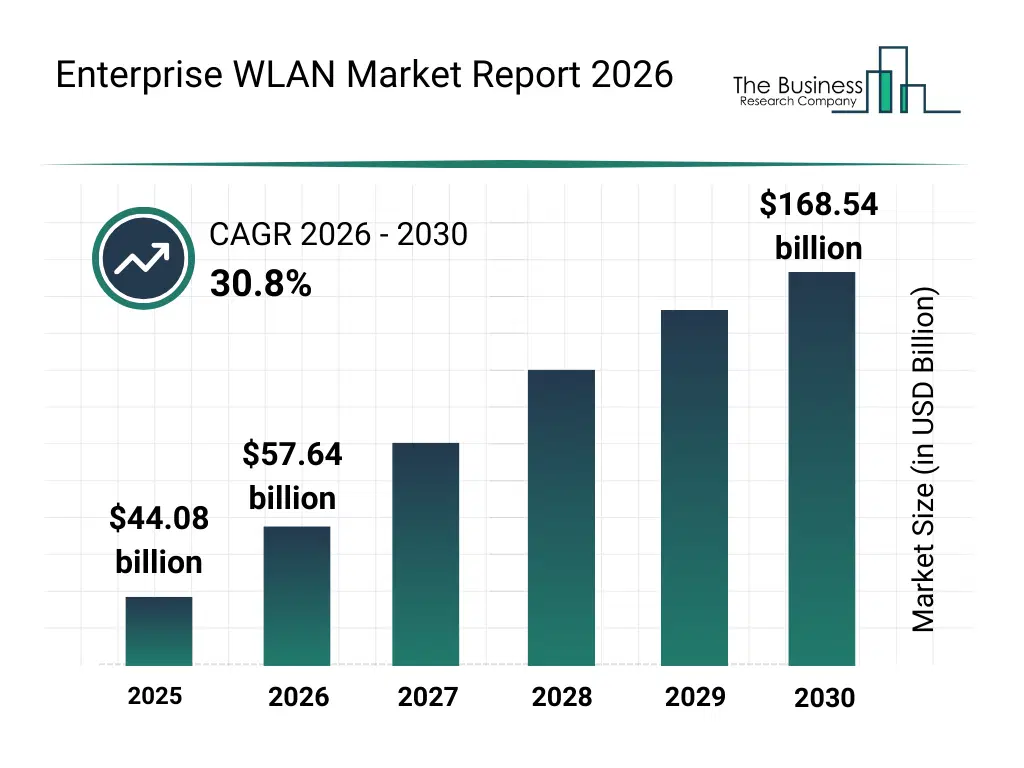
What Is The Enterprise WLAN Market Size and Share 2026?
The enterprise wlan market size has grown exponentially in recent years. It will grow from $44.08 billion in 2025 to $57.64 billion in 2026 at a compound annual growth rate (CAGR) of 30.8%. The growth in the historic period can be attributed to growth in enterprise digitization initiatives, increasing use of mobile devices in workplaces, expansion of office and campus networks, rising demand for reliable wireless connectivity, adoption of centralized network management tools.What Is The Enterprise WLAN Market Growth Forecast?
The enterprise wlan market size is expected to see exponential growth in the next few years. It will grow to $168.54 billion in 2030 at a compound annual growth rate (CAGR) of 30.8%. The growth in the forecast period can be attributed to increasing deployment of wi-fi 7 infrastructure, rising demand for low-latency wireless networks, expansion of smart building connectivity, growing emphasis on network security integration, increasing investments in cloud-native networking. Major trends in the forecast period include increasing adoption of wi-fi 6 and wi-fi 6e technologies, rising deployment of cloud-managed wlan solutions, growing integration of network analytics and monitoring tools, expansion of secure enterprise wireless networks, enhanced focus on high-density connectivity.
Global Enterprise WLAN Market Segmentation
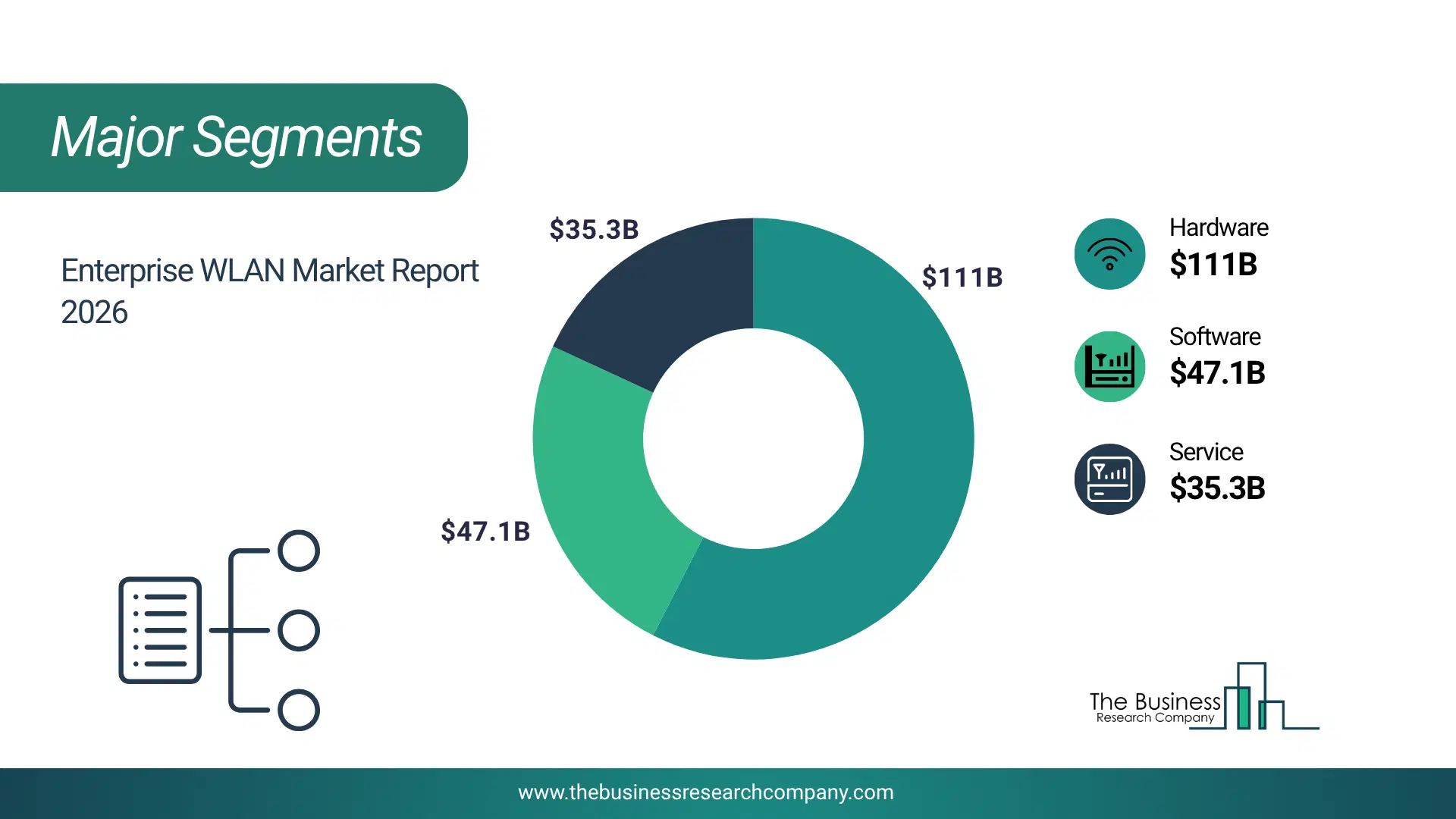
1) By Component: Hardware, Software, Service 2) By Organization Size: Small and Medium Enterprises, Large Enterprises 3) By Application: BFSI, IT And Telecom, Healthcare, Retail, Government, Other Applications Subsegments: 1) By Hardware: Access Points (APs), Wireless Controllers, Antennas, Switches, Cables And Connectors 2) By Software: WLAN Management Software, Network Security Software, Network Analytics Software, Firmware 3) By Service: Consulting Services, Installation And Configuration Services, Maintenance And Support Services, Training Services The top segments in the enterprise wlan market will be: • Hardware will reach $110.94 billion by 2030. • Software will reach $47.06 billion by 2030. • Service will reach $35.29 billion by 2030.What Is The Driver Of The Enterprise WLAN Market?
Increasing adoption of the bring your own device (BYOD) policy among businesses is significantly contributing to the growth of the enterprise WLAN market going forward. BYOD policies in organizations require robust WLAN infrastructure to accommodate employee-owned devices and ensure secure and efficient connectivity. For instance, in June 2024, according to the Tech Report, a US-based online publication dedicated to PC hardware, gaming, and personal computing, 70% of employees in global markets utilize BYOD policy, also known as I.T. consumerization; the significance of BYOD is widespread and acceptable. 95% of organizations permit their employees to use personal devices. The BYOD market expects a 16.7% compound annual growth rate between 2022 and 2026. Therefore, growing adoption of BYOD policies is driving growth in the enterprise WLAN industry.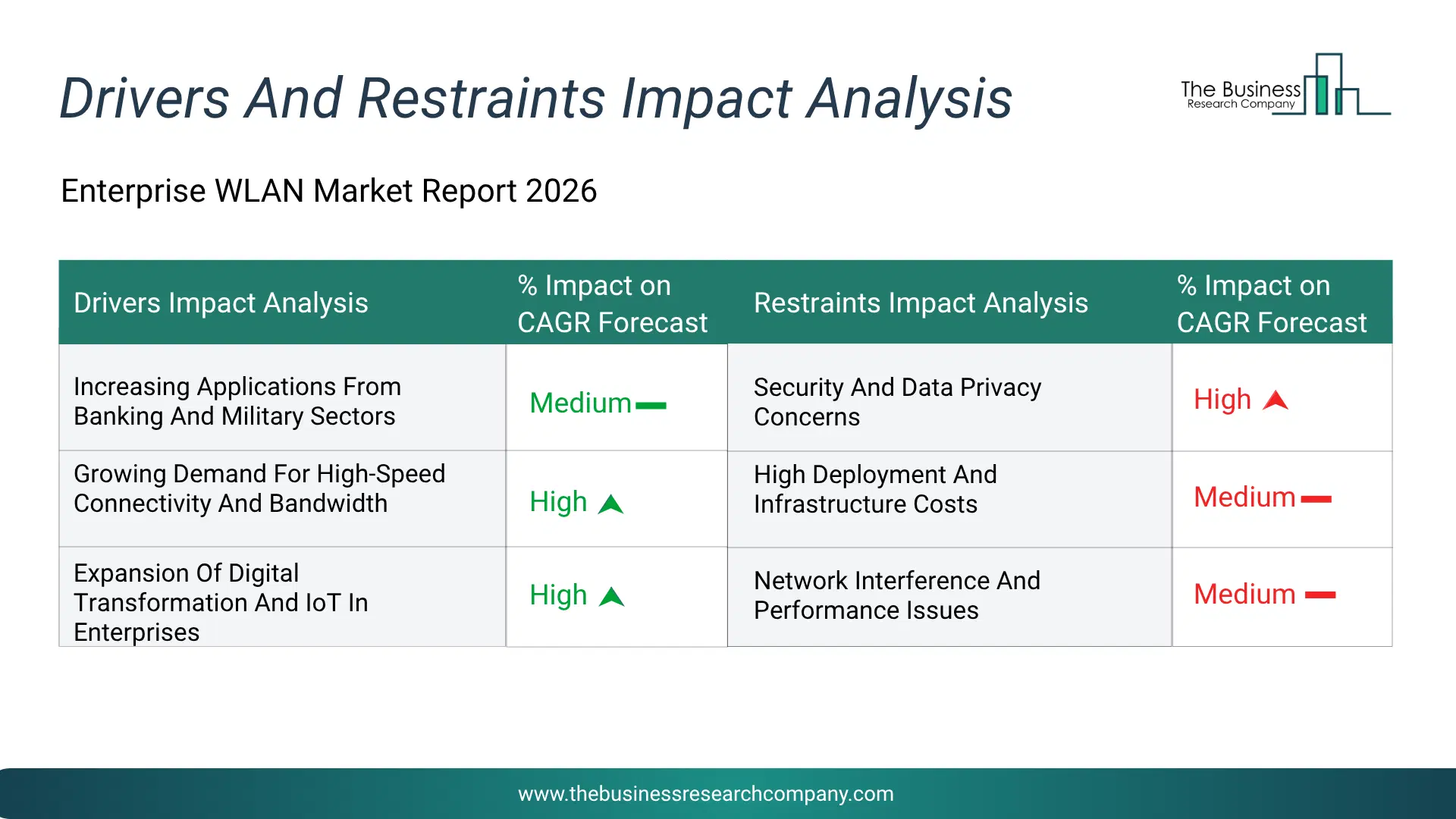
Infographic Chart Showing Key Market Drivers Analysis And Restraints For Enterprise Wlan Market
The chart presents an impact analysis of key drivers and restraints, quantifying their relative influence on the market's growth rate and helping assess the balance between growth enablers and limiting factors. This chart offers a high-level perspective; the full report contains more detailed insights.
How Will The Drivers Impact Growth In The Global Enterprise WLAN Market?
• Increasing Applications From Banking And Military Sectors (Medium) – During the forecast period, the increasing applications from banking and military sectors are expected to become a key growth driver for the enterprise wlan market by 2030. These sectors require highly secure, reliable, and high -performance wireless networks to support mission -critical operations, real -time data transmission, and advanced surveillance systems. Enterprise wlan solutions are increasingly being deployed to enhance operational efficiency, enable secure communication, and support advanced analytics capabilities. Organizations in these sectors are investing in robust and encrypted wireless infrastructure to meet stringent security requirements and regulatory standards. • Growing Demand For High-Speed Connectivity And Bandwidth (High) – During the forecast period, the growing demand for high-speed connectivity and bandwidth is expected to emerge as a major factor driving the expansion of the enterprise wlan market by 2030. Enterprises are increasingly relying on bandwidth-intensive applications such as video conferencing, cloud computing, augmented reality, and real-time collaboration tools, which require seamless and high-speed wireless connectivity. The proliferation of connected devices and increasing data consumption are further accelerating the need for advanced wlan solutions. Organizations are therefore upgrading their network infrastructure to support higher throughput, lower latency, and improved user experience. • Expansion Of Digital Transformation And IoT In Enterprises (High) – During the forecast period, the expansion of digital transformation and iot in enterprises is expected to act as a key growth catalyst for the enterprise wlan market by 2030. The increasing adoption of iot devices, smart sensors, and connected systems across industries is driving the need for scalable and efficient wireless networks. Enterprise wlan solutions play a critical role in enabling seamless device connectivity, data exchange, and automation across smart environments. Additionally, digital transformation initiatives are encouraging organizations to modernize their network infrastructure to support agile operations and data-driven decision-making. As enterprises continue to embrace iot and digital technologies, demand for advanced wlan solutions is expected to rise significantly.How Will The Restraints Impact Growth In The Global Enterprise WLAN Market?
• Security And Data Privacy Concerns (High) – During the forecast period, the security and data privacy concerns act as a major restraint for enterprise wlan adoption, as wireless networks are more vulnerable to unauthorized access, cyberattacks, and data breaches. Enterprises handling sensitive information must implement strict security protocols, which can increase complexity and cost. The risk of malware, phishing, and network intrusions can slow down wlan deployment, particularly in finance, healthcare, and government sectors. Ensuring compliance with data protection regulations adds additional operational challenges. These concerns make organizations cautious about relying heavily on wireless networks without robust security measures. • High Deployment And Infrastructure Costs (Medium) – During the forecast period, the high deployment and infrastructure costs act as a restraint for enterprise wlan adoption, as implementing enterprise-grade wireless networks requires substantial investment in access points, controllers, and management software. Additional expenses arise from network planning, installation, maintenance, and periodic upgrades to support growing bandwidth demands. Small and medium-sized enterprises may find these upfront costs particularly challenging, slowing adoption. Integrating wlan with existing it infrastructure and ensuring scalability adds to the financial burden. As a result, organizations often delay or limit wlan deployment until costs can be justified by operational benefits. • Network Interference And Performance Issues (Medium) – During the forecast period, the network interference and performance issues act as a key restraint for enterprise wlan adoption, as wireless signals can be disrupted by physical obstacles, electronic devices, or overlapping networks in dense environments. Such interference can lead to slow data transfer, dropped connections, and reduced network reliability. High user density in offices, campuses, or industrial facilities can further degrade performance if the wlan is not properly designed or managed. Maintaining consistent speed and coverage often requires additional infrastructure and careful network planning. These challenges make organizations cautious about fully relying on wlan for critical business operations.Key Players In The Global Enterprise WLAN Market
Major companies operating in the enterprise wlan market are Aerohive Networks Inc.; ALE Inc.; RUCKUS Networks; Juniper Networks Inc.; Cisco Systems Inc.; Huawei Technologies Co. Ltd.; TP-Link Technologies Co. Ltd.; Extreme Networks Inc.; ZTE Corporation; NETGEAR Inc.; WatchGuard Technologies Inc.; Dell Technologies Inc.; D-Link Corporation; Ubiquiti Inc.; Cambium Networks Corporation; Mist Systems (Juniper Networks company); Proxim Wireless Corporation; Allied Telesis Inc.; Hewlett Packard Enterprise Company; LANCOM Systems GmbH; Meru Networks a subsidiary of Fortinet Inc.; SonicWall Inc.; Zyxel Communications Corporation; Fortinet Inc.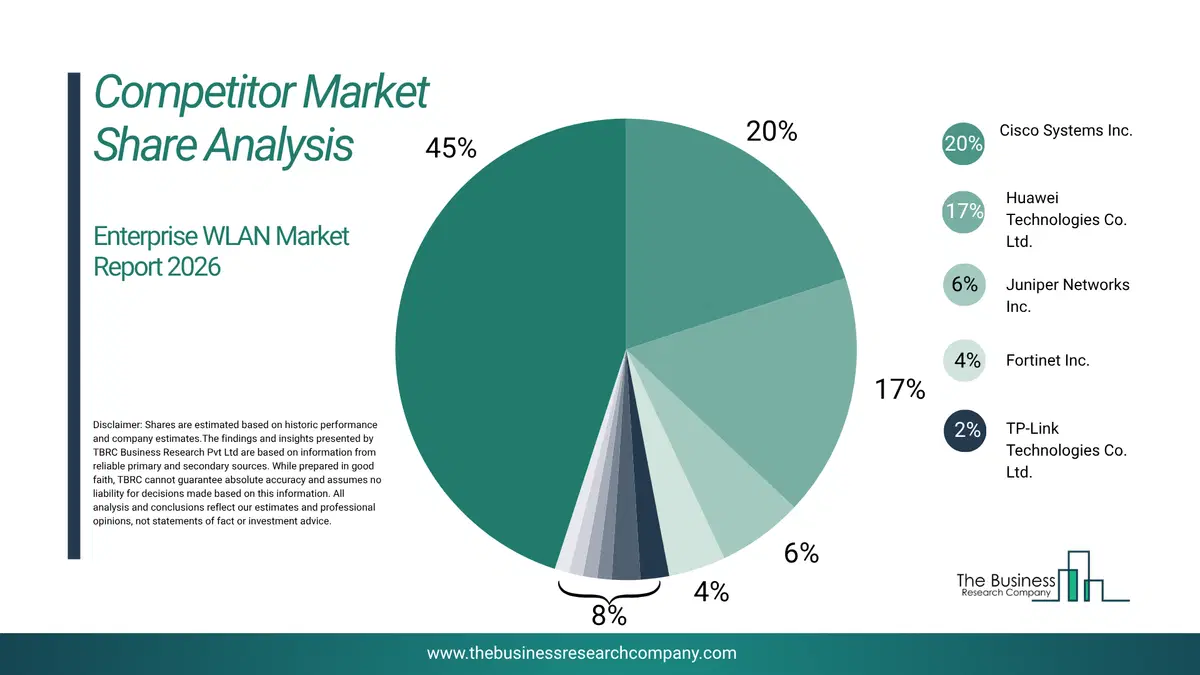
This chart is for illustrative purposes; the full report includes a detailed competitor analysis and comprehensive overview of the top 10 companies in the market.
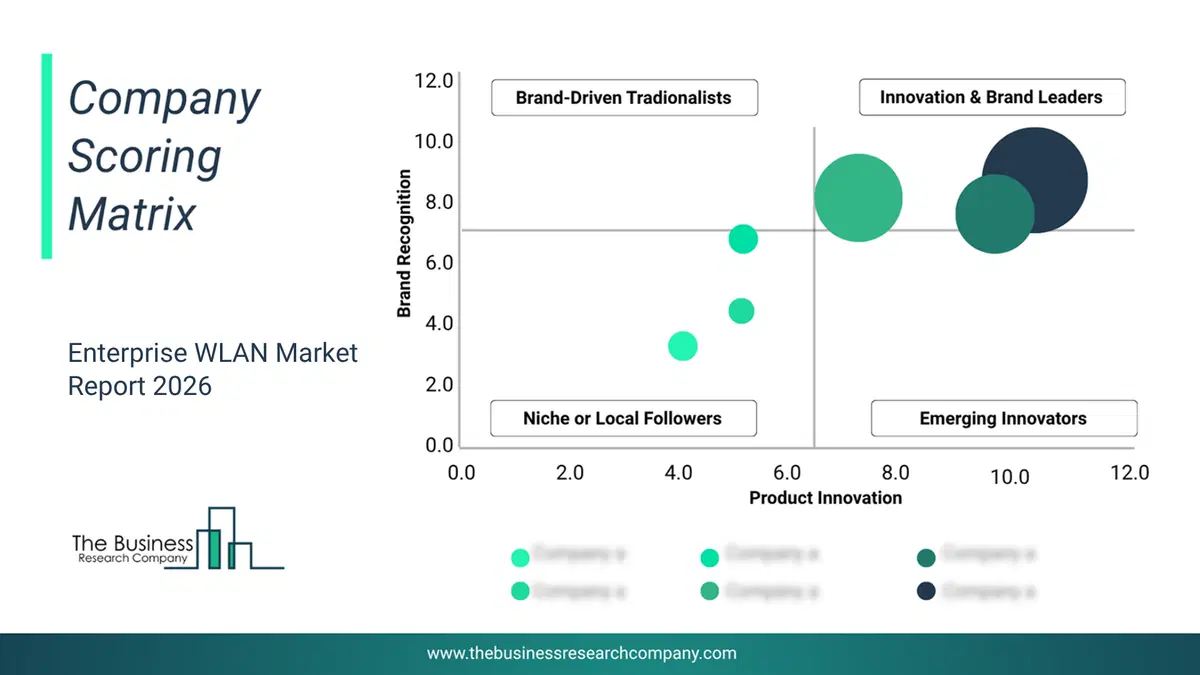
This chart maps companies by product innovation and brand strength, with bubble size indicating relative revenue, helping identify market leaders, challengers, and niche players. This is an illustrative chart; the full report provides a complete and accurate competitive analysis.
Global Enterprise WLAN Market Trends and Insights
Major companies operating in the enterprise WLAN market are increasingly focusing on next-generation wireless technologies, with the emergence of the Wi-Fi 6 (802.11ax) standard becoming a key trend driving market growth. The new Wi-Fi standard delivers significant performance benefits, including higher data rates, greater capacity, improved power efficiency, and enhanced connectivity in environments with many connected devices. For instance, in April 2024, HPE Aruba Networking, a U.S.-based provider of enterprise networking and wireless infrastructure solutions, introduced a new generation of Wi-Fi 7 access points (APs) that offer up to 30% higher capacity than competing products. Designed to support demanding enterprise use cases including AI, IoT, and location-based services the Wi-Fi 7 APs provide higher throughput, tri-band hardware with 6 GHz support, integrated IoT protocol capabilities, and advanced security features.What Are Latest Mergers And Acquisitions In The Enterprise WLAN Market?
In January 2024, Hewlett Packard Enterprise (HPE), a U.S.-based provider of hybrid cloud, edge-to-cloud infrastructure, and enterprise networking solutions, acquired Juniper Networks for approximately US $14 billion. With this acquisition, HPE aims to bolster its enterprise WLAN and AI-driven networking portfolio to challenge incumbent leaders and accelerate growth in the enterprise wireless LAN (WLAN) market. Juniper Networks is a U.S.-based provider of cloud-managed networking equipment, AI-driven enterprise WLAN solutions (via Mist AI), and routing/switching infrastructure.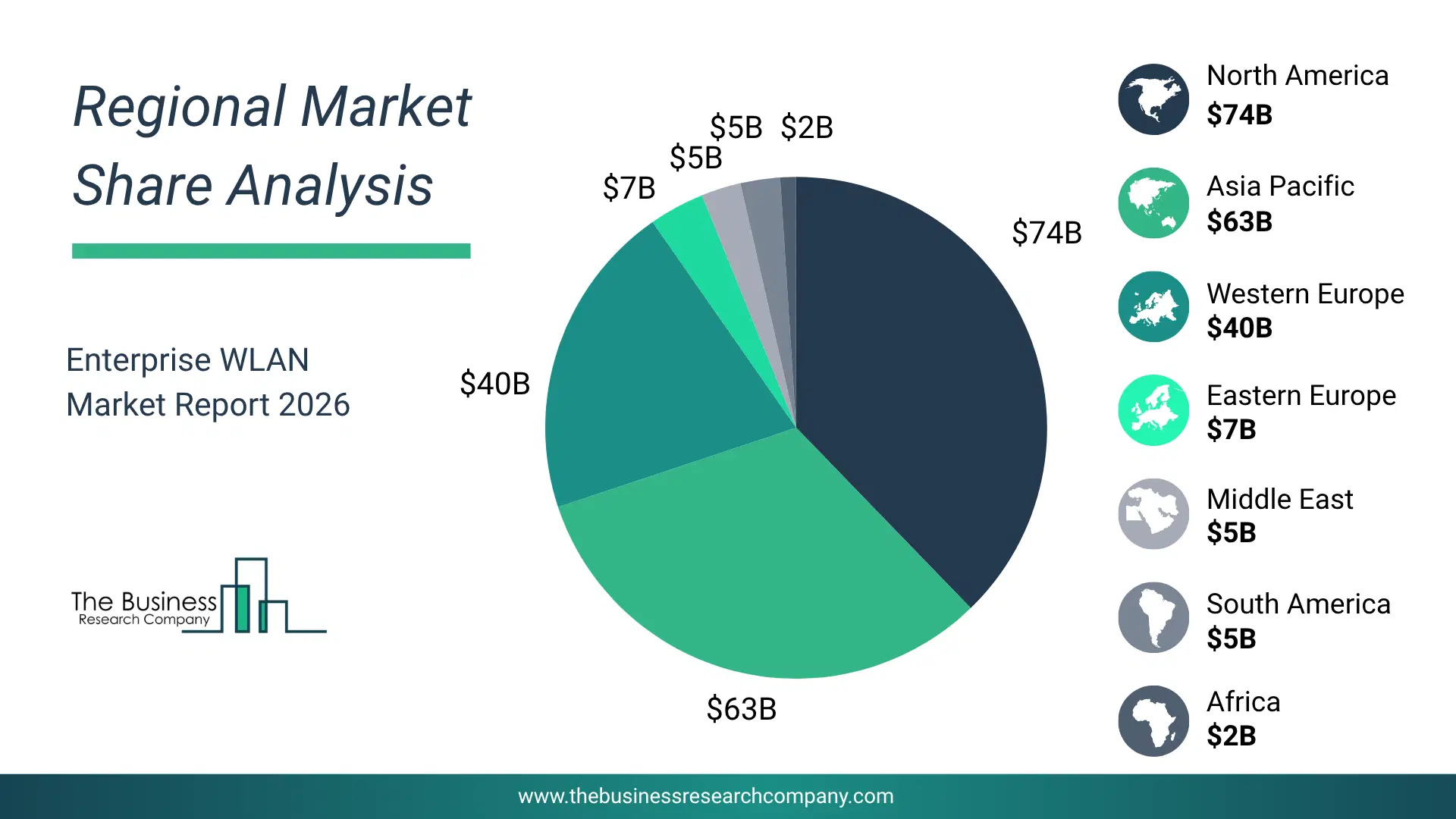
Regional Insights
North America was the largest region in the enterprise WLAN market in 2025.Asia-Pacific is expected to be the fastest growing region in the forecast period. The regions covered in this market report are Asia-Pacific, South East Asia, Western Europe, Eastern Europe, North America, South America, Middle East, Africa. The countries covered in this market report are Australia, Brazil, China, France, Germany, India, Indonesia, Japan, Taiwan, Russia, South Korea, UK, USA, Canada, Italy, SpainWhat Defines the Enterprise WLAN Market?
The enterprise WLAN market consists of revenues earned by entities by providing enterprise WLAN devices and services such as predictive planning, installation, configuration, performance assessment & validation, and future-proofing of WLAN through the organization to provide wireless network communication. The market value includes the value of related goods sold by the service provider or included within the service offering. Only goods and services traded between entities or sold to end consumers are included.How is Market Value Defined and Measured?
The market value is defined as the revenues that enterprises gain from the sale of goods and/or services within the specified market and geography through sales, grants, or donations in terms of the currency (in USD unless otherwise specified). The revenues for a specified geography are consumption values that are revenues generated by organizations in the specified geography within the market, irrespective of where they are produced. It does not include revenues from resales along the supply chain, either further along the supply chain or as part of other products.
This chart presents market attractiveness based on a quantitative evaluation of growth, competition, strategic alignment, and risk, offering a clear view of opportunity areas for decision-making. This chart is for illustrative purposes; the full report contains the complete analysis.

This chart highlights the Total Addressable Market (TAM) by estimating the maximum revenue opportunity using an assumption-driven approach, supporting strategic planning and opportunity sizing across markets. The chart is illustrative; the full report provides a more comprehensive analysis.
What Key Data and Analysis Are Included in the Enterprise WLAN Market Report 2026?
The enterprise wlan market research report is one of a series of new reports from The Business Research Company that provides market statistics, including industry global market size, regional shares, competitors with the market share, detailed market segments, market trends and opportunities, and any further data you may need to thrive in the enterprise wlan industry. The market research report delivers a complete perspective of everything you need, with an in-depth analysis of the current and future state of the industry.Enterprise WLAN Market Report Forecast Analysis
| Report Attribute | Details |
|---|---|
| Market Size Value In 2026 | $57.64 billion |
| Revenue Forecast In 2030 | $168.54 billion |
| Growth Rate | CAGR of 30.8% from 2026 to 2030 |
| Base Year For Estimation | 2025 |
| Actual Estimates/Historical Data | 2020-2025 |
| Forecast Period | 2026 - 2030 |
| Market Representation | Revenue in USD Billion and CAGR from 2026 to 2030 |
| Segments Covered | Component, Organization Size, Application |
| Regional Scope | Asia-Pacific, Western Europe, Eastern Europe, North America, South America, Middle East, Africa |
| Country Scope | The countries covered in the report are Australia, Brazil, China, France, Germany, India, ... |
| Key Companies Profiled | Aerohive Networks Inc.; ALE Inc.; RUCKUS Networks; Juniper Networks Inc.; Cisco Systems Inc.; Huawei Technologies Co. Ltd.; TP-Link Technologies Co. Ltd.; Extreme Networks Inc.; ZTE Corporation; NETGEAR Inc.; WatchGuard Technologies Inc.; Dell Technologies Inc.; D-Link Corporation; Ubiquiti Inc.; Cambium Networks Corporation; Mist Systems (Juniper Networks company); Proxim Wireless Corporation; Allied Telesis Inc.; Hewlett Packard Enterprise Company; LANCOM Systems GmbH; Meru Networks a subsidiary of Fortinet Inc.; SonicWall Inc.; Zyxel Communications Corporation; Fortinet Inc. |
| Customization Scope | Request for Customization |
| Pricing And Purchase Options | Explore Purchase Options |