
Wireless Connectivity Market Report 2026
Global Outlook – By Type (LPWAN (Low Power Wide Area Network), Cellular M2M (Machine-To-machine), WPAN (Wireless Personal Area Network), Satellite (GNSS) Global Navigation Satellite System, WLAN (Wireless Local Area Network)), By Component (Control Devices, Gateways), By Technology (Bluetooth, WI-FI, Ultra-Wideband, NFC, Cellular, Zigbee), By End Use (Wearable Devices, Healthcare, Consumer Electronics, Building Automation, Automotive And Transportation, Other End Uses) – Market Size, Trends, Strategies, and Forecast to 2030
Wireless Connectivity Market Overview
• Wireless Connectivity market size has reached to $154.08 billion in 2025 • Expected to grow to $294.9 billion in 2030 at a compound annual growth rate (CAGR) of 13.8% • Growth Driver: Rapid Internet Penetration Fuels Expansion Of The Wireless Connectivity Market • Market Trend: Innovative Product Development In Wireless Connectivity • Asia-Pacific was the largest region in 2025.What Is Covered Under Wireless Connectivity Market?
Wireless networks are computer networks that are not connected by any form of cable. A wireless connectivity network enables devices to stay connected to the network while roaming freely without being linked to any wires. The major types of wireless connectivity are LPWAN (Low Power Wide Area Network), cellular M2M (Machine-to-Machine), WPAN (Wireless Personal Area Network), satellite (GNSS) Global Navigation Satellite System and WLAN (Wireless Local Area Network). A wireless local area network (WLAN) is a wireless distribution method for two or more devices. The various deployment mode involved is control devices, gateways and cloud with technology involving Bluetooth, wi-fi, ultra-wideband, NFC, cellular and ZigBee. It is used for various end users such as wearable devices, healthcare, consumer electronics, building automation, automotive and transportation and others.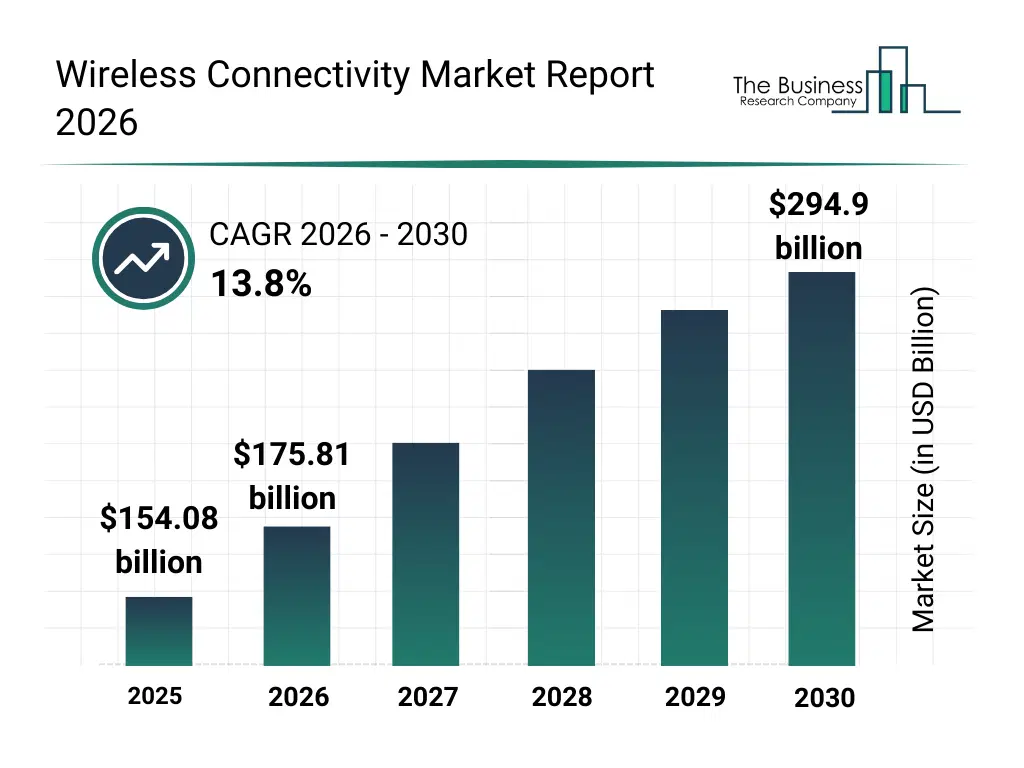
What Is The Wireless Connectivity Market Size and Share 2026?
The wireless connectivity market size has grown rapidly in recent years. It will grow from $154.08 billion in 2025 to $175.81 billion in 2026 at a compound annual growth rate (CAGR) of 14.1%. The growth in the historic period can be attributed to growth of consumer electronics adoption, expansion of wireless internet usage, rising smartphone penetration, development of wireless standards, increasing enterprise mobility needs.What Is The Wireless Connectivity Market Growth Forecast?
The wireless connectivity market size is expected to see rapid growth in the next few years. It will grow to $294.9 billion in 2030 at a compound annual growth rate (CAGR) of 13.8%. The growth in the forecast period can be attributed to deployment of 5G networks, expansion of industrial iot applications, demand for seamless device connectivity, growth of smart city projects, increasing adoption of cloud-connected devices. Major trends in the forecast period include rapid adoption of iot-enabled connectivity, growing demand for low power wide area networks, expansion of wireless networks in smart buildings, increasing use of short-range wireless technologies, integration of cloud-based connectivity platforms.
Global Wireless Connectivity Market Segmentation
1) By Type: LPWAN (Low Power Wide Area Network), Cellular M2M (Machine-To-machine), WPAN (Wireless Personal Area Network), Satellite (GNSS) Global Navigation Satellite System, WLAN (Wireless Local Area Network) 2) By Component: Control Devices, Gateways 3) By Technology: Bluetooth, WI-FI, Ultra-Wideband, NFC, Cellular, Zigbee 4) By End Use: Wearable Devices, Healthcare, Consumer Electronics, Building Automation, Automotive And Transportation, Other End Uses Subsegments: 1) By LPWAN (Low Power Wide Area Network): LoRaWAN, Sigfox, NB-IoT (Narrowband IoT) 2) By Cellular M2M (Machine-To-Machine): 2G Or 3G Or 4G LTE, 5G 3) By WPAN (Wireless Personal Area Network): Bluetooth, Zigbee, Z-Wave 4) By Satellite (GNSS) Global Navigation Satellite System: GPS, GLONASS, Galileo 5) By WLAN (Wireless Local Area Network): Wi-Fi, Wi-Fi DirectWhat Is The Driver Of The Wireless Connectivity Market?
Growing internet penetration rates are expected to boost the growth of the wireless connectivity market going forward. The internet penetration rate refers to the percentage of the total population of a given country or region that uses the internet. Due to the increase in internet users, the adoption of new technological devices by the users, such as phones, microphones, and digital cameras, has increased. Hence, growing internet penetration rates are expected to boost the wireless connectivity market. For instance, in November 2024, according to a report published by the International Telecommunication Union (ITU), a Switzerland-based specialized UN agency, in 2024 fully 5.5 billion people are online. That represents 68 per cent of the world population, compared with 65 per cent in 2023. The year-on-year growth rate is itself increasing, from 2.7 just one year ago to 3.4 per cent this year. Therefore, the growing Internet penetration rate is driving the growth of the wireless connectivity industry.Key Players In The Global Wireless Connectivity Market
Major companies operating in the wireless connectivity market are Intel Corporation; Texas Instruments Incorporated; Qualcomm Incorporated; Broadcom Inc.; STMicroelectronics; NXP Semiconductors; Microchip Technology Inc.; MediaTek Inc.; Renesas Electronics Corporation; Panasonic Corporation; Cypress Semiconductor Corporation; AT&T Inc.; Cisco Systems Inc.; Nokia Corporation; Marvell Technology Group Ltd.; Nordic Semiconductor ASA; Sierra Wireless Inc.; Skyworks Solutions Inc.; Sequans Communications S.A.; Lantronix Inc.; Qorvo Inc.; Murata Manufacturing Co. Ltd.; Inseego Corp.; u-blox Holding AG; Cambium Networks Corporation; Onsemi; Semtech Corporation; Celeno Communications; Redpine Signals Inc.
This chart is for illustrative purposes; the full report includes a detailed competitor analysis and comprehensive overview of the top 10 companies in the market.
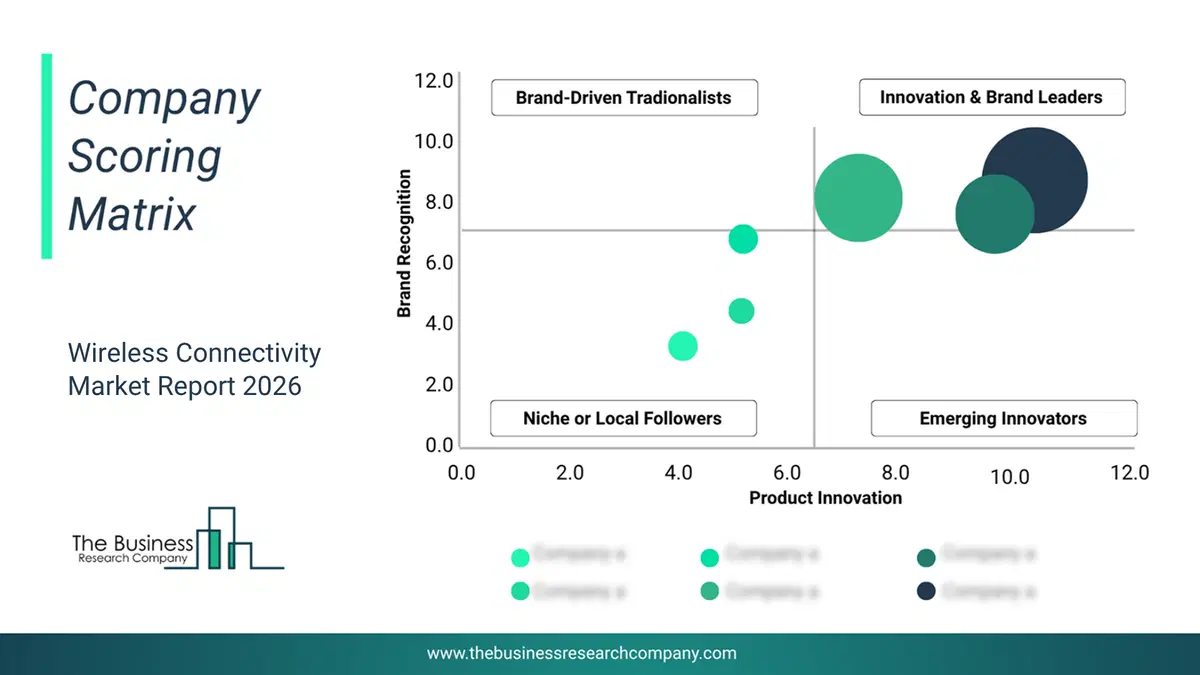
This chart maps companies by product innovation and brand strength, with bubble size indicating relative revenue, helping identify market leaders, challengers, and niche players. This is an illustrative chart; the full report provides a complete and accurate competitive analysis.
Global Wireless Connectivity Market Trends and Insights
Major companies operating in the wireless connectivity market are focused on developing innovative products, such as wireless access receivers, to gain a competitive edge in the market. A wireless access receiver, also known as a Wi-Fi adapter or dongle, is a device that allows a computer or other device to connect to a wireless network. For instance, in June 2023, Nokia Corporation, a Finland-based telecommunications, information technology, and consumer electronics company, launched the FastMile 5G receiver. The FastMile 5G receiver utilizes a powerful antenna with a gain of 9 dBi to effectively capture and amplify weak 5G signals, even in challenging environments. The receiver's wideband support encompasses a comprehensive range of 4G and 5G bands, including CBRS (Citizens Broadband Radio Service) in both 4G and 5G configurations, as well as the c-band. Additionally, it supports up to 4CA (carrier aggregation) and NR (New Radio), allowing operators to aggregate multiple bands for increased throughput and capacity. The FastMile 5G receiver is designed for outdoor installation, enabling it to capture the strongest signals available.What Are Latest Mergers And Acquisitions In The Wireless Connectivity Market?
In January 2024, Wireless Logic, a UK-based provider of managed IoT connectivity and global cellular network solutions, acquired Zipit Wireless for an undisclosed amount. With this acquisition, Wireless Logic aims to expand its presence in the North American market and strengthen its capabilities in IoT connectivity management, messaging, and device monetization platforms. Zipit Wireless is a US-based provider of IoT connectivity, cloud-based messaging, and subscription management solutions designed to help enterprises launch, manage, and monetize connected devices effectively.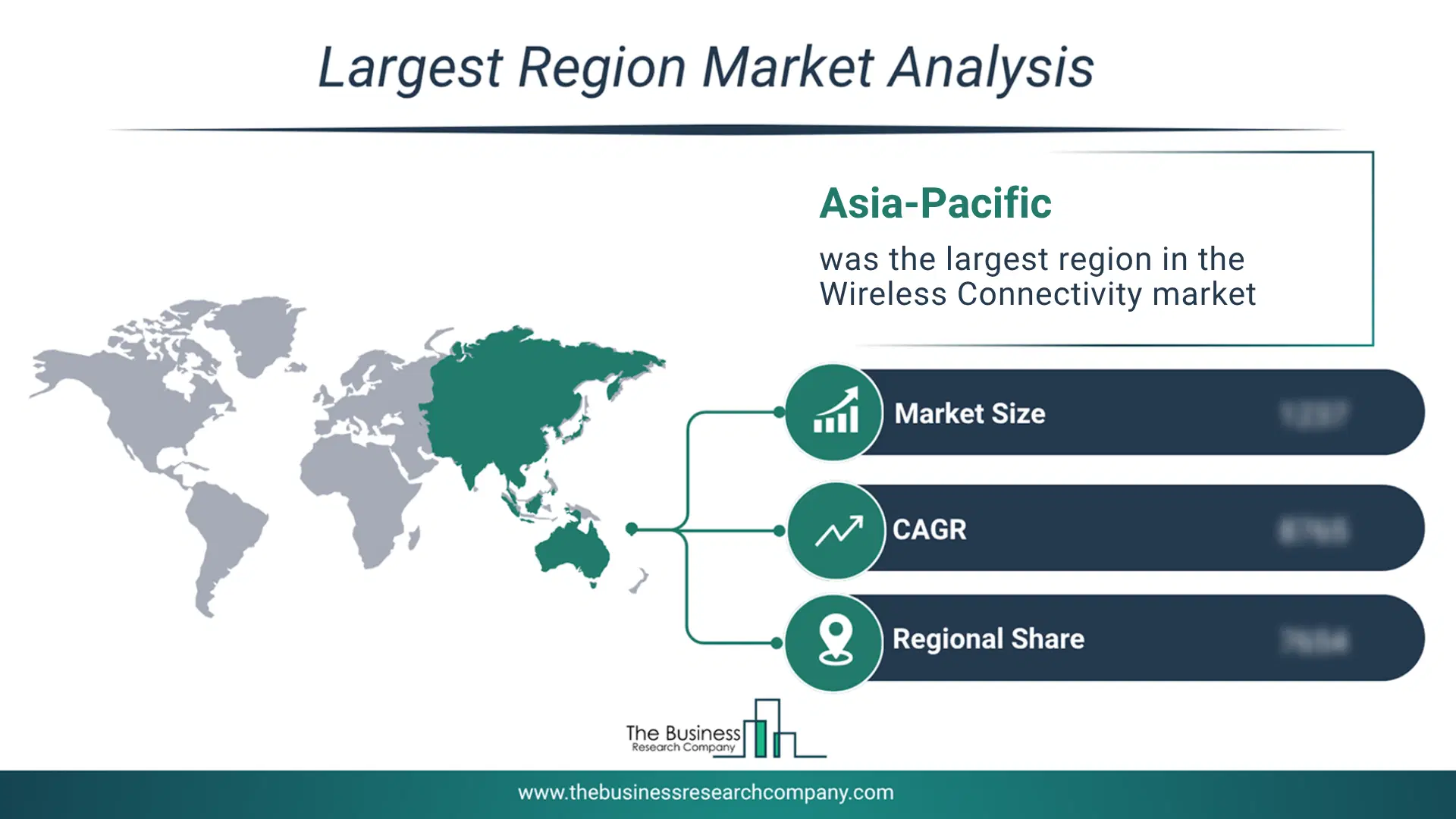
Regional Insights
Asia-Pacific was the largest region in the wireless connectivity market in 2025. The regions covered in this market report are Asia-Pacific, South East Asia, Western Europe, Eastern Europe, North America, South America, Middle East, Africa. The countries covered in this market report are Australia, Brazil, China, France, Germany, India, Indonesia, Japan, Taiwan, Russia, South Korea, UK, USA, Canada, Italy, SpainWhat Defines the Wireless Connectivity Market?
The wireless connectivity market includes revenues earned by entities by providing services such as IEEE 802.15 (WiMAX), wireless network access, wireless inter-network connectivity, a wireless extension of a wired network, cable replacement for peripherals. The market value includes the value of related goods sold by the service provider or included within the service offering. Only goods and services traded between entities or sold to end consumers are included.How is Market Value Defined and Measured?
The market value is defined as the revenues that enterprises gain from the sale of goods and/or services within the specified market and geography through sales, grants, or donations in terms of the currency (in USD unless otherwise specified). The revenues for a specified geography are consumption values that are revenues generated by organizations in the specified geography within the market, irrespective of where they are produced. It does not include revenues from resales along the supply chain, either further along the supply chain or as part of other products.
This chart presents market attractiveness based on a quantitative evaluation of growth, competition, strategic alignment, and risk, offering a clear view of opportunity areas for decision-making. This chart is for illustrative purposes; the full report contains the complete analysis.

This chart highlights the Total Addressable Market (TAM) by estimating the maximum revenue opportunity using an assumption-driven approach, supporting strategic planning and opportunity sizing across markets. The chart is illustrative; the full report provides a more comprehensive analysis.
What Key Data and Analysis Are Included in the Wireless Connectivity Market Report 2026?
The wireless connectivity market research report is one of a series of new reports from The Business Research Company that provides market statistics, including industry global market size, regional shares, competitors with the market share, detailed market segments, market trends and opportunities, and any further data you may need to thrive in the wireless connectivity industry. The market research report delivers a complete perspective of everything you need, with an in-depth analysis of the current and future state of the industry.Wireless Connectivity Market Report Forecast Analysis
| Report Attribute | Details |
|---|---|
| Market Size Value In 2026 | $175.81 billion |
| Revenue Forecast In 2030 | $294.9 billion |
| Growth Rate | CAGR of 13.8% from 2026 to 2030 |
| Base Year For Estimation | 2025 |
| Actual Estimates/Historical Data | 2020-2025 |
| Forecast Period | 2026 - 2030 |
| Market Representation | Revenue in USD Billion and CAGR from 2026 to 2030 |
| Segments Covered | Type, Component, Technology, End Use |
| Regional Scope | Asia-Pacific, Western Europe, Eastern Europe, North America, South America, Middle East, Africa |
| Country Scope | The Countries Covered In This Market Report Are Australia, Brazil, China, France, Germany, India, Indonesia, Japan, Taiwan, Russia, South Korea, Uk, Usa, Canada, Italy, Spain. |
| Key Companies Profiled | Intel Corporation, Texas Instruments Incorporated, Qualcomm Incorporated, Broadcom Inc., STMicroelectronics, NXP Semiconductors, Microchip Technology Inc., MediaTek Inc., Renesas Electronics Corporation, Panasonic Corporation, Cypress Semiconductor Corporation, AT&T Inc., Cisco Systems Inc., Nokia Corporation, Marvell Technology Group Ltd., Nordic Semiconductor ASA, Sierra Wireless Inc., Skyworks Solutions Inc., Sequans Communications S.A., Lantronix Inc., Qorvo Inc., Murata Manufacturing Co. Ltd., Inseego Corp., u-blox Holding AG, Cambium Networks Corporation, Onsemi, Semtech Corporation, Celeno Communications, Redpine Signals Inc. |
| Customization Scope | Request for Customization |
| Pricing And Purchase Options | Explore Purchase Options |