
Wearable Devices Market Report 2026
Global Outlook – By Product Type ( Smartwatches, Fitness Trackers, Smart Glasses, Wearable Health Monitors, Smart Clothing, Other Product Types), By Technology ( BlueTooth, Wi-Fi, Near Field Communication (NFC), Cellular Technology, Augmented Reality (AR) Applications), By Distribution Channel ( Online Retailers, Physical Retail Stores, Wholesale Distributors, Direct-To-Consumer Sales, Telecommunications Service Providers), By Application ( Health And Fitness Tracking, Mobile Payments, Remote Patient Monitoring, Navigation And Location Tracking, Emergency Alerts And Notifications), By End-User ( General Consumers, Healthcare Professionals, Fitness Enthusiasts, Corporate Wellness Programs, Sports Teams And Athletes) – Market Size, Trends, Strategies, and Forecast to 2030
Wearable Devices Market Overview
• Wearable Devices market size has reached to $125.22 billion in 2025 • Expected to grow to $251.48 billion in 2030 at a compound annual growth rate (CAGR) of 14.9% • Growth Driver: Rising Smartphone Penetration Fueling The Growth Of The Market Due To Enhanced Connectivity And Device Integration • Market Trend: Innovative Dual-Layer Display Technology Enhances Performance, Efficiency, And User Experience In Wearable Devices • North America was the largest region in 2025 and Asia-Pacific is the fastest growing region.What Is Covered Under Wearable Devices Market?
Wearable devices are compact electronic systems designed to be worn on the body, enabling continuous interaction with the user and their environment. These devices integrate sensors, processors, and communication components into lightweight, ergonomic forms that seamlessly fit into daily life. They function autonomously or in tandem with other systems, capturing and processing real-time data. The main product types of wearable devices include smartwatches, fitness trackers, smart glasses, wearable health monitors, smart clothing, and others. Smartwatches are wearable digital devices worn on the wrist that can perform various functions like showing time, tracking fitness, receiving calls, and running apps. It uses various technologies, including Bluetooth, Wi-Fi, near-field communication (NFC), cellular technology, and augmented reality (AR) applications, and is distributed through online retailers, physical retail stores, wholesale distributors, direct-to-consumer sales, and telecommunications service providers. It is applied for health and fitness tracking, mobile payments, remote patient monitoring, navigation and location tracking, and emergency alerts and notifications by various end-users, including general consumers, healthcare professionals, fitness enthusiasts, corporate wellness programs, and sports teams and athletes.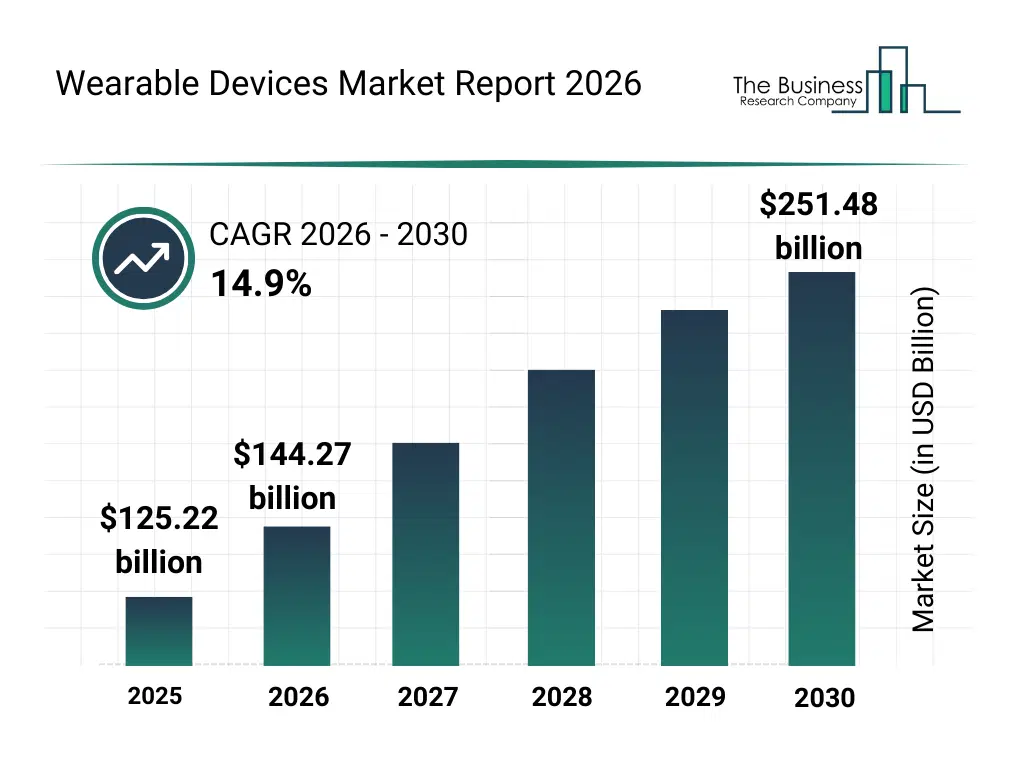
What Is The Wearable Devices Market Size 2026 And Growth Rate?
The wearable devices market size has grown rapidly in recent years. It will grow from $125.22 billion in 2025 to $144.27 billion in 2026 at a compound annual growth rate (CAGR) of 15.2%. The growth in the historic period can be attributed to advancements in sensor technology, increase in smartphone penetration, growing health awareness, adoption of fitness applications, miniaturization of electronics.What Is The Wearable Devices Market Growth Forecast?
The wearable devices market size is expected to see rapid growth in the next few years. It will grow to $251.48 billion in 2030 at a compound annual growth rate (CAGR) of 14.9%. The growth in the forecast period can be attributed to integration of AI in wearables, expansion of telemedicine, development of flexible electronics, rising demand for remote monitoring, increasing adoption in corporate wellness programs. Major trends in the forecast period include wearable AI assistants, real-time health monitoring, connected fitness ecosystems, remote patient management, wearable biometric authentication.
Global Wearable Devices Market Segmentation
1) By Product Type: Smartwatches, Fitness Trackers, Smart Glasses, Wearable Health Monitors, Smart Clothing, Other Product Types 2) By Technology: BlueTooth, Wi-Fi, Near Field Communication (NFC), Cellular Technology, Augmented Reality (AR) Applications 3) By Distribution Channel: Online Retailers, Physical Retail Stores, Wholesale Distributors, Direct-To-Consumer Sales, Telecommunications Service Providers 4) By Application: Health And Fitness Tracking, Mobile Payments, Remote Patient Monitoring, Navigation And Location Tracking, Emergency Alerts And Notifications 5) By End-User: General Consumers, Healthcare Professionals, Fitness Enthusiasts, Corporate Wellness Programs, Sports Teams And Athletes Subsegments: 1) By Smartwatches: Standalone Smartwatches, Companion Smartwatches, Hybrid Smartwatches 2) By Fitness Trackers: Wristbands, Clip-on Trackers, Ring-based Trackers 3) By Smart Glasses: AR Glasses, VR Glasses, Mixed Reality Glasses 4) By Wearable Health Monitors: Heart Rate Monitors, Blood Pressure Monitors, Blood Oxygen Monitors (SpO2), ECG Monitors, Glucose Monitors 5) By Smart Clothing: Smart Shirts, Smart Shoes, Smart Socks, Smart Sports Bras, Smart Jackets 6) By Other Product Types: Smart Rings, Wearable Cameras, Wearable Headsets, Wearable Patches, Smart EarwearWhat Is The Driver Of The Wearable Devices Market?
The increasing penetration of smartphones is anticipated to propel the growth of the wearable devices market in the coming years. Smartphones are handheld electronic devices combining mobile phone capabilities with advanced features like internet access, touchscreens, and various communication, entertainment, and productivity applications. Smartphone usage is rising due to increasing internet accessibility, allowing people to stay connected, access information, and use online services conveniently from virtually anywhere. Expanding smartphone usage supports the demand for wearable devices as smartphones serve as central hubs that sync, manage, and display data collected by wearables, enhancing their functionality and user experience through seamless connectivity. For instance, in June 2024, according to the Ericsson, a Sweden-based telecommunications company, the number of mobile subscriptions in the region is projected to increase from 1.2 billion in 2023 to 1.3 billion by 2029. Therefore, the increasing penetration of smartphones will drive the growth of the wearable devices industry.Key Players In The Global Wearable Devices Market
Major companies operating in the wearable devices market are Apple Inc., Samsung Electronics Co. Ltd., Huawei Technologies Co. Ltd., ITOCHU Corporation, Sony Corporation, Nike Inc., Qualcomm Technologies Inc., Xiaomi Corporation, Honeywell International Inc., Adidas AG, ASUSTEK Computer Inc., Seiko Epson Corporation, Motorola Solutions Inc., Garmin Ltd., Fitbit Inc., HTC Corporation, WHOOP Inc., Doodle Labs LLC, Vuzix Corporation, Humon
This chart is for illustrative purposes; the full report includes a detailed competitor analysis and comprehensive overview of the top 10 companies in the market.
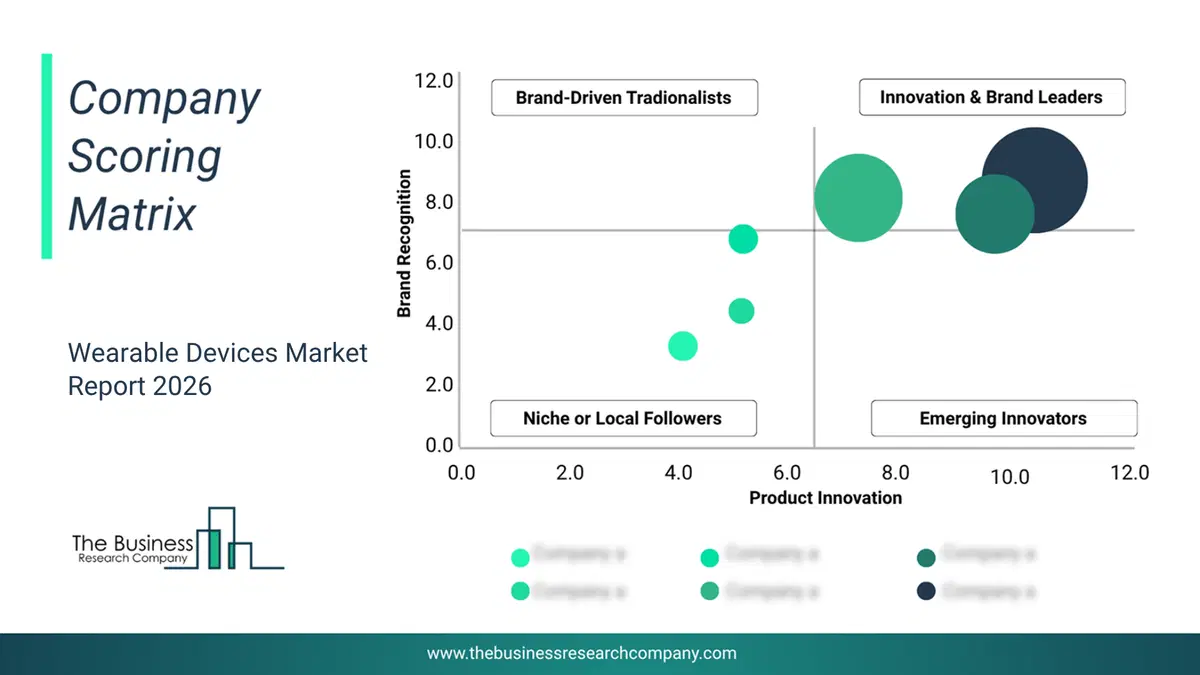
This chart maps companies by product innovation and brand strength, with bubble size indicating relative revenue, helping identify market leaders, challengers, and niche players. This is an illustrative chart; the full report provides a complete and accurate competitive analysis.
Global Wearable Devices Market Trends and Insights
Major companies operating in the wearable devices market are focusing on developing innovative products such as smartwatches with dual-layer displays to meet the rising demand for multifunctional, fitness-oriented, and connected wearable technology. A smartwatch with a dual-layer display uses two stacked screens, an energy-efficient LCD for always-on information and a high-resolution AMOLED for rich visuals, helping extend battery life while improving outdoor visibility. For instance, in May 2023, Mobvoi Inc., a China-based technology company, launched the TicWatch Pro 5, an advanced smartwatch designed for both performance and comprehensive health monitoring. The TicWatch Pro 5 features a 1.43-inch dual-layer display, Qualcomm Snapdragon W5+ Gen 1 processor for faster and more efficient operation, and a 628mAh battery supporting up to 80 hours in Smart Mode and 45 days in Essential Mode with fast charging. Its robust aluminum case meets MIL-STD-810G durability standards and is water-resistant up to 5ATM, making it suitable for swimming and outdoor activities. The watch offers over 100 workout modes, advanced health metrics including VO2 Max, stress levels, heart rate, and sleep tracking, while supporting Wear OS 3.5 for access to apps, Google Maps, and Bluetooth calling.What Are Latest Mergers And Acquisitions In The Wearable Devices Market?
In July 2025, Amazon.com Inc., a US-based e-commerce and technology company, acquired Bee, Inc. for an undisclosed amount. With this acquisition, Amazon.com, Inc. aims to strengthen its position in the emerging AI-wearables market by integrating Bee’s conversational and context-aware technology into its ecosystem, expanding beyond smart speakers into on-the-go, voice-driven personal assistants. Bee Inc. is a US-based AI wearable technology company that develops an always-listening wristband and companion app designed to record conversations, generate reminders, and provide personalized ambient intelligence for users.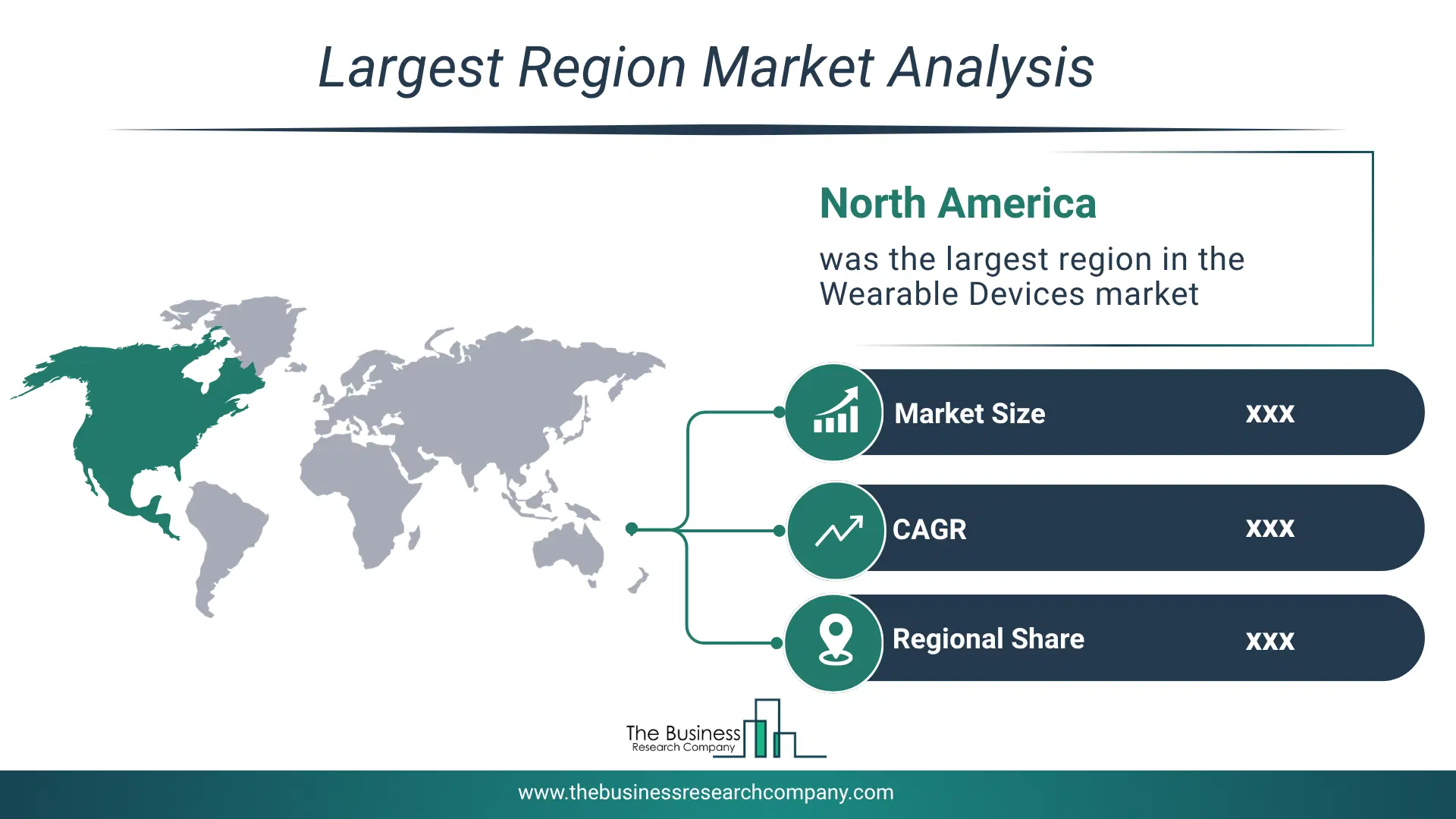
Regional Outlook
North America was the largest region in the wearable devices market in 2025. Asia-Pacific is expected to be the fastest-growing region in the forecast period. The regions covered in this market report are Asia-Pacific, South East Asia, Western Europe, Eastern Europe, North America, South America, Middle East, Africa. The countries covered in this market report are Australia, Brazil, China, France, Germany, India, Indonesia, Japan, Taiwan, Russia, South Korea, UK, USA, Canada, Italy, Spain.What Defines the Wearable Devices Market?
The wearable devices market consists of revenues earned by entities by providing services such as cloud storage, data management, software customization, integration services, and device maintenance. The market value includes the value of related goods sold by the service provider or included within the service offering. The wearable devices market also includes sales of smart rings, haptic feedback devices, wearable patches, gesture-control devices, and smart footwear. Values in this market are ‘factory gate’ values, that is the value of goods sold by the manufacturers or creators of the goods, whether to other entities (including downstream manufacturers, wholesalers, distributors and retailers) or directly to end customers. The value of goods in this market includes related services sold by the creators of the goods.How is Market Value Defined and Measured?
The market value is defined as the revenues that enterprises gain from the sale of goods and/or services within the specified market and geography through sales, grants, or donations in terms of the currency (in USD unless otherwise specified). The revenues for a specified geography are consumption values that are revenues generated by organizations in the specified geography within the market, irrespective of where they are produced. It does not include revenues from resales along the supply chain, either further along the supply chain or as part of other products.
This chart presents market attractiveness based on a quantitative evaluation of growth, competition, strategic alignment, and risk, offering a clear view of opportunity areas for decision-making. This chart is for illustrative purposes; the full report contains the complete analysis.

This chart highlights the Total Addressable Market (TAM) by estimating the maximum revenue opportunity using an assumption-driven approach, supporting strategic planning and opportunity sizing across markets. The chart is illustrative; the full report provides a more comprehensive analysis.
What Key Data and Analysis Are Included in the Wearable Devices Market Report 2026?
The wearable devices market research report is one of a series of new reports from The Business Research Company that provides market statistics, including industry global market size, regional shares, competitors with the market share, detailed market segments, market trends and opportunities, and any further data you may need to thrive in the wearable devices industry. The market research report delivers a complete perspective of everything you need, with an in-depth analysis of the current and future state of the industry.Wearable Devices Market Report Forecast Analysis
| Report Attribute | Details |
|---|---|
| Market Size Value In 2026 | $144.27 billion |
| Revenue Forecast In 2030 | $251.48 billion |
| Growth Rate | CAGR of 14.9% from 2026 to 2030 |
| Base Year For Estimation | 2025 |
| Actual Estimates/Historical Data | 2020-2025 |
| Forecast Period | 2026 - 2030 |
| Market Representation | Revenue in USD Billion and CAGR from 2026 to 2030 |
| Segments Covered | Product Type, Technology, Distribution Channel, Application, End-User |
| Regional Scope | Asia-Pacific, Western Europe, Eastern Europe, North America, South America, Middle East, Africa |
| Country Scope | The countries covered in the report are Australia, Brazil, China, France, Germany, India, Indonesia, Japan, Taiwan, Russia, South Korea, UK, USA, Canada, Italy, Spain. |
| Key Companies Profiled | Apple Inc., Samsung Electronics Co. Ltd., Huawei Technologies Co. Ltd., ITOCHU Corporation, Sony Corporation, Nike Inc., Qualcomm Technologies Inc., Xiaomi Corporation, Honeywell International Inc., Adidas AG, ASUSTEK Computer Inc., Seiko Epson Corporation, Motorola Solutions Inc., Garmin Ltd., Fitbit Inc., HTC Corporation, WHOOP Inc., Doodle Labs LLC, Vuzix Corporation, Humon |
| Customization Scope | Request for Customization |
| Pricing And Purchase Options | Explore Purchase Options |