
Environmental Sensing And Monitoring Technology Market Report 2026
Global Outlook – By Type (Portable, Stationary), By Component (Sensors, Monitors, Software, Service), By Monitoring Method (Active Monitoring, Intermediate Monitoring, Passive Monitoring), By Applications (Water Pollution Monitoring, Air Pollution Monitoring, Sound Pollution Monitoring, Soil Pollution Monitoring, Other Applications), By End-User (Meteorology, Government, Defense, Ocean Exploration Organizations, Research Organizations, Industrial Sector, Other End-Users) – Market Size, Trends, Strategies, and Forecast to 2030
Environmental Sensing And Monitoring Technology Market Overview
• Environmental Sensing And Monitoring Technology market size has reached to $18.57 billion in 2025 • Expected to grow to $23.32 billion in 2030 at a compound annual growth rate (CAGR) of 4.6% • Growth Driver: Rising Environmental Challenges Drive The Surge In Environmental Sensing And Monitoring Technology • Market Trend: Enhanced Next-Generation Environmental Sensor Solutions With IoT Integration • North America was the largest region in 2025.What Is Covered Under Environmental Sensing And Monitoring Technology Market?
Environmental sensing and monitoring technology refers to the use of various sensors and devices to collect real-time data on environmental conditions, such as air quality, temperature, and pollution levels, to monitor and assess the state of ecosystems and human impact on the environment. It plays a crucial role in understanding environmental changes and implementing effective measures for sustainability and conservation. The main types of environmental sensing and monitoring technology are portable and stationary. A portable environmental sensor with navigation technology is a compact device that measures various environmental parameters such as air quality, temperature, humidity, and pollutants for on-the-go monitoring. The components are categorized into sensors, monitors, software, and services. The monitoring methods include active monitoring, intermediate monitoring, and passive monitoring used in applications that include water pollution monitoring, air pollution monitoring, sound pollution monitoring, soil pollution monitoring, and others. The end users are meteorology, government, defense, ocean exploration organizations, research organizations, industrial sector, and others.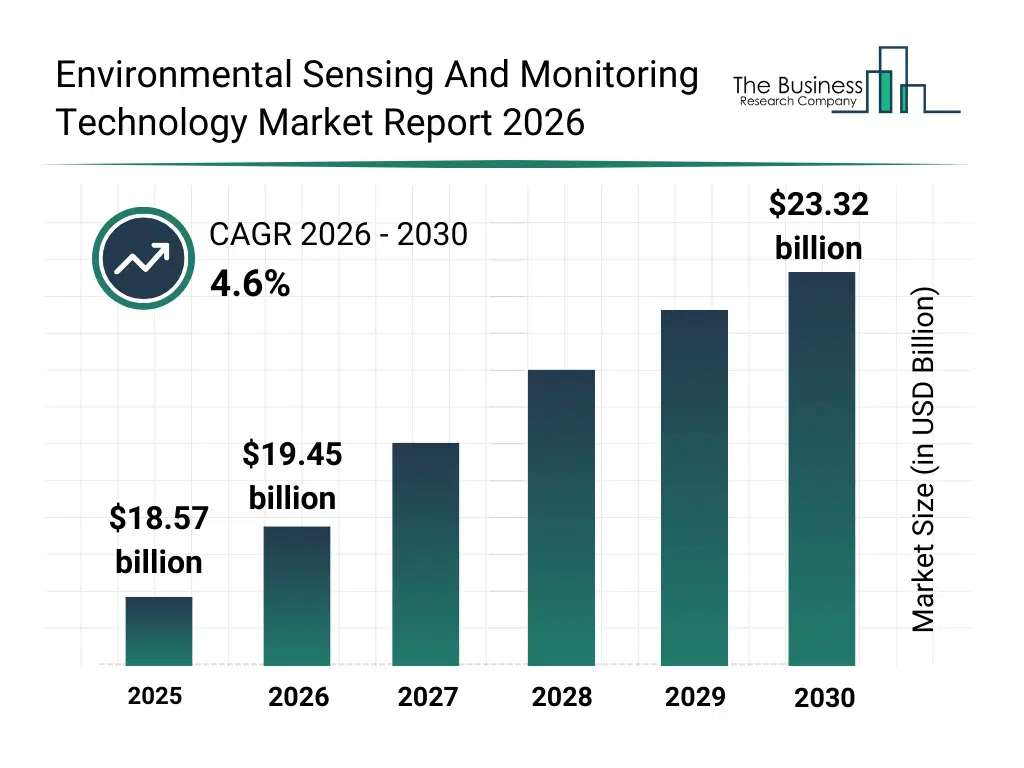
What Is The Environmental Sensing And Monitoring Technology Market Size and Share 2026?
The environmental sensing and monitoring technology market size has grown steadily in recent years. It will grow from $18.57 billion in 2025 to $19.45 billion in 2026 at a compound annual growth rate (CAGR) of 4.8%. The growth in the historic period can be attributed to increasing environmental pollution levels, rising awareness of climate change, development of portable monitoring devices, government-led environmental initiatives, advancements in sensor accuracy.What Is The Environmental Sensing And Monitoring Technology Market Growth Forecast?
The environmental sensing and monitoring technology market size is expected to see steady growth in the next few years. It will grow to $23.32 billion in 2030 at a compound annual growth rate (CAGR) of 4.6%. The growth in the forecast period can be attributed to adoption of ai-driven predictive analytics, deployment of iot-enabled monitoring networks, expansion of smart city programs, demand for real-time multi-parameter environmental data, collaboration between private and public environmental research entities. Major trends in the forecast period include real-time environmental sensing, integration of wearable and portable sensors, predictive environmental analytics, remote environmental monitoring systems, automated data collection and reporting.
Global Environmental Sensing And Monitoring Technology Market Segmentation
1) By Type: Portable, Stationary 2) By Component: Sensors, Monitors, Software, Service 3) By Monitoring Method: Active Monitoring, Intermediate Monitoring, Passive Monitoring 4) By Applications: Water Pollution Monitoring, Air Pollution Monitoring, Sound Pollution Monitoring, Soil Pollution Monitoring, Other Applications 5) By End-User: Meteorology, Government, Defense, Ocean Exploration Organizations, Research Organizations, Industrial Sector, Other End-Users Subsegments: 1) By Portable: Handheld Devices, Wearable Sensors, Mobile Monitoring Solutions, Field Monitoring Instruments 2) By Stationary: Fixed Sensors, Remote Sensing Systems, Environmental Monitoring Stations, Infrastructure-Based Monitoring SystemsWhat Is The Driver Of The Environmental Sensing And Monitoring Technology Market?
The increasing air pollution, water contamination, and soil erosion are expected to propel the growth of the environmental sensing and monitoring technology market going forward. Air pollution, water contamination, and soil erosion refer to ecological degradation caused by introducing harmful substances and disruptions to natural ecosystems. Burning fossil fuels for energy in vehicles, industries, and power plants releases pollutants, and industrial waste from factories dampens the ecological condition. Environmental sensing and monitoring technologies are utilized to track and analyze air pollution, water contamination, and soil erosion by collecting real-time data on pollutant levels, water quality, and soil conditions, aiding in assessing and mitigating environmental issues. For instance, in February 2024, according to the Government of New South Wales, an Australia-based governing body of New South Wales, the state saw an increase in particle pollution, with particulate matter (PM10 and PM2.5) rising by about 30% in 2023 compared to the previous year. Additionally, in July 2025, according to the Alluvial Soil Lab, a US-based company that offers soil test kits and lab analysis, with average erosion reaching 4.63 tons per acre and total annual soil loss exceeding 1.70 billion tons, the United States faces an estimated $12.75 billion in topsoil replacement costs, representing roughly one-quarter of the national soybean crop value. Therefore, increasing air pollution, water contamination, and soil erosion are expected to propel the growth of the environmental sensing and monitoring technology industry.Key Players In The Global Environmental Sensing And Monitoring Technology Market
Major companies operating in the environmental sensing and monitoring technology market are Siemens AG; Thermo Fisher Scientific Inc.; Honeywell International Inc.; ABB Ltd; Danaher Corporation; TE Connectivity Ltd.; Emerson Electric Co.; Amphenol Corporation; Agilent Technologies Inc.; OMRON Corporation; Xylem Inc.; Teledyne Technologies Incorporated; Shimadzu Corporation; Endress+Hauser Group; Horiba Ltd; Hebei Sailhero Environmental Protection High-tech Co., Ltd.; Focused Photonics Inc.; Sensirion AG; Beijing SDL Technology Co., Ltd.; Bosch Sensortec GmbH; Acoem Group
This chart is for illustrative purposes; the full report includes a detailed competitor analysis and comprehensive overview of the top 10 companies in the market.
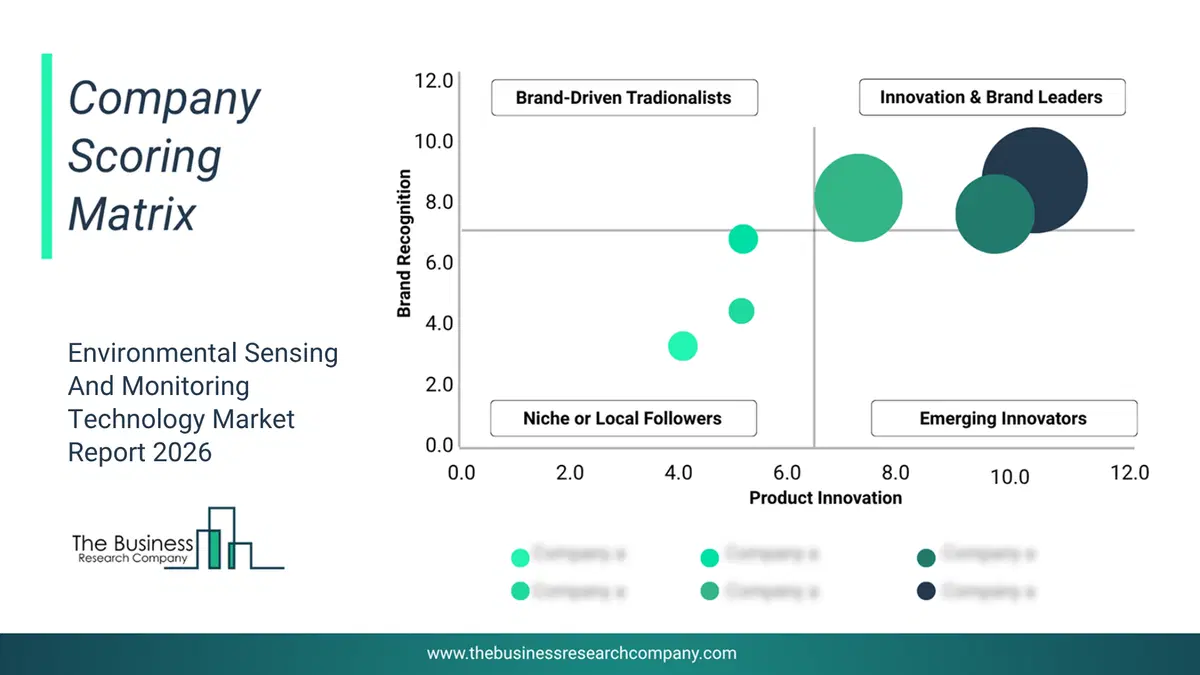
This chart maps companies by product innovation and brand strength, with bubble size indicating relative revenue, helping identify market leaders, challengers, and niche players. This is an illustrative chart; the full report provides a complete and accurate competitive analysis.
Global Environmental Sensing And Monitoring Technology Market Trends and Insights
Major companies operating in the environmental sensing and monitoring technology market are focusing on developing next-generation solutions such as environmental sensors to enhance real-time data collection and analysis. The solution utilizes IoT for real-time monitoring and management of critical infrastructure conditions. For instance, in August 2023, Vertiv, a US-based provider of critical digital infrastructure and continuity solutions, launched the geist watchdog 15 environmental sensor solution that optimizes data center monitoring in India, offering a self-contained monitor that remotely tracks real-time environmental conditions in critical IT infrastructure such as data centers and server rooms. This cost-effective solution facilitates monitoring of temperature, humidity, and dewpoint, with the capability to add up to four external plug-and-play sensors. It provides real-time sensor data, logging, and graphing, enabling data center managers to receive alerts via email and email-to-SMS for predefined threshold breaches.What Are Latest Mergers And Acquisitions In The Environmental Sensing And Monitoring Technology Market?
In May 2023, Previan, a Canada-based provides technology solutions acquired Sensor Networks Inc. for an undisclosed amount. With the acquisition of Sensor Networks, Previan aims to enhance its capabilities by integrating top-notch ultrasonic testing (UT) and phased array ultrasonic testing (PAUT) probes, along with sophisticated instruments and software. Sensor Networks Inc. is a US-based provider of sensing tools and technologies that enable the inspection and remote monitoring of safety-critical components.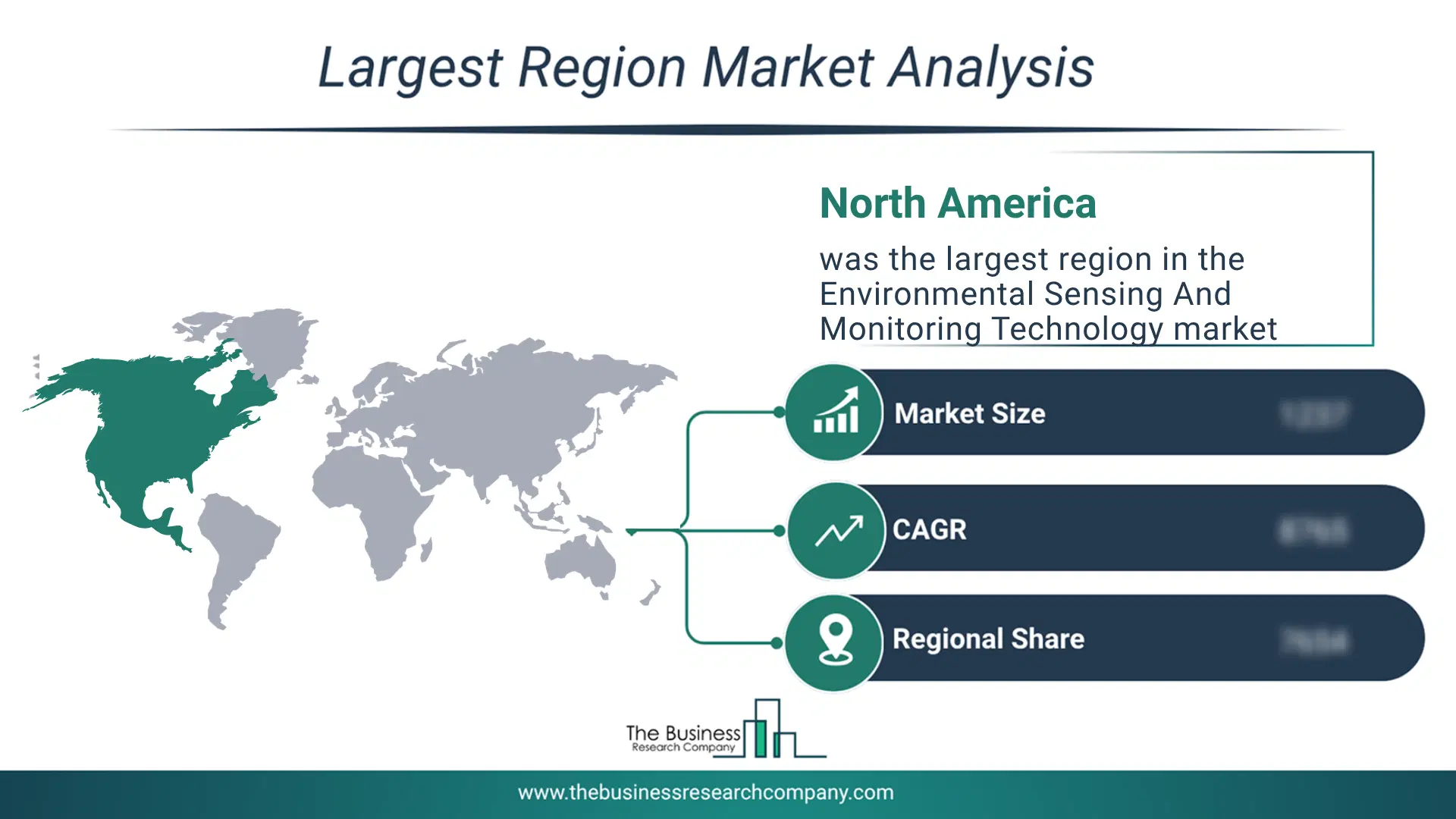
Regional Insights
North America was the largest region in the environmental sensing and monitoring technology market in 2025. The regions covered in this market report are Asia-Pacific, South East Asia, Western Europe, Eastern Europe, North America, South America, Middle East, Africa. The countries covered in this market report are Australia, Brazil, China, France, Germany, India, Indonesia, Japan, Taiwan, Russia, South Korea, UK, USA, Canada, Italy, SpainWhat Defines the Environmental Sensing And Monitoring Technology Market?
The environmental sensing and monitoring technology market consists of revenues earned by entities providing services such as collection and analysis, remote sensing, pollution monitoring, climate tracking, biodiversity assessment, and customized solutions. The market value includes the value of related goods sold by the service provider or included within the service offering. The environmental sensing and monitoring technology market also includes sales of temperature sensors, motion sensors, force sensors, and light sensors. Values in this market are ‘factory gate’ values, that is the value of goods sold by the manufacturers or creators of the goods, whether to other entities (including downstream manufacturers, wholesalers, distributors and retailers) or directly to end customers. The value of goods in this market includes related services sold by the creators of the goods.How is Market Value Defined and Measured?
The market value is defined as the revenues that enterprises gain from the sale of goods and/or services within the specified market and geography through sales, grants, or donations in terms of the currency (in USD unless otherwise specified). The revenues for a specified geography are consumption values that are revenues generated by organizations in the specified geography within the market, irrespective of where they are produced. It does not include revenues from resales along the supply chain, either further along the supply chain or as part of other products.
This chart presents market attractiveness based on a quantitative evaluation of growth, competition, strategic alignment, and risk, offering a clear view of opportunity areas for decision-making. This chart is for illustrative purposes; the full report contains the complete analysis.

This chart highlights the Total Addressable Market (TAM) by estimating the maximum revenue opportunity using an assumption-driven approach, supporting strategic planning and opportunity sizing across markets. The chart is illustrative; the full report provides a more comprehensive analysis.
What Key Data and Analysis Are Included in the Environmental Sensing And Monitoring Technology Market Report 2026?
The environmental sensing and monitoring technology market research report is one of a series of new reports from The Business Research Company that provides market statistics, including industry global market size, regional shares, competitors with the market share, detailed market segments, market trends and opportunities, and any further data you may need to thrive in the environmental sensing and monitoring technology industry. The market research report delivers a complete perspective of everything you need, with an in-depth analysis of the current and future state of the industry.Environmental Sensing And Monitoring Technology Market Report Forecast Analysis
| Report Attribute | Details |
|---|---|
| Market Size Value In 2026 | $19.45 billion |
| Revenue Forecast In 2030 | $23.32 billion |
| Growth Rate | CAGR of 4.6% from 2026 to 2030 |
| Base Year For Estimation | 2025 |
| Actual Estimates/Historical Data | 2020-2025 |
| Forecast Period | 2026 - 2030 |
| Market Representation | Revenue in USD Billion and CAGR from 2026 to 2030 |
| Segments Covered | Type, Component, Monitoring Method, Applications, End-User |
| Regional Scope | Asia-Pacific, Western Europe, Eastern Europe, North America, South America, Middle East, Africa |
| Country Scope | The Countries Covered In This Market Report Are Australia, Brazil, China, France, Germany, India, Indonesia, Japan, Taiwan, Russia, South Korea, Uk, Usa, Canada, Italy, Spain. |
| Key Companies Profiled | Siemens AG, Thermo Fisher Scientific Inc., Honeywell International Inc., ABB Ltd, Danaher Corporation, TE Connectivity Ltd., Emerson Electric Co., Amphenol Corporation, Agilent Technologies Inc., OMRON Corporation, Xylem Inc., Teledyne Technologies Incorporated, Shimadzu Corporation, Endress+Hauser Group, Horiba Ltd, Hebei Sailhero Environmental Protection High-tech Co., Ltd., Focused Photonics Inc., Sensirion AG, Beijing SDL Technology Co., Ltd., Bosch Sensortec GmbH, Acoem Group |
| Customization Scope | Request for Customization |
| Pricing And Purchase Options | Explore Purchase Options |