
Environmental Sensor Market Report 2026
Global Outlook – By Type (Temperature, Humidity, Air Quality, Water Quality, Integrated, Gas, Chemicals, Smoke, Ultraviolet (UV), Soil Moisture), By Application (Smart Home Automation, Factory Automation, Smart Cities, Automotive Powertrain System, Energy Harvesting, Other Applications), By End User (Industrial, Residential, Commercial, Automotive, Government And Public Utilities, Other End-Users) – Market Size, Trends, Strategies, and Forecast to 2030
Environmental Sensor Market Overview
• Environmental Sensor market size has reached to $2.08 billion in 2025 • Expected to grow to $3.52 billion in 2030 at a compound annual growth rate (CAGR) of 11.1% • Growth Driver: Environmental Sensors In The Fast Lane Of Automotive Industry Growth • Market Trend: Advantech Launches EVA-2000 Series Wireless LoRaWAN Technology Sensors for Precision Environmental Monitoring • North America was the largest region in 2025 and Asia-Pacific is the fastest growing region.What Is Covered Under Environmental Sensor Market?
Environmental sensors are sensors that track the environment and provide real-time data about temperature and humidity, wind speed and direction, and rainfall. Environmental sensors are used to record, store, test, and accurately measure vital environmental information using Data Center Infrastructure Management (DCIM) software. The main types of environmental sensors are temperature, humidity, air quality, water quality, integrated, gas, chemicals, smoke, ultraviolet (UV), and soil moisture sensors. Temperature sensors such as thermocouples are used in the environmental sensor market to measure temperature by gauging changes in electrical current resistance. These are applied for smart home automation, factory automation, smart cities, automotive powertrain system, energy harvesting, and others by are used in industrial, residential, commercial, automotive, government and public utilities, and other end-users.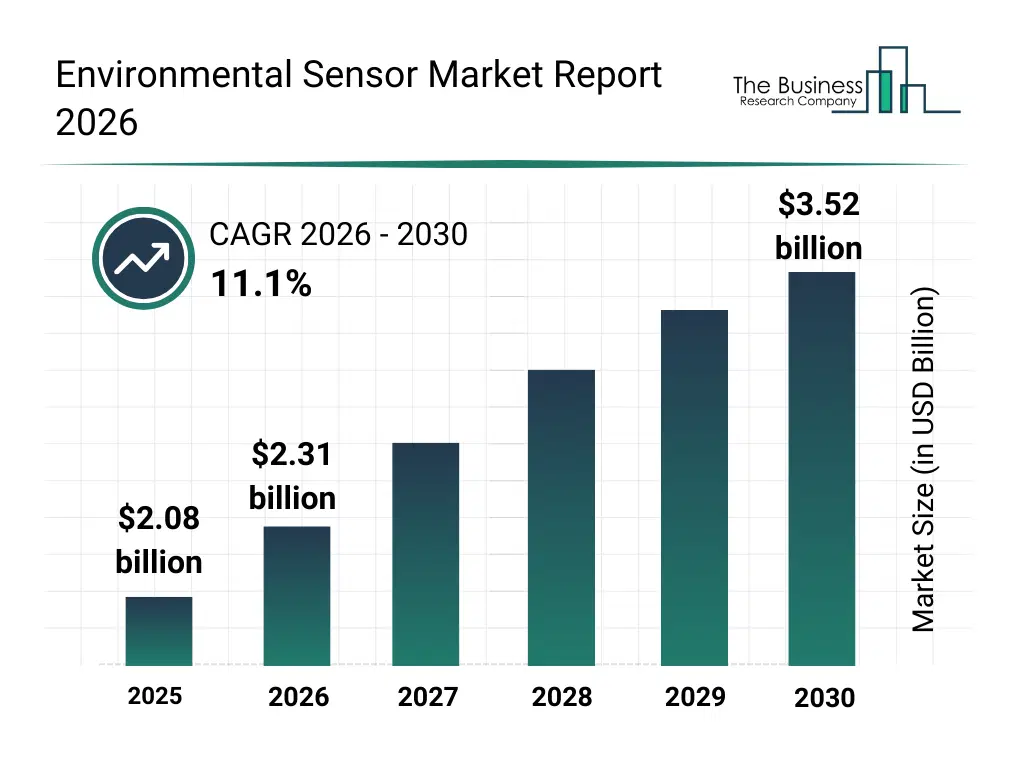
What Is The Environmental Sensor Market Size and Share 2026?
The environmental sensor market size has grown rapidly in recent years. It will grow from $2.08 billion in 2025 to $2.31 billion in 2026 at a compound annual growth rate (CAGR) of 10.9%. The growth in the historic period can be attributed to environmental regulation enforcement, growth of industrial automation, expansion of smart city projects, demand for pollution monitoring, climate change awareness.What Is The Environmental Sensor Market Growth Forecast?
The environmental sensor market size is expected to see rapid growth in the next few years. It will grow to $3.52 billion in 2030 at a compound annual growth rate (CAGR) of 11.1%. The growth in the forecast period can be attributed to government sustainability initiatives, increasing IoT adoption, growth of smart infrastructure, rising demand for climate monitoring, advancements in sensor technology. Major trends in the forecast period include real time environmental monitoring, smart city sensor deployment, multi parameter sensor integration, wireless sensor networks, predictive environmental analytics.
Global Environmental Sensor Market Segmentation
1) By Type: Temperature, Humidity, Air Quality, Water Quality, Integrated, Gas, Chemicals, Smoke, Ultraviolet (UV), Soil Moisture 2) By Application: Smart Home Automation, Factory Automation, Smart Cities, Automotive Powertrain System, Energy Harvesting, Other Applications 3) By End User: Industrial, Residential, Commercial, Automotive, Government And Public Utilities, Other End-Users Subsegments: 1) By Temperature: Thermocouples, Thermistors, Infrared Sensors 2) By Humidity: Capacitive Humidity Sensors, Resistive Humidity Sensors 3) By Air Quality: Particulate Matter Sensors, VOC Sensors, CO2 Sensors 4) By Water Quality: pH Sensors, Turbidity Sensors, Conductivity Sensors 5) By Integrated: Multi-parameter Sensors 6) By Gas: Carbon Monoxide Sensors, Methane Sensors, Hydrogen Sensors 7) By Chemicals: Ion-selective Electrodes, Optical Sensors 8) By Smoke: Ionization Smoke Detectors, Photoelectric Smoke Detectors 9) By Ultraviolet (UV): UV Index Sensors, UV Light Intensity Sensors 10) By Soil Moisture: Capacitive Soil Moisture Sensors, Resistive Soil Moisture SensorsWhat Is The Driver Of The Environmental Sensor Market?
The increasing demand for the automotive industry is expected to propel the growth of the environmental sensor market going forward. The automotive industry refers to the sector involved in the design, development, manufacturing, marketing, and sale of motor vehicles. Environmental sensors in the automotive industry contribute to safety, efficiency, and comfort by providing valuable data for various systems and features within vehicles. For instance, in August 2023, according to the Board of Governors of the Federal Reserve System, a US-based government agency, total vehicle production in the United States increased to 11.77 million units in July 2023, up from 10.91 million units in June 2023. Therefore, the increasing demand for the automotive industry is driving the growth of the environmental sensor industry.Key Players In The Global Environmental Sensor Market
Major companies operating in the environmental sensor market are Siemens AG; Schneider Electric SE; Honeywell International Inc.; ABB Ltd.; Texas Instruments Incorporated; Emerson Electric Co.; TE Connectivity; Microelectronics N.V.; Infineon Technologies AG; Amphenol Corporation; Renesas Electronics Corporation; Omron Corporation; Ams OSRAM AG; Horiba Group; Sick AG; Sensirion AG; RioT Technology Corp.; Figaro Engineering Inc.; Omega Engineering Inc.; Bosch Sensortec GmbH; Eurotech SpA.; Raritan; Eko Instruments BV; Breeze Technologies; Elichens; NuWave Sensor; Nesa Srl.; Apogee Instruments Inc.; Aeroqual Ltd.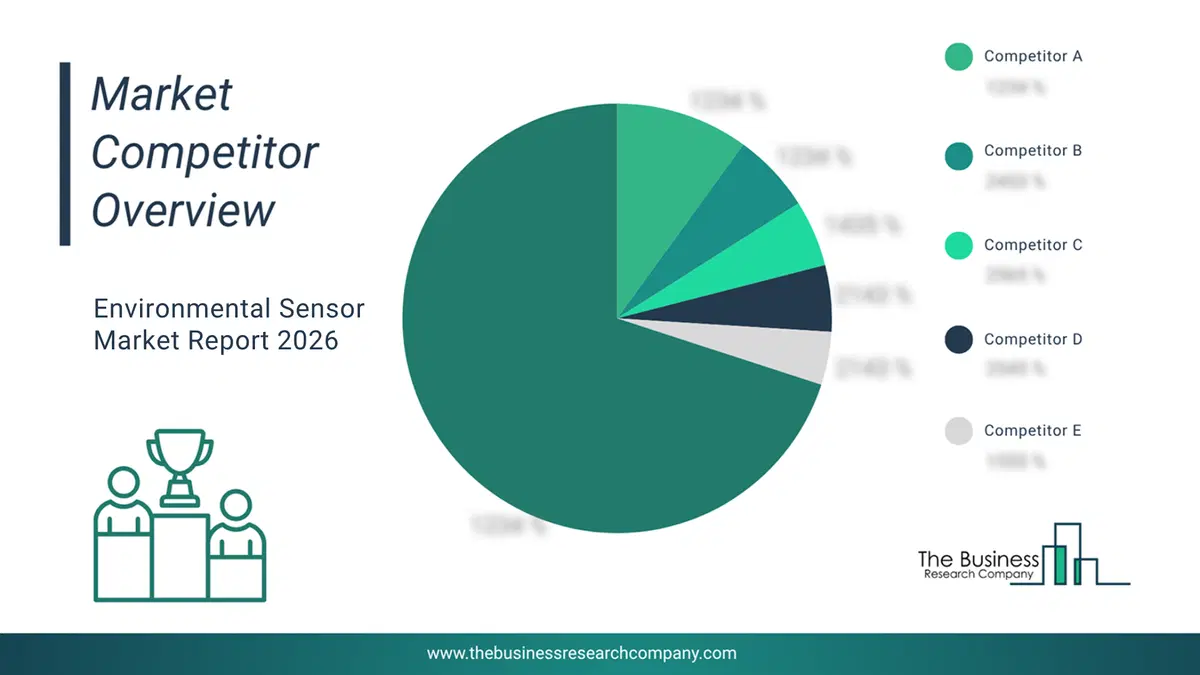
This chart is for illustrative purposes; the full report includes a detailed competitor analysis and comprehensive overview of the top 10 companies in the market.
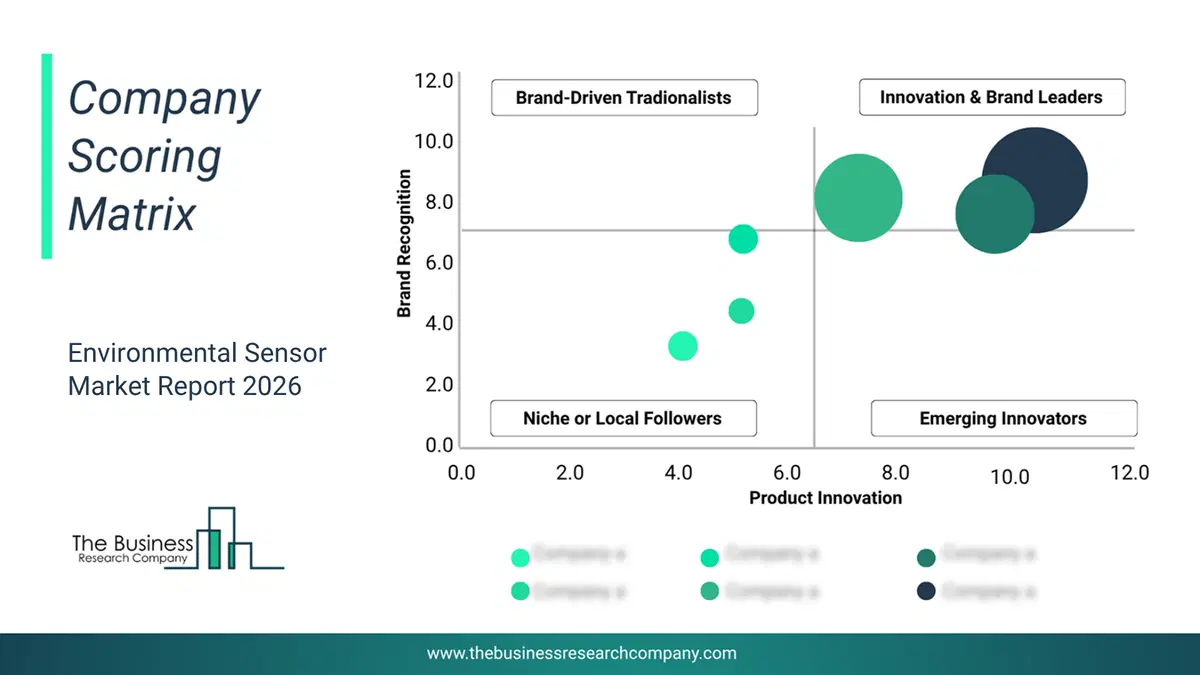
This chart maps companies by product innovation and brand strength, with bubble size indicating relative revenue, helping identify market leaders, challengers, and niche players. This is an illustrative chart; the full report provides a complete and accurate competitive analysis.
Global Environmental Sensor Market Trends and Insights
Major companies operating in the environmental sensor market are focusing on developing technological advancements such as advanced sensing devices to enhance real-time monitoring and data accuracy for improved environmental management and decision-making. Advanced sensing devices are sophisticated instruments designed to detect and measure environmental parameters like temperature, humidity, and air quality. Utilizing technologies such as microelectromechanical systems (MEMS) and artificial intelligence, these devices offer accurate, real-time data for improved monitoring and analysis. For instance, in April 2024, Advantech Co., Ltd., a China-based computer manufacturing company, launched the EVA-2000 Series Wireless LoRaWAN Technology Sensors. These sensors offer significant benefits for precision environmental monitoring. They utilize low-power, long-range LoRaWAN technology, enabling efficient data transmission over extensive distances while maintaining exceptional battery life thanks to their double 3.6V Li-ion batteries. This series not only simplifies integration within existing systems but also supports scalable deployments, making it a cost-effective solution for various industrial applications.What Are Latest Mergers And Acquisitions In The Environmental Sensor Market?
In December 2023, Motorola Solutions, Inc., a US-based provider of security and sensing solutions, acquired IPVideo Corporation for an undisclosed amount. Through this acquisition, Motorola Solutions aims to enhance its environmental sensing capabilities by integrating IPVideo’s HALO Smart Sensor, which includes real-time air-quality monitoring and intelligent sensing technologies. IPVideo Corporation is a US-based company that provides intelligent sensors for environmental monitoring, including air-quality detection.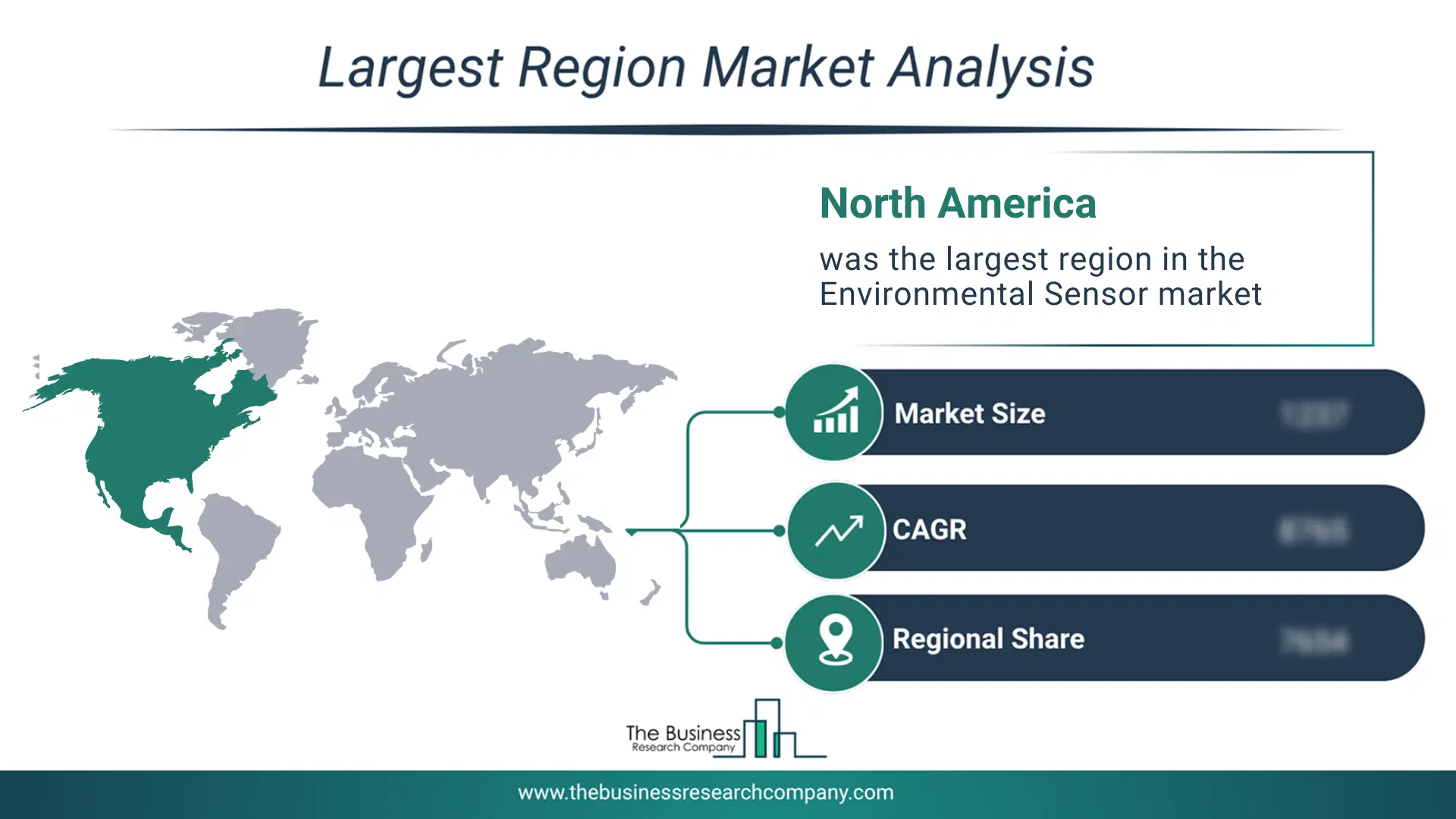
Regional Insights
North America was the largest region in the environmental sensor market in 2025. Asia-Pacific is expected to be the fastest-growing region in the forecast period. The regions covered in this market report are Asia-Pacific, South East Asia, Western Europe, Eastern Europe, North America, South America, Middle East, Africa. The countries covered in this market report are Australia, Brazil, China, France, Germany, India, Indonesia, Japan, Taiwan, Russia, South Korea, UK, USA, Canada, Italy, SpainWhat Defines the Environmental Sensor Market?
The environmental sensors market consists of sales of rainfall sensors, light sensors, wind speed sensors, direction sensors, gypsum blocks, tension meters, capacitance, volumetric, and neutron probes. Values in this market are ‘factory gate’ values, that is the value of goods sold by the manufacturers or creators of the goods, whether to other entities (including downstream manufacturers, wholesalers, distributors and retailers) or directly to end customers. The value of goods in this market includes related services sold by the creators of the goods.How is Market Value Defined and Measured?
The market value is defined as the revenues that enterprises gain from the sale of goods and/or services within the specified market and geography through sales, grants, or donations in terms of the currency (in USD unless otherwise specified). The revenues for a specified geography are consumption values that are revenues generated by organizations in the specified geography within the market, irrespective of where they are produced. It does not include revenues from resales along the supply chain, either further along the supply chain or as part of other products.
This chart presents market attractiveness based on a quantitative evaluation of growth, competition, strategic alignment, and risk, offering a clear view of opportunity areas for decision-making. This chart is for illustrative purposes; the full report contains the complete analysis.

This chart highlights the Total Addressable Market (TAM) by estimating the maximum revenue opportunity using an assumption-driven approach, supporting strategic planning and opportunity sizing across markets. The chart is illustrative; the full report provides a more comprehensive analysis.
What Key Data and Analysis Are Included in the Environmental Sensor Market Report 2026?
The environmental sensor market research report is one of a series of new reports from The Business Research Company that provides market statistics, including industry global market size, regional shares, competitors with the market share, detailed market segments, market trends and opportunities, and any further data you may need to thrive in the environmental sensor industry. The market research report delivers a complete perspective of everything you need, with an in-depth analysis of the current and future state of the industry.Environmental Sensor Market Report Forecast Analysis
| Report Attribute | Details |
|---|---|
| Market Size Value In 2026 | $2.31 billion |
| Revenue Forecast In 2030 | $3.52 billion |
| Growth Rate | CAGR of 11.1% from 2026 to 2030 |
| Base Year For Estimation | 2025 |
| Actual Estimates/Historical Data | 2020-2025 |
| Forecast Period | 2026 - 2030 |
| Market Representation | Revenue in USD Billion and CAGR from 2026 to 2030 |
| Segments Covered | Type, Application, End User |
| Regional Scope | Asia-Pacific, Western Europe, Eastern Europe, North America, South America, Middle East, Africa |
| Country Scope | The Countries Covered In This Market Report Are Australia, Brazil, China, France, Germany, India, Indonesia, Japan, Taiwan, Russia, South Korea, Uk, Usa, Canada, Italy, Spain. |
| Key Companies Profiled | Siemens AG, Schneider Electric SE, Honeywell International Inc., ABB Ltd., Texas Instruments Incorporated, Emerson Electric Co., TE Connectivity, Microelectronics N.V., Infineon Technologies AG, Amphenol Corporation, Renesas Electronics Corporation, Omron Corporation, Ams OSRAM AG, Horiba Group, Sick AG, Sensirion AG, RioT Technology Corp., Figaro Engineering Inc., Omega Engineering Inc., Bosch Sensortec GmbH, Eurotech SpA., Raritan, Eko Instruments BV, Breeze Technologies, Elichens, NuWave Sensor, Nesa Srl., Apogee Instruments Inc., Aeroqual Ltd. |
| Customization Scope | Request for Customization |
| Pricing And Purchase Options | Explore Purchase Options |