
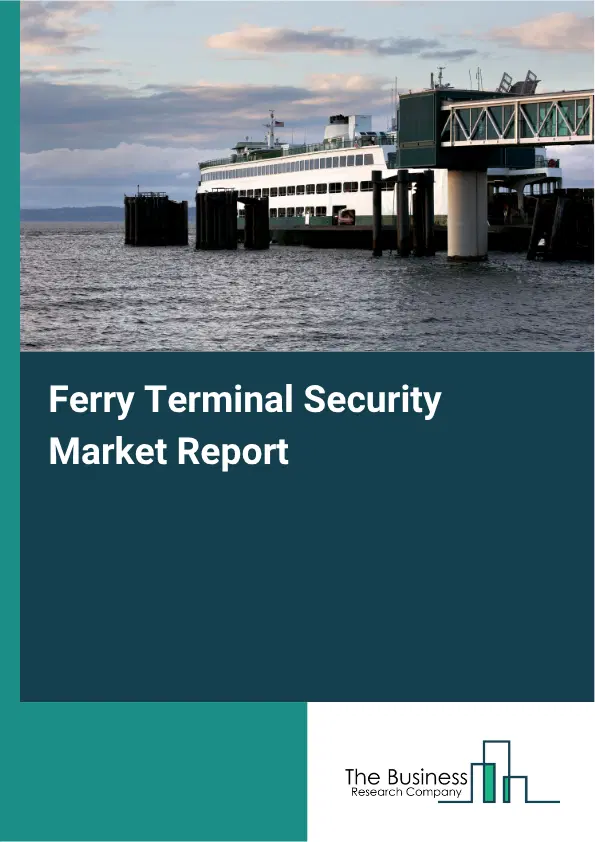
Ferry Terminal Security Market Report 2026
Global Outlook – By Component (Hardware, Software, Services), By Security Type (Access Control, Passenger Screening, Baggage Inspection, Cargo Inspection, Surveillance Monitoring, Perimeter Security, Crowd Management, Emergency Response, Traffic Control, Identity Verification), By Technology (Biometric Systems, Video Surveillance Systems, X-Ray Screening Systems, Metal Detectors, Access Control Systems, Intrusion Detection Systems, Communication Systems), By Deployment Type (On Premise, Cloud-Based), By End User (Port Authorities, Government Agencies, Private Terminal Operators, Security Service Providers) – Market Size, Trends, Strategies, and Forecast to 2035
Ferry Terminal Security Market Overview
• Ferry Terminal Security market size has reached to $1.36 billion in 2025 • Expected to grow to $2.24 billion in 2030 at a compound annual growth rate (CAGR) of 10.5% • Growth Driver: Increasing Maritime Security Threats Fueling The Growth Of The Market Due To Rising Risks Of Cyberattacks And Unauthorized Access • Market Trend: AI-Based Biometric Surveillance Systems Enable Enhanced Passenger Identification and Automated Threat Detection at Critical Transport Hubs • North America was the largest region in 2025 and Asia-Pacific is the fastest growing region.What Is Covered Under Ferry Terminal Security Market?
Ferry terminal security refers to the systems, procedures, and personnel used to protect passengers, staff, vessels, and infrastructure at ferry ports from threats and disruptions. It includes measures such as access control, surveillance, baggage screening, crowd management, and emergency response planning to ensure safe and efficient operations. These security practices help prevent incidents like unauthorized access, smuggling, terrorism, and accidents while maintaining smooth passenger flow. The main components of ferry terminal security include hardware, software, and services. Hardware refers to physical security infrastructure such as surveillance devices, screening equipment, and access control systems used to ensure safe ferry terminal operations. These systems are categorized by security type including access control, passenger screening, baggage inspection, cargo inspection, surveillance monitoring, perimeter security, crowd management, emergency response, traffic control, and identity verification and are based on technologies such as biometric systems, video surveillance systems, x-ray screening systems, metal detectors, access control systems, intrusion detection systems, and communication systems. They are deployed in modes including on premise and cloud-based and are used by end users including port authorities, government agencies, private terminal operators, and security service providers.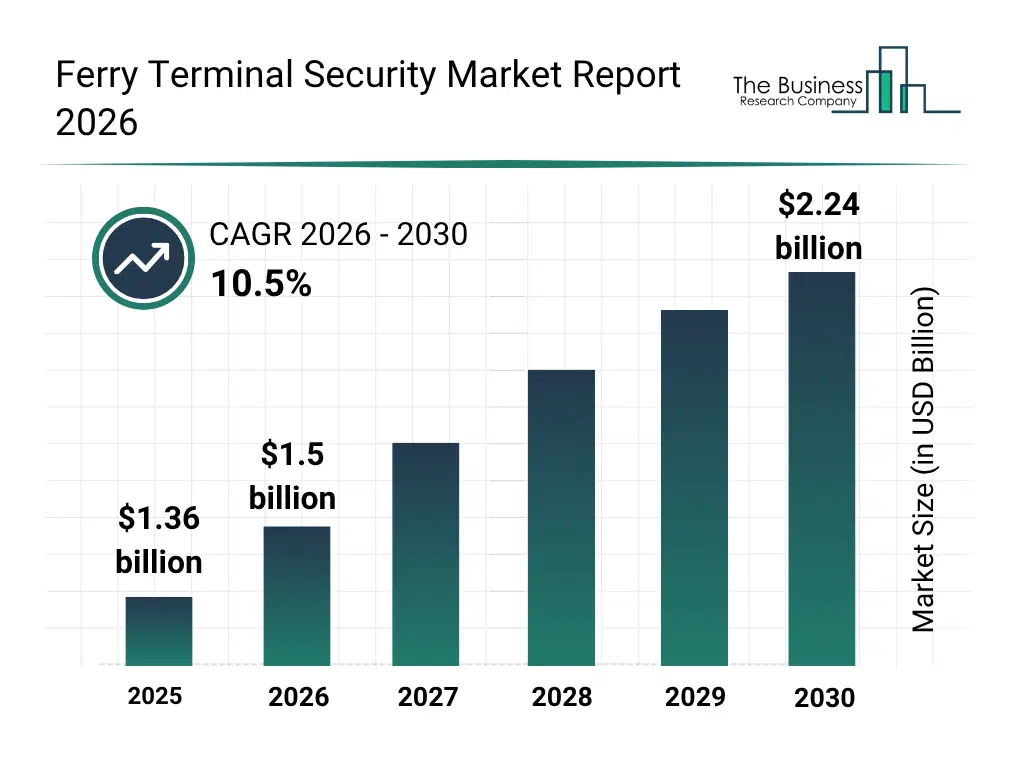
What Is The Ferry Terminal Security Market Size and Share 2026?
The ferry terminal security market size has grown rapidly in recent years. It will grow from $1.36 billion in 2025 to $1.5 billion in 2026 at a compound annual growth rate (CAGR) of 10.3%. The growth in the historic period can be attributed to rising incidents of maritime security threats and smuggling activities, increasing passenger traffic at ferry terminals, expansion of coastal tourism and intercity ferry networks, growing government focus on port and transport security, increasing adoption of basic surveillance and access control systems.What Is The Ferry Terminal Security Market Growth Forecast?
The ferry terminal security market size is expected to see rapid growth in the next few years. It will grow to $2.24 billion in 2030 at a compound annual growth rate (CAGR) of 10.5%. The growth in the forecast period can be attributed to rising adoption of AI driven security analytics and automation, increasing investment in smart port and terminal infrastructure, growth in biometric and contactless passenger processing systems, expansion of integrated maritime cybersecurity and physical security systems, increasing demand for real time situational awareness platforms. Major trends in the forecast period include increasing deployment of AI powered video surveillance and threat detection systems, rising adoption of biometric based passenger identity verification at ferry terminals, growing integration of iot enabled smart monitoring systems for real time crowd and asset tracking, expansion of automated baggage and cargo screening technologies, increasing use of predictive analytics for emergency response and risk management.
Global Ferry Terminal Security Market Segmentation
1) By Component: Hardware, Software, Services 2) By Security Type: Access Control, Passenger Screening, Baggage Inspection, Cargo Inspection, Surveillance Monitoring, Perimeter Security, Crowd Management, Emergency Response, Traffic Control, Identity Verification 3) By Technology: Biometric Systems, Video Surveillance Systems, X-Ray Screening Systems, Metal Detectors, Access Control Systems, Intrusion Detection Systems, Communication Systems 4) By Deployment Type: On Premise, Cloud-Based 5) By End User: Port Authorities, Government Agencies, Private Terminal Operators, Security Service Providers Subsegments: 1) By Hardware: Surveillance Cameras, Access Control Systems, Metal Detectors, Turnstiles, Intrusion Detection Sensors, Barrier Gates, Alarm Systems 2) By Software: Video Management Systems, Access Control Software, Surveillance Analytics Software, Incident Management Platforms, Command And Control Software, Identity Verification Software 3) By Services: Security Consulting Services, Surveillance Monitoring Services, Installation And Maintenance Services, Risk Assessment Services, Emergency Response Services, Training And Support ServicesWhat Is The Driver Of The Ferry Terminal Security Market?
The increasing maritime security threats are expected to propel the growth of the ferry terminal security going forward. Maritime security threats refer to risks and hostile activities that endanger the safety, operations, and infrastructure of ships, ports, and maritime transport systems, including cyberattacks, piracy, terrorism, and illegal trafficking. The rising maritime security threats are increasing due to the rapid digitalization of maritime operations, which expands the exposure of ports and vessels to cyberattacks targeting critical navigation and operational systems. Maritime security threats are directly relevant to ferry terminal security as ferry terminals are critical maritime access points where risks such as unauthorized entry, cyberattacks, and operational disruptions can impact passenger safety and terminal operations. For instance, in April 2026, according to CYTUR, an Israel-based cybersecurity-focused organization, a recent maritime cyber threat white paper reported a 103% year-on-year increase (2024–2025) in cyberattacks targeting shipboard operational technology (OT), particularly at the critical interface between information technology (IT) and operational technology (OT) systems. Therefore, the increasing maritime security threats is driving the growth of the ferry terminal security industry.Key Players In The Global Ferry Terminal Security Market
Major companies operating in the ferry terminal security market are Huawei Technologies Co. Ltd., Siemens AG, Cisco Systems Inc., Honeywell International Inc., Johnson Controls International plc, Allied Universal Security Services LLC, Thales Group, Leidos Holdings Inc., Securitas AB, Hexagon AB, Indra Sistemas S.A., ASSA ABLOY AB, Zhejiang Dahua Technology Co. Ltd., dormakaba Holding AG, NEC Corporation, OSI Systems Inc., Genetec Inc., Teledyne Technologies Incorporated, MER Group Ltd., Suprema Inc., HALO Maritime Defense Systems Inc., Risk Intelligence A/SGlobal Ferry Terminal Security Market Trends and Insights
Major companies operating in the ferry terminal security market are focusing on developing advanced solutions, such as biometric surveillance and AI-enabled real-time threat detection platforms to enhance passenger safety, improve automated monitoring accuracy, and strengthen terminal access control and situational awareness in high-traffic maritime environments. Artificial intelligence-driven video surveillance systems refer to advanced security solutions that integrate AI algorithms, facial recognition, behavioral analytics, and automated monitoring technologies to detect suspicious activities, identify individuals, and provide real-time security decision support across ferry terminals and port infrastructure. For instance, in May 2024, APIQROO (Comprehensive Port Administration of Quintana Roo), a Mexico-based port authority, launched an AI-based biometric surveillance security system at the Cozumel Ferry Terminal. The launched system integrates facial recognition cameras, 24/7 CCTV monitoring, and advanced passenger screening infrastructure; it enhances passenger identification accuracy, improves real-time threat detection capabilities, and strengthens overall ferry terminal security by enabling faster response to unauthorized access and security risks.What Are Latest Mergers And Acquisitions In The Ferry Terminal Security Market?
In December 2023, the Philippine Coast Guard (PCG), a Philippines-based maritime safety and security government agency, partnered with the Metropolitan Manila Development Authority (MMDA) to improve the Pasig River Ferry Service in preparation for the holiday season. With this partnership, the Philippine Coast Guard and MMDA aim to strengthen the operational safety, security monitoring, vessel inspection, and emergency response system of the Pasig River Ferry Service by deploying coast guard personnel at ferry terminals, enhancing passenger safety protocols, and ensuring continuous maritime security oversight across ferry operations in Metro Manila. The Metropolitan Manila Development Authority (MMDA) is a Philippines-based government agency responsible for managing urban transport systems, including the Pasig River Ferry Service.Regional Outlook/Insights
North America was the largest region in the ferry terminal security market in 2025. Asia-Pacific is expected to be the fastest-growing region in the forecast period. The regions covered in this market report are Asia-Pacific, South East Asia, Western Europe, Eastern Europe, North America, South America, Middle East, Africa. The countries covered in this market report are Australia, Brazil, China, France, Germany, India, Indonesia, Japan, Taiwan, Russia, South Korea, UK, USA, Canada, Italy, Spain.What Defines the Ferry Terminal Security Market?
The ferry terminal security market consists of revenues earned by entities by providing services such as security risk assessment, maritime threat intelligence analysis, cybersecurity monitoring, incident reporting, and forensic documentation. The market value includes the value of related goods sold by the service provider or included within the service offering. The ferry terminal security market also includes sales of CCTV cameras, thermal imaging cameras, and security turnstiles. Values in this market are ‘factory gate’ values, that is the value of goods sold by the manufacturers or creators of the goods, whether to other entities (including downstream manufacturers, wholesalers, distributors and retailers) or directly to end customers. The value of goods in this market includes related services sold by the creators of the goods.How is Market Value Defined and Measured?
The market value is defined as the revenues that enterprises gain from the sale of goods and/or services within the specified market and geography through sales, grants, or donations in terms of the currency (in USD unless otherwise specified). The revenues for a specified geography are consumption values that are revenues generated by organizations in the specified geography within the market, irrespective of where they are produced. It does not include revenues from resales along the supply chain, either further along the supply chain or as part of other products.What Key Data and Analysis Are Included in the Ferry Terminal Security Market Report 2026?
The ferry terminal security market research report is one of a series of new reports from The Business Research Company that provides market statistics, including industry global market size, regional shares, competitors with the market share, detailed market segments, market trends and opportunities, and any further data you may need to thrive in the ferry terminal security industry. The market research report delivers a complete perspective of everything you need, with an in-depth analysis of the current and future state of the industry.Ferry Terminal Security Market Report Forecast Analysis
| Report Attribute | Details |
|---|---|
| Market Size Value In 2026 | $1.5 billion |
| Revenue Forecast In 2035 | $2.24 billion |
| Growth Rate | CAGR of 10.5% from 2026 to 2035 |
| Base Year For Estimation | 2025 |
| Actual Estimates/Historical Data | 2020-2025 |
| Forecast Period | 2026 - 2030 - 2035 |
| Market Representation | Revenue in USD Billion and CAGR from 2026 to 2035 |
| Segments Covered | Component, Security Type, Technology, Deployment Type, End User |
| Regional Scope | Asia-Pacific, Western Europe, Eastern Europe, North America, South America, Middle East, Africa |
| Country Scope | The countries covered in the report are Australia, Brazil, China, France, Germany, India, Indonesia, Japan, Taiwan, Russia, South Korea, UK, USA, Canada, Italy, Spain. |
| Key Companies Profiled | Huawei Technologies Co. Ltd., Siemens AG, Cisco Systems Inc., Honeywell International Inc., Johnson Controls International plc, Allied Universal Security Services LLC, Thales Group, Leidos Holdings Inc., Securitas AB, Hexagon AB, Indra Sistemas S.A., ASSA ABLOY AB, Zhejiang Dahua Technology Co. Ltd., dormakaba Holding AG, NEC Corporation, OSI Systems Inc., Genetec Inc., Teledyne Technologies Incorporated, MER Group Ltd., Suprema Inc., HALO Maritime Defense Systems Inc., Risk Intelligence A/S |
| Customization Scope | Request for Customization |
| Pricing And Purchase Options | Explore Purchase Options |