
Fifth Generation (5G) Technology In Telehealth Market Report 2026
Global Outlook – By Component (Hardware, Software, Services), By Connectivity Type (Device Connectivity, Network Connectivity), By Application (Remote Patient Monitoring, Real-Time Consultation, Telemedicine, Mobile Health, Other Applications), By End-User (Hospitals, Clinics, Homecare, Other End-Users) - Market Size, Trends, Strategies, and Forecast to 2030
Fifth Generation (5G) Technology In Telehealth Market Overview
• Fifth Generation (5G) Technology In Telehealth market size has reached to $3.01 billion in 2025 • Expected to grow to $8.49 billion in 2030 at a compound annual growth rate (CAGR) of 23% • Growth Driver: Increasing Demand For Home-Based Healthcare Services Driving The Market Growth Due To Aging Population Demographics • Market Trend: Drone-Based Medicine Delivery Transforms Remote Healthcare Access For Maritime And Isolated Communities • North America was the largest region in 2025 and Asia Pacific is the fastest growing region.What Is Covered Under Fifth Generation (5G) Technology In Telehealth Market?
Fifth generation (5G) technology in telehealth is a high-speed wireless communication system that enables real-time transmission of large medical data, including high-definition imaging and patient monitoring information. It supports advanced applications such as remote surgery, virtual consultations, and continuous health tracking by providing low latency and reliable connectivity. This technology enhances the efficiency, responsiveness, and accessibility of healthcare services by facilitating seamless interaction between medical devices and healthcare systems. The main components of fifth-generation (5G) technology in telehealth are hardware, software, and services. Hardware refers to the physical devices in telehealth systems, including sensors, monitoring instruments, tablets, and wearable medical gadgets that collect patient data and enable real-time connectivity with healthcare facilities for timely clinical insights. These components support different connectivity types such as device connectivity and network connectivity. They are used for various applications including remote patient monitoring, real-time consultation, telemedicine, mobile health, and other applications, serving diverse end-users such as hospitals, clinics, homecare settings, and other healthcare providers.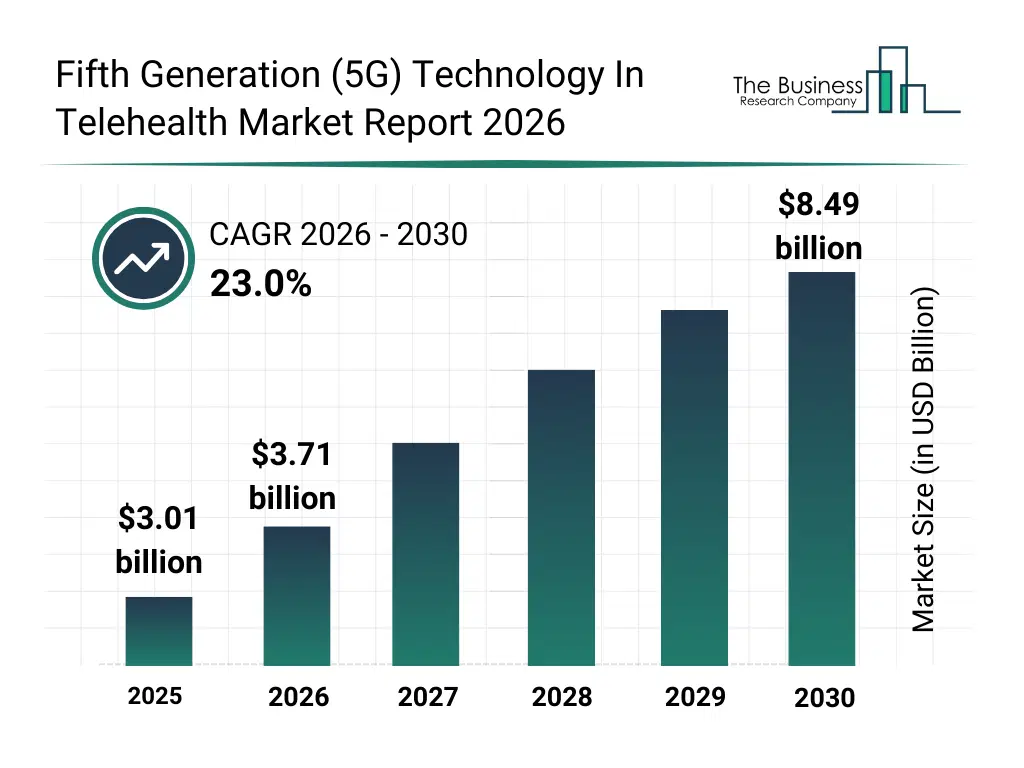
What Is The Fifth Generation (5G) Technology In Telehealth Market Size and Share 2026?
The fifth generation (5g) technology in telehealth market size has grown exponentially in recent years. It will grow from $3.01 billion in 2025 to $3.71 billion in 2026 at a compound annual growth rate (CAGR) of 23.3%. The growth in the historic period can be attributed to expansion of telehealth services adoption, rising demand for remote healthcare access, growth in digital patient engagement tools, increased availability of connected health devices, improvements in mobile healthcare connectivity.What Is The Fifth Generation (5G) Technology In Telehealth Market Growth Forecast?
The fifth generation (5g) technology in telehealth market size is expected to see exponential growth in the next few years. It will grow to $8.49 billion in 2030 at a compound annual growth rate (CAGR) of 23.0%. The growth in the forecast period can be attributed to increasing investments in nationwide 5g networks, rising demand for low-latency telehealth services, expansion of home-based healthcare delivery, growing focus on virtual care efficiency, increasing integration of ai-driven telehealth analytics. Major trends in the forecast period include increasing adoption of real-time virtual consultations, rising use of continuous remote health tracking, growing deployment of 5g-enabled wearable devices, expansion of high-definition medical imaging transmission, enhanced integration of secure cloud-based telehealth platforms.
Global Fifth Generation (5G) Technology In Telehealth Market Segmentation
1) By Component: Hardware, Software, Services 2) By Connectivity Type: Device Connectivity, Network Connectivity 3) By Application: Remote Patient Monitoring, Real-Time Consultation, Telemedicine, Mobile Health, Other Applications 4) By End-User: Hospitals, Clinics, Homecare, Other End-Users Subsegments: 1) By Hardware: Network Equipment, Communication Devices, Sensors, Wearable Devices, Edge Devices 2) By Software: Telemedicine Platforms, Remote Patient Monitoring Software, Data Analytics Software, Security Software, Cloud Management Software 3) By Services: Network Deployment Services, Integration Services, Maintenance And Support Services, Consulting Services, Training And Education ServicesWhat Is The Driver Of The Fifth Generation (5G) Technology In Telehealth Market?
The increasing demand for remote healthcare services is expected to propel the growth of the fifth generation (5G) technology in telehealth market going forward. Remote healthcare services refer to the delivery of clinical health care to patients through digital communication technologies without requiring an in-person office visit. The demand for remote healthcare services is rising due to improved accessibility and convenience, particularly for patients in rural areas and those with mobility limitations who can now access specialized medical care without geographical constraints. Fifth generation (5G) technology in telehealth enhances remote healthcare by providing ultra-fast, low-latency connectivity that enables real-time patient monitoring, high-definition virtual consultations, and seamless data transmission, thereby improving access, quality, and timeliness of care regardless of the patient's location. For instance, in August 2023, according to the Vivalink, a US-based healthcare technology company, a recent survey found that 81% of clinicians now use remote patient monitoring (RPM), up from only 20% in 2021, a 305% increase. Additionally, 84% of those currently using RPM plan to expand their use of the technology in 2024. Therefore, the increasing demand for remote healthcare services is driving the growth of the fifth generation (5G) technology in telehealth industry.Key Players In The Global Fifth Generation (5G) Technology In Telehealth Market
Major companies operating in the fifth generation (5g) technology in telehealth market are Verizon Communications Inc., AT&T Inc., Huawei Technologies Co. Ltd., Nippon Telegraph and Telephone Corporation, T-Mobile US Inc., Cisco Systems Inc., Intel Corporation, Vodafone Group Plc, Qualcomm Technologies Inc., BT Group plc, Fujitsu Limited, Telefonaktiebolaget LM Ericsson, Nokia Corporation, Siemens Healthineers AG, GE HealthCare Technologies Inc., ZTE Corporation, M1 Limited, GlobalMed Holdings LLC, Visionable Limited, Telit Communications Limited
This chart is for illustrative purposes; the full report includes a detailed competitor analysis and comprehensive overview of the top 10 companies in the market.
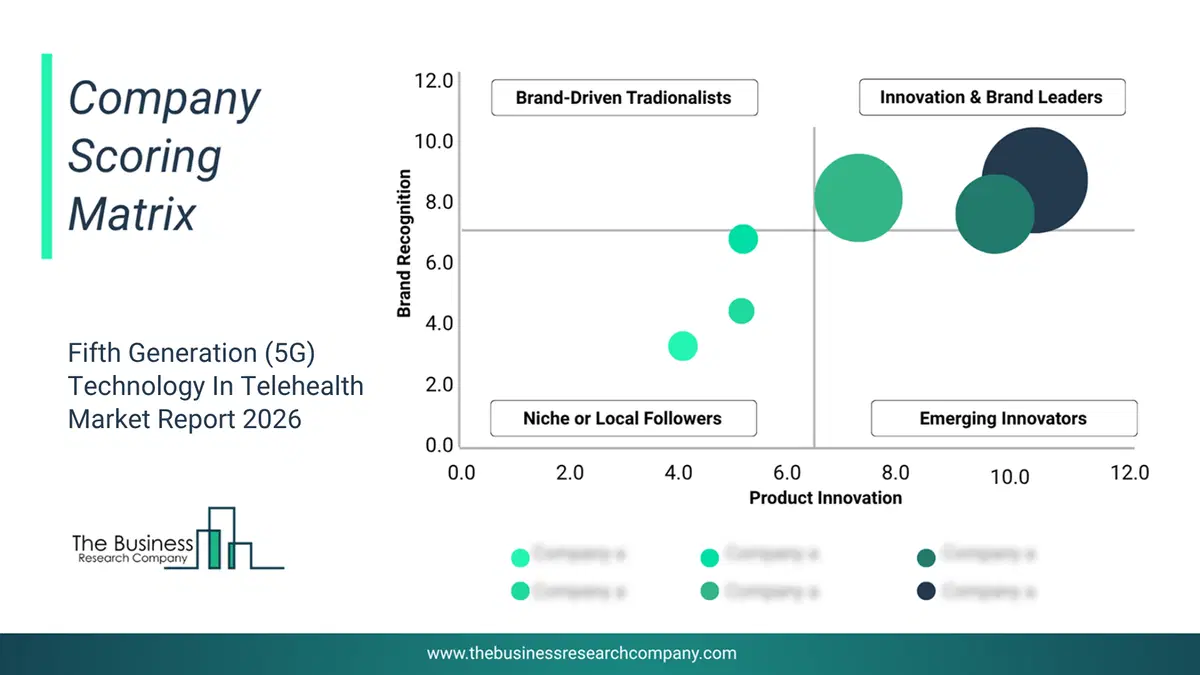
This chart maps companies by product innovation and brand strength, with bubble size indicating relative revenue, helping identify market leaders, challengers, and niche players. This is an illustrative chart; the full report provides a complete and accurate competitive analysis.
Global Fifth Generation (5G) Technology In Telehealth Market Trends and Insights
Major companies operating in the fifth generation (5G) technology in telehealth market are focusing on leveraging innovative solutions such as drone-based medicine delivery to ensure faster and remote access to healthcare. Drone-based medicine delivery is the use of unmanned aerial vehicles (drones) to transport medicines, vaccines, or medical supplies to remote or hard-to-reach locations, helping ensure faster, reliable, and contactless access to essential healthcare. For instance, in April 2023, M1 Limited, a Singapore-based telecommunication company, partnered with Fullerton Health Group, a Singapore-based healthcare provider, to launch a 5G-enabled telemedicine service for seafarers. This initiative includes live teleconsultations with shore-based healthcare professionals and the use of 5G-enabled drones to deliver medicines directly to vessels at sea, ensuring timely and efficient access to healthcare for maritime workers. The service is designed to support both seafarers’ onboard ships and employees of shipping companies on land, as long as they are connected to the 5G network. This innovation not only improves the accessibility of medical care for individuals in remote or hard-to-reach locations but also highlights the transformative potential of 5G technology in revolutionizing healthcare delivery, enhancing safety, and ensuring the wellbeing of workers critical to global trade and supply chains.What Are Latest Mergers And Acquisitions In The Fifth Generation (5G) Technology In Telehealth Market?
In June 2023, Hewlett Packard Enterprise Company (HPE), a US-based company that offers information technology services, acquired Athonet S.r.l. for an undisclosed amount. With this acquisition, Hewlett Packard aims at strengthening HPE’s position in the private 5G market by enabling telecom operators to create new revenue streams, simplifying and accelerating private network deployments for enterprises, and delivering a unified edge-to-cloud connectivity solution that integrates private 5G, managed Wi-Fi, and advanced networking technologies to support digital transformation across industries such as healthcare, transport and logistics, utilities, and government. Athonet S.r.l. is an Italy-based company that specializes in private cellular networking solutions, including 5G, for enterprises across multiple sectors.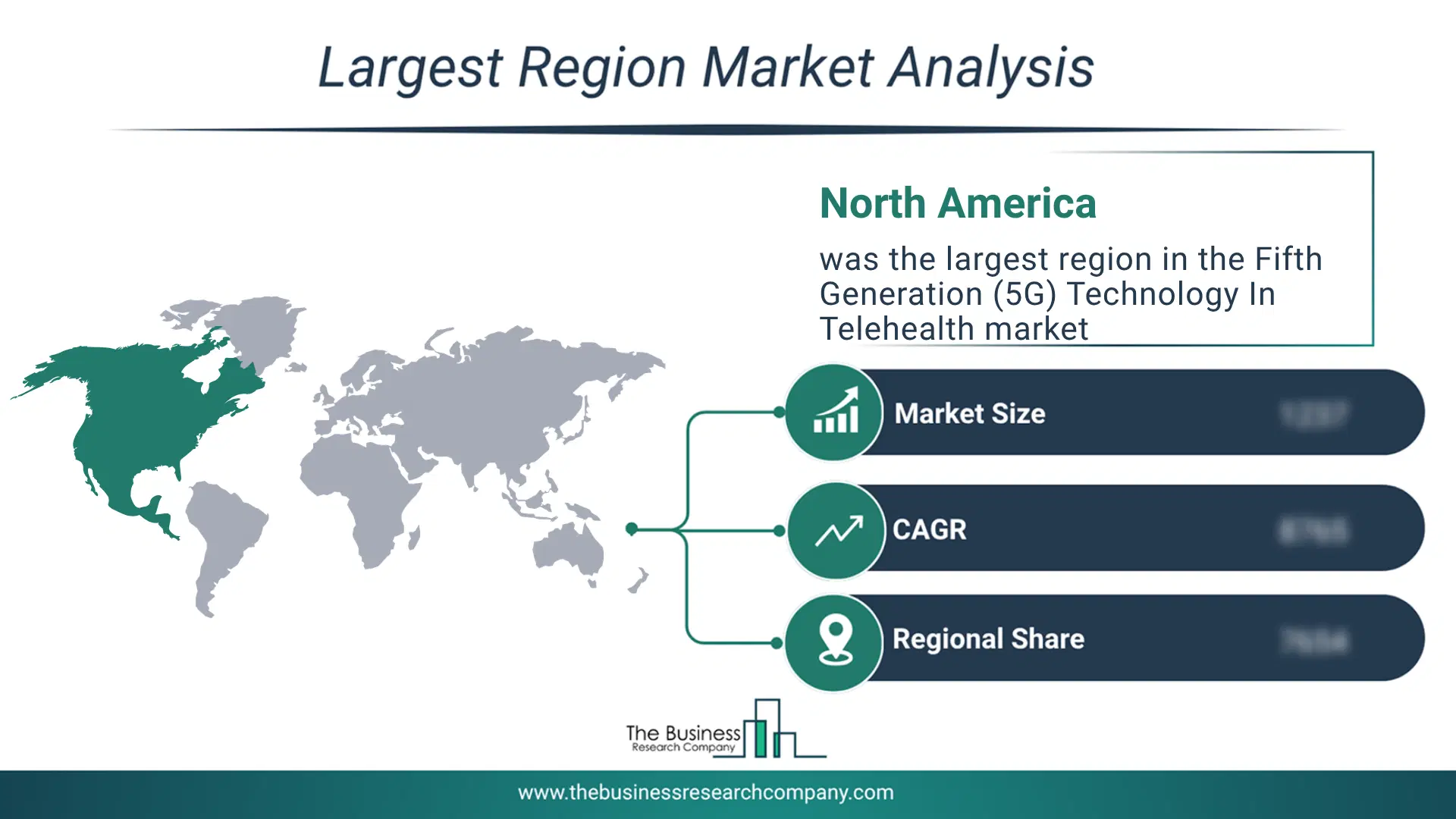
Regional Outlook
North America was the largest region in the fifth generation (5G) technology in telehealth market in 2025. Asia-Pacific is expected to be the fastest-growing region in the forecast period. The regions covered in this market report are Asia-Pacific, South East Asia, Western Europe, Eastern Europe, North America, South America, Middle East, Africa. The countries covered in this market report are Australia, Brazil, China, France, Germany, India, Indonesia, Japan, Taiwan, Russia, South Korea, UK, USA, Canada, Italy, Spain.What Defines the Fifth Generation (5G) Technology In Telehealth Market?
The fifth generation (5G) technology in telehealth market consists of revenues earned by entities by providing services such as remote diagnosis and consultation, virtual care services, mobile health monitoring, real-time video consultation, tele-intensive care unit services, remote surgery assistance, chronic disease management, and emergency response services. The market value includes the value of related goods sold by the service provider or included within the service offering. The fifth generation (5G) technology in telehealth market also includes sales of smart health monitors, portable diagnostic devices, virtual reality therapy devices, robotic surgery equipment, mobile health applications, connected ambulance solutions, digital imaging devices, and remote rehabilitation devices. Values in this market are ‘factory gate’ values, that is the value of goods sold by the manufacturers or creators of the goods, whether to other entities (including downstream manufacturers, wholesalers, distributors and retailers) or directly to end customers. The value of goods in this market includes related services sold by the creators of the goods.How is Market Value Defined and Measured?
The market value is defined as the revenues that enterprises gain from the sale of goods and/or services within the specified market and geography through sales, grants, or donations in terms of the currency (in USD unless otherwise specified). The revenues for a specified geography are consumption values that are revenues generated by organizations in the specified geography within the market, irrespective of where they are produced. It does not include revenues from resales along the supply chain, either further along the supply chain or as part of other products.
This chart presents market attractiveness based on a quantitative evaluation of growth, competition, strategic alignment, and risk, offering a clear view of opportunity areas for decision-making. This chart is for illustrative purposes; the full report contains the complete analysis.

This chart highlights the Total Addressable Market (TAM) by estimating the maximum revenue opportunity using an assumption-driven approach, supporting strategic planning and opportunity sizing across markets. The chart is illustrative; the full report provides a more comprehensive analysis.
What Key Data and Analysis Are Included in the Fifth Generation (5G) Technology In Telehealth Market Report 2026?
The fifth generation (5g) technology in telehealth market research report is one of a series of new reports from The Business Research Company that provides market statistics, including industry global market size, regional shares, competitors with the market share, detailed market segments, market trends and opportunities, and any further data you may need to thrive in the fifth generation (5g) technology in telehealth industry. The market research report delivers a complete perspective of everything you need, with an in-depth analysis of the current and future state of the industry.Fifth Generation (5G) Technology In Telehealth Market Report Forecast Analysis
| Report Attribute | Details |
|---|---|
| Market Size Value In 2026 | $3.71 billion |
| Revenue Forecast In 2030 | $8.49 billion |
| Growth Rate | CAGR of 23% from 2026 to 2030 |
| Base Year For Estimation | 2025 |
| Actual Estimates/Historical Data | 2020-2025 |
| Forecast Period | 2026 - 2030 |
| Market Representation | Revenue in USD Billion and CAGR from 2026 to 2030 |
| Segments Covered | Component, Connectivity Type, Application, End-User |
| Regional Scope | Asia-Pacific, Western Europe, Eastern Europe, North America, South America, Middle East, Africa |
| Country Scope | The countries covered in the report are Australia, Brazil, China, France, Germany, India, Indonesia, Japan, Taiwan, Russia, South Korea, UK, USA, Canada, Italy, Spain |
| Key Companies Profiled | Verizon Communications Inc., AT&T Inc., Huawei Technologies Co. Ltd., Nippon Telegraph and Telephone Corporation, T-Mobile US Inc., Cisco Systems Inc., Intel Corporation, Vodafone Group Plc, Qualcomm Technologies Inc., BT Group plc, Fujitsu Limited, Telefonaktiebolaget LM Ericsson, Nokia Corporation, Siemens Healthineers AG, GE HealthCare Technologies Inc., ZTE Corporation, M1 Limited, GlobalMed Holdings LLC, Visionable Limited, Telit Communications Limited |
| Customization Scope | Request for Customization |
| Pricing And Purchase Options | Explore Purchase Options |