
Fifth Generation Internet Of Things Software (5G IoT Software) Market Report 2026
Global Outlook – By Component (Connectivity Management Platform, Edge Computing Platform, Application Enablement Platform, Analytics Platform, Security Platform), By Network Type (Non-Standalone, Standalone), By Enterprise Size (Small And Medium-Sized Enterprises, Large Enterprises), By End-User (Manufacturing, Healthcare, Energy And Utilities, Automotive And Transportation, Supply Chain And Logistics, Government And Public Safety, Agriculture, Other End-Users) – Market Size, Trends, Strategies, and Forecast to 2030
Fifth Generation Internet Of Things Software (5G IoT Software) Market Overview
• Fifth Generation Internet Of Things Software (5G IoT Software) market size has reached to $17.98 billion in 2025 • Expected to grow to $60.13 billion in 2030 at a compound annual growth rate (CAGR) of 27.2% • Growth Driver: Rising Demand For Cloud Computing Driving Market Growth Amid Growing Need For Scalability, Low-Latency Communication, And Real-Time Data Processing • Market Trend: Radisys Unveils Industry-First 3GPP Release 18 5G Multi-RAN Software Suite to Accelerate Next-Gen IoT Deployments • North America was the largest region in 2025 and Asia-Pacific is the fastest growing region.What Is Covered Under Fifth Generation Internet Of Things Software (5G IoT Software) Market?
Fifth-generation Internet of Things software (5G IoT software) comprises platforms, applications, and frameworks that optimize and manage IoT networks through 5G connectivity. This software utilizes 5G’s high speed, minimal latency, and large-scale device support, these solutions enhance IoT operations across various industries. Their core function is to enable seamless communication, automation, and real-time data processing, ensuring efficient and intelligent IoT ecosystems. The main component types of fifth-generation Internet of Things software (5G IoT software) are connectivity management platform, edge computing platform, application enablement platform, analytics platform, and security platform. A connectivity management platform (CMP) enables businesses to efficiently manage IoT device connections, monitor data usage, and ensure seamless communication between devices. It provides different network types, such as non-standalone and standalone, for several enterprise sizes, including small and medium-sized enterprises and large enterprises, and is used by various end users, such as manufacturing, healthcare, energy and utilities, automotive and transportation, supply chain and logistics, government and public safety, agriculture, and others.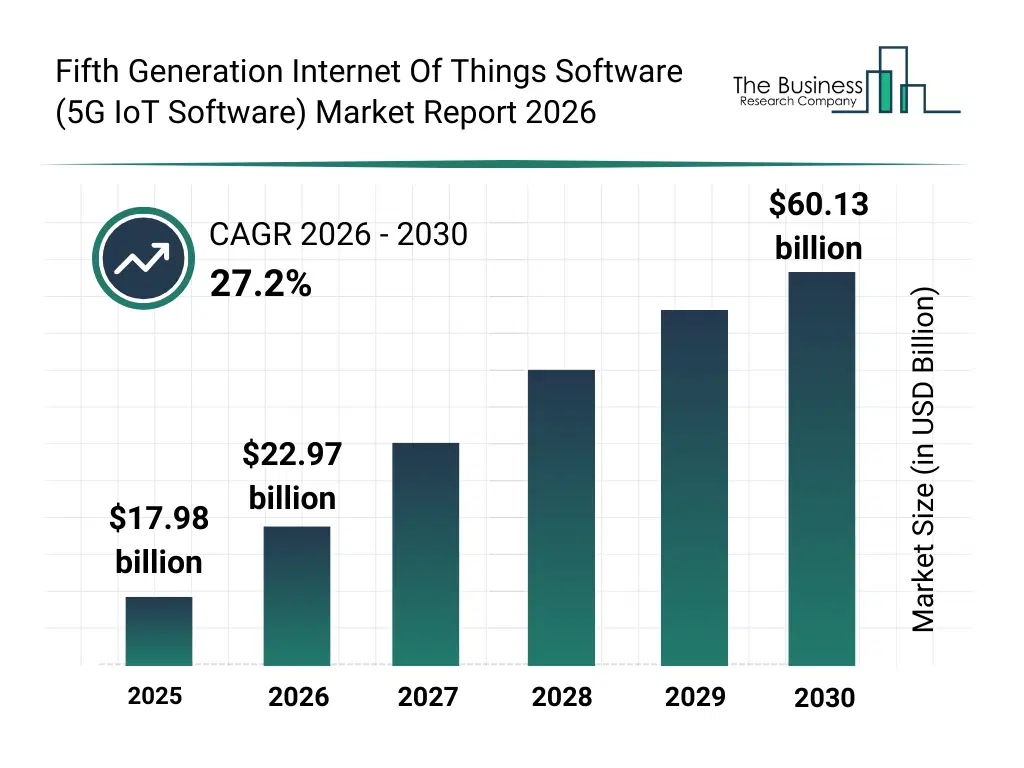
What Is The Fifth Generation Internet Of Things Software (5G IoT Software) Market Size and Share 2026?
The fifth generation internet of things software (5G iot software) market size has grown exponentially in recent years. It will grow from $17.98 billion in 2025 to $22.97 billion in 2026 at a compound annual growth rate (CAGR) of 27.7%. The growth in the historic period can be attributed to early iot platform adoption, growth of connected devices, limitations of 4g networks, expansion of cloud computing, initial smart infrastructure projects.What Is The Fifth Generation Internet Of Things Software (5G IoT Software) Market Growth Forecast?
The fifth generation internet of things software (5G iot software) market size is expected to see exponential growth in the next few years. It will grow to $60.13 billion in 2030 at a compound annual growth rate (CAGR) of 27.2%. The growth in the forecast period can be attributed to widespread 5G network availability, growth of smart factories, increasing adoption of autonomous systems, demand for real-time analytics, expansion of mission-critical iot applications. Major trends in the forecast period include 5g-enabled iot platform integration, edge computing for low-latency iot, AI-driven iot analytics, secure iot device management, industry-specific iot software platforms.
Global Fifth Generation Internet Of Things Software (5G IoT Software) Market Segmentation
1) By Component: Connectivity Management Platform, Edge Computing Platform, Application Enablement Platform, Analytics Platform, Security Platform 2) By Network Type: Non-Standalone, Standalone 3) By Enterprise Size: Small And Medium-Sized Enterprises, Large Enterprises 4) By End-User: Manufacturing, Healthcare, Energy And Utilities, Automotive And Transportation, Supply Chain And Logistics, Government And Public Safety, Agriculture, Other End-Users Subsegments: 1) By Connectivity Management Platform: 5G Network Management Software, SIM And eSIM Management Solutions, IoT Device Connectivity Monitoring, Remote Network Provisioning and Optimization, Multi-Carrier And Cross-Border Connectivity Solutions 2) By Edge Computing Platform: Real-Time Data Processing Solutions, AI-Enabled Edge Analytics, Edge Device Management Software, Edge Security And Access Control, Low-Latency Streaming And Processing Solutions 3) By Application Enablement Platform: IoT Middleware And API Management, Cloud-Based IoT Application Development, Low-Code Or No-Code IoT Solutions, Industry-Specific IoT Application Frameworks, Smart Device Integration Platforms 4) By Analytics Platform: Predictive And Prescriptive IoT Analytics, AI And Machine Learning-Based Data Insights, Real-Time IoT Data Visualization Tools, Big Data Management For IoT Networks, Event Processing And Anomaly Detection 5) By Security Platform: 5G IoT Device Authentication And Access Control, End-To-End Encryption For IoT Networks, Threat Detection And Response Solutions, Blockchain-Based IoT Security Solutions, Identity And Access Management (IAM) For IoTWhat Is The Driver Of The Fifth Generation Internet Of Things Software (5G IoT Software) Market?
The increasing demand for cloud computing is expected to propel the growth of the fifth-generation Internet of Things software (5G IoT software) market going forward. Cloud computing is the delivery of computing services, including servers, storage, databases, networking, software, and analytics. The increasing demand for cloud computing is due to scalability, cost efficiency, flexibility, enhanced security, remote accessibility, and the ability to support advanced technologies such as AI, big data analytics, and IoT. Fifth-generation Internet of Things (5G IoT) software supports cloud computing by enabling ultra-fast data transmission, low-latency communication, and seamless connectivity for massive IoT deployments, allowing real-time data processing, efficient resource management, and enhanced scalability for cloud-based applications across industries like healthcare, smart cities, industrial automation, and autonomous systems. For instance, in March 2025, according to the Office for National Statistics, a UK-based government agency, in 2023, artificial intelligence (AI) was adopted by 9% of firms, while cloud-based computing systems and applications were adopted by 69% of firms in the UK. Therefore, the increasing demand for cloud computing drives the fifth-generation Internet of Things software (5G IoT software) market.Key Players In The Global Fifth Generation Internet Of Things Software (5G IoT Software) Market
Major companies operating in the fifth generation internet of things software (5G iot software) market are Bharti Airtel Limited, Swisscom AG, Tata Communications Limited, KORE Group Holdings Inc., 6D Technologies PTE. Ltd., 1NCE GmbH, Emnify GmbH, Telit Communications Plc, Bridgera Pvt. Ltd., Cavli Inc., MAVOCO AG, Airlinq Inc., Zipit Wireless Inc., Simon IoT LLC, Velos IoT, Cobira Aps, Freeeway AG, InfiSIM Ltd., Relevant Software LLC, Droam B.V., Monogoto, Syntegra Inc.
This chart is for illustrative purposes; the full report includes a detailed competitor analysis and comprehensive overview of the top 10 companies in the market.
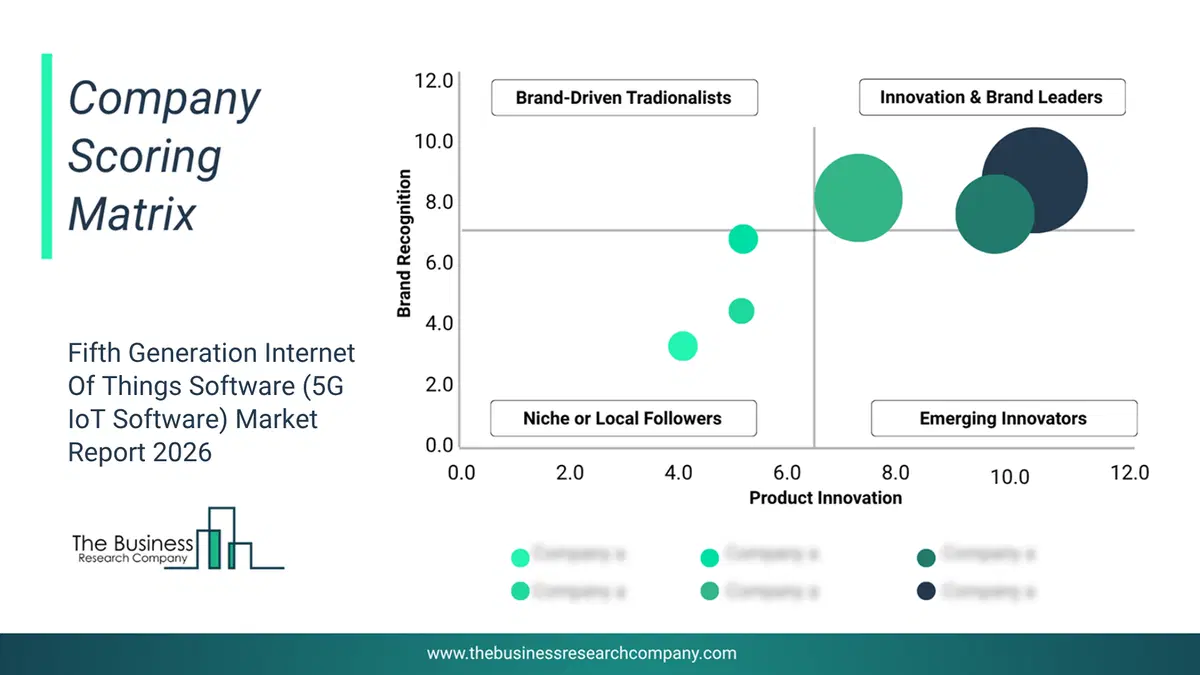
This chart maps companies by product innovation and brand strength, with bubble size indicating relative revenue, helping identify market leaders, challengers, and niche players. This is an illustrative chart; the full report provides a complete and accurate competitive analysis.
Global Fifth Generation Internet Of Things Software (5G IoT Software) Market Trends and Insights
Major companies operating in the fifth generation Internet of Things (5G IoT) software market are focusing on technological advancements, such as 3GPP Release 18 multi RAN software suites, to meet the rising demand for seamless, low latency connectivity across terrestrial, non terrestrial, and private networks for increasingly distributed IoT deployments. A 3GPP Release 18 multi RAN software suite provides a next-generation, cloud-native RAN stack that supports a variety of access technologies under a unified framework, enabling more flexible and efficient deployment compared to legacy single access architectures. For instance, in February 2025, Radisys, a U.S.-based provider of open telecom solutions, unveiled its 3GPP Release 18 5G Multi RAN software suite, which offers full backward compatibility with Release 17 and forward compatibility toward Release 19. The suite supports terrestrial and non-terrestrial networks (satellite), integrates reduced capability (RedCap) device support, and enables universal access across small cells, private networks, and NTN use cases. It allows operators and enterprises to deploy cost effective and resilient 5G IoT solutions for use cases like remote sensing, asset tracking, and mission-critical communications by leveraging a cloud-native architecture and scalable orchestration.What Are Latest Mergers And Acquisitions In The Fifth Generation Internet Of Things Software (5G IoT Software) Market?
In October 2024, OptConnect, a US-based wireless IoT connectivity company, acquired Capestone for an undisclosed amount. The acquisition aims to expand OptConnect’s international reach, enhance its IoT connectivity solutions, and strengthen its managed wireless connectivity platform. Capestone is a Netherlands-based provider of managed connectivity solutions and related hardware for IoT applications.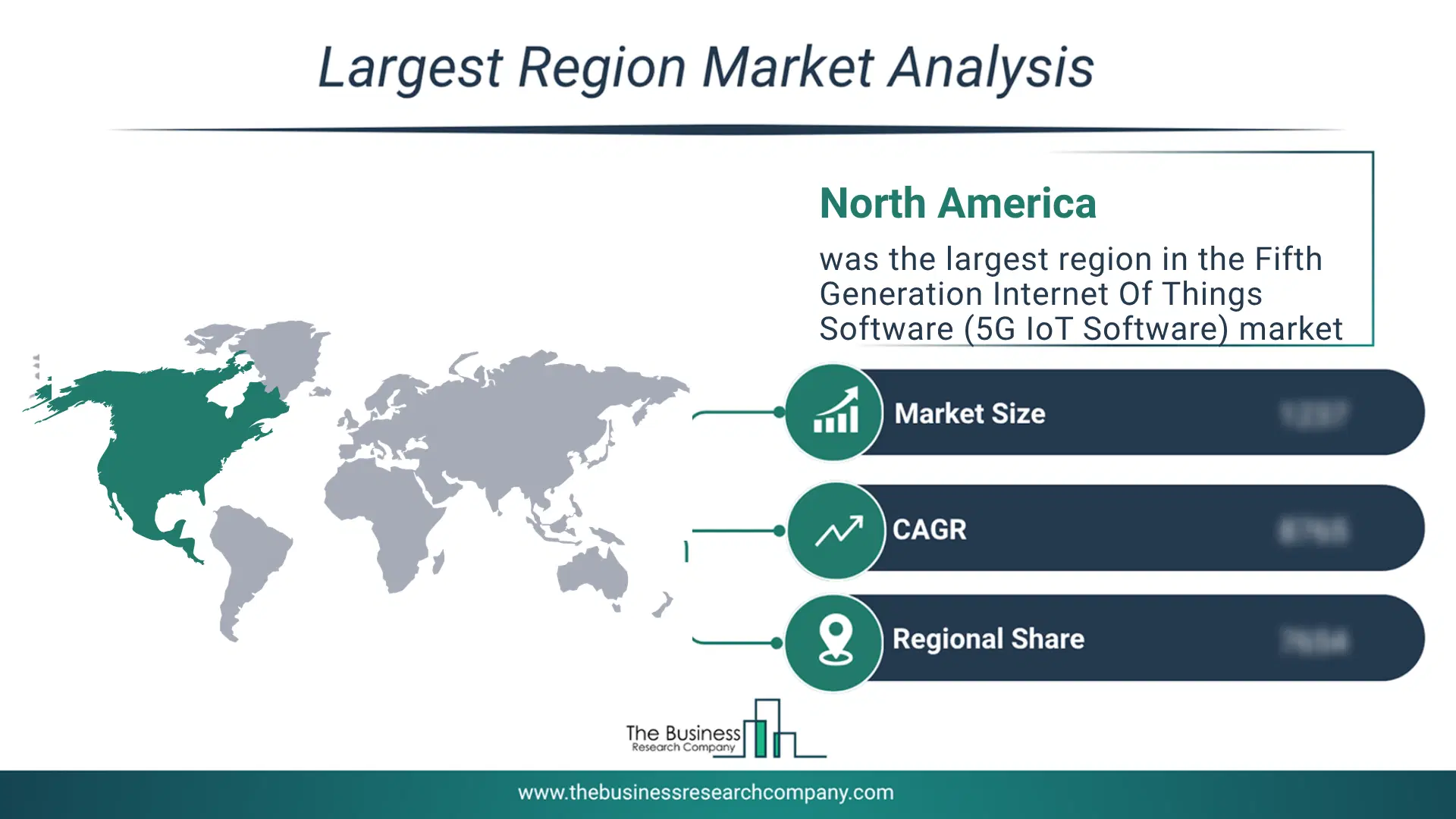
Regional Insights
North America was the largest region in the fifth-generation Internet of Things software (5G IoT software) market in 2025. Asia-Pacific is expected to be the fastest-growing region in the forecast period. The regions covered in this market report are Asia-Pacific, South East Asia, Western Europe, Eastern Europe, North America, South America, Middle East, Africa. The countries covered in this market report are Australia, Brazil, China, France, Germany, India, Indonesia, Japan, Taiwan, Russia, South Korea, UK, USA, Canada, Italy, Spain.What Defines the Fifth Generation Internet Of Things Software (5G IoT Software) Market?
The fifth-generation Internet of Things software (5G IoT software)market consists of revenues earned by entities providing services such as security-as-a-service (SAAS), and IoT device management services. The market value includes the value of related goods sold by the service provider or included within the service offering. The 5G IoT software market also includes sales of application development frameworks, security and threat management systems, AI-powered predictive analytics tools. Values in this market are ‘factory gate’ values, that is the value of goods sold by the manufacturers or creators of the goods, whether to other entities (including downstream manufacturers, wholesalers, distributors and retailers) or directly to end customers. The value of goods in this market includes related services sold by the creators of the goods.How is Market Value Defined and Measured?
The market value is defined as the revenues that enterprises gain from the sale of goods and/or services within the specified market and geography through sales, grants, or donations in terms of the currency (in USD unless otherwise specified). The revenues for a specified geography are consumption values that are revenues generated by organizations in the specified geography within the market, irrespective of where they are produced. It does not include revenues from resales along the supply chain, either further along the supply chain or as part of other products.
This chart presents market attractiveness based on a quantitative evaluation of growth, competition, strategic alignment, and risk, offering a clear view of opportunity areas for decision-making. This chart is for illustrative purposes; the full report contains the complete analysis.

This chart highlights the Total Addressable Market (TAM) by estimating the maximum revenue opportunity using an assumption-driven approach, supporting strategic planning and opportunity sizing across markets. The chart is illustrative; the full report provides a more comprehensive analysis.
What Key Data and Analysis Are Included in the Fifth Generation Internet Of Things Software (5G IoT Software) Market Report 2026?
The fifth generation internet of things software (5g iot software) market research report is one of a series of new reports from The Business Research Company that provides market statistics, including industry global market size, regional shares, competitors with the market share, detailed market segments, market trends and opportunities, and any further data you may need to thrive in the fifth generation internet of things software (5g iot software) industry. The market research report delivers a complete perspective of everything you need, with an in-depth analysis of the current and future state of the industry.Fifth Generation Internet Of Things Software (5G IoT Software) Market Report Forecast Analysis
| Report Attribute | Details |
|---|---|
| Market Size Value In 2026 | $22.97 billion |
| Revenue Forecast In 2030 | $60.13 billion |
| Growth Rate | CAGR of 27.2% from 2026 to 2030 |
| Base Year For Estimation | 2025 |
| Actual Estimates/Historical Data | 2020-2025 |
| Forecast Period | 2026 - 2030 |
| Market Representation | Revenue in USD Billion and CAGR from 2026 to 2030 |
| Segments Covered | Component, Network Type, Enterprise Size, End-User |
| Regional Scope | Asia-Pacific, Western Europe, Eastern Europe, North America, South America, Middle East, Africa |
| Country Scope | The Countries Covered In This Market Report Are Australia, Brazil, China, France, Germany, India, Indonesia, Japan, Taiwan, Russia, South Korea, Uk, Usa, Canada, Italy, Spain. |
| Key Companies Profiled | Bharti Airtel Limited, Swisscom AG, Tata Communications Limited, KORE Group Holdings Inc., 6D Technologies PTE. Ltd., 1NCE GmbH, Emnify GmbH, Telit Communications Plc, Bridgera Pvt. Ltd., Cavli Inc., MAVOCO AG, Airlinq Inc., Zipit Wireless Inc., Simon IoT LLC, Velos IoT, Cobira Aps, Freeeway AG, InfiSIM Ltd., Relevant Software LLC, Droam B.V., Monogoto, Syntegra Inc. |
| Customization Scope | Request for Customization |
| Pricing And Purchase Options | Explore Purchase Options |