
First-Life EV Battery Market Report 2026
Global Outlook – By Battery Type (Lithium-Ion, Nickel-Metal Hydride, Solid-State, Other Battery Types), By Cell Format (Cylindrical Cells, Prismatic Cells, Pouch Cells), By Vehicle Type (Passenger Cars, Commercial Vehicles, Two-Wheelers, Other Vehicle Types), By Battery Capacity (Less Than 30 Kilowatt-hours, 30–60 Kilowatt-hours, 60–100 Kilowatt-hours, Above 100 Kilowatt-hours), By Application (Original Equipment Manufacturer (OEMs), Aftermarket, Energy Storage Systems, Other Applications) – Market Size, Trends, Strategies, and Forecast to 2030
First-Life EV Battery Market Overview
• First-Life EV Battery market size has reached to $82.7 billion in 2025 • Expected to grow to $196.22 billion in 2030 at a compound annual growth rate (CAGR) of 19% • Growth Driver: The Rising Demand For Longer-Range Electric Vehicles Is Driving The First-Life EV Battery Market Due To Increasing Need For High-Capacity, Efficient Batte • Market Trend: Innovative Sodium-Ion Battery Boosts EV Range And Safety • North America was the largest region in 2025 and Asia-Pacific is the fastest growing region.Market Gains By 2030 – Top Opportunities By Segment
Market Gain identifies the most promising market opportunities by highlighting the segments or products expected to generate the highest incremental revenue growth over the next five years.
What Is Covered Under First-Life EV Battery Market?
A first-life electric vehicle (EV) battery refers to a battery that is used for its initial intended purpose, powering an electric vehicle. Its primary purpose is to store and deliver energy efficiently to drive the EV, supporting performance, range, and reliability. It is designed to withstand numerous charge-discharge cycles while maintaining safety and capacity during its operational life in the vehicle. The main battery types of the first-life electric vehicle (EV) battery are lithium-ion, nickel-metal hydride, solid-state, and others. A lithium-ion battery refers to a rechargeable battery that uses lithium ions as the primary charge carrier, offering high energy density and long cycle life. It is available in various cell formats, including cylindrical cells, prismatic cells, and pouch cells. It is used across multiple vehicle types, such as passenger cars, commercial vehicles, two-wheelers, and other vehicle types, with battery capacities categorized into less than 30 kilowatt-hours, 30–60 kilowatt-hours, 60–100 kilowatt-hours, and above 100 kilowatt-hours. It finds application in original equipment manufacturers (OEMs), aftermarket, energy storage systems, and others.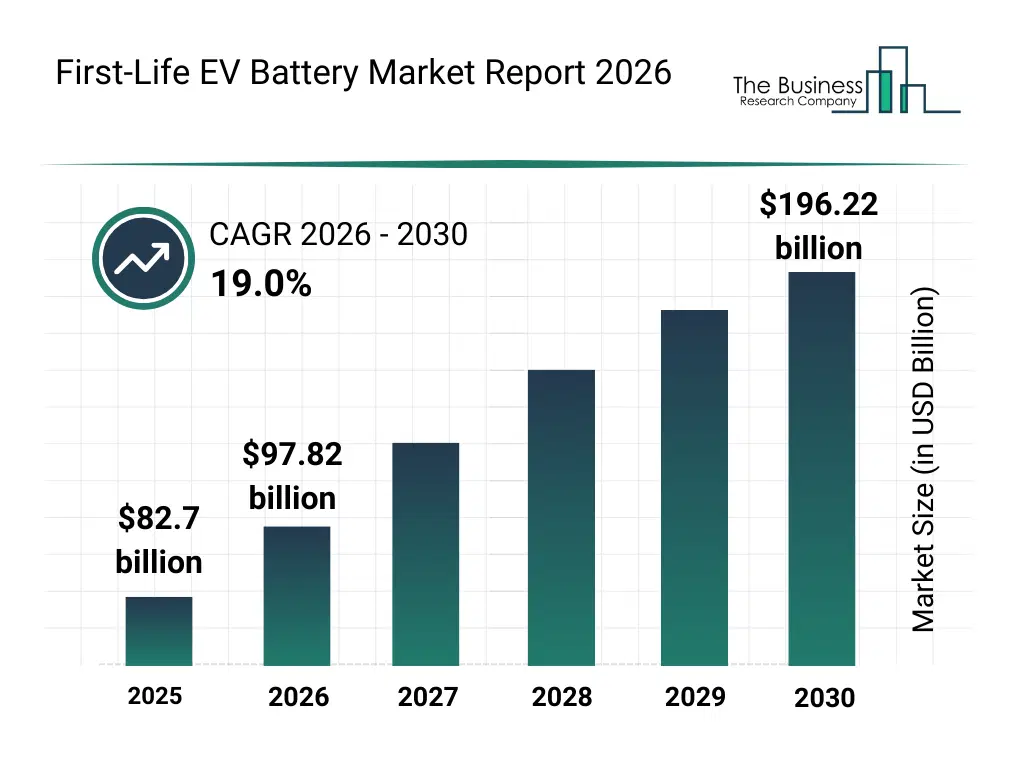
What Is The First-Life EV Battery Market Size and Share 2026?
The first-life ev battery market size has grown rapidly in recent years. It will grow from $82.7 billion in 2025 to $97.82 billion in 2026 at a compound annual growth rate (CAGR) of 18.3%. The growth in the historic period can be attributed to expansion of global electric vehicle production, improvements in lithium-ion battery performance, increasing investments in battery gigafactories, rising consumer demand for longer driving range, availability of diversified battery chemistries.What Is The First-Life EV Battery Market Growth Forecast?
The first-life ev battery market size is expected to see rapid growth in the next few years. It will grow to $196.22 billion in 2030 at a compound annual growth rate (CAGR) of 19.0%. The growth in the forecast period can be attributed to increasing adoption of solid-state batteries, rising focus on cost reduction per kilowatt-hour, expansion of electric commercial vehicle fleets, growing investments in domestic battery supply chains, increasing emphasis on battery sustainability and recyclability. Major trends in the forecast period include increasing adoption of high-energy-density battery chemistries, rising use of advanced battery management systems, growing demand for long-cycle-life ev batteries, expansion of localized battery manufacturing facilities, enhanced focus on battery safety and thermal stability.
Global First-Life EV Battery Market Segmentation
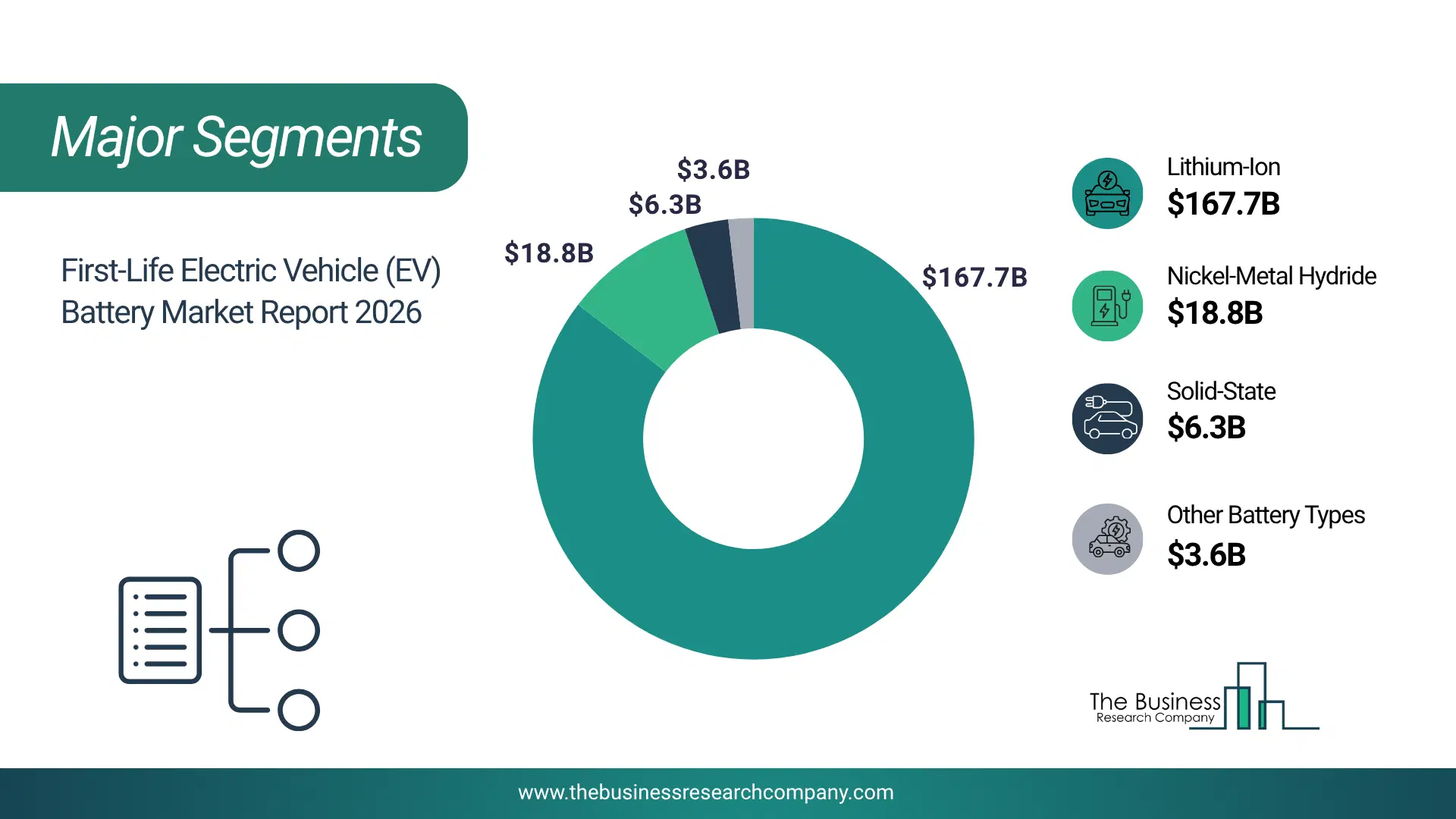
1) By Battery Type: Lithium-Ion, Nickel-Metal Hydride, Solid-State, Other Battery Types 2) By Cell Format: Cylindrical Cells, Prismatic Cells, Pouch Cells 3) By Vehicle Type: Passenger Cars, Commercial Vehicles, Two-Wheelers, Other Vehicle Types 4) By Battery Capacity: Less Than 30 Kilowatt-hours, 30–60 Kilowatt-hours, 60–100 Kilowatt-hours, Above 100 Kilowatt-hours 5) By Application: Original Equipment Manufacturer (OEMs), Aftermarket, Energy Storage Systems, Other Applications Subsegments: 1) By Lithium-Ion: Lithium-Iron Phosphate (LFP), Nickel Cobalt Manganese (NCM), Nickel Cobalt Aluminum (NCA), Lithium Titanate (LTO) 2) By Nickel-Metal Hydride: Nickel Metal Hydride Cylindrical, Nickel Metal Hydride Prismatic, Nickel Metal Hydride Pocket Cell 3) By Solid-State: Lithium Solid-State, Sodium Solid-State, Polymer Solid-State 4) By Other Battery Types: Zinc-Air, Hybrid Batteries The top segments in the first-life electric vehicle (ev) battery market will be: • Lithium-Ion will reach $167.67 billion by 2030. • Nickel-Metal Hydride will reach $18.76 billion by 2030. • Solid-State will reach $6.23 billion by 2030. • Other Battery Types will reach $3.56 billion by 2030.What Is The Driver Of The First-Life EV Battery Market?
The rising demand for longer-range electric vehicles is expected to drive the growth of the first-life EV battery market going forward. A longer-range electric vehicle (EV) is an electric vehicle designed to offer a significantly greater driving range than standard EVs, often exceeding 400 miles per charge, achieved through advanced battery technology, aerodynamics, and energy efficiency. Rising demand for longer-range electric vehicles is surging due to consumers’ preference for extended driving distances without frequent charging. The first-life EV battery support increases in demand as the rapid expansion of longer-range EVs pushes manufacturers to adopt higher-capacity and more efficient battery technologies. For instance, in July 2025, according to Virta Global, a Finland-based technology company specializing in an EV energy digital platform, government efforts to reduce heavy-duty truck emissions include the EU targeting 45% cuts by 2030 and 90% by 2040, with over 800 electric truck models available globally, and in 2024, Volvo and Scania launching long-range electric trucks exceeding 600 km per charge. Therefore, the rising demand for longer-range electric vehicles is driving the demand for the first-life EV battery industry.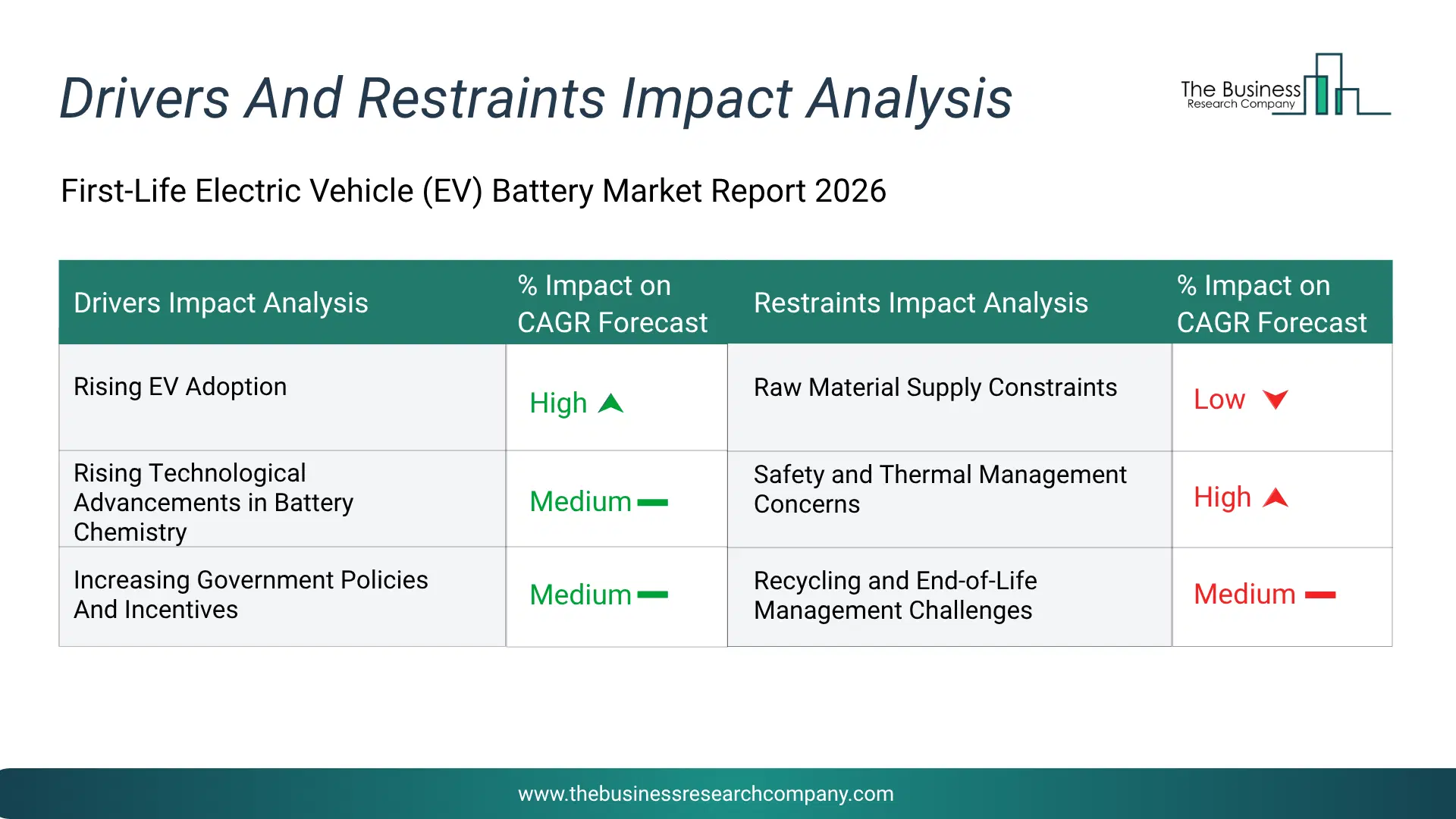
Infographic Chart Showing Key Market Drivers Analysis And Restraints For First-Life Ev Battery Market
The chart presents an impact analysis of key drivers and restraints, quantifying their relative influence on the market's growth rate and helping assess the balance between growth enablers and limiting factors. This chart offers a high-level perspective; the full report contains more detailed insights.
How Will The Drivers Impact Growth In The Global First-Life Electric Vehicle (EV) Battery Market?
• Rising EV Adoption (High) – During the forecast period, the rising ev adoption is expected to become a key growth driver for the first-life electric vehicle (ev) battery market by 2030. The rising adoption of electric vehicles is significantly increasing the demand for first-life ev batteries, as they function as the primary energy source for these vehicles. A growing preference for sustainable transportation and global efforts to lower carbon emissions have accelerated ev sales, leading to higher battery demand. Automotive manufacturers are making substantial investments in advanced battery technologies to support expanding production volumes. This rapid growth in ev adoption is creating strong opportunities for battery producers to scale up manufacturing capacity and enhance technological innovation. • Rising Technological Advancements in Battery Chemistry (Medium) – During the forecast period, the rising technological advancements in battery chemistry are expected to emerge as a major factor driving the expansion of the first-life electric vehicle (ev) battery market by 2030. Advancements in battery chemistry are a major growth driver for first-life ev batteries, as they enhance energy density and enable electric vehicles to achieve longer driving ranges per charge. Improved chemical compositions also support faster charging times, increasing convenience and attractiveness for consumers. These technological developments contribute to cost reductions by improving efficiency and optimizing the use of materials. Additionally, greater durability and enhanced safety performance resulting from advanced chemistries strengthen consumer trust and accelerate market adoption. • Increasing Government Policies And Incentives (Medium) – During the forecast period, the increasing government policies and incentives is expected to act as a key growth catalyst for the first-life electric vehicle (ev) battery market by 2030. Supportive government policies and incentives are a significant driver of growth in the first-life ev battery market, as they encourage wider adoption of electric vehicles. Financial incentives such as subsidies, tax credits, and reduced registration charges lower the total cost of ev ownership, thereby increasing battery demand. Emission reduction mandates and stricter environmental regulations compel automakers to accelerate large-scale ev production, further expanding battery requirements. In addition, government funding, grants, and investment support for battery manufacturing strengthen innovation capabilities and boost production capacity.How Will The Restraints Impact Growth In The Global First-Life Electric Vehicle (EV) Battery Market?
• Raw Material Supply Constraints (Low) – During the forecast period, the raw material supply constraints act as a major restraint for first-life ev batteries by limiting the availability of essential materials like lithium, cobalt, and nickel. Shortages or price volatility in these materials increase production costs and can delay battery manufacturing. Dependence on a few global suppliers also exposes the supply chain to geopolitical and logistical risks. Such constraints can hinder scaling up ev production to meet growing demand. Consequently, the growth of the first-life ev battery market is directly affected by these raw material limitations. • Safety and Thermal Management Concerns (High) – During the forecast period, the safety and thermal management concerns act as significant restraints for first-life ev batteries by limiting their performance and adoption. Improper heat dissipation can lead to battery overheating, reducing lifespan and increasing the risk of fire or failure. Manufacturers must invest heavily in advanced cooling and safety systems, raising production costs. These technical challenges slow down large-scale deployment of evs and batteries. Consequently, safety and thermal management issues remain a critical barrier to market growth. • Recycling and End-of-Life Management Challenges (Medium) – During the forecast period, the recycling and end-of-life management challenges act as a restraint for the first-life ev battery market because inefficient recycling infrastructure and limited recovery technologies reduce the economic value of used batteries. The lack of standardized recycling processes makes it difficult to recover critical materials like lithium, cobalt, and nickel at scale. This increases environmental compliance pressure and raises disposal costs for manufacturers. Additionally, uncertainty around second-life applications and regulatory frameworks further complicates lifecycle planning. As a result, these challenges restrict cost efficiency and sustainable scaling of the ev battery ecosystem.Key Players In The Global First-Life EV Battery Market
Major companies operating in the first-life ev battery market are Contemporary Amperex Technology Co., Limited (CATL), BYD Co. Ltd., LG Energy Solution, Panasonic Holdings Corporation, SK Inc., Samsung SDI Co.,Ltd., China Aviation Lithium Battery (CALB), Gotion Inc., EVE Energy Co.,Ltd., Sunwoda Electronic Co.,Ltd., Farasis Energy, Tesla Inc., Verkor, A123 Systems Corp., Toshiba Corporation, Romeo Power, Exide Industries Ltd., AESC (Automotive Energy Supply Corporation), Solid Power Inc., Beijing WeLion New Energy Technology Co.,Ltd., Invenox, Amprius Technologies Inc., Hitachi High-Tech Corporation, Envites Energy, Northvolt AB, OptimumNano Energy Co.,Ltd., QuantumScape Corporation.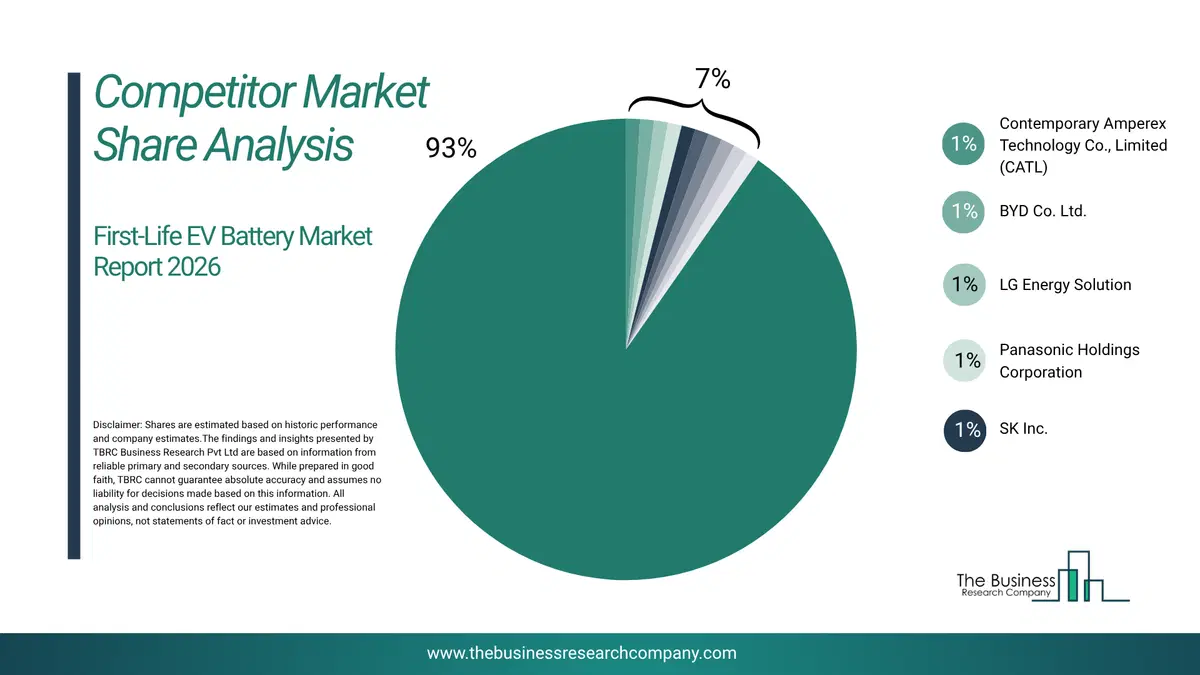
This chart is for illustrative purposes; the full report includes a detailed competitor analysis and comprehensive overview of the top 10 companies in the market.
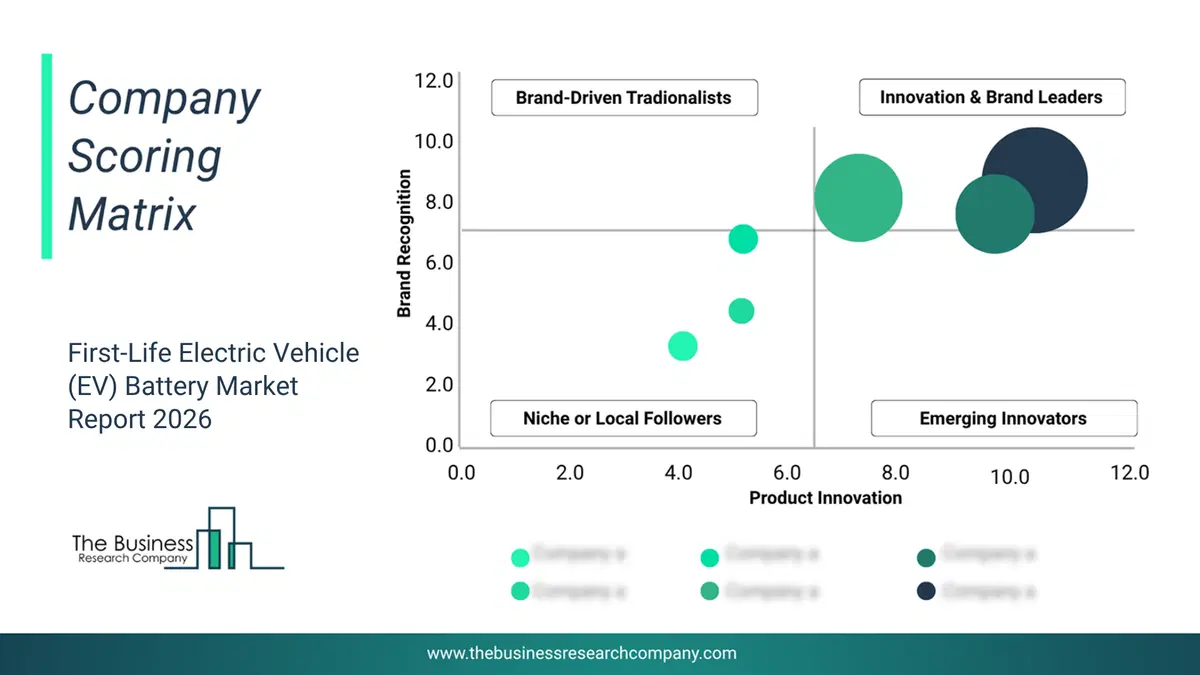
This chart maps companies by product innovation and brand strength, with bubble size indicating relative revenue, helping identify market leaders, challengers, and niche players. This is an illustrative chart; the full report provides a complete and accurate competitive analysis.
Global First-Life EV Battery Market Trends and Insights
Major companies operating in the first-life electric vehicle (EV) battery market are focusing on developing innovative products, such as sodium-ion batteries, to enhance energy density, safety, and cost-efficiency compared to traditional lithium-ion alternatives. Sodium-ion batteries are rechargeable batteries that use sodium ions to store and release energy, offering a lower-cost and more abundant alternative to lithium-ion batteries. For instance, in September 2025, Contemporary Amperex Technology Co. Limited, a China-based battery manufacturing company, launched Naxtra, a sodium-ion EV battery. This innovative battery offers an energy density of 175 Wh/kg, enabling a pure electric driving range exceeding 500 km. Naxtra also boasts remarkable durability with over 10,000 charge-discharge cycles, industry-leading 5C fast-charging capability, consistent performance in extreme temperatures from -40°C to +70°C, and a safer chemical composition that minimizes fire and explosion risks.What Are Latest Mergers And Acquisitions In The First-Life EV Battery Market?
In March 2024, Toyota Motor Corporation, a Japan-based automotive manufacturing company, acquired Primearth EV Energy Co. Ltd. from Panasonic Holdings Corporation for an undisclosed amount. With this acquisition Toyota Motor Corporation aims to strengthen its battery mass production capabilities and flexibly respond to the growing demand for diverse electric vehicle batteries to enhance competitiveness and support its multi-pathway electrification and carbon neutrality strategy. Primearth EV Energy Co. Ltd. is a Japan-based manufacturing company that offers first-life EV batteries.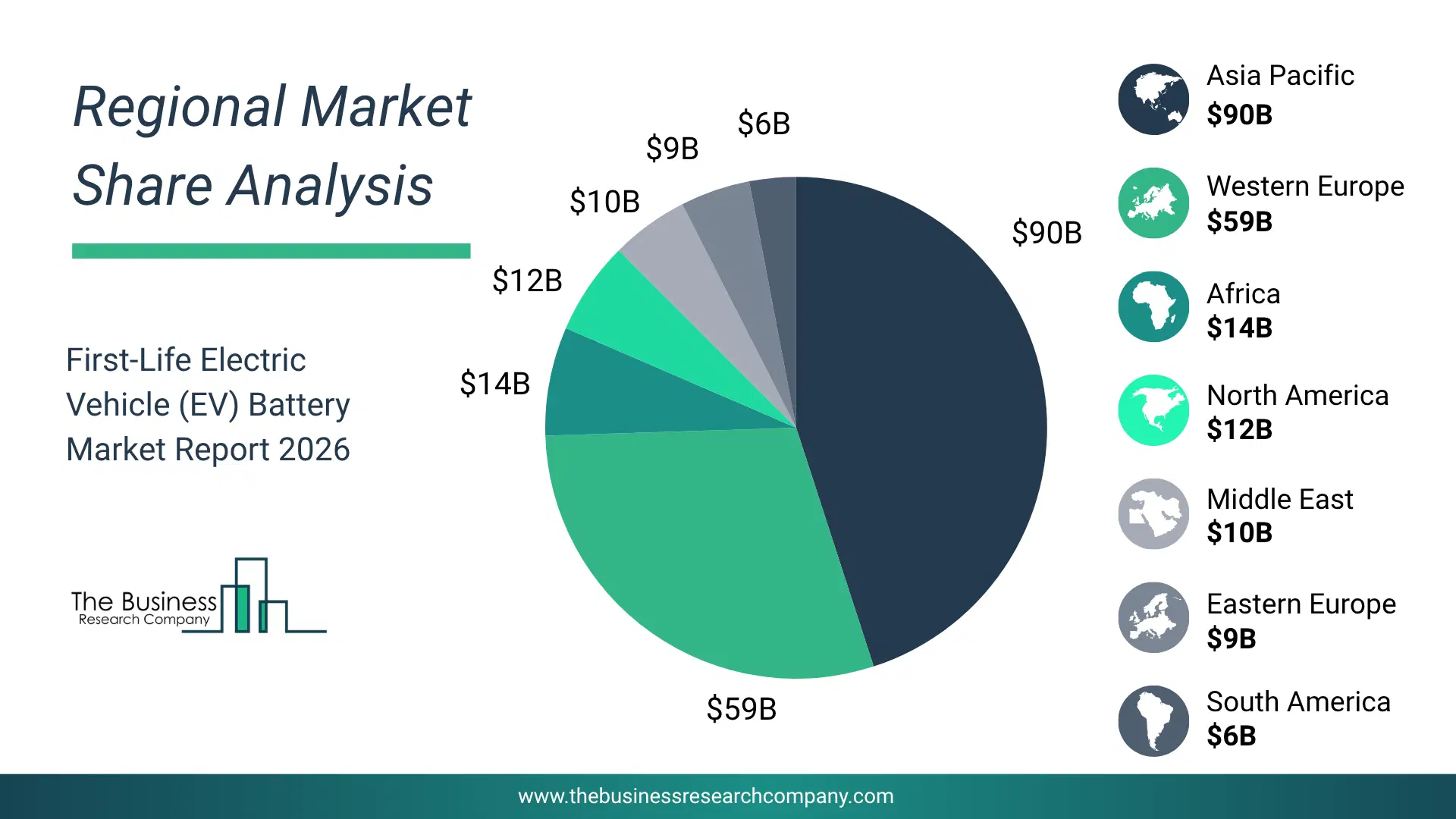
Regional Outlook
North America was the largest region in the first-life electric vehicle (EV) battery market in 2025. Asia-Pacific is expected to be the fastest-growing region in the forecast period. The regions covered in this market report are Asia-Pacific, South East Asia, Western Europe, Eastern Europe, North America, South America, Middle East, Africa. The countries covered in this market report are Australia, Brazil, China, France, Germany, India, Indonesia, Japan, Taiwan, Russia, South Korea, UK, USA, Canada, Italy, SpainWhat Defines the First-Life EV Battery Market?
The first-life electric vehicle (EV) battery market consists of sales of battery management systems, battery modules, battery packs, high-voltage wiring harnesses, and charging interface components. Values in this market are ‘factory gate’ values, that is, the value of goods sold by the manufacturers or creators of the goods, whether to other entities (including downstream manufacturers, wholesalers, distributors, and retailers) or directly to end customers. The value of goods in this market includes related services sold by the creators of the goods.How is Market Value Defined and Measured?
The market value is defined as the revenues that enterprises gain from the sale of goods and/or services within the specified market and geography through sales, grants, or donations in terms of the currency (in USD unless otherwise specified). The revenues for a specified geography are consumption values that are revenues generated by organizations in the specified geography within the market, irrespective of where they are produced. It does not include revenues from resales along the supply chain, either further along the supply chain or as part of other products.
This chart presents market attractiveness based on a quantitative evaluation of growth, competition, strategic alignment, and risk, offering a clear view of opportunity areas for decision-making. This chart is for illustrative purposes; the full report contains the complete analysis.

This chart highlights the Total Addressable Market (TAM) by estimating the maximum revenue opportunity using an assumption-driven approach, supporting strategic planning and opportunity sizing across markets. The chart is illustrative; the full report provides a more comprehensive analysis.
What Key Data and Analysis Are Included in the First-Life EV Battery Market Report 2026?
The first-life ev battery market research report is one of a series of new reports from The Business Research Company that provides market statistics, including Market Report 2026?global market size, regional shares, competitors with the market share, detailed market segments, market trends and opportunities, and any further data you may need to thrive in the first-life ev battery Market Report 2026? The market research report delivers a complete perspective of everything you need, with an in-depth analysis of the current and future state of the Market Report 2026?First-Life EV Battery Market Report Forecast Analysis
| Report Attribute | Details |
|---|---|
| Market Size Value In 2026 | $97.82 billion |
| Revenue Forecast In 2030 | $196.22 billion |
| Growth Rate | CAGR of 19% from 2026 to 2030 |
| Base Year For Estimation | 2025 |
| Actual Estimates/Historical Data | 2020-2025 |
| Forecast Period | 2026 - 2030 |
| Market Representation | Revenue in USD Billion and CAGR from 2026 to 2030 |
| Segments Covered | Battery Type, Cell Format, Vehicle Type, Battery Capacity, Application |
| Regional Scope | Asia-Pacific, Western Europe, Eastern Europe, North America, South America, Middle East, Africa |
| Country Scope | The countries covered in the report are Australia, Brazil, China, France, Germany, India, ... |
| Key Companies Profiled | Contemporary Amperex Technology Co., Limited (CATL), BYD Co. Ltd., LG Energy Solution, Panasonic Holdings Corporation, SK Inc., Samsung SDI Co.,Ltd., China Aviation Lithium Battery (CALB), Gotion Inc., EVE Energy Co.,Ltd., Sunwoda Electronic Co.,Ltd., Farasis Energy, Tesla Inc., Verkor, A123 Systems Corp., Toshiba Corporation, Romeo Power, Exide Industries Ltd., AESC (Automotive Energy Supply Corporation), Solid Power Inc., Beijing WeLion New Energy Technology Co.,Ltd., Invenox, Amprius Technologies Inc., Hitachi High-Tech Corporation, Envites Energy, Northvolt AB, OptimumNano Energy Co.,Ltd., QuantumScape Corporation. |
| Customization Scope | Request for Customization |
| Pricing And Purchase Options | Explore Purchase Options |