
Food And Grocery Retail Market Report 2026
Global Outlook – By Product (Fresh Food, Frozen Food, Food Cupboard, Beverages, Cleaning And Household), By Category (Packed, Unpacked), By Distribution channel (Supermarkets And Hypermarkets, Convenience Stores, Departmental Stores And Clubs) – Market Size, Trends, Strategies, and Forecast to 2030
Food And Grocery Retail Market Overview
• Food And Grocery Retail market size has reached to $12679.54 billion in 2025 • Expected to grow to $14973.69 billion in 2030 at a compound annual growth rate (CAGR) of 3.4% • Growth Driver: E-Commerce Surge Fuels Growth In The Food And Grocery Retail Market • Market Trend: Technological Rise Of 30-Minute Delivery Services To Meet Consumer Demand • North America was the largest region in 2025 and Asia-Pacific is the fastest growing region.Market Gains By 2030 – Top Opportunities By Segment
Market Gain identifies the most promising market opportunities by highlighting the segments or products expected to generate the highest incremental revenue growth over the next five years.
What Is Covered Under Food And Grocery Retail Market?
Food and grocery retail refers to the sector of the retail industry that focuses on the sale of food products and household essentials directly to consumers. In the food and grocery retail industry, the focus is on providing consumers with convenient access to a diverse array of products while ensuring the availability of daily necessities. The main products of the food and grocery retail are fresh food, frozen food, food cupboard, beverages, and cleaning and household. Fresh food refers to food items that have not undergone significant processing, preserving, or freezing and are in their natural, unaltered state, it includes categories such as packed, and unpacked, and it is distributed through supermarkets and hypermarkets, convenience stores, and departmental stores and clubs.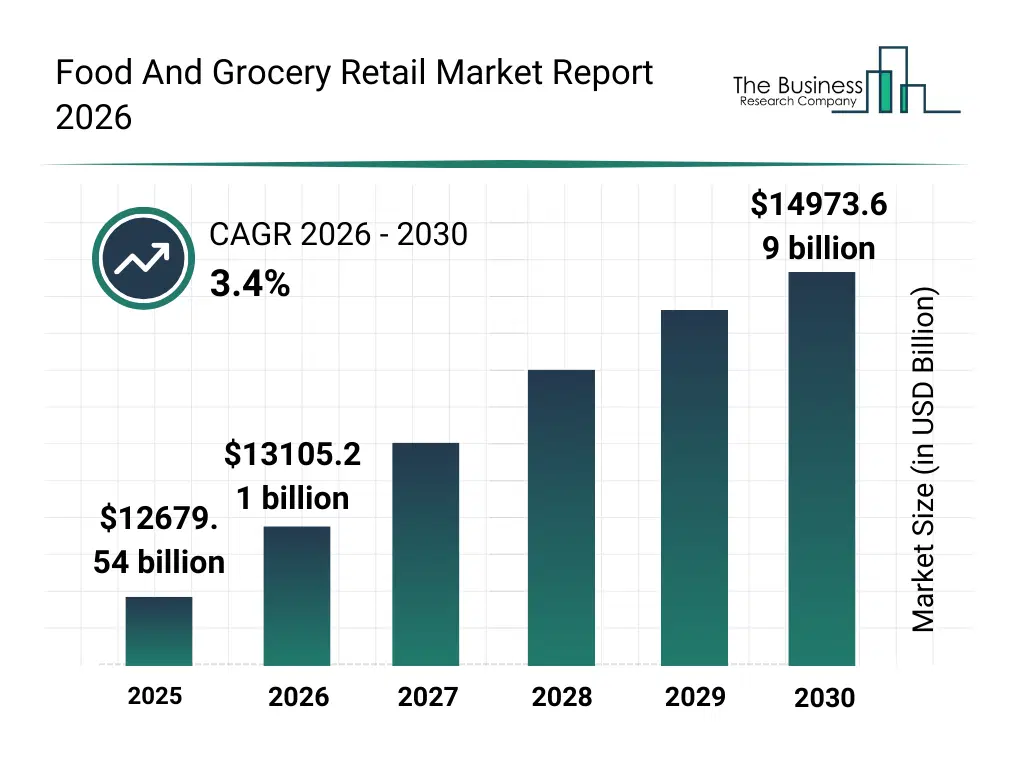
What Is The Food And Grocery Retail Market Size and Share 2026?
The food and grocery retail market size has grown steadily in recent years. It will grow from $12679.54 billion in 2025 to $13105.21 billion in 2026 at a compound annual growth rate (CAGR) of 3.4%. The growth in the historic period can be attributed to expansion of urban population centers, rising disposable income levels, growth of organized retail formats, increasing consumer preference for convenience shopping, expansion of supermarket and hypermarket chains.What Is The Food And Grocery Retail Market Growth Forecast?
The food and grocery retail market size is expected to see steady growth in the next few years. It will grow to $14973.69 billion in 2030 at a compound annual growth rate (CAGR) of 3.4%. The growth in the forecast period can be attributed to increasing penetration of online grocery platforms, rising investments in smart retail infrastructure, growing demand for sustainable food products, expansion of AI-driven demand forecasting, increasing focus on personalized shopping experiences. Major trends in the forecast period include increasing adoption of omnichannel retail models, rising demand for private label food products, expansion of quick commerce and last-mile delivery, growing focus on sustainable packaging and sourcing, enhanced use of data-driven inventory management.
Global Food And Grocery Retail Market Segmentation
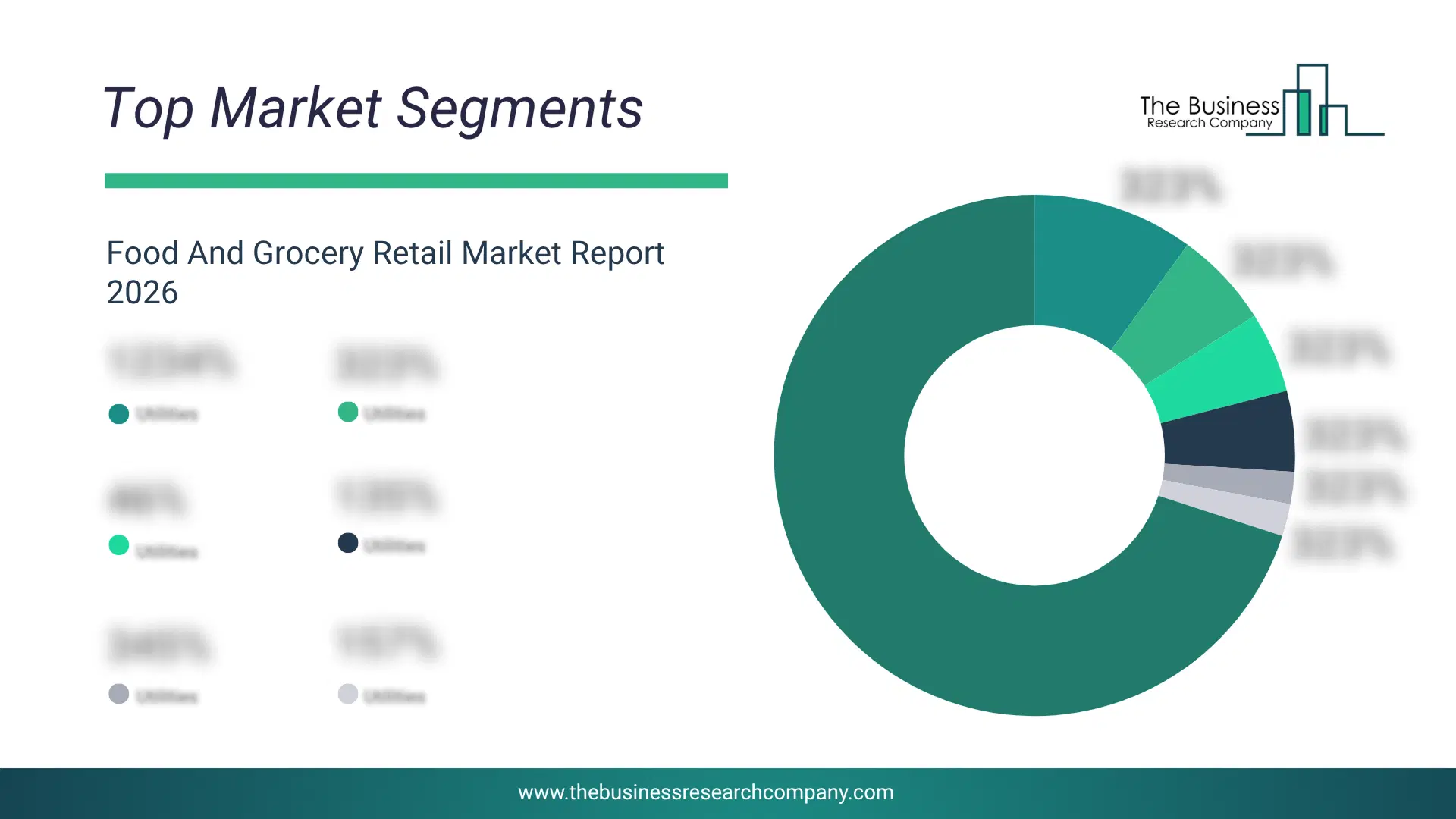
1) By Product: Fresh Food, Frozen Food, Food Cupboard, Beverages, Cleaning And Household 2) By Category: Packed, Unpacked 3) By Distribution channel: Supermarkets And Hypermarkets, Convenience Stores, Departmental Stores And Clubs Subsegments: 1) By Fresh Food: Fruits And Vegetables, Meat And Poultry, Dairy Products, Bakery Items 2) By Frozen Food: Frozen Meals, Frozen Fruits And Vegetables, Ice Cream And Desserts, Frozen Snacks 3) By Food Cupboard: Canned Goods, Dry Goods, Snacks And Confectionery, Spices And Condiments 4) By Beverages: Soft Drinks, Alcoholic Beverages, Juices, Water And Sports Drinks 5) By Cleaning And Household: Laundry Detergents, Kitchen Cleaners, Paper Products, Personal Care Products The top segments in the food and grocery retail market will be: • Fresh Food will reach $5586.91 Billion by 2030. • Food Cupboard will reach $3696.52 Billion by 2030. • Beverages will reach $2264.51 Billion by 2030. • Cleaning And Household will reach $1869.36 Billion by 2030. • Frozen Food will reach $1484.22 Billion by 2030.What Is The Driver Of The Food And Grocery Retail Market?
The increasing e-commerce sector is expected to propel the growth of the food and grocery retail market going forward. E-commerce in food and grocery retail refers to the buying and selling of food and grocery products online. It involves a transaction between two parties, usually a business and a consumer, where the payment and delivery of products are conducted online. E-commerce is used by businesses to reach a wider audience and expand their customer base, leading to increased revenue and growth in the food and grocery retail business. For instance, in November 2023, according to Census.gov, US-based e-commerce sales for the third quarter of 2023 totaled $271.7 billion, an increase of 0.9 percent (±0.4%) from the second quarter of 2023. Therefore, the rise in the e-commerce sector is driving the growth of the food and grocery retail industry.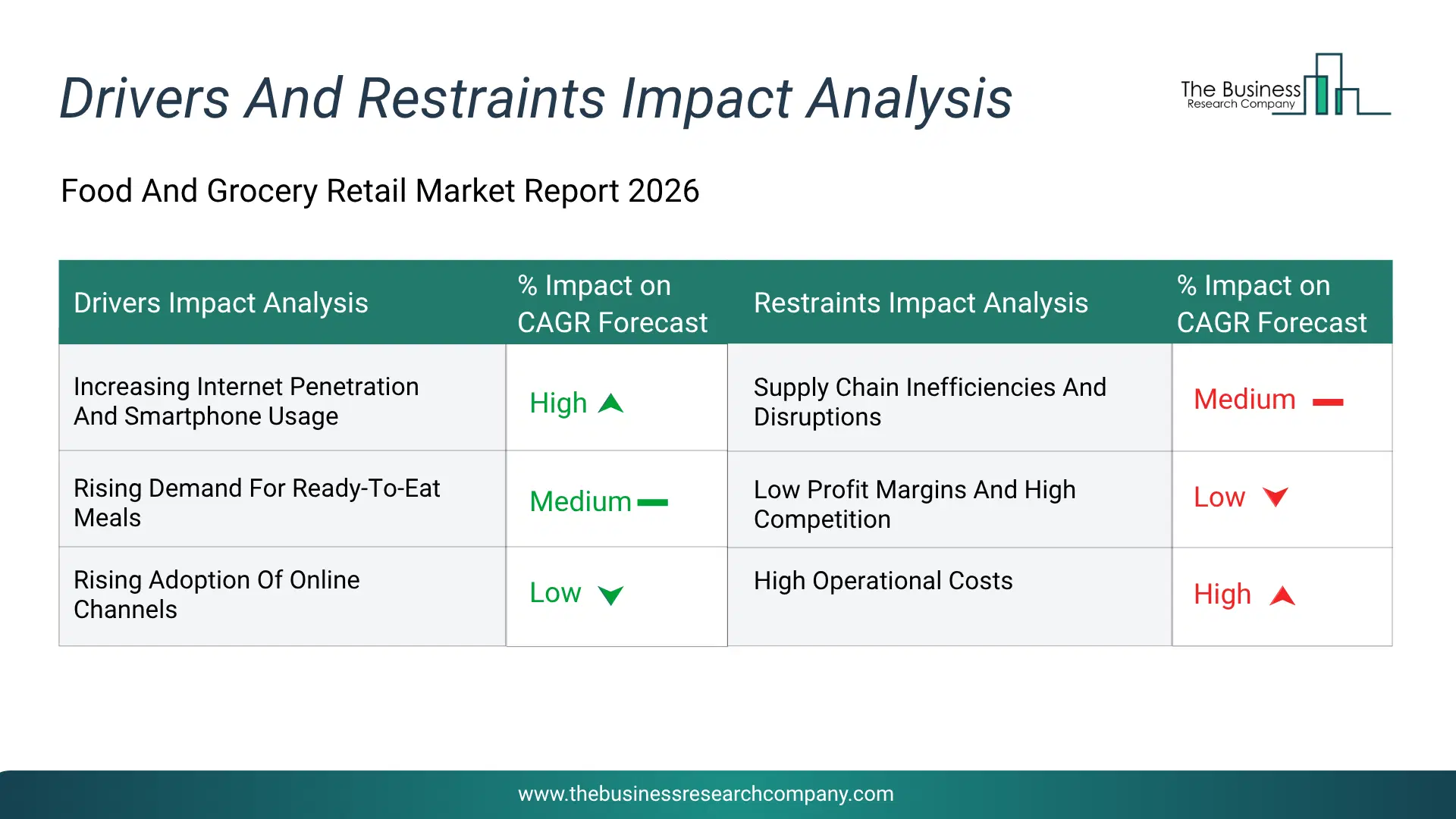
Infographic Chart Showing Key Market Drivers Analysis And Restraints For Food And Grocery Retail Market
The chart presents an impact analysis of key drivers and restraints, quantifying their relative influence on the market's growth rate and helping assess the balance between growth enablers and limiting factors. This chart offers a high-level perspective; the full report contains more detailed insights.
How Will The Drivers Impact Growth In The Global Food And Grocery Retail Market?
• Increasing Internet Penetration And Smartphone Usage (High) – During the forecast period, the increasing internet penetration and smartphone usage is expected to become a key growth driver for the food and grocery retail market by 2030. The widespread availability of affordable smartphones and high-speed internet connectivity is enabling consumers to access digital retail platforms more easily, particularly in emerging economies. This shift is facilitating seamless browsing, product comparison, and digital transactions, enhancing overall shopping convenience. Retailers are leveraging mobile applications, personalized promotions, and digital loyalty programs to attract and retain customers. The growing digital ecosystem is also enabling real-time inventory visibility and efficient last-mile delivery coordination. • Rising Demand For Ready-To-Eat Meals (Medium) – During the forecast period, the rising demand for ready-to-eat meals is expected to emerge as a major factor driving the expansion of the food and grocery retail market by 2030. Changing lifestyles, increasing urban workforce participation, and time-constrained consumers are accelerating the preference for convenient meal solutions that require minimal preparation. Retailers are expanding their offerings of pre-cooked, packaged, and instant food options to cater to evolving consumption patterns. Additionally, innovation in packaging technologies is improving shelf life and product quality, further supporting demand. The increasing availability of diverse cuisine options and health-oriented ready meals is also attracting a broader consumer base. • Rising Adoption Of Online Channels (Low) – During the forecast period, the rising adoption of online channels is expected to act as a key growth catalyst for the food and grocery retail market by 2030. Consumers are increasingly shifting toward online grocery platforms due to the convenience of home delivery, flexible ordering schedules, and access to a wide range of products. Retailers are investing in omnichannel strategies, integrating physical stores with digital platforms to enhance customer experience. Advancements in logistics, including dark stores and automated fulfillment centers, are improving delivery efficiency and reducing turnaround times. Subscription models and bulk purchasing options are further strengthening online retail adoption.How Will The Restraints Impact Growth In The Global Food And Grocery Retail Market?
• Supply Chain Inefficiencies And Disruptions (High) – During the forecast period, supply chain inefficiencies and disruptions act as a major restraint for the food and grocery retail market by affecting the timely availability of products. Delays in transportation, poor inventory management, and lack of coordination across supply networks can lead to stock shortages or overstocking. These inefficiencies increase wastage, especially for perishable goods, directly impacting profitability. Retailers also face challenges in maintaining consistent product quality and freshness. Additionally, external factors such as natural disasters or geopolitical issues can further disrupt supply chains. This unpredictability reduces consumer trust and satisfaction. Overall, it hampers operational efficiency and limits market growth. • Low Profit Margins And High Competition (Medium) – During the forecast period, low profit margins and high competition significantly restrain the growth of the food and grocery retail market by putting pressure on retailers’ profitability. The presence of numerous players, including local stores, supermarkets, and online platforms, intensifies price competition. Retailers often reduce prices or offer heavy discounts to attract and retain customers, which erodes their margins. Rising input costs further worsen the situation, making it difficult to sustain profitability. Smaller retailers especially struggle to compete with large-scale players offering competitive pricing. Continuous competition also limits opportunities for differentiation. As a result, it restricts long-term growth and investment potential. • High Operational Costs (Low) – During the forecast period, high operational costs act as a key restraint for the food and grocery retail market by increasing the financial burden on retailers. Expenses related to logistics, warehousing, labor, energy, and technology infrastructure continue to rise. Maintaining cold storage and efficient delivery systems adds further costs, particularly for perishable items. Retailers must also invest in digital platforms and supply chain optimization to stay competitive. These rising expenses reduce overall profit margins and limit scalability. Small and medium-sized retailers are particularly affected due to limited financial resources. Consequently, high operational costs hinder expansion and overall market development.Key Players In The Global Food And Grocery Retail Market
Major companies operating in the food and grocery retail market are Wal-Mart Stores Inc., Costco Wholesale Corporation, The Kroger Co., Target Brands Inc., 7-ELEVEN Inc., Carrefour S.A., REWE Group, Lidl Stiftung & Co. KG, Tesco PLC, Edeka Zentrale AG & Co. KG, Aeon Co. Ltd., Publix Super Markets Inc., Woolworths Group, J Sainsbury plc, Les Mousquetaires, Auchan Retail, Aldi Einkauf GmbH & Co. oHG, Mercadona S.A., ASDA Stores Limited, Coles Group Limited, Système U, Wm Morrison Supermarkets Limited, HEB Grocery Company LP, Meijer Inc., Wakefern Food Corporation, Kaufland Stiftung & Co. KG, Fred Meyer Stores Inc., Spar International, Safeway Inc., Leclerc SA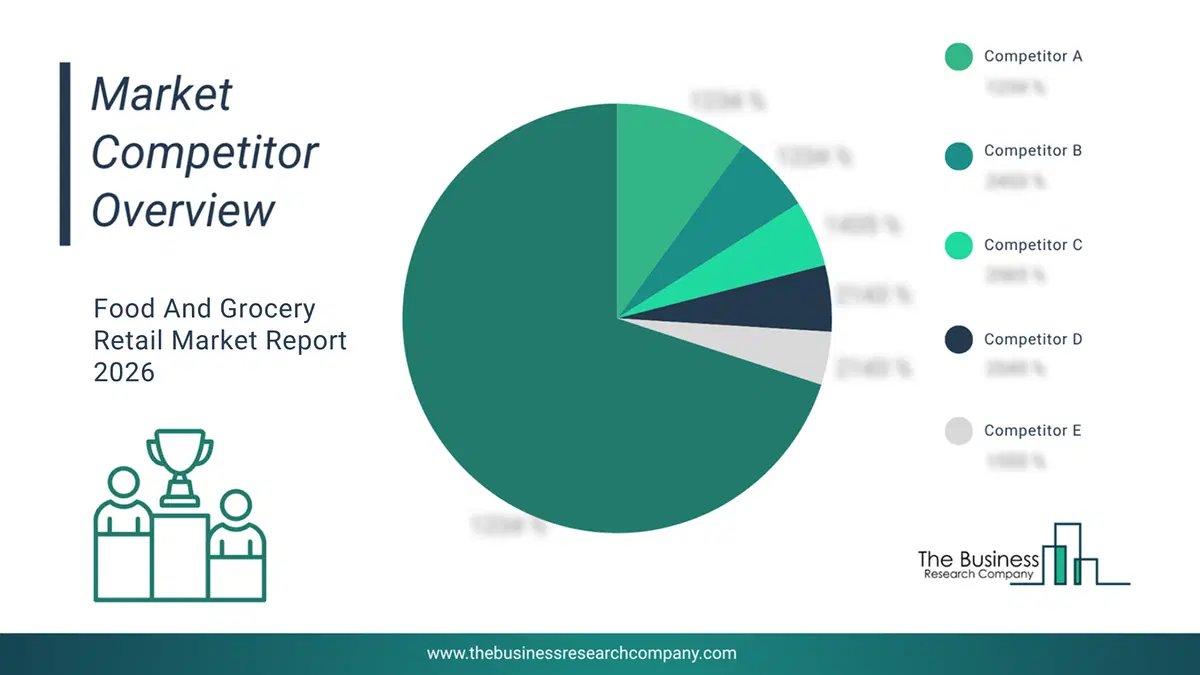
This chart is for illustrative purposes; the full report includes a detailed competitor analysis and comprehensive overview of the top 10 companies in the market.
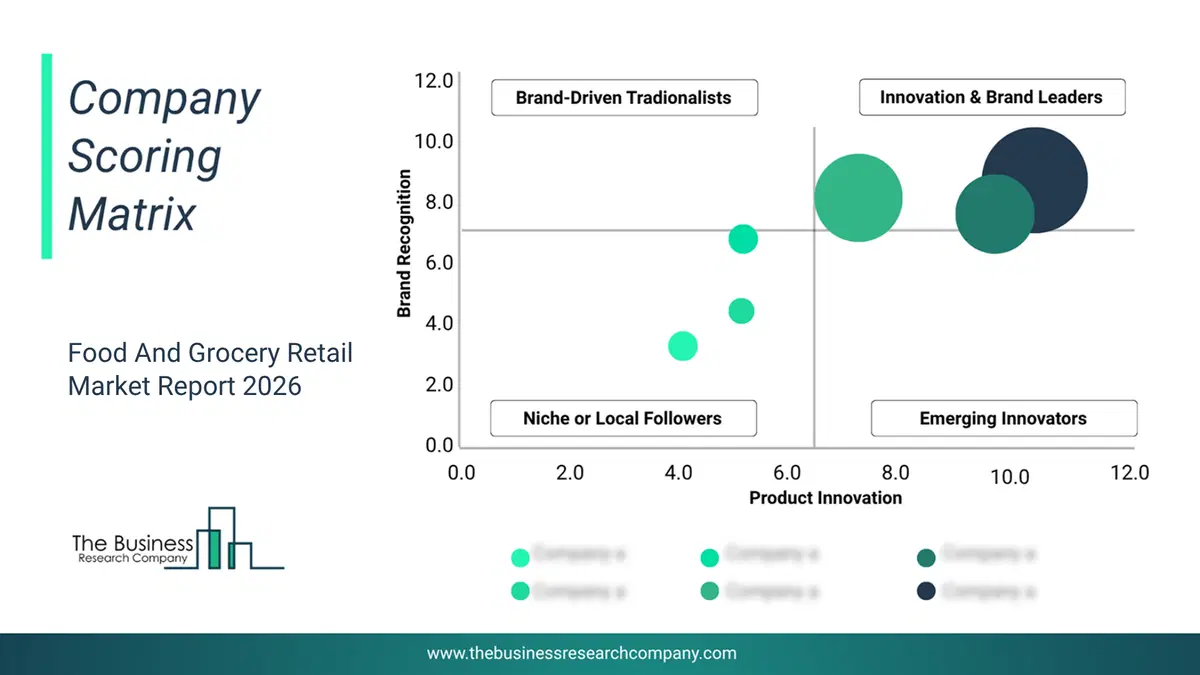
This chart maps companies by product innovation and brand strength, with bubble size indicating relative revenue, helping identify market leaders, challengers, and niche players. This is an illustrative chart; the full report provides a complete and accurate competitive analysis.
Global Food And Grocery Retail Market Trends and Insights
Major companies operating in the food and grocery retail market are developing innovative technologies, such as 30-minute delivery service, to enable ultra-fast or on-demand delivery options in the retail industry and to meet the needs of customers who seek fast and convenient shopping experiences. The 30-minute delivery service is a technology-driven offering that enables customers to receive their grocery and convenience items within a 30-minute time frame. For instance, in December 2023, Instacart of Maplebear Inc., a US-based retail company, launched a 30-minute delivery service called 'Fairway Now,' powered by Instacart. This service allows customers to receive store-to-door delivery of groceries and essentials in as fast as 30 minutes. It is designed to provide last-minute shopping convenience, enabling customers to access a wide range of items quickly.What Are Latest Mergers And Acquisitions In The Food And Grocery Retail Market?
In August 2023, Aldi Einkauf GmbH & Co. oHG, a Germany-based supermarket company, acquired Winn-Dixie Stores Inc. and Harveys Supermarket for an undisclosed amount. With this acquisition, Aldi is expanding its presence and accelerating its growth in the southeastern region of the United States. The acquisition provides Aldi with speed-to-market, quality retail locations, and a solid core business, allowing the company to better serve the Southeastern region and help more people save on their grocery bills. Winn-Dixie is a US-based supermarket chain, and Harveys Supermarket is a US-based grocery chain, both engaged in providing quality food and grocery retail products and services to their customers.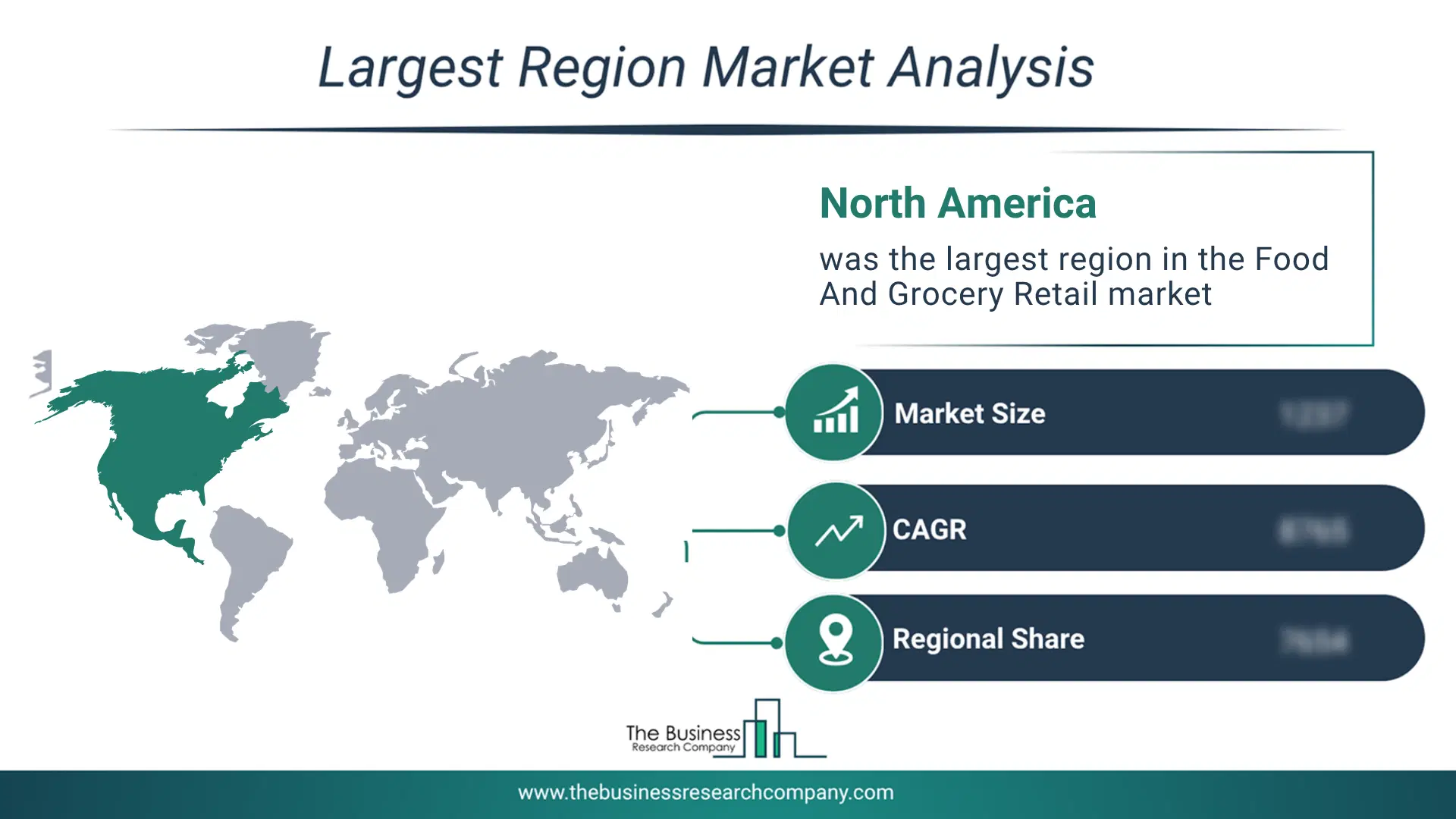
Regional Outlook
North America was the largest region in the food and grocery retail market in 2025. Asia-Pacific is expected to be the fastest-growing region in the forecast period. The regions covered in this market report are Asia-Pacific, South East Asia, Western Europe, Eastern Europe, North America, South America, Middle East and Africa. The countries covered in this market report are Australia, Brazil, China, France, Germany, India, Indonesia, Japan, Taiwan, Russia, South Korea, UK, USA, Italy, Spain, CanadaWhat Defines the Food And Grocery Retail Market?
The food and grocery retail market includes revenues earned by entities by subscription services, online shopping and delivery, in-store services, specialty services, digital coupons and discounts, health and wellness programs, sustainability initiatives. The market value includes the value of related goods sold by the service provider or included within the service offering. Only goods and services traded between entities or sold to end consumers are included.How is Market Value Defined and Measured?
The market value is defined as the revenues that enterprises gain from the sale of goods and/or services within the specified market and geography through sales, grants, or donations in terms of the currency (in USD unless otherwise specified). The revenues for a specified geography are consumption values that are revenues generated by organizations in the specified geography within the market, irrespective of where they are produced. It does not include revenues from resales along the supply chain, either further along the supply chain or as part of other products.
This chart presents market attractiveness based on a quantitative evaluation of growth, competition, strategic alignment, and risk, offering a clear view of opportunity areas for decision-making. This chart is for illustrative purposes; the full report contains the complete analysis.

This chart highlights the Total Addressable Market (TAM) by estimating the maximum revenue opportunity using an assumption-driven approach, supporting strategic planning and opportunity sizing across markets. The chart is illustrative; the full report provides a more comprehensive analysis.
What Key Data and Analysis Are Included in the Food And Grocery Retail Market Report 2026?
The food and grocery retail market research report is one of a series of new reports from The Business Research Company that provides market statistics, including industry global market size, regional shares, competitors with the market share, detailed market segments, market trends and opportunities, and any further data you may need to thrive in the food and grocery retail industry. The market research report delivers a complete perspective of everything you need, with an in-depth analysis of the current and future state of the industry.Food And Grocery Retail Market Report Forecast Analysis
| Report Attribute | Details |
|---|---|
| Market Size Value In 2026 | $13105.21 billion |
| Revenue Forecast In 2030 | $14973.69 billion |
| Growth Rate | CAGR of 3.4% from 2026 to 2030 |
| Base Year For Estimation | 2025 |
| Actual Estimates/Historical Data | 2020-2025 |
| Forecast Period | 2026 - 2030 |
| Market Representation | Revenue in USD Billion and CAGR from 2026 to 2030 |
| Segments Covered | Product, Category, Distribution channel |
| Regional Scope | Asia-Pacific, Western Europe, Eastern Europe, North America, South America, Middle East, Africa |
| Country Scope | The countries covered in the report are Australia, Brazil, China, France, Germany, India, Indonesia, Japan, Taiwan, Russia, South Korea, UK, USA, Canada, Italy, Spain. |
| Key Companies Profiled | Wal-Mart Stores Inc., Costco Wholesale Corporation, The Kroger Co., Target Brands Inc., 7-ELEVEN Inc., Carrefour S.A., REWE Group, Lidl Stiftung & Co. KG, Tesco PLC, Edeka Zentrale AG & Co. KG, Aeon Co. Ltd., Publix Super Markets Inc., Woolworths Group, J Sainsbury plc, Les Mousquetaires, Auchan Retail, Aldi Einkauf GmbH & Co. oHG, Mercadona S.A., ASDA Stores Limited, Coles Group Limited, Système U, Wm Morrison Supermarkets Limited, HEB Grocery Company LP, Meijer Inc., Wakefern Food Corporation, Kaufland Stiftung & Co. KG, Fred Meyer Stores Inc., Spar International, Safeway Inc., Leclerc SA |
| Customization Scope | Request for Customization |
| Pricing And Purchase Options | Explore Purchase Options |