
Free Space Optic Communication Market Report 2026
Global Outlook – By Component (Transmitter, Transceiver, Receiver, Other Components), By Platform (Space, Airborne, Ground), By Range (Short Range, Medium Range, Long Range), By Application (Mobile Backhaul, Disaster Recovery, Data Transmission, Airborne Application, Last-Mile Access, Security And Surveillance, Other Applications), By End Use (Healthcare, Defense, Telecommunications, Other End Uses) – Market Size, Trends, Strategies, and Forecast to 2030
Free Space Optic Communication Market Overview
• Free Space Optic Communication market size has reached to $1.14 billion in 2025 • Expected to grow to $4.66 billion in 2030 at a compound annual growth rate (CAGR) of 31.2% • Growth Driver: Rising Interest In Space Exploration Fueling The Growth Of The Market Due To Increasing Demand For High-Speed Deep-Space Data Transmission • Market Trend: Leading Companies Innovating In Mercury-Free Space Optics (FSO) Solutions • North America was the largest region in 2025 and Asia-Pacific is the fastest growing region.What Is Covered Under Free Space Optic Communication Market?
Free space optic communication refers to transmitting modulated visible or infrared (IR) beams through the atmosphere to obtain broadband communications. This communication provides a cost-effective and flexible solution for establishing wireless communication links where traditional wired infrastructure is impractical or cost-prohibitive, offering a reliable alternative for high-speed data transmission. The main types of components of free space optic communication are the transmitter, transceiver, receiver, and others. A transmitter is an electronic device used in telecommunications that generates radio waves from an antenna to send and receive data over a distance. The various types of platforms such as space, airborne, and ground, and different ranges including short range, medium range, and long range. These are used in various applications such as mobile backhaul, disaster recovery, data transmission, airborne application, last-mile access, security and surveillance, and others, and also by several end-use industries including healthcare, defense, telecommunications, and others.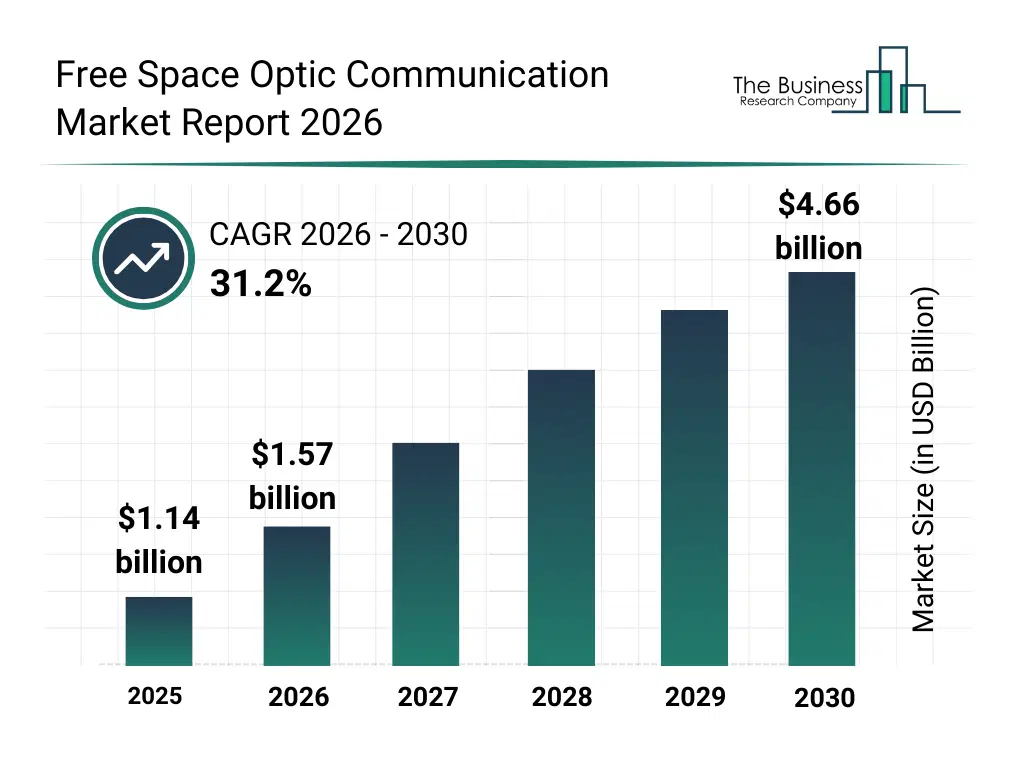
What Is The Free Space Optic Communication Market Size and Share 2026?
The free space optic communication market size has grown exponentially in recent years. It will grow from $1.14 billion in 2025 to $1.57 billion in 2026 at a compound annual growth rate (CAGR) of 37.5%. The growth in the historic period can be attributed to expansion of broadband network requirements, limitations of fiber deployment in urban areas, growth of temporary communication networks, adoption of optical wireless technologies, rising demand for secure data links.What Is The Free Space Optic Communication Market Growth Forecast?
The free space optic communication market size is expected to see exponential growth in the next few years. It will grow to $4.66 billion in 2030 at a compound annual growth rate (CAGR) of 31.2%. The growth in the forecast period can be attributed to increasing investments in smart city connectivity, rising demand for high-capacity wireless infrastructure, expansion of defense and aerospace communication needs, growing use of fso in 5G backhaul, advancements in optical transmission technologies. Major trends in the forecast period include increasing deployment of high-speed wireless backhaul links, rising use of fso in disaster recovery networks, growing adoption for last-mile connectivity, expansion of secure line-of-sight communication systems, enhanced focus on low-latency data transmission.
Global Free Space Optic Communication Market Segmentation
1) By Component: Transmitter, Transceiver, Receiver, Other Components 2) By Platform: Space, Airborne, Ground 3) By Range: Short Range, Medium Range, Long Range 4) By Application: Mobile Backhaul, Disaster Recovery, Data Transmission, Airborne Application, Last-Mile Access, Security And Surveillance, Other Applications 5) By End Use: Healthcare, Defense, Telecommunications, Other End Uses Subsegments: 1) By Transmitter: Laser Diodes, Modulators, Beam Shaping Devices, Optics (Lenses, Mirrors), Power Supply Units 2) By Transceiver: Optical Transceivers, Photodetectors, Digital Signal Processors, Integrated Circuit (IC) Chips, Wavelength Division Multiplexing (WDM) Modules 3) By Receiver: Photodiodes (APDs, PIN Diodes), Photodetector Arrays, Optical Amplifiers, Signal Processing Units, Optical Lenses 4) By Other Components: Optical Filters, Beam Splitters, Communication Cables (Optical Fiber, Fiber Connectors), Power Management Systems, Environmental Protection And Cooling SystemsWhat Is The Driver Of The Free Space Optic Communication Market?
The rising interest in space exploration is expected to propel the growth of the free space optic communication market going forward. Space exploration is the discovery and study of outer space through the use of spacecraft, satellites, and advanced technology. The rising interest in space exploration is due to growing demand for advanced communication and Earth observation satellites, as they enable global connectivity, environmental monitoring, and enhanced security. Free-space optic communication enhances space exploration by delivering high-speed, laser-based data transmission, making it ideal for deep-space missions that require rapid and reliable information exchange. It improves mission accuracy and efficiency by supporting faster scientific data transfer and real-time communication between spacecraft and ground stations. For instance, in September 2023, according to Novaspace, a France-based space governance provider, government spending on space exploration reached $27 billion in 2024 and is anticipated to grow to almost $31 billion by 2034. Therefore, the rising interest in space exploration is driving the growth of the free space optic communication industry.Key Players In The Global Free Space Optic Communication Market
Major companies operating in the free space optic communication market are Amazon Inc., Huawei Technologies Co. Ltd., Furukawa Electric Co. Ltd., Koninklijke Philips N.V., NEC Corporation, L3Harris Technologies Inc., ZTE Corporation, Panasonic Corp., ViaSat Inc., QinetiQ Group, Space Exploration Technologies Corp (SpaceX), Tesat Spacecom GmbH Co Kg, Fsona Networks Corporation, EC System, SA Photonics Inc., Redline Infrastructure, Cailabs, Collinear Networks Inc., Plaintree Systems Inc., Anova Technologies Inc., Mostcom Inc., Airlinx Communications Inc., Mynaric AG, NTT Electronics Corporation, Laser Light Communications LLC
This chart is for illustrative purposes; the full report includes a detailed competitor analysis and comprehensive overview of the top 10 companies in the market.
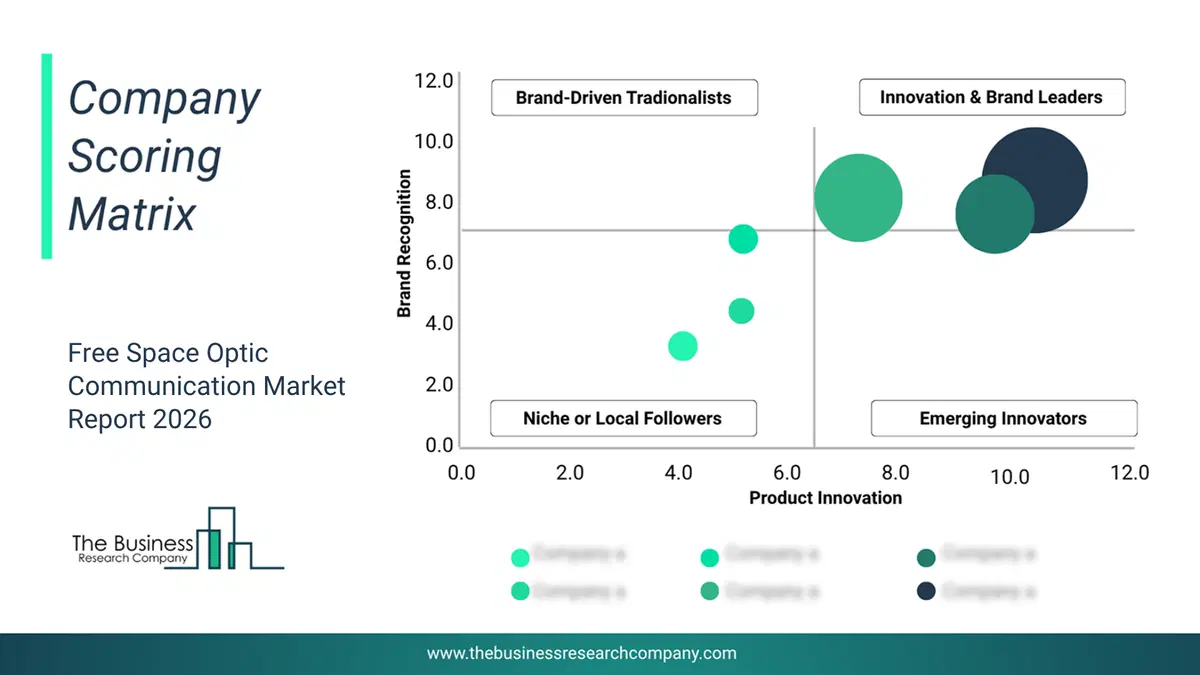
This chart maps companies by product innovation and brand strength, with bubble size indicating relative revenue, helping identify market leaders, challengers, and niche players. This is an illustrative chart; the full report provides a complete and accurate competitive analysis.
Global Free Space Optic Communication Market Trends and Insights
Major companies operating in the free space optic communication market are developing innovative solutions, such as mercury-free space optics (FSO) solutions, to gain a competitive edge in the market. Mercury-free space optics solutions offer improved performance, reliability, and safety while addressing environmental concerns associated with mercury-containing technologies. For instance, in April 2023, Viasat Inc., a US-based communications company, launched the Mercury Free Space Optical Communications (FSOC) terminal. This leverages free-space optical technology to enable rapid deployment and reliable connectivity in challenging environments without physical cable infrastructure. The terminal is designed as a high-capacity and cost-effective solution to support a range of expeditionary communications scenarios, including ground-to-ground, ground-to-air, ship-to-ship, and ship-to-shore.What Are Latest Mergers And Acquisitions In The Free Space Optic Communication Market?
In June 2024, Luxium Solutions, a US-based provider of high-performance crystals used in photonics and radiation detection applications, acquired PLX Inc., for an undisclosed amount. This acquisition, allows Luxium to integrate PLX’s advanced optical assemblies, including their patented Monolithic Optical Structure Technology (M.O.S.T.). With complementary expertise in material sciences, the combined teams will create innovative, precision solutions for harsh environments, advancing Luxium’s mission to meet the high-performance demands of its global customer base. PLX Inc. is a US-based Manufacturer of unique optical instruments.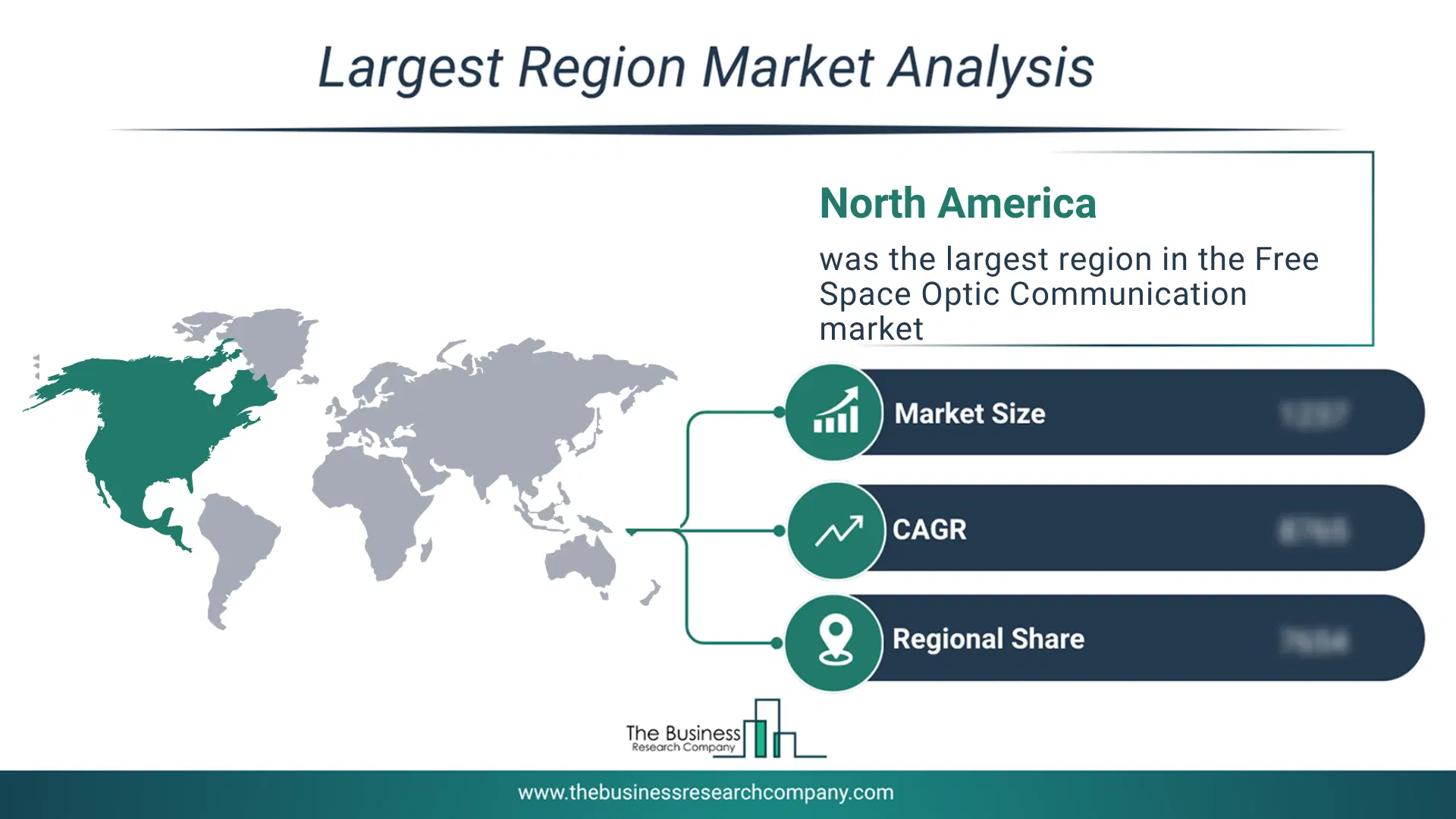
Regional Insights
North America was the largest region in the free space optic communication market in 2025. Asia-Pacific is expected to be the fastest-growing region in the forecast period. The regions covered in this market report are Asia-Pacific, South East Asia, Western Europe, Eastern Europe, North America, South America, Middle East, Africa. The countries covered in this market report are Australia, Brazil, China, France, Germany, India, Indonesia, Japan, Taiwan, Russia, South Korea, UK, USA, Canada, Italy, Spain.What Defines the Free Space Optic Communication Market?
The free space optics communication market consists of revenues earned by entities by providing services such as telecommunication and computer networking services, temporary network installations, and fiber backup services. The market value includes the value of related goods sold by the service provider or included within the service offering. The free space optic communication market also includes sales of modulating retro-reflectors, fiber optic modems, ethernet connectivity solutions, and network systems. Values in this market are ‘factory gate’ values, that is the value of goods sold by the manufacturers or creators of the goods, whether to other entities (including downstream manufacturers, wholesalers, distributors, and retailers) or directly to end customers. The value of goods in this market includes related services sold by the creators of the goods.How is Market Value Defined and Measured?
The market value is defined as the revenues that enterprises gain from the sale of goods and/or services within the specified market and geography through sales, grants, or donations in terms of the currency (in USD unless otherwise specified). The revenues for a specified geography are consumption values that are revenues generated by organizations in the specified geography within the market, irrespective of where they are produced. It does not include revenues from resales along the supply chain, either further along the supply chain or as part of other products.
This chart presents market attractiveness based on a quantitative evaluation of growth, competition, strategic alignment, and risk, offering a clear view of opportunity areas for decision-making. This chart is for illustrative purposes; the full report contains the complete analysis.

This chart highlights the Total Addressable Market (TAM) by estimating the maximum revenue opportunity using an assumption-driven approach, supporting strategic planning and opportunity sizing across markets. The chart is illustrative; the full report provides a more comprehensive analysis.
What Key Data and Analysis Are Included in the Free Space Optic Communication Market Report 2026?
The free space optic communication market research report is one of a series of new reports from The Business Research Company that provides market statistics, including industry global market size, regional shares, competitors with the market share, detailed market segments, market trends and opportunities, and any further data you may need to thrive in the free space optic communication industry. The market research report delivers a complete perspective of everything you need, with an in-depth analysis of the current and future state of the industry.Free Space Optic Communication Market Report Forecast Analysis
| Report Attribute | Details |
|---|---|
| Market Size Value In 2026 | $1.57 billion |
| Revenue Forecast In 2030 | $4.66 billion |
| Growth Rate | CAGR of 31.2% from 2026 to 2030 |
| Base Year For Estimation | 2025 |
| Actual Estimates/Historical Data | 2020-2025 |
| Forecast Period | 2026 - 2030 |
| Market Representation | Revenue in USD Billion and CAGR from 2026 to 2030 |
| Segments Covered | Component, Platform, Range, Application, End Use |
| Regional Scope | Asia-Pacific, Western Europe, Eastern Europe, North America, South America, Middle East, Africa |
| Country Scope | The Countries Covered In This Market Report Are Australia, Brazil, China, France, Germany, India, Indonesia, Japan, Taiwan, Russia, South Korea, Uk, Usa, Canada, Italy, Spain. |
| Key Companies Profiled | Amazon Inc., Huawei Technologies Co. Ltd., Furukawa Electric Co. Ltd., Koninklijke Philips N.V., NEC Corporation, L3Harris Technologies Inc., ZTE Corporation, Panasonic Corp., ViaSat Inc., QinetiQ Group, Space Exploration Technologies Corp (SpaceX), Tesat Spacecom GmbH Co Kg, Fsona Networks Corporation, EC System, SA Photonics Inc., Redline Infrastructure, Cailabs, Collinear Networks Inc., Plaintree Systems Inc., Anova Technologies Inc., Mostcom Inc., Airlinx Communications Inc., Mynaric AG, NTT Electronics Corporation, Laser Light Communications LLC |
| Customization Scope | Request for Customization |
| Pricing And Purchase Options | Explore Purchase Options |