
Gaming Merchandise Market Report 2026
Global Outlook – By Product Type (Apparel And Wearables, Collectibles And Figurines, Accessories And Lifestyle Products, Home Decor And Utility Merchandise, Stationery And Office Merchandise), By Licensing Type (Triple A Game Franchise Licensed Merchandise, Esports Team And League Licensed Merchandise, Streamer And Influencer Branded Merchandise, Retro And Classic Game Intellectual Property Merchandise, Other Licensing Types), By Age Group (Children, Teenagers And Young Adults, Adult Collectors, Other Age Groups), By Distribution Channel (Direct To Consumer Online Stores, Online Marketplaces, Offline Retail Stores, Other Distribution Channels), By End User (Casual Gamers, Core And Hardcore Gamers, Esports Fans, Collectors And Enthusiasts, Other End Users) – Market Size, Trends, Strategies, and Forecast to 2035
Gaming Merchandise Market Overview
• Gaming Merchandise market size has reached to $67.54 billion in 2025 • Expected to grow to $109.31 billion in 2030 at a compound annual growth rate (CAGR) of 10.2% • Growth Driver: Explosive Growth Of Esports Driving The Market Growth Due To Rising Global Competitive Gaming Engagement • Market Trend: Advancements In High-Precision Manufacturing, Digital Design Integration, And Smart Licensing Technologies In Fan Collectibles • North America was the largest region in 2025 and Asia-Pacific is the fastest growing region.What Is Covered Under Gaming Merchandise Market?
Gaming merchandise refers to licensed physical products inspired by video games, gaming franchises, characters, and virtual gaming worlds. These products are designed to translate digital gaming content into tangible branded items that reflect game aesthetics, narratives, and character identities. They are developed using intellectual property licensing and franchise-based design elements to strengthen fan engagement and extend gaming experiences beyond interactive gameplay. The main product types of gaming merchandise include apparel and wearables, collectibles and figurines, accessories and lifestyle products, home decor and utility merchandise, and stationery and office merchandise. Apparel and wearables refer to gaming-themed clothing and wearable items designed to represent game characters, franchises, or esports identities. These products are categorized by licensing type including triple A game franchise licensed merchandise, esports team and league licensed merchandise, streamer and influencer branded merchandise, retro and classic game intellectual property merchandise, and other licensing types and by age group such as children, teenagers and young adults, adult collectors, and other age groups. They are distributed through direct to consumer online stores, online marketplaces, offline retail stores, and other distribution channels, while the end-use includes casual gamers, core and hardcore gamers, esports fans, collectors and enthusiasts, and others.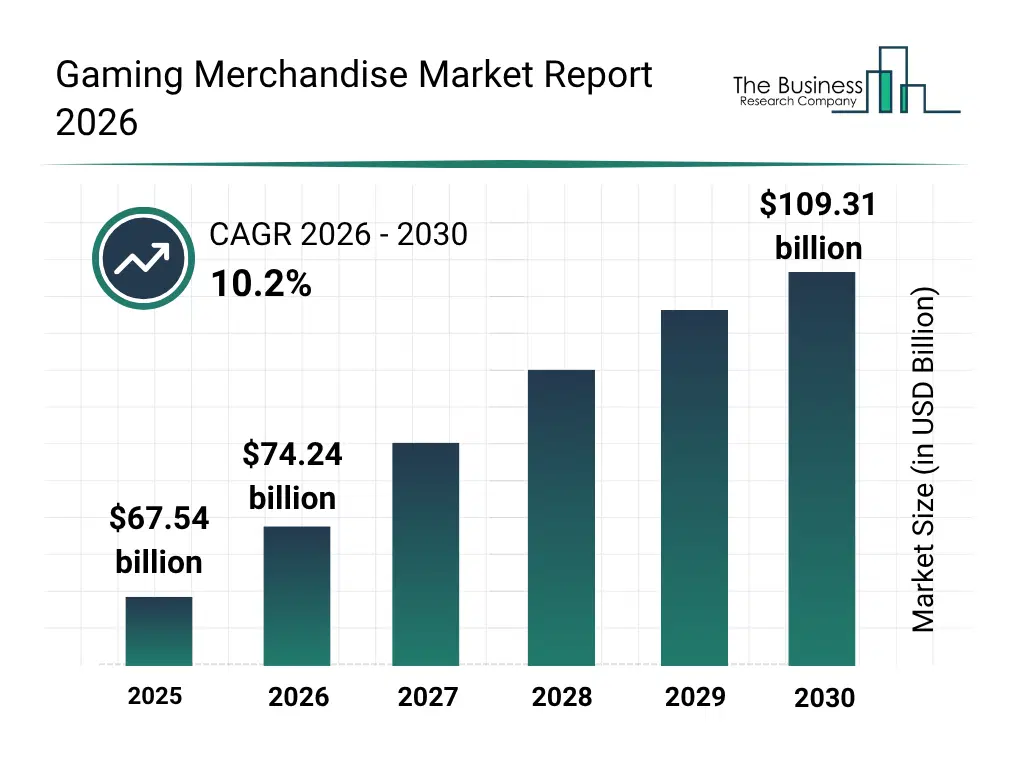
What Is The Gaming Merchandise Market Size and Share 2026?
The gaming merchandise market size has grown strongly in recent years. It will grow from $67.54 billion in 2025 to $74.24 billion in 2026 at a compound annual growth rate (CAGR) of 9.9%. The growth in the historic period can be attributed to growth of global gaming community, increasing popularity of franchise-based video games, expansion of esports tournaments and fan culture, rising demand for character-based collectibles, growth of retail gaming merchandise distribution channels.What Is The Gaming Merchandise Market Growth Forecast?
The gaming merchandise market size is expected to see rapid growth in the next few years. It will grow to $109.31 billion in 2030 at a compound annual growth rate (CAGR) of 10.2%. The growth in the forecast period can be attributed to expansion of metaverse-linked gaming ecosystems, increasing adoption of AI-driven personalized merchandise design, rising demand for sustainable gaming apparel and collectibles, growth of direct-to-consumer gaming brand platforms, increasing integration of digital and physical gaming experiences. Major trends in the forecast period include rise of character-driven collectible gaming merchandise demand, expansion of esports-themed branded apparel ecosystems, growing popularity of limited edition and rare gaming collectibles, increasing collaboration between streamers and gaming franchises for merchandise, personalization of gaming lifestyle accessories and décor products.
Global Gaming Merchandise Market Segmentation
1) By Product Type: Apparel And Wearables, Collectibles And Figurines, Accessories And Lifestyle Products, Home Decor And Utility Merchandise, Stationery And Office Merchandise 2) By Licensing Type: Triple A Game Franchise Licensed Merchandise, Esports Team And League Licensed Merchandise, Streamer And Influencer Branded Merchandise, Retro And Classic Game Intellectual Property Merchandise, Other Licensing Types 3) By Age Group: Children, Teenagers And Young Adults, Adult Collectors, Other Age Groups 4) By Distribution Channel: Direct To Consumer Online Stores, Online Marketplaces, Offline Retail Stores, Other Distribution Channels 5) By End User: Casual Gamers, Core And Hardcore Gamers, Esports Fans, Collectors And Enthusiasts, Other End Users Subsegments: 1) By Apparel And Wearables: T Shirts, Hooded Sweatshirts, Jackets And Outerwear, Caps And Headwear, Socks And Footwear 2) By Collectibles And Figurines: Action Figures, Character Statues, Limited Edition Models, Miniature Figurines, Replica Items 3) By Accessories And Lifestyle Products: Bags And Backpacks, Keychains And Charms, Phone Cases And Covers, Jewelry And Wristbands, Gaming Themed Watches 4) By Home Decor And Utility Merchandise: Wall Art And Posters, Bed Linen And Cushions, Lighting And Lamps, Kitchenware And Drinkware, Storage And Organizers 5) By Stationery And Office Merchandise: Notebooks And Diaries, Pens And Writing Tools, Desk Accessories, Calendars And Planners, Filing And Storage SuppliesWhat Is The Driver Of The Gaming Merchandise Market?
The explosive growth of esports is expected to propel the growth of the gaming merchandise market going forward. Esports refers to organized, competitive video gaming where players and teams compete in tournaments for prizes and recognition. Esports are rising due to increasing global internet penetration, as wider access to high-speed internet enables more players and viewers to participate in online gaming and live-streamed competitive events. Gaming merchandise strengthens the esports ecosystem by enhancing fan engagement and brand loyalty through themed apparel, collectibles, and accessories that allow audiences to physically connect with their favorite teams, players, and tournaments. For instance, in June 2025, according to a report published by Esports News UK, a UK-based online publication that provides daily updates about UK esports, revenues from UK games events and venues surged by 140% year-on-year, reaching £10.3 ($11.05) million in 2023, compared to £4.35 ($4.66) million in 2022. Therefore, the explosive growth of esports is driving the growth of the gaming merchandise industry.Key Players In The Global Gaming Merchandise Market
Major companies operating in the gaming merchandise market are Microsoft Corporation, Sony Group Corporation, Nintendo Co. Ltd., Bandai Namco Entertainment Inc., Valve Corporation, Roblox Corporation, Sega Corporation, Square Enix Holdings Co. Ltd., Ubisoft Entertainment SA, Capcom Co. Ltd., Funko Inc, CD Projekt S.A., Riot Games Inc., Jinx Inc., First 4 Figures Limited, Displate, Good Smile Company, Dark Horse Comics LLC, Numskull Designs Ltd, Gaming Heads Ltd., Merchoid LtdGlobal Gaming Merchandise Market Trends and Insights
Major companies operating in the gaming merchandise market are focusing on developing innovative solutions, such as a premium fan-focused design approach, to enhance fan engagement, strengthen brand loyalty, and deliver authentic, high-quality products that resonate with global gaming communities. A premium fan-focused design approach is a product development strategy that prioritizes high-quality, authentic, and detail-rich designs tailored specifically to the preferences and expectations of dedicated fans of a brand or franchise. For instance, in November 2025, Fanattik Ltd., a UK-based collectibles and merchandise company, partnered with Activision Blizzard, a US-based video game publisher, to launch a new range of officially licensed merchandise based on franchises including World of Warcraft, Diablo, Overwatch, and Hearthstone. It includes collectibles, home décor, gifts, and accessories tailored for gaming audiences worldwide. The range was introduced across Europe, North America, Japan, South Korea, Australasia, MENA, and China, enabling broad international reach and enhancing access to premium gaming merchandise for fans across multiple regions.What Are Latest Mergers And Acquisitions In The Gaming Merchandise Market?
In July 2025, Veloce Media Group Limited, a UK-based digital media and sports entertainment company, acquired Quadrant Esports Ltd. for an undisclosed amount. With this acquisition, Veloce Media aimed to strengthen its position in the motorsport, gaming, and creator-led content ecosystem by expanding its audience reach, enhancing its lifestyle and apparel offerings, and accelerating growth through integration of Quadrant’s community-driven brand and digital content capabilities into its broader media network. Quadrant Esports Ltd. is a UK-based digital media and lifestyle company that specializes in providing gaming merchandise.Regional Outlook/Insights
North America was the largest region in the gaming merchandise market in 2025. Asia-Pacific is expected to be the fastest-growing region in the forecast period. The regions covered in this market report are Asia-Pacific, South East Asia, Western Europe, Eastern Europe, North America, South America, Middle East, Africa. The countries covered in this market report are Australia, Brazil, China, France, Germany, India, Indonesia, Japan, Taiwan, Russia, South Korea, UK, USA, Canada, Italy, Spain.What Defines the Gaming Merchandise Market?
The gaming merchandise market consists of sales of figurines, action figures, collectibles, posters, keychains, mugs, bags, toys, trading cards, replica weapons, gaming-themed accessories, and other licensed merchandise inspired by video game intellectual properties. Values in this market are ‘factory gate’ values, that is, the value of goods sold by the manufacturers or creators of the goods, whether to other entities (including downstream manufacturers, wholesalers, distributors, and retailers) or directly to end customers. The value of goods in this market includes related services sold by the creators of the goods.How is Market Value Defined and Measured?
The market value is defined as the revenues that enterprises gain from the sale of goods and/or services within the specified market and geography through sales, grants, or donations in terms of the currency (in USD unless otherwise specified). The revenues for a specified geography are consumption values that are revenues generated by organizations in the specified geography within the market, irrespective of where they are produced. It does not include revenues from resales along the supply chain, either further along the supply chain or as part of other products.What Key Data and Analysis Are Included in the Gaming Merchandise Market Report 2026?
The gaming merchandise market research report is one of a series of new reports from The Business Research Company that provides market statistics, including industry global market size, regional shares, competitors with the market share, detailed market segments, market trends and opportunities, and any further data you may need to thrive in the gaming merchandise industry. The market research report delivers a complete perspective of everything you need, with an in-depth analysis of the current and future state of the industry.Gaming Merchandise Market Report Forecast Analysis
| Report Attribute | Details |
|---|---|
| Market Size Value In 2026 | $74.24 billion |
| Revenue Forecast In 2035 | $109.31 billion |
| Growth Rate | CAGR of 10.2% from 2026 to 2035 |
| Base Year For Estimation | 2025 |
| Actual Estimates/Historical Data | 2020-2025 |
| Forecast Period | 2026 - 2030 - 2035 |
| Market Representation | Revenue in USD Billion and CAGR from 2026 to 2035 |
| Segments Covered | Product Type, Licensing Type, Age Group, Distribution Channel, End User |
| Regional Scope | Asia-Pacific, Western Europe, Eastern Europe, North America, South America, Middle East, Africa |
| Country Scope | The countries covered in the report are Australia, Brazil, China, France, Germany, India, Indonesia, Japan, Taiwan, Russia, South Korea, UK, USA, Canada, Italy, Spain. |
| Key Companies Profiled | Microsoft Corporation, Sony Group Corporation, Nintendo Co. Ltd., Bandai Namco Entertainment Inc., Valve Corporation, Roblox Corporation, Sega Corporation, Square Enix Holdings Co. Ltd., Ubisoft Entertainment SA, Capcom Co. Ltd., Funko Inc, CD Projekt S.A., Riot Games Inc., Jinx Inc., First 4 Figures Limited, Displate, Good Smile Company, Dark Horse Comics LLC, Numskull Designs Ltd, Gaming Heads Ltd., Merchoid Ltd |
| Customization Scope | Request for Customization |
| Pricing And Purchase Options | Explore Purchase Options |