
CO₂ To Propylene Oxide Market Report 2026
Global Outlook – By Technology (Direct Synthesis, Indirect Synthesis, Catalytic Conversion, Other Technologies), By Application (Polyurethane Production, Glycol Ethers, Propylene Glycol, Other Applications), By End-Use Industry (Automotive, Construction, Textiles, Chemicals, Other End-Use Industries) – Market Size, Trends, Strategies, and Forecast to 2030
CO2 To Propylene Oxide Market Overview
• CO2 To Propylene Oxide market size has reached to $1.14 billion in 2025 • Expected to grow to $2.15 billion in 2030 at a compound annual growth rate (CAGR) of 13.4% • Growth Driver: Surge In Environmental Regulations And Net-Zero Goals Fueling The Growth Of The Market Due To Demand For Low-Carbon Chemical Production • North America was the largest region in 2025 and Asia-Pacific is the fastest growing region.What Is Covered Under CO₂ To Propylene Oxide Market?
Carbon dioxide (CO₂) to propylene oxide refers to a sustainable chemical conversion process that transforms carbon dioxide into propylene oxide, an important industrial chemical used in producing polyurethanes and glycols. This process utilizes CO₂ as a carbon source, reducing greenhouse gas emissions while creating valuable products. Catalysts, such as metal oxides or metal–organic frameworks, play a key role in enabling this transformation efficiently. Overall, it represents an innovative approach to carbon capture and utilization in the chemical industry. The main technologies in CO₂ to propylene oxide are direct synthesis, indirect synthesis, catalytic conversion, and others. Direct synthesis refers to a catalytic process that directly converts carbon dioxide and propylene into propylene oxide in a single reaction step without intermediate formation of other compounds. These are used in applications such as polyurethane production, glycol ethers, propylene glycol, and others in the end-use industries such as automotive, construction, textiles, chemicals, and others.What Is The CO₂ To Propylene Oxide Market Size and Share 2026?
The co₂ to propylene oxide market size has grown rapidly in recent years. It will grow from $1.14 billion in 2025 to $1.3 billion in 2026 at a compound annual growth rate (CAGR) of 13.7%. The growth in the historic period can be attributed to propylene oxide demand growth, petrochemical dependency, polyurethane market expansion, early catalyst research, industrial co2 emissions.What Is The CO₂ To Propylene Oxide Market Growth Forecast?
The co₂ to propylene oxide market size is expected to see rapid growth in the next few years. It will grow to $2.15 billion in 2030 at a compound annual growth rate (CAGR) of 13.4%. The growth in the forecast period can be attributed to green chemistry adoption, regulatory emission limits, sustainable materials demand, catalyst efficiency improvements, circular economy investments. Major trends in the forecast period include rising adoption of co2 based chemical processes, growing demand for sustainable polyurethanes, expansion of advanced catalyst technologies, increased focus on emission reduction, development of pilot scale conversion plants.
Global CO₂ To Propylene Oxide Market Segmentation
1) By Technology: Direct Synthesis, Indirect Synthesis, Catalytic Conversion, Other Technologies 2) By Application: Polyurethane Production, Glycol Ethers, Propylene Glycol, Other Applications 3) By End-Use Industry: Automotive, Construction, Textiles, Chemicals, Other End-Use Industries Subsegments: 1) By Direct Synthesis: Carbon Dioxide Hydrogenation, Electrochemical Reduction, Photocatalytic Reduction, Thermocatalytic Reduction 2) By Indirect Synthesis: Carbonate Intermediate Route, Epoxidation Via Carbonate Conversion, Co-Oxidation Process, Hydrocarbon Oxidation Pathway 3) By Catalytic Conversion: Heterogeneous Catalysis, Homogeneous Catalysis, Bimetallic Catalysis, Enzyme-Based Catalysis 4) By Other Technologies: Plasma-Assisted Conversion, Biochemical Conversion, Hybrid Chemical Processes, Emerging Pilot-Scale TechnologiesWhat Are The Drivers Of The CO₂ To Propylene Oxide Market?
Rising environmental regulations and net-zero goals are expected to propel the growth of the CO₂ to propylene oxide market going forward. Environmental regulations and net-zero goals refer to mandatory legal rules and voluntary commitments that require businesses to achieve carbon neutrality. Environmental regulations and net-zero goals are rising because governments are intensifying climate policies to meet international decarbonization commitments set under the Paris Agreement, driving stricter emission reduction requirements across industries. The CO₂ to propylene oxide process supports environmental regulations and net-zero goals by converting captured carbon dioxide into valuable chemical intermediates, thereby reducing industrial emissions and promoting circular carbon utilization within manufacturing systems. For instance, in December 2023, according to the Department for Energy Security and Net Zero, a UK-based government department, under the United Kingdom’s Net Zero Strategy, emissions from public sector buildings are targeted to be reduced by 50% by 2032 and by 75% by 2037. Therefore, rising environmental regulations and net-zero goals are driving the growth of the CO₂ to propylene oxide industry. The increasing adoption of sustainable chemical processes is expected to propel the growth of the CO₂ to propylene oxide market going forward. Sustainable chemical processes refer to the development and implementation of production methods that minimize environmental impact by reducing waste generation, conserving energy, utilizing renewable feedstocks, and lowering greenhouse gas emissions throughout the chemical lifecycle. Sustainable chemical processes are increasingly adopted due to stringent regulatory and policy measures promoting industrial decarbonization, compelling industries to adopt cleaner technologies to ensure compliance and competitiveness. The CO₂ to propylene oxide process exemplifies this transition by converting captured carbon dioxide into a valuable chemical intermediate, thereby aligning industrial production with sustainability objectives through carbon utilization and reduced dependence on fossil-based raw materials. For instance, in November 2023, according to the Department of Energy, a US-based federal executive department, accounting for nearly one-third of total U.S. emissions, the industrial sector is a key focus of IEDO, whose 2050 mission centers on accelerating the innovation and adoption of advanced technologies to achieve net-zero emissions. Therefore, the increasing adoption of sustainable chemical processes is driving the CO₂ to propylene oxide industry. The increasing shift toward sustainable and bio-based production is expected to propel the growth of the CO₂ to propylene oxide market going forward. Sustainable and bio-based production involves utilizing renewable biological resources and eco-friendly methods to reduce carbon emissions and fossil fuel dependence and promote circular economy principles. The shift toward sustainable and bio-based production is driven by environmental and policy efforts to reduce fossil fuel dependence, promoting innovation in renewable feedstocks and low-carbon technologies to achieve climate goals and industrial resilience. The CO₂ to propylene oxide process supports this transition by converting captured carbon dioxide into a valuable industrial chemical, integrating carbon utilization into production systems, and advancing sustainable, bio-based chemical manufacturing. For instance, in March 2024, according to the University of Sheffield, a UK-based research university, chemical and plastic manufacturing, accounting for 6% of global carbon dioxide equivalent emissions, remains predominantly dependent on virgin fossil resources, with around 88% of production derived from them, while achieving fossil independence by 2050 would necessitate producing at least 20% of these materials from biomass. Therefore, the increasing shift toward sustainable and bio-based production is driving the CO₂ to propylene oxide industry.Key Players In The Global CO₂ To Propylene Oxide Market
Major companies operating in the co₂ to propylene oxide market are Shell, BASF, Repsol, Dow, SABIC, Linde, Wanhua, Asahi Kasei, Sumitomo Chemical, INEOS, Evonik, Covestro, Mitsui Chemicals, Tosoh, Huntsman, Tokuyama, Manali Petrochemicals, Jiangsu Zhongneng Chemical, RTI International, Topsoe A/S, Econic Technologies, Novomer Inc. / Danimer Scientific, Newlight Technologies, LanzaTech, Carbon Clean Solutions Ltd., Global Thermostat, Carbon Engineering Ltd., Svante Inc.
This chart is for illustrative purposes; the full report includes a detailed competitor analysis and comprehensive overview of the top 10 companies in the market.
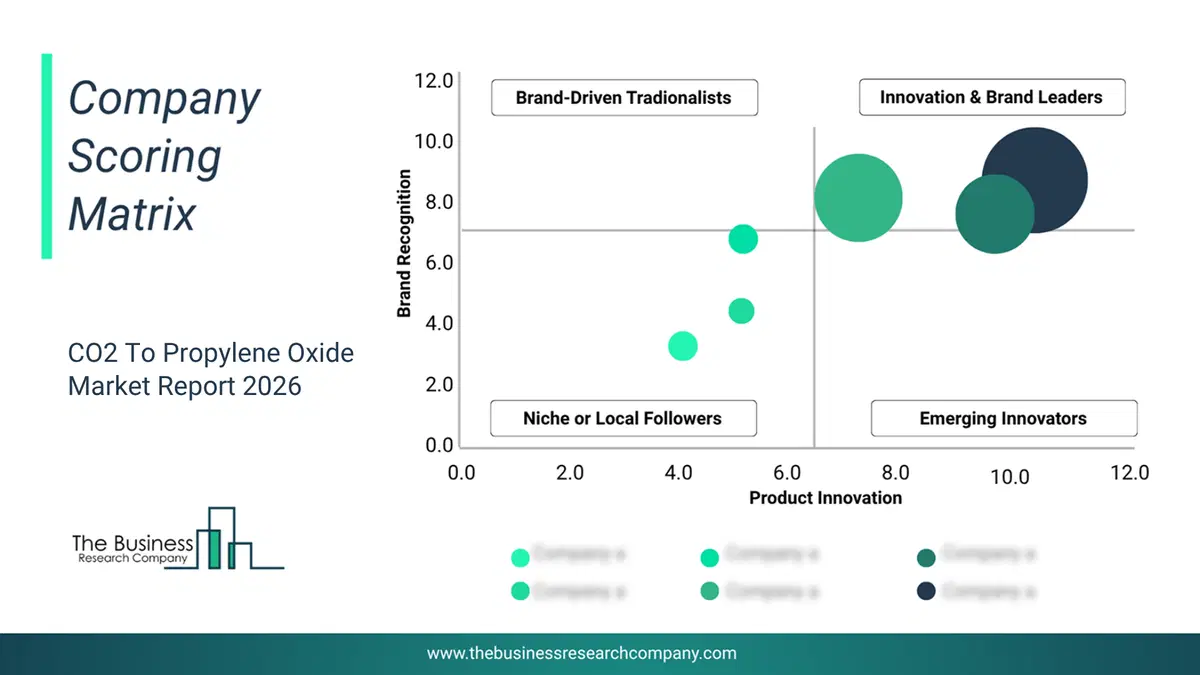
This chart maps companies by product innovation and brand strength, with bubble size indicating relative revenue, helping identify market leaders, challengers, and niche players. This is an illustrative chart; the full report provides a complete and accurate competitive analysis.
Regional Insights
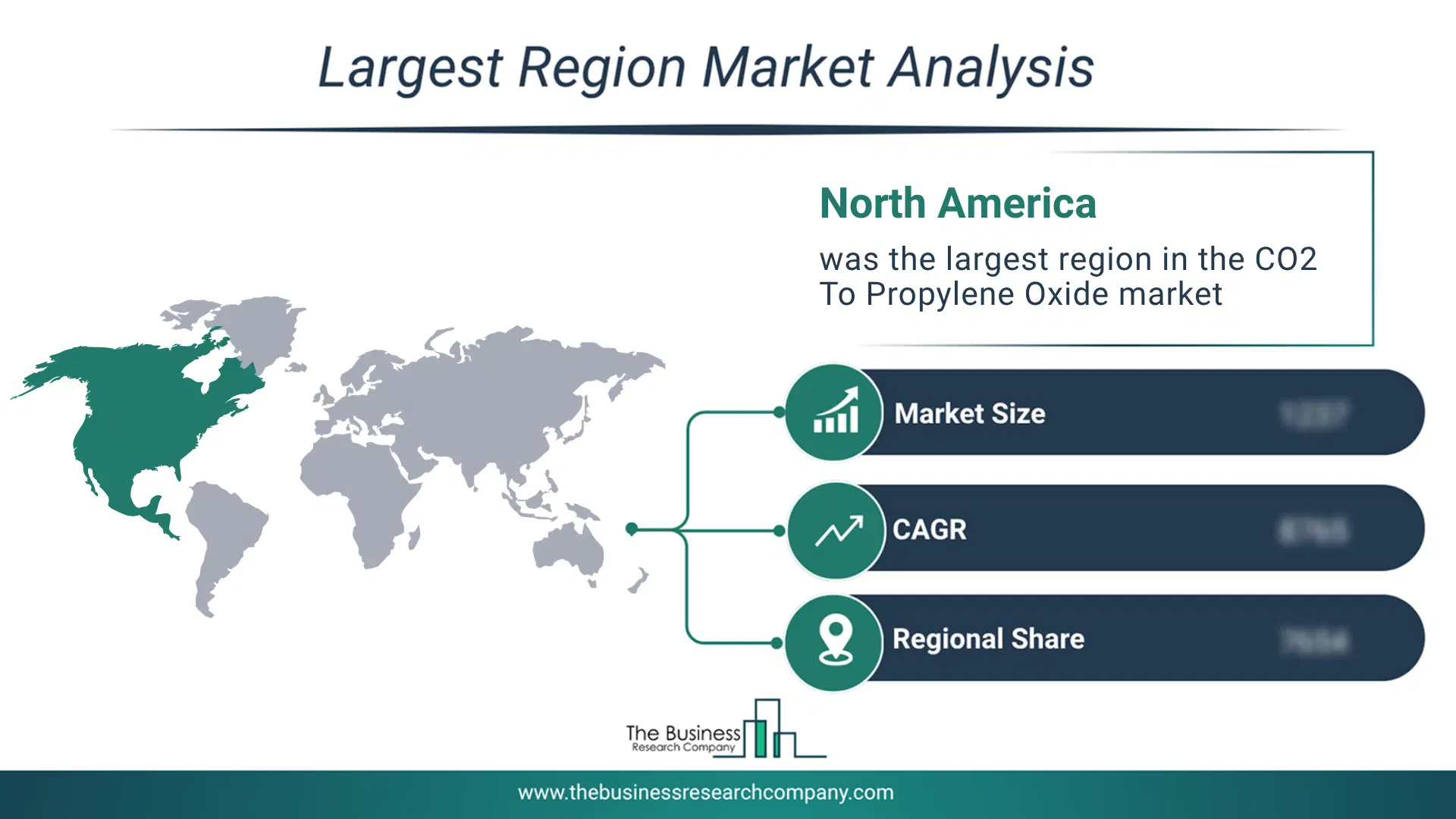
North America was the largest region in the CO₂ to propylene oxide market in 2025. Asia-Pacific is expected to be the fastest-growing region in the forecast period. The regions covered in the co₂ to propylene oxide market report are Asia-Pacific, South East Asia, Western Europe, Eastern Europe, North America, South America, Middle East, Africa The countries covered in the co₂ to propylene oxide market report are Australia, Brazil, China, France, Germany, India, Indonesia, Japan, Taiwan, Russia, South Korea, UK, USA, Canada, Italy, SpainWhat Defines the CO₂ To Propylene Oxide Market?
The CO₂ to propylene oxide market consists of revenues earned by entities by providing services such as process optimization, quality testing and certification, and downstream integration services. The market value includes the value of related goods sold by the service provider or included within the service offering. The CO₂ to propylene oxide market also includes sales of polyether polyols, propylene glycol, propylene oxide glycol ethers, and butanediol. Values in this market are ‘factory gate’ values, that is, the value of goods sold by the manufacturers or creators of the goods, whether to other entities (including downstream manufacturers, wholesalers, distributors, and retailers) or directly to end customers. The value of goods in this market includes related services sold by the creators of the goods.How is Market Value Defined and Measured?
The market value is defined as the revenues that enterprises gain from the sale of goods and/or services within the specified market and geography through sales, grants, or donations in terms of the currency (in USD unless otherwise specified). The revenues for a specified geography are consumption values that are revenues generated by organizations in the specified geography within the market, irrespective of where they are produced. It does not include revenues from resales along the supply chain, either further along the supply chain or as part of other products.
This chart presents market attractiveness based on a quantitative evaluation of growth, competition, strategic alignment, and risk, offering a clear view of opportunity areas for decision-making. This chart is for illustrative purposes; the full report contains the complete analysis.

This chart highlights the Total Addressable Market (TAM) by estimating the maximum revenue opportunity using an assumption-driven approach, supporting strategic planning and opportunity sizing across markets. The chart is illustrative; the full report provides a more comprehensive analysis.
What Key Data and Analysis Are Included in the CO₂ To Propylene Oxide Market Report 2026?
The co₂ to propylene oxide market research report is one of a series of new reports from The Business Research Company that provides market statistics, including industry global market size, regional shares, competitors with the market share, detailed market segments, market trends and opportunities, and any further data you may need to thrive in the co₂ to propylene oxide industry. The market research report delivers a complete perspective of everything you need, with an in-depth analysis of the current and future state of the industry.CO2 To Propylene Oxide Market Report Forecast Analysis
| Report Attribute | Details |
|---|---|
| Market Size Value In 2026 | $1.3 billion |
| Revenue Forecast In 2030 | $2.15 billion |
| Growth Rate | CAGR of 13.7% from 2026 to 2030 |
| Base Year For Estimation | 2025 |
| Actual Estimates/Historical Data | 2020-2025 |
| Forecast Period | 2026 - 2030 |
| Market Representation | Revenue in USD Billion and CAGR from 2026 to 2030 |
| Segments Covered | Technology, Application, End-Use Industry |
| Regional Scope | Asia-Pacific, Western Europe, Eastern Europe, North America, South America, Middle East, Africa |
| Country Scope | The countries covered in this market report are Australia, Brazil, China, France, Germany, India, Indonesia, Japan, Taiwan, Russia, South Korea, UK, USA, Canada, Italy, Spain |
| Key Companies Profiled | Shell, BASF, Repsol, Dow, SABIC, Linde, Wanhua, Asahi Kasei, Sumitomo Chemical, INEOS, Evonik, Covestro, Mitsui Chemicals, Tosoh, Huntsman, Tokuyama, Manali Petrochemicals, Jiangsu Zhongneng Chemical, RTI International, Topsoe A/S, Econic Technologies, Novomer Inc. / Danimer Scientific, Newlight Technologies, LanzaTech, Carbon Clean Solutions Ltd., Global Thermostat, Carbon Engineering Ltd., Svante Inc. |
| Customization Scope | Request for Customization |
| Pricing And Purchase Options | Explore Purchase Options |