
Grain Products Market Report 2026
Global Outlook – By Type (Flour, Rice And Malt, Other Grain Products ), By Price Range (Premium, Mid, Low), By Distribution Channel (Supermarkets Or Hypermarkets, Convenience Stores, E-Commerce, Other Distribution Channels ) – Market Size, Trends, Strategies, and Forecast to 2030
Grain Products Market Overview
• grain products market size has reached to $394.51 billion in 2025 • Expected to grow to $527.12 billion in 2030 at a compound annual growth rate (CAGR) of 6.1% • Growth Driver: Rising Demand For Sustainable Organic Dairy Fuels Market Growth • Market Trend: Central Life Sciences Launches Gravista-D For A New Era In Pest Control For Grain Products • Asia-Pacific was the largest region in 2025 and North America is the fastest growing region.What Is Covered Under Grain Products Market?
Grain products are obtained by a milling process in which grains are cleaned, crushed and grinded into pieces for food preparation. These grains are often milled or processed into forms such as flour, meal, or bran, which are then used to make various foods. The main types of grain products are flour, rice, and malt, and other grain products. Flour grains are powders made from either legumes, nuts, or other grains. The main distribution channels of grain products are supermarkets/hypermarkets, convenience stores, e-commerce, and other distribution channels. The different price ranges include premium, mid, and low.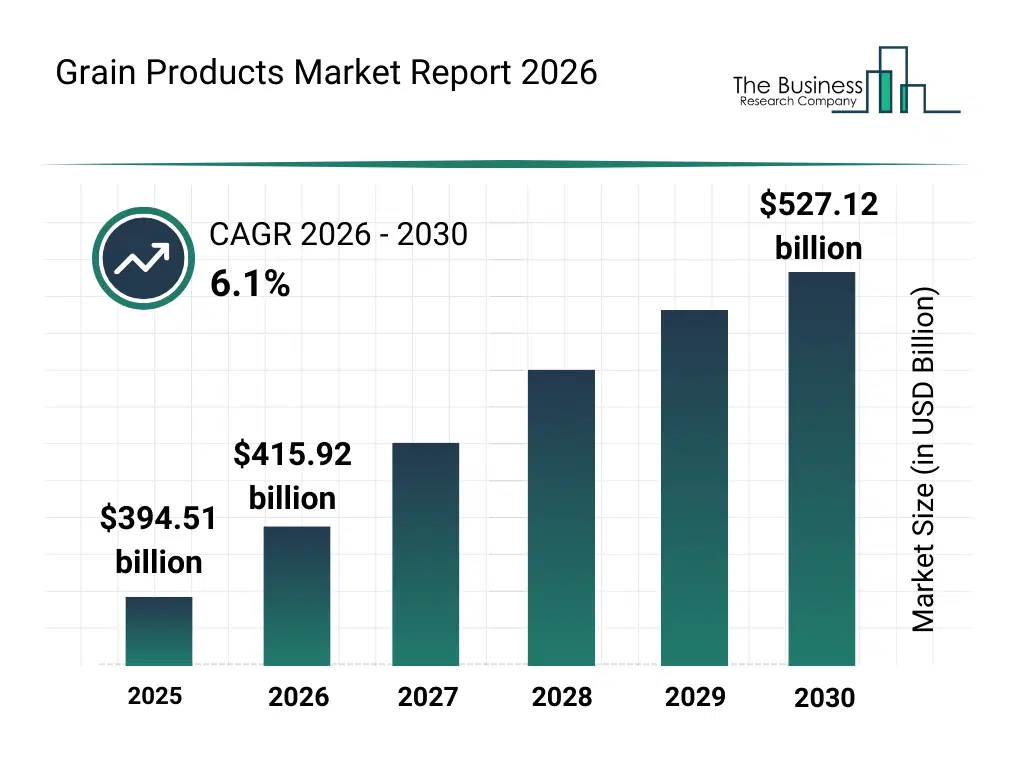
What Is The Grain Products Market Size and Share 2026?
The grain products market size has grown strongly in recent years. It will grow from $394.51 billion in 2025 to $415.92 billion in 2026 at a compound annual growth rate (CAGR) of 5.4%. The growth in the historic period can be attributed to expansion of staple food consumption, growth of milling and processing infrastructure, increasing population growth, rising urban food demand, availability of diverse grain varieties.What Is The Grain Products Market Growth Forecast?
The grain products market size is expected to see strong growth in the next few years. It will grow to $527.12 billion in 2030 at a compound annual growth rate (CAGR) of 6.1%. The growth in the forecast period can be attributed to increasing focus on nutritional grain products, rising demand for gluten-free alternatives, expansion of packaged food markets, growing investments in food processing technology, increased consumer awareness of grain nutrition. Major trends in the forecast period include increasing demand for whole and specialty grains, growing adoption of fortified grain products, expansion of processed and ready-to-cook grain foods, enhanced focus on traceability and quality control, rising innovation in grain-based snacks.
Global Grain Products Market Segmentation
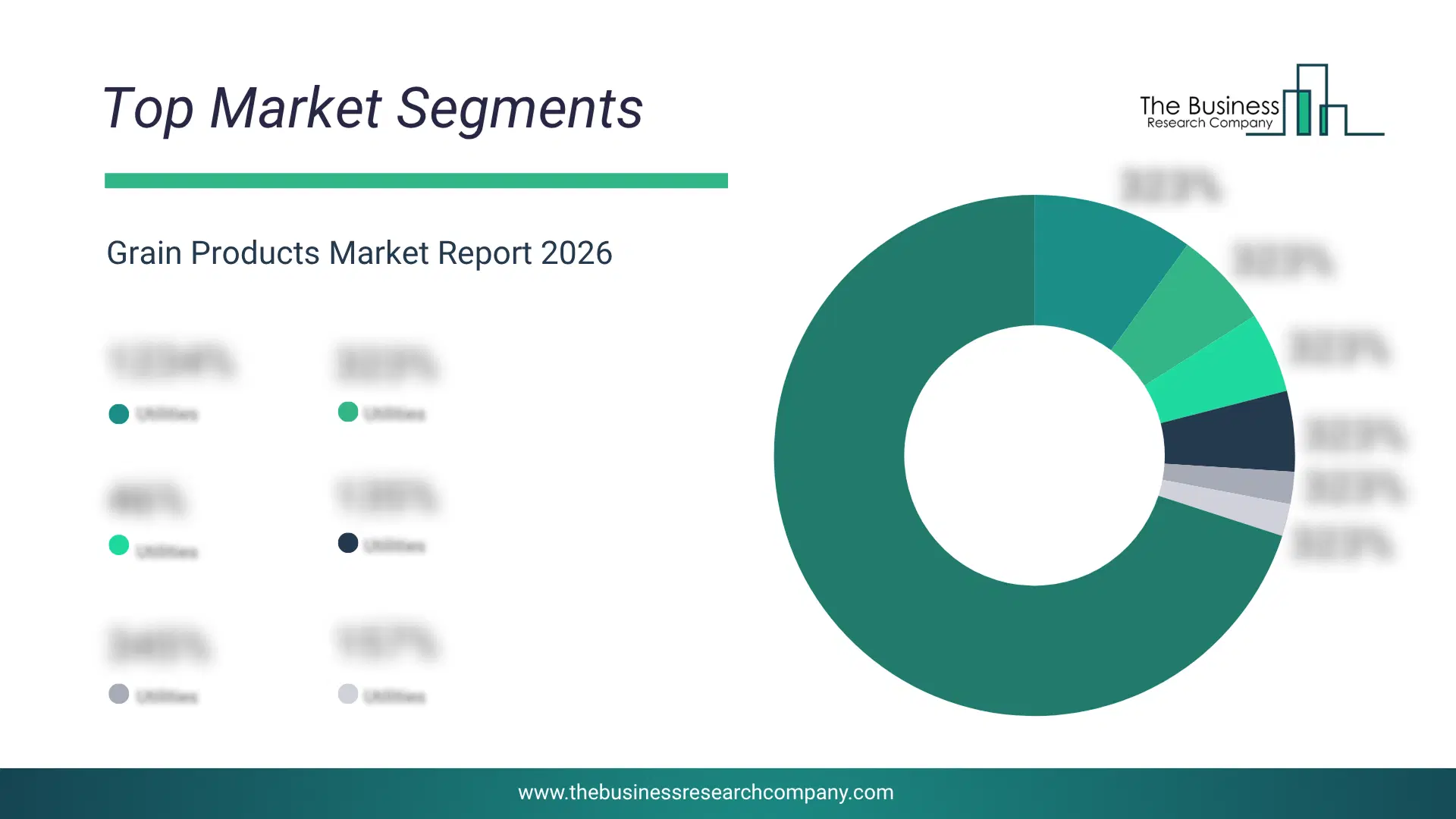
1) By Type: Flour, Rice And Malt, Other Grain Products 2) By Price Range: Premium, Mid, Low 3) By Distribution Channel: Supermarkets Or Hypermarkets, Convenience Stores, E-Commerce, Other Distribution Channels Subsegments: 1) By Flour: All-Purpose Flour, Whole Wheat Flour, Specialty Flours, Bread Flour, Cake Flour 2) By Rice And Malt: White Rice, Brown Rice, Specialty Rice, Malted Barley, Malt Extract 3) By Other Grain Products: Breakfast Cereals, Grain-Based Snacks, Pasta, Cornmeal, Oats And Oat ProductsWhat Is The Driver Of The Grain Products Market?
The increasing demand for local, sustainable, and organic food production is expected to positively impact the dairy food market during the forecast period. Organic food production, including organic dairy products, places a strong emphasis on consumer health, environmental protection, and animal welfare. Consumers are now becoming more concerned with how food is raised and prepared and are willing to pay a little more for something they recognize as healthy. Across Europe, there is an extremely high import rate (especially for fruits and vegetables), as the rate of production is far lower than the consumer demand for organic produce. For instance, in December 2023, according to the United States Department of Agriculture, a US-based federal agency, India produced 2.9 million metric tons of certified edible organic products for 2022-23. This growing demand for organic products offers considerable opportunities for dairy product producers in both developed and developing countries, which is likely to drive the market during the forecast period.Key Players In The Global Grain Products Market
Major companies operating in the grain products market are Cargill Incorporated, Archer Daniels Midland, Wilmar International Ltd, Bunge Limited, Louis Dreyfus Company B.V., Olam International, CJ Corp, United Natural Foods Inc, CJ CheilJedang Corp, General Mills Inc, The Andersons Inc, Kellogg Company, Conagra Brands Inc, Seaboard Corporation, Ingredion Incorporated, The J.M. Smucker Company, Post Holdings Inc, Nisshin Seifun Group Inc, Gruma S.A.B. de C.V, Soufflet SA, Ardent Mills LLC, Toyo Suisan Kaisha Ltd, The Hain Celestial Group, Riceland Foods Inc, SunOpta Inc, MGP Ingredients Inc, GrainCorp Malt, Malteurop Malting Company, The Scoular Company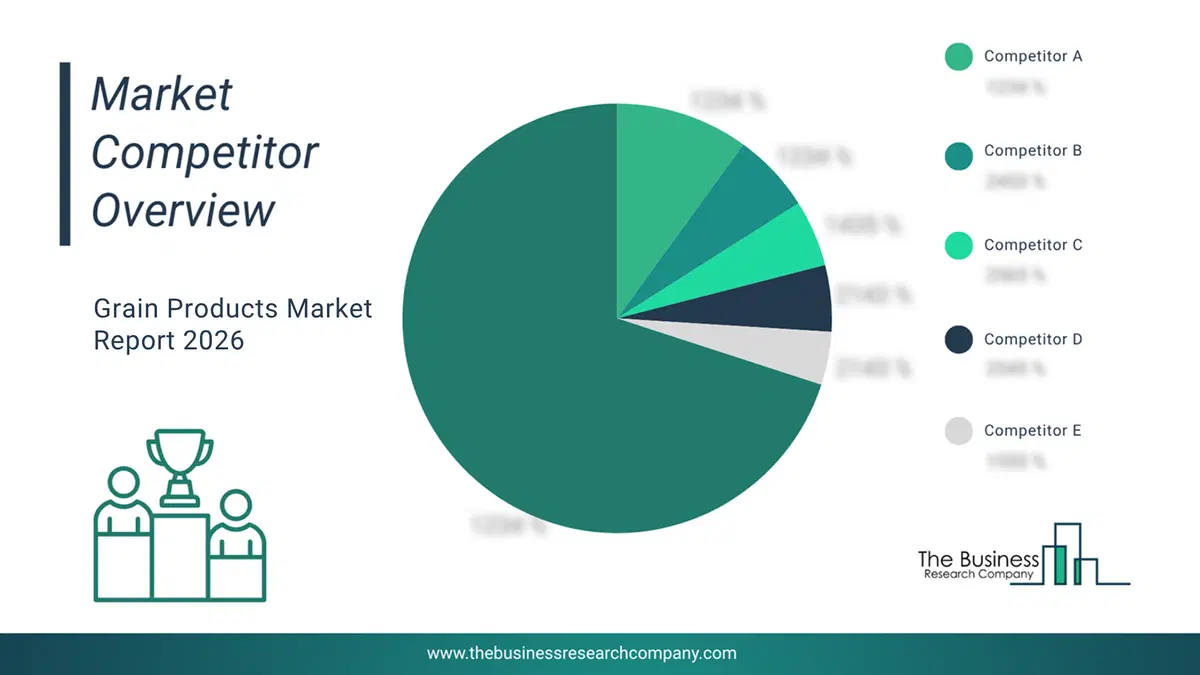
This chart is for illustrative purposes; the full report includes a detailed competitor analysis and comprehensive overview of the top 10 companies in the market.
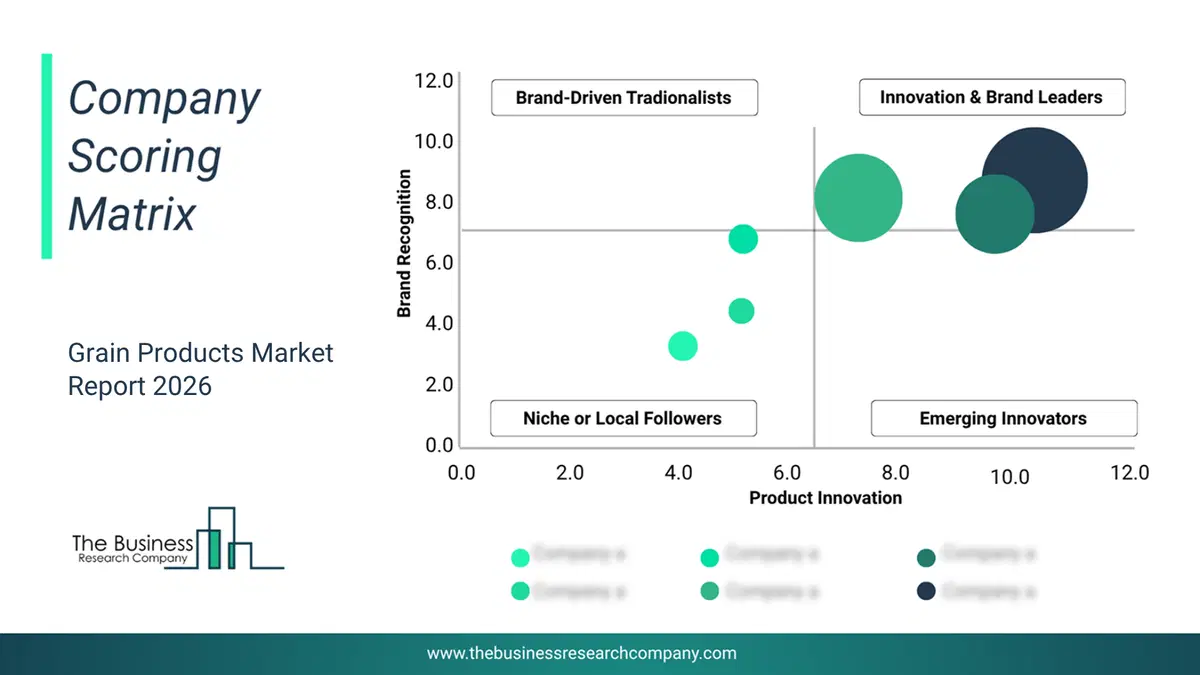
This chart maps companies by product innovation and brand strength, with bubble size indicating relative revenue, helping identify market leaders, challengers, and niche players. This is an illustrative chart; the full report provides a complete and accurate competitive analysis.
Global Grain Products Market Trends and Insights
Major companies operating in the grain products market are focused on developing innovative ready-to-use insecticide solutions for stored grains to protect against pests, reduce spoilage, and extend shelf life, ensuring food quality and safety throughout the supply chain. A ready-to-use insecticide solution for stored grains is a pre-mixed, formulated insecticide specifically designed to protect stored grains from pests such as beetles, moths, and weevils. For instance, in January 2024, Central Life Sciences, a US-based company that develops insect control products, launched Gravista-D, an insecticide designed for pest control in stored grains. This ready-to-use solution combines an adulticide with an insect growth regulator to effectively target a range of pests, ensuring long-lasting protection for various cereal grains.What Are Latest Mergers And Acquisitions In The Grain Products Market?
In September 2024, SIA Linas Agro, a Latvia-based Latvian trading company that serves farmers, acquired Elagro Trade, SIA, for an undisclosed amount. With this acquisition, SIA Linas Agro aims to enhance its competitive position in the Latvian grain market by integrating SIA Elagro Trade’s operations, which include a significant market share in grain, seeds, crop protection, and fertilizers, thereby increasing efficiency in services to farmers, expanding storage capacity, and doubling growth potential in the Baltic region. SIA Elagro Trade is a Latvia-based company that offers grain products.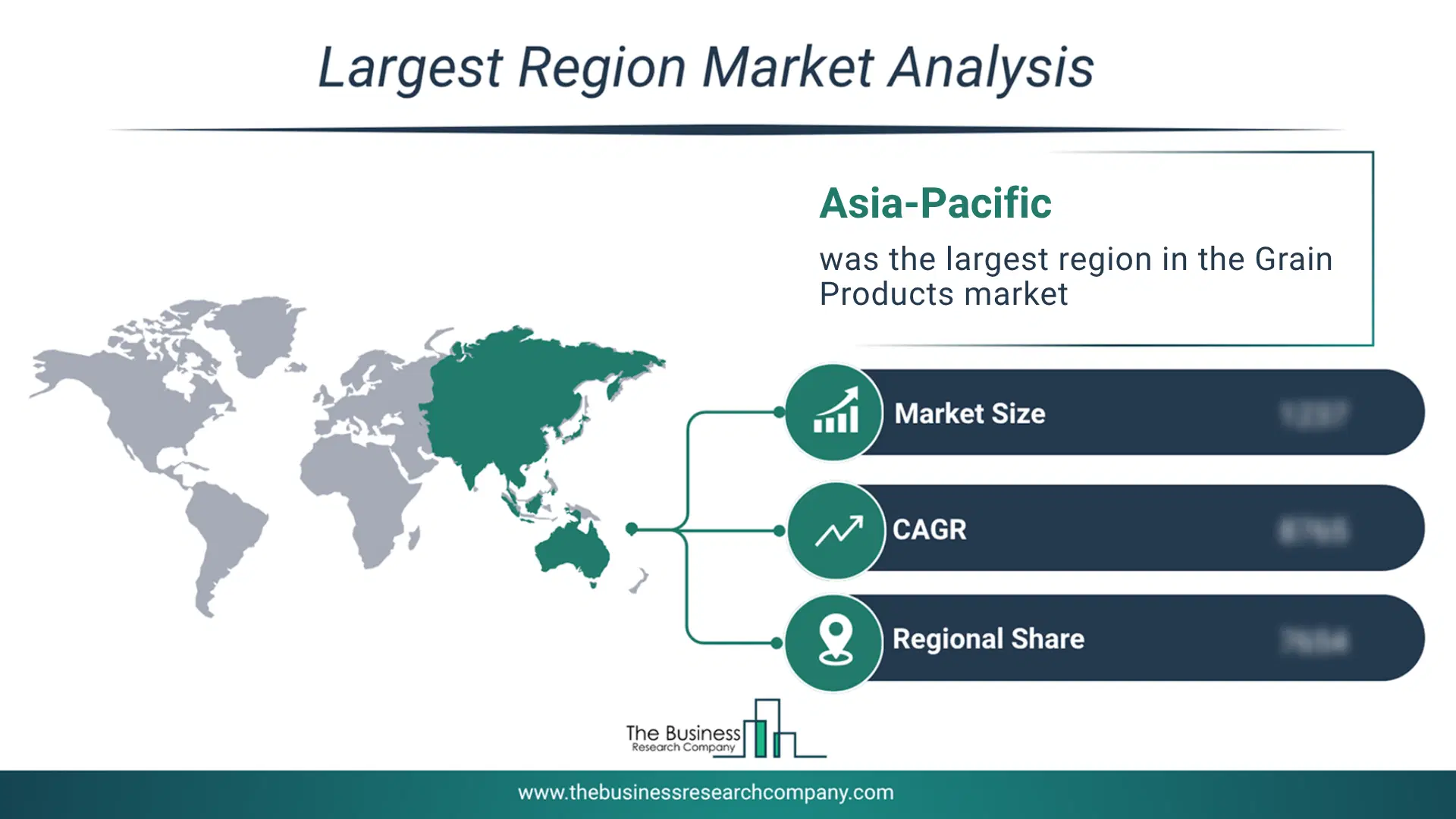
Regional Outlook
Asia-Pacific was the largest region in the grain products market in 2025. North America was the second-largest region in the grain products market. The regions covered in this market report are Asia-Pacific, South East Asia, Western Europe, Eastern Europe, North America, South America, Middle East and Africa. The countries covered in this market report are China, India, Japan, Australia, Indonesia, South Korea, Bangladesh, Thailand, Vietnam, Malaysia, Singapore, Philippines, Hong Kong, Taiwan, New Zealand, UK, Germany, France, Italy, Spain, Austria, Belgium, Denmark, Finland, Ireland, Netherlands, Norway, Portugal, Sweden, Switzerland, Russia, Czech Republic, Poland, Romania, Ukraine, USA, Canada, Mexico, Brazil, Chile, Argentina, Colombia, Peru, Saudi Arabia, Israel, Iran, Turkey, UAE, Egypt, Nigeria, South Africa.What Defines the Grain Products Market?
The grain products market consists of sales of wheat flour, corn flour, rice flour, barley flour, buckwheat flour, durum flour, fruit flour, graham flour, oat flour, potato flour, rye flour, parboiled rice, glutinous rice, wild rice, arborio rice, red cargo rice, sushi rice, rose Matta rice, barley malt, corn malt, rye malt, wheat malt, millet, rye, oats, quinoa, and other grain products. The companies in the grain products industry process raw materials into grain products, package and distribute them through various distribution channels to both individual customers and commercial establishments. Values in this market are ‘factory gate’ values, that is the value of goods sold by the manufacturers or creators of the goods, whether to other entities (including downstream manufacturers, wholesalers, distributors and retailers) or directly to end customers. The value of goods in this market includes related services sold by the creators of the goods.How is Market Value Defined and Measured?
The market value is defined as the revenues that enterprises gain from the sale of goods and/or services within the specified market and geography through sales, grants, or donations in terms of the currency (in USD unless otherwise specified). The revenues for a specified geography are consumption values that are revenues generated by organizations in the specified geography within the market, irrespective of where they are produced. It does not include revenues from resales along the supply chain, either further along the supply chain or as part of other products.
This chart presents market attractiveness based on a quantitative evaluation of growth, competition, strategic alignment, and risk, offering a clear view of opportunity areas for decision-making. This chart is for illustrative purposes; the full report contains the complete analysis.

This chart highlights the Total Addressable Market (TAM) by estimating the maximum revenue opportunity using an assumption-driven approach, supporting strategic planning and opportunity sizing across markets. The chart is illustrative; the full report provides a more comprehensive analysis.
What Key Data and Analysis Are Included in the Grain Products Market Report 2026?
The grain products market research report is one of a series of new reports from The Business Research Company that provides market statistics, including industry global market size, regional shares, competitors with the market share, detailed market segments, market trends and opportunities, and any further data you may need to thrive in the grain products industry. The market research report delivers a complete perspective of everything you need, with an in-depth analysis of the current and future state of the industry.Grain Products Market Report Forecast Analysis
| Report Attribute | Details |
|---|---|
| Market Size Value In 2026 | $415.92 billion |
| Revenue Forecast In 2030 | $527.12 billion |
| Growth Rate | CAGR of 5.4% from 2026 to 2030 |
| Base Year For Estimation | 2025 |
| Actual Estimates/Historical Data | 2020-2025 |
| Forecast Period | 2026 - 2030 |
| Market Representation | Revenue in USD Billion and CAGR from 2026 to 2030 |
| Segments Covered | Type, Price Range, Distribution Channel |
| Regional Scope | Asia-Pacific, Western Europe, Eastern Europe, North America, South America, Middle East, Africa |
| Country Scope | The countries covered in the report are Australia, Brazil, China, France, Germany, India, Indonesia, Japan, Taiwan, Russia, South Korea, UK, USA, Canada, Italy, Spain. |
| Key Companies Profiled | Cargill Incorporated, Archer Daniels Midland, Wilmar International Ltd, Bunge Limited, Louis Dreyfus Company B.V., Olam International, CJ Corp, United Natural Foods Inc, CJ CheilJedang Corp, General Mills Inc, The Andersons Inc, Kellogg Company, Conagra Brands Inc, Seaboard Corporation, Ingredion Incorporated, The J.M. Smucker Company, Post Holdings Inc, Nisshin Seifun Group Inc, Gruma S.A.B. de C.V, Soufflet SA, Ardent Mills LLC, Toyo Suisan Kaisha Ltd, The Hain Celestial Group, Riceland Foods Inc, SunOpta Inc, MGP Ingredients Inc, GrainCorp Malt, Malteurop Malting Company, The Scoular Company |
| Customization Scope | Request for Customization |
| Pricing And Purchase Options | Explore Purchase Options |