
Green Home Retrofit Loan Platform Market Report 2026
Global Outlook – By Platform Type (Web-Based, Mobile-Based, Hybrid), By Loan Type (Personal Loans, Home Equity Loans, Government-Backed Loans, Green Mortgages, Other Loan Types), By Distribution Channel (Direct, Third-Party Agents, Financial Institutions), By Application (Residential, Rental Properties), By End-User (Homeowners, Landlords, Property Managers) – Market Size, Trends, Strategies, and Forecast to 2030
Green Home Retrofit Loan Platform Market Overview
• Green Home Retrofit Loan Platform market size has reached to $12.03 billion in 2025 • Expected to grow to $29.36 billion in 2030 at a compound annual growth rate (CAGR) of 19.5% • Growth Driver: Expansion Of Residential Remodeling Activities Driving The Growth Of The Market Due To Rising Focus On Energy Efficiency • Market Trend: Adoption Of Sustainable Upgrade Platforms Driving Energy Efficiency And Cost Savings In Home Renovations • North America was the largest region in 2025 and Asia-Pacific is the fastest growing region.Market Gains By 2030 – Top Opportunities By Segment
Market Gain identifies the most promising market opportunities by highlighting the segments or products expected to generate the highest incremental revenue growth over the next five years.
What Is Covered Under Green Home Retrofit Loan Platform Market?
A green home retrofit loan platform is an online system that supports financing for eco-friendly home upgrades. It enables smooth management and processing of funds aimed at improving a property’s energy efficiency and environmental sustainability. The platform combines financial management, project tracking, and sustainability assessment tools to promote environmentally responsible home improvements while ensuring transparency and efficiency in the funding process. The main types of green home retrofit loan platforms include web-based, mobile-based, and hybrid. Web-based platforms are online portals accessible through browsers, allowing users to apply for loans, track application status, and access resources from any device connected to the internet. It offers various loan types, such as personal loans, home equity loans, government-backed loans, green mortgages, and others, and is distributed through direct, third-party agents and financial institutions. It is applied for residential, commercial, and industrial use by several end-users, including homeowners, landlords, property managers, and contractors.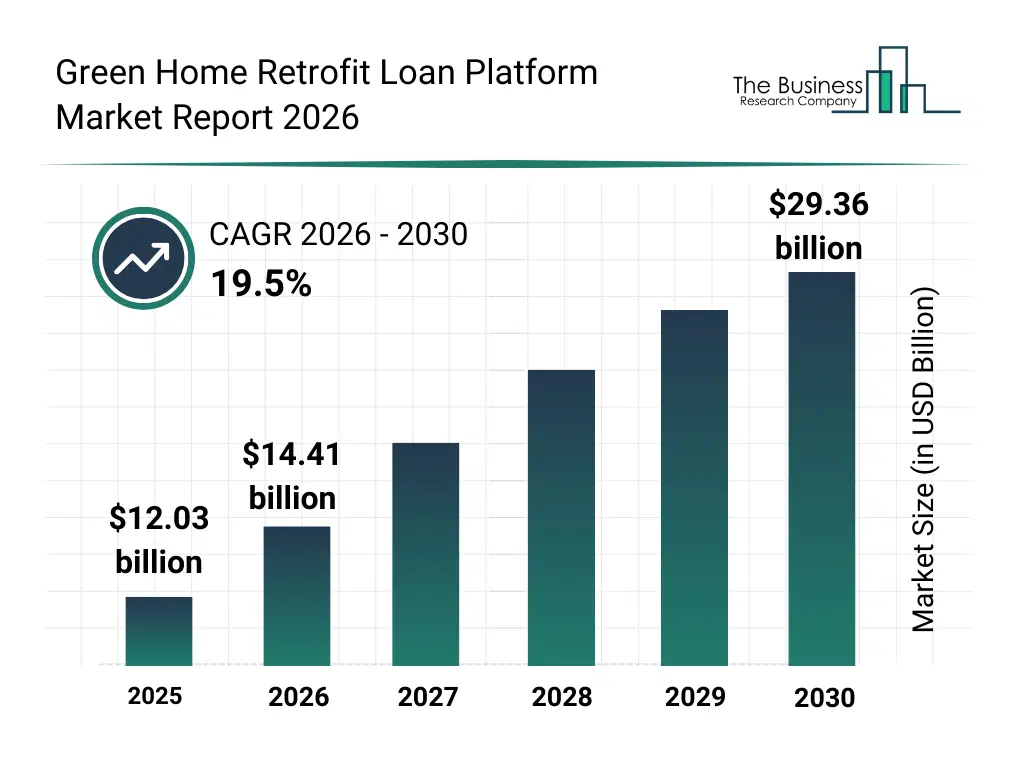
What Is The Green Home Retrofit Loan Platform Market Size and Share 2026?
The green home retrofit loan platform market size has grown rapidly in recent years. It will grow from $12.03 billion in 2025 to $14.41 billion in 2026 at a compound annual growth rate (CAGR) of 19.8%. The growth in the historic period can be attributed to growing demand for energy-efficient housing, early government incentives for home retrofits, rising residential renovation activities, increasing availability of digital lending platforms, initial adoption of green loan programs.What Is The Green Home Retrofit Loan Platform Market Growth Forecast?
The green home retrofit loan platform market size is expected to see rapid growth in the next few years. It will grow to $29.36 billion in 2030 at a compound annual growth rate (CAGR) of 19.5%. The growth in the forecast period can be attributed to expansion of net-zero building targets, rising investments in residential decarbonization, increasing regulatory support for green finance, growing adoption of smart home energy systems, expansion of sustainable housing finance platforms. Major trends in the forecast period include increasing adoption of digital platforms for green financing, rising integration of energy performance tracking tools, growing use of sustainability scoring mechanisms, expansion of government-backed retrofit financing platforms, enhanced focus on transparent fund utilization.
Global Green Home Retrofit Loan Platform Market Segmentation
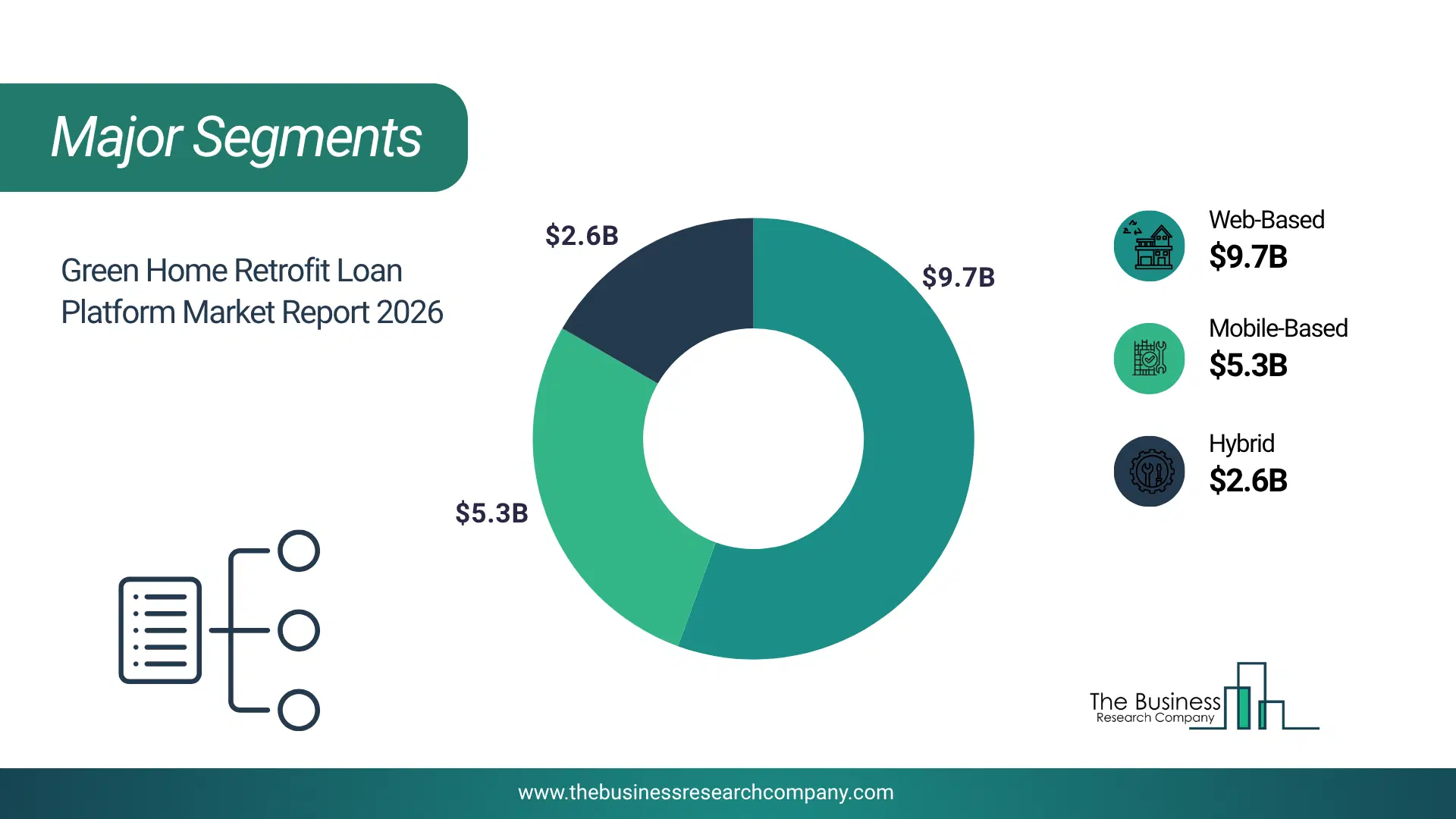
1) By Platform Type: Web-Based, Mobile-Based, Hybrid 2) By Loan Type: Personal Loans, Home Equity Loans, Government-Backed Loans, Green Mortgages, Other Loan Types 3) By Distribution Channel: Direct, Third-Party Agents, Financial Institutions 4) By Application: Residential, Rental Properties 5) By End-User: Homeowners, Landlords, Property Managers Subsegments: 1) By Web-Based: Traditional Desktop Interface, Browser-Based Access, Backend System Integration 2) By Mobile-Based: Touch-Optimized Interface, Mobile App Access, Push Notifications, Location-Based Services 3) By Hybrid: Combined Web And Mobile Interface, Multi-Device Accessibility, Cross-Platform Integration The top segments in the green home retrofit loan platform market will be: • Web-Based will reach $9.62 billion by 2030. • Mobile-Based will reach $5.23 billion by 2030. • Hybrid will reach $2.51 billion by 2030.What Is The Driver Of The Green Home Retrofit Loan Platform Market?
The expansion of residential remodeling activities is expected to propel the growth of the green home retrofit loan platform market going forward. Residential remodeling activity means making changes or improvements to an existing home to enhance its appearance, efficiency, or overall living conditions. Residential remodeling activities are rising due to increasing homeowner focus on improving energy efficiency, as many seek to reduce utility costs and create more sustainable living spaces. Green home retrofit platforms support residential remodeling activities by offering affordable financing solutions that enable homeowners to undertake energy-efficient and sustainable home improvement projects. For instance, in May 2025, according to the National Association of Home Builders (NAHB), a US-based trade association, residential remodeling activity is projected to increase by 5% in 2025, followed by a 3% rise in 2026. Therefore, the expansion of residential remodeling activities is driving the growth of the green home retrofit loan platform industry.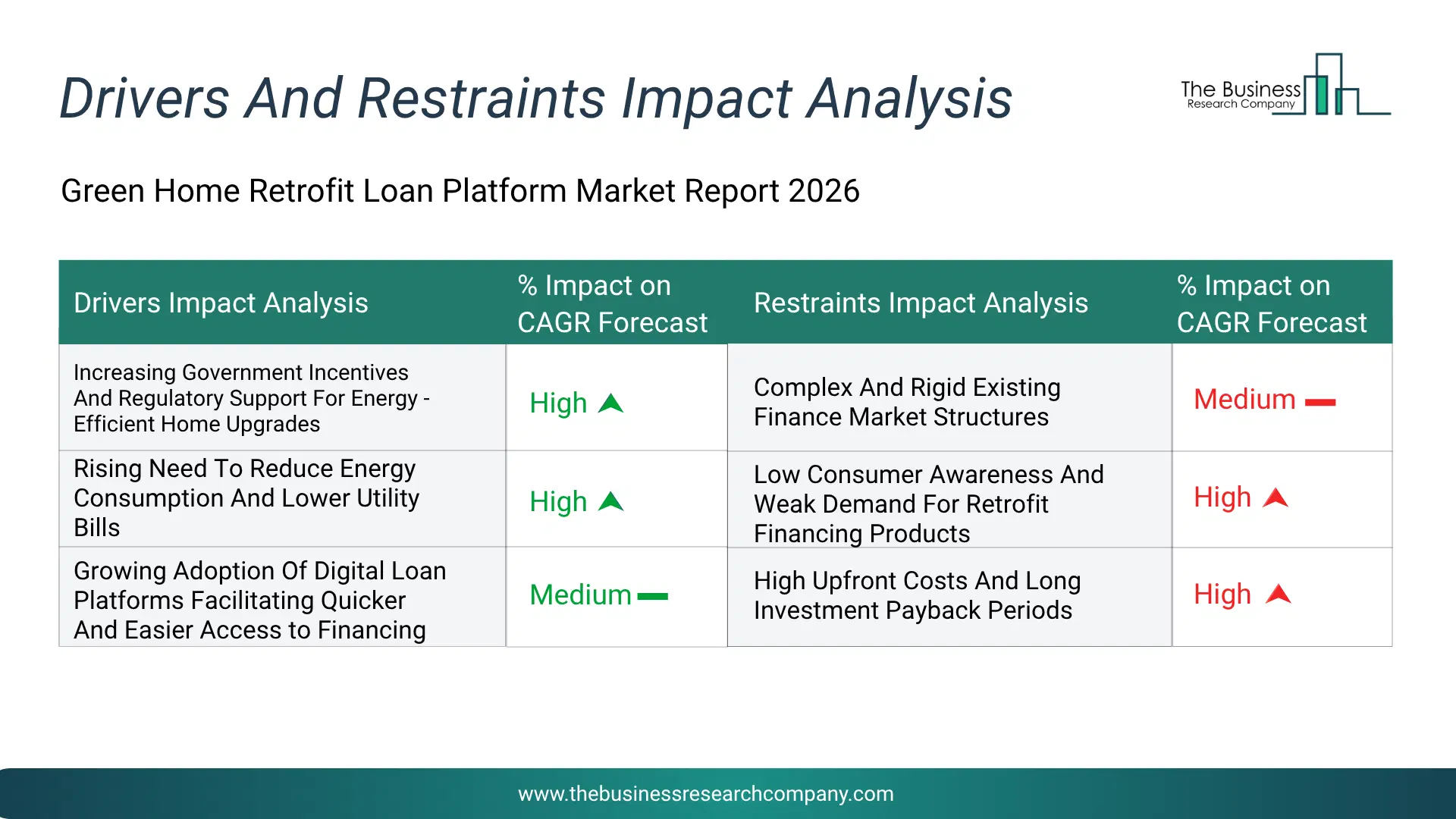
Infographic Chart Showing Key Market Drivers Analysis And Restraints For Green Home Retrofit Loan Platform Market
The chart presents an impact analysis of key drivers and restraints, quantifying their relative influence on the market's growth rate and helping assess the balance between growth enablers and limiting factors. This chart offers a high-level perspective; the full report contains more detailed insights.
How Will The Drivers Impact Growth In The Global Green Home Retrofit Loan Platform Market?
• Increasing Government Incentives And Regulatory Support For Energy -Efficient Home Upgrades (High) – During the forecast period, the increasing government incentives and regulatory support for energy -efficient home upgrades are expected to become a key growth driver for the green home retrofit loan platform market by 2030. Rising government incentives and supportive regulatory frameworks for energy -efficient home upgrades are strengthening demand for green home retrofit loan platforms by making retrofit projects more affordable and accessible. Subsidies, tax credits, and low -interest financing programs help lower initial investment costs and improve the financial feasibility of retrofit projects for homeowners. At the same time, well -defined regulatory policies enhance investor confidence and encourage financial institutions to broaden their green financing offerings. These supportive measures stimulate demand for retrofit funding while aligning with broader decarbonization and sustainability objectives. Overall, strong policy support is accelerating market expansion and encouraging wider adoption of energy -efficient housing solutions. • Rising Need To Reduce Energy Consumption And Lower Utility Bills (High) – During the forecast period, the rising need to reduce energy consumption and lower utility bills is expected to emerge as a major factor driving the expansion of the green home retrofit loan platform market by 2030. Growing concerns about energy consumption and rising utility costs are prompting homeowners to invest in efficiency-enhancing home upgrades. Energy-efficient retrofits such as improved insulation, efficient hvac systems, and solar installations help households significantly reduce long-term energy expenses. Green home retrofit loan platforms support these improvements by offering accessible financing options that minimize upfront cost barriers. Increasing awareness of both financial savings and environmental benefits is encouraging homeowners to adopt sustainable home improvement solutions. This shift toward energy-efficient living is accelerating demand for dedicated retrofit financing platforms. • Growing Adoption Of Digital Loan Platforms Facilitating Quicker And Easier Access to Financing (Medium) – During the forecast period, the growing adoption of digital loan platforms facilitating quicker and easier access to financing is expected to act as a key growth catalyst for the green home retrofit loan platform market by 2030. The expanding use of digital lending platforms is improving the speed, accessibility, and convenience of financing for home retrofit projects. Advanced technologies such as automated credit assessment, online application systems, and digital documentation simplify the borrowing process and reduce approval times. These platforms enhance transparency and allow homeowners to easily compare loan options, encouraging wider adoption of retrofit financing solutions. Financial institutions are also leveraging digital tools to expand their reach and efficiently deliver green lending products. As a result, digital lending ecosystems are making retrofit financing more accessible while improving the overall customer experience.How Will The Restraints Impact Growth In The Global Green Home Retrofit Loan Platform Market?
• Complex And Rigid Existing Finance Market Structures (Medium) – During the forecast period, the complex and rigid existing finance market structures act as a restraint for green home retrofit loan platforms by limiting the flexibility needed to design and distribute specialized green loan products. Traditional banking systems often rely on conventional credit assessment models that fail to capture the long-term value of energy savings, making retrofit loans appear riskier. Fragmented regulations and lack of harmonized standards across regions further complicate product alignment and cross-border financing. Additionally, institutional inertia and slow policy adaptation hinder integration of innovative digital financing tools. As a result, these structural rigidities reduce access, scalability, and investor confidence in green home financing. • Low Consumer Awareness And Weak Demand For Retrofit Financing Products (High) – During the forecast period, the low consumer awareness and weak demand for retrofit financing products act as major restraints for green home retrofit loan platforms because many homeowners are unfamiliar with the financial and environmental benefits of energy-efficient renovations. Limited understanding of available loan schemes and eligibility criteria reduces participation in green financing programs. This lack of awareness leads to lower application rates, making it difficult for platforms to scale operations. Additionally, misconceptions about loan complexity or repayment risks discourage potential borrowers. Consequently, the market experiences slow growth despite increasing policy and institutional support for sustainable housing finance. • High Upfront Costs And Long Investment Payback Periods (High) – During the forecast period, the high upfront costs and long investment payback periods act as major restraints for green home retrofit loan platforms because they discourage homeowners from taking on additional debt for energy-efficient renovations. The initial expenses for technologies like insulation, solar panels, or heat pumps are often substantial, making retrofits financially daunting even with loan support. Since the financial returns from energy savings accrue slowly over many years, borrowers perceive limited short-term benefits. This reduces loan demand and increases default risk for lenders. Consequently, the platform’s overall adoption and profitability are hindered by low consumer participation and delayed return on investment.Key Players In The Global Green Home Retrofit Loan Platform Market
Major companies operating in the green home retrofit loan platform market are Fannie Mae, Freddie Mac, GoodLeap LLC, Renew Financial, Ygrene Energy Fund Inc., Solar Mosaic Inc., Dividend Solar Inc., Sunlight Financial LLC, Sunsave Group Limited, Clean Energy Credit Union, PACE Funding Group, Spruce Finance, Colorado Clean Energy Fund, CPC Climate Capital, SoFi Finance LLC, LendingClub Corp., LightStream, Green Communities Foundation, Avant Brands Inc., Coutts & Co.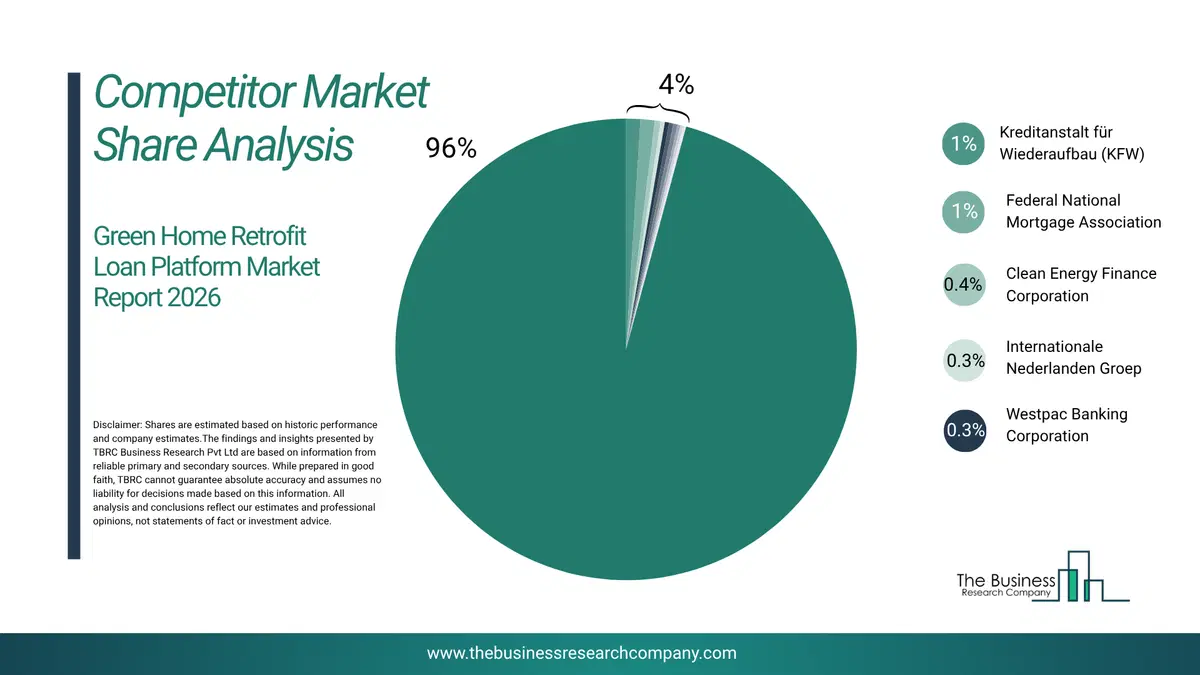
This chart is for illustrative purposes; the full report includes a detailed competitor analysis and comprehensive overview of the top 10 companies in the market.
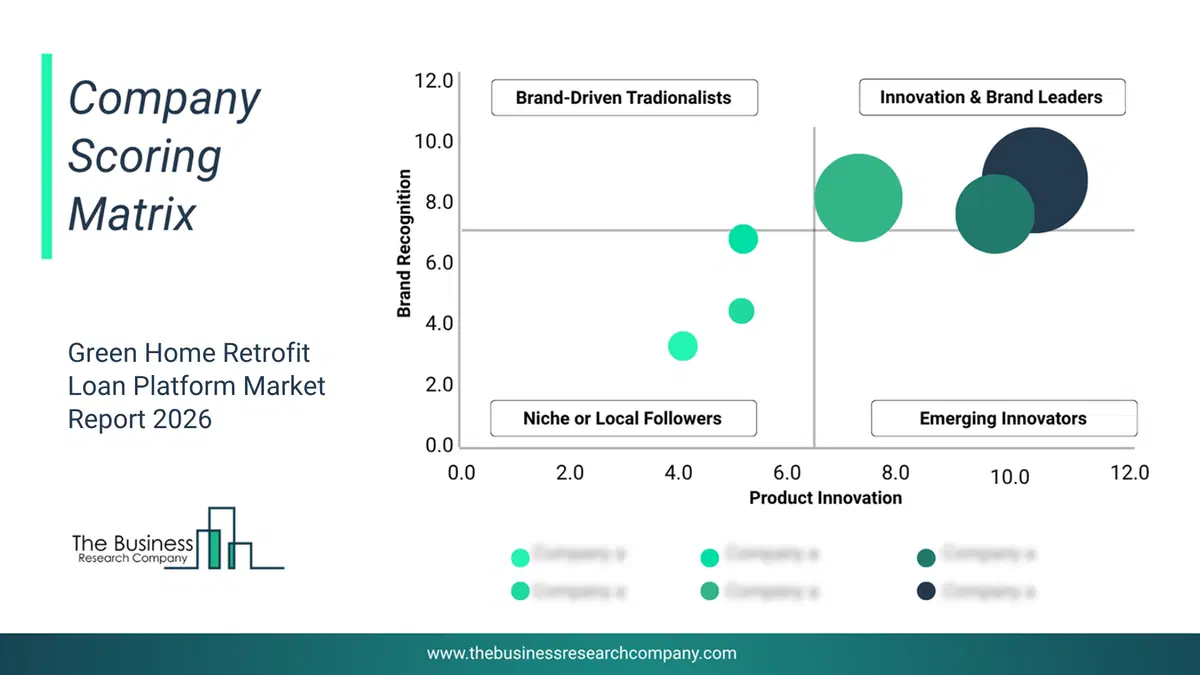
This chart maps companies by product innovation and brand strength, with bubble size indicating relative revenue, helping identify market leaders, challengers, and niche players. This is an illustrative chart; the full report provides a complete and accurate competitive analysis.
Global Green Home Retrofit Loan Platform Market Trends and Insights
Major companies operating in the green home retrofit loan platform market are focusing on developing advanced solutions, such as sustainable upgrade platforms, to help reduce long-term energy costs and enhance the environmental performance of buildings. Sustainable upgrade platforms are services that help homeowners and businesses make environmentally friendly improvements by offering tools, funding, and support for energy-saving and eco-conscious upgrades. For instance, in August 2025, Cogo, a New Zealand-based company offering carbon footprint solutions, launched the Cogo Electrification Tool, a white-label platform that helps users optimize home and vehicle energy efficiency through personalized insights and carbon-saving recommendations. This sustainable upgrade platform offers personalized insights that help homeowners identify energy-efficient improvements, enabling cost savings and measurable carbon reductions. Integrated seamlessly into a green home retrofit loan platform, it allows users to input details such as property address, heating fuel type, and vehicle information to generate tailored upgrade recommendations. The platform provides clear cost analyses, payback timelines, and specific suggestions like solar panels, heat pump installations, insulation improvements, or EV upgrades. Additionally, it connects users with available grants, subsidies, financing options, and trusted local installers to simplify the retrofit process.What Are Latest Mergers And Acquisitions In The Green Home Retrofit Loan Platform Market?
In November 2023, NatWest, a UK-based banking and insurance company, partnered with Airbnb and the Energy Saving Trust to assist hosts in enhancing the energy efficiency of their homes. This tripartite collaboration enables UK homeowners hosting on Airbnb to receive tailored retrofit loan options along with guidance on improving energy efficiency. It also provides direct access to certified installers through NatWest’s online platform. Airbnb is a US-based online marketplace for lodging and tourism experiences, and the Energy Saving Trust is a UK-based organization devoted to promoting energy efficiency.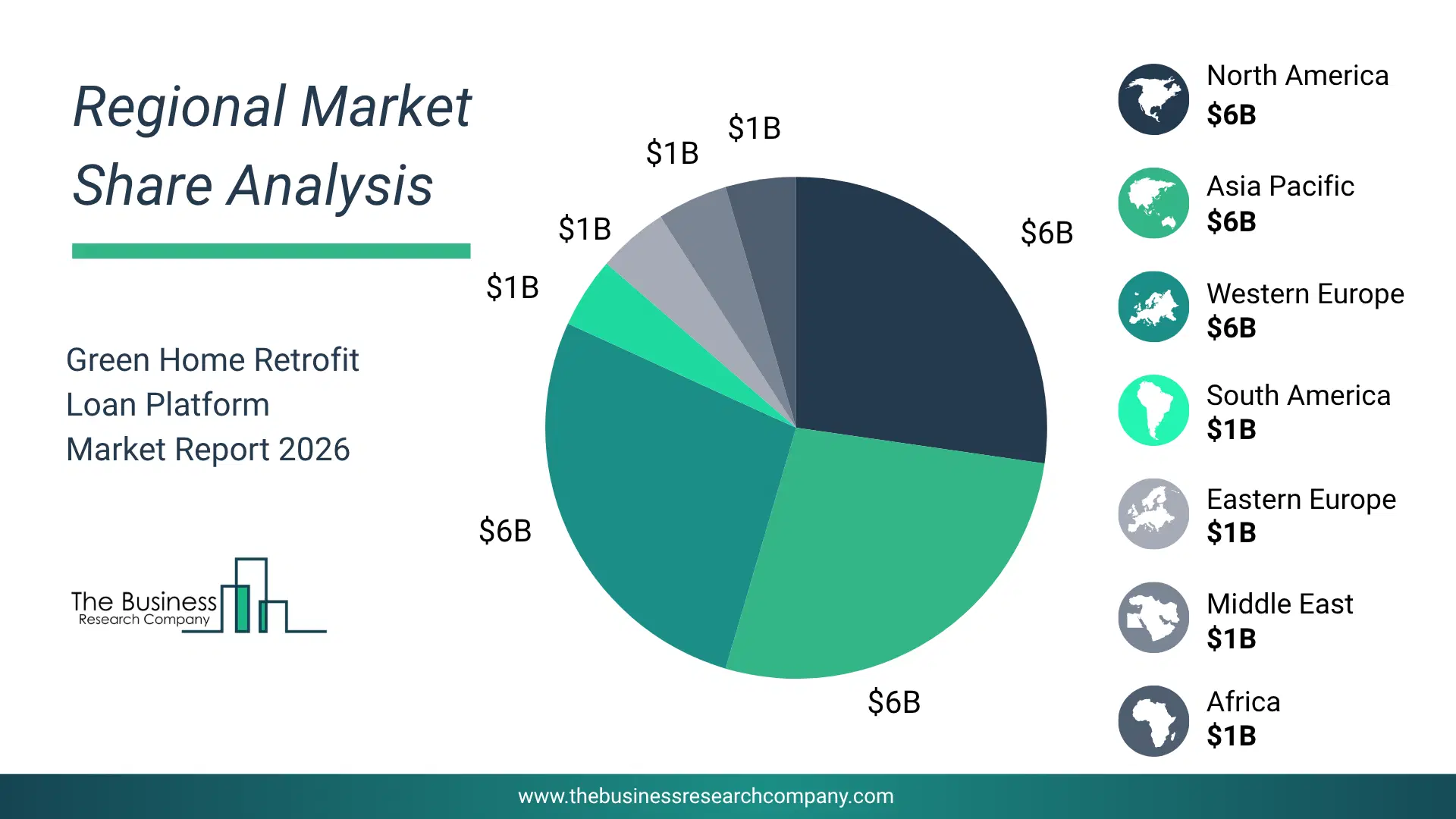
Regional Outlook
North America was the largest region in the green home retrofit loan platform market in 2025. Asia-Pacific is expected to be the fastest-growing region in the forecast period. The regions covered in this market report are Asia-Pacific, South East Asia, Western Europe, Eastern Europe, North America, South America, Middle East, Africa. The countries covered in this market report are Australia, Brazil, China, France, Germany, India, Indonesia, Japan, Taiwan, Russia, South Korea, UK, USA, Canada, Italy, Spain.What Defines the Green Home Retrofit Loan Platform Market?
The green home retrofit loan platform market includes revenues earned by entities by energy efficiency assessment, project financing support, carbon footprint analysis, and sustainability consulting. The market value includes the value of related goods sold by the service provider or included within the service offering. Only goods and services traded between entities or sold to end consumers are included.How is Market Value Defined and Measured?
The market value is defined as the revenues that enterprises gain from the sale of goods and/or services within the specified market and geography through sales, grants, or donations in terms of the currency (in USD unless otherwise specified). The revenues for a specified geography are consumption values that are revenues generated by organizations in the specified geography within the market, irrespective of where they are produced. It does not include revenues from resales along the supply chain, either further along the supply chain or as part of other products.
This chart presents market attractiveness based on a quantitative evaluation of growth, competition, strategic alignment, and risk, offering a clear view of opportunity areas for decision-making. This chart is for illustrative purposes; the full report contains the complete analysis.

This chart highlights the Total Addressable Market (TAM) by estimating the maximum revenue opportunity using an assumption-driven approach, supporting strategic planning and opportunity sizing across markets. The chart is illustrative; the full report provides a more comprehensive analysis.
What Key Data and Analysis Are Included in the Green Home Retrofit Loan Platform Market Report 2026?
The green home retrofit loan platform market research report is one of a series of new reports from The Business Research Company that provides market statistics, including Market Report 2026?global market size, regional shares, competitors with the market share, detailed market segments, market trends and opportunities, and any further data you may need to thrive in the green home retrofit loan platform Market Report 2026? The market research report delivers a complete perspective of everything you need, with an in-depth analysis of the current and future state of the Market Report 2026?Green Home Retrofit Loan Platform Market Report Forecast Analysis
| Report Attribute | Details |
|---|---|
| Market Size Value In 2026 | $14.41 billion |
| Revenue Forecast In 2030 | $29.36 billion |
| Growth Rate | CAGR of 19.5% from 2026 to 2030 |
| Base Year For Estimation | 2025 |
| Actual Estimates/Historical Data | 2020-2025 |
| Forecast Period | 2026 - 2030 |
| Market Representation | Revenue in USD Billion and CAGR from 2026 to 2030 |
| Segments Covered | Platform Type, Loan Type, Distribution Channel, Application, End-User |
| Regional Scope | Asia-Pacific, Western Europe, Eastern Europe, North America, South America, Middle East, Africa |
| Country Scope | The countries covered in the report are Australia, Brazil, China, France, Germany, India, ... |
| Key Companies Profiled | Fannie Mae, Freddie Mac, GoodLeap LLC, Renew Financial, Ygrene Energy Fund Inc., Solar Mosaic Inc., Dividend Solar Inc., Sunlight Financial LLC, Sunsave Group Limited, Clean Energy Credit Union, PACE Funding Group, Spruce Finance, Colorado Clean Energy Fund, CPC Climate Capital, SoFi Finance LLC, LendingClub Corp., LightStream, Green Communities Foundation, Avant Brands Inc., Coutts & Co. |
| Customization Scope | Request for Customization |
| Pricing And Purchase Options | Explore Purchase Options |