
Greywater Recycling Systems Market Report 2026
Global Outlook – By Type (Diversion Systems, Treatment Systems), By Technology (Filtration Technologies, Biological Treatment Technologies, Chemical Treatment Technologies, Membrane Technology), By Application (Residential, Commercial, Industrial), By Distribution Channel (Direct Sales, Authorized Distributors And Dealers, Plumbing And Building Material Retailers), By End User (Households, Hotels, Educational Institutions, Industrial Facilities) – Market Size, Trends, Strategies, and Forecast to 2035
Greywater Recycling Systems Market Overview
• Greywater Recycling Systems market size has reached to $1.5 billion in 2025 • Expected to grow to $2.59 billion in 2030 at a compound annual growth rate (CAGR) of 11.5% • Growth Driver: Increasing Water Scarcity Fueling The Growth Of The Market Due To Climate Change And Limited Access To Safe Water • Market Trend: Smart Technologies Drive Efficient Water Recycling For Urban Sustainability • North America was the largest region in 2025 and Asia-Pacific is the fastest growing region.Market Gains By 2030 – Top Opportunities By Segment
Market Gain identifies the most promising market opportunities by highlighting the segments or products expected to generate the highest incremental revenue growth over the next five years.
What Is Covered Under Greywater Recycling Systems Market?
Greywater recycling systems are water treatment solutions designed to collect, treat, and reuse wastewater from non-toilet sources, such as sinks, showers, and washing machines, to reduce freshwater use and wastewater output. These systems are used for toilet flushing, landscape irrigation, cooling, and industrial processes. Greywater recycling systems conserve fresh water, reduce water usage, and promote sustainability by recycling greywater for everyday household needs. The main types in the greywater recycling systems are diversion systems and treatment systems. Diversion systems refer to methods or mechanisms designed to redirect or separate wastewater, typically greywater, from other waste streams for treatment and reuse. The available technologies encompass filtration, biological treatment, chemical treatment, and membrane technologies. These technologies find applications in various sectors, including residential, commercial, industrial, and agricultural. Distribution channels for these systems include both online and offline platforms. The primary end users are households, hotels, educational institutions, industrial facilities, and other relevant sectors.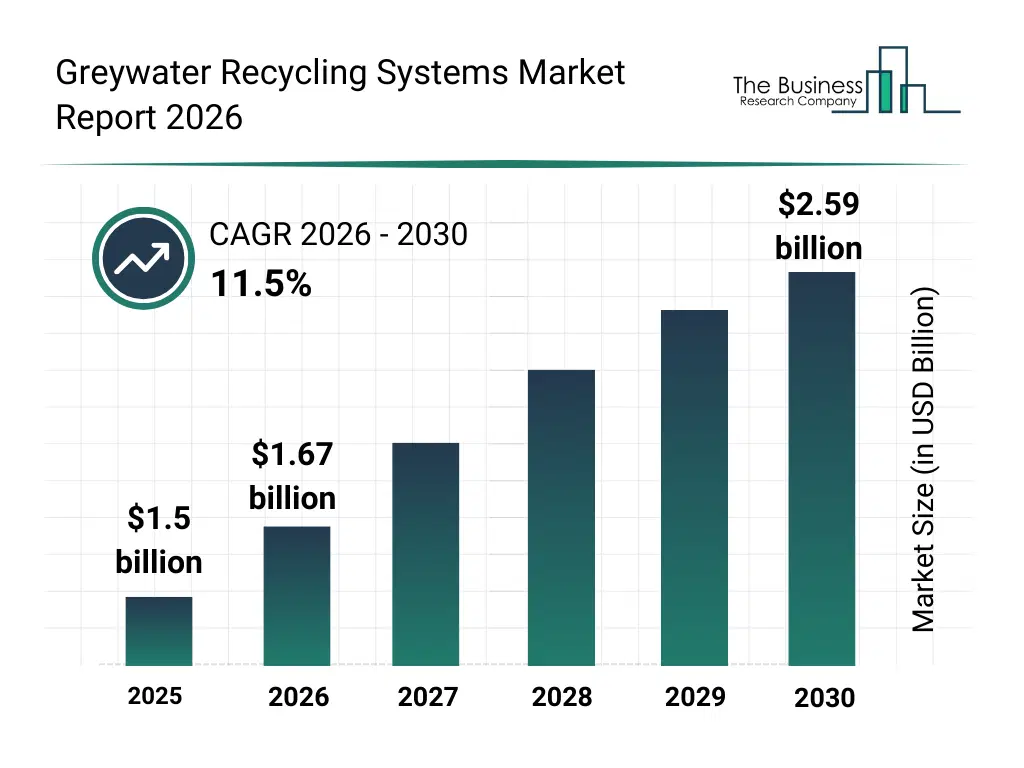
What Is The Greywater Recycling Systems Market Size and Share 2026?
The greywater recycling systems market size has grown rapidly in recent years. It will grow from $1.5 billion in 2025 to $1.67 billion in 2026 at a compound annual growth rate (CAGR) of 11.6%. The growth in the historic period can be attributed to rising water scarcity issues, increasing urbanization and population growth, government regulations on water conservation, advancements in water treatment technologies, growing environmental awareness.What Is The Greywater Recycling Systems Market Growth Forecast?
The greywater recycling systems market size is expected to see rapid growth in the next few years. It will grow to $2.59 billion in 2030 at a compound annual growth rate (CAGR) of 11.5%. The growth in the forecast period can be attributed to increasing adoption of smart water management systems, rising demand for sustainable building solutions, technological innovations in membrane and filtration systems, expansion in commercial and industrial applications, integration with smart city infrastructure. Major trends in the forecast period include integration of smart sensors for greywater monitoring, adoption of ai-driven water management systems, implementation of iot-based water recycling solutions, expansion of automated greywater treatment systems, development of eco-friendly and low-energy treatment technologies.
Global Greywater Recycling Systems Market Segmentation
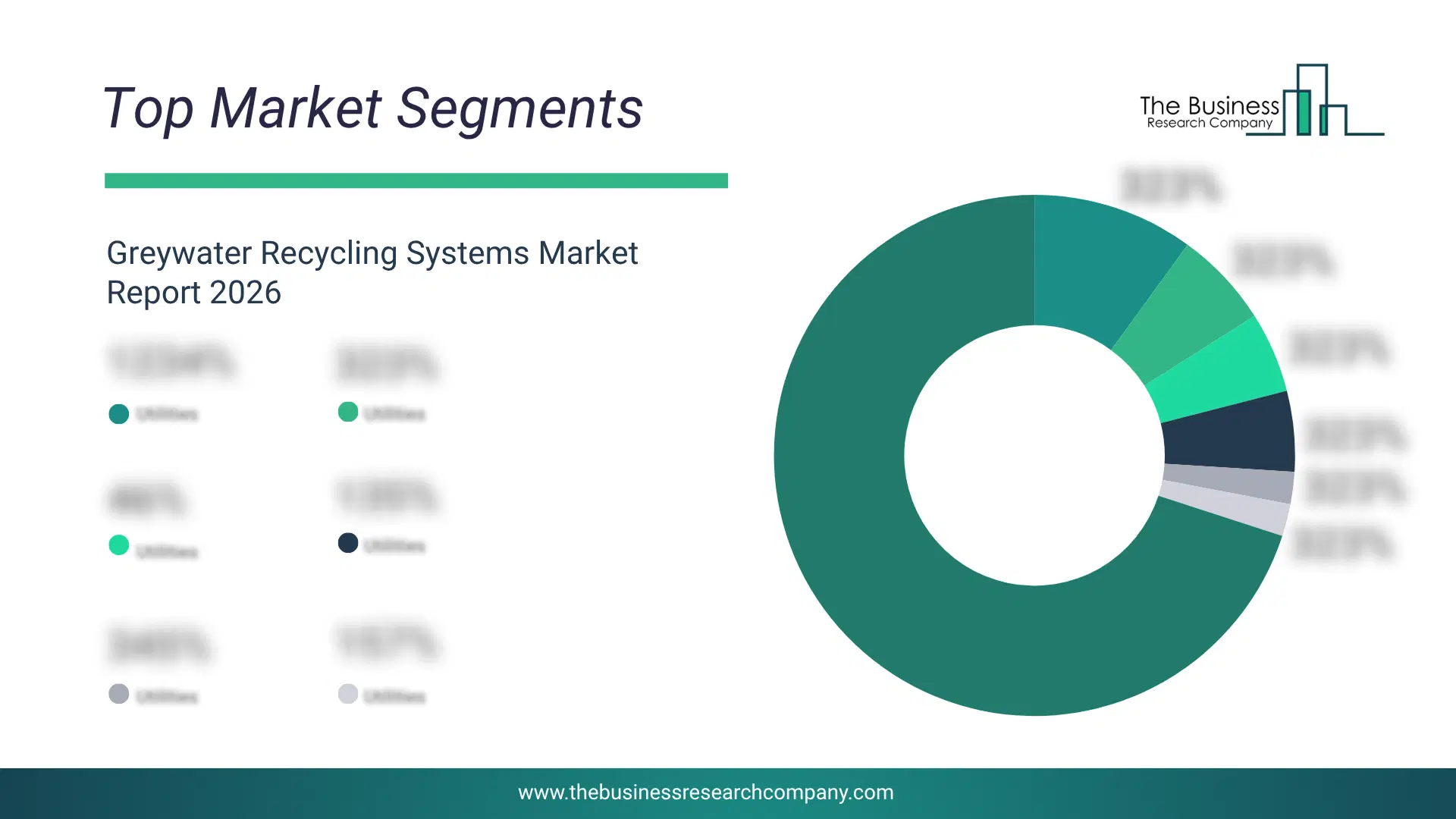
1) By Type: Diversion Systems, Treatment Systems 2) By Technology: Filtration Technologies, Biological Treatment Technologies, Chemical Treatment Technologies, Membrane Technology 3) By Application: Residential, Commercial, Industrial 4) By Distribution Channel: Direct Sales, Authorized Distributors And Dealers, Plumbing And Building Material Retailers 5) By End User: Households, Hotels, Educational Institutions, Industrial Facilities Subsegments: 1) By Diversion Systems: Gravity Fed Diversion Systems, Pump Based Diversion Systems, Manual Diversion Systems, Automatic Diversion Systems 2) By Treatment Systems: Physical Filtration Systems, Biological Treatment Systems, Chemical Treatment Systems, Membrane Filtration Systems, Ultraviolet Disinfection Systems The top segments in the greywater recycling systems market will be: • Diversion Systems will reach $907 Million by 2025. • Residential will reach $784.9 Million by 2025. • Treatment Systems will reach $593 Million by 2025. • Filtration Technologies will reach $499.5 Million by 2025. • Commercial will reach $478.6 Million by 2025.What Is The Driver Of The Greywater Recycling Systems Market?
The increasing water scarcity is expected to propel the growth of the greywater recycling systems market going forward. Water scarcity refers to the situation where the water demand exceeds its available supply in a particular region, leading to insufficient access to basic needs. Water scarcity is rising due to climate change, which causes altered precipitation patterns, more frequent droughts, and increased evaporation, reducing water availability. Greywater recycling systems support water scarcity by offering efficient methods for reusing wastewater from non-potable sources, such as sinks and showers. These systems reduce the demand for freshwater by treating and repurposing greywater for irrigation and toilet flushing, promoting sustainable water usage in urban and industrial areas. For instance, in August 2025, according to the World Health Organization (WHO), a Switzerland-based intergovernmental organization in 2024, 2.1 billion people globally lacked access to safely managed drinking water, including 106 million who relied on untreated surface water, highlighting persistent challenges in water availability. Therefore, the increasing water scarcity is driving the growth of the greywater recycling systems industry.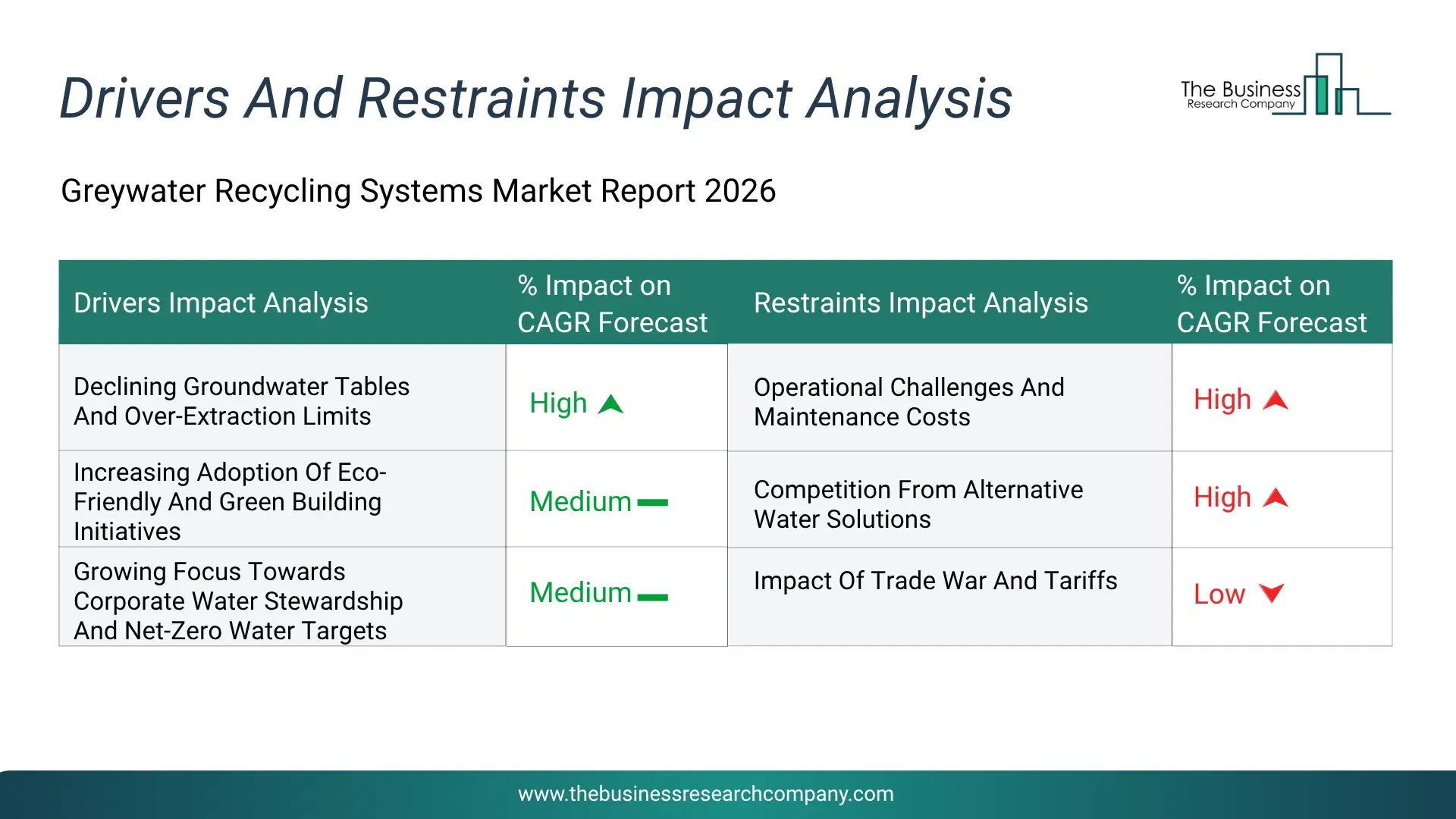
Infographic Chart Showing Key Market Drivers Analysis And Restraints For Greywater Recycling Systems Market
The chart presents an impact analysis of key drivers and restraints, quantifying their relative influence on the market's growth rate and helping assess the balance between growth enablers and limiting factors. This chart offers a high-level perspective; the full report contains more detailed insights.
How Will The Drivers Impact Growth In The Global Greywater Recycling Systems Market?
• Declining Groundwater Tables And Over-Extraction Limits (High) – The declining groundwater tables and over-extraction limits will become a key driver of growth in the greywater recycling systems market by 2030. As water scarcity intensifies across urban and semi-urban regions, regulatory authorities impose stricter controls on groundwater withdrawal, residential, commercial, and industrial users are increasingly seeking alternative water sources to meet non-potable water demands. The excessive depletion of groundwater resources has heightened the need for sustainable water management practices, encouraging the adoption of greywater recycling systems to reduce dependency on freshwater sources. These systems enable the reuse of wastewater from showers, sinks, and laundry for applications such as irrigation, flushing, and cooling, thereby conserving groundwater reserves. The growing emphasis on water conservation, coupled with regulatory restrictions on groundwater extraction, is expected to accelerate the adoption of greywater recycling technologies, supporting sustained growth in the greywater recycling systems market. As a result, the declining groundwater tables and over-extraction limits is anticipated to contributing to a 2.0% annual growth in the market. • Increasing Adoption Of Eco-Friendly And Green Building Initiatives (Medium) – The increasing adoption of eco-friendly and green building initiatives will emerge as a major factor driving the expansion of the greywater recycling systems market by 2030. As developers, architects, and urban planners continue to prioritize sustainable construction and resource-efficient infrastructure, a larger share of residential, commercial, and institutional buildings is expected to integrate greywater recycling systems to reduce freshwater consumption and wastewater discharge. Green building approaches are more likely to enhance water efficiency, lower operational costs, and support environmental compliance, increasing demand for advanced greywater treatment solutions such as decentralized recycling units, smart filtration systems, and automated water reuse technologies. The growing emphasis on sustainable construction standards and green certifications is expected to accelerate the adoption of greywater recycling systems, supporting continued growth in the greywater recycling systems market. Consequently, the increasing adoption of eco-friendly and green building initiatives is projected to contributing to a 1.5% annual growth in the market. • Growing Focus Towards Corporate Water Stewardship And Net-Zero Water Targets (Medium) – The Growing focus towards corporate water stewardship and net-zero water targets will serve as a key growth catalyst for the greywater recycling systems market by 2030. As corporations, industrial facilities, and commercial real estate developers increasingly prioritize sustainable water management and resource efficiency, a larger share of organizations is expected to adopt greywater recycling systems to reduce freshwater consumption and wastewater discharge. Corporate sustainability commitments and net-zero water goals are more likely to encourage the implementation of on-site water reuse solutions for non-potable applications such as cooling, landscaping, and sanitation. These initiatives are expected to enhance operational resilience, lower water-related costs, and support compliance with environmental regulations, increasing demand for advanced greywater treatment and recycling technologies. The growing emphasis on corporate water responsibility and circular water usage is expected to accelerate the adoption of greywater recycling systems, supporting continued growth in the greywater recycling systems market. Therefore, this focus towards corporate water stewardship and net-zero water targets is projected to supporting to a 1.0% annual growth in the market. • Increasing Focus On Modernization Of Aging Water Infrastructure (Low) – The increasing focus on modernization of aging water infrastructure will become a significant driver contributing to the growth of the greywater recycling systems market by 2030. As municipalities, utilities, and infrastructure authorities continue to upgrade outdated water systems, aging infrastructure and capacity constraints are expected to drive the adoption of decentralized greywater recycling solutions for efficient local wastewater reuse. Modernization initiatives are also expected to incorporate smart monitoring, automation, and advanced filtration technologies, increasing the efficiency and reliability of greywater systems. The growing emphasis on infrastructure upgrades and sustainable water management is expected to accelerate the adoption of greywater recycling systems, supporting continued growth in the greywater recycling systems market. Consequently, the increasing focus on modernization of aging water infrastructure is projected to contributing to a 0.8% annual growth in the market.How Will The Restraints Impact Growth In The Global Greywater Recycling Systems Market?
• Operational Challenges And Maintenance Costs (High) – Operational challenges and maintenance costs is expected to restrain market growth during the forecast period. It creates operational, financial, regulatory, or commercial challenges that can increase costs, delay projects, reduce investments, or discourage purchasing decisions depending on the market. These challenges can reduce product adoption, affect business confidence, and limit the ability of companies to expand efficiently across key regions. This can disrupt long-term growth strategies and reduce the ability of companies to capitalize on emerging market opportunities. • Competition From Alternative Water Solutions (Medium) – During the forecast period, competition from alternative water solutions is likely to limit market expansion. It creates operational, financial, regulatory, or commercial challenges that can increase costs, delay projects, reduce investments, or discourage purchasing decisions depending on the market. These challenges can reduce product adoption, affect business confidence, and limit the ability of companies to expand efficiently across key regions. As a result, organizations may postpone purchasing decisions, limiting demand across both established and emerging markets. • Impact Of Trade War And Tariffs (Medium) – The market is expected to face challenges due to impact of trade war and tariffs over the forecast period. It creates operational, financial, regulatory, or commercial challenges that can increase costs, delay projects, reduce investments, or discourage purchasing decisions depending on the market. These challenges can reduce product adoption, affect business confidence, and limit the ability of companies to expand efficiently across key regions. This may reduce production efficiency, extend project timelines, and create challenges in meeting evolving customer requirements.Key Players In The Global Greywater Recycling Systems Market
Major companies operating in the greywater recycling systems market are Watts Water Technologies Incorporated, Hydraloop Systems, Greyter Water Systems, Aqua2use, ReWater Systems, Newterra Inc., Kingspan Group Public Limited Company, Stormsaver Limited, Coerco, Ecozi Limited, Cleantech Water, Ecovie Water Management, W&F Technologies BV, Aquacell, EcoGreensolutions, D & D Ecotech Services, JalSevak Solutions, N S And Associates, Waterwise Group, Nubian Water Systems, BioGill, Organica Water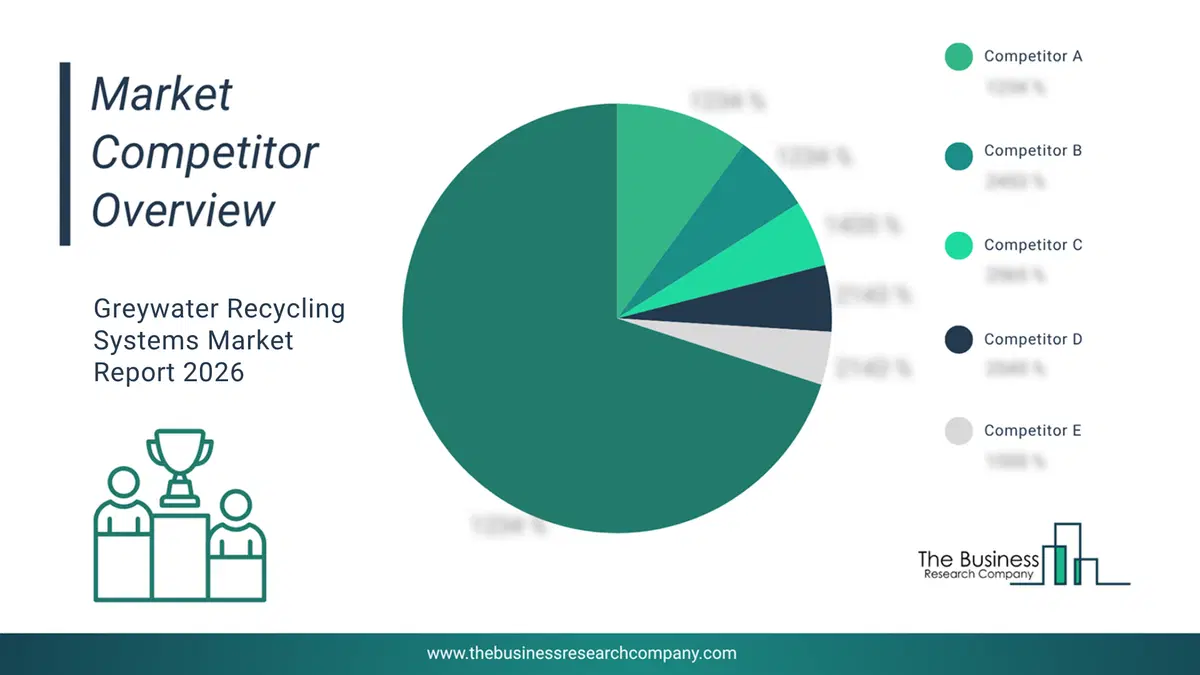
This chart is for illustrative purposes; the full report includes a detailed competitor analysis and comprehensive overview of the top 10 companies in the market.
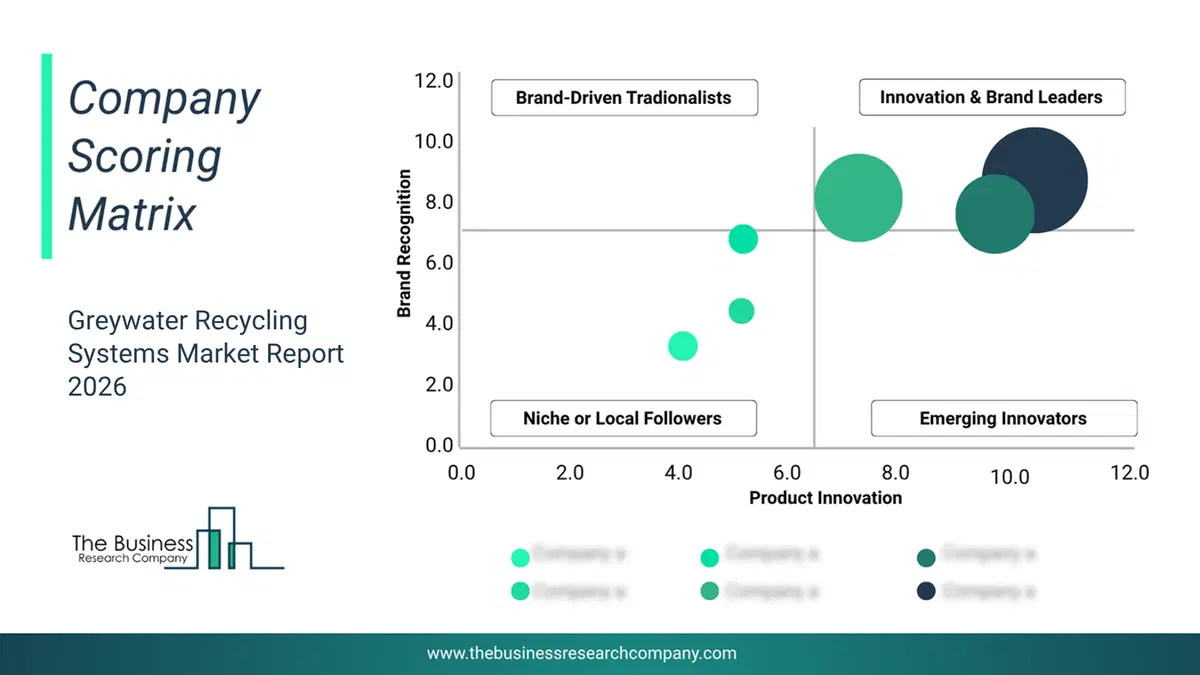
This chart maps companies by product innovation and brand strength, with bubble size indicating relative revenue, helping identify market leaders, challengers, and niche players. This is an illustrative chart; the full report provides a complete and accurate competitive analysis.
Global Greywater Recycling Systems Market Trends and Insights
Major companies operating in the greywater recycling systems market are focusing on developing innovative solutions by integrating smart technologies, such as the mobile greywater reuse system, to provide sustainable and efficient water management solutions that support urban areas. The mobile greywater reuse system is a portable solution that treats and recycles greywater on-site for non-potable uses, such as toilet flushing and irrigation, promoting sustainable water management. For instance, in May 2024, Nijhuis Saur Industries, a Netherlands-based industrial water company, launched the Grey Water Treatment 2.0 solution. This mobile water treatment unit enables the decentralized treatment and reuse of greywater for toilet flushing and irrigation applications. The innovative solution addresses water management challenges in real estate developments and disaster relief areas, promoting sustainable water usage in rapidly growing urban populations.What Are Latest Mergers And Acquisitions In The Greywater Recycling Systems Market?
In May 2023, Coerco, an Australia-based liquid management company, acquired Aquarius Wastewater Systems Pty Ltd. for an undisclosed amount. With this acquisition, Coerco aims to expand its capabilities in wastewater and greywater treatment solutions, enhancing its product portfolio and strengthening its position in the residential, commercial, and industrial water management sectors. Aquarius Wastewater Systems Pty Ltd. is an Australia-based wastewater treatment company specializing in greywater recycling systems.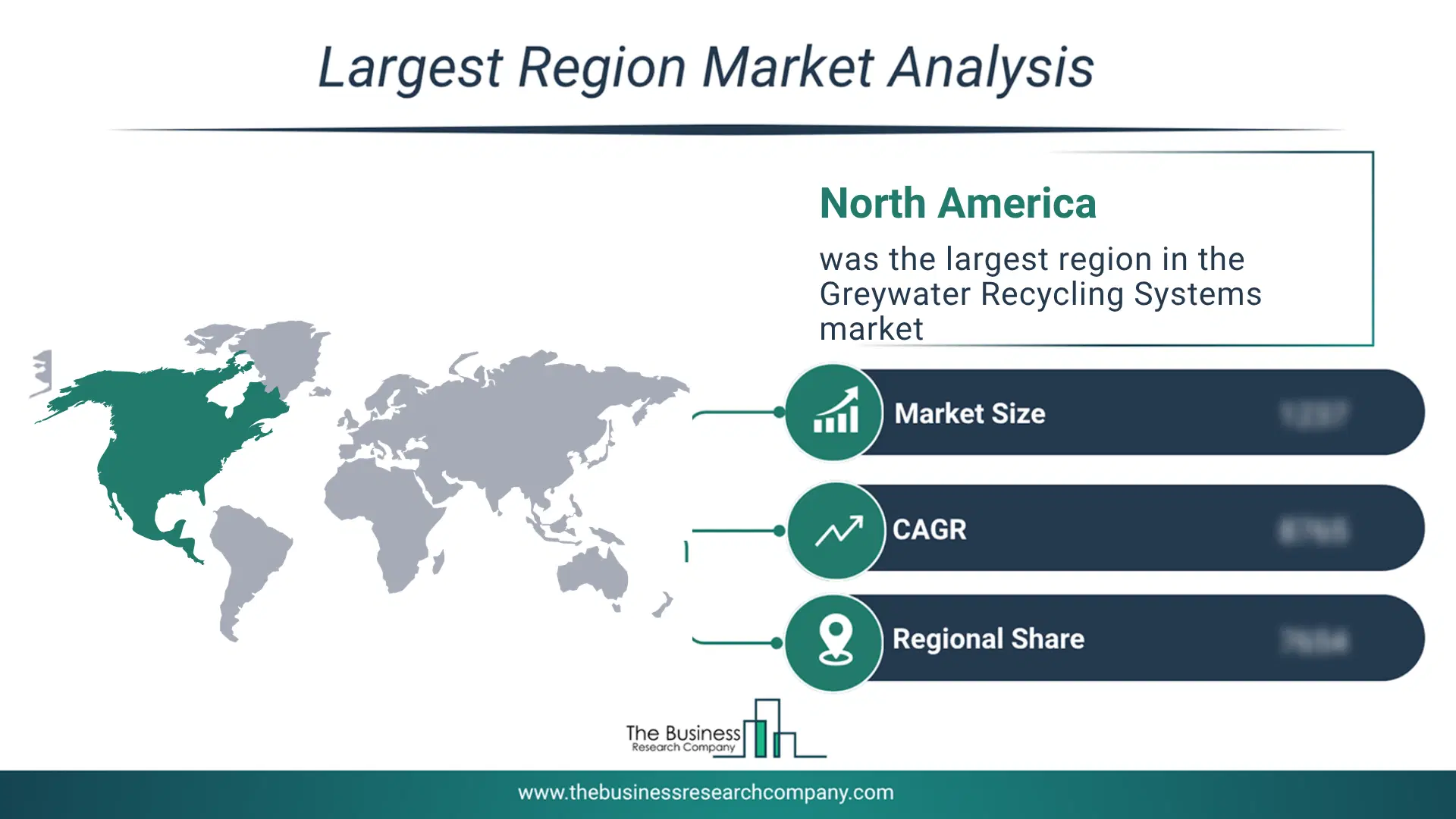
Regional Outlook
North America was the largest region in the greywater recycling systems market in 2025. Asia-Pacific is expected to be the fastest-growing region in the forecast period. The regions covered in this market report are Asia-Pacific, South East Asia, Western Europe, Eastern Europe, North America, South America, Middle East, Africa. The countries covered in this market report are Australia, Brazil, China, France, Germany, India, Indonesia, Japan, Taiwan, Russia, South Korea, UK, USA, Canada, Italy, SpainWhat Defines the Greywater Recycling Systems Market?
The greywater recycling systems market consists of revenues earned by entities by providing services such as system design and engineering, installation services, regulatory compliance and consultation and water quality monitoring. The market value includes the value of related goods sold by the service provider or included within the service offering. The greywater recycling systems market also includes sales of recycling units, filtration systems, pumps, tanks, sensors, valves, pipes, control panels, and associated plumbing components, as well as pre-fabricated greywater treatment kits for residential and commercial use. Values in this market are ‘factory gate’ values, that is, the value of goods sold by the manufacturers or creators of the goods, whether to other entities (including downstream manufacturers, wholesalers, distributors, and retailers) or directly to end customers. The value of goods in this market includes related services sold by the creators of the goods.How is Market Value Defined and Measured?
The market value is defined as the revenues that enterprises gain from the sale of goods and/or services within the specified market and geography through sales, grants, or donations in terms of the currency (in USD unless otherwise specified). The revenues for a specified geography are consumption values that are revenues generated by organizations in the specified geography within the market, irrespective of where they are produced. It does not include revenues from resales along the supply chain, either further along the supply chain or as part of other products.
This chart presents market attractiveness based on a quantitative evaluation of growth, competition, strategic alignment, and risk, offering a clear view of opportunity areas for decision-making. This chart is for illustrative purposes; the full report contains the complete analysis.

This chart highlights the Total Addressable Market (TAM) by estimating the maximum revenue opportunity using an assumption-driven approach, supporting strategic planning and opportunity sizing across markets. The chart is illustrative; the full report provides a more comprehensive analysis.
What Key Data and Analysis Are Included in the Greywater Recycling Systems Market Report 2026?
The greywater recycling systems market research report is one of a series of new reports from The Business Research Company that provides market statistics, including Market Report 2026?global market size, regional shares, competitors with the market share, detailed market segments, market trends and opportunities, and any further data you may need to thrive in the greywater recycling systems Market Report 2026? The market research report delivers a complete perspective of everything you need, with an in-depth analysis of the current and future state of the Market Report 2026?Greywater Recycling Systems Market Report Forecast Analysis
| Report Attribute | Details |
|---|---|
| Market Size Value In 2026 | $1.67 billion |
| Revenue Forecast In 2035 | $2.59 billion |
| Growth Rate | CAGR of 11.6% from 2026 to 2035 |
| Base Year For Estimation | 2025 |
| Actual Estimates/Historical Data | 2020-2025 |
| Forecast Period | 2026 - 2030 - 2035 |
| Market Representation | Revenue in USD Billion and CAGR from 2026 to 2035 |
| Segments Covered | Type, Technology, Application, Distribution Channel, End User |
| Regional Scope | Asia-Pacific, Western Europe, Eastern Europe, North America, South America, Middle East, Africa |
| Country Scope | The countries covered in the report are Australia, Brazil, China, France, Germany, India, ... |
| Key Companies Profiled | Watts Water Technologies Incorporated, Hydraloop Systems, Greyter Water Systems, Aqua2use, ReWater Systems, Newterra Inc., Kingspan Group Public Limited Company, Stormsaver Limited, Coerco, Ecozi Limited, Cleantech Water, Ecovie Water Management, W&F Technologies BV, Aquacell, EcoGreensolutions, D & D Ecotech Services, JalSevak Solutions, N S And Associates, Waterwise Group, Nubian Water Systems, BioGill, Organica Water |
| Customization Scope | Request for Customization |
| Pricing And Purchase Options | Explore Purchase Options |