
Grid Frequency Control Market Report 2026
Global Outlook – By Component (Hardware, Software, Services), By Solution (Primary Frequency Control, Secondary Frequency Control, Tertiary Frequency Control, Other Solutions), By Technology (Battery Energy Storage Systems, Flywheels, Supercapacitors, Demand Response, Other Technologies), By Application (Power Generation, Transmission, Distribution, Industrial), By End-User (Utilities, Independent Power Producers, Industrial, Commercial) – Market Size, Trends, Strategies, and Forecast to 2030
Grid Frequency Control Market Overview
• Grid Frequency Control market size has reached to $2.45 billion in 2025 • Expected to grow to $4 billion in 2030 at a compound annual growth rate (CAGR) of 10.3% • Growth Driver: Surge In Renewable Energy Penetration Driving The Growth Of The Market Due To Rising Demand For Frequency Stability And Ancillary Grid Services • Market Trend: Adoption Of Grid-Forming Inverter Technologies To Strengthen Grid Frequency Control • North America was the largest region in 2025 and Asia-Pacific is the fastest growing region.What Is Covered Under Grid Frequency Control Market?
Grid frequency control refers to the mechanisms and systems used to maintain the electrical grid frequency within specified limits by continuously balancing power generation and consumption. It helps to ensure grid stability, prevent equipment damage and blackouts, and maintain a reliable and high-quality power supply. The main components of grid frequency control are hardware, software, and services. Hardware refers to physical devices and equipment used to monitor, regulate, and stabilize grid frequency in real time. These solutions include various solutions, such as primary frequency control, secondary frequency control, tertiary frequency control, and other solutions, and leverage different technologies, including battery energy storage systems, flywheels, supercapacitors, demand response, and other technologies. They are applied across multiple applications, such as power generation, transmission, distribution, and industrial, and serve diverse end-users, including utilities, independent power producers, industrial, and commercial sectors.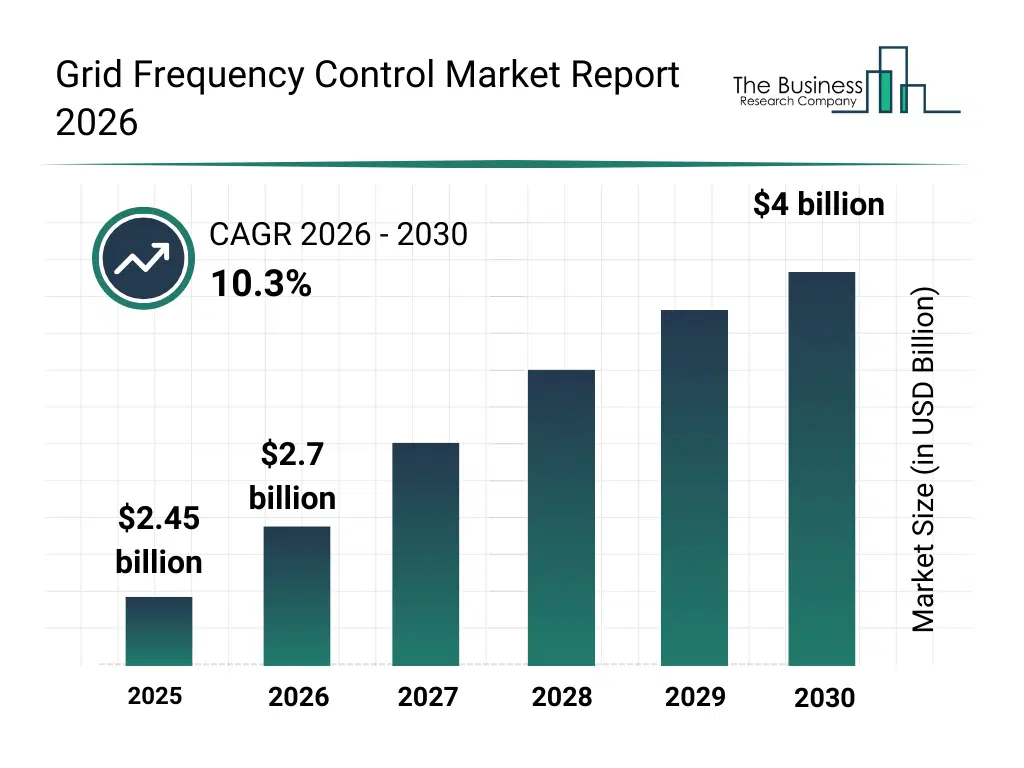
What Is The Grid Frequency Control Market Size and Share 2026?
The grid frequency control market size has grown rapidly in recent years. It will grow from $2.45 billion in 2025 to $2.7 billion in 2026 at a compound annual growth rate (CAGR) of 10.1%. The growth in the historic period can be attributed to increasing penetration of variable renewable energy, expansion of interconnected power grids, reliance on conventional frequency regulation assets, early deployment of grid-scale storage, growth of ancillary service markets.What Is The Grid Frequency Control Market Growth Forecast?
The grid frequency control market size is expected to see rapid growth in the next few years. It will grow to $4 billion in 2030 at a compound annual growth rate (CAGR) of 10.3%. The growth in the forecast period can be attributed to increasing renewable energy integration, rising electrification of transport, growing investments in grid-scale storage, expansion of real-time grid control solutions, increasing focus on grid stability standards. Major trends in the forecast period include increasing use of battery energy storage for frequency regulation, rising deployment of automated generation control systems, growing adoption of fast-response power electronics, expansion of demand response participation, enhanced focus on real-time grid balancing.
Global Grid Frequency Control Market Segmentation
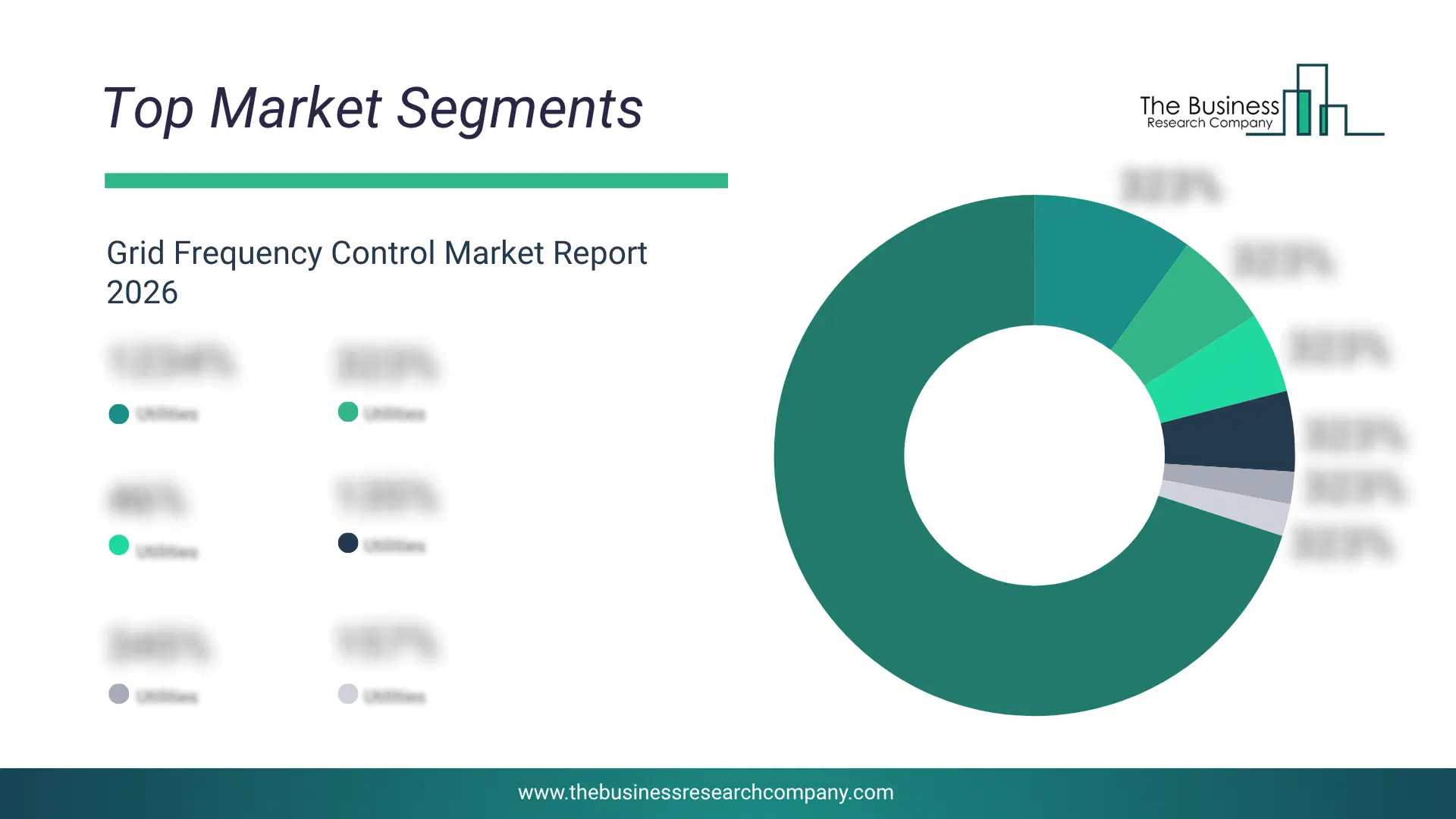
1) By Component: Hardware; Software; Services 2) By Solution: Primary Frequency Control; Secondary Frequency Control; Tertiary Frequency Control; Other Solutions 3) By Technology: Battery Energy Storage Systems; Flywheels; Supercapacitors; Demand Response; Other Technologies 4) By Application: Power Generation; Transmission; Distribution; Industrial 5) By End-User: Utilities; Independent Power Producers; Industrial; Commercial Subsegments: 1) By Hardware: Governors And Turbine Control Systems; Automatic Generation Control Units; Power Electronic Converters; Frequency Sensors And Relays; Energy Storage Systems 2) By Software: Frequency Monitoring Software; Grid Control And Optimization Software; Load Forecasting And Scheduling Software; Real-Time Analytics And Visualization Software; Simulation And Modeling Software 3) By Services: Frequency Regulation Services; Grid Balancing And Ancillary Services; System Integration And Deployment Services; Operation And Maintenance Services; Consulting And Optimization ServicesWhat Is The Driver Of The Grid Frequency Control Market?
The rising renewable energy penetration is expected to propel the growth of the Grid Frequency Control market going forward. Renewable energy penetration refers to the proportion or share of total electricity generation in a power system that is supplied by renewable energy sources such as solar, wind, hydro, and biomass. The rise in renewable energy penetration is increasing due to record additions driven by falling costs and policy support for decarbonization. The grid frequency control supports rising renewable energy penetration by providing essential ancillary services like primary, secondary, and tertiary control to counteract intermittency and low inertia effects for grid stability. For instance, in December 2025, according to the European Union, a Belgium-based organization, renewable energy penetration in the EU continued to increase, with renewables accounting for 25.2% of gross final energy consumption in 2024, up from 24.6% in 2023, while the share of renewable energy used in transport rose to 11.2% from 10.9% over the same period. Therefore, the rising renewable energy penetration is driving the growth of the grid frequency control industry.Key Players In The Global Grid Frequency Control Market
Major companies operating in the grid frequency control market are BYD Co. Ltd., Siemens AG, Hitachi Energy, Schneider Electric, Mitsubishi Electric Corporation, Honeywell International, GE Vernova, ABB Ltd., Toshiba Corporation, Eaton Corporation, Emerson Electric Co., Sungrow Power Supply, Rockwell Automation, Wärtsilä Corporation, Yokogawa Electric Corporation, Woodward Inc., Fluence Energy, Itron Inc., Schweitzer Engineering Laboratories (SEL), Landis+Gyr, S&C Electric Company, DEIF A/S, ComAp a.s., NARI Technology Co. Ltd., NR Electric Co. Ltd., Nuvve Holding Corp.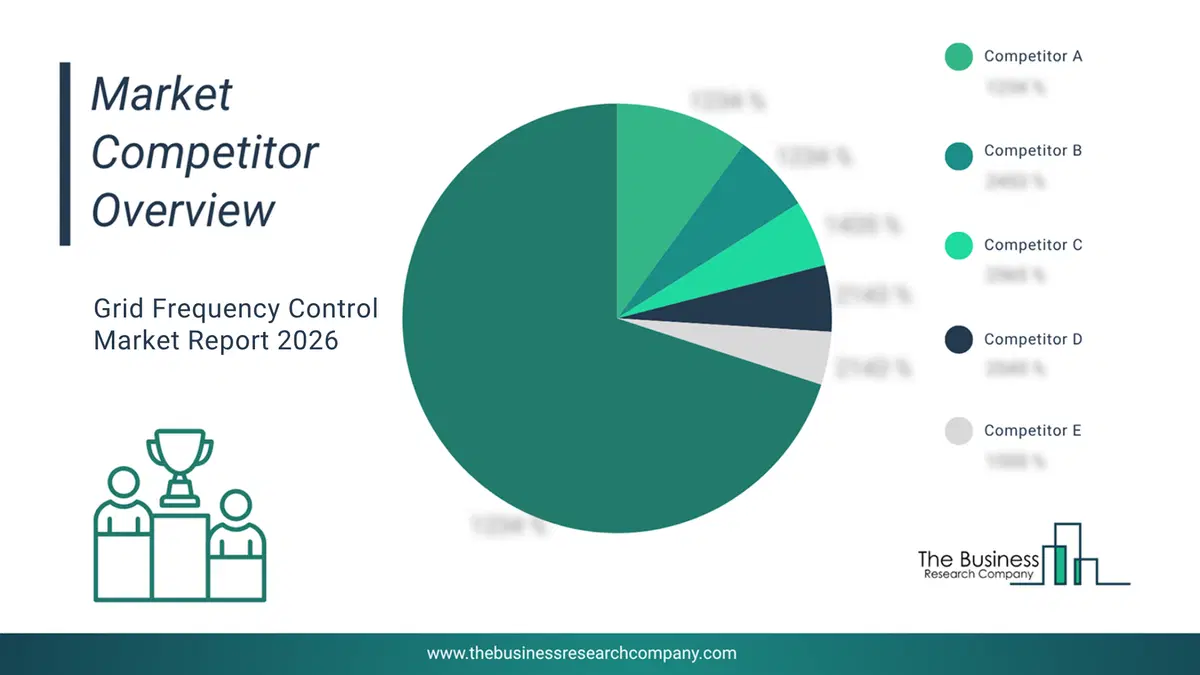
This chart is for illustrative purposes; the full report includes a detailed competitor analysis and comprehensive overview of the top 10 companies in the market.
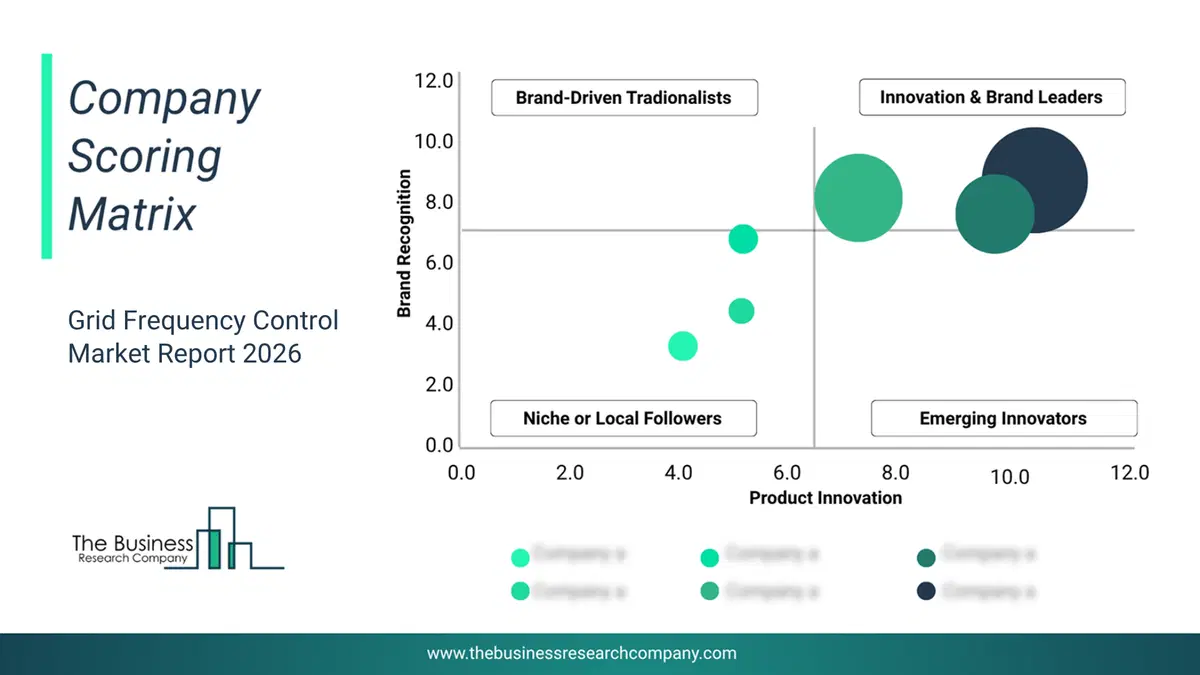
This chart maps companies by product innovation and brand strength, with bubble size indicating relative revenue, helping identify market leaders, challengers, and niche players. This is an illustrative chart; the full report provides a complete and accurate competitive analysis.
Global Grid Frequency Control Market Trends and Insights
Major companies operating in the grid frequency control market are focusing on technological innovation, such as power conditioners, to enhance frequency stability, replace lost system inertia from retiring thermal plants, and improve supply-side responsiveness under high renewable penetration. Grid-forming inverters refer to power-electronic systems that actively establish and regulate voltage and frequency at the point of interconnection, enabling stable operation of grids and microgrids during disturbances and low-inertia conditions. For instance, in April 2025, Hitachi Industrial Equipment Systems Co., Ltd., a Japan-based technology company, launched a next-generation grid-forming inverter system in the form of a power conditioner at its Narashino Works facility. The system is designed to stabilize the plant’s electricity supply by simulating generator inertia, supporting precise frequency control amid renewable energy variability, and integrating solar power, energy storage, and advanced inverter controls to enable autonomous operation during grid disruptions and strengthen local frequency management.What Are Latest Mergers And Acquisitions In The Grid Frequency Control Market?
In October 2024, Calibrant Energy, a US-based provider of distributed energy, energy-as-a-service, and battery energy storage systems (BESS), acquired Enel X Storage, LLC, for an undisclosed amount. With this acquisition, Calibrant Energy aims to expand its distributed energy asset base and optimization capabilities, strengthening its ability to deliver scalable clean energy, resilience, and grid-support services to commercial, industrial, and institutional customers across North America. Enel X Storage, LLC, is a US-based provider of battery energy storage projects, distributed energy solutions, and optimization services supporting grid services and customer-sited energy management.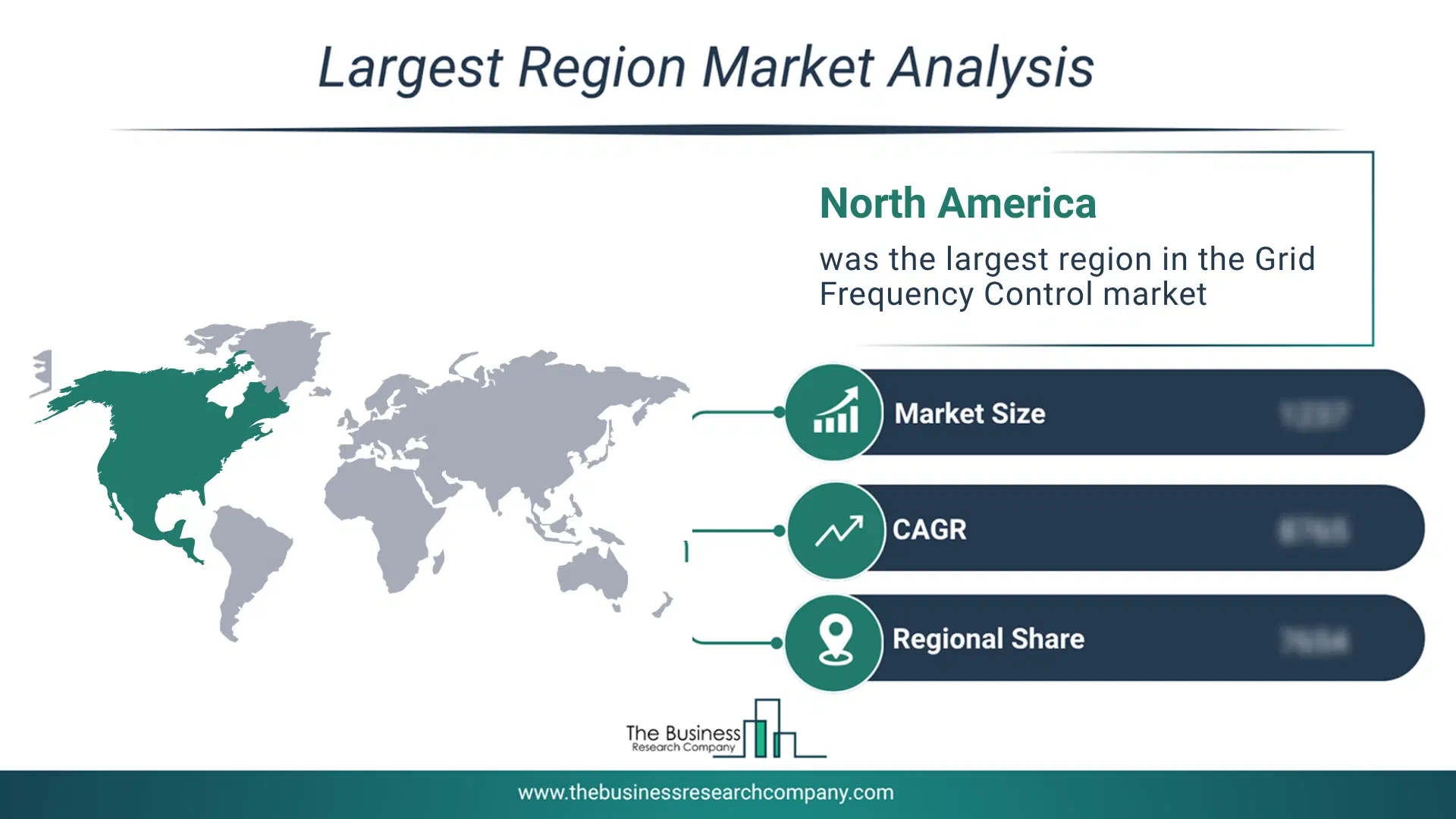
Regional Insights
North America was the largest region in the grid frequency control market in 2025. Asia-Pacific is expected to be the fastest-growing region in the forecast period. The regions covered in this market report are Asia-Pacific, South East Asia, Western Europe, Eastern Europe, North America, South America, Middle East, Africa. The countries covered in this market report are Australia, Brazil, China, France, Germany, India, Indonesia, Japan, Taiwan, Russia, South Korea, UK, USA, Canada, Italy, Spain.What Defines the Grid Frequency Control Market?
The grid frequency control market consists of revenues earned by entities by providing services such as ancillary services participation and management, automatic generation control (AGC) operation, grid balancing and load-generation optimization, and system tuning and optimization. The market value includes the value of related goods sold by the service provider or included within the service offering. The grid frequency control market includes sales of grid-scale energy storage systems, power electronic converters and inverters, frequency relays and sensors, communication and control hardware, and associated components. Values in this market are ‘factory gate’ values, that is, the value of goods sold by the manufacturers or creators of the goods, whether to other entities (including downstream manufacturers, wholesalers, distributors, and retailers) or directly to end customers. The value of goods in this market includes related services sold by the creators of the goods.How is Market Value Defined and Measured?
The market value is defined as the revenues that enterprises gain from the sale of goods and/or services within the specified market and geography through sales, grants, or donations in terms of the currency (in USD unless otherwise specified). The revenues for a specified geography are consumption values that are revenues generated by organizations in the specified geography within the market, irrespective of where they are produced. It does not include revenues from resales along the supply chain, either further along the supply chain or as part of other products.
This chart presents market attractiveness based on a quantitative evaluation of growth, competition, strategic alignment, and risk, offering a clear view of opportunity areas for decision-making. This chart is for illustrative purposes; the full report contains the complete analysis.

This chart highlights the Total Addressable Market (TAM) by estimating the maximum revenue opportunity using an assumption-driven approach, supporting strategic planning and opportunity sizing across markets. The chart is illustrative; the full report provides a more comprehensive analysis.
What Key Data and Analysis Are Included in the Grid Frequency Control Market Report 2026?
The grid frequency control market research report is one of a series of new reports from The Business Research Company that provides market statistics, including industry global market size, regional shares, competitors with the market share, detailed market segments, market trends and opportunities, and any further data you may need to thrive in the grid frequency control industry. The market research report delivers a complete perspective of everything you need, with an in-depth analysis of the current and future state of the industry.Grid Frequency Control Market Report Forecast Analysis
| Report Attribute | Details |
|---|---|
| Market Size Value In 2026 | $2.7 billion |
| Revenue Forecast In 2030 | $4 billion |
| Growth Rate | CAGR of 10.1% from 2026 to 2030 |
| Base Year For Estimation | 2025 |
| Actual Estimates/Historical Data | 2020-2025 |
| Forecast Period | 2026 - 2030 - 2030 |
| Market Representation | Revenue in USD Billion and CAGR from 2026 to 2030 |
| Segments Covered | Component, Solution, Technology, Application, End-User |
| Regional Scope | Asia-Pacific, Western Europe, Eastern Europe, North America, South America, Middle East, Africa |
| Country Scope | The countries covered in the report are Australia, Brazil, China, France, Germany, India, Indonesia, Japan, Taiwan, Russia, South Korea, UK, USA, Canada, Italy, Spain. |
| Key Companies Profiled | BYD Co. Ltd., Siemens AG, Hitachi Energy, Schneider Electric, Mitsubishi Electric Corporation, Honeywell International, GE Vernova, ABB Ltd., Toshiba Corporation, Eaton Corporation, Emerson Electric Co., Sungrow Power Supply, Rockwell Automation, Wärtsilä Corporation, Yokogawa Electric Corporation, Woodward Inc., Fluence Energy, Itron Inc., Schweitzer Engineering Laboratories (SEL), Landis+Gyr, S&C Electric Company, DEIF A/S, ComAp a.s., NARI Technology Co. Ltd., NR Electric Co. Ltd., Nuvve Holding Corp. |
| Customization Scope | Request for Customization |
| Pricing And Purchase Options | Explore Purchase Options |