

Turbine Control System Market Report 2026
Global Outlook – By Type (Gas Turbine, Steam Turbine, Hydro-Turbine, Wind Turbine, Other Types), By Component (Sensors, Human-Machine Interface, Controllers, Software, Other Components), By Function (Speed Control, Load Control, Temperature Control, Pressure Control, Other Functions), By Application (Power Generation, Oil And Gas, Marine, Other Applications) – Market Size, Trends, Strategies, and Forecast to 2030
Turbine Control System Market Overview
• Turbine Control System market size has reached to $20.35 billion in 2025 • Expected to grow to $25.34 billion in 2030 at a compound annual growth rate (CAGR) of 4.5% • Growth Driver: Rising Demand For Electricity Driving Growth Of Turbine Control System Market • Market Trend: Advancements In Adaptive Turbine Control Systems For Enhanced Efficiency And Reliability • Asia-Pacific was the largest region and fastest growing region.What Is Covered Under Turbine Control System Market?
A turbine control system is a complex system designed to monitor, regulate, and optimize the operation of turbines used in various industrial applications, such as power generation, propulsion, or mechanical drive, to maximize the performance, safety, reliability, and efficiency of turbines. It handles power management from start-up to shut down and coordinates multiple turbines based on changing environmental and operational factors. The main types of turbine control systems are gas turbines, steam turbines, hydro turbines, wind turbines, and others. A gas turbine, also known as a combustion turbine, is a type of internal combustion engine that converts the energy from fuel into mechanical energy via combustion. It includes various components, including sensors, human-machine interfaces, controllers, software, and others, as well as numerous functions such as speed control, load control, temperature control, pressure control, and others, and is used in various applications such as power generation, oil and gas, marine, and others.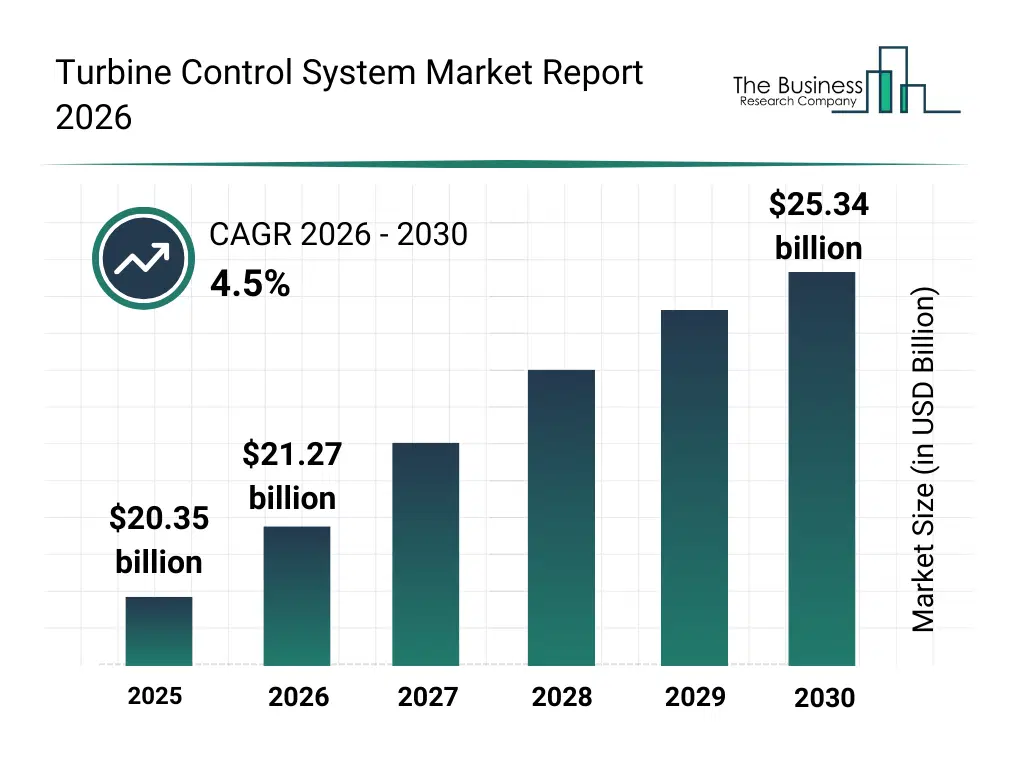
What Is The Turbine Control System Market Size and Share 2026?
The turbine control system market size has grown steadily in recent years. It will grow from $20.35 billion in 2025 to $21.27 billion in 2026 at a compound annual growth rate (CAGR) of 4.5%. The growth in the historic period can be attributed to expansion of power generation capacity, increasing use of automated control systems, growth of gas and steam turbine installations, rising emphasis on turbine safety systems, availability of digital control hardware.What Is The Turbine Control System Market Growth Forecast?
The turbine control system market size is expected to see steady growth in the next few years. It will grow to $25.34 billion in 2030 at a compound annual growth rate (CAGR) of 4.5%. The growth in the forecast period can be attributed to increasing adoption of ai-based turbine optimization, rising investments in renewable and hybrid power plants, expansion of digital twin technology, growing demand for real-time turbine monitoring, increasing focus on lifecycle efficiency. Major trends in the forecast period include increasing deployment of digital turbine control platforms, rising integration of predictive maintenance software, growing adoption of advanced sensor networks, expansion of centralized control architectures, enhanced focus on operational safety and efficiency.
Global Turbine Control System Market Segmentation
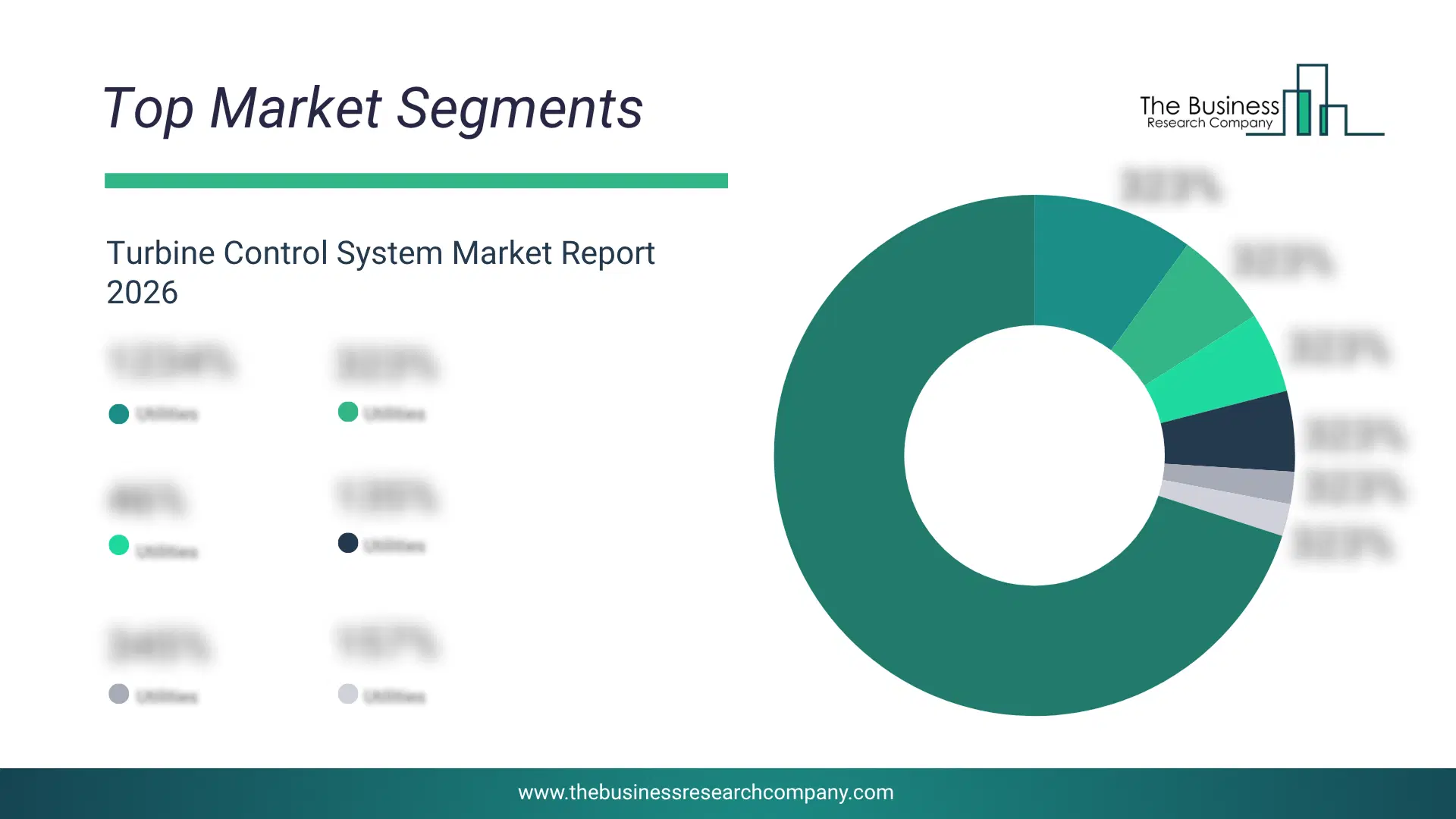
1) By Type: Gas Turbine, Steam Turbine, Hydro-Turbine, Wind Turbine, Other Types 2) By Component: Sensors, Human-Machine Interface, Controllers, Software, Other Components 3) By Function: Speed Control, Load Control, Temperature Control, Pressure Control, Other Functions 4) By Application: Power Generation, Oil And Gas, Marine, Other Applications Subsegments: 1) By Gas Turbine: Industrial Gas Turbines, Aeroderivative Gas Turbines 2) By Steam Turbine: Condensing Steam Turbine, Back Pressure Steam Turbine, Extraction Steam Turbine 3) By Hydro-Turbine: Pelton Turbine, Francis Turbine, Kaplan Turbine 4) By Wind Turbine: Horizontal-Axis Wind Turbine (HAWT), Vertical-Axis Wind Turbine (VAWT) 5) By Other Types: Microturbine, Organic Rankine Cycle (ORC) Turbine, Wave Energy TurbineWhat Is The Driver Of The Turbine Control System Market?
The rising electricity demand is expected to propel the growth of the turbine control system market going forward. Electricity is a form of energy resulting from the movement of charged particles, typically electrons. The electricity demand is increasing because of increased population, urbanization, expansion, industrialization, and technological improvements. Turbine control systems are used in electricity generation to regulate the operation of turbines, ensuring efficient and safe performance and controlling the steam flow to steam turbines in various conditions through extraction control valves. For instance, in September 2025, according to the International Energy Agency, a US-based intergovernmental organization in 2025, total net electricity generation in the OECD reached 922.6 TWh in June, marking a 1.4% increase compared to June 2024. Therefore, the rising electricity demand is driving the growth of the turbine control system industry.Key Players In The Global Turbine Control System Market
Major companies operating in the turbine control system market are Siemens AG, General Electric Company, Mitsubishi Electric Corporation, Honeywell International Inc., ABB Ltd, Rolls-Royce Holdings plc, Emerson Electric Co., Danfoss Power Solutions Inc., Rockwell Automation Inc., WEG Electric Corp., Voith Group, Sulzer Ltd., Woodward Inc., Brunel Energy Pty Ltd., Enercon Services Inc., Schneider Electric Societas Europaea, Compressor Controls Corporation, Bently Nevada, Omicron Energy Solutions, Power Systems Manufacturing, LLC, Qualitrol Corporation, Endurance Wind Power Inc., Peak Machinery Inc., Turbine Controls Ltd., Turbine Technology Services Corporation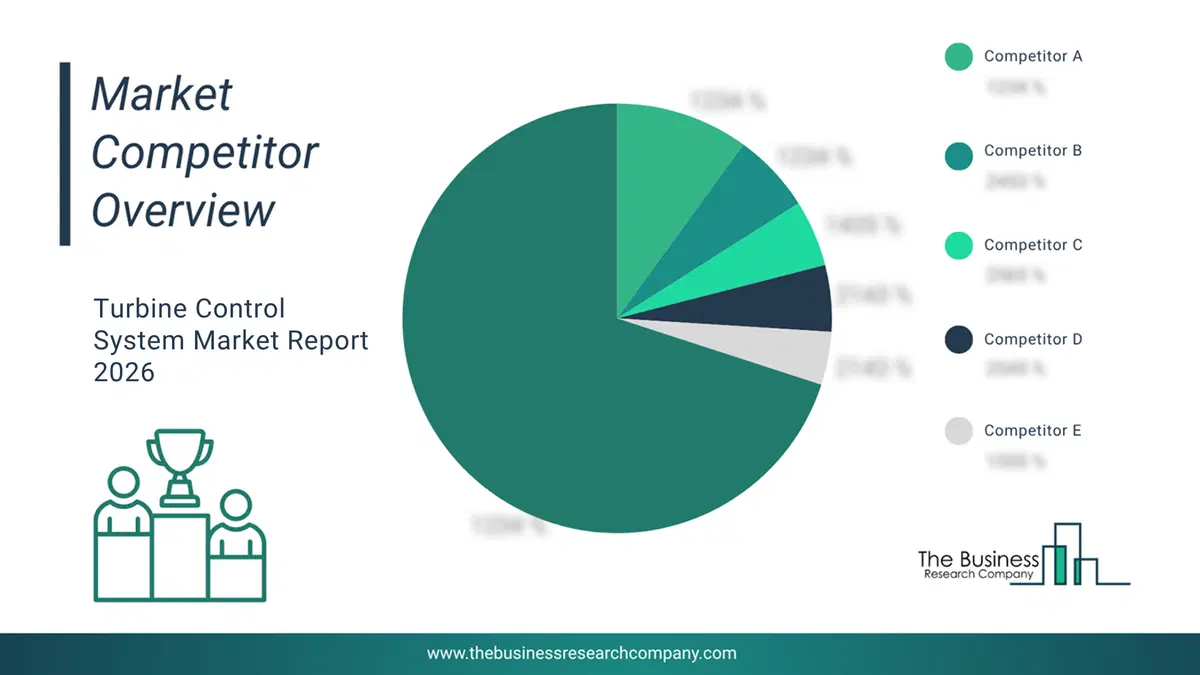
This chart is for illustrative purposes; the full report includes a detailed competitor analysis and comprehensive overview of the top 10 companies in the market.
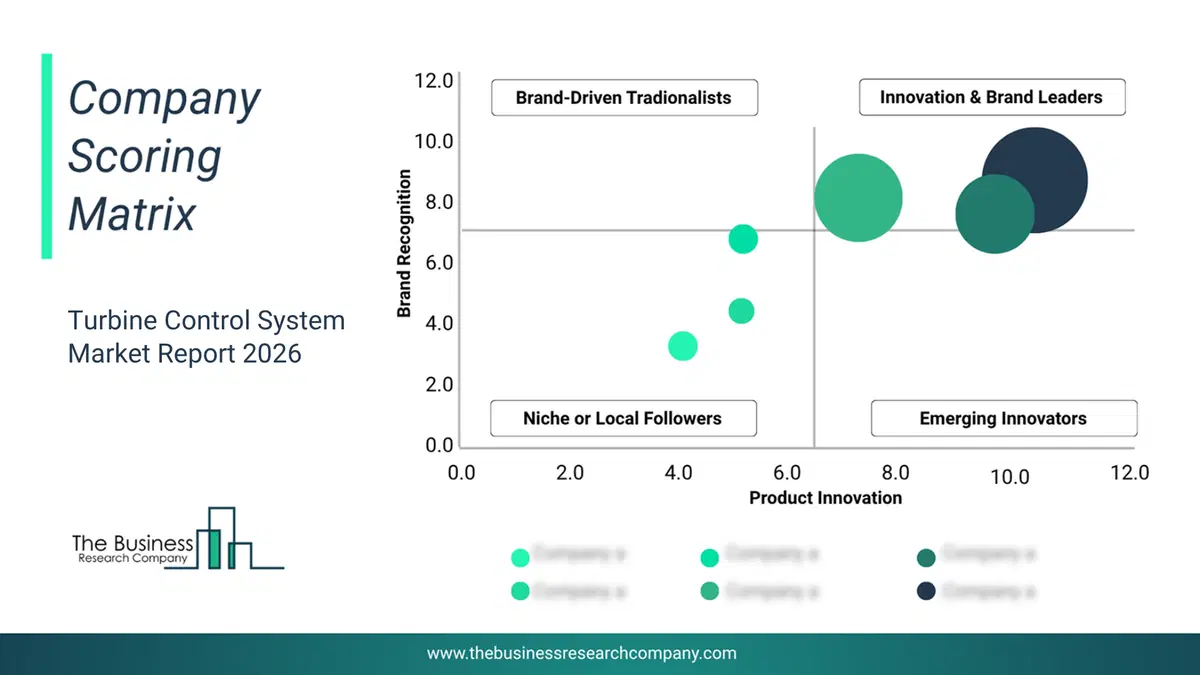
This chart maps companies by product innovation and brand strength, with bubble size indicating relative revenue, helping identify market leaders, challengers, and niche players. This is an illustrative chart; the full report provides a complete and accurate competitive analysis.
Global Turbine Control System Market Trends and Insights
Major companies operating in the turbine control system market are focusing on developing innovative solutions, such as advanced adaptive controllers, to meet the rising demand for enhanced energy efficiency, grid compliance, and reliable performance in low wind conditions. Adaptive controllers are intelligent systems that monitor environmental variables, such as wind speed and turbulence, and automatically adjust turbine operations to optimize energy output while reducing mechanical stress, in contrast to traditional fixed-parameter control systems that cannot dynamically respond to changing conditions. For instance, in September 2024, RE Technologies GmbH, a Germany-based wind energy technology company, launched the 4.2M160 wind turbine generator, featuring an advanced controller designed for low wind regions and extreme climate conditions. The controller integrates modular design principles, real-time load management, and environmental adaptation, enabling the turbine to maintain high efficiency, reduce wear and tear, and ensure reliable power output across diverse geographic locations.What Are Latest Mergers And Acquisitions In The Turbine Control System Market?
In April 2024, VSE Corporation, a US-based technology and aftermarket services company, acquired Turbine Controls Inc. for an undisclosed amount. With this acquisition, VSE aimed to enhance and expand its Maintenance, Repair, and Overhaul (MRO) capabilities in the high-growth aviation aftermarket, broadening its repair offerings and OEM relationships. Turbine Controls Inc. is a US-based aviation MRO services provider that specializes in aftermarket support, repair, and overhaul of complex engine components and engine and airframe accessories for commercial, military, and general aviation applications.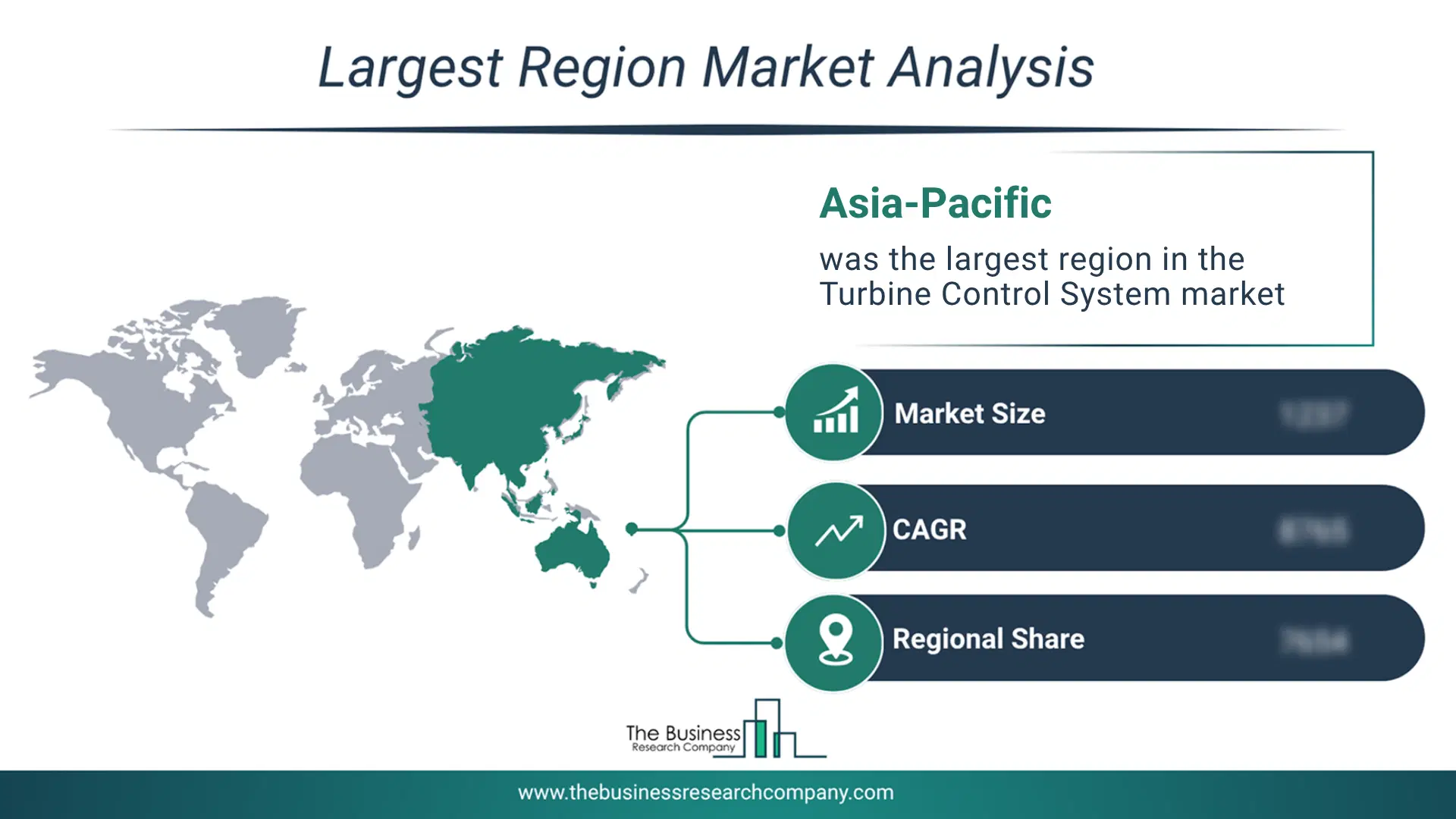
Regional Outlook
Asia-Pacific was the largest region in the turbine control system market in 2025. Asia-Pacific is expected to be the fastest-growing region in the forecast period. The regions covered in this market report are Asia-Pacific, South East Asia, Western Europe, Eastern Europe, North America, South America, Middle East, Africa. The countries covered in this market report are Australia, Brazil, China, France, Germany, India, Indonesia, Japan, Taiwan, Russia, South Korea, UK, USA, Canada, Italy, SpainWhat Defines the Turbine Control System Market?
The turbine control system market consists of revenues earned by entities by providing services such as monitoring and supervisory services, control services, protection and safety services, and communication and integration services. The market value includes the value of related goods sold by the service provider or included within the service offering. The turbine control system market also includes sales of control systems, sensors, actuators, communication equipment, and safety systems. Values in this market are ‘factory gate’ values, that is, the value of goods sold by the manufacturers or creators of the goods, whether to other entities (including downstream manufacturers, wholesalers, distributors, and retailers) or directly to end customers. The value of goods in this market includes related services sold by the creators of the goods.How is Market Value Defined and Measured?
The market value is defined as the revenues that enterprises gain from the sale of goods and/or services within the specified market and geography through sales, grants, or donations in terms of the currency (in USD unless otherwise specified). The revenues for a specified geography are consumption values that are revenues generated by organizations in the specified geography within the market, irrespective of where they are produced. It does not include revenues from resales along the supply chain, either further along the supply chain or as part of other products.
This chart presents market attractiveness based on a quantitative evaluation of growth, competition, strategic alignment, and risk, offering a clear view of opportunity areas for decision-making. This chart is for illustrative purposes; the full report contains the complete analysis.

This chart highlights the Total Addressable Market (TAM) by estimating the maximum revenue opportunity using an assumption-driven approach, supporting strategic planning and opportunity sizing across markets. The chart is illustrative; the full report provides a more comprehensive analysis.
What Key Data and Analysis Are Included in the Turbine Control System Market Report 2026?
The turbine control system market research report is one of a series of new reports from The Business Research Company that provides market statistics, including Market Report 2026?global market size, regional shares, competitors with the market share, detailed market segments, market trends and opportunities, and any further data you may need to thrive in the turbine control system Market Report 2026? The market research report delivers a complete perspective of everything you need, with an in-depth analysis of the current and future state of the Market Report 2026?Turbine Control System Market Report Forecast Analysis
| Report Attribute | Details |
|---|---|
| Market Size Value In 2026 | $21.27 billion |
| Revenue Forecast In 2030 | $25.34 billion |
| Growth Rate | CAGR of 4.5% from 2026 to 2030 |
| Base Year For Estimation | 2025 |
| Actual Estimates/Historical Data | 2020-2025 |
| Forecast Period | 2026 - 2030 - 2030 |
| Market Representation | Revenue in USD Billion and CAGR from 2026 to 2030 |
| Segments Covered | Type, Component, Function, Application |
| Regional Scope | Asia-Pacific, Western Europe, Eastern Europe, North America, South America, Middle East, Africa |
| Country Scope | The countries covered in the report are Australia, Brazil, China, France, Germany, India, Indonesia, Japan, Taiwan, Russia, South Korea, UK, USA, Canada, Italy, Spain. |
| Key Companies Profiled | Siemens AG, General Electric Company, Mitsubishi Electric Corporation, Honeywell International Inc., ABB Ltd, Rolls-Royce Holdings plc, Emerson Electric Co., Danfoss Power Solutions Inc., Rockwell Automation Inc., WEG Electric Corp., Voith Group, Sulzer Ltd., Woodward Inc., Brunel Energy Pty Ltd., Enercon Services Inc., Schneider Electric Societas Europaea, Compressor Controls Corporation, Bently Nevada, Omicron Energy Solutions, Power Systems Manufacturing, LLC, Qualitrol Corporation, Endurance Wind Power Inc., Peak Machinery Inc., Turbine Controls Ltd., Turbine Technology Services Corporation |
| Customization Scope | Request for Customization |
| Pricing And Purchase Options | Explore Purchase Options |