
Wind Turbine Market Report 2026
Global Outlook – By Component (Rotator Blade, Gearbox, Generator, Nacelle, Other Components), By Axis Type (Horizontal, Vertical ), By Location Of Deployment (Onshore, Offshore ), By Connectivity Type (Grid Connected, Stand Alone ), By Application (Industrial, Commercial, Residential, Utility) – Market Size, Trends, Strategies, and Forecast to 2030
Wind Turbine Market Overview
• Wind Turbine market size has reached to $178.89 billion in 2025 • Expected to grow to $283.8 billion in 2030 at a compound annual growth rate (CAGR) of 9.9% • Growth Driver: Exploring The Surge In Demand For Renewable Energy With Wind Turbines • Market Trend: Ultra-High-Capacity Offshore Turbines Transforming Next-Generation Wind Projects • Asia-Pacific was the largest region and fastest growing region.What Is Covered Under Wind Turbine Market?
The wind turbine refers to a power-generating device that has been driven by the kinetic energy of the wind. A wind turbine turns wind energy into electricity using the aerodynamic force of the rotor blades, which work like an airplane wing or helicopter rotor blade. When wind flows across the blade, the air pressure on one side of the blade will decrease. The main types of wind turbines are the rotator blade, gearbox, generator, nacelle, and others. Rotor blades are the most important parts of a wind turbine for the performance and cost of the wind power system. The shape of the rotor blades has a direct impact on performance as it will determine the conversion of kinetic energy related to the wind to mechanical energy. The axis of a wind turbine is horizontal and vertical and can be deployed onshore and offshore. They can be grid-connected or stand-alone for industrial, commercial, residential, and utility applications.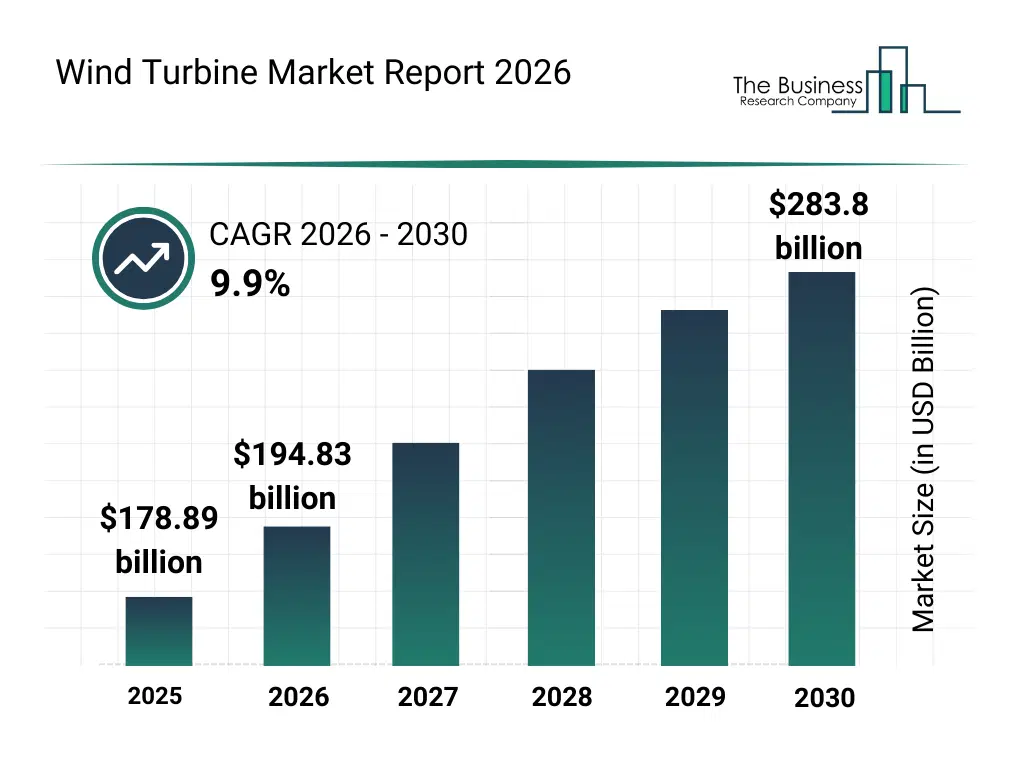
What Is The Wind Turbine Market Size and Share 2026?
The wind turbine market size has grown strongly in recent years. It will grow from $178.89 billion in 2025 to $194.83 billion in 2026 at a compound annual growth rate (CAGR) of 8.9%. The growth in the historic period can be attributed to renewable energy policies, declining wind power costs, climate change commitments, grid diversification needs, fossil fuel price volatility.What Is The Wind Turbine Market Growth Forecast?
The wind turbine market size is expected to see strong growth in the next few years. It will grow to $283.8 billion in 2030 at a compound annual growth rate (CAGR) of 9.9%. The growth in the forecast period can be attributed to net zero targets, offshore wind investments, grid scale renewable integration, advancements in turbine efficiency, energy security initiatives. Major trends in the forecast period include rapid expansion of utility scale wind projects, increasing deployment of offshore wind farms, advancements in turbine blade materials, integration of digital monitoring systems, growth of high capacity wind turbines.Tariff Impact On Wind Turbine Market
Tariffs have affected the wind turbine market by increasing costs of imported blades, generators, gearboxes, and electronic control systems. Offshore and high capacity turbines are most impacted, especially in asia pacific and north america. Elevated costs have delayed some project timelines. Conversely, tariffs are encouraging domestic turbine manufacturing and localized supply chain development.
Global Wind Turbine Market Segmentation
1) By Component: Rotator Blade, Gearbox, Generator, Nacelle, Other Components 2) By Axis Type: Horizontal, Vertical 3) By Location Of Deployment: Onshore, Offshore 4) By Connectivity Type: Grid Connected, Stand Alone 5) By Application: Industrial, Commercial, Residential, Utility Subsegments: 1) By Rotator Blade: Composite Blades, Steel Blades, Carbon Fiber Blades 2) By Gearbox: Planetary Gearbox, Helical Gearbox, Spur Gearbox 3) By Generator: Synchronous Generators, Asynchronous Generators, Permanent Magnet Generators 4) By Nacelle: Housing Components, Cooling Systems, Control Systems 5) By Other Components: Tower, Yaw System, Pitch Control SystemWhat Is The Driver Of The Wind Turbine Market?
Increasing demand for renewable energy sources is contributing to the growth of the wind turbine market. A renewable energy source refers to an energy source that is repeatedly replenished without running out. Most of this energy will come from fossil fuels like coal, oil, and natural gas. The wind is a renewable energy source. Overall, using wind to produce energy has fewer effects on the environment than other energy sources. Wind turbines will not release emissions that will pollute the air or water and they do not require water for cooling. Wind turbines will also reduce the amount of electricity generated from fossil fuels, which results in lower total air pollution and carbon dioxide emissions. For instance, in February 2025, according to the World Resources Institute, a US-based non-profit organization, reported that in 2024, solar energy set a new record by adding an estimated 39.6 gigawatts (GW) of capacity, surpassing the 27.4 GW installed in 2023. Therefore, increasing demand for renewable energy sources drives the growth of the wind turbine industry.Key Players In The Global Wind Turbine Market
Major companies operating in the wind turbine market are Clipper Windpower A/S, Siemens AG, General Electric Company, Suzlon Energy Limited, CRRC Group Corporation, Shanghai Electric Group Co. Ltd., Vestas Wind Systems A/S, Sany Heavy Industry Co. Ltd., Gamesa Electric, Dongfang Electric Corporation, Nordex SE, Goldwind Science and Technology Co. Ltd., Ming Yang Smart Energy Group Co. Ltd., Guodian United Power Technology Co. Ltd., Zhejiang Windey Co. Ltd., Envision Energy, LM Windpower A/S, Impsa S.A., Sinovel Wind Group Co. Ltd., Leitwind GmbH, Vergnet S.A., Northern Power Systems Ltd., Enercon GmbH Windenergieanlagen, Senvion SE, Bergey Windpower Inc., United Power Inc.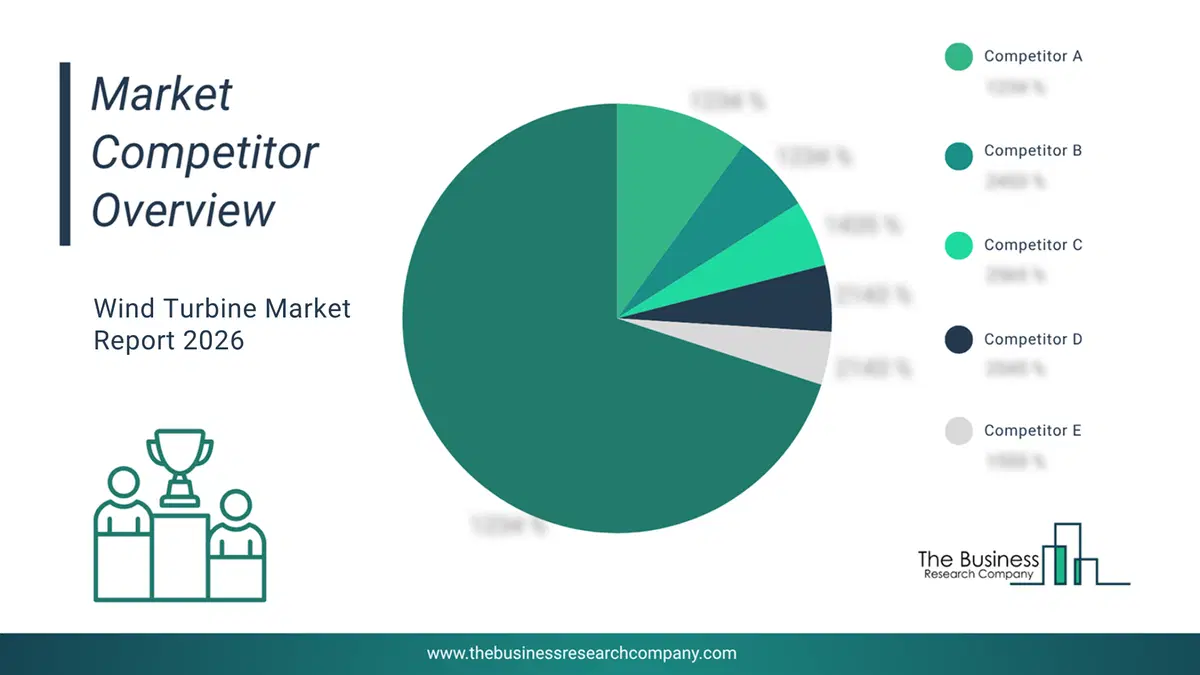
This chart is for illustrative purposes; the full report includes a detailed competitor analysis and comprehensive overview of the top 10 companies in the market.
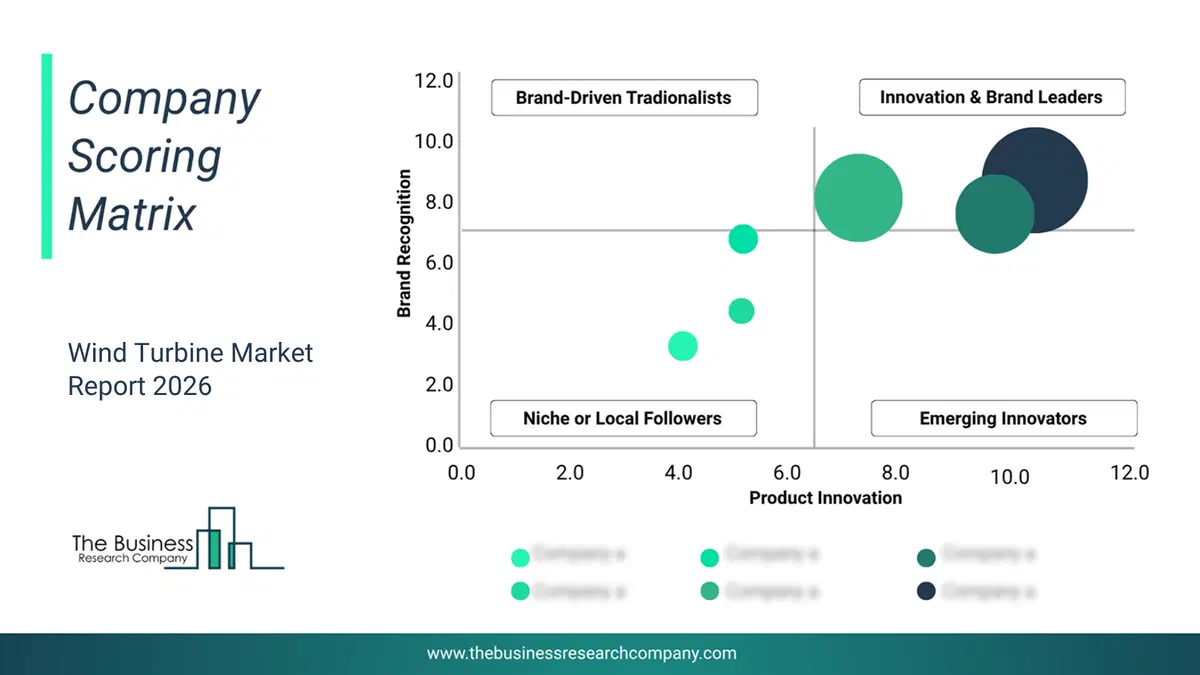
This chart maps companies by product innovation and brand strength, with bubble size indicating relative revenue, helping identify market leaders, challengers, and niche players. This is an illustrative chart; the full report provides a complete and accurate competitive analysis.
Global Wind Turbine Market Trends and Insights
Major companies operating in the wind turbine market are focusing on developing next-generation ultra-high-capacity offshore turbines, often referred to as multi-megawatt “super WTG” platforms, to boost energy capture and improve project economics. Ultra-high-capacity offshore turbines feature significantly larger rotor diameters and higher nominal power ratings, enabling them to generate more electricity per unit while reducing the overall levelized cost of energy (LCoE) for utility-scale wind farms. For instance, in December 2024, Siemens Gamesa, a Germany-based energy automation company, began installing a 21 MW offshore wind turbine prototype at the Østerild Test Centre in Denmark. This 21 MW prototype features a rotor height exceeding 300 meters from base to blade tip and aims to deliver world class power output per turbine. This trend allows developers to reduce the number of turbines needed per farm and to optimize O&M costs. On the downside, the technical complexity, higher capital expenditure and challenging logistics of installing such large offshore units may constrain adoption in regions with limited installation infrastructure or financing.What Are Latest Mergers And Acquisitions In The Wind Turbine Market?
In July 2023, Ryse Energy, a United Arab Emirates-based global leader in renewable energy systems acquired Primus Wind Power for an undisclosed amount. Through this acquisition, Ryse Energy aims to expand its global footprint in America and diversify its small turbine product portfolio. With this acquisition, both companies look forward to broadening their customer base for microturbine products. Primus Wind Power is a US-based micro wind turbine manufacturer that offers portable wind power turbines and air breeze turbines.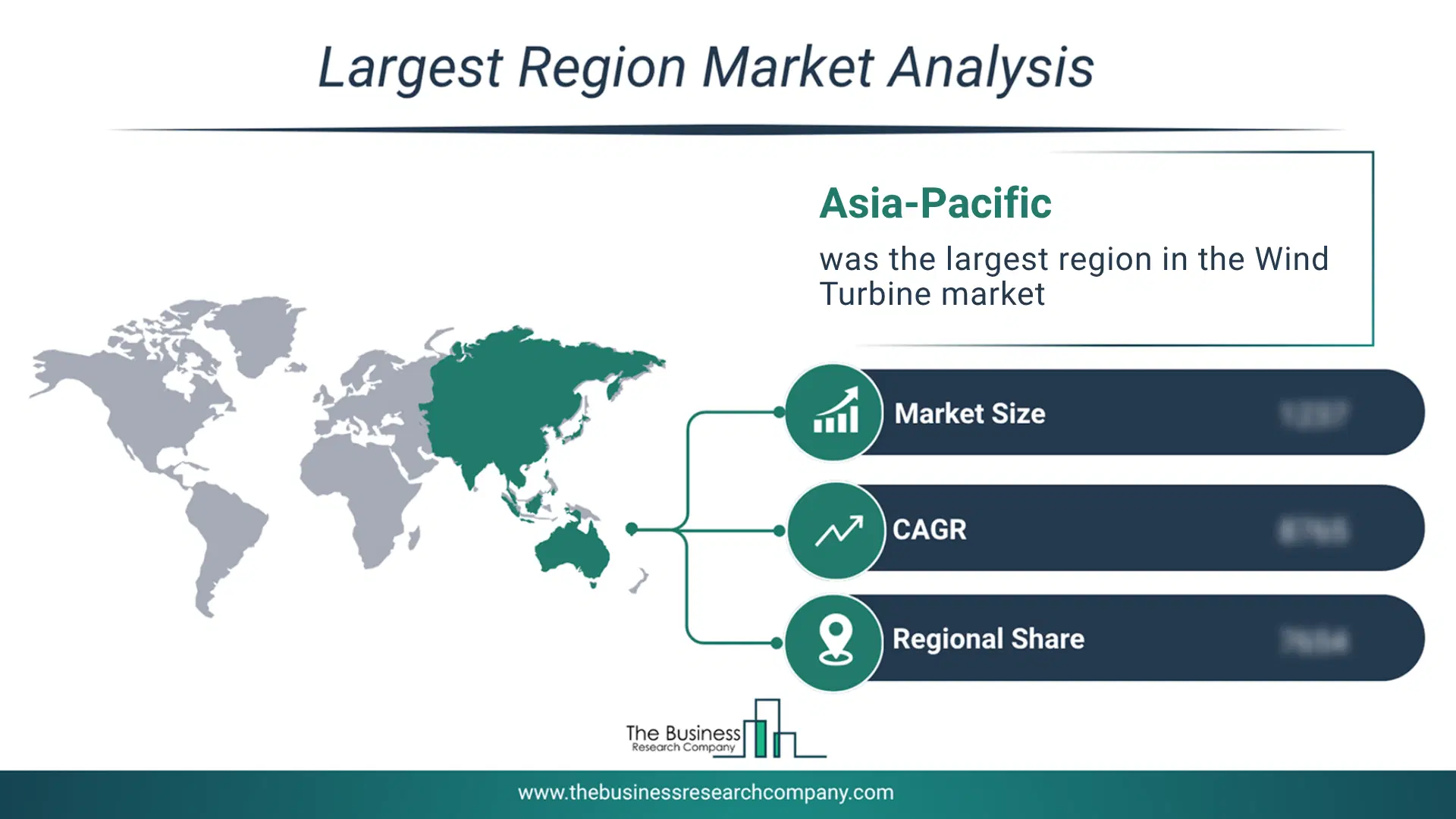
Regional Outlook
Asia-Pacific was the largest region in the wind turbine market in 2025. Asia-Pacific is expected to be the fastest-growing region in the forecast period. The regions covered in this market report are Asia-Pacific, South East Asia, Western Europe, Eastern Europe, North America, South America, Middle East, Africa The countries covered in this market report are Australia, Brazil, China, France, Germany, India, Indonesia, Japan, Taiwan, Russia, South Korea, UK, USA, Canada, Italy, Spain.What Defines the Wind Turbine Market?
The wind turbine market consists of sales of single blade horizontal-axis turbines, two-blade horizontal-axis turbine, three-blade horizontal-axis turbines. Values in this market are ‘factory gate’ values, that is the value of goods sold by the manufacturers or creators of the goods, whether to other entities (including downstream manufacturers, wholesalers, distributors and retailers) or directly to end customers. The value of goods in this market includes related services sold by the creators of the goods.How is Market Value Defined and Measured?
The market value is defined as the revenues that enterprises gain from the sale of goods and/or services within the specified market and geography through sales, grants, or donations in terms of the currency (in USD unless otherwise specified). The revenues for a specified geography are consumption values that are revenues generated by organizations in the specified geography within the market, irrespective of where they are produced. It does not include revenues from resales along the supply chain, either further along the supply chain or as part of other products.
This chart presents market attractiveness based on a quantitative evaluation of growth, competition, strategic alignment, and risk, offering a clear view of opportunity areas for decision-making. This chart is for illustrative purposes; the full report contains the complete analysis.

This chart highlights the Total Addressable Market (TAM) by estimating the maximum revenue opportunity using an assumption-driven approach, supporting strategic planning and opportunity sizing across markets. The chart is illustrative; the full report provides a more comprehensive analysis.
What Key Data and Analysis Are Included in the Wind Turbine Market Report 2026?
The wind turbine market research report is one of a series of new reports from The Business Research Company that provides market statistics, including industry global market size, regional shares, competitors with the market share, detailed market segments, market trends and opportunities, and any further data you may need to thrive in the wind turbine industry. The market research report delivers a complete perspective of everything you need, with an in-depth analysis of the current and future state of the industry.Wind Turbine Market Report Forecast Analysis
| Report Attribute | Details |
|---|---|
| Market Size Value In 2026 | $194.83 billion |
| Revenue Forecast In 2030 | $283.8 billion |
| Growth Rate | CAGR of 9.9% from 2026 to 2030 |
| Base Year For Estimation | 2025 |
| Actual Estimates/Historical Data | 2020-2025 |
| Forecast Period | 2026 - 2030 |
| Market Representation | Revenue in USD Billion and CAGR from 2026 to 2030 |
| Segments Covered | Component, Axis Type, Location Of Deployment, Connectivity Type, Application |
| Regional Scope | Asia-Pacific, Western Europe, Eastern Europe, North America, South America, Middle East, Africa |
| Key Companies Profiled | Clipper Windpower A/S, Siemens AG, General Electric Company, Suzlon Energy Limited, CRRC Group Corporation, Shanghai Electric Group Co. Ltd., Vestas Wind Systems A/S, Sany Heavy Industry Co. Ltd., Gamesa Electric, Dongfang Electric Corporation, Nordex SE, Goldwind Science and Technology Co. Ltd., Ming Yang Smart Energy Group Co. Ltd., Guodian United Power Technology Co. Ltd., Zhejiang Windey Co. Ltd., Envision Energy, LM Windpower A/S, Impsa S.A., Sinovel Wind Group Co. Ltd., Leitwind GmbH, Vergnet S.A., Northern Power Systems Ltd., Enercon GmbH Windenergieanlagen, Senvion SE, Bergey Windpower Inc., United Power Inc. |
| Customization Scope | Request for Customization |
| Pricing And Purchase Options | Explore Purchase Options |