
Halogen-Free Flame Retardants Market Report 2026
Global Outlook – By Type (Aluminum Hydroxide, Organophosphorus, Other Types), By Application (Polyolefins, Epoxy Resin, Unsaturated Polyester, Polyvinyl Chloride, Rubber, Engineered Thermoplastic, Styrenics, Other Applications), By End User (Textile, Transportation, Wires And Cables, Electrical And Electronics, Building And Construction) – Market Size, Trends, Strategies, and Forecast to 2030
Halogen-Free Flame Retardants Market Overview
• Halogen-Free Flame Retardants market size has reached to $6.31 billion in 2025 • Expected to grow to $9.86 billion in 2030 at a compound annual growth rate (CAGR) of 9.2% • Growth Driver: Environmental Concerns Drive Growth Of Halogen-Free Flame Retardants Market • Market Trend: Innovative Trends In The Halogen-Free Flame Retardants Market • North America was the largest region in 2025 and Asia-Pacific is the fastest growing region.What Is Covered Under Halogen-Free Flame Retardants Market?
Halogen-free flame retardants refer to a substance that lacks a certain group of halogen elements and is said to be halogen-free (fluorine, chlorine, bromine, iodine, and astatine). In addition to poisonous gases that are hazardous to people, these fire components also cause metals to corrode. The main types of halogen-free flame retardants are aluminum hydroxide, organophosphorus and other types. Aluminum hydroxide refers to a naturally occurring mineral that can refer to any of numerous white, gelatinous, or crystalline hydrates of alumina, known as aluminum hydroxide. These are used in various applications such as polyolefins, epoxy resin, unsaturated polyester, polyvinyl chloride, rubber, engineered thermoplastic, styrenics, and other applications and various end users such as textile, transportation, wires and cables, electrical and electronics and building and construction.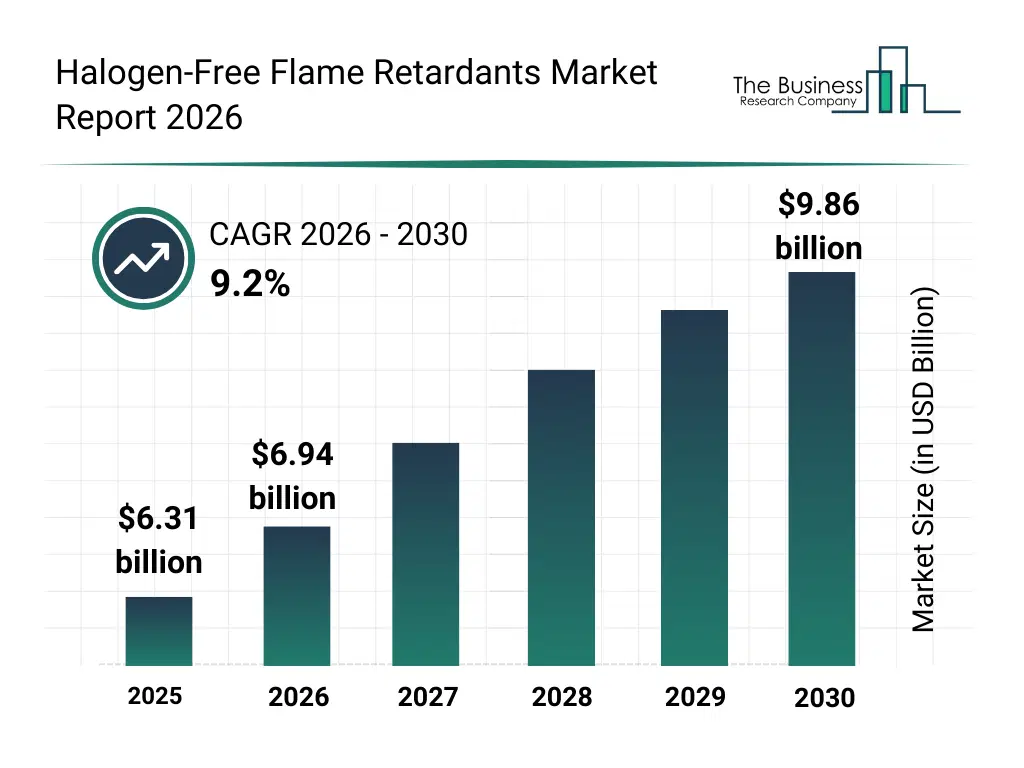
What Is The Halogen-Free Flame Retardants Market Size and Share 2026?
The halogen-free flame retardants market size has grown rapidly in recent years. It will grow from $6.31 billion in 2025 to $6.94 billion in 2026 at a compound annual growth rate (CAGR) of 10.1%. The growth in the historic period can be attributed to stricter fire safety regulations, increasing use of flame retardants in construction materials, growth of electrical and electronics manufacturing, rising demand for safer polymer additives, expansion of transportation safety standards.What Is The Halogen-Free Flame Retardants Market Growth Forecast?
The halogen-free flame retardants market size is expected to see strong growth in the next few years. It will grow to $9.86 billion in 2030 at a compound annual growth rate (CAGR) of 9.2%. The growth in the forecast period can be attributed to increasing adoption of sustainable flame retardant solutions, rising demand from electric mobility and charging infrastructure, expansion of halogen-free materials in electronics, growing focus on recyclable polymer systems, increasing investments in green chemistry. Major trends in the forecast period include increasing adoption of halogen-free formulations, rising use of intumescent flame retardants, growing demand from electric vehicle components, expansion of flame-retardant thermoplastics, enhanced focus on low-toxicity fire safety.
Global Halogen-Free Flame Retardants Market Segmentation
1) By Type: Aluminum Hydroxide, Organophosphorus, Other Types 2) By Application: Polyolefins, Epoxy Resin, Unsaturated Polyester, Polyvinyl Chloride, Rubber, Engineered Thermoplastic, Styrenics, Other Applications 3) By End User: Textile, Transportation, Wires And Cables, Electrical And Electronics, Building And Construction Subsegments: 1) By Aluminum Hydroxide: Micronized Aluminum Hydroxide, Non-Micronized Aluminum Hydroxide 2) By Organophosphorus: Phosphate Esters, Phosphonates, Phosphinates 3) By Other Types: Magnesium Hydroxide, Intumescent Flame Retardants, Silicate-Based Flame Retardants, Natural Fiber-Based Flame RetardantsWhat Is The Driver Of The Halogen-Free Flame Retardants Market?
Growing health concerns regarding the use of halogen-based flame retardants because of the polluted environment are expected to propel the growth of the halogen-free flame retardants market going forward. Several regulations are being introduced for the growing concerns regarding human health through environmental pollution, which had resulted in the ban of several halogen-based flame retardants across the world, and as a result, increases the demand for the halogen-free flame retardants market. For instance, in July 4, according to the Copernicus Climate Change Service, a Europe-based agency, the ERA5 dataset recorded a new daily global average temperature high of 17.16°C, surpassing the previous record of 17.09°C set just a day earlier on July 21, 2024, and the 17.08°C record from the previous year on July 6, 2023. Therefore, growing health concerns regarding the use of halogen-based flame retardants because of the polluted environment drive the growth of the halogen-free flame retardants industry.Key Players In The Global Halogen-Free Flame Retardants Market
Major companies operating in the halogen-free flame retardants market are Clariant AG, LANXESS, J.M. Huber Corporation, Israel Chemicals Limited, Nabaltech AG, BASF SE, Italmatch Chemicals s.p.a., Dupont De Nemours Inc., Albemarle Corporation, Akzo Nobel N.V., DSM N.V., FRX Polymers Inc., Greenchemicals SpA, ICL Industrial Products, Jiangsu Yoke Technology Co. Ltd., Kisuma Chemicals, Kyowa Chemical Industry Co. Ltd., Lanpoly Chemical Industrial Co. Ltd., Nippon Carbide Industries Co. Inc., Oceanchem Group Limited, Sinochem Group, Sumitomo Chemical Co. Ltd., Thor Group Limited, Tosoh Corporation, Zhejiang Wansheng Co. Ltd., Presafer Uluslararası A.Ş., Budenheim Iberica S.L., Aurum Chemicals Corporation, AGC Chemicals Americas Inc.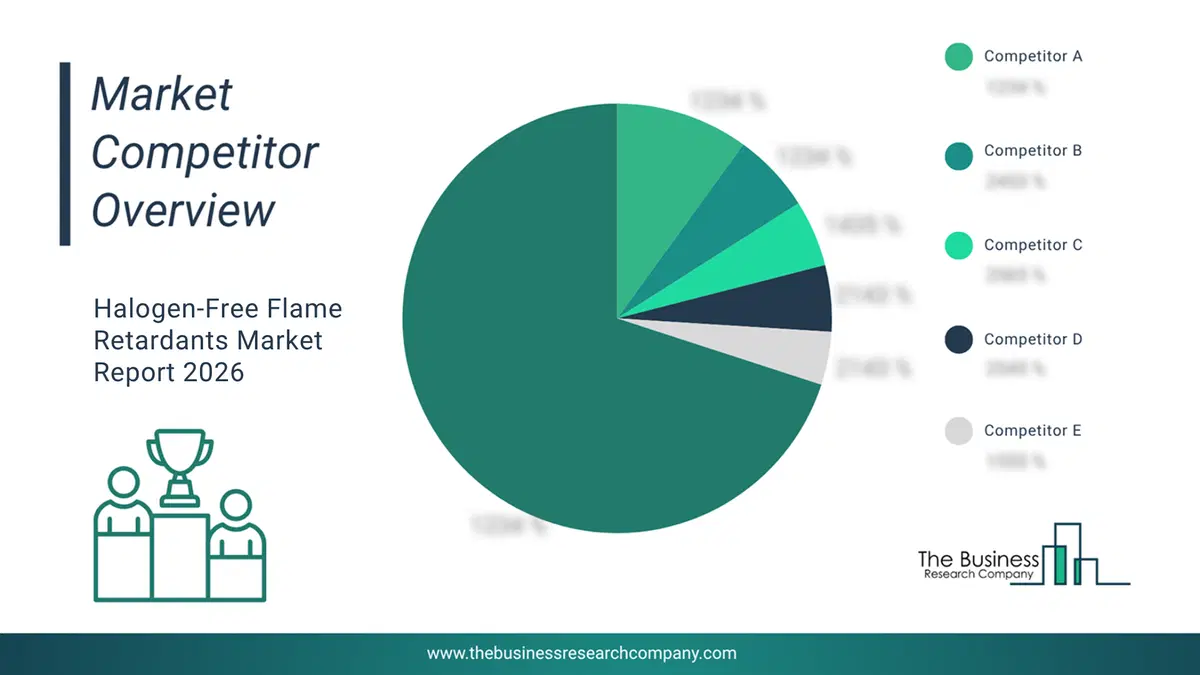
This chart is for illustrative purposes; the full report includes a detailed competitor analysis and comprehensive overview of the top 10 companies in the market.
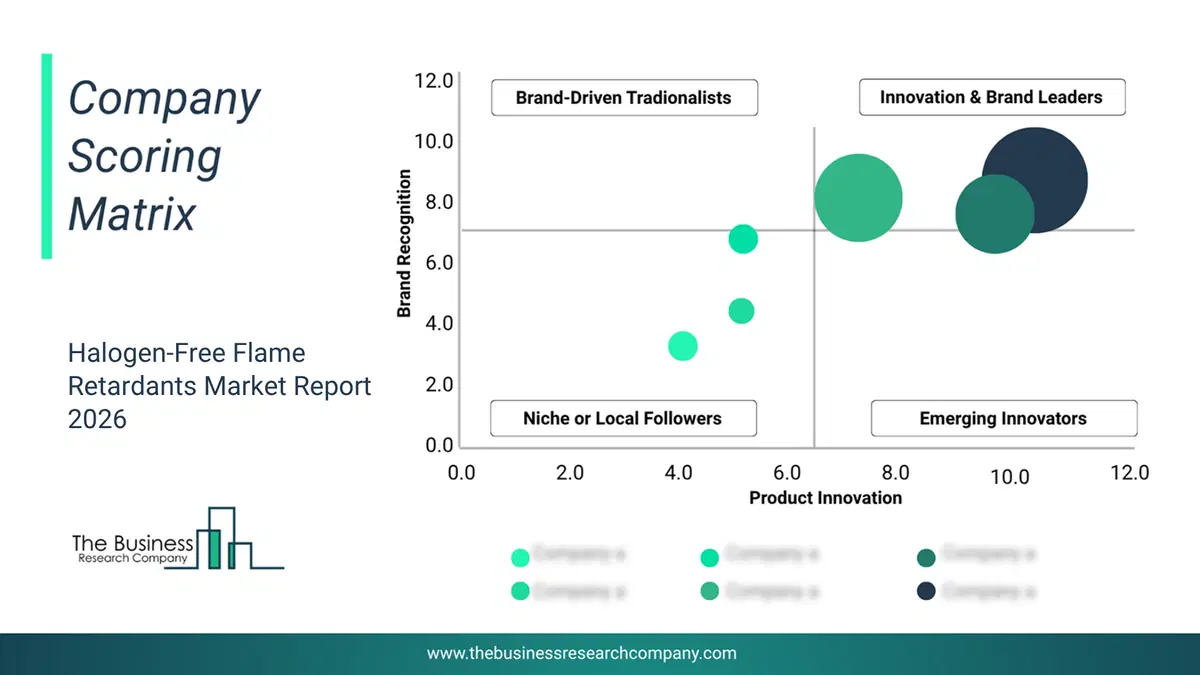
This chart maps companies by product innovation and brand strength, with bubble size indicating relative revenue, helping identify market leaders, challengers, and niche players. This is an illustrative chart; the full report provides a complete and accurate competitive analysis.
Global Halogen-Free Flame Retardants Market Trends and Insights
Major companies operating in the halogen-free flame retardants market are focusing on innovative product launches like halogen-free flame-retardant (HFFR) grades containing recycled and bio-based resin. Halogen-free flame retardants using recycled and biobased resin are gaining popularity in the flame-retardant sector, providing increased sustainability and performance while satisfying the growing demand for environmentally responsible products. For instance, in June 2023, Avient, a US-based manufacturer of polymer materials, launched halogen-free flame-retardant Thermoplastic Elastomer (TPE) grades made with sustainable raw materials for USB-C cable jackets. These new grades have been created to suit the growing need for consumer electronic products built using sustainable raw materials that fulfill high FR compliance without sacrificing performance or processability, such as USB-C connector cable jackets.What Are Latest Mergers And Acquisitions In The Halogen-Free Flame Retardants Market?
In August 2024, BlackRock, Inc., a US-based company, acquired Albemarle Corporation for an undisclosed amount. With this acquisition, BlackRock aims to expand its portfolio by incorporating Albemarle's expertise in providing halogen-free flame retardants. Albemarle Corporation is a US-based company that manufactures halogen-free flame retardants.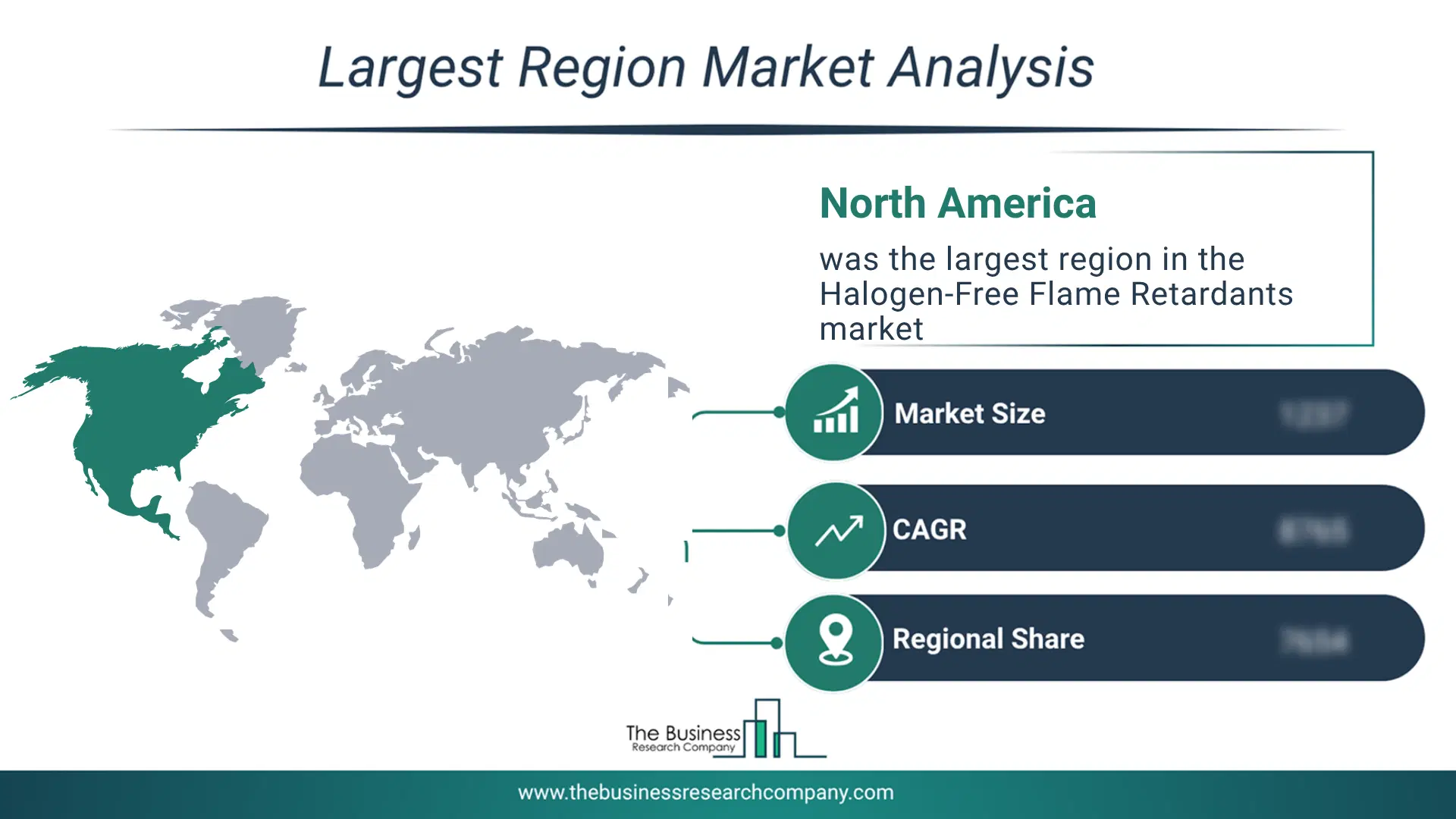
Regional Insights
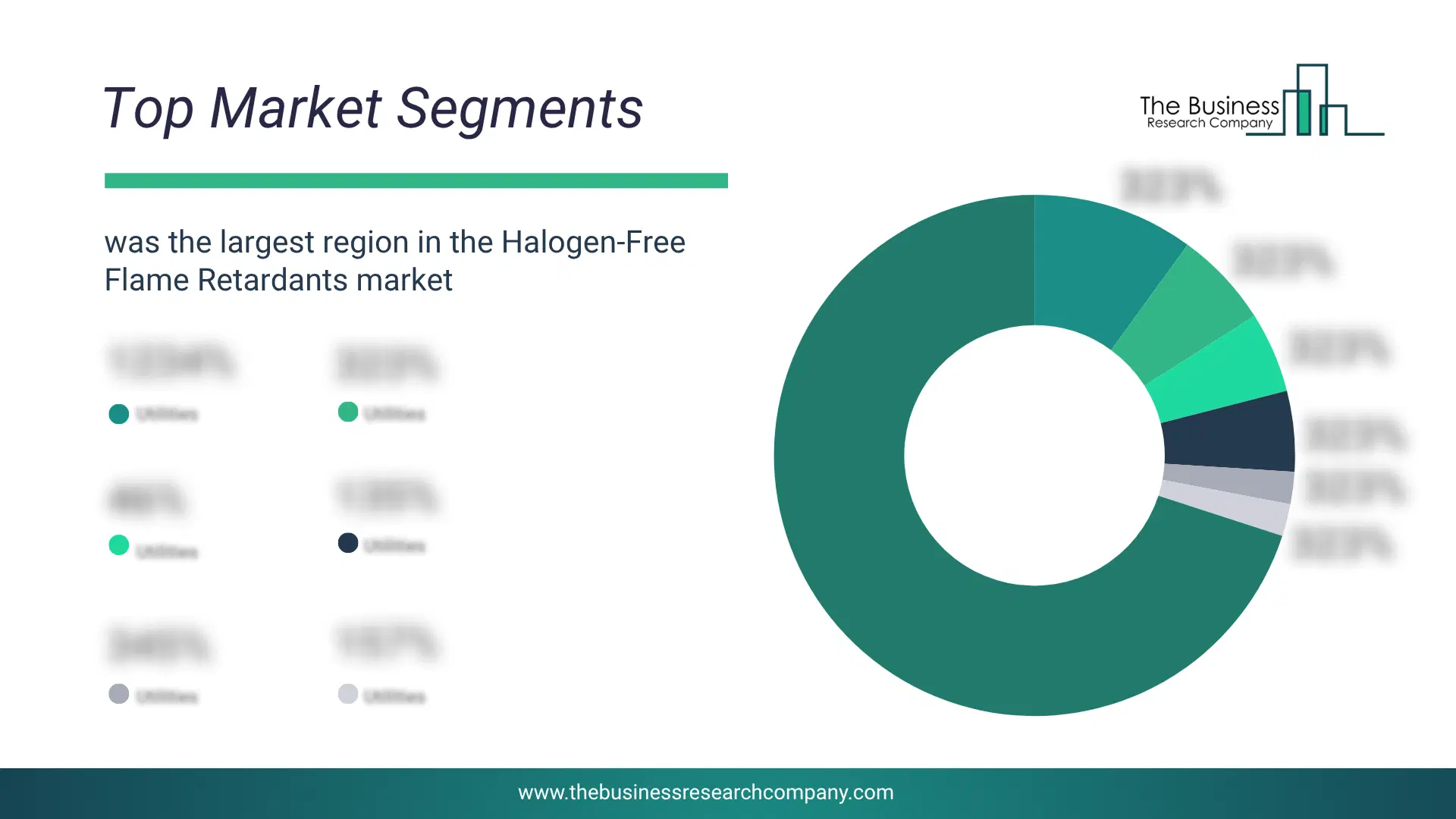
North America was the largest region in the halogen-free flame retardants market in 2025 and is expected to be the fastest-growing region in the forecast period. The regions covered in this market report are Asia-Pacific, South East Asia, Western Europe, Eastern Europe, North America, South America, Middle East, Africa The countries covered in this market report are Australia, Brazil, China, France, Germany, India, Indonesia, Japan, Taiwan, Russia, South Korea, UK, USA, Canada, Italy, SpainWhat Defines the Halogen-Free Flame Retardants Market?
The halogen-free flame retardants market consists of sales of phosphorus-based halogen-free flame retardants and magnesium hydroxide-based halogen-free flame retardants. Values in this market are ‘factory gate’ values, that is the value of goods sold by the manufacturers or creators of the goods, whether to other entities (including downstream manufacturers, wholesalers, distributors, and retailers) or directly to end customers. The value of goods in this market includes related services sold by the creators of the goods.How is Market Value Defined and Measured?
The market value is defined as the revenues that enterprises gain from the sale of goods and/or services within the specified market and geography through sales, grants, or donations in terms of the currency (in USD unless otherwise specified). The revenues for a specified geography are consumption values that are revenues generated by organizations in the specified geography within the market, irrespective of where they are produced. It does not include revenues from resales along the supply chain, either further along the supply chain or as part of other products.
This chart presents market attractiveness based on a quantitative evaluation of growth, competition, strategic alignment, and risk, offering a clear view of opportunity areas for decision-making. This chart is for illustrative purposes; the full report contains the complete analysis.

This chart highlights the Total Addressable Market (TAM) by estimating the maximum revenue opportunity using an assumption-driven approach, supporting strategic planning and opportunity sizing across markets. The chart is illustrative; the full report provides a more comprehensive analysis.
What Key Data and Analysis Are Included in the Halogen-Free Flame Retardants Market Report 2026?
The halogen-free flame retardants market research report is one of a series of new reports from The Business Research Company that provides market statistics, including industry global market size, regional shares, competitors with the market share, detailed market segments, market trends and opportunities, and any further data you may need to thrive in the halogen-free flame retardants industry. The market research report delivers a complete perspective of everything you need, with an in-depth analysis of the current and future state of the industry.Halogen-Free Flame Retardants Market Report Forecast Analysis
| Report Attribute | Details |
|---|---|
| Market Size Value In 2026 | $6.94 billion |
| Revenue Forecast In 2030 | $9.86 billion |
| Growth Rate | CAGR of 10.1% from 2026 to 2030 |
| Base Year For Estimation | 2025 |
| Actual Estimates/Historical Data | 2020-2025 |
| Forecast Period | 2026 - 2030 |
| Market Representation | Revenue in USD Billion and CAGR from 2026 to 2030 |
| Segments Covered | Type, Application, End User |
| Regional Scope | Asia-Pacific, Western Europe, Eastern Europe, North America, South America, Middle East, Africa |
| Country Scope | The countries covered in this market report are Australia, Brazil, China, France, Germany, India, Indonesia, Japan, Taiwan, Russia, South Korea, UK, USA, Canada, Italy, Spain |
| Key Companies Profiled | Clariant AG, LANXESS, J.M. Huber Corporation, Israel Chemicals Limited, Nabaltech AG, BASF SE, Italmatch Chemicals s.p.a., Dupont De Nemours Inc., Albemarle Corporation, Akzo Nobel N.V., DSM N.V., FRX Polymers Inc., Greenchemicals SpA, ICL Industrial Products, Jiangsu Yoke Technology Co. Ltd., Kisuma Chemicals, Kyowa Chemical Industry Co. Ltd., Lanpoly Chemical Industrial Co. Ltd., Nippon Carbide Industries Co. Inc., Oceanchem Group Limited, Sinochem Group, Sumitomo Chemical Co. Ltd., Thor Group Limited, Tosoh Corporation, Zhejiang Wansheng Co. Ltd., Presafer Uluslararası A.Ş., Budenheim Iberica S.L., Aurum Chemicals Corporation, AGC Chemicals Americas Inc. |
| Customization Scope | Request for Customization |
| Pricing And Purchase Options | Explore Purchase Options |