

Heat Network Optimization Market Report 2026
Global Outlook – By Component (Software, Hardware, Services), By Deployment Mode (On-Premises, Cloud), By Application (District Heating, District Cooling, Industrial Processes, Residential Buildings, Commercial Buildings), By End User (Utilities, Industrial, Commercial, Residential, Other End Users) – Market Size, Trends, Strategies, and Forecast to 2030
Heat Network Optimization Market Overview
• Heat Network Optimization market size has reached to $4.23 billion in 2025 • Expected to grow to $7.78 billion in 2030 at a compound annual growth rate (CAGR) of 13% • Growth Driver: Growing Emphasis On Energy Efficiency In Thermal Networks Fueling The Growth Of The Market Due To Reduced Energy Losses And Improved System Performance • Market Trend: Advancements In Predictive Simulation And Long-Term Scenario Modeling For Efficient Heat Network Planning And Optimization • Europe was the largest region in 2025 and Asia-Pacific is the fastest growing region.What Is Covered Under Heat Network Optimization Market?
Heat network optimization refers to the process of improving the efficiency and performance of heat distribution systems through advanced monitoring, control, and management techniques. It involves using data-driven insights and intelligent technologies to balance heat supply and demand, reduce energy losses, and enhance system reliability. This approach aims to maximize energy efficiency, lower operational costs, and support sustainable energy usage within thermal networks. The main components of heat network optimization are software, hardware, and services. Software refers to solutions that monitor, analyze, and optimize heat distribution and consumption across networks for improved efficiency and reduced energy loss. These solutions are deployed through on-premises and cloud deployment modes. They are used across various applications, including District Heating, district cooling, industrial processes, residential buildings, and commercial buildings, and cater to multiple end-users, such as utilities, industrial, commercial, residential, and other end-users.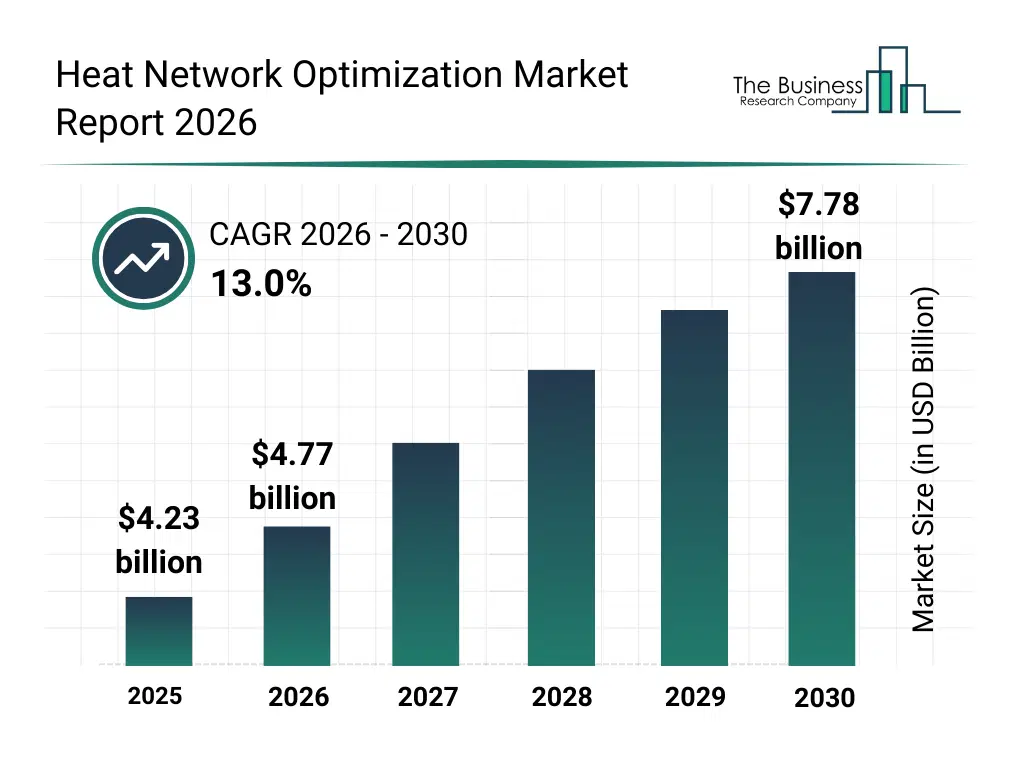
What Is The Heat Network Optimization Market Size and Share 2026?
The heat network optimization market size has grown rapidly in recent years. It will grow from $4.23 billion in 2025 to $4.77 billion in 2026 at a compound annual growth rate (CAGR) of 12.8%. The growth in the historic period can be attributed to expansion of district heating infrastructure, increasing focus on energy efficiency in thermal systems, deployment of smart heat meters, rising operational cost pressures on utilities, early adoption of network monitoring software.What Is The Heat Network Optimization Market Growth Forecast?
The heat network optimization market size is expected to see rapid growth in the next few years. It will grow to $7.78 billion in 2030 at a compound annual growth rate (CAGR) of 13.0%. The growth in the forecast period can be attributed to increasing investments in smart thermal infrastructure, rising integration of AI-based optimization tools, expansion of low-carbon district heating networks, growing adoption of predictive maintenance solutions, increasing regulatory focus on energy efficiency. Major trends in the forecast period include increasing adoption of real-time heat network monitoring, rising use of predictive heat demand forecasting, growing integration of advanced control and balancing solutions, expansion of data-driven Network Optimization Services, enhanced focus on reducing thermal losses.
Global Heat Network Optimization Market Segmentation
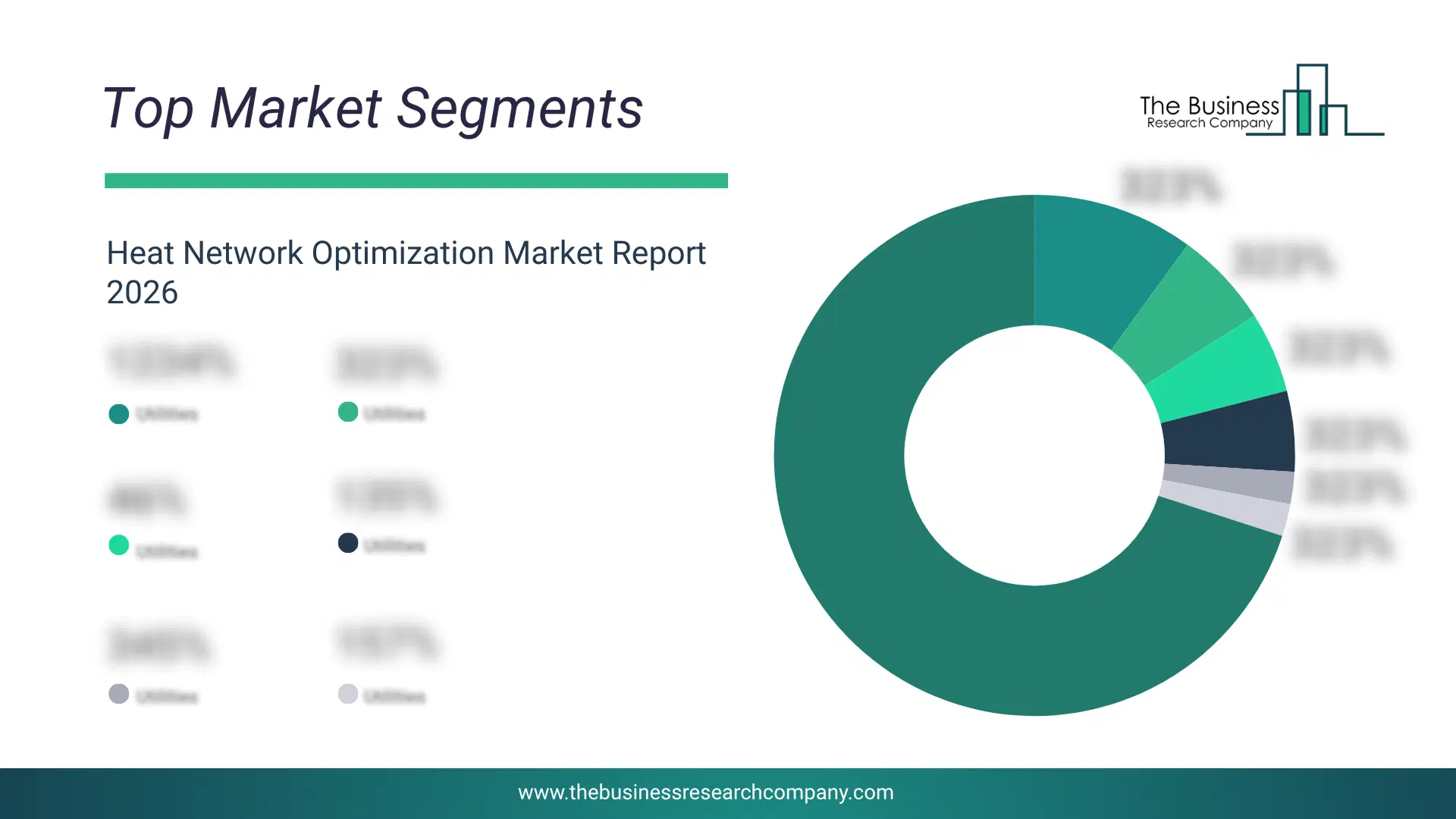
1) By Component: Software; Hardware; Services 2) By Deployment Mode: On-Premises; Cloud 3) By Application: District Heating; District Cooling; Industrial Processes; Residential Buildings; Commercial Buildings 4) By End User: Utilities; Industrial; Commercial; Residential; Other End Users Subsegments: 1) By Software: Network Optimization Platforms; Energy Management Software; Demand Forecasting Software; Analytics And Reporting Software; Control And Monitoring Software 2) By Hardware: Smart Meters; Sensors And Actuators; Control Valves; Heat Exchangers; Communication Devices 3) By Services: Installation And Integration Services; Consulting And Advisory Services; Maintenance And Support Services; Optimization And Performance Services; Training And Education ServicesWhat Is The Driver Of The Heat Network Optimization Market?
The rising demand for energy efficiency in thermal networks is expected to propel the growth of the heat network optimization market going forward. Energy efficiency in thermal networks refers to the reduction of energy losses and improved delivery of heat from the source to end users through better design, equipment, and operational practices. The rising demand for energy efficiency in thermal networks is driven by increasing decarbonization targets, escalating energy costs, and the need to optimize heat generation and distribution, as utilities and network operators seek to reduce heat losses, improve system performance, and integrate renewable and waste-heat sources to ensure reliable, cost-effective, and sustainable thermal energy supply. Heat network optimization enhances energy efficiency in thermal networks by intelligently balancing heat supply and demand, as advanced monitoring, control, and analytics reduce distribution losses, improve temperature management, and enable more efficient use of energy resources, leading to lower fuel consumption, reduced emissions, and improved overall system performance. For instance, in March 2024, according to the Department for Energy Security and Net Zero, a UK-based government agency, in 2023, approximately 318,600 energy efficiency measures were implemented through these schemes, representing a 49% increase compared to 2022. Therefore, the rising demand for energy efficiency in thermal networks is driving the growth of the heat network optimization industry.Key Players In The Global Heat Network Optimization Market
Major companies operating in the heat network optimization market are E.ON SE, ENGIE SA, Siemens AG, Veolia Environnement SA, Schneider Electric SE, Honeywell International Inc., ABB Ltd, Centrica plc, Johnson Controls International plc, Trane Technologies plc, Emerson Electric Co., Danfoss A/S, Fortum Oyj, Ramboll Group A/S, Itron Inc., COWI A/S, Kelvion Holding GmbH, Kamstrup A/S, NODA Intelligent Systems GmbH, and Sycous Limited.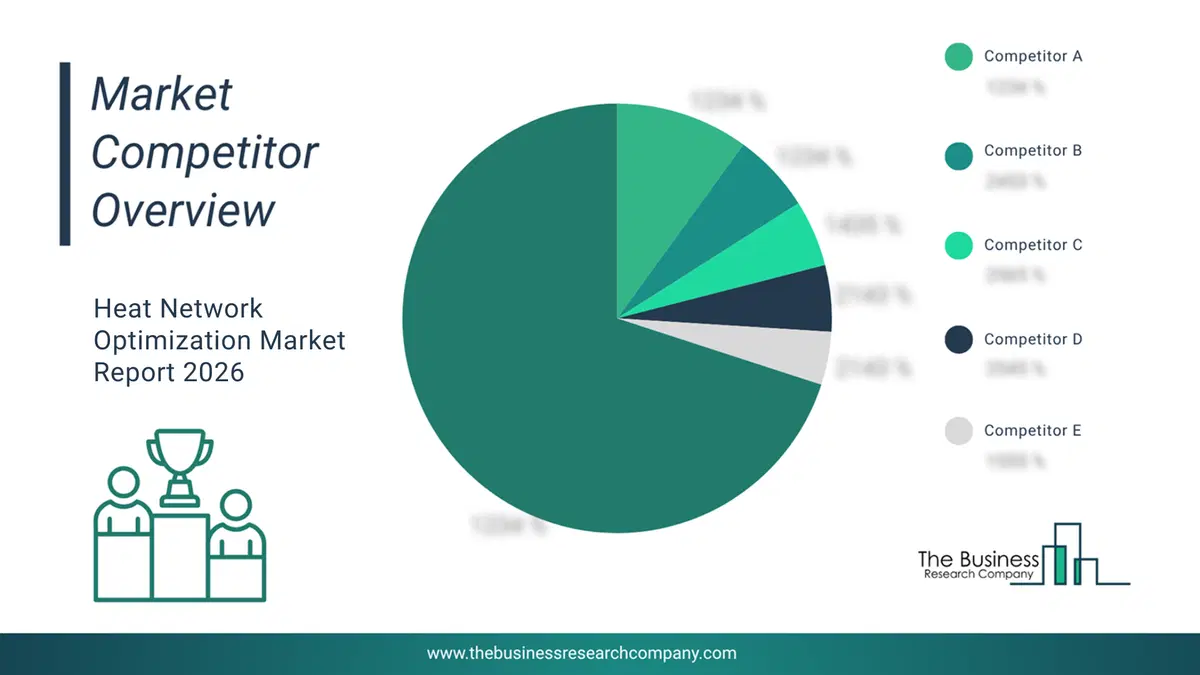
This chart is for illustrative purposes; the full report includes a detailed competitor analysis and comprehensive overview of the top 10 companies in the market.
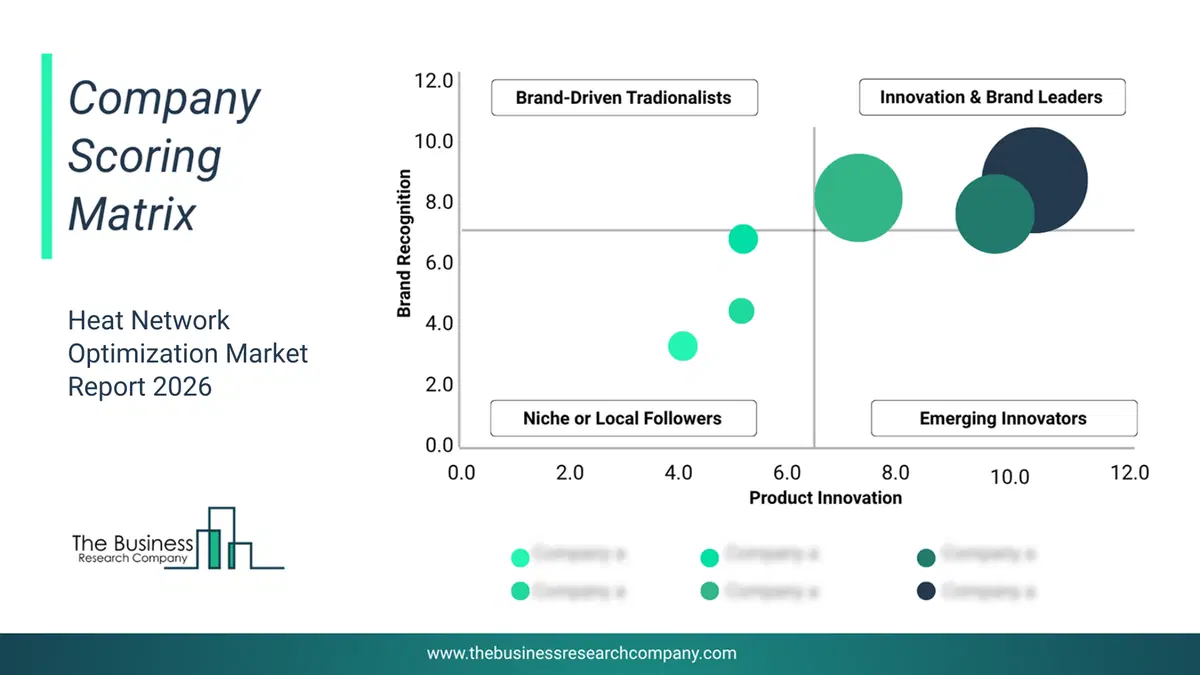
This chart maps companies by product innovation and brand strength, with bubble size indicating relative revenue, helping identify market leaders, challengers, and niche players. This is an illustrative chart; the full report provides a complete and accurate competitive analysis.
Global Heat Network Optimization Market Trends and Insights
Major companies operating in the heat network optimization market are increasingly introducing advanced simulation and predictive modeling tools, such as next-generation district heating simulation software, to meet the rising demand for accurate performance forecasting, strategic planning, and cost-effective network operation. These simulation tools leverage detailed system modeling, historical data, and scenario analysis to enable operators to evaluate long-term heat generation, network behavior, supply strategies, and investment impacts, offering far deeper insight than traditional spreadsheet-based planning or static hydraulic calculations, which often lack dynamic forecasting and integrated scenario testing. For example, in February 2025, Kelvin Green, a Germany-based sustainable energy solutions provider, unveiled HeatSim, a cutting-edge district heating simulation software tool at E-world 2025, designed to enable heat network operators to simulate hourly heat generation and explore operational and investment scenarios up to 20 years ahead. HeatSim’s key features include lifecycle cost optimization, tariff and procurement strategy analysis, predictive operational planning, subsidy and tariff impact evaluation, and network optimization insights that can guide decisions on heat pump integration and temperature management, enhancing both financial and operational outcomes for sustainable district heating systems.What Are Latest Mergers And Acquisitions In The Heat Network Optimization Market?
In April 2023, Air Water Incorporated, a Japan-based manufacturing and industrial technology company, acquired M1 Engineering Holdings Limited for an undisclosed amount. With this acquisition, Air Water aimed to strengthen its engineering and technological capabilities, expand its global footprint, and enhance its ability to deliver advanced energy and thermal infrastructure solutions that support efficient system design, optimization, and long-term operational performance. M1 Engineering Holdings Limited is a Singapore-based engineering and technology company that specializes in the design, fabrication, and maintenance of cryogenic, gas, and energy-related engineering systems by providing customized solutions that improve thermal control, system reliability, and efficiency across complex energy and heat-related networks.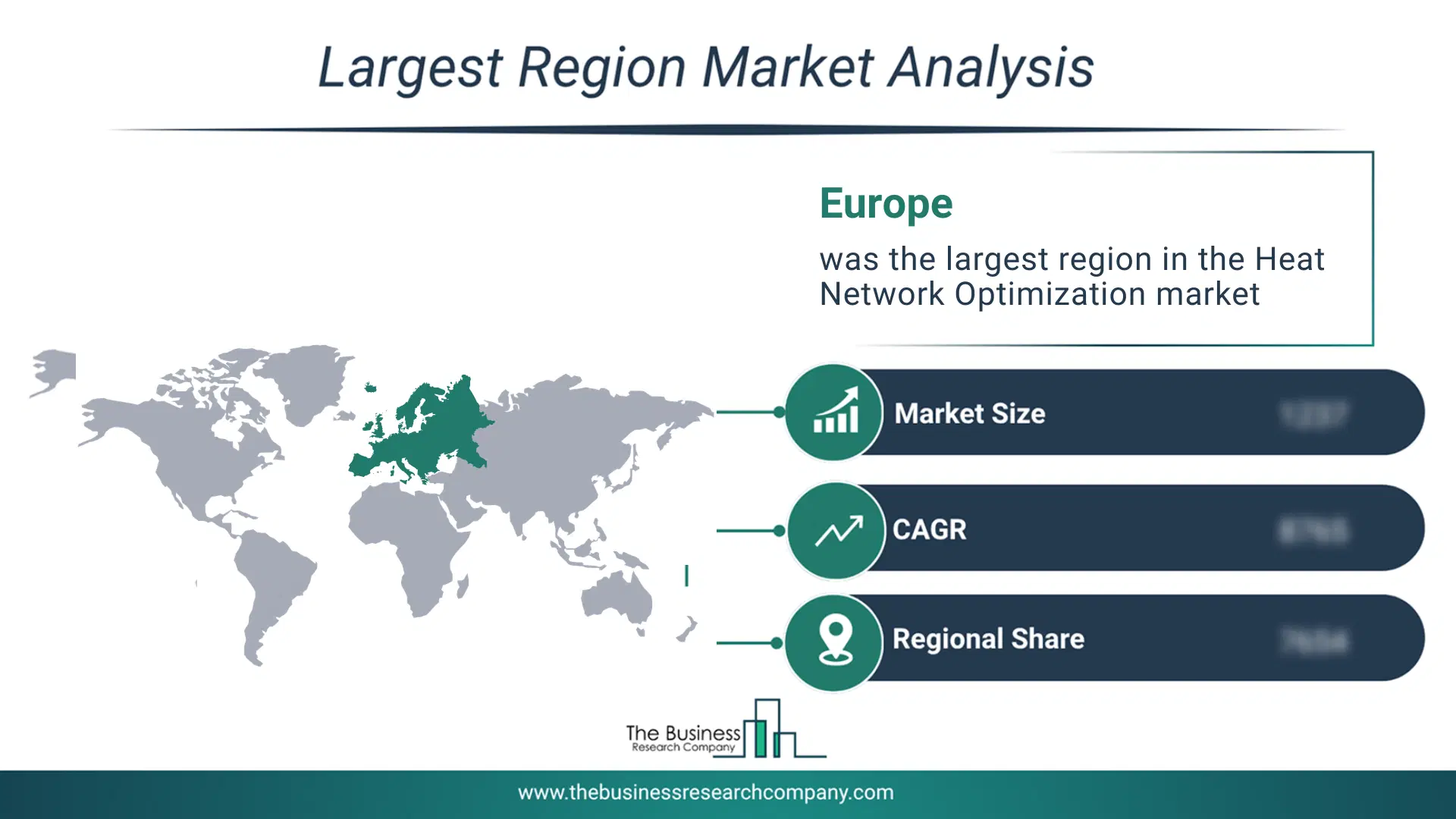
Regional Insights
Europe was the largest region in the heat network optimization market in 2025. Asia-Pacific is expected to be the fastest-growing region in the forecast period. The regions covered in this market report are Asia-Pacific, South East Asia, Western Europe, Eastern Europe, North America, South America, Middle East, Africa. The countries covered in this market report are Australia, Brazil, China, France, Germany, India, Indonesia, Japan, Taiwan, Russia, South Korea, UK, USA, Canada, Italy, Spain.What Defines the Heat Network Optimization Market?
The heat network optimization market consists of revenues earned by entities by providing services such as network performance monitoring, heat demand forecasting, operational optimization, system integration, data analytics and reporting, predictive maintenance, energy efficiency consulting, software implementation, and configuration services. The market value includes the value of related goods sold by the service provider or included within the service offering. The heat network optimization market includes sales of smart heat meters, temperature sensors, flow meters, pressure sensors, control valves, heat exchangers, programmable logic controllers, communication gateways, and data acquisition units. Values in this market are ‘factory gate’ values, that is, the value of goods sold by the manufacturers or creators of the goods, whether to other entities (including downstream manufacturers, wholesalers, distributors, and retailers) or directly to end customers.How is Market Value Defined and Measured?
The market value is defined as the revenues that enterprises gain from the sale of goods and/or services within the specified market and geography through sales, grants, or donations in terms of the currency (in USD unless otherwise specified). The revenues for a specified geography are consumption values that are revenues generated by organizations in the specified geography within the market, irrespective of where they are produced. It does not include revenues from resales along the supply chain, either further along the supply chain or as part of other products.
This chart presents market attractiveness based on a quantitative evaluation of growth, competition, strategic alignment, and risk, offering a clear view of opportunity areas for decision-making. This chart is for illustrative purposes; the full report contains the complete analysis.

This chart highlights the Total Addressable Market (TAM) by estimating the maximum revenue opportunity using an assumption-driven approach, supporting strategic planning and opportunity sizing across markets. The chart is illustrative; the full report provides a more comprehensive analysis.
What Key Data and Analysis Are Included in the Heat Network Optimization Market Report 2026?
The heat network optimization market research report is one of a series of new reports from The Business Research Company that provides market statistics, including industry global market size, regional shares, competitors with the market share, detailed market segments, market trends and opportunities, and any further data you may need to thrive in the heat network optimization industry. The market research report delivers a complete perspective of everything you need, with an in-depth analysis of the current and future state of the industry.Heat Network Optimization Market Report Forecast Analysis
| Report Attribute | Details |
|---|---|
| Market Size Value In 2026 | $4.77 billion |
| Revenue Forecast In 2030 | $7.78 billion |
| Growth Rate | CAGR of 12.8% from 2026 to 2030 |
| Base Year For Estimation | 2025 |
| Actual Estimates/Historical Data | 2020-2025 |
| Forecast Period | 2026 - 2030 - 2030 |
| Market Representation | Revenue in USD Billion and CAGR from 2026 to 2030 |
| Segments Covered | Component, Deployment Mode, Application, End User |
| Regional Scope | Asia-Pacific, Western Europe, Eastern Europe, North America, South America, Middle East, Africa |
| Country Scope | The countries covered in the report are Australia, Brazil, China, France, Germany, India, Indonesia, Japan, Taiwan, Russia, South Korea, UK, USA, Canada, Italy, Spain. |
| Key Companies Profiled | E.ON SE, ENGIE SA, Siemens AG, Veolia Environnement SA, Schneider Electric SE, Honeywell International Inc., ABB Ltd, Centrica plc, Johnson Controls International plc, Trane Technologies plc, Emerson Electric Co., Danfoss A/S, Fortum Oyj, Ramboll Group A/S, Itron Inc., COWI A/S, Kelvion Holding GmbH, Kamstrup A/S, NODA Intelligent Systems GmbH, and Sycous Limited. |
| Customization Scope | Request for Customization |
| Pricing And Purchase Options | Explore Purchase Options |