

Higher Education M-Learning Market Report 2026
Global Outlook – By Component (Content, Services, Platforms), By Learning Mode (Asynchronous Self-Paced, Synchronous Virtual Classroom), By Deployment Model (On-Premises, Cloud-Based), By Device Type (Smartphones, Tablets, Wearables, Other Device Types), By End User (Public Universities, Private Universities, Community And Technical Colleges, Other End Users) – Market Size, Trends, Strategies, and Forecast to 2030
Higher Education M-Learning Market Overview
• Higher Education M-Learning market size has reached to $41.62 billion in 2025 • Expected to grow to $105.07 billion in 2030 at a compound annual growth rate (CAGR) of 20.4% • Growth Driver: Rising Smartphone Penetration Among Students Fueling The Growth Of The Market Due To Growing Reliance On Digital Learning Platforms • Market Trend: Developing Adaptive Mobile Learning Tools To Improve Academic Performance And Engagement • North America was the largest region in 2025 and Asia-Pacific is the fastest growing region.What Is Covered Under Higher Education M-Learning Market?
The higher education m-learning refers to the use of mobile technologies and digital platforms to deliver academic content, facilitate communication, and support learning activities within higher education institutions. It includes mobile applications, learning management systems, and cloud-based tools designed to enable flexible access to lectures, assessments, collaboration features, and educational resources. The main components of higher education M-learning are content, services, and platforms. Content solutions are specialized learning materials designed to deliver interactive, mobile-optimized educational experiences that enhance student engagement and knowledge retention. The different learning modes include asynchronous self-paced and synchronous virtual classroom, and multiple deployment models include on-premises and cloud-based. The various device types include smartphones, tablets, wearables, and other device types, and they are used by several end users such as public universities, private universities, community and technical colleges, and others.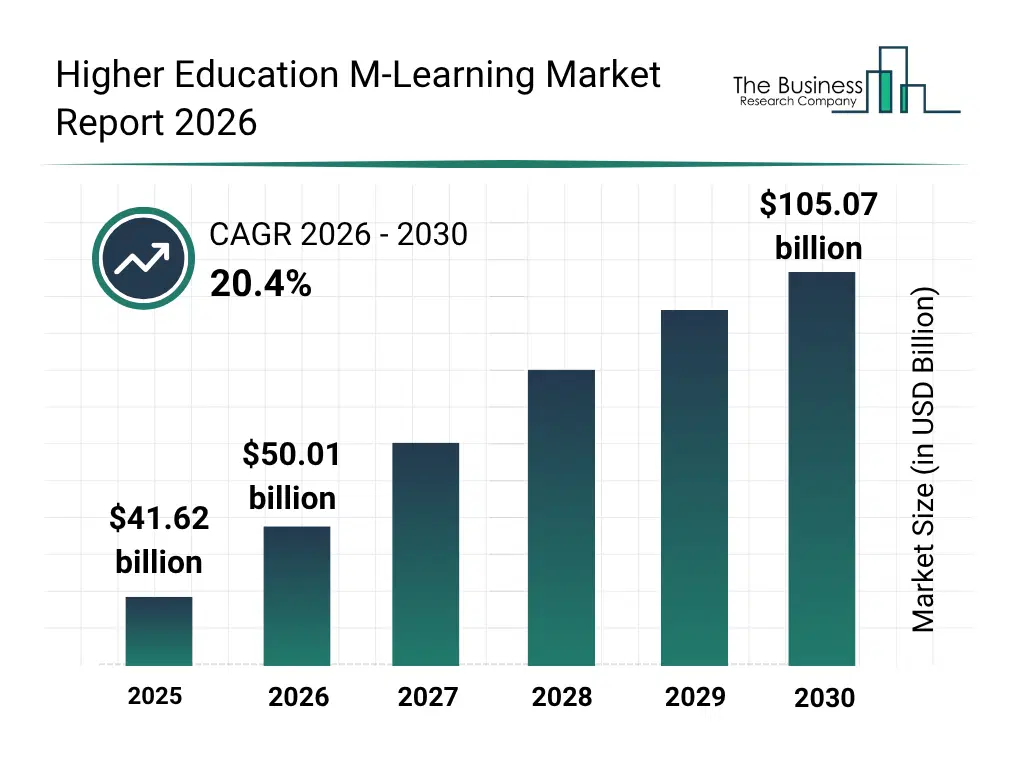
What Is The Higher Education M-Learning Market Size and Share 2026?
The higher education m-learning market size has grown exponentially in recent years. It will grow from $41.62 billion in 2025 to $50.01 billion in 2026 at a compound annual growth rate (CAGR) of 20.2%. The growth in the historic period can be attributed to rise in smartphone and tablet penetration, increasing internet accessibility in higher education institutions, adoption of LMS platforms, demand for remote learning solutions, emphasis on digital literacy among students.What Is The Higher Education M-Learning Market Growth Forecast?
The higher education m-learning market size is expected to see exponential growth in the next few years. It will grow to $105.07 billion by 2030 at a compound annual growth rate (CAGR) of 20.4%. The growth in the forecast period can be attributed to increasing investment in mobile edtech platforms, growth of AI-driven adaptive learning tools, rising demand for hybrid and blended learning models, expansion of cloud-based content delivery, integration of gamification and immersive learning experiences. Major trends in the forecast period include growing adoption of mobile learning applications in higher education, integration of learning analytics for student performance tracking, expansion of cloud-based learning management systems, increasing demand for interactive and multimedia educational content, rising focus on flexible and personalized learning experiences.
Global Higher Education M-Learning Market Segmentation
1) By Component: Content, Services, Platforms 2) By Learning Mode: Asynchronous Self-Paced, Synchronous Virtual Classroom 3) By Deployment Model: On-Premises, Cloud-Based 4) By Device Type: Smartphones, Tablets, Wearables, Other Device Types 5) By End User: Public Universities, Private Universities, Community And Technical Colleges, Other End Users Subsegments: 1) By Content: Interactive Modules, E-Books, Video Lectures, Audio Lessons, Quizzes And Assessments, Case Studies 2) By Services: Tutoring, Mentoring, Technical Support, Learning Analytics, Progress Tracking, Certification Assistance 3) By Platforms: Learning Management Systems, Mobile Applications, Web Portals, Virtual Classrooms, Social Learning Platforms, Collaborative ToolsWhat Is The Driver Of The Higher Education M-Learning Market?
The increasing smartphone penetration among students is expected to propel the growth of the higher education m-learning market going forward. Smartphone penetration among students refers to the increasing ownership and regular use of smartphones for communication, learning, entertainment, and academic activities. The rise in smartphone penetration among students is driven by growing reliance on digital learning platforms, encouraging students to adopt smartphones as essential tools for accessing educational content and online resources. Higher education m-learning supports this trend by enabling flexible, mobile-based access to lectures, study materials, and assessments, making smartphones integral to academic engagement and participation. For instance, in December 2023, according to the Pew Research Center, a US-based nonpartisan fact tank, smartphone penetration among students increased in the United States in 2023, with about 95% of U.S. teens aged 13 to 17 reporting access to a smartphone at home, indicating near-universal adoption of mobile technology among school-age youth. Therefore, the increasing smartphone penetration among students is driving the growth of the higher education m-learning industry.Key Players In The Global Higher Education M-Learning Market
Major companies operating in the higher education m-learning market are LinkedIn Learning, GoToWebinar, Udemy Inc., Chegg Inc., Coursera Inc., Unacademy Learning Pvt Ltd, Duolingo Inc., Simplilearn Solutions Inc., D2L Corporation, Anthology, Moodle Pty Ltd, Thinkific Labs Inc., Classplus Technologies Pvt Ltd, FutureLearn Ltd., Khan Academy Inc., WizIQ Solutions Pvt Ltd, Study.com LLC, Blackboard Inc., TalentLMS, Saylor Academy.
This chart is for illustrative purposes; the full report includes a detailed competitor analysis and comprehensive overview of the top 10 companies in the market.
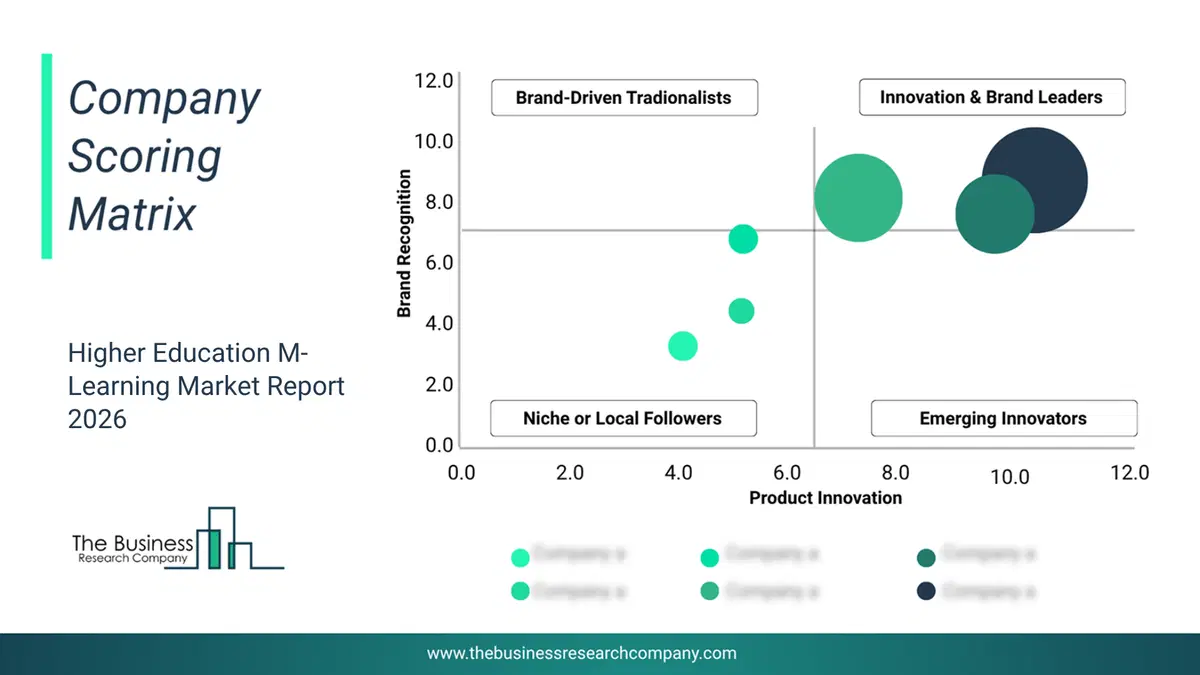
This chart maps companies by product innovation and brand strength, with bubble size indicating relative revenue, helping identify market leaders, challengers, and niche players. This is an illustrative chart; the full report provides a complete and accurate competitive analysis.
Global Higher Education M-Learning Market Trends and Insights
Major companies operating in the higher education mobile learning market are focusing on advanced solutions such as artificial intelligence (AI)-powered personalized study sets to enhance learning outcomes, improve exam preparation, and increase student engagement. AI-powered personalized study sets are mobile-enabled features that generate tailored learning materials, summaries, and practice questions based on a student’s uploaded content, enabling efficient, on-the-go learning. For instance, in March 2024, QANDA, a South Korea-based education technology company backed by Google, launched Prep.Pie, its first U.S. product targeting college students. The solution offers adaptive AI-driven study tools, including Prep Notes, Prep Sets, and Quick Solver, to help students at universities such as USC and UCLA prepare more effectively for exams. By enabling mobile access to personalized learning resources, the platform helps improve knowledge retention, streamline study workflows, and enhance overall academic performance.What Are Latest Mergers And Acquisitions In The Higher Education M-Learning Market?
In February 2024, Instructure Holdings Inc., a US-based educational technology company, acquired Parchment Inc. for $835 million. Through this acquisition, Instructure aims to strengthen its higher education and lifelong learning ecosystem by integrating digital credential issuance, verification, and learner record services into its learning management and m-learning solutions, enhancing learner mobility and proof of achievement. Parchment Inc. is a US-based credential management technology company specializing in secure digital transcripts, diplomas, certificates, and comprehensive learner record exchange.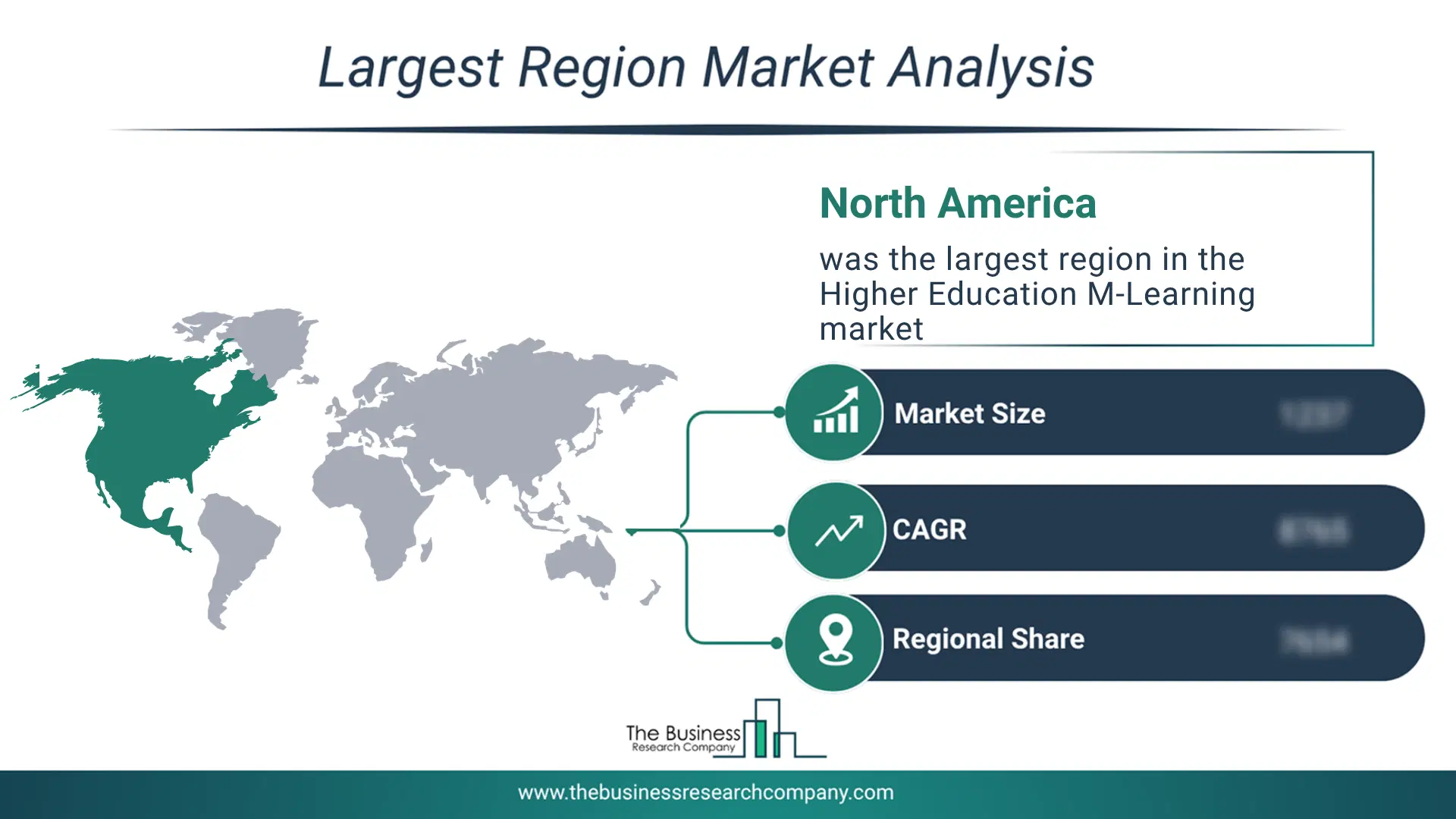
Regional Insights
North America was the largest region in the higher education m-learning market in 2025. Asia-Pacific is expected to be the fastest-growing region in the forecast period. The regions covered in this market report are Asia-Pacific, South East Asia, Western Europe, Eastern Europe, North America, South America, Middle East, Africa. The countries covered in this market report are Australia, Brazil, China, France, Germany, India, Indonesia, Japan, Taiwan, Russia, South Korea, UK, USA, Canada, Italy, Spain.What Defines the Higher Education M-Learning Market?
The higher education m-learning market consists of revenues earned by entities by providing services such as mobile-based content delivery, virtual classroom facilitation, learning management system integration, real-time collaboration tools, digital assessment solutions, and cloud-enabled academic resource management. The market value includes the value of related goods sold by the service provider or included within the service offering. The higher education m-learning market also includes sales of digital whiteboards, stylus-enabled devices, wearable devices, and e-readers. Values in this market are ‘factory gate’ values, that is, the value of goods sold by the manufacturers or creators of the goods, whether to other entities (including downstream manufacturers, wholesalers, distributors, and retailers) or directly to end customers. The value of goods in this market includes related services sold by the creators of the goods.How is Market Value Defined and Measured?
The market value is defined as the revenues that enterprises gain from the sale of goods and/or services within the specified market and geography through sales, grants, or donations in terms of the currency (in USD unless otherwise specified). The revenues for a specified geography are consumption values that are revenues generated by organizations in the specified geography within the market, irrespective of where they are produced. It does not include revenues from resales along the supply chain, either further along the supply chain or as part of other products.
This chart presents market attractiveness based on a quantitative evaluation of growth, competition, strategic alignment, and risk, offering a clear view of opportunity areas for decision-making. This chart is for illustrative purposes; the full report contains the complete analysis.

This chart highlights the Total Addressable Market (TAM) by estimating the maximum revenue opportunity using an assumption-driven approach, supporting strategic planning and opportunity sizing across markets. The chart is illustrative; the full report provides a more comprehensive analysis.
What Key Data and Analysis Are Included in the Higher Education M-Learning Market Report 2026?
The higher education m-learning market research report is one of a series of new reports from The Business Research Company that provides market statistics, including industry global market size, regional shares, competitors with the market share, detailed market segments, market trends and opportunities, and any further data you may need to thrive in the higher education m-learning industry. The market research report delivers a complete perspective of everything you need, with an in-depth analysis of the current and future state of the industry.Higher Education M-Learning Market Report Forecast Analysis
| Report Attribute | Details |
|---|---|
| Market Size Value In 2026 | $50.01 billion |
| Revenue Forecast In 2030 | $105.07 billion |
| Growth Rate | CAGR of 20.4% from 2026 to 2030 |
| Base Year For Estimation | 2025 |
| Actual Estimates/Historical Data | 2020-2025 |
| Forecast Period | 2026 - 2030 |
| Market Representation | Revenue in USD Billion and CAGR from 2026 to 2030 |
| Segments Covered | Component, Learning Mode, Deployment Model, Device Type, End User |
| Regional Scope | Asia-Pacific, Western Europe, Eastern Europe, North America, South America, Middle East, Africa |
| Country Scope | The Countries Covered In This Market Report Are Australia, Brazil, China, France, Germany, India, Indonesia, Japan, Taiwan, Russia, South Korea, Uk, Usa, Canada, Italy, Spain. |
| Key Companies Profiled | LinkedIn Learning, GoToWebinar, Udemy Inc., Chegg Inc., Coursera Inc., Unacademy Learning Pvt Ltd, Duolingo Inc., Simplilearn Solutions Inc., D2L Corporation, Anthology, Moodle Pty Ltd, Thinkific Labs Inc., Classplus Technologies Pvt Ltd, FutureLearn Ltd., Khan Academy Inc., WizIQ Solutions Pvt Ltd, Study.com LLC, Blackboard Inc., TalentLMS, Saylor Academy. |
| Customization Scope | Request for Customization |
| Pricing And Purchase Options | Explore Purchase Options |