
Home Solar Equipment Market Report 2026
Global Outlook – By Product Type (Solar Panels, Solar Inverters, Solar Batteries, Mounting And Racking Systems, Solar Charge Controllers, Monitoring And Control Systems, Balance Of System Components), By Connectivity (Grid-Connected Systems, Standalone Systems), By Application (Electricity Generation, Water Heating, Lighting Solutions, Backup Power Systems), By End User (Residential Homeowners, Housing Societies Or Apartments) – Market Size, Trends, Strategies, and Forecast to 2035
Home Solar Equipment Market Overview
• Home Solar Equipment market size has reached to $89.65 billion in 2025 • Expected to grow to $137.68 billion in 2030 at a compound annual growth rate (CAGR) of 9% • Growth Driver: Surge In Electricity Prices Fueling The Growth Of The Market Due To Increasing Electricity Generation And Fuel Costs Leading To Higher Consumer Utility Bills And Greater Adoption Of Cost-saving Solar Alternatives • Market Trend: Integrated Rooftop Solar Platforms Redefine Residential Energy Management • Asia-Pacific was the largest region and fastest growing region.What Is Covered Under Home Solar Equipment Market?
Home solar equipment refers to an integrated set of components designed to capture, convert, regulate, and manage energy derived from sunlight within a residential setting. It encompasses technologies that facilitate the transformation of solar radiation into usable electrical power, along with systems that ensure efficient energy flow, performance optimization, and system protection. These components collectively enable energy generation, storage, distribution, and monitoring at a small-scale level, forming a self-contained energy ecosystem that supports reliable and sustainable power management within a household environment. The main product types of home solar equipment include solar panels, solar inverters, solar batteries, mounting and racking systems, solar charge controllers, monitoring and control systems, and balance of system components. Solar panels refer to photovoltaic devices designed to convert sunlight into electricity for residential and small-scale energy generation applications. These systems are categorized by connectivity including grid-connected systems and standalone systems. They find application in electricity generation, water heating, lighting solutions, and backup power systems, serving end users including residential homeowners and housing societies or apartments.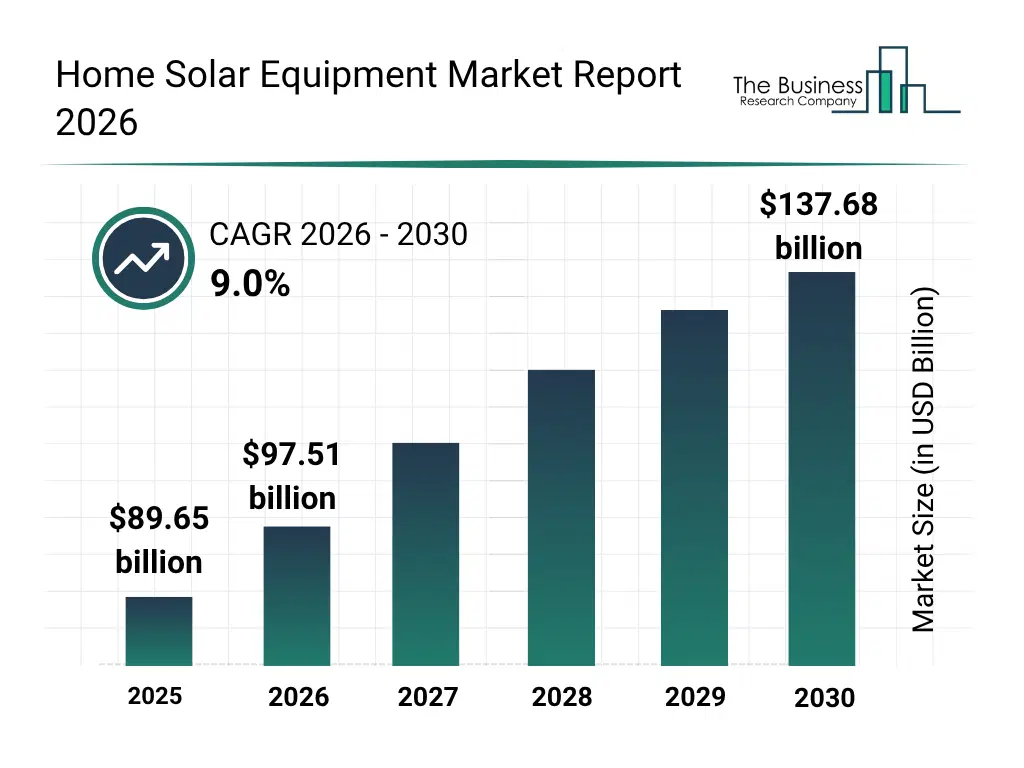
What Is The Home Solar Equipment Market Size and Share 2026?
The home solar equipment market size has grown strongly in recent years.It will grow from $89.65 billion in 2025 to $97.51 billion in 2026 at a compound annual growth rate (CAGR) of 8.8%. The growth in the historic period can be attributed to rising electricity costs driving solar adoption, government subsidies and incentive programs for residential solar installations, increasing awareness of renewable energy benefits, expansion of urban housing electrification, early adoption of solar photovoltaic technology in residential sector.What Is The Home Solar Equipment Market Growth Forecast?
The home solar equipment market size is expected to see strong growth in the next few years.It will grow to $137.68 billion by 2030 at a compound annual growth rate (CAGR) of 9.0%. The growth in the forecast period can be attributed to increasing penetration of smart home energy management systems, declining cost of solar panels and battery storage, rising demand for net-zero residential buildings, expansion of decentralized energy generation models, growing integration of AI-driven energy optimization systems.Major trends in the forecast period include increasing adoption of rooftop solar installations in urban residential housing, rising demand for hybrid solar systems with battery storage integration, growing popularity of modular and scalable home solar kits, expansion of subscription-based solar energy service models for households, increasing focus on energy independence and grid outage resilience solutions.
Global Home Solar Equipment Market Segmentation
1) By Product Type: Solar Panels, Solar Inverters, Solar Batteries, Mounting And Racking Systems, Solar Charge Controllers, Monitoring And Control Systems, Balance Of System Components 2) By Connectivity: Grid-Connected Systems, Standalone Systems 3) By Application: Electricity Generation, Water Heating, Lighting Solutions, Backup Power Systems 4) By End User: Residential Homeowners, Housing Societies Or Apartments Subsegments: 1) By Solar Panels: Monocrystalline Solar Panels, Polycrystalline Solar Panels, Thin Film Solar Panels, Bifacial Solar Panels, Building Integrated Photovoltaic Panels 2) By Solar Inverters: String Inverters, Micro Inverters, Central Inverters, Hybrid Inverters, Off Grid Inverters 3) By Solar Batteries: Lithium Ion Batteries, Lead Acid Batteries, Flow Batteries, Nickel Cadmium Batteries 4) By Mounting And Racking Systems: Roof Mount Systems, Ground Mount Systems, Pole Mount Systems, Tracking Mount Systems, Ballasted Mount Systems 5) By Solar Charge Controllers: Pulse Width Modulation Charge Controllers, Maximum Power Point Tracking Charge Controllers 6) By Monitoring And Control Systems: Energy Monitoring Systems, Remote Monitoring Systems, Smart Energy Management Systems, Performance Analytics Systems 7) By Balance Of System Components: Junction Boxes, Wiring And Cabling, Combiner Boxes, Fuses And Circuit Breakers, Disconnect Switches, Conduits And Mounting HardwareWhat Is The Driver Of The Home Solar Equipment Market?
The rising electricity prices are expected to propel the growth of the home solar equipment industry going forward.Electricity prices refer to the cost paid by consumers for each unit of electricity consumed, typically measured per kilowatt-hour (kWh).The rise in electricity prices is driven by increasing generation and fuel costs, as higher input expenses for power production and distribution are passed on to consumers, leading to higher overall electricity tariffs.Home solar equipment helps reduce electricity prices by generating power on-site from solar energy, thereby lowering dependence on grid electricity and reducing monthly utility bills for consumers.For instance, in July 2025, according to the International Energy Agency, a France-based intergovernmental organization, wholesale electricity prices in the European Union averaged around USD 90/MWh in the first half of 2025, representing about a 30% increase compared to the same period in 2024 due to higher fuel and carbon costs.Therefore, the rising electricity prices are driving the growth of the home solar equipment industry going forward.Key Players In The Global Home Solar Equipment Market
Major companies operating in the home solar equipment market are Siemens AG, LG Electronics Inc., Panasonic Holdings Corporation, Schneider Electric SE, ABB Ltd., LONGi Green Energy Technology Co. Ltd., JinkoSolar Holding Co. Ltd., Trina Solar Co. Ltd., Hanwha Q CELLS Co. Ltd., Canadian Solar Inc., SolarEdge Technologies Inc., Enphase Energy Inc., SMA Solar Technology AG, Suntech Power Holdings Co. Ltd., Fronius International GmbH, GoodWe Technologies Co. Ltd., SunPower Corporation, Growatt New Energy Technology Co. Ltd., Tesla Energy Operations Inc., JA Solar Technology Co. Ltd.Global Home Solar Equipment Market Trends and Insights
Major companies operating in the home solar equipment market are focusing on developing advanced solutions, such as integrated rooftop solar management systems, to enhance energy efficiency, simplify installation, and improve real-time monitoring and optimization of household solar power generation. Integrated rooftop solar management systems refer to smart solar solutions that combine solar panels, inverters, and digital platforms to enable homeowners to monitor energy production, manage consumption, and optimize savings through intelligent energy control. For instance, in April 2026, AB Energia, an India-based renewable energy company, launched Arkannect, an integrated rooftop solar solution designed to transform residential solar adoption in India. The platform enables seamless solar energy generation, monitoring, and optimization, helping homeowners improve energy efficiency, reduce electricity costs, and enhance overall system performance through smart digital control and connected solar infrastructure.What Are Latest Mergers And Acquisitions In The Home Solar Equipment Market?
In October 2025, Premier Energies, an India-based provider of solar photovoltaic modules and integrated solar solutions, acquired Ksolare Energy for $9. 29 million (₹86. 7 Crore). With this acquisition, Premier Energies aims to expand its presence in the solar value chain by entering the solar inverter manufacturing segment, thereby strengthening its product portfolio and enhancing its technological capabilities in integrated solar solutions. Ksolare Energy is an India-based provider of solar inverters and related power electronics solutions.Regional Insights
Asia-Pacific was the largest region in the home solar equipment market in 2025 and is expected to be the fastest-growing region in the forecast period. The regions covered in this market report are Asia-Pacific, South East Asia, Western Europe, Eastern Europe, North America, South America, Middle East and Africa. The countries covered in this market report are Australia, Brazil, China, France, Germany, India, Indonesia, Japan, Taiwan, Russia, South Korea, UK, USA, Canada, Italy, Spain.What Defines the Home Solar Equipment Market?
The home solar equipment market consists of sales of solar combiner boxes, solar connectors, and solar monitoring systems. Values in this market are ‘factory gate’ values, that is, the value of goods sold by the manufacturers or creators of the goods, whether to other entities (including downstream manufacturers, wholesalers, distributors, and retailers) or directly to end customers. The value of goods in this market includes related services sold by the creators of the goods.What is the Market Assessment and Strategic Outlook for the Home Solar Equipment Industry?
The home solar equipment market research report is one of a series of new reports from The Business Research Company that provides market statistics, including industry global market size, regional shares, competitors with the market share, detailed market segments, market trends and opportunities, and any further data you may need to thrive in the home solar equipment industry. The market research report delivers a complete perspective of everything you need, with an in-depth analysis of the current and future state of the industry.What is the Market Assessment and Strategic Outlook for the Home Solar Equipment Market Report 2026?
The home solar equipment market research report is one of a series of new reports from The Business Research Company that provides home solar equipment market statistics, including home solar equipment industry global market size, regional shares, competitors with a home solar equipment market share, detailed home solar equipment market segments, market trends and opportunities, and any further data you may need to thrive in the home solar equipment industry. This home solar equipment market research report delivers a complete perspective of everything you need, with an in-depth analysis of the current and future scenario of the industry.Home Solar Equipment Market Report Forecast Analysis
| Report Attribute | Details |
|---|---|
| Market Size Value In 2026 | $97.51 billion |
| Revenue Forecast In 2035 | $137.68 billion |
| Growth Rate | CAGR of 9.0% from 2026 to 2035 |
| Base Year For Estimation | 2025 |
| Actual Estimates/Historical Data | 2020-2025 |
| Forecast Period | 2026 - 2030 - 2035 |
| Market Representation | Revenue in USD Billion and CAGR from 2026 to 2035 |
| Segments Covered | Product Type, Connectivity, Application, End User |
| Regional Scope | Asia-Pacific, Western Europe, Eastern Europe, North America, South America, Middle East, Africa |
| Country Scope | The countries covered in the report are Australia, Brazil, China, France, Germany, India, Indonesia, Japan, Taiwan, Russia, South Korea, UK, USA, Canada, Italy, Spain. |
| Key Companies Profiled | Siemens AG, LG Electronics Inc., Panasonic Holdings Corporation, Schneider Electric SE, ABB Ltd., LONGi Green Energy Technology Co. Ltd., JinkoSolar Holding Co. Ltd., Trina Solar Co. Ltd., Hanwha Q CELLS Co. Ltd., Canadian Solar Inc., SolarEdge Technologies Inc., Enphase Energy Inc., SMA Solar Technology AG, Suntech Power Holdings Co. Ltd., Fronius International GmbH, GoodWe Technologies Co. Ltd., SunPower Corporation, Growatt New Energy Technology Co. Ltd., Tesla Energy Operations Inc., JA Solar Technology Co. Ltd. |
| Customization Scope | Request for Customization |
| Pricing And Purchase Options | Explore Purchase Options |