
Hotel Internet Of Things (IoT) Market Report 2026
Global Outlook – By Component (Hardware, Software, Services, Other Components), By Deployment Mode (On-Premises, Cloud, Other Deployment Modes), By Hotel Type (Luxury, Mid-Scale, Economy, Boutique, Other Hotel Types), By Application (Energy Management, Guest Experience Automation, Building Automation, Security and Surveillance, Asset Management, Other Applications), By End User (Chain Hotels, Independent Hotels, Resorts, Other End Users) – Market Size, Trends, Strategies, and Forecast to 2030
Hotel Internet Of Things (IoT) Market Overview
• Hotel Internet Of Things (IoT) market size has reached to $11.07 billion in 2025 • Expected to grow to $28.87 billion in 2030 at a compound annual growth rate (CAGR) of 21.1% • Growth Driver: Rising Demand For Personalized Guest Experiences And Automation Driving The Growth Of The Market Due To Increasing Traveler Expectations For Tailored And Tech-enabled Services • Market Trend: IoT Transformation for Improved Hotel Management With Enhanced Front Desk Monitoring & Control, Cloud Connectivity, And Smart Access Intelligence • North America was the largest region in 2025 and Asia-Pacific is the fastest growing region.What Is Covered Under Hotel Internet Of Things (IoT) Market?
The hotel internet of things (IOT) refers to the integration of connected devices, smart sensors, and automated systems that enable hotels to enhance operational efficiency, improve guest experiences, and support intelligent facility management. It focuses on the deployment of digitally connected infrastructure such as smart room controls, automated energy management, and real-time monitoring technologies across hotel environments. The market is driven by increasing adoption of automation, energy optimization solutions, and data-powered service innovation in the hospitality industry. The main components of hotel Internet of Things (IoT) include hardware, software, services, and others. Hardware refers to the physical devices and equipment that enable connectivity, automation, and data collection within a hotel’s Internet of Things ecosystem. The deployment modes include on-premises, cloud, and others. The hotel types include luxury, mid-scale, economy, boutique, and others. The applications include energy management, guest experience automation, building automation, security and surveillance, asset management, and others, catering to key end users such as chain hotels, independent hotels, resorts, and others.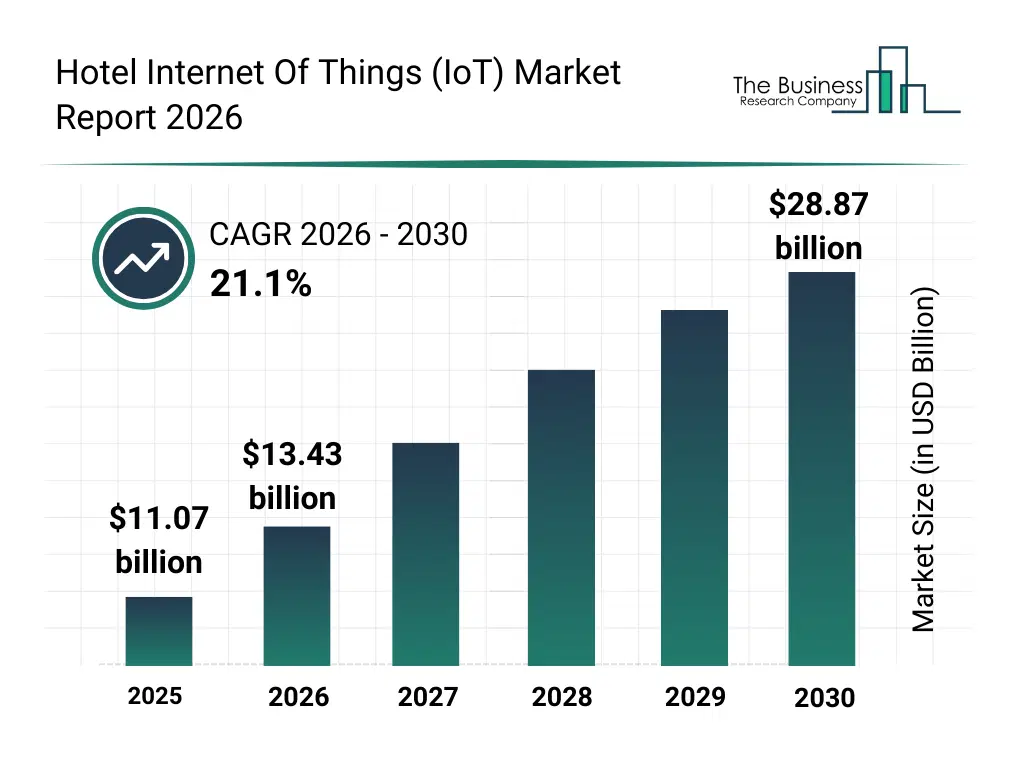
What Is The Hotel Internet Of Things (IoT) Market Size and Share 2026?
The hotel internet of things (IOT) market size has grown exponentially in recent years. It will grow from $11.07 billion in 2025 to $13.43 billion in 2026 at a compound annual growth rate (CAGR) of 21.4%. The growth in the historic period can be attributed to growing adoption of connected devices in hospitality operations, increasing demand for personalized guest experiences, rising use of smart energy management solutions, expansion of digital transformation initiatives in hotels, growing focus on operational efficiency and automation.What Is The Hotel Internet Of Things (IoT) Market Growth Forecast?
The hotel internet of things (IOT) market size is expected to see exponetial growth in the next few years. It will grow to $28.87 billion in 2030 at a compound annual growth rate (CAGR) of 21.1%. The growth in the forecast period can be attributed to increasing integration of artificial intelligence (AI) enabled smart hotel solutions, rising demand for real time monitoring and predictive maintenance, growing adoption of connected room controls and automated guest services, expansion of smart building and sustainability programs, rise in deployment of advanced wireless communication technologies. Major trends in the forecast period include technology driven innovations in smart hospitality platforms, advancements in artificial intelligence (AI) powered guest experience systems, developments in seamless device interoperability and cloud based hotel management, rising research and development in sensor enabled hotel infrastructure, innovation in data analytics and predictive service technologies.
Global Hotel Internet Of Things (IoT) Market Segmentation
1) By Component: Hardware, Software, Services, Other Components 2) By Deployment Mode: On-Premises, Cloud, Other Deployment Modes 3) By Hotel Type: Luxury, Mid-Scale, Economy, Boutique, Other Hotel Types 4) By Application: Energy Management, Guest Experience Automation, Building Automation, Security and Surveillance, Asset Management, Other Applications 5) By End User: Chain Hotels, Independent Hotels, Resorts, Other End Users Subsegments: 1) By Hardware: Smart Sensors, Connected Appliances, Network Gateways, Security Devices 2) By Software: Property Management Software, Energy Management Software, Guest Experience Software, Analytics and Reporting Software 3) By Services: Installation Services, Maintenance Services, Integration Services, Consulting Services 4) By Other Components: Connectivity Modules, Power Supply Units, Mounting and Enclosures, Cables and AccessoriesWhat Is The Driver Of The Hotel Internet Of Things (IoT) Market?
The rising demand for personalized guest experiences and automation is expected to propel the growth of the Hotel IoT market going forward. Personalized guest experiences refer to tailoring hotel services and interactions to individual guest preferences, such as customized room settings, tailored recommendations, and automated service delivery. The demand for personalized guest experiences and automation is rising as travelers now expect hotels to adapt services to their individual preferences and tech enabled convenience. Hotel IoT supports personalized guest experiences and automation by enabling smart devices and connected systems that automate room environments, personalize service delivery, and streamline guest interactions. For instance, in May 2024, according to LoungeUp, a France-based hotel technology platform, 57% of hotels have implemented at least three new technologies, focusing on cloud computing for guest processing (29%), reservation management (26%), and personalized recommendations (23%). Additionally, 62% of business leaders report improved customer retention, and 92% of companies leverage AI-based personalization. Therefore, the rising demand for personalized guest experiences and automation is driving the growth of the Hotel IoT market.Key Players In The Global Hotel Internet Of Things (IoT) Market
Major companies operating in the hotel internet of things (iot) market are Microsoft Corporation, Samsung Electronics Co. Ltd., International Business Machines Corporation (IBM), Panasonic Corporation, Schneider Electric SE, Honeywell International Inc., Johnson Controls International plc, ASSA ABLOY AB, dormakaba Holding AG, Bosch Security Systems GmbH, Crestron Electronics Inc., Control4 Corporation, Siemens AG, LG Electronics Inc., Delta Controls Inc., Interel Group, Legrand SA, Huawei Technologies Co. Ltd., TEKTELIC Communications Inc., MOKOSmart Technology Co. Ltd., Telkonet Inc., Cisco Systems Inc., BuildingIQ Inc., Verdant Environmental Technologies Inc.
This chart is for illustrative purposes; the full report includes a detailed competitor analysis and comprehensive overview of the top 10 companies in the market.
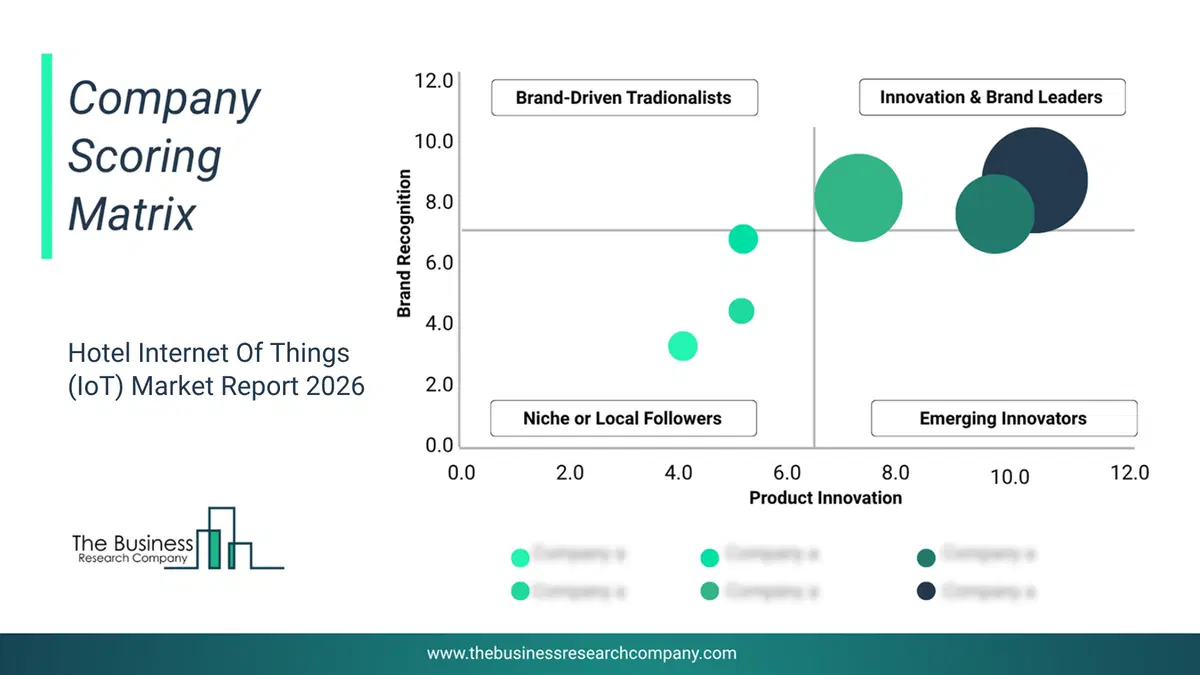
This chart maps companies by product innovation and brand strength, with bubble size indicating relative revenue, helping identify market leaders, challengers, and niche players. This is an illustrative chart; the full report provides a complete and accurate competitive analysis.
Global Hotel Internet Of Things (IoT) Market Trends and Insights
Major companies operating in the hotel IoT market are focusing on developing advanced capabilities, such as enhanced front desk monitoring and control solutions, to improve operational efficiency, security oversight, and guest experience across hospitality properties. Enhanced front desk monitoring and control solutions refers to an IoT-enabled feature that allows hotel staff to centrally monitor door lock status, battery levels, and security alerts in real time, while enabling remote actions such as locking down individual doors or responding instantly to forced entry events. For instance, in June 2024, Onity Inc., a US-based provider of electronic access control and mobile key solutions for the hospitality industry, announced new 1-way and 2-way cloud-connected IoT hospitality solutions. These solutions enable front desk teams to receive live alerts for doors held open or forced entry attempts, monitor lock battery health remotely, and manage door access centrally without physical intervention. The platform also supports remote maintenance functions such as daylight savings time adjustments, remote audits, and eliminating the need to reprogram locks after battery replacement.What Are Latest Mergers And Acquisitions In The Hotel Internet Of Things (IoT) Market?
In April 2024, ASSA ABLOY Global Solutions, a Sweden‑based provider of advanced security, access and smart hospitality technology solutions, acquired Axxess Industries Inc. for an undisclosed amount. With this acquisition, ASSA ABLOY aims to expand its smart hotel technology portfolio by integrating Axxess’s IoT‑driven electronic controls, including lighting, curtain, guest presence, and access solutions, to deliver more comprehensive and connected hotel room systems. Axxess Industries Inc. is a US‑based developer and supplier of IoT-enabled hotel technology that enhances guest experience and streamlines hotel operations.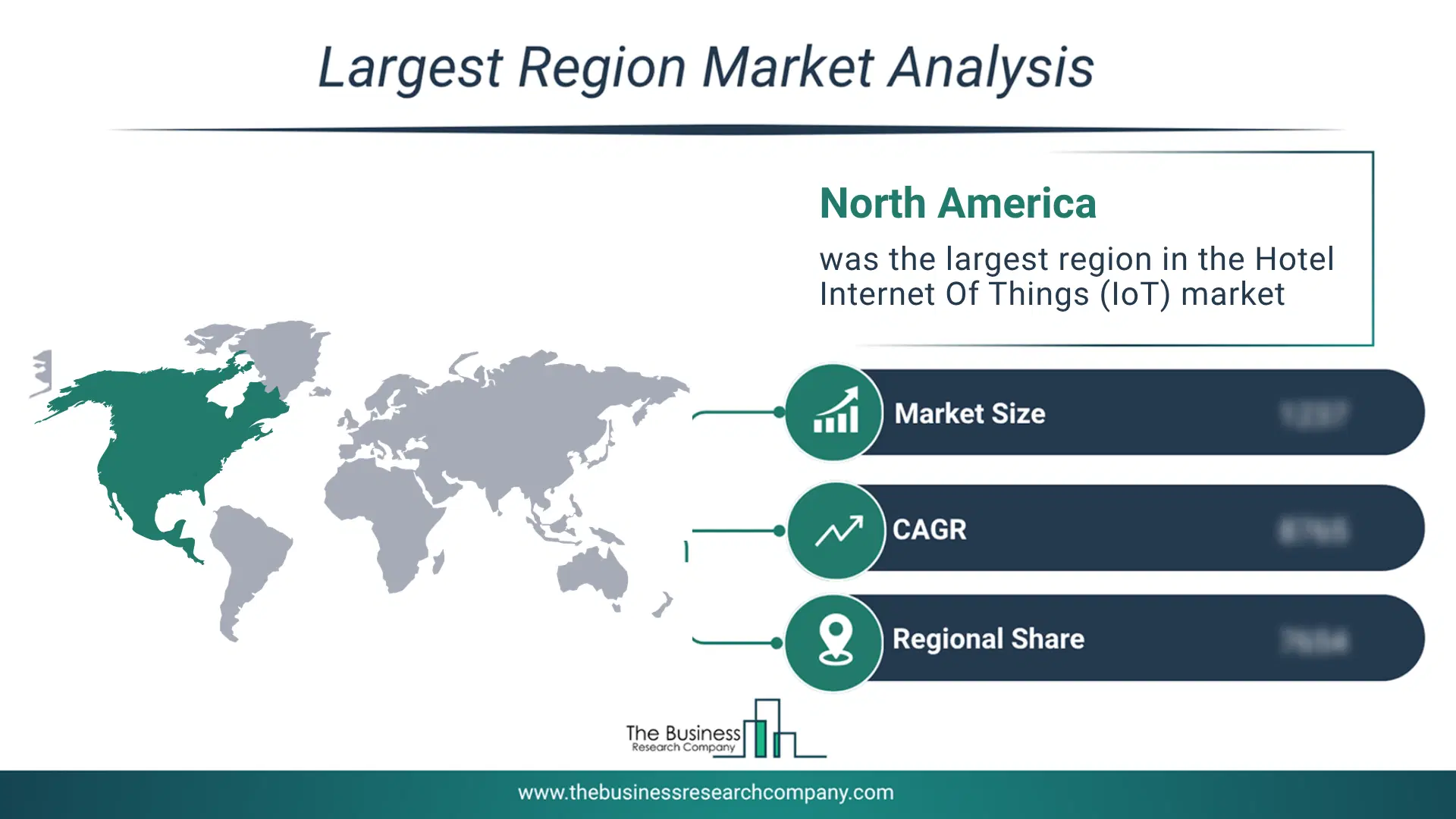
Regional Insights
North America was the largest region in the hotel internet of things (IOT) market in 2025. Asia-Pacific is expected to be the fastest-growing region in the forecast period. The regions covered in this market report are Asia-Pacific, South East Asia, Western Europe, Eastern Europe, North America, South America, Middle East, Africa. The countries covered in this market report are Australia, Brazil, China, France, Germany, India, Indonesia, Japan, Taiwan, Russia, South Korea, UK, USA, Canada, Italy, Spain.What Defines the Hotel Internet Of Things (IoT) Market?
The hotel internet of things (IOT) consists of revenues earned by entities by providing solutions such as smart room automation systems, connected environmental control devices, building management sensors, and real-time hotel operations monitoring platforms. The market value includes the value of related goods sold by the service provider or included within the service offering. The hotel internet of things (IOT) includes sales of smart lighting components, occupancy sensors, predictive maintenance modules, and cloud-connected device management systems. Values in this market are ‘factory gate’ values, that is, the value of goods sold by the manufacturers or creators of the goods, whether to other entities (including downstream manufacturers, wholesalers, distributors, and retailers) or directly to end customers. The value of goods in this market includes related services sold by the creators of the goods.How is Market Value Defined and Measured?
The market value is defined as the revenues that enterprises gain from the sale of goods and/or services within the specified market and geography through sales, grants, or donations in terms of the currency (in USD unless otherwise specified). The revenues for a specified geography are consumption values that are revenues generated by organizations in the specified geography within the market, irrespective of where they are produced. It does not include revenues from resales along the supply chain, either further along the supply chain or as part of other products.
This chart presents market attractiveness based on a quantitative evaluation of growth, competition, strategic alignment, and risk, offering a clear view of opportunity areas for decision-making. This chart is for illustrative purposes; the full report contains the complete analysis.

This chart highlights the Total Addressable Market (TAM) by estimating the maximum revenue opportunity using an assumption-driven approach, supporting strategic planning and opportunity sizing across markets. The chart is illustrative; the full report provides a more comprehensive analysis.
What Key Data and Analysis Are Included in the Hotel Internet Of Things (IoT) Market Report 2026?
The hotel internet of things (iot) market research report is one of a series of new reports from The Business Research Company that provides market statistics, including industry global market size, regional shares, competitors with the market share, detailed market segments, market trends and opportunities, and any further data you may need to thrive in the hotel internet of things (iot) industry. The market research report delivers a complete perspective of everything you need, with an in-depth analysis of the current and future state of the industry.Hotel Internet Of Things (IoT) Market Report Forecast Analysis
| Report Attribute | Details |
|---|---|
| Market Size Value In 2026 | $13.43 billion |
| Revenue Forecast In 2030 | $28.87 billion |
| Growth Rate | CAGR of 21.1% from 2026 to 2030 |
| Base Year For Estimation | 2025 |
| Actual Estimates/Historical Data | 2020-2025 |
| Forecast Period | 2026 - 2030 |
| Market Representation | Revenue in USD Billion and CAGR from 2026 to 2030 |
| Segments Covered | Component, Deployment Mode, Hotel Type, Application, End User |
| Regional Scope | Asia-Pacific, Western Europe, Eastern Europe, North America, South America, Middle East, Africa |
| Key Companies Profiled | Microsoft Corporation, Samsung Electronics Co. Ltd., International Business Machines Corporation (IBM), Panasonic Corporation, Schneider Electric SE, Honeywell International Inc., Johnson Controls International plc, ASSA ABLOY AB, dormakaba Holding AG, Bosch Security Systems GmbH, Crestron Electronics Inc., Control4 Corporation, Siemens AG, LG Electronics Inc., Delta Controls Inc., Interel Group, Legrand SA, Huawei Technologies Co. Ltd., TEKTELIC Communications Inc., MOKOSmart Technology Co. Ltd., Telkonet Inc., Cisco Systems Inc., BuildingIQ Inc., Verdant Environmental Technologies Inc. |
| Customization Scope | Request for Customization |
| Pricing And Purchase Options | Explore Purchase Options |