
Smart Hospitality Market Report 2026
Global Outlook – By Offering (Solution, Services), By Deployment Mode (Cloud, On-Premises), By End User (Hotel, Cruise, Luxury Yachts, Other End-Users) – Market Size, Trends, Strategies, and Forecast to 2030
Smart Hospitality Market Overview
• Smart Hospitality market size has reached to $29.55 billion in 2025 • Expected to grow to $92.37 billion in 2030 at a compound annual growth rate (CAGR) of 25.4% • Growth Driver: IoT-Driven Transformation In Hospitality Experiences • Market Trend: Innovations In Robotics And Automation Enhance Guest Experience And Operational Efficiency In hotels • North America was the largest region in 2025.Market Gains By 2030 – Top Opportunities By Segment
Market Gain identifies the most promising market opportunities by highlighting the segments or products expected to generate the highest incremental revenue growth over the next five years.
What Is Covered Under Smart Hospitality Market?
The smart hospitality market refers to hospitality services in which smart electronic devices powered by the Internet of Things (IoT), automation, and artificial intelligence are used to control various functions and activities. It allows users to handle and control multiple services remotely. The primary purpose is to increase employee efficiency and advance guest service facilities and experiences. The main offerings of smart hospitality solutions and services The solutions offered refer to providing solutions such as hospitality consulting, hotel development, event management, spa and fitness development, and hospitality recruitment. The smart hospitality is deployed on the cloud and on-premises in hotels, cruise ships, and luxury yachts.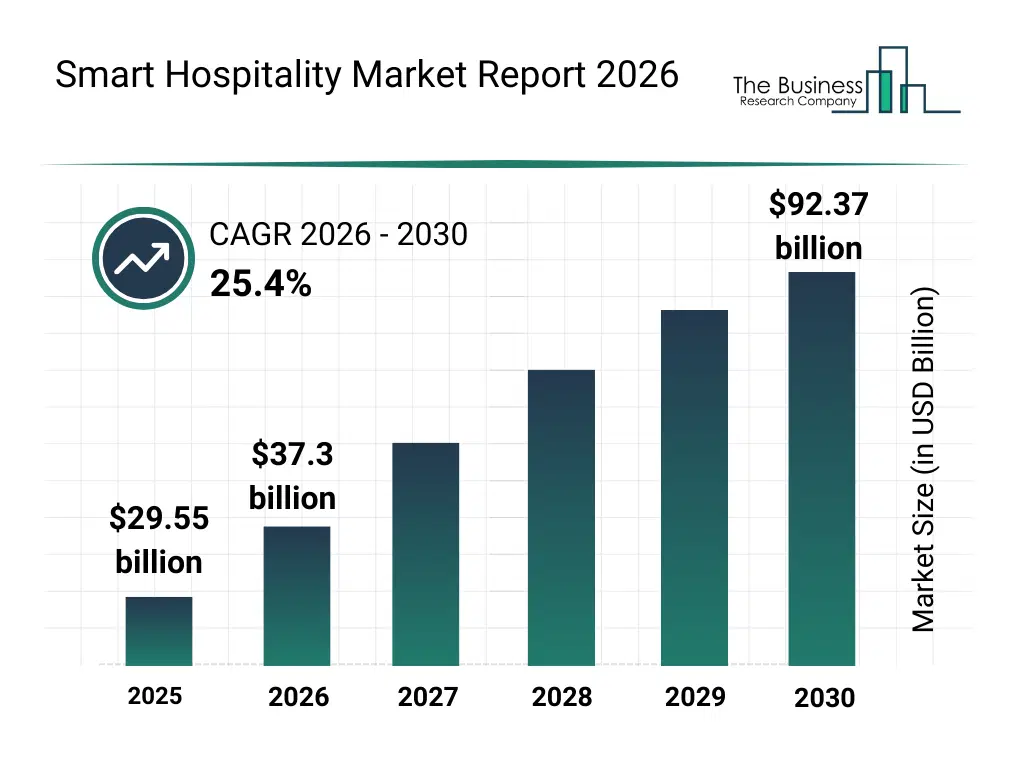
What Is The Smart Hospitality Market Size and Share 2026?
The smart hospitality market size has grown exponentially in recent years. It will grow from $29.55 billion in 2025 to $37.3 billion in 2026 at a compound annual growth rate (CAGR) of 26.2%. The growth in the historic period can be attributed to expansion of digital hotel management systems, rising demand for enhanced guest experiences, growth of connected building technologies, adoption of cloud-based hospitality platforms, increasing labor efficiency requirements.What Is The Smart Hospitality Market Growth Forecast?
The smart hospitality market size is expected to see exponential growth in the next few years. It will grow to $92.37 billion in 2030 at a compound annual growth rate (CAGR) of 25.4%. The growth in the forecast period can be attributed to increasing investments in smart hotels and resorts, rising demand for ai-driven personalization, expansion of sustainable hospitality operations, growing adoption of immersive guest technologies, increasing focus on remote service management. Major trends in the forecast period include increasing adoption of contactless guest services, rising deployment of smart room automation systems, growing integration of iot-based energy management, expansion of personalized guest experience platforms, enhanced focus on operational efficiency.
Global Smart Hospitality Market Segmentation
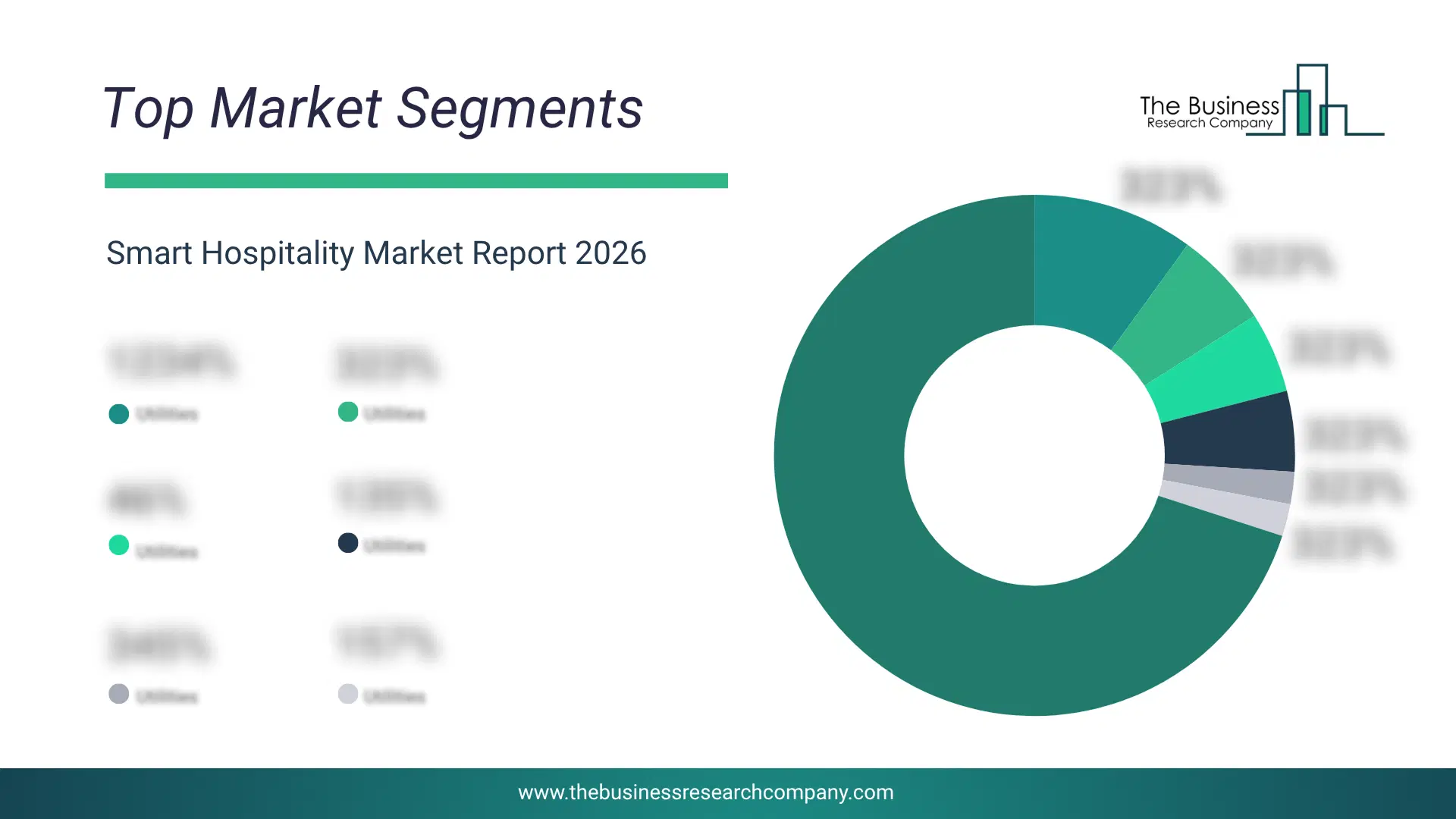
1) By Offering: Solution, Services 2) By Deployment Mode: Cloud, On-Premises 3) By End User: Hotel, Cruise, Luxury Yachts, Other End-Users Subsegments: 1) By Solutions: Property Management Systems (PMS), Guest Experience Management, Revenue Management Systems, Energy Management Solutions, Mobile Applications, Internet Of Things (IoT) Solutions, Contactless Technology 2) By Services: Consulting Services, Integration Services, Maintenance And Support Services, Training Services, Managed Services The top segments in the smart hospitality market will be: • Solution will reach $59.97 Billion by 2030. • Services will reach $31.86 Billion by 2030.What Is The Driver Of The Smart Hospitality Market?
The growing demand for enhanced smart IoT-based solutions is expected to propel the growth of the smart hospitality market. The Internet of Things (IoT) is a connected network that has the potential to significantly alter how hotels, resorts, cruise ships, casinos, restaurants, and other leisure services work. When IoT is combined with technologies such as user mobility and data analytics, a new paradigm in hospitality is created in which businesses collect data, interact with users, and automate processes to improve guest experiences. This adoption of IoT-based solutions improves processes by lowering operating costs, increasing productivity, and developing new services. For instance, in September 2024, according to the IoT Analytics GmbH, a Germany-based non-governmental organization, by the end of 2023 there were 16.6 billion connected IoT devices, reflecting a 15% increase from 2022, with IoT Analytics projecting a further 13% growth to 18.8 billion by the end of 2024. Additionally, the number of connected IoT devices is projected to reach 40 billion by 2030, a significant increase from the last market update in 2023. Therefore, the increase in the growing demand for enhanced smart IoT-based solutions will drive the smart hospitality industry.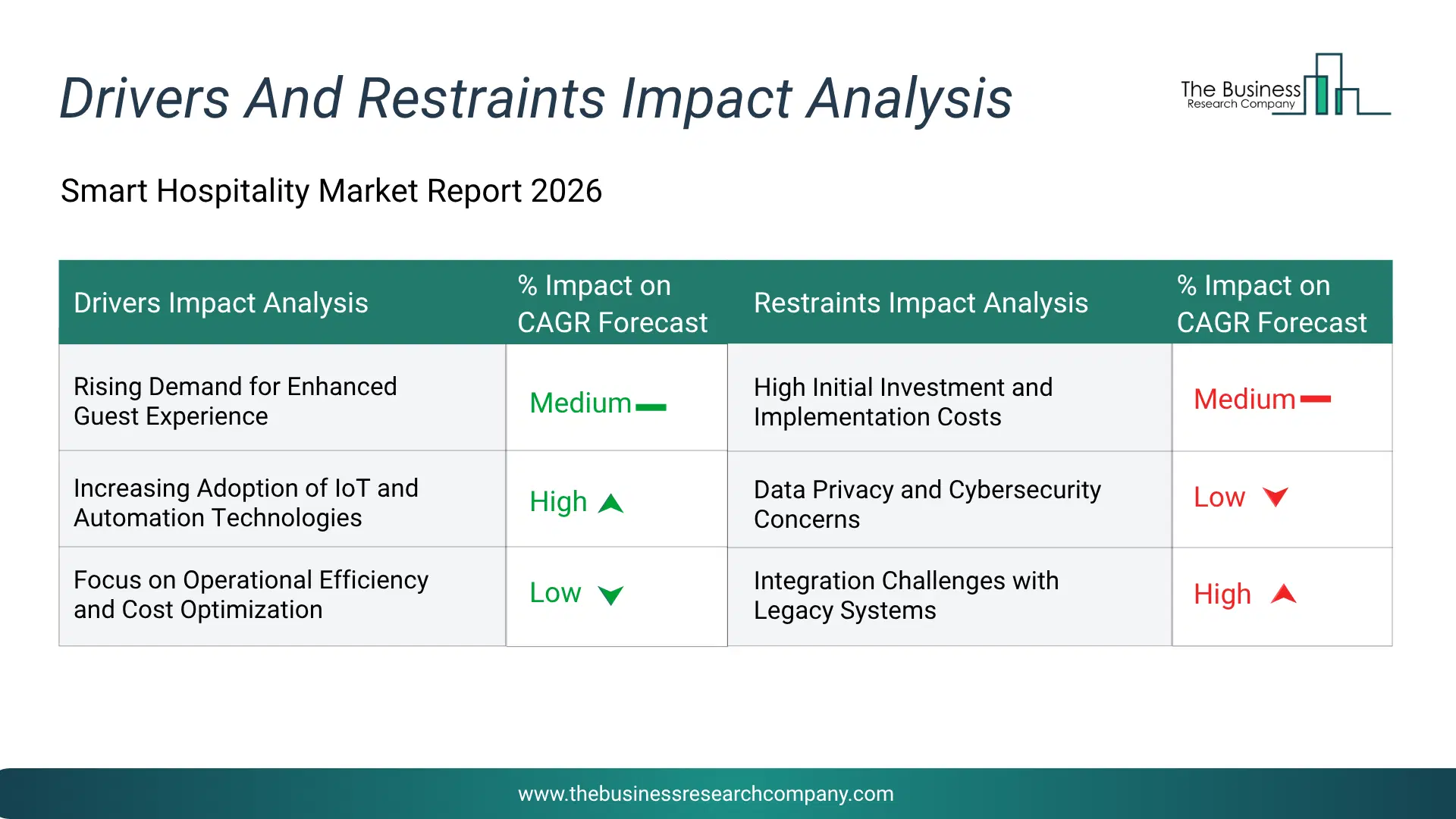
Infographic Chart Showing Key Market Drivers Analysis And Restraints For Smart Hospitality Market
The chart presents an impact analysis of key drivers and restraints, quantifying their relative influence on the market's growth rate and helping assess the balance between growth enablers and limiting factors. This chart offers a high-level perspective; the full report contains more detailed insights.
How Will The Drivers Impact Growth In The Global Smart Hospitality Market?
• Rising Demand for Enhanced Guest Experience (Medium) – During the forecast period, the rising demand for enhanced guest experience is expected to become a key growth driver for the smart hospitality market by 2030. The growing expectation for personalized, seamless, and contactless services is driving adoption of smart hospitality solutions. Hotels use IoT and AI technologies such as mobile check-ins, smart rooms, and virtual assistants to enhance convenience and satisfaction. These solutions enable tailored guest experiences, improving comfort and engagement. As competition intensifies, delivering superior customer experience becomes a key differentiator. This directly boosts customer retention, brand loyalty, and revenue growth. • Increasing Adoption of IoT and Automation Technologies (High) – During the forecast period, the increasing adoption of IoT and automation technologies is expected to emerge as a major factor driving the expansion of the smart hospitality market by 2030. The expansion of IoT and automation technologies is accelerating digital transformation in the hospitality sector. Smart systems enable centralized control of operations such as lighting, HVAC, and security, improving efficiency. Automation reduces manual workload and operational errors while enabling real-time monitoring and predictive maintenance. Declining costs of smart devices further support adoption across hotels of all sizes. This technological integration enhances scalability and modernizes service delivery. • Focus on Operational Efficiency and Cost Optimization (Low) – During the forecast period, the focus on operational efficiency and cost optimization is expected to act as a key growth catalyst for the smart hospitality market by 2030. Hospitality providers are increasingly adopting smart solutions to streamline operations and reduce costs. Systems like property and network management platforms automate routine processes, minimizing labor dependency. Energy management solutions help significantly lower utility expenses and improve sustainability. Data analytics enables better forecasting, resource allocation, and decision-making. These benefits collectively improve operational efficiency and overall profitability.How Will The Restraints Impact Growth In The Global Smart Hospitality Market?
• High Initial Investment and Implementation Costs (Medium) – During the forecast period, the deployment of smart hospitality systems requires significant upfront investment in hardware, software, and infrastructure. Additional costs for system integration, customization, and employee training increase the financial burden. Small and medium-sized enterprises often face budget constraints, limiting adoption. The return on investment may take longer, especially in cost-sensitive markets. This high initial cost acts as a major barrier to widespread implementation. • Data Privacy and Cybersecurity Concerns (High) – During the forecast period, the smart hospitality solutions involve the collection and processing of sensitive guest data, increasing security risks. These systems are vulnerable to cyberattacks, data breaches, and unauthorized access if not properly secured. Concerns over data privacy and compliance with regulations discourage adoption. Any security failure can lead to reputational damage and financial losses. As a result, trust and data protection remain critical challenges for the market. • Integration Challenges with Legacy Systems (Low) – During the forecast period, the many hospitality businesses operate on outdated systems that are not easily compatible with modern smart technologies. Integrating IoT and AI solutions with existing infrastructure can be complex and resource-intensive. Lack of standardization across platforms creates interoperability issues. Implementation may cause temporary disruptions in operations and service delivery. These challenges slow down adoption, particularly among established and traditional operators.Key Players In The Global Smart Hospitality Market
Major companies operating in the smart hospitality market are Cisco Systems Inc.; Honeywell International; IBM Corporation; Johnson Controls; NEC Corporation; Oracle Corporation; Schneider Electric SE; Siemens AG; Infor; Huawei Technologies; Samsung; BuildingIQ; Cloudbeds; Hotel Internet Services; Onity Inc.; Shiji Group; Ubiquity LLC; Zebra Technologies Corp.; Altronix Systems Inc.; Agilysys; Mews Systems; Protel Hotelsoftware; Guestline; Sabre Hospitality; Hotelogix; StayNTouch; Amadeus IT Group; eZee Technosys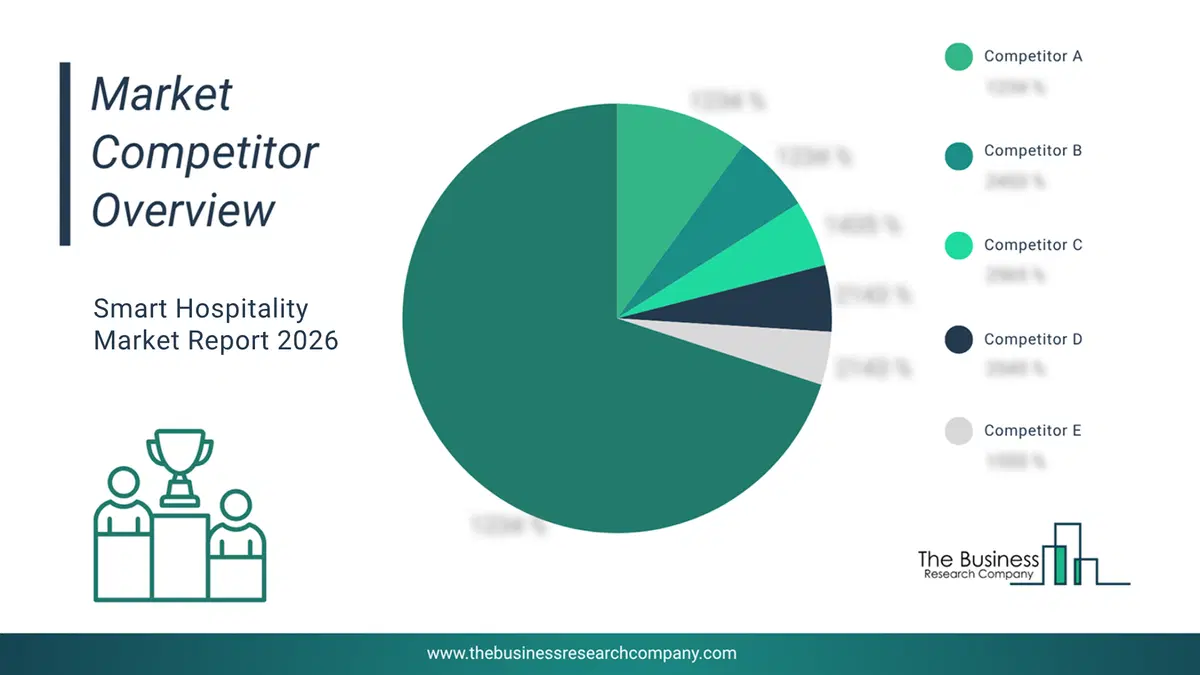
This chart is for illustrative purposes; the full report includes a detailed competitor analysis and comprehensive overview of the top 10 companies in the market.
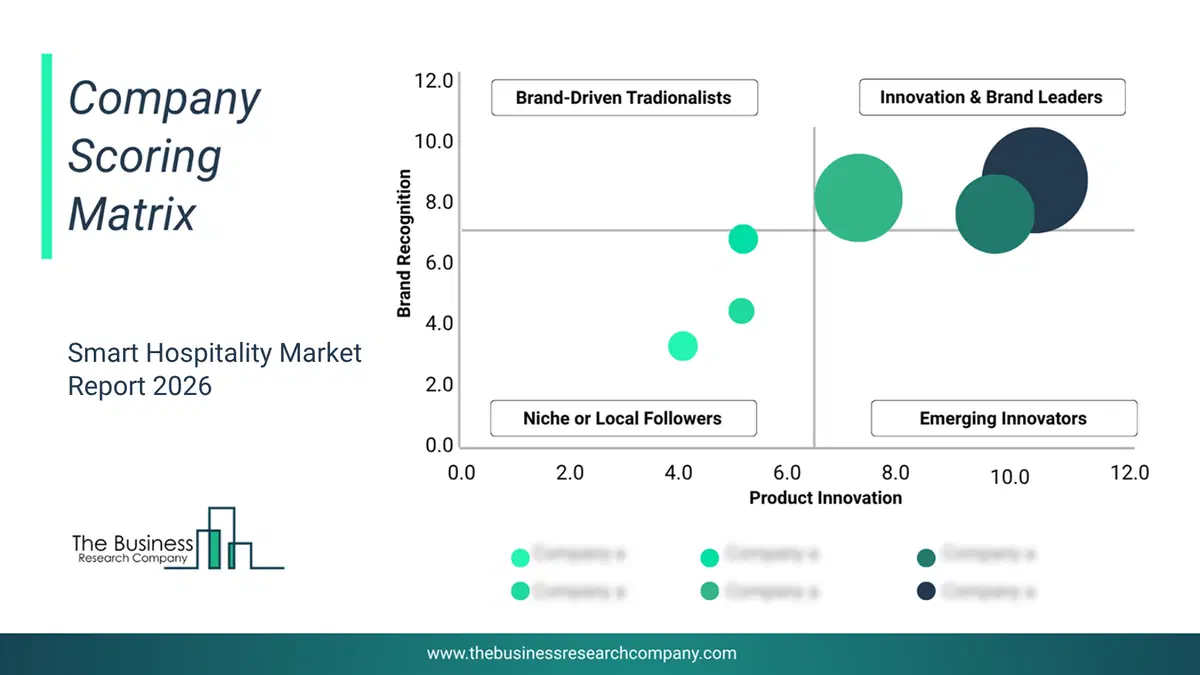
This chart maps companies by product innovation and brand strength, with bubble size indicating relative revenue, helping identify market leaders, challengers, and niche players. This is an illustrative chart; the full report provides a complete and accurate competitive analysis.
Global Smart Hospitality Market Trends and Insights
Major companies operating in the smart hospitality market are focusing on developing advanced solutions, such as autonomous delivery robots, to enhance guest experiences, streamline operations, and improve service efficiency. Autonomous delivery robots refer to robotic systems designed to transport amenities, room-service items, and other materials within hotel environments without human intervention, thereby reducing staff workload and improving service speed. For instance, in June 2023, Relay Robotics, a US-based manufacturer of autonomous service robots for the hospitality industry, introduced the Relay2, a high-capacity hotel delivery robot capable of carrying twice the payload of previous models. Designed to support faster and more efficient delivery of guest amenities and room-service items, the Relay2 helps hotels improve operational efficiency while elevating overall guest satisfaction.What Are Latest Mergers And Acquisitions In The Smart Hospitality Market?
In April 2024, Assa Abloy, a Sweden-based building materials company, acquired Axxess Industries Inc. for an undisclosed amount. This acquisition aims to enhance Assa Abloy's presence in the North American market and expand its product portfolio in access control and security solutions. Axxess Industries specializes in innovative door hardware and related products. Axxess Industries Inc. is a Canada-based company that specializes in providing advanced technology solutions.Regional Insights
North America was the largest region in the smart hospitality market share in 2025. The regions covered in this market report are Asia-Pacific, South East Asia, Western Europe, Eastern Europe, North America, South America, Middle East, Africa. The countries covered in this market report are Australia, Brazil, China, France, Germany, India, Indonesia, Japan, Taiwan, Russia, South Korea, UK, USA, Canada, Italy, SpainWhat Defines the Smart Hospitality Market?
The smart hospitality market consists of revenues earned by entities by providing property management systems, network management systems, and integrated security management. The market value includes the value of related goods sold by the service provider or included within the service offering. The smart hospitality market also includes sales of solutions such as POS cashier systems and table-top ordering systems. Values in this market are ‘factory gate’ values, that is, the value of goods sold by the manufacturers or creators of the goods, whether to other entities (including downstream manufacturers, wholesalers, distributors, and retailers) or directly to end customers. The value of goods in this market includes related services sold by the creators of the goods.How is Market Value Defined and Measured?
The market value is defined as the revenues that enterprises gain from the sale of goods and/or services within the specified market and geography through sales, grants, or donations in terms of the currency (in USD unless otherwise specified). The revenues for a specified geography are consumption values that are revenues generated by organizations in the specified geography within the market, irrespective of where they are produced. It does not include revenues from resales along the supply chain, either further along the supply chain or as part of other products.
This chart presents market attractiveness based on a quantitative evaluation of growth, competition, strategic alignment, and risk, offering a clear view of opportunity areas for decision-making. This chart is for illustrative purposes; the full report contains the complete analysis.

This chart highlights the Total Addressable Market (TAM) by estimating the maximum revenue opportunity using an assumption-driven approach, supporting strategic planning and opportunity sizing across markets. The chart is illustrative; the full report provides a more comprehensive analysis.
What Key Data and Analysis Are Included in the Smart Hospitality Market Report 2026?
The smart hospitality market research report is one of a series of new reports from The Business Research Company that provides market statistics, including industry global market size, regional shares, competitors with the market share, detailed market segments, market trends and opportunities, and any further data you may need to thrive in the smart hospitality industry. The market research report delivers a complete perspective of everything you need, with an in-depth analysis of the current and future state of the industry.Smart Hospitality Market Report Forecast Analysis
| Report Attribute | Details |
|---|---|
| Market Size Value In 2026 | $37.3 billion |
| Revenue Forecast In 2030 | $92.37 billion |
| Growth Rate | CAGR of 26.2% from 2026 to 2030 |
| Base Year For Estimation | 2025 |
| Actual Estimates/Historical Data | 2020-2025 |
| Forecast Period | 2026 - 2030 |
| Market Representation | Revenue in USD Billion and CAGR from 2026 to 2030 |
| Segments Covered | Offering, Deployment Mode, End User |
| Regional Scope | Asia-Pacific, Western Europe, Eastern Europe, North America, South America, Middle East, Africa |
| Country Scope | The countries covered in the report are Australia, Brazil, China, France, Germany, India, Indonesia, Japan, Taiwan, Russia, South Korea, UK, USA, Canada, Italy, Spain. |
| Key Companies Profiled | Cisco Systems Inc.; Honeywell International; IBM Corporation; Johnson Controls; NEC Corporation; Oracle Corporation; Schneider Electric SE; Siemens AG; Infor; Huawei Technologies; Samsung; BuildingIQ; Cloudbeds; Hotel Internet Services; Onity Inc.; Shiji Group; Ubiquity LLC; Zebra Technologies Corp.; Altronix Systems Inc.; Agilysys; Mews Systems; Protel Hotelsoftware; Guestline; Sabre Hospitality; Hotelogix; StayNTouch; Amadeus IT Group; eZee Technosys |
| Customization Scope | Request for Customization |
| Pricing And Purchase Options | Explore Purchase Options |