
Human Microchipping Market Report 2026
Global Outlook – By Type (Implantable Microchips, Non-Implantable Microchips), By Technology (RFID (Radio Frequency Identification), NFC (Near Field Communication), Other Technologies), By Application (Medical Identification And Monitoring, Personal Identification And Access Control, Financial Transactions, Other Applications), By End User (Healthcare, Financial Services, Retail And logistics, Government And Law Enforcement, Other End-Users) – Market Size, Trends, Strategies, and Forecast to 2030
Human Microchipping Market Overview
• Human Microchipping market size has reached to $1.98 billion in 2025 • Expected to grow to $2.83 billion in 2030 at a compound annual growth rate (CAGR) of 7.4% • Growth Driver: Growing Demand For Contactless Transactions Fuels Growth In The Human Microchipping Market • Market Trend: Advancements In Brain-Computer Interface Technology For Enhanced Communication And Neuroprosthetics • North America was the largest region in 2025 and Asia-Pacific is the fastest growing region.What Is Covered Under Human Microchipping Market?
Human microchipping refers to a process that involves the implantation of microscopic integrated circuits, typically under the skin, to serve various purposes. The utilization of human microchipping offers advantages such as seamless access to health information during emergencies, automated management of devices, and enhanced convenience in everyday activities. The main types of human microchips are implantable microchips and non-implantable microchips. Implantable microchips refer to electronic devices that are implanted subcutaneously (under the skin) in humans or animals. Various types of technologies are included, such as RFID (radio frequency identification), NFC (near-field communication), and others. These are used for various applications, including medical identification and monitoring, personal identification and access control, financial transactions, and others, by several end users, such as healthcare, financial services, retail and logistics, government and law enforcement, and others.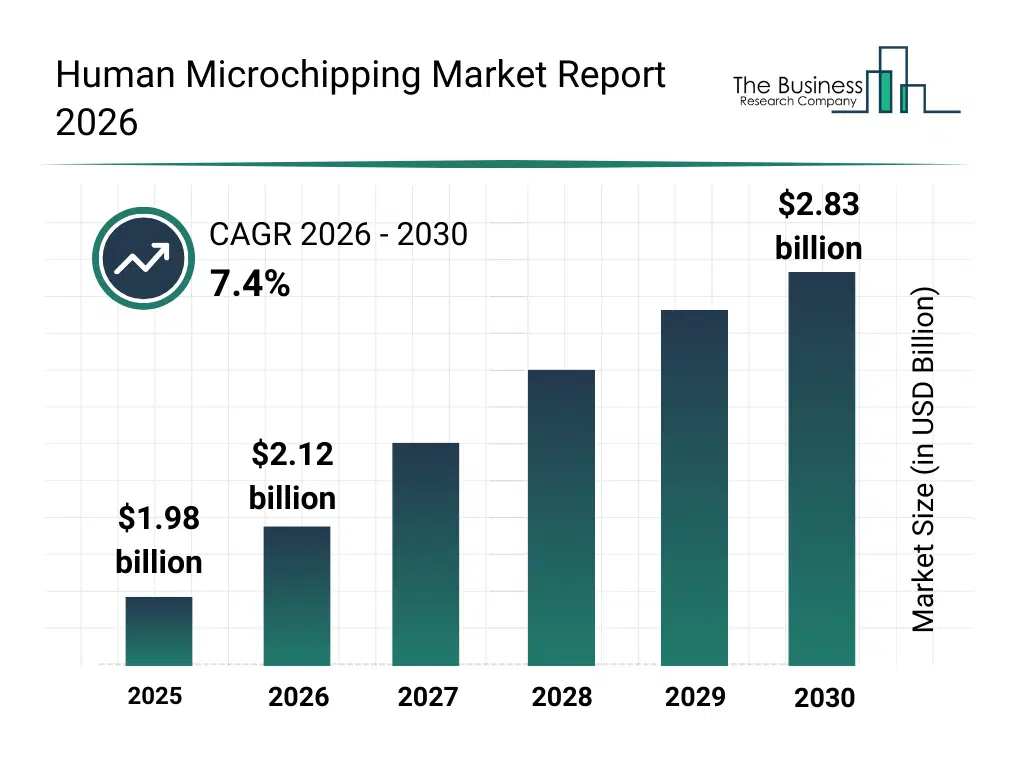
What Is The Human Microchipping Market Size and Share 2026?
The human microchipping market size has grown strongly in recent years. It will grow from $1.98 billion in 2025 to $2.12 billion in 2026 at a compound annual growth rate (CAGR) of 7.3%. The growth in the historic period can be attributed to use of rfid identification systems, growth of access control solutions, adoption in medical identification, expansion of contactless technologies, early experimentation in biometric security.What Is The Human Microchipping Market Growth Forecast?
The human microchipping market size is expected to see strong growth in the next few years. It will grow to $2.83 billion in 2030 at a compound annual growth rate (CAGR) of 7.4%. The growth in the forecast period can be attributed to integration with digital identity systems, rising demand for secure authentication, healthcare emergency data access needs, growth of cashless transactions, advancements in biocompatible materials. Major trends in the forecast period include implantable identification technologies, secure access and authentication systems, integrated health data storage, contactless payment enablement, multi-function microchip integration.
Global Human Microchipping Market Segmentation
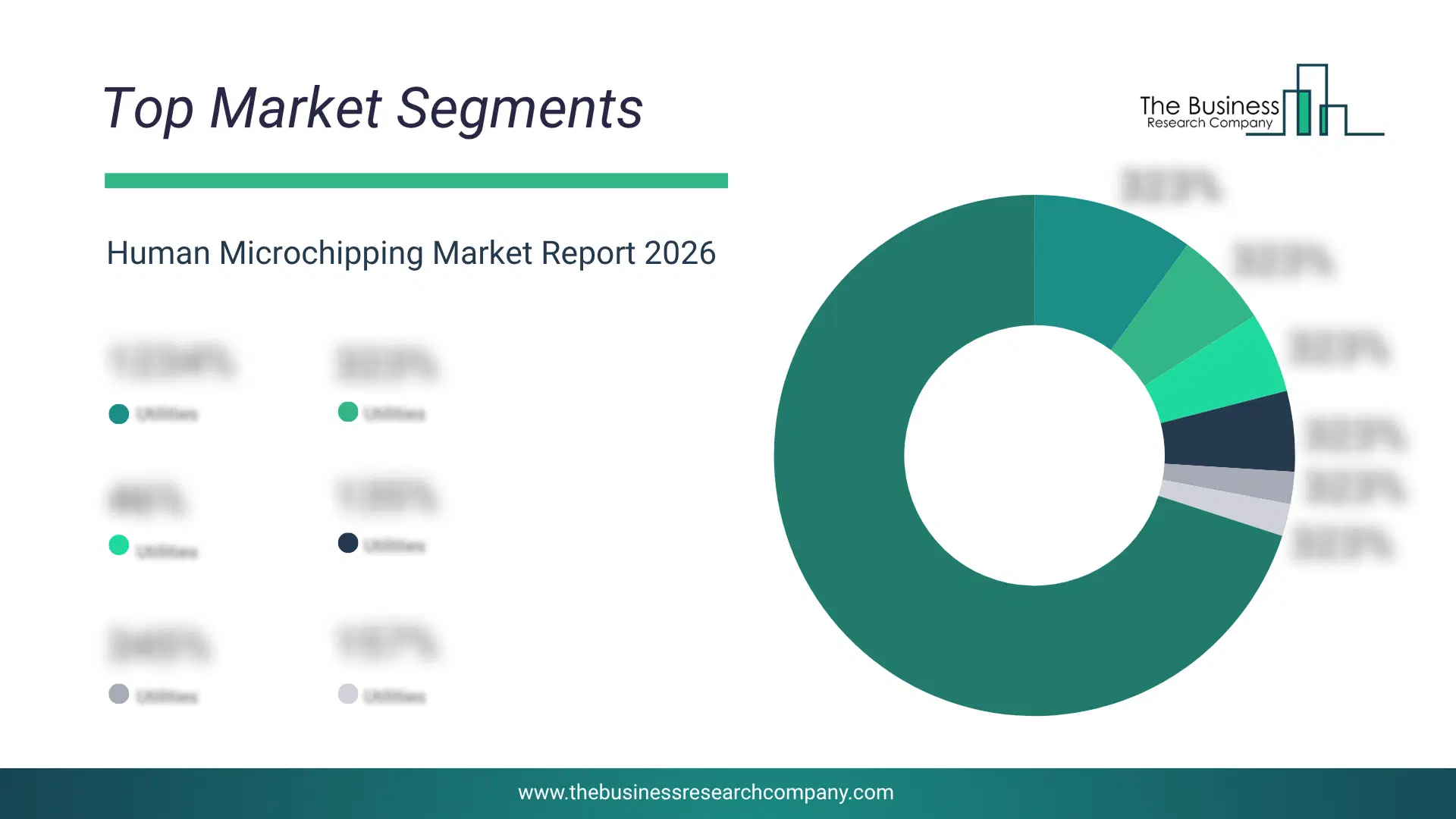
1) By Type: Implantable Microchips, Non-Implantable Microchips 2) By Technology: RFID (Radio Frequency Identification), NFC (Near Field Communication), Other Technologies 3) By Application: Medical Identification And Monitoring, Personal Identification And Access Control, Financial Transactions, Other Applications 4) By End User: Healthcare, Financial Services, Retail And logistics, Government And Law Enforcement, Other End-Users Subsegments: 1) By Implantable Microchips: RFID Microchips, NFC Microchips, Biometric Microchips 2) By Non-Implantable Microchips: Wearable Microchips, Portable Microchips, External RFID TagsWhat Are The Drivers Of The Human Microchipping Market?
The growing demand for contactless transactions is expected to propel the growth of the human microchipping market going forward. Contactless transactions refer to a safe way of making a purchase when the seller's point-of-sale (POS) terminal and the buyer's card don't have to come into direct contact. The COVID-19 pandemic significantly accelerated the adoption of contactless payments due to heightened concerns about hygiene and germ transmission. Human microchipping is used in contactless or digital payments using near-field communication (NFC) or radio-frequency identification (RFID) technology. Contactless payments can be made possible by implanting these microchips into a person's hand or other bodily part. For instance, in July 2023, according to a report shared by Finder.com, an Australia-based independent comparison website, an estimated 93% of Brits were using online banking in 2022 and another 5.3 million Brits (10%) intend to get a digital-only bank account in 2023. Further, the number of digital-only bank account holders is predicted to be 22.6 million (43%) by 2026. Therefore, the growing demand for contactless transactions is driving the growth of the human microchipping industry. The rising security concerns are expected to propel the growth of the human microchipping market going forward. Security concerns refer to the threats and risks related to identity theft, unauthorized access, data breaches, and cybercrime that compromise personal safety and financial wellbeing. The growing security concerns are driven by the rapid expansion of digital transactions and online services, as increased reliance on internet-based financial systems creates more opportunities for cybercriminals to exploit vulnerabilities and target individuals through sophisticated fraud schemes. Rising security concerns support the need for advanced biometric identification solutions as individuals and organizations seek more secure authentication methods that cannot be easily stolen, duplicated, or compromised like traditional passwords and access cards. For instance, in April 2025, according to the Federal Bureau of Investigation (FBI), a US-based government agency, the number of cybercrime complaints rose to 859,532 in 2024 with reported losses exceeding $16.6 billion, reflecting a 33% increase in losses from 2023. Therefore, rising security concerns are driving the growth of the human microchipping industry.Key Players In The Global Human Microchipping Market
Major companies operating in the human microchipping market are Johnson Controls International PLC; Texas Instruments Inc.; STMicroelectronics N.V.; NXP Semiconductors; ARM Holdings Plc; Neuralink Corporation; VivoKey Technologies; Avid Identification Systems Inc.; Micronit Microtechnologies B.V.; Applied Digital Solutions; Grindhouse Wetware; Dangerous Things LLC; Digiwell; BioTeq Ltd.; Walletmor Ltd.; Chip AG; Biohax International AB; VeriChip Corporation; Cantaloupe Inc.; Epicenter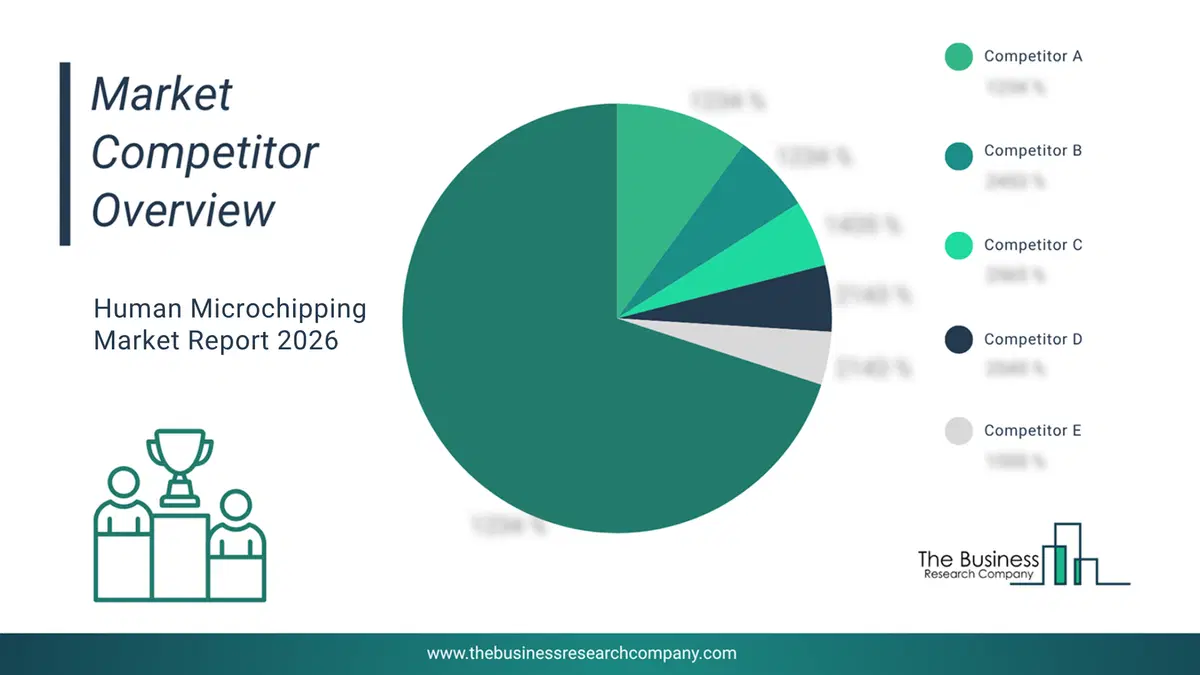
This chart is for illustrative purposes; the full report includes a detailed competitor analysis and comprehensive overview of the top 10 companies in the market.
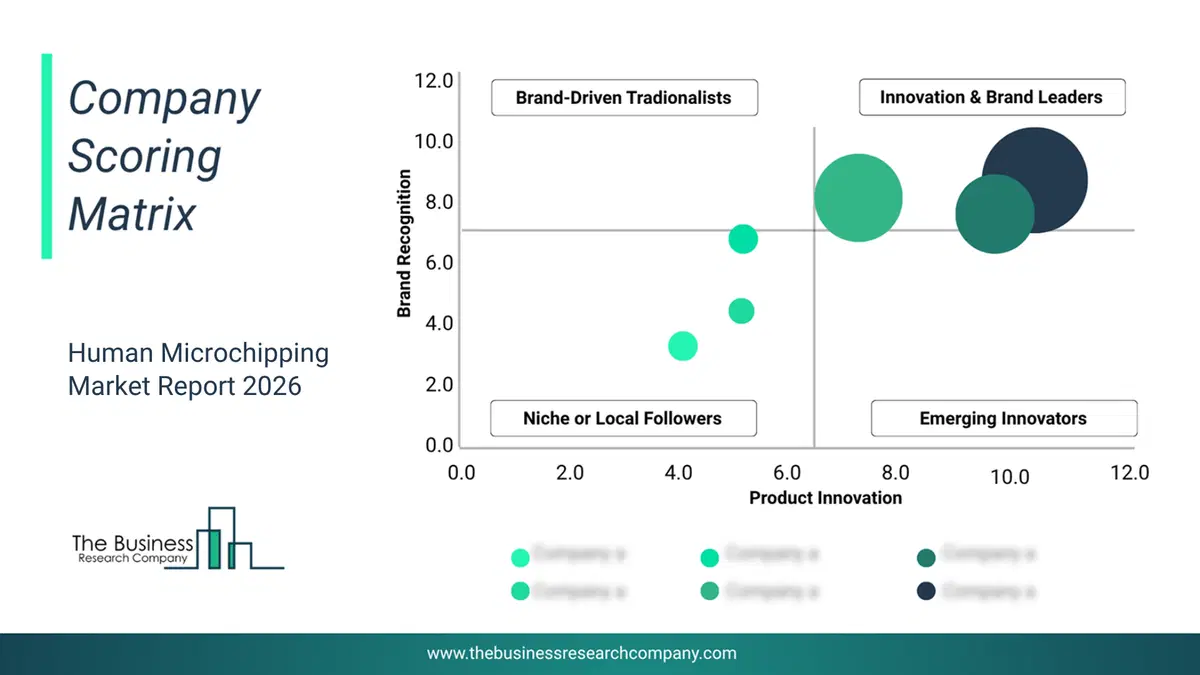
This chart maps companies by product innovation and brand strength, with bubble size indicating relative revenue, helping identify market leaders, challengers, and niche players. This is an illustrative chart; the full report provides a complete and accurate competitive analysis.
Global Human Microchipping Market Trends and Insights
Major companies operating in the human microchipping market are developing advanced technologies, such as neuron spike detection, to enhance brain-computer interface (BCI) capabilities, facilitate seamless communication between humans and machines, and improve the functionality of neuroprosthetic devices for individuals with mobility impairments. Neuron spike detection is crucial for identifying and measuring the electrical signals produced by neurons, enabling a better understanding of brain activity and the functionality of BCIs. For instance, in January 2024, Neuralink Corporation, a US-based technology company specializing in brain-computer interface technology, implanted the human brain-computer interface named Telepathy. This wireless device incorporates a chip and over 1,000 ultra-thin, flexible electrode arrays that are surgically inserted into the cerebral cortex. Designed to detect neuronal electrical activity associated with movement, telepathy translates these neural signals into commands for computer control, facilitating thought-based communication at unprecedented speeds. Key features include neuron spike detection, wireless functionality, a flexible electrode design for minimal invasiveness, and precise robotic implantation, all aimed at enhancing communication for individuals with severe disabilities.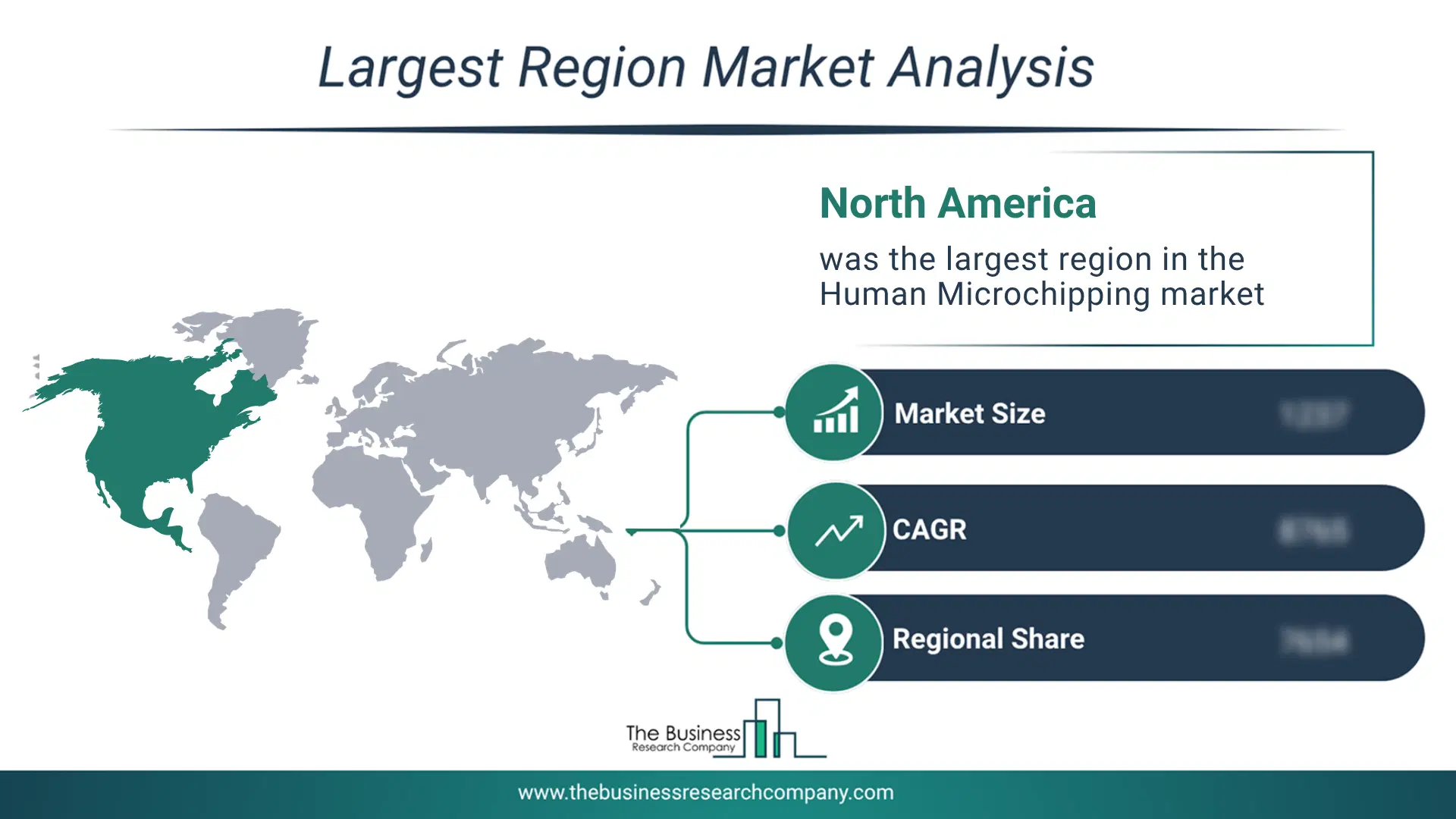
Regional Insights
North America was the largest region in the human microchipping market in 2025. Asia-Pacific is expected to be the fastest-growing region in the forecast period. The regions covered in this market report are Asia-Pacific, South East Asia, Western Europe, Eastern Europe, North America, South America, Middle East, Africa. The countries covered in this market report are Australia, Brazil, China, France, Germany, India, Indonesia, Japan, Taiwan, Russia, South Korea, UK, USA, Canada, Italy, SpainWhat Defines the Human Microchipping Market?
The human microchipping market consists of revenues earned by entities by providing services such as microchip implantation, integration, data management, and research and development. The market value includes the value of related goods sold by the service provider or included within the service offering. The human microchipping market also includes sales of syringes, RFID (Radio Frequency Identification) devices, silicate glass, bio-safe encasement, and antenna wire coils. Values in this market are ‘factory gate’ values, that is the value of goods sold by the manufacturers or creators of the goods, whether to other entities (including downstream manufacturers, wholesalers, distributors and retailers) or directly to end customers. The value of goods in this market includes related services sold by the creators of the goods.How is Market Value Defined and Measured?
The market value is defined as the revenues that enterprises gain from the sale of goods and/or services within the specified market and geography through sales, grants, or donations in terms of the currency (in USD unless otherwise specified). The revenues for a specified geography are consumption values that are revenues generated by organizations in the specified geography within the market, irrespective of where they are produced. It does not include revenues from resales along the supply chain, either further along the supply chain or as part of other products.
This chart presents market attractiveness based on a quantitative evaluation of growth, competition, strategic alignment, and risk, offering a clear view of opportunity areas for decision-making. This chart is for illustrative purposes; the full report contains the complete analysis.

This chart highlights the Total Addressable Market (TAM) by estimating the maximum revenue opportunity using an assumption-driven approach, supporting strategic planning and opportunity sizing across markets. The chart is illustrative; the full report provides a more comprehensive analysis.
What Key Data and Analysis Are Included in the Human Microchipping Market Report 2026?
The human microchipping market research report is one of a series of new reports from The Business Research Company that provides market statistics, including industry global market size, regional shares, competitors with the market share, detailed market segments, market trends and opportunities, and any further data you may need to thrive in the human microchipping industry. The market research report delivers a complete perspective of everything you need, with an in-depth analysis of the current and future state of the industry.Human Microchipping Market Report Forecast Analysis
| Report Attribute | Details |
|---|---|
| Market Size Value In 2026 | $2.12 billion |
| Revenue Forecast In 2030 | $2.83 billion |
| Growth Rate | CAGR of 7.4% from 2026 to 2030 |
| Base Year For Estimation | 2025 |
| Actual Estimates/Historical Data | 2020-2025 |
| Forecast Period | 2026 - 2030 |
| Market Representation | Revenue in USD Billion and CAGR from 2026 to 2030 |
| Segments Covered | Type, Technology, Application, End User |
| Regional Scope | Asia-Pacific, Western Europe, Eastern Europe, North America, South America, Middle East, Africa |
| Country Scope | The Countries Covered In This Market Report Are Australia, Brazil, China, France, Germany, India, Indonesia, Japan, Taiwan, Russia, South Korea, Uk, Usa, Canada, Italy, Spain. |
| Key Companies Profiled | Johnson Controls International PLC, Texas Instruments Inc., STMicroelectronics N.V., NXP Semiconductors, ARM Holdings Plc, Neuralink Corporation, VivoKey Technologies, Avid Identification Systems Inc., Micronit Microtechnologies B.V., Applied Digital Solutions, Grindhouse Wetware, Dangerous Things LLC, Digiwell, BioTeq Ltd., Walletmor Ltd., Chip AG, Biohax International AB, VeriChip Corporation, Cantaloupe Inc., Epicenter |
| Customization Scope | Request for Customization |
| Pricing And Purchase Options | Explore Purchase Options |