
Retail Technology Market Report 2026
Global Outlook – By Technology (Point Of Sale Systems, Inventory Management Systems, Customer Relationship Management, Electronic Commerce Platforms), By Deployment Type (Cloud-Based, On-Premises, Hybrid), By Application (Store Operations, Supply Chain Management, Sales And Marketing, Customer Engagement), By End Use (Hypermarkets, Supermarkets, Specialty Stores, Online Retailers) – Market Size, Trends, Strategies, and Forecast to 2030
Retail Technology Market Overview
• Retail Technology market size has reached to $252.81 billion in 2025 • Expected to grow to $338.55 billion in 2030 at a compound annual growth rate (CAGR) of 6.1% • Growth Driver: Expanding Online Shopping Adoption Fueling The Market Growth Due To Rising Digital Retail Engagement • Market Trend: Advancements In Generative AI–Driven Retail Analytics Platforms Enhance Operational Efficiency And Decision-Making • Asia-Pacific was the largest region and fastest growing region.What Is Covered Under Retail Technology Market?
Retail technology refers to the use of digital tools, software, and hardware to optimize retail operations and improve customer experience across both online and offline channels. It enables efficient management of inventory, billing, supply chains, and customer interactions through automation and data-driven insights. Overall, retail technology enhances operational efficiency, reduces costs, and supports personalized and seamless shopping experiences. The main technology types of retail technology are point of sale systems, inventory management systems, customer relationship management, and electronic commerce platforms. Point of sale systems refer to technologies used by retailers to process transactions, manage sales, and track customer purchases at checkout points. These solutions are deployed through various deployment types, including cloud-based, on-premises, and hybrid. They are applied across multiple applications, such as store operations, supply chain management, sales and marketing, and customer engagement, and cater to different end-use sectors, including hypermarkets, supermarkets, specialty stores, and online retailers.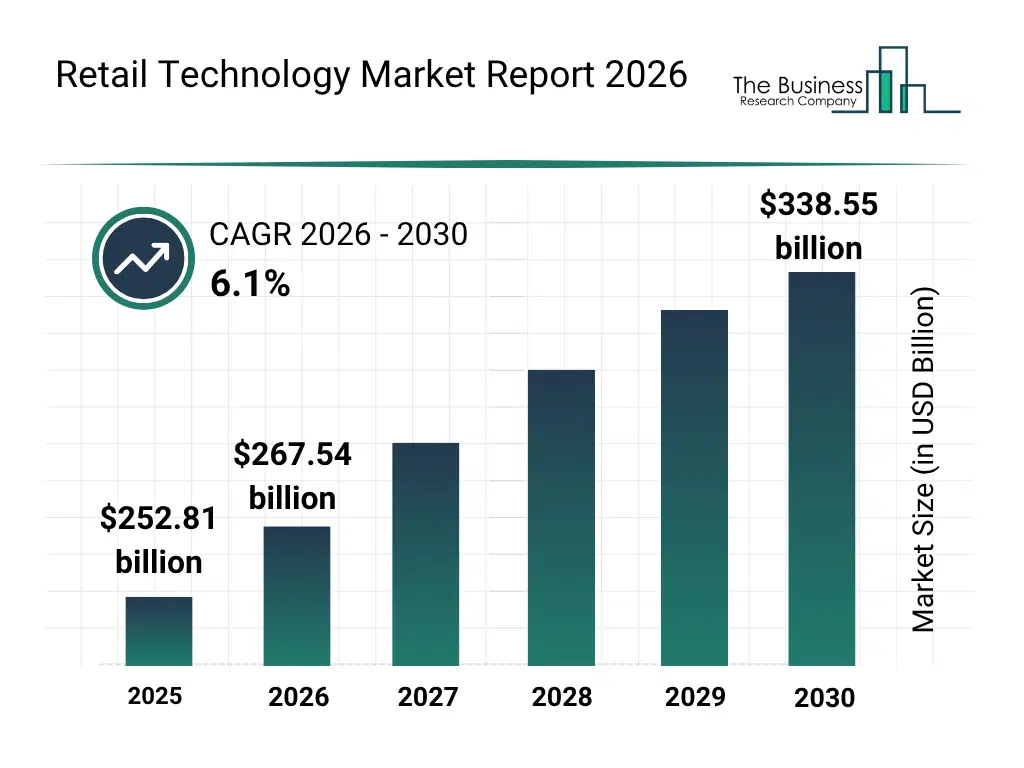
What Is The Retail Technology Market Size and Share 2026?
The retail technology market size has grown strongly in recent years. It will grow from $252.81 billion in 2025 to $267.54 billion in 2026 at a compound annual growth rate (CAGR) of 5.8%. The growth in the historic period can be attributed to growing adoption of digital payment systems, increasing retail automation, expansion of e-commerce channels, rising customer demand for personalized experiences, adoption of barcode and rfid inventory systems.What Is The Retail Technology Market Growth Forecast?
The retail technology market size is expected to see strong growth in the next few years. It will grow to $338.55 billion by 2030 at a compound annual growth rate (CAGR) of 6.1%. The growth in the forecast period can be attributed to increasing deployment of ai-driven analytics in retail, rising adoption of cloud-based and hybrid retail platforms, expansion of omnichannel customer engagement solutions, growing focus on mobile commerce and self-service technologies, integration of immersive ar/vr experiences in retail. Major trends in the forecast period include increasing adoption of mobile and self-service pos systems, rising demand for automated inventory tracking and optimization, growing integration of customer loyalty and engagement platforms, expansion of multi-channel e-commerce management solutions, rising focus on cloud-based deployment for retail technology.
Global Retail Technology Market Segmentation
1) By Technology: Point Of Sale Systems, Inventory Management Systems, Customer Relationship Management, Electronic Commerce Platforms 2) By Deployment Type: Cloud-Based, On-Premises, Hybrid 3) By Application: Store Operations, Supply Chain Management, Sales And Marketing, Customer Engagement 4) By End Use: Hypermarkets, Supermarkets, Specialty Stores, Online Retailers Subsegments: 1) By Point Of Sale Systems: Mobile Point Of Sale Systems, Cloud Based Point Of Sale Systems, Self Service Point Of Sale Systems, Tablet Based Point Of Sale Systems, Integrated Point Of Sale Systems 2) By Inventory Management Systems: Automated Inventory Tracking Systems, Barcode Based Inventory Management Systems, Radio Frequency Identification Inventory Systems, Cloud Based Inventory Management Systems, Demand Forecasting And Inventory Optimization Systems 3) By Customer Relationship Management: Customer Data Management Platforms, Customer Loyalty Program Management Systems, Customer Engagement And Marketing Automation Systems, Sales And Customer Interaction Management Systems, Customer Analytics And Insight Platforms 4) By Electronic Commerce Platforms: Online Storefront Management Platforms, Mobile Commerce Platforms, Multi Channel Commerce Management Platforms, Digital Payment Integration Platforms, Order And Fulfillment Management PlatformsWhat Is The Driver Of The Retail Technology Market?
The increasing e-commerce penetration worldwide is expected to propel the growth of the retail technology market going forward. E-commerce penetration refers to the growing share of consumers purchasing goods and services through online platforms such as marketplaces, retailer websites, and mobile shopping applications. E-commerce penetration is driven mainly by widespread internet access and increasing consumer preference for convenient digital purchasing channels in developed economies. Retail technology supports e-commerce penetration by providing digital payment systems, inventory management software, smart point-of-sale solutions, and omnichannel retail platforms that enable retailers to manage online and offline operations efficiently. For instance, in February 2026, according to Eurostat, a Luxembourg-based European Union statistical office, in 2025, 95% of individuals aged 16–74 in the European Union had used the internet within the previous 12 months, and among these users, 78% reported purchasing or ordering goods and services online. Therefore, the increasing e-commerce penetration worldwide is driving the growth of the retail technology industry.Key Players In The Global Retail Technology Market
Major companies operating in the retail technology market are Microsoft Corporation, Oracle Corporation, Salesforce Inc., SAP SE, Toshiba Corporation, NCR Voyix Corporation, Shopify Inc., Stripe Inc., EPAM Systems Inc., Zebra Technologies Corporation, Publicis Groupe S.A., Blue Yonder Group Inc., Adyen N.V., Diebold Nixdorf Incorporated, Lightspeed Commerce Inc., PAX Global Technology Limited, Cegid Group, Ingenico Group S.A., Block Inc., Aptos Inc., GK Software SE, Trax Technology Solutions Pte Ltd, Clover Network LLC.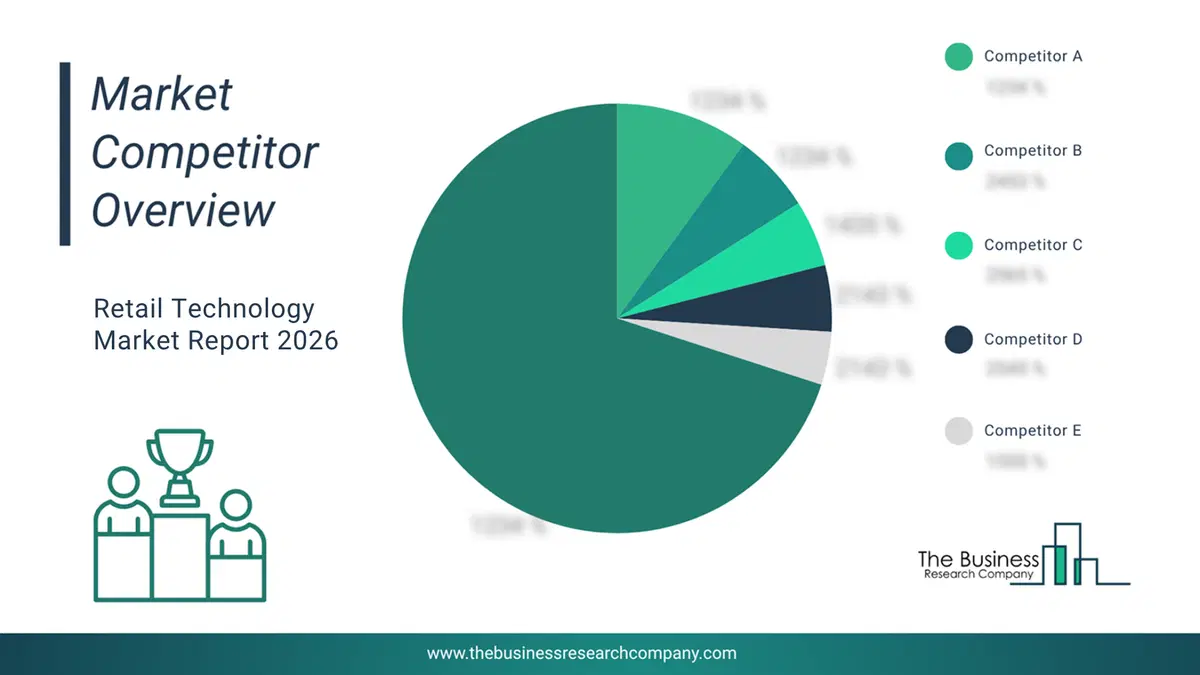
This chart is for illustrative purposes; the full report includes a detailed competitor analysis and comprehensive overview of the top 10 companies in the market.
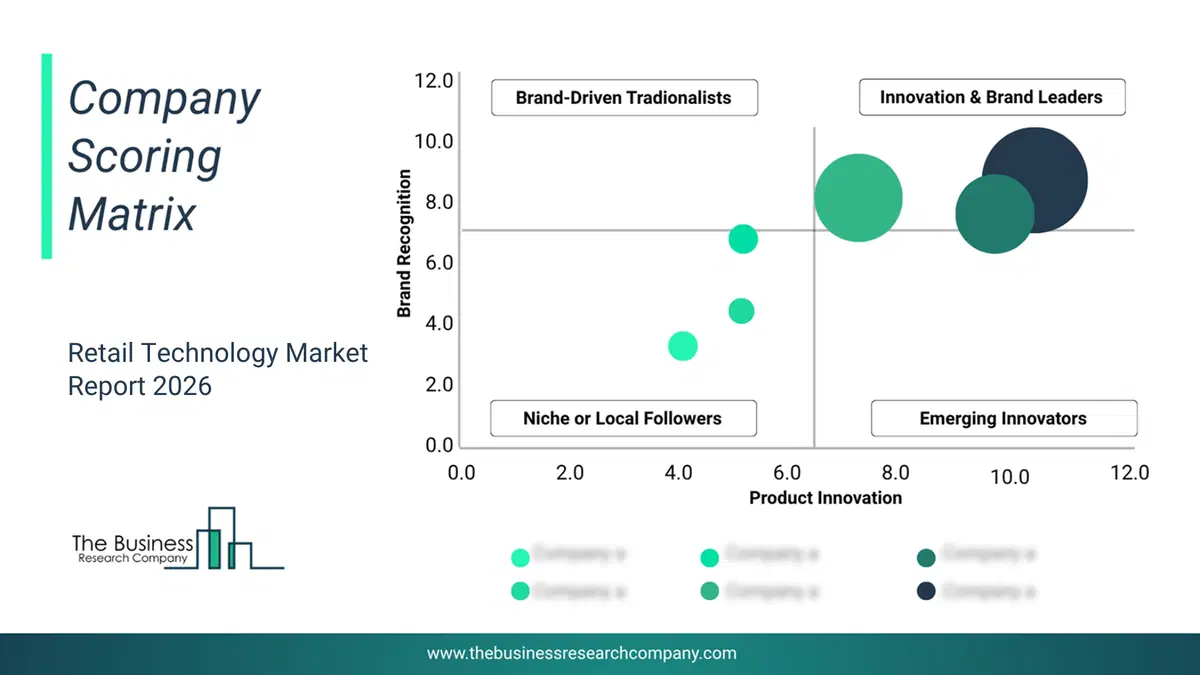
This chart maps companies by product innovation and brand strength, with bubble size indicating relative revenue, helping identify market leaders, challengers, and niche players. This is an illustrative chart; the full report provides a complete and accurate competitive analysis.
Global Retail Technology Market Trends and Insights
Major companies operating in the retail technology market are focusing on developing advancements in artificial intelligence-driven retail analytics, such as generative AI retail platforms designed to automate decision-making, generate insights, and streamline operational workflows across logistics, merchandising, and customer engagement, to gain a competitive advantage. Generative AI retail platforms refer to integrated digital systems that combine artificial intelligence capabilities such as automated content creation, predictive analytics, intelligent search, and workflow automation to optimize retail business processes and improve customer experiences. For instance, in September 2024, UST, a US-based digital transformation and technology services company, launched the UST Retail GenAI Platform, a purpose-built generative AI solution designed to enhance retail operations. The platform integrates capabilities such as AI-driven search, summarization, automation, and content creation while enabling retailers to simulate scenarios and align AI strategies with enterprise capabilities for improved decision-making. These features allow retailers to pilot AI-driven innovations and optimize operational efficiency, although integration complexity and data governance requirements may influence implementation speed.What Are Latest Mergers And Acquisitions In The Retail Technology Market?
In August 2024, Accenture plc, an Ireland-based professional services company, acquired Logic for an undisclosed amount. Through this acquisition, Accenture aims to expand its retail technology capabilities and strengthen its ability to help retailers modernize operations using cloud, data analytics, artificial intelligence, and digital commerce technologies. Logic, a US-based retail technology services company, helps retailers improve customer loyalty and increase operational agility.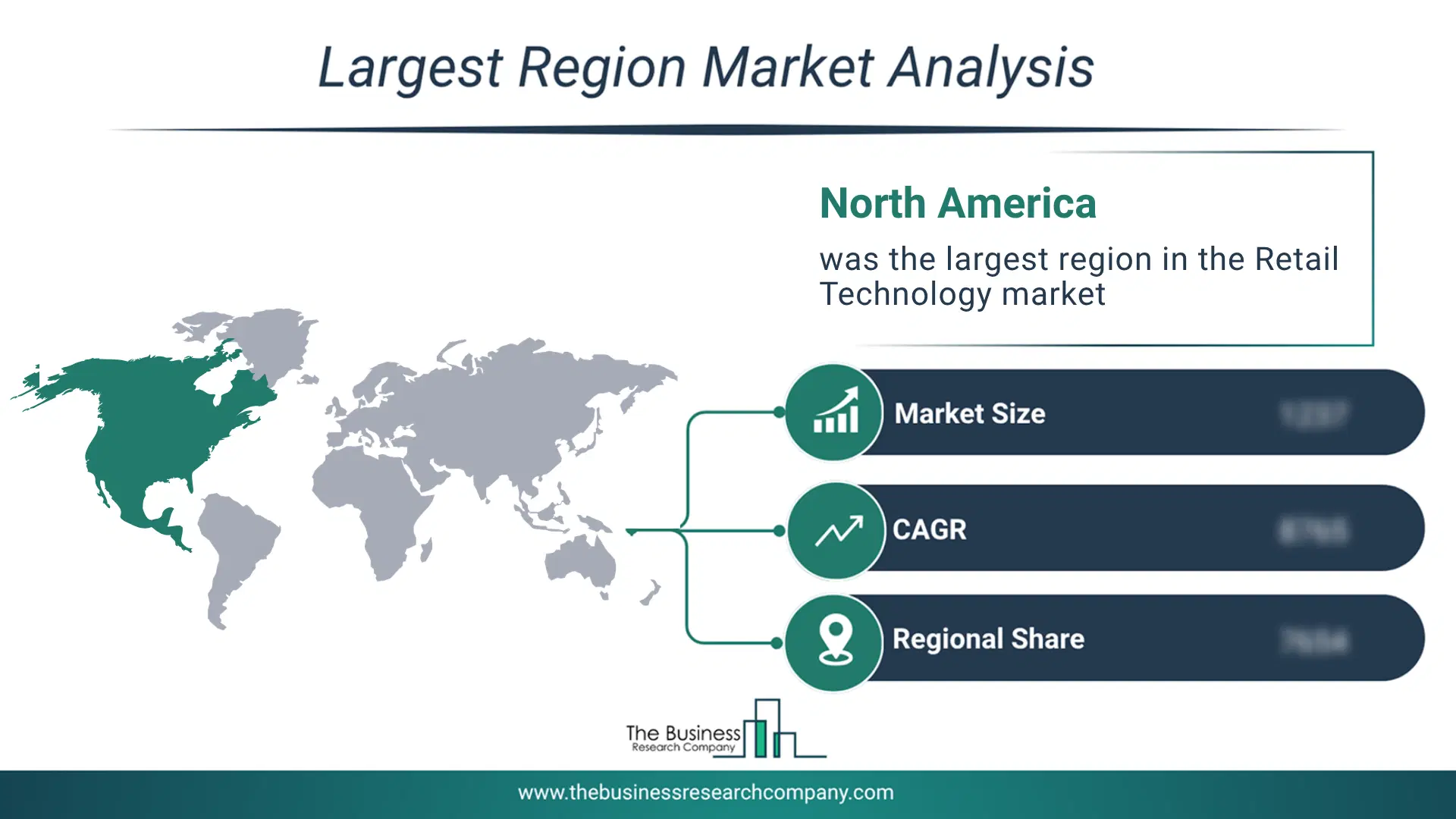
Regional Insights
North America was the largest region in the retail technology market in 2025. Asia-Pacific is expected to be the fastest-growing region in the forecast period. The regions covered in this market report are Asia-Pacific, South East Asia, Western Europe, Eastern Europe, North America, South America, Middle East, Africa. The countries covered in this market report are Australia, Brazil, China, France, Germany, India, Indonesia, Japan, Taiwan, Russia, South Korea, UK, USA, Canada, Italy, Spain.What Defines the Retail Technology Market?
The retail technology market consists of revenues earned by entities by providing services such as digital retail platform development, retail analytics and data management, payment processing solutions, and technology support services that enhance retail operations and customer engagement. The market value includes the value of related goods sold by the service provider or included within the service offering. The retail technology market also includes sales of electronic shelf labels, smart shopping carts, self-checkout kiosks, and retail analytics dashboards. Values in this market are ‘factory gate’ values, that is, the value of goods sold by the manufacturers or creators of the goods, whether to other entities (including downstream manufacturers, wholesalers, distributors, and retailers) or directly to end customers. The value of goods in this market includes related services sold by the creators of the goods.How is Market Value Defined and Measured?
The market value is defined as the revenues that enterprises gain from the sale of goods and/or services within the specified market and geography through sales, grants, or donations in terms of the currency (in USD unless otherwise specified). The revenues for a specified geography are consumption values that are revenues generated by organizations in the specified geography within the market, irrespective of where they are produced. It does not include revenues from resales along the supply chain, either further along the supply chain or as part of other products.
This chart presents market attractiveness based on a quantitative evaluation of growth, competition, strategic alignment, and risk, offering a clear view of opportunity areas for decision-making. This chart is for illustrative purposes; the full report contains the complete analysis.

This chart highlights the Total Addressable Market (TAM) by estimating the maximum revenue opportunity using an assumption-driven approach, supporting strategic planning and opportunity sizing across markets. The chart is illustrative; the full report provides a more comprehensive analysis.
What Key Data and Analysis Are Included in the Retail Technology Market Report 2026?
The retail technology market research report is one of a series of new reports from The Business Research Company that provides market statistics, including industry global market size, regional shares, competitors with the market share, detailed market segments, market trends and opportunities, and any further data you may need to thrive in the retail technology industry. The market research report delivers a complete perspective of everything you need, with an in-depth analysis of the current and future state of the industry.Retail Technology Market Report Forecast Analysis
| Report Attribute | Details |
|---|---|
| Market Size Value In 2026 | $267.54 billion |
| Revenue Forecast In 2030 | $338.55 billion |
| Growth Rate | CAGR of 6.1% from 2026 to 2030 |
| Base Year For Estimation | 2025 |
| Actual Estimates/Historical Data | 2020-2025 |
| Forecast Period | 2026 - 2030 |
| Market Representation | Revenue in USD Billion and CAGR from 2026 to 2030 |
| Segments Covered | Technology, Deployment Type, Application, End Use |
| Regional Scope | Asia-Pacific, Western Europe, Eastern Europe, North America, South America, Middle East, Africa |
| Country Scope | The Countries Covered In This Market Report Are Australia, Brazil, China, France, Germany, India, Indonesia, Japan, Taiwan, Russia, South Korea, Uk, Usa, Canada, Italy, Spain. |
| Key Companies Profiled | Microsoft Corporation, Oracle Corporation, Salesforce Inc., SAP SE, Toshiba Corporation, NCR Voyix Corporation, Shopify Inc., Stripe Inc., EPAM Systems Inc., Zebra Technologies Corporation, Publicis Groupe S.A., Blue Yonder Group Inc., Adyen N.V., Diebold Nixdorf Incorporated, Lightspeed Commerce Inc., PAX Global Technology Limited, Cegid Group, Ingenico Group S.A., Block Inc., Aptos Inc., GK Software SE, Trax Technology Solutions Pte Ltd, Clover Network LLC. |
| Customization Scope | Request for Customization |
| Pricing And Purchase Options | Explore Purchase Options |